

IntelliPaper
Abstract
The main objective of the current research is to determine the content of heavy metals from the Bistrita and Siret River banks, respectively Siret River – in Bridge Holt area, Siret River – canal UHE and Siret River- downstream confluence Bistrita/Siret. The choice of sampling points took into consideration the areas where the pollution sources are located. Established maximum values were not exceeded in the case of mercury in the soil for all three sampling points Siret River – in Bridge Holt area, Siret River – canal UHE and Siret River- downstream confluence Bistrita/Siret. Exceeding values recorded in the sampling points Siret River – in Bridge Holt area, Siret River –
canal UHE and Siret River- downstream confluence Bistrita/Siret (for cadmium, nickel and chrome) resulted from discharged residual waters, industrial platforms form Bacau city and the improper storage of municipal waste.
Explore Digital Article Text
I. INTRODUCTION
Naturally, heavy metals are held in the soil in relatively low concentrations but may occur in high concentrations with toxic potential, as a result of anthropogenic and especially uncontrolled activities. In this alternative, of their excess, heavy metals can cause disturbances in soil, plants and water and subsequently in the upper links of the food chain .
The pollution of the environment with heavy metals through human activities has caused their accumulation in surface waters, sediments and soil, especially in industrial areas .
Heavy metal soil pollution has a cumulative character, which means that the pollutants accumulate slowly, being the result of permanent and long-term exposure of the soil to the action of these pollutants, without decomposing and without being able to remove them, whence and their permanent character. Once polluted, soils can only regenerate very hard and thus reduce their fertility .
Research aimed to determine the influence of industrial activities carried out in Bacau city on the contents of heavy metals on the banks of Bistrita and Siret River. This influence was determined by analyzing the concentrations of heavy metals Siret River – in Bridge Holt area, Siret River – canal UHE and Siret River- downstream confluence Bistrita/Siret, in locations along the Bistrita and Siret River.
II. EXPERIMENTAL PART
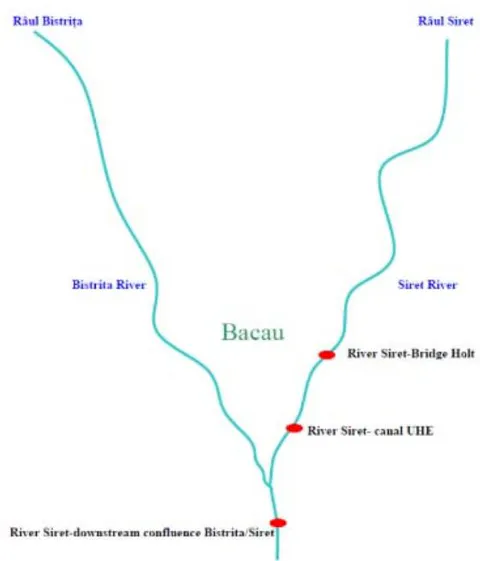
For the selection of sampling points we had in view the areas where pollution sources are located. For every sampling section, sediments must be samples from representative places, so that we could have exact knowledge of the pollution sources as well as of the hydrological and geomorphologic characteristics of the area. The sampling points must represent areas in which the sediment layer is thick and its granulosity is lower than 63 m, consisting of clay and slime [2].
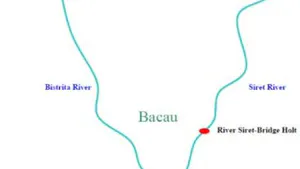
Sections targeted for the sample-taking programme are presented in Figure 1. Sediments were sampled Siret River – Bridge Holt area (S1), Siret River – canal UHE (S2) and Siret River- downstream confluence Bistrita/Siret (S3), in locations along the Bistrita and Siret River, and experiments were conducted so as to test four heavy metals, namely Cd, Ni, Cr and Hg [2].
The significant punctiform pollution sources are from industrial or agricultural area.
Soil samples were taken for three levels [2]:
minimum level: soil-water interface level of 0 cm;
medium level: soil-water interface level of 50 cm, on the river bank;
maximum level: soil-water interface level of 100 cm, on the river bank.
In Governmental Order no. 161 as of February 16 2006, entitled Elements and standards concerning the chemical quality of the alluvia – section 63 m, Table 1 presents the established maximum concentration levels for heavy metals in the soil [42].
| Quality indicator | Unit of measure | Quality standard |
| Cadmium | [mg/kg d.m.] | 0.8 |
| Nickel | 35 | |
| Chromium | 100 | |
| Mercury | 0.3 |
![Fig. 2: Atomic absorption spectrometer (AAS), Zeenit 700 version [43]](https://doc.journalspress.com/grnm49_108522/ocr/images/derivatives/a1/a19bc70e3e2d6988d354331b02c5551c8cb25d61db796dbd238ac53d4be92aa7.webp)
III. RESULTS AND DISCUSSIONS
Figure 3 represents the variations of cadmium concentration in the soil for sampling points Siret River – Bridge Holt area, Siret River – canal UHE and Siret River- downstream confluence Bistrita/Siret.
{"image_source":{"path":"images/5177d603157a6e4aeb5ae14981a2eb31f4c2fa7ccbe9fd3ab586d07d0dd13268.jpg"},"content":"","chart_caption":[{"type":"text","content":"Fig. 3: Cadmium concentration in the soil for sampling points Siret River – Bridge Holt area, Siret River – canal UHE and Siret River- downstream confluence Bistrita/Siret"}],"chart_footnote":[]} {"image_source":{"path":"images/2f242497cd76a01517b879fc67c42e58b72e4224a57dcce8448f03d193e223a2.jpg"},"content":"","chart_caption":[{"type":"text","content":"Fig. 4: Cadmium concentration in the soil for sampling points Siret River – Bridge olt area, Siret River – canal UHE and Siret River- downstream confluence Bistrita/Siret."}],"chart_footnote":[]}
Nickel concentrations in the soil for sampling point Siret River – canal UHE exceeds established levels with 110.57% for the soil-water interface level of 0 cm, and for the soil-water interface level of 50 cm the nickel concentration in the soil exceeded permitted limits with 107.22%.
For a soil-water interface level of 100 cm the maximum established limit for nickel in the soil is exceeded with 107.57%.
The established maximum level for nickel, in the soil is exceeded in sampling point Siret Riverdownstream confluence Bistrita/Siret for all three level so:
minimum level water-soil interface (0 cm) with 130.22%;
medium level water-soil interface (50 cm) with 138.62%;
maximum level water-soil interface (100 cm) with 137.22%.
The established maximum level for chromium (100 mg/kg d.m.), in the soil was not exceeded in sampling point Siret River – Bridge Holt (the maximal value obtained was for the minimum soil-water interface level of 0 cm – 57.11 mg/kg d.m., fig. 5).
The established maximum limit for chromium in the soil in the sampling point Siret River – canal UHE is exceeded with 154.2% for the soil-water interface level of 0 cm.
For sampling point Siret River – canal UHE, the established maximum limit for chromium in exceeded with 133.4% for the medium level soil-water interface and with 152.3% for the maximal level soil-water interface.
{"image_source":{"path":"images/4f874b7989044e8974d8f9a83d9f97f5ec725f3312ce514fa8661315265332f5.jpg"},"content":"","chart_caption":[{"type":"text","content":"Fig. 5: Chromium concentration in the soil for sampling points Siret River – Bridge Holt area, Siret River – canal UHE and Siret River- downstream confluence Bistrita/Siret"}],"chart_footnote":[]}
The established maximum level for chromium, in the soil is exceeded in sampling point Siret Riverdownstream confluence Bistrita/Siret for all three level and the higher value was registered for the minimum level soil-water interface (154.7 mg/kg d.m.):
The established maximum level for mercury, in the soil is not exceeded in all three sampling points, so the value obtained was (fig. 6):
Sampling point Siret River – Bridge Holt: 0.038÷0.076 mg/kg d.m.;
Sampling point Siret River – canal UHE: 0.066÷0.11 mg/kg d.m.;
Sampling point Siret River downstream confluence Bistrita/Siret: 0.07÷0.082 mg/kg d.m.
{"image_source":{"path":"images/00fca207c5e37313de18a36fa6738bbc8945483efb277719161afa249c570f16.jpg"},"content":"","chart_caption":[{"type":"text","content":"Fig. 6: Mercury concentration in the soil for sampling points Siret River – Bridge Holt area, Siret River – canal UHE and Siret River- downstream confluence Bistrita/Siret."}],"chart_footnote":[]}
IV. CONCLUSIONS
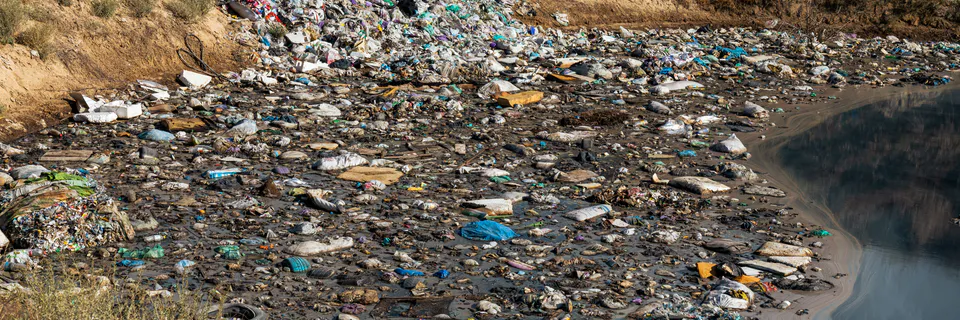
The exceeding of limits of heavy metals (cadmium, nickel, chromium and mercury) in the soil is the result of urban wastewater discharged in Bistrita river by means of water treatment stations, industrial platforms form Bacau city, the inappropriate storage of municipal waste.
The higher value of concentration of heavy metal in the soil was registered for cadmium, for the sampling point Siret River – Bridge Holt, minimum level soil-water interface – 1.89 mg/kg d.m.
The established maximum limit for cadmium, nickel, chromium and mercury in the soil is not exceeded in the sampling points:
Siret River – canal UHE and Siret River- downstream confluence Bistrita/Siret-for all three levels (for cadmium); - Siret River – Bridge Holt - for all three levels (for nickel and chromium);
- The established maximum level for mercury in the soil is not exceeded in all three sampling points.
Conflict of Interest
The authors declare no conflict of interest.
Ethical Approval
Not applicable
Data Availability
The datasets used in this study are openly available at [repository link] and the source code is available on GitHub at [GitHub link].
Funding
This work did not receive any external funding.
References
Cite this article
Related Research

Special Issue
Launch a focused special issue to highlight research, emerging trends, and expert insights in your academic field.