

Abstract
In this text, we discuss Einstein's theory of relativity, which has been challenged several times but has only become more solid and confirmed with each attempt to invalidate it, even in contemporary times. In this article, we present one of the arguments that tries to refute the theory and explain why it is incorrect. We aim to present this simply so a wide audience can easily understand.
Explore Digital Article Text
I. INTRODUCTION
In this text, we discuss Einstein's theory of relativity, which has been challenged several times but has only become more solid and confirmed with each attempt to invalidate it, even in contemporary times. In this article, we present one of the arguments that tries to refute the theory and explain why it is incorrect. We aim to show this so a broad audience can easily understand.
Some critics doubt Einstein's theory that light is bent by "gravity" along the geodesic trajectory created by the curvature of space-time. Some of these critics suggest that the observed phenomenon is caused by refraction rather than the curvature of space-time.
The refraction of light can be demonstrated through a simple experiment. I recommend observing it firsthand to witness its impressive behavior. This experiment provides a straightforward and practical understanding of light refraction.
When light travels from one material to another, it changes direction and speed, a phenomenon known as refraction. For instance, light refracts when it passes through the air and hits water.
Our experiment involves observing what happens when light travels from water to air.
When light passes through different materials, it changes direction because light travels at different speeds in other materials. Refraction only happens when the light wave hits the surface at an angle, and the materials have different refractive indices.
For instance, the speed of light in a vacuum is approximately 300,000 km/s, while in air, it is slightly lower at around 299,900 km/s. In water, the speed is even lower, at approximately 250,000 km/s.
The refractive index is calculated by dividing (C) the speed of light in vacuum by the speed of light in the medium.
This article aims to provide the reader with a basic understanding of refraction's behavior, confirm Einstein's theory of relativity, and offer an explanation that challenges those who think it is refraction, not the curvature of space and time. We want to emphasize the experiment conducted in the pool, which produced a remarkable outcome for most people.
This experiment is not a debate about Einstein's theory but rather a confirmation. In the following article, the author approaches Gravity behavior as a natural and logical extension of Einstein's theory of relativity.
In the upcoming article, the author explains gravity's behavior as a natural and logical extension of Einstein's theory of relativity.
We were amazed by the exciting experience described in the following experiment.
- As we did, please dip a rod into the pool.
The rod we used is made of aluminum, about 3 meters long, and has a width of.025 m. (1 in) and a thickness of.001 m. (1 cm.) You can use a rod of a different material, such as a broomstick.
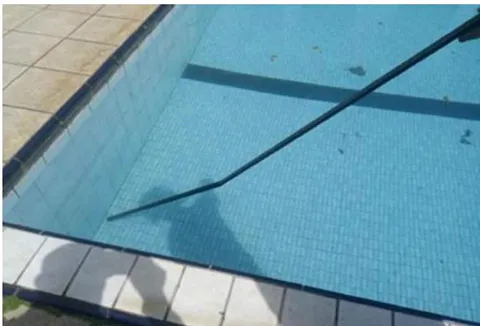
When a bent rod is inclined, the point where it curves is visible at the water level. The angle at which the curve is most pronounced is 45 degrees.
- Attach a flashlight with a laser beam to the rod and position it like a telescopic sight to project the light parallel to it.
Observe the refraction of light from water to air by submerging the rod and light emitter in the pool.
The following figure shows what happened.
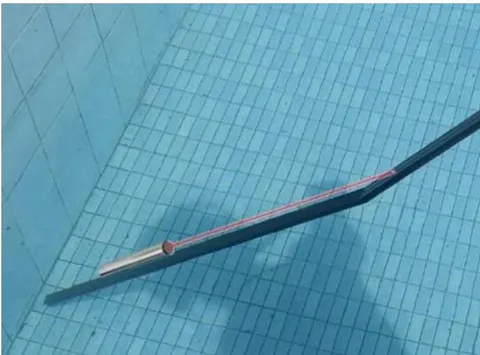
The straight rod appears bent. The light beam bends as it emerges from the water and hits the straight rod even though the light looks straight. It is a creation of an optical illusion.
In Figure 3, we observe the effect of light refraction as it passes from a less dense medium like air to a denser medium like water. This refraction type is simple to understand and is commonly used to illustrate the concept.
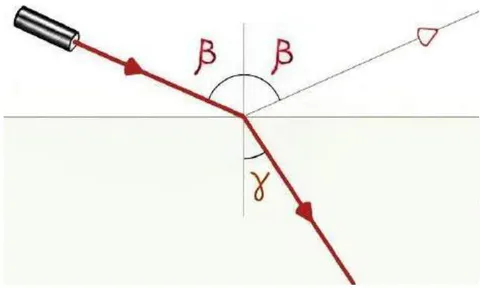
When light hits the water, it reflects at the same angle as the "normal line" (BETA) and refracts by bending downwards at an angle (gamma) determined by the refractive index.
When light passes from one medium to another, it bends. The "normal line" is an imaginary line perpendicular to the surface where the light enters. All angles are measured from this line. The angle at which the light enters the second medium is called the angle of incidence (beta in Figure 3). The angle at which the light bends or refracts is called the angle of refraction (gamma in Figure 3).
Atmospheric refraction occurs when a ray of light changes its direction as it passes through different layers of the atmosphere. This happens because the atmosphere's temperature and pressure are not constant and vary at various altitudes, which also causes the refractive index to vary.
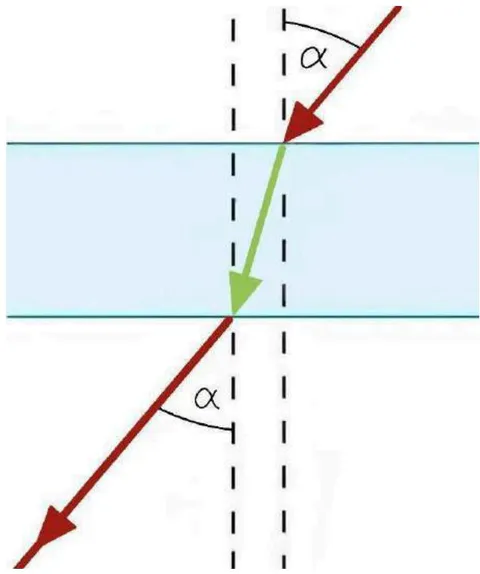
In conclusion, we can observe that when light passes through a denser medium and exits it, it is subject to refraction; the light maintains its original direction but is displaced to a parallel line (Figure 4).
If you look carefully. The refraction of light causes us to see a star at the edge of a massive stellar object due to its atmosphere, even though its actual position is further away from that edge.
II. CONCLUSION
The phenomenon of refraction that we observe in the experiment, in addition to the well-known refraction (air to water), can provide a complete understanding of how refraction works. The effect on light refraction is opposite to the Einstein effect.
The figures below confirm Einstein's theory that the bending of light's path when we see a star behind a massive body is due to the curvature of space-time caused by gravity rather than refraction.
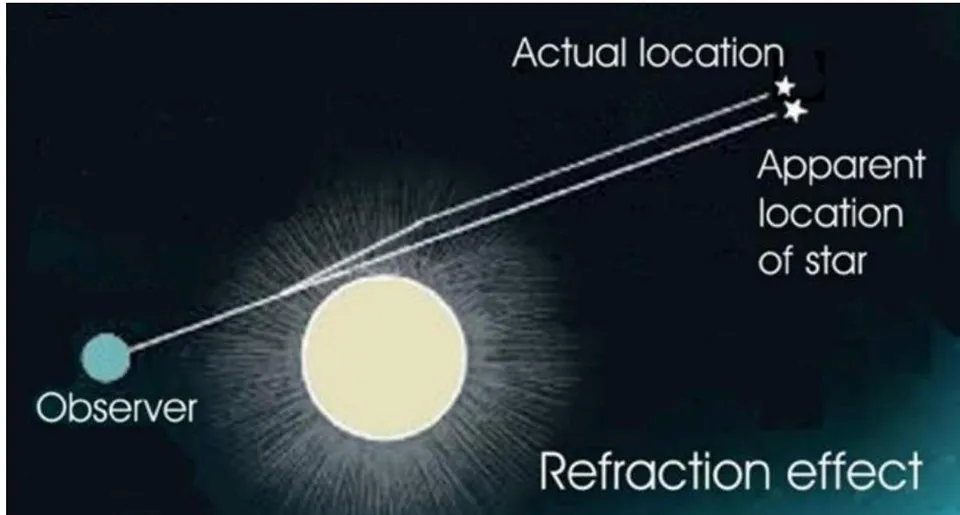
On the other hand, gravity bending space-time causes us to see the star at the edge, but its actual position is behind the massive stellar object (Figure 6).
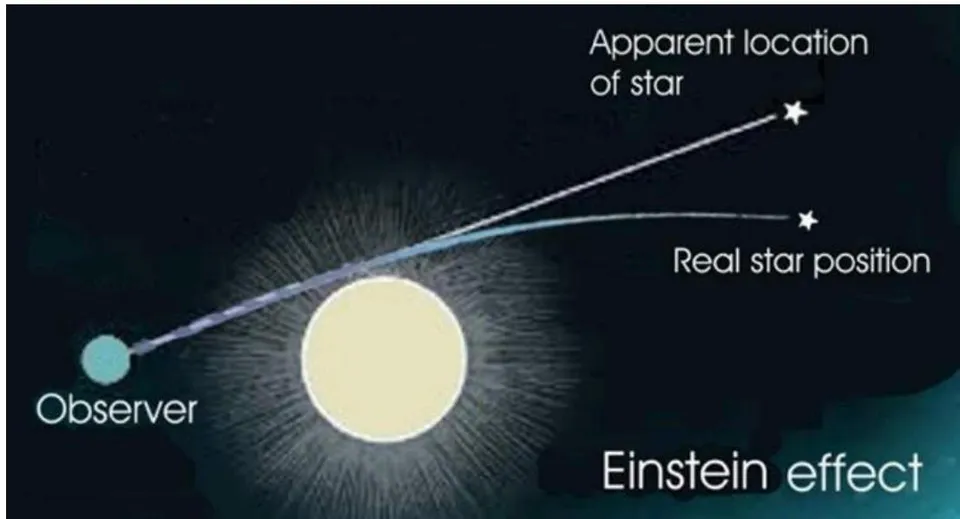
This experiment and explanation confirm the credibility of Einstein's theory of relativity and disproves critics who use refraction to challenge it.
Light travels along a geodesic path without experiencing any inertial effect due to its lack of mass.
Einstein's theory of relativity tells us that gravitation or masses warp the space-time around them. Anything passing near a mass (for example, near the Sun or a galaxy) will change its trajectory since its path will follow the warped space there, so Einstein predicted that "light should be deflected when passing near a massive object."
According to Einstein's theory of relativity, masses can warp the space-time surrounding them. When an object passes by a massive body such as the Sun or a galaxy, its trajectory is altered as it follows the curved space-time. Even light particles, or photons, are affected by this phenomenon, causing them to be deflected when passing near a massive object (Figure 7).
This was predicted by Einstein and explained by the gravitational theory of the author of this article, "Universal Expansion Produces Gravity." (The document is currently in the process of being published.)
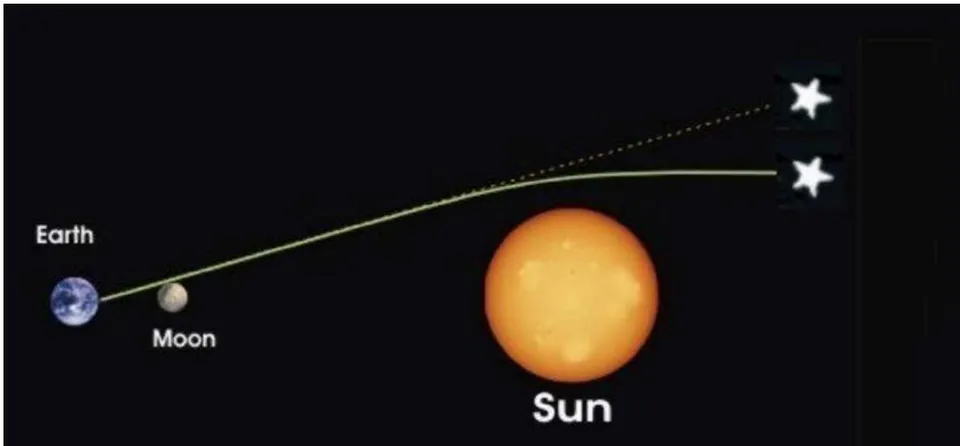
Refraction is not the way light bends due to "gravity." This change in direction is opposite to the bending caused by gravitational force.
The experiment described in this article not only teaches the behavior of refraction in massive objects with atmosphere, where we learn that Light continues straight in the same direction as when the medium comes back, but this displacement is contrary to Einstein's effect of light bending caused by the curvature of space-time.
However, the experiment also shows that it is very striking because it creates an optical illusion. What is observed is entirely contrary to reality. The rod, being straight, looks bent, and the light beam looks straight when the fact is that the light bends as it exits the water and hits the rod.
All this shows us that everything interpreted in physics is relative, including gravity.
In the upcoming article, the author explains gravity's behavior as a natural and logical extension of Einstein's theory of relativity. Entitled "Universal Expansion Produces Gravity".
The new article explains that objects in free fall are not affected by any gravitational force but by the curvature of space-time.
Conflict of Interest
The authors declare no conflict of interest.
Ethical Approval
Not applicable
Data Availability
The datasets used in this study are openly available at [repository link] and the source code is available on GitHub at [GitHub link].
Funding
This work did not receive any external funding.
Cite this article
Related Research

Special Issue
Launch a focused special issue to highlight research, emerging trends, and expert insights in your academic field.