





IntelliPaper
Abstract
The motive of the study was to find if students mathematics interest mediates other variables such as Instructor Quality, Teacher Self-Efficacy and Student Teacher Relationship Towards Student Mathematics Performance. The study was a quantitative research design that uses a structural equation model. A simple random sampling procedure was used to select 497 Senior High School students from five SHS across the Ashanti region of Ghana. The data collection was mainly based on administered questionnaire to the participants which was analyzed using the Structural Equation Model (SEM) with the help of SPSS and AMOS. It was found that teacher student relationship had no significant effect on students’ mathematics performance. Instructional quality and teacher self-efficacy on the other hand had significant positive effects on students’ mathematics performance. Also, it was found that student mathematics interest did not mediate the relationship between teacher student relationship and mathematics performance. Similarly, mathematics interest played no mediating role in the relationship between instructional quality and mathematics performance. Finally, it was concluded that student mathematics interest partially mediated the relationship between teacher self-efficacy and students’ mathematics interest.
Explore Digital Article Text
I. INTRODUCTION
In the last decade or two, research in the area of student mathematics performance has intensified across the globe. Prominent among them are the Trends in Science and Mathematics Studies (TIMSS) and Program for International Student Assessment (PISA). Studies have revealed that mathematics application is in all facets of human endeavors and the knowledge of mathematics has the impetus to make an individual critical in thinking, innovative and problem solving oriented. Modern studies have revealed that school mathematics can improve one's communication skills, liberate learners from oppression towards social justice and promote democratic values like leadership qualities, loyalty, and tolerance aimed at promoting peace and tranquility for national development. However, achieving this feat depends on many other factors like, Instructor quality, teacher-student relationship, teacher self-efficacy and student interest.
II. INSTRUCTIONAL QUALITY AND STUDENTS' PERFORMANCE
Instructor quality refers to tutoring strategies that meet students' demands for autonomy (a sense of self-determination and freedom from control), competence, and relatedness - a sense of belongingness (Williams & Sembiente, 2022). According to Dupuis et al., (2020) highly effective instruction enable both long-term and short-term intellectual learning changes in learners. Consequently, in every educational context, teacher quality is the most contentious aspect of advancing student achievement and eliminating achievement gaps (Hachfeld & Lazarides, 2021). Quality instruction motivate students to learn and students who are motivated to learn mathematics attend all mathematics lessons, follow lessons attentively, participate in group discussions, learn extremely to achieve their goals, receive higher grades, are eager to learn at school, recognize the importance of mathematics in other subjects, and are eager to learn (Affuso et al., 2022).
Multiple studies have indicated that characteristics such as instructors' cognitive ability, subject matter expertise, teaching and learning knowledge, and classroom teaching behaviours are associated with improved student accomplishment (Khodarahmi et al., 2022). In fact, some data suggests that teacher instructional approaches influence student mathematical achievement more than any other variable (McKinney & Frazier, 2008). Unlike some other variables, such as gender, race, and socioeconomic status (SES), teacher instructional practices are controlled at the local school level and can thus be modified.
III. TEACHER STUDENT RELATIONSHIP AND STUDENTS' PERFORMANCE
Personal characteristics related to responsiveness to student requests and the teaching environment, resilience at school, self-reflection, resourceful ness, and the development of positive relationships are regarded as essential components of the emotional work required of teachers in their classroom practice (Amorim Neto et al., 2022). Since, in a conducive classroom where students are encouraged to ask questions and take risks, they are more inclined to seek assistance when they experience challenges (Awoniyi & Butakor, 2021). This social contact, which is an essential component of student-centered teaching techniques, plays a crucial role in problem solving. Through the implementation of student-centered teaching approaches that foster inquiry-based learning, students are afforded opportunity to share their own opinions and strategies with their peers when confronted with difficulties located in real-world contexts (Amoako Atta & Asiedu-Addo, 2021). Since, student-centred instructional practises do not pit students against one another in a competitive environment, student-to-student and student-initiated student-to-teacher interactions become the norm in the classroom (Lerkkanen et al., 2016; Muhonen et al., 2016). In student-centered classrooms, students are more likely to share their ideas and learning practises to both their classmates and teachers since they do not fear being embarrassed or criticized for making a mistake (Muhonen et al., 2016).
According to Vygotsky (1978) cited in (Lasmawan & Budiarta, 2020), there are learners who can perform thinking and problem-solving abilities independently, learners who can perform thinking and problem-solving abilities with assistance, and learners who cannot perform thinking and problem-solving abilities with assistance. A classroom environment that encourages students to collaborate with their peers and exposes them to multiple approaches during problem-solving situations is associated with higher mathematics achievement (Atta & Brantuo, 2021). The interaction process in class cannot be separated from the learning process. Interaction is part of a person's endeavour to comprehend something. In light of the significance of teacher-student interactions in mathematics learning, it is vital to identify the relationships that must be constructed between teachers and students. The kinds of healthy teacher-student contact must be understood and fostered by the instructor in order to improve student learning.
Huinker, (2018) observed that the NCTM in 2014 suggested in the United States that teachers should assist students in mastering mathematics through dialogue, creative tools, and past knowledge and experience. The national curriculum of Ghana is centered on fostering an atmosphere conducive to problem-solving, communication, and mathematical thinking among students (NaCCA, MOE, 2019). The connection between teachers and students is the focal point of classroom instruction and a crucial component in enhancing teaching quality and student progress. Therefore, a good teacher-student relationship provides an environment conducive to learning.
IV. TEACHER SELF-EFFICACY AND STUDENTS' PERFORMANCE
Self-efficacy is the confidence in one's ability to attain the necessary levels of learning and behaviour (Bandura, 1977) cited in (Abdullah & Ahmed, 2022). Self-efficacy is the belief that one is capable of doing a task; it is considerably distinct from knowing what to do. It is the evaluation of an individual's self-efficacy, skills, and capacities, as well as their transformation into behaviour. Self-efficacy therefore is an individual's belief in their ability to implement a set of actions and accomplish a set of objectives. The actions include managing physical behaviour and cognitive and emotional states (Bandura, 1997). In student-centered education, teachers share authority with students, and students are expected to participate as co-investigators in mathematics learning communities. Innovative classrooms can be intimidating for teachers accustomed to teacher-centered practices (Khodarahmi et al., 2022), however, teachers with a strong sense of self-efficacy are more likely to use innovative approaches.
Numerous studies have found that teachers with high self-efficacy beliefs exert more effort in the classroom, are more willing to engage in the learning-teaching process, are more successful in the selection of methods and techniques, and, in general, are more effective in implementing the curriculum (Affuso et al., 2022; Ahmed et al., 2022; Akman, 2021; Woodcock & Faith, 2021). Therefore, a teacher with a high self-efficacy belief is more enthusiastic in the classroom, plans more efficiently.
V. MEDIATING ROLE OF STUDENT MATHEMATICAL INTEREST
According to Ainley (2006), as cited in (Wong & Wong, 2019a), interest is an emotional state that describes how a person feels when they are learning. In this study, interest is operationally defined as the way students feel when they are engaged in learning math and enjoy the process of learning. It's important to look at the student's interest, attitude, and motivation to learn mathematics because these are the things that might make students want to do better in mathematics classes. Hashim et al., (2021) found that a student's interest in mathematics affected how they felt about learning. Asante (2012) for instance says that male and female students are interested in mathematics in different ways, and the school, the environment, the beliefs and attitudes of the teachers, the way they teach, and the opinions of the parents were all looked as factors that affect how students feel about mathematics. It is collaborative learning, learning through games, and other strategic methods that can be used to get learners interested in and excited about learning mathematics.
(Langat, 2015) for instance, conducted a survey in Kenya and discovered that the majority of students who perform well had positive attitudes toward mathematics. Similarly, (de Vera et al., 2022; Peteros, 2022) concluded that students' views toward mathematics have a greater influence on their academic performance. Attitude toward mathematics has been broken down into multiple components, according to the research. For instance, Davadas and Lay (2017) posited motivation, enjoyment, and self-confidence. Researchers in the Trends in International Mathematics and Science Study (TIMSS) did a similar analysis, focusing on three aspects of students' mindsets toward mathematics (Martin et al., 2020) students' love of mathematics, the importance of mathematics, and their confidence in mathematics. In conclusion, while many researchers may have used various names, three components have consistently been employed to measure mathematics-related attitudes: like mathematics (LM), value mathematics (VM), and trust in mathematics (CM).
VI. THE OBJECTIVE OF THE STUDY
Many studies on students' mathematics performance have tried to look at how individual constructs like teacher self-efficacy, and student mathematics interests among others enhance students' mathematics performance. Especially in Ghana much is not known about the mediating role of students' interest in promoting student mathematics performance so far as these constructs are concerned. The motive of this student was to assess the mediating role of student mathematical interest in instructor quality, teacher self-efficacy and student-teacher relationship towards student mathematics performance. To achieve this objective, the following hypotheses were formulated.
H1: Instructional Quality has a direct positive effect on Student Performance.
H2: Teacher Student Relationship has a direct positive effect on Student Performance.
H3: "Teacher Self-Efficacy has a direct positive effect on Student Performance.
H4: "Student Mathematics Interest mediates the relationship between teacher student relationship and student performance
H5: "Student Mathematics Interest mediates the relationship between instructional quality and student performance.
H6: "Student Mathematics Interest mediates the relationship between teacher self-efficacy and student performance.
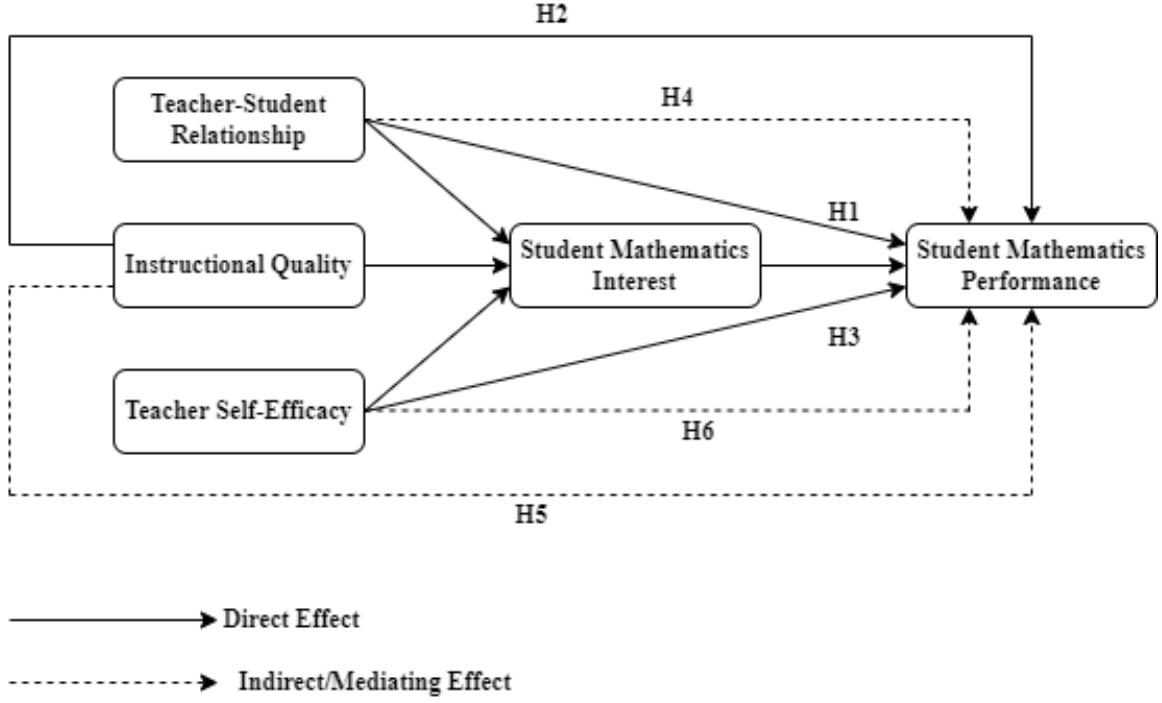 Figure 1: Conceptual framework
VII. METHODOLOGY
7.1 Sample and Data Collection
The study was a quantitative research design that uses a structural equation model. The study targeted all the Senior High Schools in the Ashanti Region. However, five senior high schools were purposively selected. Out of this a total of 497 students using a simple random sampling technique were engaged.
They comprised form one, form two and form three students from the selected schools. The questionnaires were administered while the participants were in school. An official approval was sought from the school authorities before administering the questionnaires. Table 1 presents the demographic distributions of the study.
Table 1: Demographics Information
| Demographics (response/option) | Frequencies (N) | Percentages (%) |
| Gender | ||
| Female | 244 | 49.1 |
| Male | 253 | 50.9 |
| Total | 497 | 100.0 |
| Age | ||
| Below 18 years | 349 | 70.2 |
| 18 years and above | 148 | 29.8 |
| Total | 497 | 100.0 |
| Form | ||
| Form One | 134 | 27.0 |
| Form Two | 197 | 39.6 |
| Form Three | 166 | 33.4 |
| Total | 497 | 100.0 |
Out of the total of 497 students, 253 representing 50.9% were males and 244 constituting 49.1% were females. Also 349 students representing 70.2% were below 18 years and 148 students representing 29.8% were either 18 years or above. Out of the total participants 134 were in form one, 197 were in form two while 166 were in form three.
VIII. QUESTIONNAIRE AND MEASURES
There were five main variables in the study namely Teacher-Self Efficacy, Instructional Quality, Teacher-Student Relationship, Student Mathematics Interest and Student Performance. These variables were measured on a 5-point Likert scale of 1= Strongly disagree to 5= Strongly agree. The measurement items for teacher self-efficacy were adapted from (Adarkwah et al., 2022; Akman, 2021) those for instructional quality were adapted from (Arthur et al., 2022), those for teacher-student relationship were adapted from (Xu & Qi, 2019), those for mathematics interest were adapted from (Wong & Wong, 2019), while those for student performance were adapted from (Arthur et al., 2021, 2022).
IX. VALIDITY AND RELIABILITY ANALYSIS
Cronbach's alpha analysis was run in SPSS (v.26) to assessed the internal consistency of the measurement items. The expected value of alpha in order to achieve internal consistency is at least 0.7 (Pomegbe et al., 2020). As demonstrated in Table 2, Teacher Student Relationship had a CA of 0.930, Instructional Quality had a CA of 0.765, Teacher Self-Efficacy had a CA of 0.918, Mathematics Interest had a CA of 0.901 while Student Performance had a CA of 0.904.
For reliability and validity analysis of the model a confirmatory factor analysis (CFA) was run using Amos (v.23) software. Measurement items with poor factor loadings (score less than 0.5) were deleted from further analysis as suggested by Amoako et al. (2020). Two items were deleted from instructional quality whiles an item each was deleted from teacher self-efficacy, mathematics interest and student performance. The results are presented in Table 2 and Figure 2. Convergent validity was assessed using average variance extracted (AVE) and composite reliability (CR). Fornell & Larcker (1981) recommended an AVE score of at least 0.5 and CR score of at least 0.7 in order to achieve convergence. The least AVE as reported in Table 2 is 0.523 (Instructional Quality) and the least CR score was 0.723 (Instructional Quality).
As recommended by Hair et al. (2010) the model fit indices should be: CMIN/DF should be less than three, TLI and CFI should be greater than 0.9, GFI greater than 0.8 while RMR and RMSEA should be less than or equal to 0.08. From Table 2 it can be seen that all the model fit indices were achieved which suggest that the dataset fits the model appropriately.
Table 2: Confirmatory Factor Analysis
| MFI: CMIN=269.009; df=176; CMIN/df=1.528; GFI=0.950; CFI=0.988; TLI=0.985; RMR=0.080; RMSEA=0.033 | Std. Factor Loading |
| Teacher Student Relationship (TSR): CA=0.930; CR=0.933; AVE=0.702 | |
| I get along well with my Mathematics teacher (TSR1) | 0.843 |
| My Mathematics teacher is very concerned about my physical and mental health (TSR2) | 0.921 |
| My Mathematics teacher is willing to provide extra help when I need it (TSR3) | 0.877 |
| My Mathematics teacher is very happy to listen to me (TSR4) | 0.832 |
| My Mathematics teacher is fair to me (TSR5) | 0.859 |
| My Mathematics teacher is willing to better explain concepts I don't understand to me outside classroom hours (TSR6) | 0.672 |
| Instructional Quality (IQ): CA=0.765; CR=0.767; AVE=0.523 | |
| My Mathematics teacher provides good feedback for better understanding (IQ1) | 0.684 |
| My Mathematics teacher developing mathematical concepts systematically is a quality of a good teacher (IQ2) | 0.730 |
| My Mathematics teacher give enough classroom exercises to practice to test my understanding of the concept being taught (IQ3) | 0.754 |
| Teacher-Self Efficacy (TSE): CA=0.918; CR=0.910; AVE=0.717 | |
| My Mathematics teacher encourages competition among students to motivate them to learn more (TSE1) | 0.851 |
| My Mathematics teacher is effective in monitoring mathematics experiments (TSE2) | 0.923 |
| My Mathematics teacher knows the steps necessary to teach mathematics concepts effectively (TSE3) | 0.851 |
| My Mathematics teacher encourages students to solve mathematics problems independently (TSE4) | 0.755 |
| Student Mathematics Interest (SMI): CA=0.901; CR=0.898; AVE=0.694 | |
| I want to know all about how to do Mathematics problems (SMI1) | 0.940 |
| I am excited when a new Mathematics topic is announced in class (SMI2) | 0.937 |
| I want to know all about Mathematics (SMI3) | 0.827 |
| I want to talk about Mathematics with my friends (SMI4) | 0.574 |
| Student Mathematics Performance (SP): CA=0.904; CR=0.907; AVE=0.711 | |
| I am confident in my understanding of Mathematics as a subject (SP1) | 0.900 |
| I score high marks in Mathematics Examination (SP2) | 0.895 |
| I teach my colleagues who need help in Mathematics (SP3) | 0.881 |
| Learning Mathematics enhances my thinking ability (SP4) | 0.676 |
NOTE: CFI: Comparative Fit Index; CMIN/df: Chi-square/degree of freedom; TLI: Turkey-Lewis Index; RMR: Root Mean Square Residual; RMSEA: Root Mean Square Error of Approximation
The descriptive statistics and discriminant validity are shown in Table 3. From the analysis presented, instructional quality had the highest mean score of 3.614, while teacher self-efficacy had the lowest mean score of 3.026. The measurement items of the constructs were assessed on a 5-point Likert scale of 1=Strongly disagree to 5=Strongly agree, which has a highest possible mean of 5. A mean score of 3 and above indicates respondents agreed to the measurement items and this was the case for all the five constructs as presented in Table 3. According to Sarsah et al. (2020) discriminant validity is achieved when the least value of the square root of AVE is larger than the highest correlation coefficient. As demonstrated in Table 3 the least square root of AVE is 0.723 which is greater than 0.571 which is the highest correlation coefficient. This demonstrates that discriminant validity was achieved.
Table 3: Descriptive and Discriminant Validity
| Variables | Mean | Std Dev. | Teac-Std Rel. | Instruc. Qual | Efficacy | Interest | Performance |
| Teac-Stud Rel. | 3.134 | 1.107 | 0.838 | ||||
| Instruc. Qual | 3.614 | 0.932 | 0.245*** | 0.723 | |||
| Efficacy | 3.026 | 1.281 | 0.280*** | 0.121* | 0.847 | ||
| Interest | 3.084 | 1.214 | 0.096* | 0.084 | 0.571*** | 0.833 | |
| Performance | 3.112 | 1.249 | 0.111* | 0.227*** | 0.469*** | 0.392*** | 0.843 |
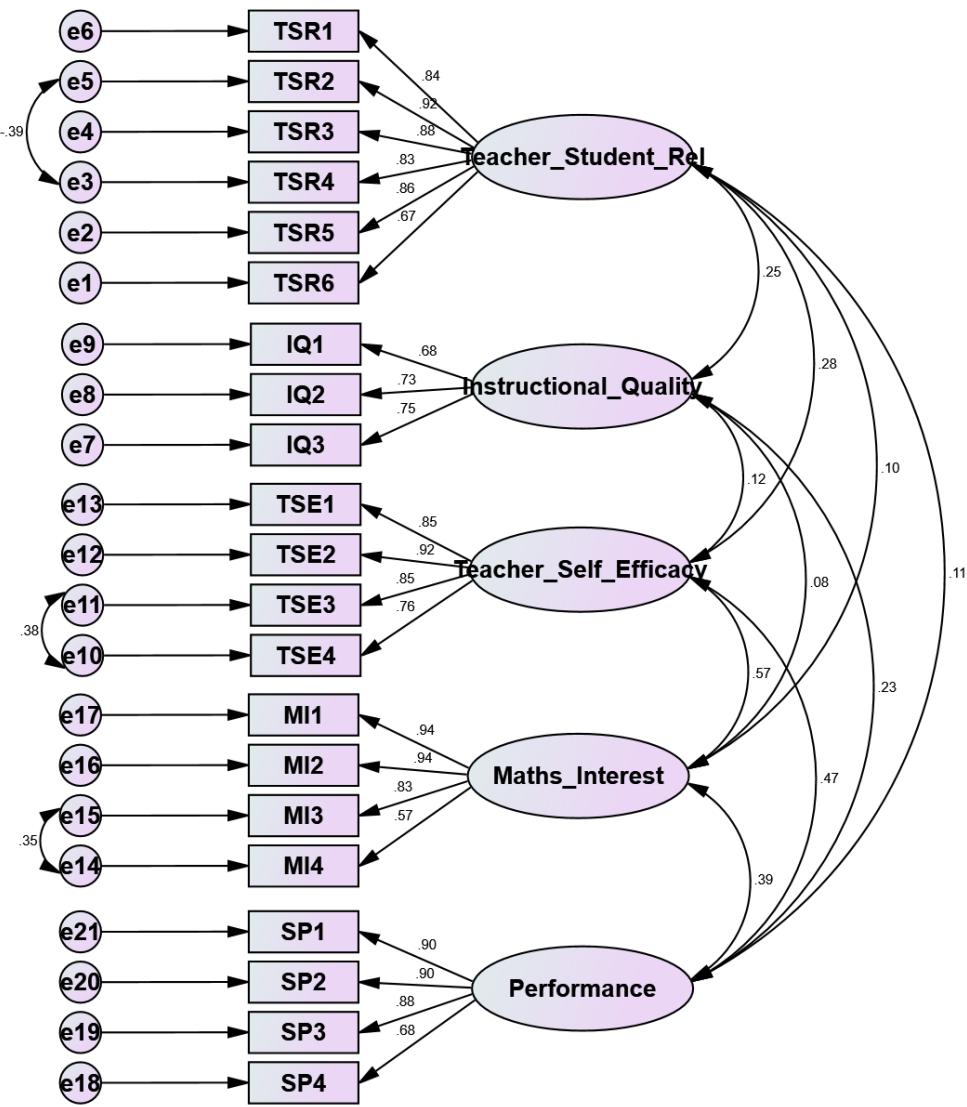 Figure 2: Confirmatory Factor Analysis
X. RESULTS
The path analysis was estimated using the Structural Equation Modelling (SEM) run in Amos (v.23). the result is presented in Table 4 and Figure 3. The estimation was based on 5000 Bootstrap samples, with Bias-Corrected Confidence Interval of 95%.
For the hypothesized paths, it was identified that Teacher Student relationship had a negative but statistically insignificant effect on Student Performance ( ).
Hypothesis H1 "Teacher Student Relationship has a direct positive effect on Student Performance", was therefore rejected.
Instructional Quality on the other hand had a significant positive effect on Student Performance ( ). This suggests that as the quality of instruction in the classroom becomes better, students' performance is likely to be enhanced by about 19.4%, and vice versa.
Hypothesis H2 "Instructional Quality has a direct positive effect on Student Performance" was therefore accepted. Again, from the results, Teacher Self-Efficacy had a significant positive effect on Student Performance ( ). This shows that a good teacher's self-efficacy enhanced students' performance by about 30.7% and vice versa.
Hypothesis H3 "Teacher Self-Efficacy has a direct positive effect on Student Performance" was therefore accepted.
To assess the mediating effect of student mathematics interest, in the relationship between teacher student relationship and student performance, the effect of teacher student relationship on mathematics interest was first estimated. The result indicated that teacher student relationship had a negative but statistically insignificant effect on mathematics interest ( ). Teacher student relationship also had an insignificant effect on student performance. The coefficient of the indirect effect was -0.010 which was statistically insignificant (since zero (o) can be found in-between the lower and upper bounds).
Hypothesis H4 "Student Mathematics Interest mediates the relationship between teacher student relationship and student performance" was therefore rejected.
The mediating effect of student mathematics interest, in the relationship between instructional quality and student performance was ascertained. The effect of instructional quality on mathematics interest was first tested. The results indicated that instructional quality had a positive but statistically insignificant effect on student mathematics interest ( ). The coefficient of the indirect path was 0.006 which was statistically insignificant (since zero (o) can be found in-between the lower and upper bounds).
Hypothesis H5 "Student Mathematics Interest mediates the relationship between instructional quality and student performance" was therefore rejected.
Finally, in determining the mediating effect of mathematics interest in the relationship between teacher self-efficacy and student performance, the effect of teacher self-efficacy on mathematics interest was first tested. The results showed a significant positive effect of teacher self-efficacy on mathematics interest ( ). This suggests that a good teacher self-efficacy could enhance students' interest in mathematics by about 42.1% and vice versa. Student mathematics interest also had a positive significant effect on student performance ( ). An increase in student mathematics interest could enhance student performance by about 21.0% and vice versa. The coefficient of the indirect effect was 0.003 which was statistically significant (because both lower bound and upper bound were positive and zero (o) cannot be found in-between them). This represents a partial mediating effect since teacher self-efficacy had a direct positive effect on student performance.
Hypothesis H6 "Student Mathematics Interest mediates the relationship between teacher self-efficacy and student performance" was therefore accepted.
Table 4: Direct and Indirect Paths
| Direct paths | Un-standard estimate | Standard error | Composite reliability |
| Teach_Stud_Rel → Maths_Interest | -0.048 | 0.033 | -1.469 |
| Instruct_Quality → Maths Interest | 0.030 | 0.040 | 0.736 |
| Teach_Self_Efficacy → Maths Interest | 0.421 | 0.043 | 9.684** |
| Teach_Stud_Rel → Performance | -0.031 | 0.040 | -0.766 |
| Instruct_Quality → Performance | 0.194 | 0.052 | 3.727** |
| Teach_Self_Efficacy → Performance | 0.307 | 0.050 | 6.108** |
| Maths Interest → Performance | 0.210 | 0.065 | 3.214** |
| Indirect paths | Un-standard estimate | Lower BC | Upper BC |
| Teach_Stud_Rel → Interest → Performance | -0.010 | -0.030 | 0.003 |
| Instruct_Quality → Interest → Performance | 0.006 | -0.011 | 0.029 |
| Self_Efficacy → Interest → Performance | 0.089 | 0.035 | 0.148 |
Bias-Corrected (BC) Percentile Method; 5000 Bootstrap sample; 95% Confidence level ** ~ P-value significant at 1% (0.01)
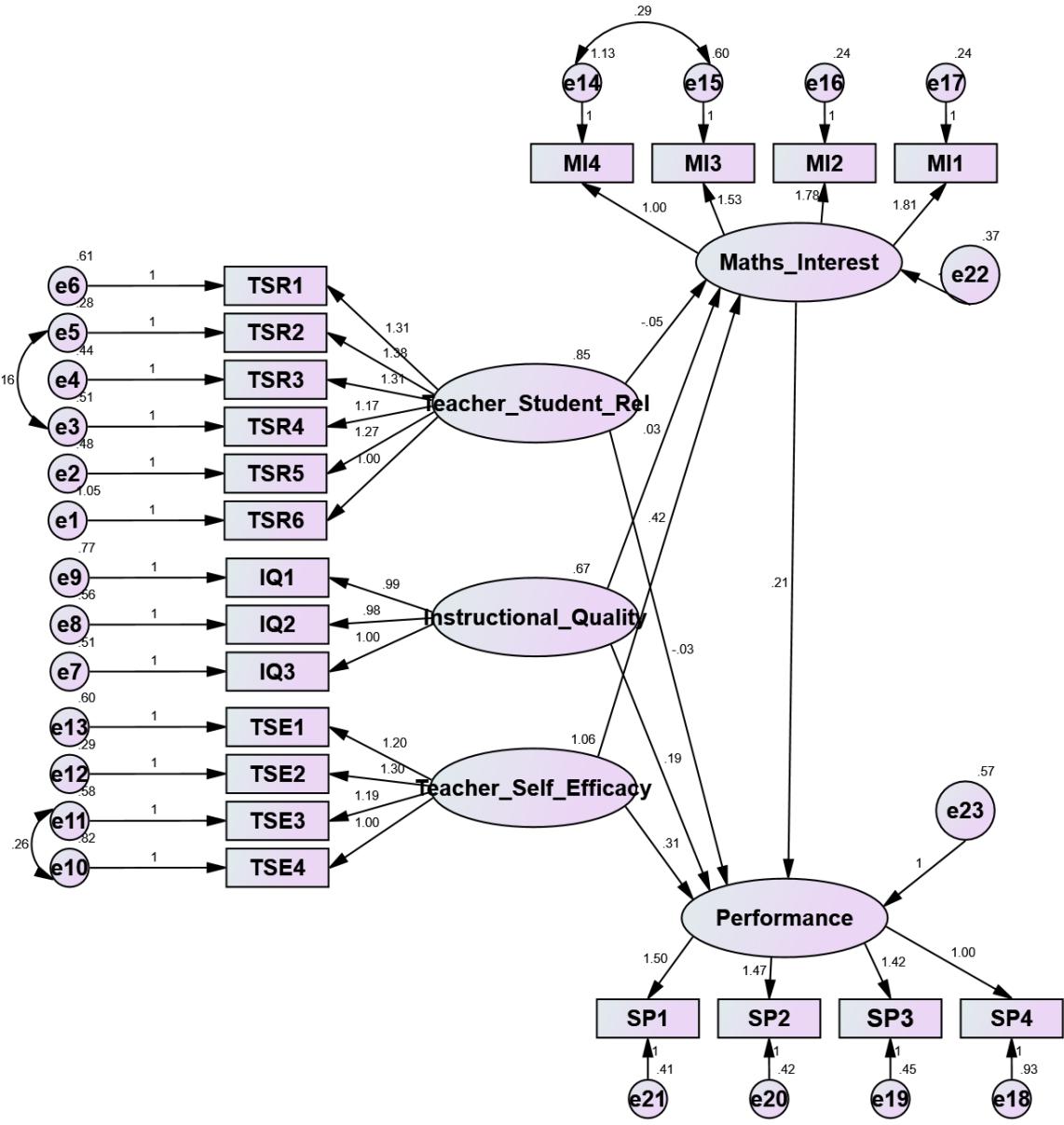 Figure 3: Structural Paths
XI. DISCUSSION
After the Structural equation modelling (SEM) was used to estimate the model, it was found that teacher student relationship had no significant effect on students' mathematics performance. Instructional quality and teacher self-efficacy on the other hand had significant positive effects on students' mathematics performance. This finding is in line with studies like (Dupuis et al., 2020; Hachfeld & Lazarides, 2021; Affuso et al., 2022) which have confirmed that quality instruction can improve students' performance.
Also, it was found that student mathematics interest did not mediate the relationship between teacher student relationship and mathematics performance. Similarly, mathematics interest played no mediating role in the relationship between instructional quality and mathematics performance. Finally, it was concluded that student mathematics interest partially mediated the relationship between teacher self-efficacy and students' mathematics interest. This also in tandem with the study of (Arthur et al., 2022; Khodarahmi et al., 2022; Wong & Wong, 2019b).
XII. CONCLUSION
The findings of the study have revealed that instructor quality is very key determinant of student mathematics interest which intend affects student performance.
Conflict of Interest
The authors declare no conflict of interest.
Ethical Approval
Not applicable
Data Availability
The datasets used in this study are openly available at [repository link] and the source code is available on GitHub at [GitHub link].
Funding
This work did not receive any external funding.
References
Cite this article
Related Research


Special Issue
Launch a focused special issue to highlight research, emerging trends, and expert insights in your academic field.
