

IntelliPaper
Abstract
The adults and nymphs ofrugose spiralling whitefly, Aleurodicusrugioperculatuswere collected from ten different host crops (coconut, banana, arecanut, bamboo palm, Syzygium sp. maize, guava, custard apple, sapota, karanja) during 2021-2023. The fungal isolation from adults and nymphs was carried out through plating technique and obtained colonies were pure cultured for identification. The results revealed that, Aspergillus spp. and Penicilliumspp.. were found common in adults and nymphs of A. rugioperculatuscollected on seven host crops (coconut, banana, arecanut, bamboo palm, guava, custard apple, and sapota). The fungi were identified based on conidia and conidiophore structure. The role of fungus in association with A. rugioperculatus is assumed to be symbiotic, where fungus would help in digestion of cellulose and provides nutritional support.
Explore Digital Article Text
I. INTRODUCTION
Whiteflies (Hemiptera: Aleyrodidae) are one of the most economically important group of pests with global distribution and wide host range (Kanakala and Ghanim, 2019). They cause damage in an active way by acting as vector for various plant viruses under the genera Begomovirus, Crinivirus, Closterovirus etc.) and passively by encouraging sooty mould deposits on plants through honeydew secretion (Head and Savinelli, 2008). Later, the sooty mould formed by the honeydew secreted by them leads to the closing of stomata as a result the gas exchange by the plants get interrupted that leads to poor development of plants. The invasive insect pest, rugose spiraling whitefly, Aleurodicus rugioperculatus (Hemiptera: Sternorrhyncha: Aleyrodidae) was described by Martin from Belize in Central America in 2004 based on puparia collected under the leaves of coconut. India is the only country in the Oriental region, where this whitefly has been introduced on coconut in the Pollachi region of Coimbatore district, Tamil Nadu and Kottayam in Kerala during July – August 2016 (Sundararaj and Selvaraj, 2017). The adaptation trait of the whiteflies to changing climate and to the new host is the key factor their spatiotemporal distribution. Since, whiteflies are phloem feeders which mainly suck the nutritionally deprived sap from the plant. The supplementation of the required nutrients (mainly essential amino acids) will be supplied by the microbes which resides inside their body in a symbiotic way. The two main functions of these endosymbionts of sap sucking insects are; those which are beneficial to the insect under specific ecological conditions and those which play a role in metabolic activities of the insect. (Gosalbes et al., 2010). Fungus is being an unexplored microbe in the insect, hence the present study is focusing on the isolation and identification of fungal isolates of A. rugioperculatus collected on different hosts.
II. MATERIALS AND METHODS
2.1 Preparation of insects for experiment
The whiteflies were collected on different host plants (Coconut, Banana, from the different zones of Karnataka, from each zone minimum three locations were selected (Table 2). Alive whitefly adults and nymphs were collected from each host of each location for microbial isolation The adult whiteflies collected from different locations and hosts (Table 2) were surface sterilized with 70 per cent ethanol for 1 minute followed by 0.1 per cent sodium hypochlorite for 1 minute and then rinsed with sterile distilled water for 2 to 3 times to remove the external microbes and wax.
2.2 Serial dilution and plating
The media of 1M potato dextrose agar (PDA) were prepared for isolating the fungus respectively and autoclaved at C and 15 psi for one hour. Autoclaved PDA was allowed to cool then, streptomycin sulphate (100mg/ml) was added (to prevent bacterial growth) just before pouring the media into Petri plates (to avoid disintegration of antibiotic). The surface sterilized adults were crushed in a sterilized 1.5 ml micro-centrifuge tube using a sterilized micro pestle with 1 ml of phosphate buffer saline (PBS) solution (pH 7.4). Prior to that, micro-centrifuge tubes were labelled with date, host and location. The homogenized samples were centrifuged at 2000 RPM for 10 minutes. Then 100 l of the homogenized mixture was added to micro centrifuge tubes containing 900 l of sterile distilled water. Serial dilution of samples was made up to .
Each Petri plate was labelled with host, location, date and respective dilution on the ventral surface. 100 l of aliquot of all the dilutions were plated on PDA media and spread using a sterilized glass spreader. Then, Petri plates were wrapped with the para-film and incubated at 28°C for 5-7 days in bio-oxygen demand (BOD) incubator (KEMI ). Further, plates were observed for microbial growth after every 48 hours.
2.3 Identification and characterization of microbes
Fungal plates, the incubation period was five to seven days, then fungal isolates were pure cultured in a single plate by inoculating a single spore in the PDA plate and incubated at room temperature for seven days. Further, fungi were identified by dropping the small portion of the mycelia on the glass slide with cotton blue dye. Then mycelia was sheared and observed under compound microscope at 100X lens. The conidiophore characters were observed for identification of fungus using a compound microscope (LEICA DM750) with a 100X lens at the Department of Plant Pathology, UAS Bangalore.
III. RESULTS AND DISCUSSION
3.1 Fungal diversity of whiteflies collected from different hosts
The fungal isolates Aspergillus spp. and Penicillium spp. were obtained from the A. rugioperculatus collected from the seven host crops i.e., coconut, banana, arecanut, bamboo palm, guava, custard apple, and sapota. The fungal isolates were pure cultured in a single plate by inoculating a single spore in the PDA plate and incubated at room temperature for seven days. The small portion of the mycelia was picked up and dropped on the glass slide with cotton blue dye. Then mycelia was sheared and observed under compound microscope at 100X lens.
3.2 Morphological identification of fungus
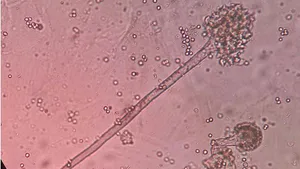
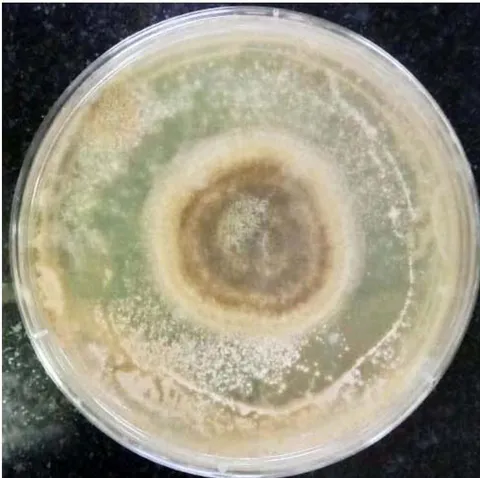
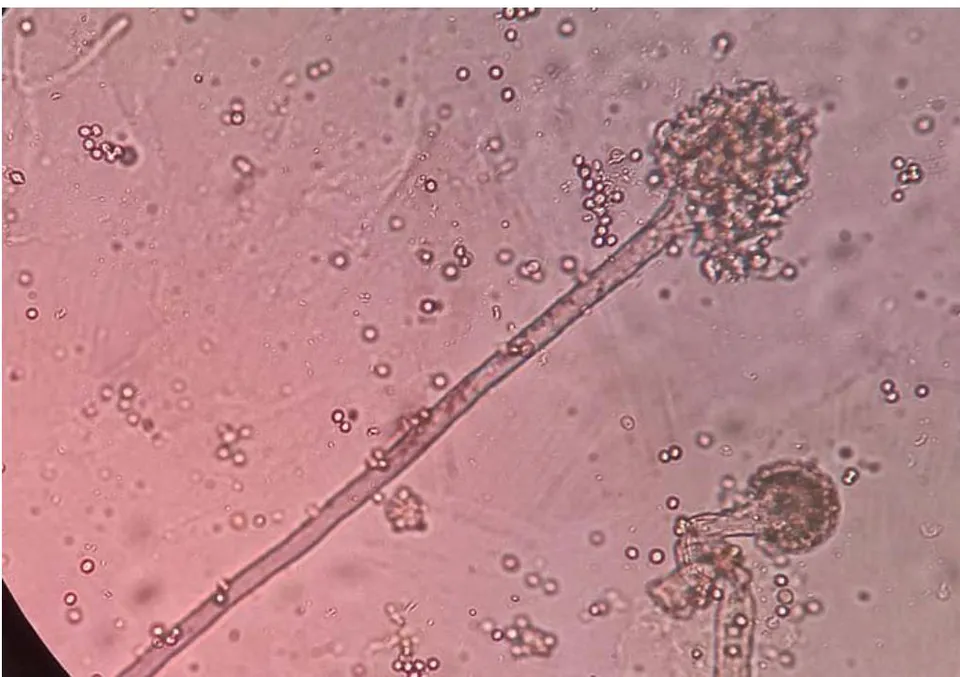
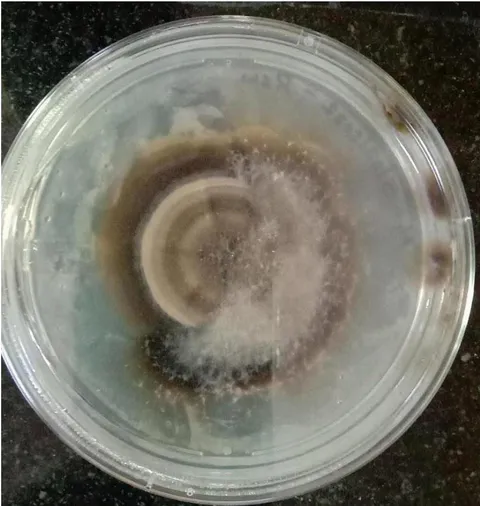
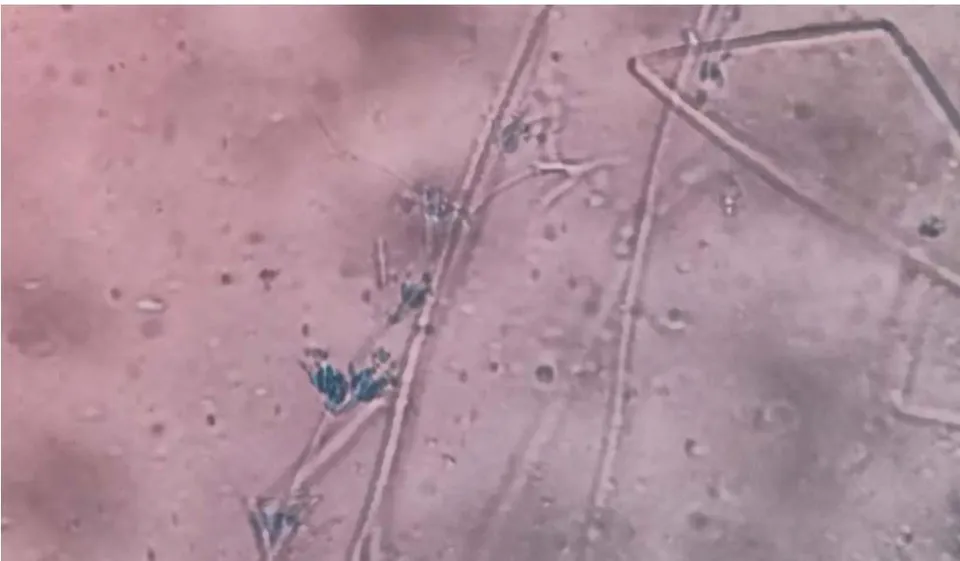
The colonies of the Aspergillus spp. were green and its reverse side was brown with biserrated conidiophores. Flask-shaped or cylindrical phialides either in a single or double series on the surface of a vesicle at the apex of a conidiophore was observed (Plate 1 and 2). Penicillium species had septate hyphae that gave rise to branched or unbranched conidiophores with secondary branches that give Penicillium a brush-like appearance (Plate 3 and 4) Wang et al. (2017) also identified the Penicillium species based on the brush like appearance of the conidiophores. Similar morphological characters of A. flavus were listed by Klich (2002) and Samson et al. (2019). In general, Aspergillus spp. and Penicillium spp. were recorded as a pathogen, food contaminator etc. But in the present study, selective presence of fungus in different hosts and absence of fungal isolate in the control plates revealed their association with A. rugioperculatus. As per the report of Okyere (2023), the most frequent fungal isolates found on insects are species of Aspergillus, Penicillium, Fusarium, Cladosporium, and Phycomycetes. As a support to the present study, A. flavus, was isolated as from the gut contents of wax moth G. mellonella larvae as potential microplastic particle-degrading microorganism in the study of Zhang et al. (2020). Poitevin et al. (2018) reported the association of Trichoderma atroviride, Aspergillus flavipes, Aspergillus iizukae, Penicillium mallochii, Penicillium adametzioides with European pepper moth (Duponchelia fovealis). The fungus, involves in digestion of the cellulose in leaves through production of cellulase. Which was clearly reported in the study of Klemm et al. (2002) that, binding of lignins to cellulose requires further degrading enzymes, which many fungi possess.
IV. CONCLUSION
The present study revealed the association of Aspergillus sp. and Penicillium sp. with A. rugioperculatus on different host crops. The facultative fungi residing in the insects are less explored and most of the insect-associated fungi are uncultivable, hence the low diversity with respect to fungi was observed in the present study.
Great Britain Journal Press Membership For Authors, subscribers, Boards and organizations

Great Britain Journals Press membership is an elite community of scholars, researchers, scientists, professionals and institutions associated with all the major disciplines. Great Britain memberships are for individuals, research institutions, and universities. Authors, subscribers, Editorial Board members, Advisory Board members, and organizations are all part of member network.



Author Membership provide access to scientific innovation, next generation tools, access to conferences/seminars/symposiums/webinars, networking opportunities, and privileged benefits. Authors may submit research manuscript or paper without being an existing member of GBJP. Once a non-member author submits a research paper he/she becomes a part of "Provisional Author Membership".
Society flourish when two institutions Come together." Organizations, research institutes, and universities can join GBJP Subscription membershipor privileged "Fellow Membership" membership facilitating researchers to publish their work with us, become peer reviewers and join us on Advisory Board.
Subscribe to distinguished STM (scientific, technical, and medical) publisher. Subscription membership is available for individuals universities and institutions (print & online). Subscribers can access journals from our libraries, published in different formats like Printed Hardcopy, Interactive PDFs, EPUBs, eBooks, indexable documents and the author managed dynamic live web page articles, LaTeX, PDFs etc.
Conflict of Interest
The authors declare no conflict of interest.
Ethical Approval
Not applicable
Data Availability
The datasets used in this study are openly available at [repository link] and the source code is available on GitHub at [GitHub link].
Funding
This work did not receive any external funding.
References
Cite this article
Related Research


Special Issue
Launch a focused special issue to highlight research, emerging trends, and expert insights in your academic field.