


IntelliPaper
Abstract
Laundry detergent is one such indispensable commodity that has been used by consumers all over the world. With the introduction of new and advanced laundry detergents, the global laundry detergent market is expected to rise by 4 percent during the years 2022 -2027. The present paper aims to understand consumer laundry behavior at the household level and how detergents can play a major role in the shedding ofmicrofibers and causing pollution to the environment. Results indicated that water hardness plays a major role in the usage of detergents, but most consumers are ignorant about the dosage of laundry detergent and are using twice or more than the amount of detergent required. This is a potential cause of over usage and pollution, and with the usage of more detergents, more water is required to wash off the residue which otherwise causes skin problems to the users. A heavy dosage of powder detergents can increase the shedding of microfibers upto 193 percent when compared to the liquid detergent. Educatingconsumers and bringing our suitable legislation may help mitigate the problem to some extent.
Explore Digital Article Text
I. INTRODUCTION
Laundry is one of the most common and most widespread activities (Pakula & Stamminger, 2010) carried out all around the world (Bianchetti et al., 2015), which is associated with many environmental impacts like the amount of water used, detergent dosage, and water heating (Golsteijn et al., 2015). Huge amounts of laundry detergents with their adjoining components enter the environment on daily basis (Warne & Schifko, 1999). Laundry detergent is mainly subdivided into three main groups; anionic, cationic, and non-ionic. Anionic surfactants are mainly used for soil and dirt removal, cationic surfactants act as a fabric softener and non-ionic surfactants reduce the hardness of water, which in turn helps the anionic surfactants to work their effectiveness on soiled textiles (Cheng et al., 2020).
The global laundry market was expected to show an additional CAGR of 4 percent from 2022 to 2027, with the present market having a value of 62.4 billion USD (for the year 2020) (Laundry Detergents Market Size, Share, Price Trends, Report 2022-2027, n.d.).
Numerous brands have been setting up their mark on the industry with several advertisements having keywords like bio-degradable (Batista, 2022), safe for the environment, eco-friendly (Bolt, 2022), low phosphorous, etc. to encourage consumers to purchase their merchandise. Unfortunately, many of these statements fail to reach the expectations or standards of the industry. One pertinent question that remains unanswered is that consumers need to ask about the ingredients in these products and their chemical load. Some laundry detergents with hidden bleaching agents have the potential to kill off the beneficial bacteria present in the waterways (Bianchetti et al., 2015). Studies also suggest that laundry detergents and washing loads can play a major role in the shedding of microfibers from laundered textile items (Volgare et al., 2021). Apart from other concerns consumer knowledge and behavior play a crucial role in the daily basis of following sustainable laundry practices (Kruschwitz et al., 2014).
Thus, a need for the present study arises to suggest the optimization measures which not only control the usage of detergents but also mitigate the microfibers pollution being generated. The main objectives of the present study are to get acquainted with consumers' domestic household laundry practices, consumer attitudes toward the laundry, and how the difference in the usage is responsible for the microfiber generation.
II. METHODOLOGY
A household survey was conducted to find out the laundry practices of the households and to gather information regarding the mode of washing, type of water/ detergent, locality, and different patterns followed during laundry. Additionally, open-ended question-like problems faced during laundry were also added to know about the constraints faced by the respondents. The Snowball sampling technique was used and an online Google survey proforma was developed and circulated among respondents and respondents were encouraged to share the proforma among their circle. A total of 315 responses were obtained, after deleting the duplicate and wrongly filled proforma, 297 responses were finalized for further evaluation.
Laundry effluents samples were collected from the selected households and were analyzed for microfiber contaminants. To optimize the detergent usage and microfibers shedding laundry cycles were run under different quantitative and qualitative measures to get familiar with sheddability triggers.
III. RESULTS
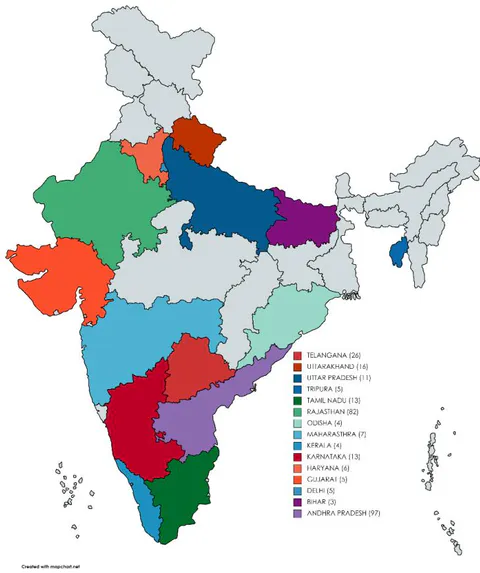
The Snowball sampling method enabled us to get responses from a wider consumer base, Figure 1 depicts the domicile states of the respondents who participated in the study. A total of 297 participants belonging to 15 states shared their opinions. Female respondents were higher (223 responses) than males (74 responses). A striking difference noted is due to the fact that laundry is still considered to be a gender-sensitive role.
As age can also play a major role in the understanding of the laundry habits, respondents were categorized to find out that, females and males within the age group of 20-29 were comparatively more than other categories (Figure 2).
{"image_source":{"path":"images/e9412014307bfae44aa74e2b5bd13b1b515f3cb9c06c274299512603a7e8b25b.jpg"},"content":"","chart_caption":[{"type":"text","content":"Figure 2: Respondents' age and gender-wise percent"}],"chart_footnote":[]}
Water has a key role in the laundry process, and water hardness plays a major role in the amount of detergent to be used for the laundry. Table 1 depicts the percentage of the respondents using different water sources and different laundry types. The majority of the respondents (66.33%) were using freshwater, whereas a considerable amount of respondents (29.63%) were using bore water, and only 0.67 percent of the respondents were using both bore and municipal water. Bore water is considered hard water compared with freshwater. About 1.35 percent of the respondents use saline water to launder their clothes, this type of water requires more detergent than other types of water to make the fabric feel fresh.
| Row Labels | Type of water used for washing |
| Bore plus municipal water mixed | 0.67% |
| Machine wash, Maid services | 0.67% |
| Bore water | 29.63% |
| Both Hand and Machine wash | 12.46% |
| Both Hand and Machine wash, Dry cleaning | 3.03% |
| Both Hand and Machine wash, Maid services, Dry cleaning | 1.35% |
| Hand wash | 5.72% |
| Machine wash | 4.71% |
| Machine wash, Dry cleaning | 0.67% |
| Machine wash, Maid services, Dry cleaning | 1.01% |
| Maid services | 0.67% |
| Freshwater | 66.33% |
| Both Hand and Machine wash | 27.27% |
| Both Hand and Machine wash, Dry cleaning | 5.72% |
| Both Hand and Machine wash, Maid services | 2.02% |
| Both Hand and Machine wash, Maid services, Dry cleaning | 2.02% |
| Hand wash | 9.76% |
| Hand wash, Dry cleaning | 0.67% |
| Hand wash, Machine wash, Dry cleaning | 0.34% |
| Machine wash | 14.14% |
| Machine wash, Maid services | 1.35% |
| Machine wash, Maid services, Dry cleaning | 2.02% |
| Maid services | 1.01% |
| Lake water | 1.68% |
| Hand wash | 1.68% |
| Saline water | 1.35% |
| Both Hand and Machine wash | 0.67% |
| Both Hand and Machine wash, Maid services | 0.34% |
| Hand wash | 0.34% |
| Well | 0.34% |
| Hand wash | 0.34% |
| Grand Total | 100.00% |
To get a clear note, Cameron, (2015) in his study observed that liquid detergents were least affected or sometimes not affected by the increase or decrease in water hardness and gave the same results during the washing process. Whereas, powder detergents were most affected and hence necessitated a need for increased usage. The study also gave an insight that powder detergents gave their best performance compared to liquid detergents in favorable/ soft water. Information regarding the type of detergent being was sought from the respondents. A majority of them (56.90%) opted for the powder detergent, 23.23 percent used liquid, and 16.83 percent used both powder and liquid detergents. Only 3.03 percent of the respondents used eco-friendly or zero waste detergents, which shows the attitude of consumers towards choosing a laundry detergent.
| S.No | Parameters | Number of Households* | Percent (%) |
| 1. | Type of detergent being used | ||
| a) Powder | 169 | 56.90 | |
| b) Liquid | 69 | 23.23 | |
| c) Zerowaste/ Eco-friendly | 9 | 3.03 | |
| d) Both Liquid and Powder | 50 | 16.83 | |
| 2. | Preferred detergent brands | ||
| a) Ariel | 29 | 9.76 | |
| b) Ezee | 19 | 6.39 | |
| c) Ghadi | 10 | 3.36 | |
| d) Henko | 19 | 6.39 | |
| e) IFB | 9 | 3.03 | |
| f) Mr White | 10 | 3.36 | |
| g) Praacheen Vidhaan | 9 | 3.03 | |
| h) Rin | 59 | 19.86 | |
| i) Surf excel | 118 | 40.06 | |
| j) Tide | 39 | 13.13 | |
| k) XXX | 20 | 6.73 |
The most popular laundry detergent among the subjects was Surf Excel (40.06%), followed by Rin (19.86%), Tide (13.13%), and Ariel (9.76%). Patterson, (2004) has conducted a study on 40 powder and 21 liquid laundry detergents. Results showed that powder detergents are having a comparatively higher amount of phosphorous content than that of the liquid detergents, and the labeling does not indicate the quantities of these in the detergent, which should be a matter of concern. Indian Standards (BIS) have prescribed the set of standards for the manufacturing of laundry detergents and most of the brands have exceeded the amounts of phosphorous, carbonate, sulfate, etc. IS 4955: 2001 gives three standard grades as per detergents performance (Chaudhary, 2015), and the clause given under the standards suggests that detergent powder should be non-injurious to the fabrics being washed.
Most labels of laundry detergents do not contain the ingredients for a ready reference. This information was provided in a roundabout way with a QR code which has to be scanned by the consumer to know about the ingredients. Most consumers use more laundry detergent than necessary by following the recommended dose on the labels of the detergent, whereas in reality consumers should choose their own dosing practices keeping in mind the requirements of their laundry load.
Figure 3 clearly shows the knowledge gap in the consumer's mind, when enquired about the amount of laundry detergent used, 60.50 percent of the respondents opined that detergent usage is based on the amount of laundry, whereas only 25.00 percent use the detergent based on the amount of uncleanliness/ dirt on the clothing, while 13.90 percent stated that they use the same amount of detergent irrespective of the amount of laundry. It is interesting to note that mainstream responses were found for the statement, based on the amount of laundry, which is not the right practice resulting in excessive usage and waste generation. Instead, consumers should adapt the dosing practices based on the uncleanliness of clothing items. Kruschwitz et al., (2014) studied 236 private households and found out that consumers do not adjust the detergent dosage according to the type of textile, soil level, load size, and water hardness. This leads to over or under dosage of the laundry detergent.
{"image_source":{"path":"images/08f234564049f36a692d56a6a07cafb4a78070e3d46f69cf8a87795f8377e472.jpg"},"content":"","chart_caption":[{"type":"text","content":"Figure 3: Parameters for the usage of detergent during laundry"}],"chart_footnote":[]}
Laundry sorting practices have an indirect impact on the shedding of microfibers and the usage of detergents. Synthetic fabrics/ clothing needs a fabric softener to reduce the agitation and abrading to adjacent clothing items while washing, whereas cotton clothing needs considerably a little more detergent to shed off dust and stains. When enquired about the sorting practices, a significant result with a p-value of 0.008631 was found for sorting the laundry by fabric type of content before washing and sorting the laundry by color. Sorting by colour seemed to be the most followed criteria when compared to sorting the laundry by fiber content.
| Demographic region | P-value | Remark | |||
| Urban | Rural | Semi-urban | 0.008631 | Significant | |
| Sort the laundry by fabric type or content before washing | 95 | 51 | 37 | ||
| Sort the laundry by fabric color | 108 | 46 | 50 | ||
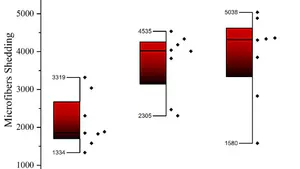
Laundry water from real household conditions was collected without any standardization to get an accurate analysis of the fibers/ microfibers released. Laundered effluents were filtered using a microfiber filter paper with a 0.7 m pore size. ANOVA showed that there is a significant difference between the detergent types and the number of microfibers released (p=0.001). Figure 4 depicts the statistical box plot depicting that powder detergents were usage have a comparative heightened shedding index than the other two detergent types. In natural detergents, pracheen vidhaan a powder based detergent and soap nuts were used, with soap nuts resulting in less shedding. But the main constrain faced was that soap nuts were not efficient in the removal of hard stains, thus restricting its usage.
{"image_source":{"path":"images/48e9791e0b9abeb15114de345325100b5f7aa286e4edc4c65a458f29924cfa60.jpg"},"content":"","chart_caption":[{"type":"text","content":"Figure 4: Microfibers shedding rate under different type of laundry detergents Effect of detergent of Microfibers shedding"}],"chart_footnote":[]}
Similar studies were conducted by researchers stated that detergent usage have an impact on microfibers release. Falco et al., (2017) in a study washed three synthetic textiles namely, polyester, acrylic, and polyester blend, and claimed that usage of powder detergent releases microfibers per gram of fabric, whereas only microfibers per gram of fabric were released when using a liquid detergent. Hernandez et al., (2017) stated that the usage of detergents (both liquid and powder) is the cause of the release of more microfibers. Napper & Thompson (2016) testified that detergents containing bio-detergent enzymes increased the fiber loss in some washes, but they appeared to decrease or do not have any impact on fiber loss in other washes. Yang et al., (2019) bring in that the usage of detergent has significantly increased the microfiber loss, especially when polyester/ synthetic fibers are washed at lower temperatures.
SEM Analysis
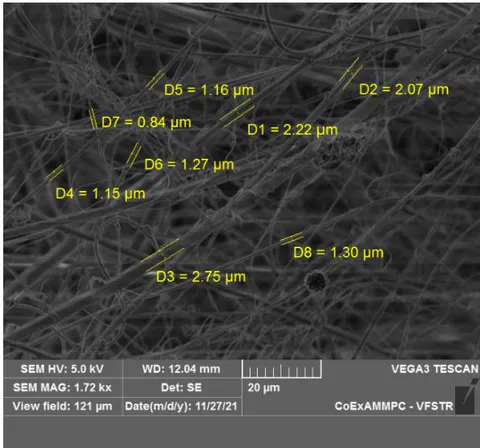
SEM imaging conducted revealed that (figure 5) laundry effluent have a varied lengths and widths of microfibers, irrespective of the type of detergent used. Apart from laundry detergent, several other factors are responsible for the microfibers shedding, which renders the obtained image inconclusive with respect to the length and width dimensions.
IV. CONCLUSION
To conclude consumer knowledge and laundry practices play a major role in the purchase and utilization of detergents. Powder detergents are more affected by variations in water than liquid detergents. Bleach additives used in the detergents are making the detergent perform well but when released into waterways they are causing harm to aquatic flora and fauna. While educating householders is critical, on-site regulations must be publicized and guidelines and information to be provided on packages. With the increase in microfiber pollution, there is a need to bring out and encourage sustainable laundry practices. Increased levels of awareness and consciousness are the only ways to reduce excessive chemical use in households. This can be a step towards the advancement of effective on-site wastewater treatment systems.
ACKNOWLEDGMENT
I would like to acknowledge Dr. Vijay Lakshmi, Assistant Professor, YSR Horticulture University
Thadepalli Gudem, for her guidance in the statistical procedures.
Conflict of Interest
The authors declare no conflict of interest.
Ethical Approval
Not applicable
Data Availability
The datasets used in this study are openly available at [repository link] and the source code is available on GitHub at [GitHub link].
Funding
This work did not receive any external funding.
References
Cite this article
Related Research


Special Issue
Launch a focused special issue to highlight research, emerging trends, and expert insights in your academic field.