





IntelliPaper
Abstract
Technologies have been a fundamental part of education for several decades since, through their use, all students can access information more easily and remotely. However, it is not until recent years that it has been latently noticed how the attention of educators and researchers has been redirected towards students with visual impairment or other special needs in an attempt to promote their inclusion in today's classrooms. It should be noted that the adaptation of material in the classroom and the use of typhlotechnology as teachers of students with visual impairment has not been studied much from the perspective of the students; hence the objective of this study. The data analysis was collected through the use of interviews that provided first-hand information from students with visual impairment in relation to the knowledge that their teachers have -or not- about typhlotechnology and the adaptation of materials to cover their curriculum. The data analysis was carried out with the coding of students' responses and with the identification of topics based on the research questions. Consequently, the study indicates that students with visual impairment consider it important that their teachers are aware of the technologies used by the aforementioned to adapt the materials depending on their educational needs.
Explore Digital Article Text
I. INTRODUCTION
As mentioned in my previous work, it was found that most of the teachers and institutions neither have the appropriate infrastructure or classroom materials adapted in braille nor do they have other devices used by visual impairment students to enhance and accompany their learning process inside the academic field. As evidence of this, it was reported that as teachers "not only is it fundamental to be aware of each condition present in their groups but also to have materials previously acquired or designed according to their particular demands." Noriega Pérez, Paz Dominguez, Hernández Ángeles & Hernández Alvarado (2023).
For this reason and by working for the service of blind and visual impairment kindergarten children up to youngsters for a year now, I have noticed that the implementation of typhlo technological devices is essential for their education, active learning and autonomy inside and outside the classroom. On account of that (Aquino Zúñiga, García Martínez & Izquierdo Sandoval, n.d., as cited in Vilchis, 2023) claim that there are specialized means that low vision and blind students can appropriate to their learning process such as "talking systems, audio recording systems, computer peripherals and optical systems". These are some examples in which everyday technologies not only can become suitable didactic learning tools for these types of students but also an opportunity to facilitate and engage them in learning. For instance, Stadler-Heer (2019) agrees that in order to have learners actively engaged, "computer-assisted technology" and other approaches can be used with each learner. Moreover, it is also necessary to trigger the students' autonomy and independence as equals with the rest of the population, hence, promoting their social inclusion. As the United Nations (2022) insist, people with visual disabilities and sighted ones are the same since both parties are capable of socializing with others, being independent and productive. (p. 11).
Regarding material adaptation in classroom activities, it is imperative -as teachers- to modify accessible educational materials for sighted people in a way that visual impairment students can avail the knowledge the same way other students do. On the contrary, if teachers do not readjust their material focus, visual impairment students who assist to regular classrooms will feel disadvantaged and definitely not involved in terms of educational inclusion. "Because of the imbalanced focus on visual learning materials, students with visual impairments are often at a disadvantage." (Kaplan-Rakowski & Heap, 2023). This means that, as teachers of students with visual impairments not only should we be thoughtful on the material selection to prompt their learning and language acquisition -if they are learning any language- but we should also have typhlotechnological knowledge that we can put into practice in case students have any doubt during their learning process or do not remember which shortcuts are used on their computer for certain actions. Thus, the aim of this study is to raise awareness on the importance of having the basic knowledge on the use of typhlotechnology as teachers to provide better teaching and better attention to visual impairment students of preschool, primary, secondary, high school and university; as well as adults who, for some reason, lost their sight. Besides, it aims to explore whether students with visual disabilities are provided with educational materials adapted by teachers to facilitate their learning.
The research questions addressed in the present study are the following: What are the main advantages of learning how to use typhlotechnology as a teacher? How does the use of typhlotechnology help visual impairment students in learning? and What are the advantages of adapting materials for visual impairment students?
This study is significant to identify the advantages of knowing how to use typhlotechnology as teachers of visual impairment students and to determine whether or not we successfully adapt the accessible materials to facilitate their learning to broaden their academic development.
To this extent, Velázque Wong & Rodríguez Robles (2024) acknowledges that "likewise, there is little research that takes into account the voice of students with VI, regarding how they experience barriers in inclusion support services." (p. 7) Thence, although there have been studies regarding inclusive education; the extent to which Spanish or English teachers have the essential knowledge regarding typhlotechnological devices and how can they guide their students learning when using such devices yet adapt accessible classroom materials according to their needs has been little delved into from the students' perspective.
II. LITERATURE REVIEW
2.1 Typhlotechnology
To begin with, Organización Nacional de Ciegos en España, best known as ONCE (n.d.) defines typhlotechnology as the "set of techniques, knowledge and resources aimed at providing people with blindness or severe visual impairment with the appropriate means for the correct use of technology." To this extent, it can be inferred that typhlotechnology is the means by which blind and visually impaired people can have an approach to information through the use of social media and websites with the help of other means such as computer or cell phone speakers -in most cases-to reinforce their autonomy within the society and communication with others.
Therefore, as claimed by Vilchis et al. (2023) "typhlotechnology emerged to help people with blindness or visual impairments to access electronic information and communication technologies in order to facilitate their independence and personal autonomy." (para 2) It should also be noted that the same author lists some tools that were modified throughout the time or improved to be used by visual impairment students like "voice synthesizers, screen readers, optical character readers, Braille keyboards, text and image magnifiers, talking scanners, among other solutions" As can be seen, there have emerged a wide variety of technological devices for blind and visual impairment students whilst the digital world evolves through the years and with that, as teachers, we try to use these gadgets to include the learners as much as possible onto the society offering equal approach to the information displayed in the network.
Similarly, this means of technology for visual impairment students has represented a change in societal and academic inclusion allowing special and unique people to access the same information as the sighted part of the population. For instance, Pegalajar Palomino (2013) observes that
"The introduction of ICT in schools provides teachers with a series of aid for the improvement of teaching and learning processes, which has an impact on positive way in the students. However, it is not a simple process, as it requires of a series of didactic and organizational changes in the classroom as well as the consideration of certain general aspects associated with its implementation." (p. 13)
Based on what has been formerly said, thanks to the invention of the braille system by Louis Braille in 1824 up to the current advanced Information and Communication Technologies (ICT) for these parties, there has been an outstanding impact in the learning process of visual impairment and sighted students as mentioned by the author; however, it is also necessary to make some modifications so as to achieve a substantial implementation of the materials in use during all student academic performance.
Correspondingly, (Kaplan-Rakowski & Heap et al., 2023) emphasize that "evolving digital environments need to keep pace and offer equivalent learning opportunities to visually impaired individuals. Therefore, the existence of assistive technologies is fundamental to allow for diversity and inclusion." In fact, not everything is as it seems since, despite now having the material and technological resources necessary to provide equal education to students with visual impairment or other types of disabilities, not all teachers are sufficiently trained in public or private schools to meet the educational needs and demands of the students in question. As evidence of this, Noriega Pérez, Paz Dominguez, Hernández
Ángeles & Hernández Alvarado et al. (2023) report that "it is necessary to delve deeper into other people's perspectives since they may feel that, superficially, there is inclusion in the classrooms. Also, being given coaching would help them address their students' needs adequately" (p. 62) Still, this is a strong assertion that makes us reflect on the importance of having the basic knowledge about the typhlotechnologies used by students with visual impairment as well as the curriculum and material adequacies that can be made so that the educational demands of today's students can be met.
2.2 Curriculum Material Adaptation
As aforementioned, by being informed about the way of working and teaching students with visual impairments, together with an informed adaptation of materials within the school curriculum, activities can be carried out in a significant way to strengthen the learning of all students equally. Furthermore, should teachers acquire knowledge respecting both means, future generations of students would have the required attention from their educators whenever they have an inquiry inside the academic terrain.
It is worth mentioning that Rodríguez Puerta (2021) describes a curriculum adaptation as "tools used in education to help students with special educational needs. In general, they consist of modifying aspects of the syllabus or teaching method, so that the educational objectives are suitable for all students."
Besides, the same author describes different formats in which a curriculum can be adapted to the needs of these particular students like "Curriculum Access Adjustments" that encloses "physical access accommodations" and "communication access accommodations", to mention some of them.
The first ones are those that modify some parts in terms of physical means to provide an accessible classroom and environment (e.g. "ramps, adapted furniture or support staff within classrooms to help students with severe motor problems"). The second one is related to the adaptation and/or modification of "teaching materials" for a "certain group of students" such as "books written in Braille for blind people or audio recording of school materials". These are some of the examples given concerning the adaptation of curriculum materials and changes that can be made depending on the special educational needs of each student with the intention of adapting the knowledge to be acquired by them.
III. METHODOLOGY
In terms of the outline of this study, it was chosen a constructivist worldview, a case study design and a qualitative approach. Moreover, a qualitative instrument was implemented to collect data to answer the following research questions: What are the main advantages of learning how to use typhlotechnology as a teacher? How does the use of typhlotechnology help visual impairment students in learning? and What are the advantages of adapting materials for visual impairment students?
Respecting the viewpoint of this study, a constructivist worldview was adopted to explore the students' perspective about the importance of having basic knowledge on the use of typhlotechnology as teachers of students with visual impairment and its adequacy in classroom activities.
Additionally, a qualitative approach was implemented. According to Creswell and Creswell (2018), a qualitative approach is meant for "exploring and understanding the meaning individuals or groups ascribe to a social or human problem" (p. 41). This means that the firsthand perspectives that visual impairment students have is vital so that they perform the same activities that their other classmates without disabilities do. Thus, promoting equitable and inclusive treatment.
It was also essential to interview students in order to understand their point of view concerning this matter and how their prior experiences with their teacher's material adaptation influenced their social meanings and learning. On account of that, a case study design was favoured.
The setting of this study was a private non-lucrative foundation in Pachuca de Soto, Hidalgo named Ciegos Fundación Hidalguense (CIFUNHI). The institution promotes the autonomy of each beneficiary through the ripening of their self-development in terms of social and educational skills. It is a foundation for genetically blind and visually impaired babies, children, youngsters and young adults, some of whom are combined with other special needs such as blindness with cerebral palsy, blindness with bipolar disorder, blindness with autism, blindness with muscular atrophy, possible beneficiaries with attention deficit hyperactivity disorder and visual impairment with hearing problems. As well as adults who used to see but lost their sight due to different circumstances.
This building houses four main areas: preschool, primary, secondary/high school and computer room. The additional rooms are a music room, a playground, the headmasters office, five bathrooms and a kitchen in which all the beneficiaries discover and deepen their autonomy by carrying out daily activities. Withal, the setting impacted this research due to the differences in the availability that students had to be interviewed due to their classes, together with the places in which they could be interviewed without getting interrupted. For this reason, the interviews were conducted in the afternoon in the music room since at that time of day there were just high school students and teachers inside the building.
The participants in this study were four students who attend this Foundation; one university student attending law online classes and three high school students attending the same regular classroom as an agreement between both institutions. They were interviewed since they all use typhlotechnological devices to carry out their school and extracurricular activities. There were two women and two men aging between sixteen and twenty-one years old; each has different years of knowledge and experiences using typhlotechnological devices in this institution.
The key instrument of this study was an interview that consisted of 20 open-ended unbiased questions to compile first-hand information about these students' honest perspectives in relation to their previous and actual experiences with their teachers' curriculum and material adaptation in classroom activities and typhlotechnological knowledge to prompt their particular development and provide these students with better resources to strengthen their learning. The interview questions were written in Spanish to obtain slightly more extensive answers since the students have little or basic knowledge about the language. (appendix 1)
The piloting of the instrument was done once the interview was completed. A piloting session was scheduled with a high school student to proofread the questions that were similar to avoid reiteration and consolidate its better understanding. On account of that, the participant was chosen for the rapport we have established throughout this time we have known each other along my English teaching practice in addition with the years of experience they had using typhlotechnological devices. The piloting session lasted around 30 minutes depending on the length of the answers; it was conducted at CIFUNHI. On the whole, the piloting of the instrument facilitated the weighting of viable and non-viable questions so that the pertinent arrangements could be made before their official application to the students to be interviewed. Plus, it helped to verify whether the interviewee's answers were fruitful to clarify the research questions or not.
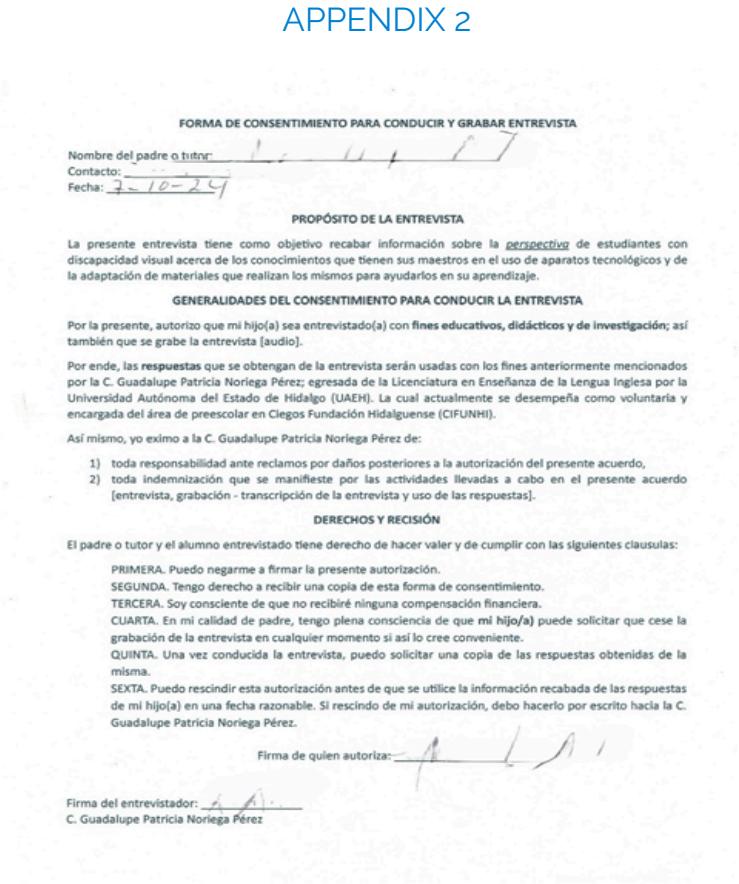
In consequence, a consent form was given to the parents of the participants as an ethical issue to fill in on behalf of the students to authorize their interview recording and the later analysis of their answers since they are minors. It was also asked for the students' consent to record their interview. (appendix 2)
IV. DATA ANALYSIS
In the aftermath of the application of the instrument, an exhaustive analysis of the student's answers were made. Besides, the analysis of the data took place to couple relevant information that would answer the research questions. As part of the coding process, interviews were transcribed and key ideas that provided evidence regarding the importance of having basic knowledge about the use of typhlotechnology as teachers of students with visual impairment and its adaptation in classroom activities were highlighted. The participants' responses were classified by colours with the purpose to identify themes, as well as to have a better understanding of each question's responses. For this reason, the patterns vested by the feedback of the participants was of utmost importance and first-hand since their personal experiences were taken into account.
The prior mentioned analysis was significant in the sense that it helped identify the perspectives of visual impairment students towards the importance for teachers to learn the basics of typhlotechnology nowadays along with its adequacy in classroom activities.
V. FINDINGS AND DISCUSSION
Apropos of the above mentioned, the following three central themes related to the research questions were attained: teachers' knowledge, helpful typhlotechnological devices and material adequacy. Moreover, the ensuing subcategories were implicitly divided within the former themes: reasons to have basic knowledge as teachers, more helpful devices for students learning until now, ways in which devices help students to learn, material adaptation, external teachers' material adaptation and advantages of using different materials in class. This feedback was the foremost important from these visual impairment students' perspectives related to the subject matter of this study. Each theme is furtherly explained below.
5.1 Teachers' Knowledge
Data gathered from the students' perspective pointed out that some of the reasons as of why teachers should know how to use typhlotechnology is based on their previous experiences from attending regular classrooms where some teachers did not know how to treat them, how to work with them and support them considering their needs and learning patterns;
ending up excluding them. Additionally, student 4 states that having knowledge on this subject matter is a must if you want to expand your job prospects as a teacher apart from providing an egalitarian education for all types of students.
Because many times...eh...me, who attended normal schools. For having a disability, not only visually but the issue of all (persons') disabilities...eh...teachers- when they don't have the basic knowledge- and I'm talking about how they don't even know how to treat a person with a disability. They exclude us a lot in terms of activities. In fact, I had several experiences that- I don't know, they gave me eh- 10 without having done anything. Why? They excluded me from the activities or failed me because I had not turned in work... but they did not let me do anything either. I had many problems with respect to that but because teachers do not take the time to obtain the knowledge (even if it is basic) to treat a person with a disability. (Student 1)
Eh- because...well, if a- a child needs help to move something in the computer well...ah...For being able to support him it is important to learn to use the computer because as I say, if at any time a child requires your help then obviously you can't tell him "I don't know". No! Or-" I don't understand this technology thing" Right? This- "Check out how you can fix the problem yourself". And so, yes, it is very important that teachers are also updated, right? Or focus a little more on what technology is. (Student 2)
I think they should have knowledge because they should also learn how to treat a blind or visually impaired person...because if not, when they see a visually impaired person, they obviously will not understand what that person does. And I think it is very good that they learn to have that knowledge so that in the future they can learn how to help those visually impaired people. (Student 3)
I believe that having the knowledge in typhlotechnology for teachers, apart from the fact that it opens a more extensive field of job opportunities, endorses what the Third Article of the Constitution mentions in terms of education for all. (Student 4)
These statements show that visual impairment students would want their teachers to be knowledgeable for different reasons: to know how to treat and include them, to understand how they work, to have broader job opportunities and to provide these students with equal education.
Ergo, attending regular classrooms was a watershed for two of the students' personal experiences before the personalized attention they now have at this Foundation. According to these participants' perspectives and prior involvement within mainstream classrooms, both student 1 and 3 concede that their previous teachers neither have the adequate knowledge regarding braille nor they had enough awareness on the typhlotechnologies they used to consolidate their learning. In fact, hindering their learning and excluding them from the activities and assessment since they had no or little comprehension on how their students worked and how they can adapt the methodologies to teach them. Velázque Wong & Rodríguez Robles et al. (2024) insist as a result of their study that there is a great need to prepare teachers in terms of accompaniment in classrooms and to provide them with information on the teaching strategies or methodologies that they can adapt in their classes; based on that they can know how to deal with and how to work with students who have a disability, not necessarily visual, but of all kinds. Likewise, these authors report in their study that attitude is important if you are a teacher of students with visual impairment since "sometimes they do not have the empathy and willingness to take into account their needs as students" (p. 13) In respect to what student 2 suggests, being an updated teacher is a benefit for both parties; the students involved and the educator in charge of their learning by virtue of the support they can avail if a quality teaching is provided. Hence, Zamora López and Marín Perabá (2015) believe that teachers must be updating themselves regularly because it can suppose "offering good and quality teaching for students with this disability"; on the contrary, if the teacher is not knowledgeable regarding technological aspects, they might not comply with their visual impairment students demands.
Perhaps, the UNESCO (2005) claims that in order to cater quality and inclusiveness inside the classroom there should be "flexibility and variation at the centre, structurally as well as in terms of content, with the goal of offering every individual a relevant education and optimal opportunities for development." (p. 16) So, as student 4 declared, knowing about technologies -not only as teachers who work specifically for these students, but also teachers in regular schools- is essential to widen our personal careers, to contribute to an equal education for all and to encourage others to be inclusive within the academic realm.
5.2 Helpful Typhlotechnological Devices
In regards to the tyohlotechnological devices that have mostly helped these students on their learning process until now, they mentioned that the Perkins machine, computers and cell phones along with applications installed within them -that involve talking systems- have been the most outstanding means used by them that have favoured their academic development and learning. Being the NVDA one of the talking systems mentioned below by participant 2.
Eh...the Perkins machine...eh...the computer speaker and the phone speakers that at first, I used the entire pack that is the Android one. But now I use the (incomprehensible) that is the iPhone one. (Student 1)
Well, I think that the computer. Because maybe to be able to write eh...I feel like I write a little faster. I have the mobility of my hands, eh...and I write more- like more fluently. (Student 2)
...For example, mine when we bought it...eh...It didn't bring anything, it only had the basics like Word, Powerpoint... all that comes with a computer. And here they installed the NVDA- it's called NVDA...and this one- it's very functional... well... for blind people (sigh) because with that you can open Power Point documents and so. (Student 2)
Well...look. What has helped me a lot is the mobile phone and the computer. I use- I always use the computer because it's like the one I know how to use the most. And they're just teaching us how to use – they're teaching us, how can you say? the use of mobile phones and computers. I feel that I already understand more functions. (Student 3)
I certainly think technological gadgets like smartphones and computers with a talking system have been very useful for my academic development. (Student 4) As reported by these students, the most common technological resources they use are computers and cellphones with talking systems to be able to listen to what they write and to have their devices read the texts and documents they are given by their teachers or texts displayed on their computer. Given this circumstance, (Ruiz, 2015, as cited in Zamora López and Marín Perabá et al., 2015) proposes "other tools with typhlo technology" such as "screen readers, software that uses a speech synthesizer to read a given information on the screen or to be read through touch." (p. 6) Moreover, to clarify what student 2 mentioned, Comunidad de NVDA en español (n.d.) explains in their website that the Non-Visual Desktop Access (NVDA) is a "free and open screen reader" that aids visual impairment students when using computers due to a "synthetic voice" that reads any text that they have on their computer screen.
Ancillary, the use of diverse typhlotechnological gadgets is preponderant for these visual impairment students in question; this as a result of the functionality, accessibility and easier understanding they have on how to use such gadgets together with the help of these "synthetic voice" screen readers that lightens their reading process in braille by just deciphering the computer input written by them.
Furthermore, the extent to which these devices facilitate their learning is considerable by virtue of the information that they can search academically speaking. However, one of the students highlighted the importance of joining the theoretical with the practical, of course, adapting the materials available so that they have an approximate idea of how things, objects, among others really look through their physical representation by using textures according to the color of these meanings. It was also noted that even if the devices they use improve their lives; for student 2 is easier to use the Perkins machine rather than the computer when having to read.
Eh...for example, when it is not- eh... well, when we don't know what they are talking about, for example, I don't know, let's say... a cell in biology because obviously we cannot see the cell so we do not know. Theoretically we know what they are talking about, but in terms of knowing what it is like... Not really; but many times, they recreate all that with materials and I think it helps me to learn in an exact way, for example the cell, to be able to know and understand theoretically and connect all those dots. (Student 1)
Oh, they help me a lot because...because thanks to them I can eh- ah- learn. This- it has helped me at the same time because, for example, I tell you that I love to compose and as I have the slate right now. And I'm one of those who grabs the guitar, takes notes, and then I write and check the notes. And it's a bit of a hard time for me because, if I have already written a verse, I don't know...eh... let's say "three little carts pulled my horses" or so.... If I didn't write...I pick up the guitar again and do another verse that I didn't write and see where I left off. I get lost a lot...and of course the Perkins machine was- it's, it's, easier, isn't it? And I'm grabbing the guitar here, I'm going to sing this... and read what I left behind. (Student 2) On the computer it's kind of complicated because when it comes to writing I have to go back. And when you read it, that's what I tell you, it's complicated. (Student 2)
I think they help me, they help me a lot because now, as I mentioned before, we can make our daily lives much easier because before- in the years before, a person not only with visual impairment but any person...how did they do it, right? They had to do things more by hand, looking...for example, if a task was left as homework, searching in books or in what else... in magazines they searched. Or they went to a museum to do some research...and I think that yes, it has helped me much easier because you just search on Google what such a thing means. (Student 3) As quoted by student 1, even with the use of various tools, their teachers have to adapt the accessible materials they have so as to provide them with a meaningful language that owns a signified and signifier as mentioned by Saussure. With reference to this statement, Bigot (s.f.) cites that
"Saussure then calls the combination of concept and acoustic image a "sign", and this is a psychic entity. Since in current usage the word "sign" was used to designate only the acoustic image, Saussure proposes to retain the word "sign" to designate the whole, and replaces "concept" with "signified" and "acoustic image" with "signifier". (p. 51) In other words, the oral and written language is a system of signs. Perhaps, the signified is the union of characteristics that generate a graphical idea; for instance, the physical image that we have of a tree (branches, leaves, tree trunk). On the other hand, when we talk about the signifier, we refer to the information that we have about the signified, that is, the word as it is (e.g. t-r-e-e). Finally, the acoustic image is the mental memory of the sound of that word. Considering what has been said, in this case the role of the teacher is to bestow the necessary adapted materials for the students to create a mental image of a word, together with their sound and its written form by reading braille materials or using typhlotechnologies to accelerate the identification and association of vocabulary with textures, silicone enhanced images as well as talking systems.
5.3 Material Adaptation
In accordance with what is mentioned in the previous subcategory, the extent to which typhlotechnological devices facilitate learning is tethered with the material adaptation so as to achieve a meaningful learning of visual impairment students through the recreation of didactic educational means and the adaptation of regular course plans together with the use of a well-structured teaching strategies; always considering their learning styles.
Yes...Yes, yes, yes, because right now that we're in high school...we study high school by a school, eh...so the teachers- they send the course planning...eh, but planning like all students. And they have to adapt that planning so that we can learn. A clear example was that in the first semester we were given a book with the elements of the periodic table in Braille and each element-each group of elements had a texture. For example, the gases were cotton so it was easier for you to locate the elements. (Student 1)
Well, I believe that everyone knows the learning style from each one and maybe...For example, disability too. The same...maybe- I with a way of learning- well, perhaps if they tell me... Let's see, do- I'm going to give you an example, I like music. If a teacher from above tells me to make a poem for him, then obviously I will be able to do it a little faster than my classmates... maybe something is more difficult for them, for others not, and so on. (Student 2)
I think so, yes. They know how to adapt them so that we can feel...even if it is through an image how that material feels and I think that yes, it is a very good idea that they learn to adapt it because we, as well as teachers can-- or as well as people who can see how something really is...also a person with visual impairment has that right. They cannot see it but they can feel it and use- or let your imagination run wild. (Student 3) Without a doubt, I consider that my teachers are more than capable of adapting the necessary tools for my classes. (Student 4)
Putting all of the above together, it leads us to analyze that visually impaired students go through the same process but differently from that of a sighted person. Vision being replaced by touch, hence the recreation of objects with materials for students with disabilities, resulting in meaningful learning as Ausubel declares in the cognitive paradigm of education. Hernández Rojas (1998) emphasizes that "From the Ausbelian perspective, the teacher must be deeply interested in promoting meaningful learning of school content in his or her students, either through a well-structured expository strategy that promotes meaningful learning by reception, or through a didactic strategy that promotes learning by autonomous or guided discovery." (p. 135-136)
This conveys that, as teachers we must further the inclusion of visual impairment students by adapting materials for them to acquire meaningful input beyond learning the basics of typhlotecnology as teachers to assist them when needed while using computers or cellphones. What is more, implementing various strategies to meet their requirements when learning; whether in Spanish or English.
In terms of the external teachers that some of them have had, two of the students mentioned that they were provided with the means to reinforce their learning by using materials teachers had at hand for them to understand what they were being taught. Even when their teachers did not know the specific textures used by visual impairment students to identify the colors or other objects, they tried their best to boost their academic development. The same with the implementation of typhlotechnological devices with high school students; even with no knowledge on this area their teachers took the time to include them in their own way. So, one of the reasons they decided to attend this Foundation is to have a particular attention, better inclusion and learning materials.
It's that...some yes and some no, for example, I had two teachers who taught me how to use – well one of them had knowledge of braille and made me write in braille when I was very young and then I forgot how to write and made me – for example, when I reviewed the tens, hundreds and that, I did the tens with a little circle the hundreds with a triangle and so on. Oh- and when I was in first grade of high school another teacher that- eh...did all the activities orally for me, that is, homework, she read me math operations and I had to answer them right there. Ehmm... she taught me how to use the white cane... Eh, but I also had experiences with a third-grade teacher... that because she lacked on basic knowledge; I was excluded from many activities, and I did very badly...I failed many subjects because I did not do the activities... Not even she taught me. (Student 1)
Eh...in fact they supported me a little more, for example, for exams...they sat with me to read my questions and obviously I was answering them. In the case of writing with the Perkins machine, they only dictated and I wrote it. And in the case of handing in work, some were taught what the braille system was, but they left. There were new teachers...and there was no opportunity to teach them what the braille system is. And with some of them we had a small problem in terms of exams...eh- because some did tell me: "I'm going to give you your exam, answer it by yourself" I stayed like that...so how? Answer it by myself? It's not in- You see that they give it to you on a sheet of paper? They give it to you in bold. (Student 2)
Yes, they adapted them. For example, the first year I entered- when I entered fourth grade, they gave us all notebooks, but I didn't know what to use them for, I just scratched them until I entered fifth grade. What my teachers did was, for example, we had 3 notebooks, one that was math, which was obviously the subject of mathematics, and there they adapted me in silicone...my teachers made me a figure or a drawing for me to color it.
We had the language one, which was Spanish...they adapted things related to Spanish, for example, they drew me a mandala or so –I don't remember– so that I could color it. And cultural areas that were science, geography and history, and in those they also adapted some drawings so that I could only draw and fill in the drawing that was inside the notebooks. They also put cardboard embossed with materials, for instance, maps of the republic. Obviously, everyone in life was given a map of the republic or a world map, they made me color the states or the continents on the enhanced map. (Student 3)
Although in external matters, very few teachers have been concerned with the adaptation of typhlotechnological tools. Perhaps there have been two or three teachers throughout my career, who have done their best to adapt the contents. (Student 4)
These quotes show that the inclusion of teachers towards visual impairment students is paramount for the latter ones since they feel considered when their educators design materials in braille or adapt them in silicone for them to avail the acquired knowledge provided in class in concordance with the use of typhlotechnological devices to accompany their academic process. Willings (n.d.) insists that
"Print textbooks and instructional materials used in classrooms are not always accessible to students and can present barriers to learning. Students must be provided with materials in a format that they can access to participate and achieve in the general curriculum. Many students with visual impairments may require one or more specialized formats including braille, large print, audio and/or digital. When specialized formats, paired with support for proper use, are matched to a student's unique learning needs and combined with effective instruction in reading, the result can mean the difference between exclusion and achievement across the curriculum." (para 5)
I cannot agree more with this author because what she mentions is exactly what happens with the design of materials for the students in question. In the case of the Foundation they attend, they have the advantage of owning all the essential materials and devices to carry out their activities whereas in external schools there is little chance that teachers have supportive devices for this type of students, the adequate training or even the initiative to learn about how to treat students with any disability as mentioned above by the participants. The same is true of the extent to which educators who teach in regular classrooms nowadays are informed or updated about the devices used by visually impaired students to guide them in their learning without leaving them excluded. In fact, it is important for these students to have knowledgeable teachers who help them in any need or doubt they have during their learning process making a big difference in their academic achievements and withal stimulating an inclusive classroom environment for their visual impairment students.
Last but not least, there were mentioned some advantages with which a teacher of a blind or visual impairment student can benefit themselves and others with such as bringing their students a clearer idea of how things are when using the correct adequation of pedagogic resources and by considering the characteristics and particular needs of each undergraduate.
Eh, the advantages...that you have more creativity in terms of- uh...I don't know, for example, about a demo or something like that. You already have many ideas on how to do it, that is, for example... In this part of the model, we are going to put foamy and in this other- eh...styrofoam and so on. (Student 1)
The advantages are that you can organize yourself and there are some materials that you may like, others that you may not. And you can feel comfortable when it comes to working. (Student 2)
The advantages that I think are very easy is that thanks to the materials we can more or less feel how things really are, for example a house- that they enhance a house we feel how the shape of that house is. Or for example, what else, the sun...it can be seen but we can also feel what's its true- or more or less what the shape of the sun is. Yes, the same with the colors that they differentiate with different textures. (Student 3)
All in all, these statements show that the advantages that students and teachers have in common is the fact that they both can harness the resources adaptation in the classroom to make learning more efficient and create an association of objects with their real color based on textures by having a mental idea of what they are being presented with or taught. Pegalajar Palomino et al (2013) agrees that
"Faced with this new situation, the teacher is not exempt from work but, on the contrary, his task must focus on the structuring, organization and adaptation of such resources to the characteristics and needs of the students as well as their cognitive demands and specific learning styles." (p.14)
Nonetheless, there is no doubt that teachers must put extra effort on organizing the structure of the material usage to fortify the cognitive development of their students by acknowledging that each visual impairment undergraduate has a personalized learning style that helps them during their learning process apart from adapting the curriculum -if given- to further their academic growth.
VI. CONCLUSION
This study yields fundamental findings respecting visual impairment students' perspectives on how important is for them to have versed educators in diverse matters so that they are able to put into practice what they know such as supporting their special students to solve issues they might encounter while implementing typhlotechnological resources inside and outside the classroom to enhance their autonomy. On that account, the intention of this study was to explore and center its focus on visual impairment students' outlook on the subject of typhlotechnological knowledge and material adaptation within their educational curriculum at Ciegos Fundación Hidalguense (CIFUNHI) in Pachuca de Soto, Hidalgo. On the whole, this study aspiration was to raise awareness among teachers of preschool, primary, secondary, high school and university students; as well as adults who have a visual impairment to keep up to date with the medical conditions that their students may present and thus know how to treat and include them appropriately in the classroom. Lastly, I strongly believe that if you -as a Spanish or English teacher- want to have truly inclusive schools, why not start preparing and looking for specialized organizations so that we understand how to treat these people? Or simply, to have the initiative to request information from someone who has had more in-depth contact with what it implies teaching visual impairment students and ultimately prompt partnerships between specialized foundations and schools or any organization to expand the professional development of every person regardless of what they have studied or what they do. Everyone can learn, not just educators.
APPENDIX 1
1. ¿Cuál es tu nombre?
2. ¿Cuál es tu pasatiempo favorito?
-
¿Cuánto tiempo llevas acudiendo a la Fundación?
-
Me podrías decir si ¿sólo acudes a la Fundación o acudes a otra escuela de estudios académicos?
-
Me podrías comentar un poco sobre ¿por qué decidiste acompañar tus estudios en la Fundación?
-
¿Prefieres venir a estudiar a la Fundación o preferirías ir a una escuela regular?
-
¿Qué es lo que más disfrutas de venir a estudiar a la Fundación?
8. ¿Sabes qué es la tiflotecnología?
-
Me podrías decir ¿cómo aprendiste a usar la tiflotecnología?
-
¿Qué aparatos tiflotecnológicos te han ayudado más en tu aprendizaje hasta ahora?
-
Me podrías dar una razón de ¿por qué como maestros debemos tener conocimientos básicos sobre la tiflotecnología?
-
¿Crees que tus maestros saben adaptar sus materiales para tus clases? ¿Por qué lo crees así?
-
Cuando tus maestros diseñan materiales pensando en tu aprendizaje ¿te sientes incluido(a)?
-
¿Consideras que los maestros que te dan clases actualmente o que te han dado clases usan material variado?
-
¿Qué sugerencias tienes para tus maestros sobre los materiales que pueden usar para dar sus clases?
-
¿Qué crees que hace falta en cuestión de materiales y de su diseño para facilitar tu aprendizaje?
-
¿De qué manera te ayudan los materiales tiflotecnológicos para aprender?
-
¿Cuáles son las ventajas de utilizar diferentes materiales en las actividades de clase?
-
Para tí ¿por qué es importante que tus maestros sepan usar materiales tiflotecnológicos, la máquina Perkins u otros materiales en negrilla?
APPENDIX 2
Conflict of Interest
The authors declare no conflict of interest.
Ethical Approval
Not applicable
Data Availability
The datasets used in this study are openly available at [repository link] and the source code is available on GitHub at [GitHub link].
Funding
This work did not receive any external funding.
References
Cite this article
Related Research


Special Issue
Launch a focused special issue to highlight research, emerging trends, and expert insights in your academic field.
