



IntelliPaper
Abstract
In recent years, unprecedented global changes have occurred in the digital and traditional worlds, associated with a significant acceleration of the impact of digital transformations and artificial intelligence tools as one of the main factors of the evolutionary and revolutionary engines of modern civilization, which provides unprecedented opportunities, problems and challenges for everyone. The problem, in our opinion, is that the huge potential of using advanced digital transformations and artificial intelligence systems for mass deep lifelong learning, increasing the literacy and competencies of persons through the implementation of their long-term projects has still not found widespread application in practice. One of the methods and means of promoting the sustainable development of persons under the influence of increasingly rapid changes is our evolutionary approach to modeling a general mathematized metaphor of a dynamic science-based object, a long-term project, means “Massive Deep Learning Throughout the Life of Civil Servants of Ukraine”, namely: “Escalator of Sustainable Development of Unique Person-Centered Projects”. The aim of this study was to define in the mathematical constructs of our arrow theory, this Escalator, which represents the evolution of personal project trajectories relative to established planned results and aims to facilitate the search for the best first search for an exemplary solution based on best practices, allowing persons to timely understand their status quo and adapt to the future of learning, work and social life. Our arrow approach is based on the proposed mathematized method of horizontal and vertical reduction, system methodology, abstraction, analysis and synthesis, analogies, virtualization, methods from basic disciplines such as mathematics, psychology, digital pedagogy, lifelong learning, linguistics, computer science, project management. Project volume indicators for the next 3-5 years are determined.
Explore Digital Article Text
I. INTRODUCTION
Modeling the targeted development of massive deep learning in the era of digital transformation, AI and unprecedented acceleration of changes at all levels in the digital and traditional worlds requires solving many complex scientific and practical problems, tasks, such as understanding and explanation, management, forecasting, control, evaluation, leadership, evolution or revolution, variability, complexity, scalability, property protection and confidentiality, reliability, elimination of uncertainty, compatibility, harmonization with existing official and actual standards, laws. In the conditions of the "shift of understanding" in the era of digital transformation, the current scientific and practical problem is the change of thinking and understanding and explanation based on the integration of scientific and technical achievements of various disciplines in various fields of application, territories, etc. The priority areas, the goal of our many years of scientific and applied research and development are the targeted development of our turnout theory, innovative models, online project management systems, AI systems, large databases, behavior analysis, analytics of all kinds in real time in the field of distance education, lifelong e-learning and applied linguistics. For example, a large multi-year state project for the targeted development of the National Dictionary Base of Ukraine (Shirokov, 2001) and the project of virtual laboratories of the normative explanatory dictionary of the Ukrainian language in 20 volumes, with over 200 thousand dictionary articles, 300 million linguistic corpus units, tens of millions of users from all over the world (Shirokov, 2009), (Shirokov, 2018). The first steps of our Strategy, long-term action plan for solving the above problems and sustainable development of our arrow theory (Manako, 2024), (Manako, 2025): 1. "Data analysis models of the subject's learning throughout life" consisting of: a general model, inheritance models and a Task Register in order to improve the understanding of the properties and qualities of combinations, patterns and making informed decisions by individuals based on the toolkit of data analysis of the subject's learning using an available management system; 2. Paradigmatic model of understanding and using artificial intelligence in learning consisting of a model of learning metaphors and artificial intelligence, a model of paradigms of academician V.M. Glushkov and psychology (Behaviorism (Body, Mind); Information processing and cognitive psychology; Individual constructivism; Social constructivism and situational learning), "Action. Task Register"; 3. One of the ways, methods, and means of promoting sustainable development of persons is our Virtual Laboratory for the exchange of exemplary digital transformations and artificial intelligence means (VLE). The best strategy, long-term plan is the balanced implementation of personally-centric projects with the support of a powerful ecosystem and scientific and educational infrastructure of online management systems, including: the Evolutionary Big Data Base on the sustainable development of personally-centric projects, patterns, insights, regularities; Online laboratories with online schools, master classes and smart simulators of environments, situations, scenarios, procedures, which are sustainably improved on the basis of existing packages of international and national guidance documents, laws, and standards: Knowledge gap, Goal, problem, About concepts from our learning-oriented Glossary, ACH: 3.1 Hypothesis formulation, 3.2 The conceptual idea, 3.3 Categories of arrow criteria for the evaluation models, 3.4 The general statement of the problem, 3.5 Arrow Strategy for Problem Solving, 3.6 Arrow principles. 3.7 Escalator Task Register model 3.8 Indicators of Project Scope: DISCUSSION; REFERENCES: 49.
II. OBJECTIVES
Table of Contents: 2.1 Knowledge gap, 2.2 Goal, problem, 2.3 About concepts from our learning-oriented Glossary, Approach. II. (1) a move toward something (e.g., a stimulus, a goal); a particular method or strategy used to achieve a goal or purpose (2) taking preliminary steps towards a certain goal; a particular way of taking such steps (https://dictionary.apa.org/approach); a particular method or strategy used to achieve a goal or objective, (https://www.merriamwebster.com/dictionary/approach) Arrow. The notation , where X, Y denote the ends of the arrow, expresses the relative presence of the properties of object X in the properties of object Y. In particular, that in the relations "form-content", "subject-object" from the old, progressive, successful has passed into the new or, conversely, during the life of the subject or from standards, etc. Examples of visual forms of the arrow object: straight, arc, dash-dotted, thick, colored, with sound. Examples of other interpretations of the arrow object: relation, reflection, Cartesian product, function, functor, operator, procedure, algorithm, process, event, activity. The arrow denotes the transition from one description (state) to another at a given level of abstraction (intention, design) or its implementation (expression of design), manifestation (the implementation of the design becomes available to users) and instances of manifestation - just like a unique personal project. The arrow denotes the transition between these descriptions in the direction Abstraction-Implementation and vice versa Arrow approach: a systematic approach defined in the constructs of arrow patterns, , insights to improve understanding and use of the best first search (BFS) method, problemsolving strategies; an analytical practice tool approach in the form of arrow patterns for understanding and using BFS and problem-solving strategies. Different possible solutions are evaluated in terms of the state in which they are likely to be successful, and the path, trajectory, that is considered most promising is tried first. Different possible solutions are made by a person taking into account reliable recommendations of the AI system and are evaluated according to established criteria. Our arrow approach is based on determinism as a fundamental assumption, empiricism as a basic directive, experimentation as a basic strategy, repetition, the necessary requirement of reliability, parsimony as its conservative value, and philosophical doubt as its guiding conscience. It is implemented step by step, combining adaptation and digital transformation of scientific and technical solutions with sustainable value addition using an adapted Agile approach. Agile: is a way of thinking and philosophy, which corresponds to a set of approaches (Scrum, Kanban, XP, Lean) and management methods. Agile methodology is a project management framework that breaks projects down into several dynamic phases, commonly known as sprints. The Agile framework is an iterative methodology. After every sprint, teams reflect and look back to see if there was anything that could be improved so they can adjust their strategy for the next sprint (Agile. 2025) The arrow denotes proposed method of horizontal and vertical reduction procedures. These procedures are performed as a Defined processess in the constructions of our theory. Reduction: rewriting an abstraction (intention, design) or its implementation (expression) into a simpler form; (complexity), transforming one problem into another; simplifying data to facilitate analysis; a technique for reducing the size of the state space that a model checking algorithm needs to search; reduction strategy, the use of rewriting systems to eliminate condensed expressions. Process, project area: a set of related practices, entities that, when implemented together, satisfy a set of goals that are considered essential for improving and optimizing a process, project. Where practice: an activity (functions, work, operations) that contributes to the goals or outputs of a process, project or increases its capabilities; acquired experience, a set of skills, specific knowledge in a certain field of activity. A process, project area is also a means of grouping activities (inputs-outputs, works, activities, functions, operations, etc.) according to their contribution to the possibility, potential, maturity of the process, project. A area is a basic construct of the description a set of related entities, events, practices that, when carried out together, satisfy a set of goals, tasks that are considered essential for improving something. An example of a practice: an activity (function, work, operation) that contributes to the goals (outputs, results) of a process or increases its capabilities; acquired experience, a set of skills, specific knowledge in a certain context. A area is a means of grouping and focusing activities, scenarios of events, options for arrow trajectories, inputs and outputs, works, activities, functions, operations, etc., in order to improve something and increase potential; this basic construct is an effective mechanism for focusing on improving the process, increasing the quality level of specific products, services. Task: goal-oriented activity undertaken by an individual or a group. When such an activity is the subject of observation in an experimental setting (e.g., in problem-solving and decision-making studies), the researcher may set particular objectives and control and manipulate those objectives, stimuli, or possible responses, thus changing task parameters to observe behavioral adjustments. See also search (APA, 2018). Project: A unique process consisting of a set of coordinated and controlled activities with start and end dates, performed to achieve a goal that meets specific requirements and that has limitations in terms of time, cost, and resources (Agile. 2025). An example of understanding the impact of change and the challenges for everyone. During the Athens Innovation Summit 2025, Google's Chief
Scientist and 2024 Nobel Prize laureate Hassabis emphasized (Gassabis. 2025): "In normal cases, it is very difficult to predict the future, for example, 10 years ahead. Today it is even more difficult, given how quickly AI is changing, changes are happening even week after week. The only thing that can be said for sure is that huge changes are coming... The key skill for the new generation will be the ability to "learn to learn", that is, not just to absorb information, but to be able to independently search for knowledge and adapt to change."
2.1 Knowledge gap
Metaphor knowledge gap: "In order for a person to be able to grasp mentally; understand even a single word (<Virtual Laboratory of Exemplary Deep Learning using AI, VLEDL), the entire language as a whole (=descriptions of models VLEDL verbal VLEDL mathematical; arrow procedure, method of horizontal and vertical reduction and implements the principle of unity of near and far goals) and in all its relationships must already be embedded in him" (Wilhelm von Humboldt).
Common, fashionable concepts and objects in the era of rapid digital transformations and advanced AI systems have many different definitions, meanings and explanations that dynamically change in different contexts, in particular, for civil servants of Ukraine. Currently, there is no generally accepted definition, understanding and explanation of many concepts and objects. Moreover, this is a complex problem. For example, modern linguistics, having realized that the object of its research - language - is evolutionary, has an informational nature, and in the objective sense is a carrier of intelligence, faced a cardinal problem for itself: to realize and understand at the fundamental level the nature of the emergence and formation of connections between language and the natural and AI and vice versa (Shirokov, 2022). One way people communicate with each other about their separate and different experiences in the world is by using figurative language to describe or understand one thing in terms of another. The three most common metaphorical systems that students use to describe their learning experiences are: "learning is construction," "learning is growth," and "learning is movement." In psychology, metaphor: a figure of speech (figurative language) in which a word or phrase is applied to an object, person, or action that it does not literally denote (e.g., a life path) in order to create a strong, energetic, and powerful (forceful) analogy. Conceptual metaphor: a cognitive process that expresses and shapes new concepts, and without which new knowledge is impossible; iceberg metaphor: the notion that conscious events, like the proverbial tip of the iceberg, represent only a small and accessible aspect of a larger domain of unconscious psychological functioning. Although this metaphor is commonly attributed to Sigmund Freud, it appears nowhere in his published works (APA, 2018).
An example of the semantic interpretation of the project management metaphor in the form of two scenarios of the functioning of sets of individual or group trajectories of the Escalator movement of individuals and their unique projects of life, lifelong learning, work, socialization: 1. A person can move up the steps of his Escalator path (vertical reduction) or move sideways (horizontal reduction), having the necessary types of literacy and competence. This movement (arrow trajectories) determines and realizes their choice by the person himself or not, someone or AI; 2. The escalator suddenly and uncontrollably begins to move in incomprehensible directions with unpredictable accelerations, jerks under the control of AI, possibly to a catastrophe, failure or to the ideal, achievement of planned goals and results, victory. Exercise, task. If everything is clear to you, then please outline your questions and comment, explain possible personal or group scenarios or cases in different contexts.
2.2 Goal, problem
How to better define and support the sustainable development of an evolutionary decision-making system, the project "Virtual Laboratory of Exemplary Deep Learning Using AI" in the context of multilingualism and cultural diversity, the impact of increasingly rapid change? The study was to identify a general arrow metaphor
"Escalator of sustainable development of unique personally-centric projects". Within our overall model, it is a partial model and represents the evolution of personal project trajectories relative to established planned outcomes. The Escalator aims to achieve the best first search for an exemplary solution based on best practice in the face of increasingly rapid change. The Escalator provides individuals with the opportunity to timely understand the status quo and adapt to the future of learning, work and social life.
2.3 About concepts from our learning-oriented
Examples of detailed descriptions of concepts: arrow theory (Manako, 2006); artificial intelligence; best first search, BFS (Koenig, 2004); consciousness, intelligence (Cleeremans, 2025), (Futurepedia, 2025) (Wrike, 2025), (Vieriu, 2025); best practice (Howard, 2019), (Lopes, 2024); deep learning (Mehta, 2024); digital transformation (Farrell, 2024); lifelong learning (SEC, 2000), (Manako, 2003), (Nygren, 2019), (Webb, 2019); literacy and competencies (Council, 2018), (OECD, 2022), (Vuorikari, 2022); mathematical object (Sharma, 2024); metaphor (Cakhnyuk, 2019), (Pappas, 2023); modeling (EML, 2007), (Kritz, 2023), (Vieira, 2023); project, program (ISO, 2021), (Dawood, 2017), (Endres, 2019); project-based learning (Condliffe, 2017), (Hart, 2019), (Howard, 2019), (PBLWork, 2025); psychological object (Brock, 2015); status https://dictionary.apa.org/quo (Haas, 2023). (Zuurmond, 2024). (See also https://leadschool.in/school-owner/edtech-glossary/ https://glossary.sil.org/term/l https://dictionary.cambridge.org/ru/plus https://www.britannica.com/Science-Tech https://uis.unesco.org/en/glossary).
III. MODELING APPROACH
3.1 Hypothesis formulation, 3.2 The conceptual idea, 3.3 Categories of arrow criteria for the evaluation models, 3.4 The general statement of the problem, 3.5 Arrow Strategy for Problem Solving, 3.6 Arrow principles. 3.7 Escalator Task Register model, 3.8 Indicators of Project Scope.
3.1 Hypothesis formulation
The status quo has a basic arrow metaphor. The mathematical metaphor we have developed is simple - it is the "Escalator of sustainable development of unique human-centric projects", which represents the individual trajectories of project participants relative to the established planned results and tasks. It is defined in the mathematical constructs of our arrow theory (Cartesian square, commutative arrow triangle) and ensures the implementation of the BFS exemplary solution in practice. An example of a fundamental fact is the Löwenheim-Skolem theorem: any consistent first-order theory that has an uncountable model also has a countable model. This is a statement from model theory: if the set of propositions in a countable first-order language has an infinite model, then it has a countable model. This means that the possible infinite description has a countable description (model) that contains all the information (Kolmogorov, 1987) about the infinite object. An example of understanding concepts. Information, in its most general sense, is a measure of the heterogeneity and distribution of matter and energy in space and time, a measure of the changes that accompany all processes occurring in the world (Glushkov, 1964). Information available to a computing machine consists of some data about reality - such data that are considered relevant to the task at hand and from which, as is assumed, the desired result can be obtained (Virt, 1985), information: 1. knowledge about facts or ideas gained through investigation, experience, or practice; 2. in information theory, a message that reduces uncertainty; that is, information tells us something we do not already know. The bit is the common unit of information in information theory (APA, 2018); metadata: data about data or information that describes other information; the difference between data and metadata is not absolute and arises mainly from their application - the same resource can be interpreted as both data and metadata (Norris, 2003), (IEEE, 2020). The basic constructs of the description are: triangle, description in the form of triangles with arrows between the vertices, for example, with the vertices , , , and ideally all are commutative., i.e., any result of traversing the vertices will be the same; square, with arrows between the vertices, for example, with the vertices , , , , and if any result of traversing the vertices will be the same, then this is a Cartesian square. Ideal case: all squares are Cartesian. Catastrophe: valuable squares are missing or not identified or not taken into account. If the Student makes a decision without AI, then this is described in the Escalator by a triangle, and if with AI, then by a square. The VLE, DLS projects are managed in the form of a defined process with Indicators of Sustainable Improvement of Results using the digital and AI Toolkits. It is defined with mathematicized constructs and reference models and metadata sets. Instances of manifestations are Demonstrators. The following definitions are proposed in our models. Defined Process (DP): a process that can be used step by step to achieve a defined aggregation of objects of the ict-content (ict-content: , , ); i-content: content in which one or more ideas are defined; g-content: content in which one or more goals are defined; task: goal in a defined context; t-content: content in which one or more tasks are defined; step: activity structure that is defined for the aggregation of objects of the ict-content.
3.2 The Conceptual Idea of the VLE is Simple
To identify existing and imagined exemplary digital transformations, AI and best practices of their application and to ensure their exchange over a long period of time to promote sustainable development. A basic mathematized Model has been developed with target areas of the Consolidated Register, Defined processes, Toolkit, Demonstrators of the results of human-centric projects. The exchange covers many different processes such as lifelong learning, joint sensing, measurement, collection, cleaning, processing, storage, evaluation, visualization of information, providing feedback of all kinds of analytics. Of particular importance is the exchange of questions and answers in order to improve the search for valuable information samples, patterns, insights, regularities. This idea is based on the ideas of V. M. Glushkov's new understanding of cybernetics, who back in 1957 defined the main direction of its development mathematization of computing technology and its applications (Glushkov, 1964). He defined the paradigm AI as an additional means of human survival, the content of which is revealed in his 27 conceptual ideas (Kapitonova, 2011).
Metaphor of explanation of the conceptual idea of VLE(naive definition)- The WORKROOM of the famous science fiction writer H.G. Wells (1940): "A vast, ever-growing wealth of knowledge is scattered throughout the world today. This knowledge would probably be enough to solve all the enormous difficulties of our days but it is scattered and disorganized. We need a purification of thinking in a kind of WORKROOM where knowledge and ideas can be received, sorted, summarized, assimilated, clarified and compared"
3.3 Categories of Arrow Criteria for the Evaluation Models
Accurate, Valuable, Simple, Practical. Accurate (Definite) - means systematically aimed at predicting results with a high degree of accuracy based on the analysis of an evolutionary database to increase the reliability of information, taking into account assumptions, uncertainties and errors. Valuable - means systematically providing people with valuable information, predictions and recommendations to help them make the right decision, make the best choice. Simple - means systematically aimed, on the one hand, at building an intuitively understandable semantic structure that every user (from novice to expert) can adapt to their needs, expectations, easily change, explain and interpret. On the other hand, simple means systematically aimed at reducing the intrinsic complexity of the problem; simplicity: mathematical developments are often valued for providing shorter proofs, easier calculations, or streamlined solutions to problems. It seems to have more to do with streamlining our thought processes and modes of expression than simplifying models and reducing the number of parameters (Avigad, 2010) or complexity of information. The complexity of a problem is a
measure of how much time, space or other resources are spent. necessary to solve a problem or perform a task. Information complexity is a measure of the total number of properties transmitted by an object and detected by an observer. Practical - means systematic and timely consideration of factors, changes affecting the simulated real situation, in order to provide useful information and forecasts, recommendations, feedback that are relevant and important for making a better decision.
3.4 The General Statement of the Problem
Of developing basic models at the highest level of abstraction is written in the form of combinations of arrows constructs in angle brackets:
X verbal in mathematical description of the object "Virtual Laboratory for the Exchange of exemplary digital transformations and artificial intelligence means (VLE)" and DLS. Y framework, is . VLE a science intensive means with reliable digital Toolkit, AI Toolkit in the form of integrated online laboratories (decision-making systems): Online Laboratory for the Exchange of exemplary digital transformations and artificial intelligence means. Evolutionary database of Big data OBD on the sustainable development of personalicentric projects, samples, insights into patterns; Online school with master classes for beginners, trainees and experts with smart Simulators of environments, situations, scenarios, procedures, which are sustainably improved on the basis of current packages of international and national guidance documents, laws, standards, technical notes, standard procedures, protocols and scenarios, etc. Types of Simulators: Virtual Reality (VR); Augmented Reality (AR); Haptic Feedback; Digital Twin. this is a simulator that simulates situations, scenarios of sustainable development with measurable accuracy in a generated virtual environment. and the corresponding reactions of imitators; Accuracy is one of the 4 mathematicized criteria for critical assessment of the state of the problem-online space. The idea of project is simple: to identify existing and imagined exemplary digital transformations and AI tools for sustainable development and to ensure their convenient exchange over time. The exchange covers many different processes such as lifelong learning, joint sensing, measurement, collection, cleaning, processing, storage, evaluation, visualization of information, providing feedback of all kinds of analytics. Of particular importance is the exchange of questions and answers in order to improve the search for valuable information samples, patterns, insights, regularities. A mathematical description, the status quo question model, is given in. Status Quo: the current state of affairs.
The notation , where denote the ends of the arrow, expresses the relative presence of the properties of object X in the properties of object Y, in particular, that in the relations "form-content", "subject-object" from the old, progressive, successful has passed into the new or, conversely, during the life of the subject or from standards, etc. Examples of visual forms of the arrow object: straight, arc, dash-dotted, thick, colored, with sound. Examples of other interpretations of the arrow object: relation, reflection, Cartesian product, function, functor, operator, procedure, algorithm, process, event, activity. Student: a subject who learns throughout life. Examples of information description of a student: e-portfolio, language, preferences, eye movement, emotion, window, information panel on the screen, mental schema, roles. Roles (functions) of a lifelong learner: (general role) the main engine, the factor of movement towards the world of innovations; digital client, partner, newcomer, expert, pioneer, leader, dreamer (one who sees something about the future). "Imagination is more important than knowledge. Knowledge is limited, while imagination encompasses the whole world, stimulating progress, generating evolution" (A. Einstein).
The arrow denotes the transition from one description (state) to another at a given level of abstraction (intention, design) or its implementation (expression of design), manifestation (the implementation of the design becomes available to users) and instances of manifestation - just like a unique personal project. The arrow denotes the transition between these descriptions in the opposite direction. In other words, denotes the application of horizontal and vertical reduction procedures. These procedures are performed as a certain process in the constructions of our theory. Reduction: rewriting an abstraction (intention, design) or its implementation (expression) into a simpler form; (complexity), transforming one problem into another; simplifying data to facilitate analysis; a technique for reducing the size of the state space that a model checking algorithm needs to search; reduction strategy, the use of rewriting systems to eliminate condensed expressions.
3.5 Arrow Strategy for Problem Solving
In the "Understanding Shift" Era of AI defines, based on basic models, the evolution of the exchange of large amounts of information about the status quo to predict the most likely scenarios of sustainable development of events, making informed decisions, approaches and improving processes and results, progress in general. The goal of this process is to determine where we are, why we are here and what will happen in the future if this happens. The principles of sustainable development are defined and described in verbal and mathematized forms. Verbal descriptions are based on relevant best practices.
3.6 Arrow Principles
The main principle of VLE, DLS is formulated in verbal form: It is not the subject that "runs after exemplary DT and AI systems" but on the contrary - they should run after the client, the user. The content of the main principle is revealed and interpreted by the following mathematized principles.
The "MiniMax" principle. This is the principle of unity of close and distant goals of the TR. It is practically implemented by the method of integrating the results of combinations of horizontal and vertical reduction according to rules such as "Minimal options are implemented top-down, starting from the maximum. And vice versa - "Maximum options are implemented bottom-up, starting from the minimum". Given the acceleration of digital transformations and their impact on change, it is advisable to update unique projects every three years.
The principle of "Personal-centricity": The minimum unit of projects is a unique personal project of each participant in a joint project; AI is an additional reliable means of survival and sustainable development. The decision is made by a person. All arrow patterns are timely made as personally-centric, metaphorical, known, practical as possible and timely "run" after individuals with best practices, samples.
The principle of "BFS based on best practices". An example of a verbal definition of BFS (Best First Search): a search algorithm that works according to a certain rule and uses a priority queue and heuristic search. It is ideally suited for computers to estimate the appropriate and shortest path through a maze of possibilities. An example of a verbal definition of BFS: a search algorithm that works according to a certain rule and uses a priority queue and heuristic search. It is ideally suited for computers to estimate the appropriate and shortest path through a maze of possibilities. An example of a mathematicized definition of BFS in constructs of arrow theory: a search algorithm on a graph whose edges are arrows.
The principle of "Duality". This is the famous mathematical principle of Duality (https://en.wikipedia.org/wiki/Duality_(mathematics)). If there is an entity, then there is usually its double (and vice versa), which is represented in convenient forms. The construct Double is defined in a formalized dictionary with the meanings Contextual Double. Psychological, Mathematical Double, Metaphorical Double.
Digital Double, Artificial Double.
The principle of "Partial understanding". If something is not defined, then it refers to something more generalized.
The main principle of sustainable development of VLE, DLS in natural language: People should not "run" after samples but vice versa, samples should "run" after people. Or in other words, all arrow patterns are made as person-centered, metaphorical, known, practical as possible, and move in a timely manner with the best practices of the person. Mathematized principles of sustainable development of VLE.
3.7 Escalator Task Register Model Y in the Constructs of the Basic Task Register Model
\langle \rangle$ according to the criteria CR. Example CR: selection of an algorithm for calculating the extremum of a certain objective function or quality function. According to the system methodology, the definition and use of additional structures for PIO objects and their elements provides many opportunities to define and describe various classes of tasks in the Register, as well as to interpret them in an appropriate way.
Example. CR, Levels of assessment of sets of sections: experimental set; controlled set; exemplary set (proven, optimized, best practice); changes (innovations) of the process are managed; the process is optimized. Process improvement indicator (IND): a discrete measure (degree) of process improvement in a predefined set of process areas, in which all goals from the set are achieved. To determine the IND, it is necessary to establish the appropriate CR criteria and sets of areas. Let the following IND gradations and names be established: IND1 - experimental. IND2 - controlled, IND3 - typified, IND4 - predicted; IND5 - exemplary (proven, optimized). Criteria for determining the IND for a set of process areas: experimental set - has the following characteristics: implemented; goals (outputs, results) are systematically not achieved or partially achieved; controlled set - has the characteristics: implemented; goals are achieved; there is planning, monitoring and regulation; work products are appropriately established, controlled and maintained; typified set - has the characteristics: managed; uses measured information and methods of analysis and control to improve the process; built on the basis of reference (base) models of parameter aggregations, basic procedures; predicted set - has the characteristics: typified; is managed on the basis of quantitatively measured information; variability limits are set for normal implementation. If necessary, they are set again after appropriate corrective actions, i.e. variations are controlled within the established limits; exemplary set (proven, optimized) - has the following characteristics: predicted; there is evidence (evidence) of compliance with rules and requirements; is constantly improved to achieve current and planned goals (results); changes (innovations) of the process are managed; process optimization is carried out.
Example. Categories of behavior assessment analysis (signals): Conceptually systematic, Applied, Analytical, Technological, Effective assessment. Dimensions of behavior assessment analysis. Conceptually systematic assessment signals that changes in behavior of the person and interpretations of how and why the procedures and scenarios used were effective should be described in terms of relevant standards and recommendations. Applied assessment signals the effects on improving behavior of the person. Analytical assessment signals that the person experimenting should be able to control the occurrence and non occurrence of the behavior. Technological assessment signals when all operational procedures are defined and described with sufficient detail and clarity. Effective assessment signals that the person is effectively using the techniques of behavior and improving it. conceptual internal external.
Model of description of the task Register as an input-output, a decision-making system = <(conceptual, internal, external): <<data generator data receiver >> Sets of sections : < >.
Types of data origin: <role: consumer>, <role: non-consumer>, , , , ; : process of communications with the subject with interested subjects in order to report their results; (commutative triangles): process section of cycles: <transformation \leftrightarrow \uparrow$ evaluation - a set of workflows for organizing data to store it in a consistent form that matches the semantics of the data set and its storage method; narrowing down observational, monitoring data sets; creating new variables, functions from existing variables, or computing a set of summary statistics; - the process of providing answers (reactions) to questions posed or new questions about the data, in different visual forms, Constructive widget: a Python programming language object containing many events that have a representation in a browser; - the action or event of making a judgment about something: the act of evaluating something; assessment. threat assessment. assessment of achievements and progress. Explanation of the construct is an interactive analytical dashboard: "a user interface based on predefined measured data flows and data exchange, to which the end user can apply filters and graphical display methods to improve (understand, optimize) activities (functions, works, operations) to achieve set goals (results, outputs) and which is suitable for regular use with minimal training". Explanation of analytical dashboards in a virtual laboratory: this is a user interface of a specific process designed for long-term tracking by users of various indicators related to distributed processing of registry units and their structural elements; the user interface of the process designed for documenting interactions between users, in particular, provides for adding, processing, storing, filtering comments (explanations) to register entries, creating and providing messages (corrective actions). Examples of explaining the essence of, the use of which contributes to the definition and assessment of sustainable development, the impact of changes, since various images, animations, videos are easier and better to understand intuitively or logically by end users than verbal or mathematical descriptions in the context of basic disciplines. The metaphor of the Escalator in the form of an Euler spiral (Levien, 2008), various visualizations that present and explain the impact of rapid change for an individual, a group of individuals, and in general in various status quo, from different points of view and perspectives.
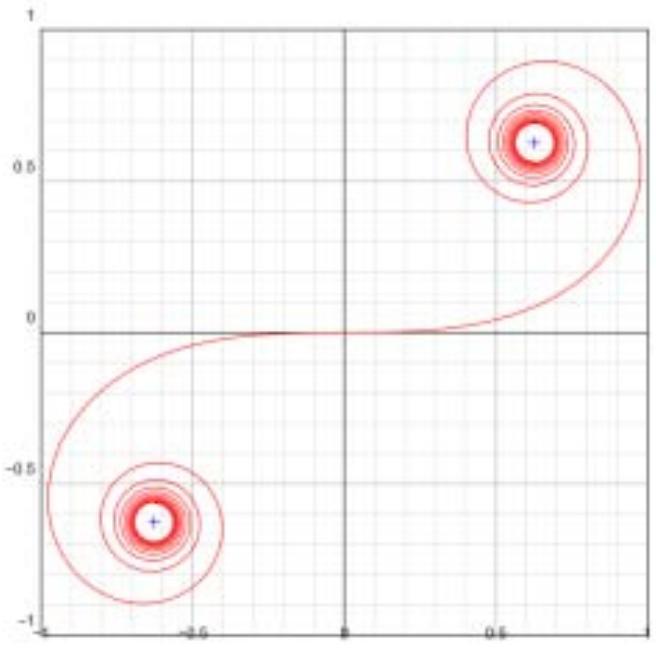
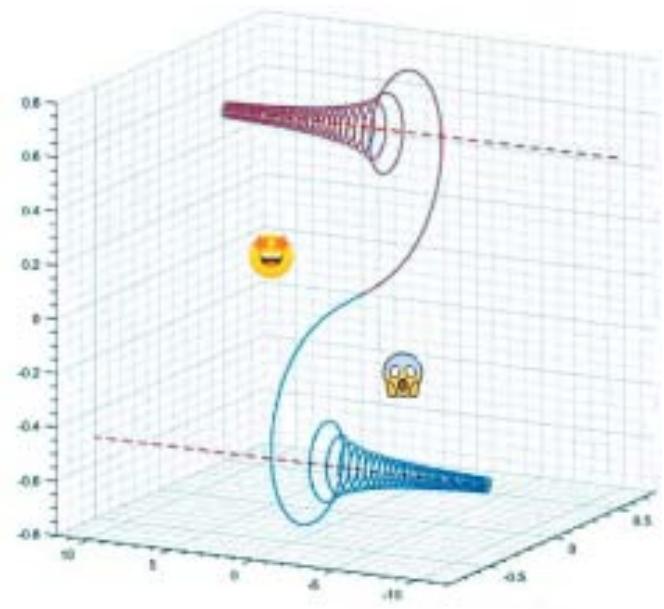 Fig. Euler spiral visualizations
See more complex examples of visualizations in the form of Chinese dragons, images of which have been part of Chinese culture since ancient times. The skins of various dragons represent the evolution of the Escalator and consist of basic constructs, i.e., triangles, squares. (https://en.wikipedia.org/wiki/Chinese_dragon).
The modeling problem can be solved by: building integrated partial models and their implementations; immediately developing a set of visualization templates, which requires determining a set of parameters and systematic experiments taking into account the comments of all stakeholders over a long period of time. Therefore, a relevant new problem is the development and maintenance of a Big Data database of comments. Example of Escalator visualization parameters: author, visualization adder people, system, AI or together; observation points (arrow, eyes, head, finger, etc.) with sets of metadata about their status quo, history; zoom visualizations; variability of Escalator representations with equivalent mathematical descriptions, for example, line-ribbon, layer-torus; adding sounds, gestures.
Mathematized Model of functional structure and digital content is proposed: < . Description of the model : < <communication (interaction)>
<assessment: answers> ...>>.Example of the model
: <metadata: keywords> , ...>.
Example. Formalized description of the Register: <context: lifelong learning> , :
...>; : ...>.Our arrow approach is based on determinism as a fundamental assumption, empiricism as a basic directive, experimentation as a basic strategy, repetition, the necessary requirement of reliability, parsimony as its conservative value, and philosophical doubt as its guiding conscience. It is implemented step by step, combining adaptation and digital transformation of scientific and technical solutions with sustainable value addition using an adapted Agile approach. Agile: is a way of thinking and philosophy, which corresponds to a set of approaches (Scrum, Kanban, XP, Lean) and management methods. Agile methodology is a project management framework that breaks projects down into several dynamic phases, commonly known as sprints. The Agile framework is an iterative methodology. After every sprint, teams reflect and look back to see if there was anything that could be improved so they can adjust their strategy for the next sprint (Agile. 2025).
3.8 Indicators of Project Scope
Register of entries and learning units: over 2,500 concepts, 3,000 AI tools, over 5,500 learning units associated with concepts and tools; Virtual website of the virtual organization of Project at least 2 million visits quarterly by servants (Given the social significance and number of people, the Community of Civil Servants was selected for our project); Evolutionary information base of Big data with current good practices, templates, patterns, samples, recommendations, revealed patterns and insights; Specialized online laboratories with projects of exemplary solutions of individuals in various contexts, situations and conditions. Registers of samples with reference sets of metadata; Strategy (plan) of further digital transformation determined on the basis of our Mathematical inheritance model (Manako, 2024). Register of BFS tasks.
IV. RESULTS AND DISCUSSION
The main result of our research and development, in our opinion, is the mathematization of an evolutionary science-based object, a long-term project, a tool for "Massive Deep Learning Throughout the Lifetime of Civil Servants" (from the point of view of basic disciplines such as mathematics, psychology, digital pedagogy, lifelong learning, linguistics, computer science, project management) in the form of an arrow approach and basic arrow models starting from the highest level of abstraction to the level of engineering implementations. See details II. OBJECTIVES: 2.1 About the objects of our research; 2.2 Problems; 2.3 Model of a learning-oriented Glossary; 2.4 Knowledge gap; 2.5 This study aim. III. Modeling Approach: 3.1 The conceptual idea; 3.2 Arrow criteria of evaluation; Common problem; 3.4 Hypothesis; 3.5 The Escalator Task Register model; 3.6 Arrow Strategy; 3.7 The arrow principles 3.8. Indicators of Project Scope IV. Results And Discussion: V. Conclusion.
Indicators of Project Scope: Register of entries and learning units: over 2,500 concepts, 3,000 AI tools, over 5,500 learning units associated with concepts and tools; Virtual website of the virtual organization of Project at least 2 million visits quarterly by servants (Given the social significance and number of people, the Community of Civil Servants was selected for our project). Evolutionary information base of big data with current good practices, templates, patterns, samples, recommendations, revealed patterns and insights; Specialized online laboratories with projects of exemplary solutions of individuals in various contexts, situations and conditions. Registers of samples with reference sets of metadata; Strategy (plan) of further digital transformation determined on the basis of our Mathematical inheritance model (Manako, 2024) Register of BFS tasks.
Questions for open commenting
A metaphor to improve understanding and explanation Content: "We can allow the future to happen or make an effort to imagine it. We can imagine it as dark or light - it depends on what it will be like" (David Gelertner, 2000).
a). . Question, problem. Consciousness science: where are we, where are we going, and what if we get there? Understanding consciousness is one of the most substantial challenges of 21st-century science and is urgent due to advances in AI and other technologies (Cleeremans, 2025). b). How to define and visualize a set of single arrows of an evolutionary entity object ? How do we define and visualize a set of single arrows ? For example, the basic metaphor is the evolutionary object . Are Escalator and Memo equivalent, congruent?
c). In arrow theories, abstract mathematical entities are considered real, and others are their meaningful interpretations. Do they exist independently, are they real, independent of us, or are they created by our brain for practice? How to prove the identity between X and Y - a description of X?. Examples of answers regarding understanding the difference: prove that X is an ideal analogue of Y and vice versa; catastrophe metaphor: the subject evaluates something and does not understand that his literacy and competencies are not enough to see the "White Crow" in X and Y. There are many research questions regarding the communication model. How to determine the context? How to determine and use the main language of the subject? How to determine and use the methods and tools of the subject? Is there no difference between X and Y if there is an algorithm that proves that all known information about X and Y is the same. Who, when, why, how best to define human-centric lifelong learning projects for target groups of individuals: AI; model, solution; patterns, samples from the system's Big Data database; external best practices? Other examples of natural language description of definitions of an object from different points of view. A mathematical object see definition and questions in (Sharma, 2024). The LTSC IEEE standard Metadata of an educational object defines (IEEE, 2020): an educational object, LO: Any entity, digital and non-digital, that can be used for learning, education or training. Psychological objects (Brock, 2015): these are the things that psychologists study. Some examples can be found by reviewing the contents of an introductory psychology textbook. These include perception, memory, learning, intelligence, personality, attitudes and motivation, and attitudes. The four main goals of psychology are to describe, explain, predict, and change or control the minds and behavior of others. As an interdisciplinary and multifaceted science, psychology includes a wide range of subfields, such as social behavior, human development, and cognitive functions. See more in the article History of Psychological Subjects. The eight different types of psychology include abnormal, biopsychology, cognitive, developmental, forensic, industrial-organizational, personality, and social psychology. Each field offers unique perspectives and practical applications in the real world.
As before, we believe in the power of our arrow theory....
V. CONCLUSION
In the era of digital transformation and AI, the relevance of solving the complex problem of the shift of "thinking and understanding" based on the integration of scientific achievements from various disciplines, in particular, in our scientific and practical arrow theory, which has been developing since the beginning of the 21st century, is increasing. The complex problem of understanding, explaining, predicting and controlling digital transformations and AI systems in order to promote the sustainable development of entities in conditions of increasingly rapid changes can be considered from different points of view, perspectives, goals, scientific and technological paradigms, theories, approaches, methods, using various information processing tools, procedures, tools, services, taking into account relevant international and national guiding documents.
The overall goal, the problem of our long-term research: How to better define and support the sustainable development of evolutionary science-based complex decision-making systems and the project "Virtual Laboratory of Exemplary Mass Deep Learning using AI in conditions of multilingualism, multiculturalism and the influence of increasingly rapid changes" (VLEDL1)? Integrated subsystems: Online research laboratories, training, training with simulators of situations and context, evolutionary database of Big Data on unique projects of persons. Each participant of VLEDL1 is a consumer and contributor, co-author of the entire project. We are interested in current research and projects with the participation of international and Ukrainian parties with our Scientific Council of experts - individuals, legal entities. The goal of this research was achieved on the basis of our arrow theory and the basic models. A model of metaphor management was built. Sustainable development of unique person centered projects in order to improve understanding and explanation of the essence of a complex system and project. Metaphors represent interactive visualizations of the evolution of personal project trajectories relative to planned results and measurable goals. Conceptual idea of building a model: to identify existing and imagined exemplary digital transformations and AI, practices of their application and to ensure their exchange over a long period of time to
The strategy for further digital transformation of VLEDL1 is determined on the basis of our Mathematized inheritance model and BFS Task Register. The strategy aims to: systematically and sustainably improve value, understanding, progress, accessibility, reliability, safety, efficiency, certainty and exemplary decision-making; assessed on the basis of a critical analysis of the status quo of the project, i.e., What and why it happened and what will happen and do in the future.
The main steps, goals of parent research: completion of the building of user interface models, commenting, testing, the Metadata Register; Creation and testing of the project website Demonstrator for civil servants' communities (vledl1.org).
The main outcome of the project will be people armed with digital literacy and 21st century competencies.
Conflict of Interest
The authors declare no conflict of interest.
Ethical Approval
Not applicable
Data Availability
The datasets used in this study are openly available at [repository link] and the source code is available on GitHub at [GitHub link].
Funding
This work did not receive any external funding.
Cite this article
Related Research

Special Issue
Launch a focused special issue to highlight research, emerging trends, and expert insights in your academic field.