


IntelliPaper
Abstract
In Russian nurseries, growth powders are widely used for rooting semi-lignified cuttings of coniferous crops. Due to the fact that the range of such powders is represented by preparations with only one concentration of the active substance (4 (indol-3-yl) butyric acid) - 5 g / l (0.5% IBA), a study was conducted on the possibility of diluting the preparations with talc and crushed charcoal using the Kornevin powder as an example. Semi-lignified cuttings of Juníperus sabína were used in the experiments; rooting was carried out under the conditions of installing low-pressure artificial fog with substrate heating. It was shown that the best option under the experimental conditions was the use of Kornevin-talc powder in a volume ratio of 1 to 1 to stimulate rooting. The rooting of the cuttings was 89.3%. Undiluted Kornevin had a phytotoxic effect, which caused a decrease in the survival rate from the values of the best option by 26%. The use of powders with a more significant dilution of Kornevin led to the appearance of signs of auxin deficiency in the stimulator. Thus, it was shown that for rooting cuttings of Juníperus sabína, powders with an IMC content of 0.25% are needed, which can be obtained by diluting Kornevin powder with talc or crushed charcoal. It was shown that when diluting growth powder, it is necessary to take into account that with the same degree of dilution (by powder volume), the hormonal properties of IMC decrease more intensively in options with crushed charcoal than talc.
Explore Digital Article Text
I. INTRODUCTION
Juníperus sabína L. is a creeping form of coniferous shrub, due to which it is an easily rooted coniferous crop. The survival rate of cuttings of many varieties without the use of rooting stimulants is 80-100% [1,2]. Despite this fact, nurseries use stimulation of root formation of this and other easily rooted species of coniferous crops in order to accelerate rhizogenesis and form a better root system, which reduces the time it takes to obtain rooted cuttings ready for transplantation [3,4,5]. There is also a justified need to use a stimulant when cuttings of such crops are prepared from aged - 10-15 year old mother plants [6].
At the same time, we must not forget that the unjustified use of rhizogenesis stimulants can lead to phytotoxicity up to the death of cuttings . Such data were obtained during rooting of Picea A. Dietr. , Thuja occidentalis , Juniperus sabina L. and Juniperus communis L. , and Juniperus x pfitzeriana. In this regard, it is necessary to select the optimal concentration of the stimulant for a specific crop, rooting conditions, age of mother plantings, and other factors . For example, when studying the range of IMC concentrations from 0 to 8 g/l in an alcohol solution when dipping the bases of Juníperus sabína L. cuttings for 5 seconds, the best concentration was 1 g/l IMC. Concentrations above 4 g/l IMC reduced rooting .
A method of stimulating the rooting of cuttings by dusting their bases with growth powder is widely used in Russian nurseries. With this method, there is no need to tie the cuttings into bundles, there is no need to subject the cuttings to additional soaking and storage, which can lead to infection with phytoparasitic organisms. This method is also widely used abroad and there is a whole range of growth powders with different concentrations of the active substance. For example, the line of powders produced by Rizopon (Netherlands) is represented by growth powders Chrysatop and Rizopon AA with an IMC content of 0.1%, 0.25%, 0.4%, 0.5%, 0.8%, 1%, 2%. On the Russian market, similar growth powders are represented by preparations containing only one concentration of the active substance - 5 g/kg IMC (0.5%, 4 (indol-3yl) butyric acid) [14]. In this regard, we conducted a study on the possibility of using Kornevin growth powder for rooting semi-lignified cuttings of Cossack juniper, including by diluting it to reduce the concentration of the active substance.
II. MATERIALS AND METHODS
The studies were conducted at the Vashutino production nursery of ornamental plants in a branch located in the city of Zubtsov, Tver Region. Semi-lignified cuttings of Cossack juniper (Juníperus sabína L.) were used in the studies. The cuttings were planted for rooting on April 30, 2022, in film gable cutting beds 0.6-0.9 m high, equipped with low-pressure fog and floor heating. The cutting beds were placed inside a film hangar greenhouse equipped with air heating and fine-droplet air cooling. Additionally, a shade made of white spunbond with a density of 60 g/m was installed under the roof of the greenhouse. The illumination range of the cuttings during the daytime was from 2000 to 15000 lux. The average switching mode of the fogging unit on sunny days was 5 seconds every 30 minutes; on cloudy days, the cuttings were sprayed once a day. Talc and charcoal crushed to a powder state were used to reduce the concentration of IMC in Kornevin. The ratio of the components during mixing was made by volume, since the density of crushed charcoal is two times lower than talc and Kornevin. According to the technological scheme, the cuttings were completely dipped in a solution of fundazole 5 g/10 liters, powdered with stimulants according to the manufacturer's recommendation and the adopted method [15]. The cuttings were planted in cassettes by sticking them into the substrate to a depth of 2-3 cm. The cuttings rooted without a stimulator served as a control. A mixture of slightly decomposed high-moor peat with a pH of 4.8-5.3 with preliminary application of Trichocin at a dose of 30 g/m and agroperlite of a fraction of 1-5 mm in a ratio of 2 parts peat to 1 part perlite 4-5 days before was used as a rooting substrate. The cassettes were placed in cutting boxes randomly among the production cassettes in seven replicates with 14 cuttings per replicate, a total of 784 cuttings. The experimental results were processed according to the dispersion analysis [16]. The cuttings were examined and the results of the study were calculated on the 188th day after planting the cuttings for rooting.
III. RESULTS OF THE STUDY AND THEIR DISCUSSION
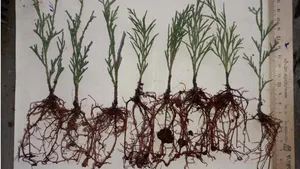
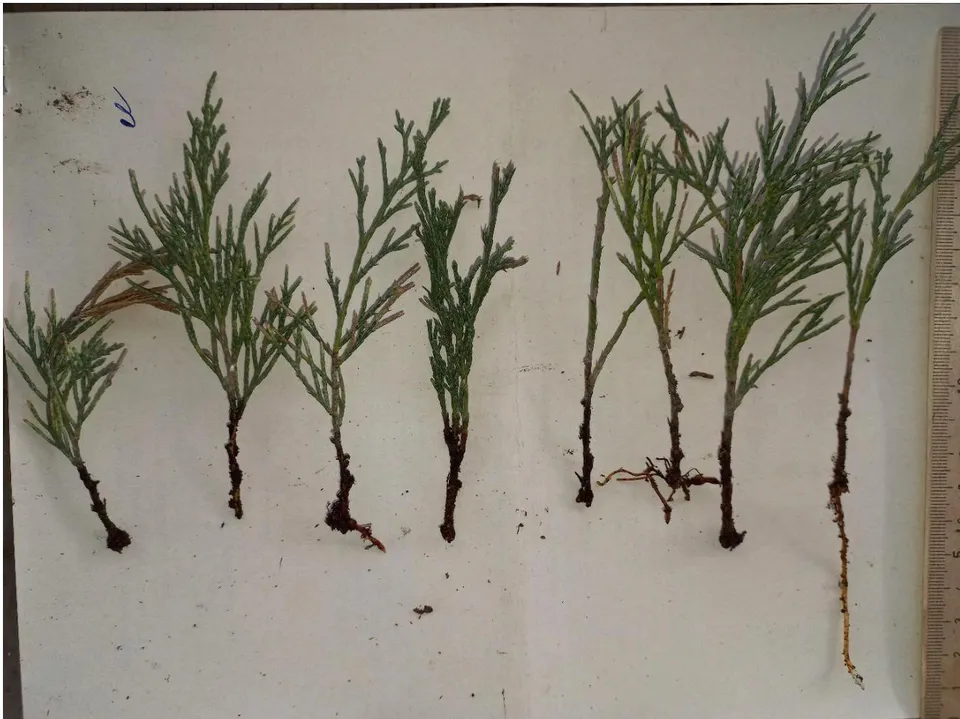
The rooting of cuttings in the control variant was 10.7%, the average number of roots per cutting was the lowest of all variants - 1.36 pcs, a large number of cuttings formed callus - 44.59%, the maximum value of all variants (Figure 1, 2). We assume that the low value of cuttings survival in the control variant for such an easily rooted crop as Cossack juniper is explained by the significant age of the mother plants.
{"image_source":{"path":"images/69e98820edd2513661e815b39323290bd9fe4119704dfec403614b5a7b5d0239.jpg"},"content":"","chart_caption":[],"chart_footnote":[]} {"image_source":{"path":"images/0ca545c267d5d0a50ede702db077c295886355805f997ca5dd1139f14dc3028a.jpg"},"content":"","chart_caption":[],"chart_footnote":[]}
{"image_source":{"path":"images/04b4b2f34be60c29406e6eb2aca5e8c123ff53463974d6558dceeac7d1c760df.jpg"},"content":"","chart_caption":[],"chart_footnote":[]} {"image_source":{"path":"images/0f8675db74eef16409b4166ba6ec0a7c01f11edf9742618ade8bd2b100e69a3f.jpg"},"content":"","chart_caption":[],"chart_footnote":[]}
{"image_source":{"path":"images/89b8b2a5491393835b938e0428d00075aaa22fa58eec97bf6c2575c02f041d67.jpg"},"content":"","chart_caption":[{"type":"text","content":"Figure 2: Changes in the rooting rates of semi-lignified cuttings of Juníperus sabína L. with a decrease in the IMC content in growth powders based on Kornevin. The age of mother plants is 8 years. Planting for rooting was on 30.04.2022, results were calculated on 04.11.2022."}],"chart_footnote":[]}
The use of Kornevin (0.5% IMC) gave a significant positive effect on rooting. The survival rate of cuttings increased by 6.17 times to 66.1%, the average number of roots per cutting increased by 6.8 times and amounted to 9.2 pcs. (Figure 3). As expected, this variant showed phytotoxicity of the stimulator, which was characterized by the appearance of a "rotten base" in the cuttings [7], the average value of which was 0.65 cm. Diluting Kornevin with talc by two times (IMC content 0.25%) reduced phytotoxicity and increased the number of rooted cuttings by 23.2%, the average length of the "rotten base" decreased by 1.8 times and amounted to 0.36 cm. A statistically significant increase in the number of rooted cuttings after diluting Kornevin proves its phytotoxicity for the studied crop in its pure form. The obtained data show that 26% of the cuttings of the Kornevin:talc (1:1) variant could have died if undiluted Kornevin had been used.
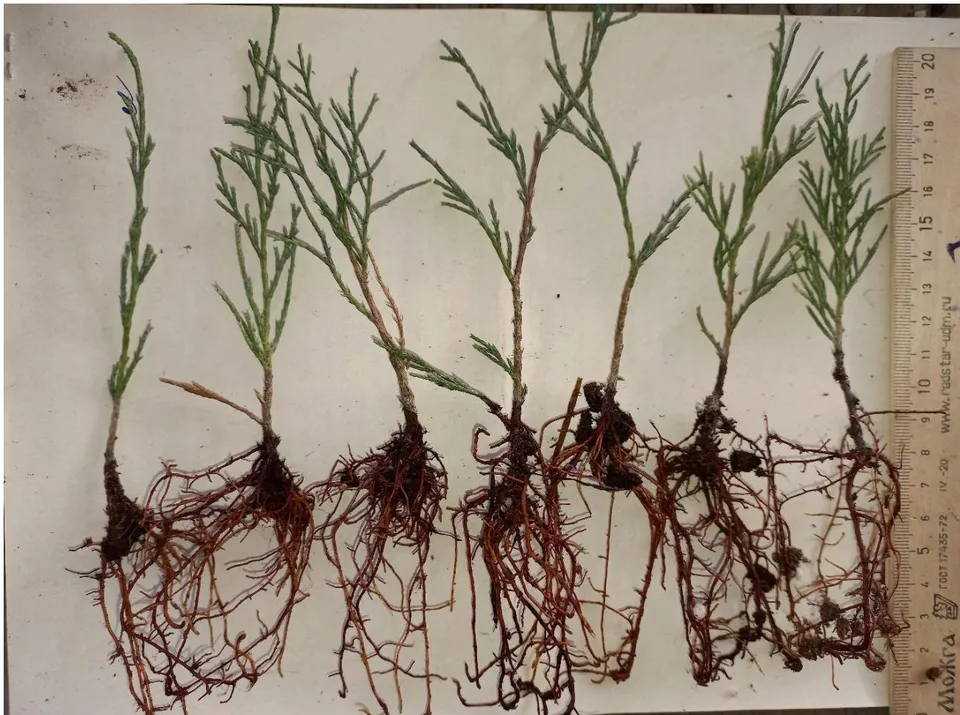
In the Kornevin:talc (1:2) variant, the IMC concentration was 0.17%, rooting decreased to 73.2%, the average number of roots decreased to 7.2 pcs., the average length of the rotten base and the length of the root zone decreased to 0.16 cm and 1.46 cm, respectively. The appearance of cuttings with callus (5.6%) in the Kornevin:talc (1:2) variant indicates a transition of the IMC concentration in the stimulator from excess to deficiency [5]. The presence of cuttings with callus (auxin deficiency) and a small proportion of cuttings with a "rotten base" (auxin excess) can be explained both by the different quality of cuttings with different endogenous auxin status, and by the error of the dusting method itself, when different amounts of powder fall on the cuttings.
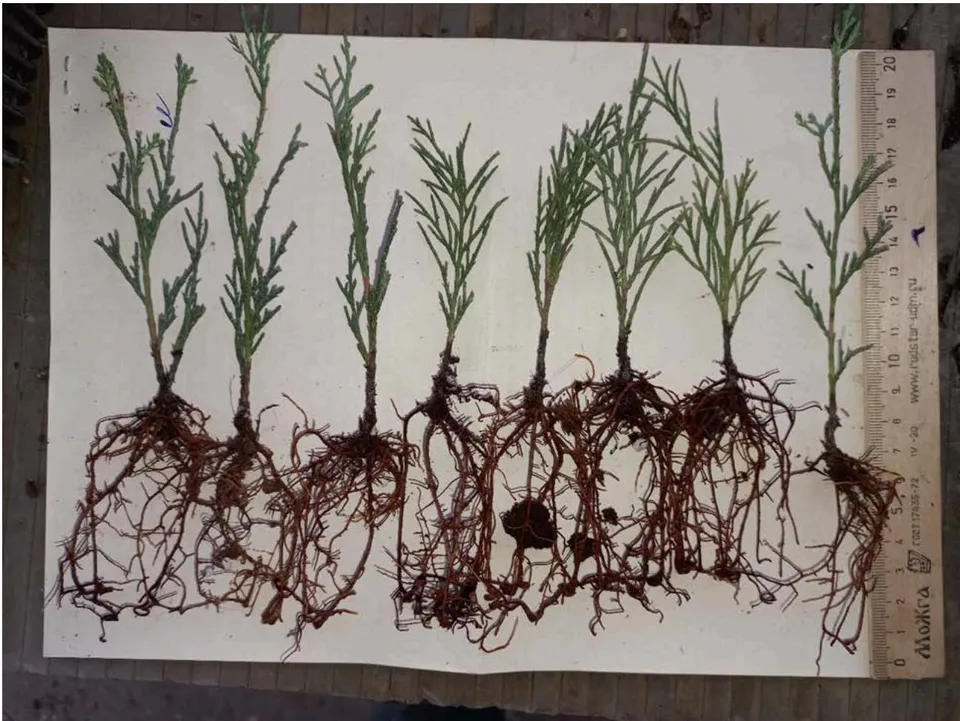
The Kornevin:talc (1:3) variant containing 0.125% IMC showed a further decrease in rooting rates, and phytotoxicity ceased to be observed. Thus, the percentage of rooting of cuttings decreased by another 17.8% from the previous variant and amounted to 55.4%, the average number of roots decreased to 3.6 pcs. The average length of the root zone decreased by 6.6 times compared to the previous variant to 0.22 cm and began to tend to zero values of the control variant. The average length of the "rotten base" (a sign of phytotoxicity) decreased to zero values - to 0.09 cm, which is within the statistical error compared to the control variant. Callus formation, on the contrary, increased significantly - to 27.4%, which indicates an increase in the lack of auxin in the regulator. Thus, the best option in the series of studied powders Kornevin - Kornevin:talc was the option Kornevin:talc (1:1) with a rooting level of 89.3%.
For the dilution of Kornevin, charcoal ground into powder was also used. Since its density is two times less than that of Kornevin and talc, the dilution was done by volume. It is clear from the diagrams that when diluted with charcoal, the values of the rooting parameters change significantly towards a decrease in the concentration of IMC compared to the dilution of Kornevin with talc. Thus, the indicators of the Kornevin:charcoal (1:1) option are close in their values to the Kornevin:talc (1:2) option, and the indicators of the Kornevin:charcoal (1:2) option to the Kornevin:talc (1:3) option. A stronger decrease in the effect of the regulator at the same dilution in charcoal can occur due to the adsorption of part of the active substance and due to a change in the physical properties of the adhesion of the modified powder to the cutting. Conclusions.
When propagating the Cossack juniper, it is necessary to use growth powders with an IMC concentration of 2.5 g/kg (0.25%).
To obtain growth powders with a content of 0.25% IMC, it is necessary to modify Russian-made growth powders such as Kornevin(0.5% IMC)by diluting them with talc or crushed charcoal. When diluting the growth powder, it is necessary to take into account that with the same degree of dilution (by powder volume), the hormonal properties of IMC decrease more intensively in variants with crushed charcoal. For specific rooting conditions, it is necessary to inspect the cuttings in order to identify signs of deficiency or phytotoxicity of the auxin concentration in the growth powder used for its correction using the proposed modification method.
Conflict of Interest
The authors declare no conflict of interest.
Ethical Approval
Not applicable
Data Availability
The datasets used in this study are openly available at [repository link] and the source code is available on GitHub at [GitHub link].
Funding
This work did not receive any external funding.
References
Cite this article
Related Research

Special Issue
Launch a focused special issue to highlight research, emerging trends, and expert insights in your academic field.