



Abstract
Transients of large power steam turbines with the single capacity of 250-300 MW and more should be run based mainly on the unsteady thermal-stress state of the high-temperature rotors monitored with the use of mathematical modeling by means of computing techniques at disposal under power plant’s real operational conditions. The problem was articulated and practical work started about half a century ago.
Explore Digital Article Text
Monitoring Unsteady Thermal-Stress State of Large Power Steam Turbines based on Mathematical Modeling – Semi-Centennial
Dr. Alexander S. Leyzerovich
ANNOTATION
Transients of large power steam turbines with the single capacity of 250-300 MW and more should be run based mainly on the unsteady thermal-stress state of the high-temperature rotors monitored with the use of mathematical modeling by means of computing techniques at disposal under power plant's real operational conditions. The problem was articulated and practical work started about half a century ago.
Reasonable is to apply the same approach (as to the rotors) to monitoring unsteady thermal-stress state of the HP valve steam-chests what is especially essential for supercritical- and ultra-supercritical-pressure turbines. Special field studies as well as long-term practice of operation have confirmed that introducing operational monitoring of non-stationary temperature and thermal-stress states of the turbine at the transients makes it possible to identify operator errors that usually remain unnoticed with the traditional approach, creates conditions for improving the quality of operation and extending the turbine service life. The quality of monitoring based on mathematical modeling to a large extent depends on reliability and representativeness of primary heating steam temperature measurements. It should be expected that in the nearest future under conditions of commissioning dominantly energy producers on renewable sources and the unresolved problem of accumulating the excess and covering the deficit of produced energy, a significant part of large fossil-fuel steam-turbine power units will be forced to operate in cyclic and standby modes what retains the actuality of the considered problem.
In these years of the early 2020s we could celebrate a semi-centennial anniversary of a kind of revolution in our views on running, controlling and monitoring large steam turbines at their transients, even though even nowadays the sense and results of this revolution are hardly completely accepted, as well as comprehended, learnt, employed and deployed.
What Was New? With raising the rated output of power steam turbines, the radial dimensions of their rotors enlarge too and for turbines with the single capacity of over 250-300 MW the unsteady thermal stresses in the rotors of the high temperature high-pressure (HP) and intermediate pressure (IP) or integrated HP-IP cylinders become the main factor limiting the rate of turbine transients: start-ups, shut-downs, load changes within the governed range, and so on.
Hence, the transients should be scheduled and run based on unsteady thermal stresses arising in the high-temperature rotors. Repeated, cycling action of these stresses is fraught with low-cycle fatigue cracking, especially in the case of inadequate quality of operation. These principal propositions have been generally recognized and articulated, and this understanding fundamentally changed our approach to the steam turbine transients—their pre-operating scheduling and setting, operational control and surveillance, as well as post-operating analysis .
In order to run the transients or follow up their automatic or automated control, the operator should be provided with feedback, that is, should have a possibility of monitoring the indices of unsteady thermal-stress state of the rotors just like for steam turbines of less capacity the operators have monitored temperature differences across the thickness of the most massive high-temperature casing elements. Since the direct, immediate thermometry of the turbine rotors for operating purposes is too laborious and unreliable, it should be substituted for modeling.
For the HP and IP or HP-IP rotors, their maximum thermal stresses take place on the outside, heated surface nearby the steam admission zone and can be characterized by so called "effective" metal temperature difference: of the heated surface in the most stressed section and the average integral metal temperature in the
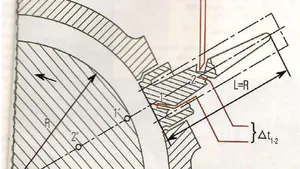
Some History. In the mid-1960s up to the early 1970s, in the absence of any computational techniques with sufficient experience of usage at power plants, it was unreal to use mathematical models of rotors in the operating purposes, and for the time being these mathematical models were substituted for physical ones. So, some large steam turbine producers, primarily Brown Boveri (aka BBC, then ABB, ABB Alstom and, finally, Alstom Power, which in 2015 merge in GE), Siemens (aka Kraftwerk Union AG) and Škoda, provided high-temperature cylinders of their large power steam turbines with so-called "thermometric probes" installed within the cylinder's intercasing space [7-10]. Such a probe
![Fig. 1: Schematic of a thermometric probe used to model physically the rotor metal temperature state [8, 9]](https://doc.journalspress.com/lxeq89_85502/ocr/images/derivatives/e4/e45e1d333af0cdc20343aebb88ea2aa96db39c53b818ae406c17f34bd4d4d7ac.webp)
as if imitates physically a sector of the rotor, and its butt-end is heated with the same steam flow that sweeps the rotor surface near the considered section. The use of differential iron-constantan thermocouples enables measuring directly the temperature difference between the probe's butt-end and mid-length that is believed to be close to the actual "effective" temperature difference in the rotor to be monitored.
This proxy method has several serious shortcomings. The main of them is that the true heat transfer conditions from steam to the rotor surface differ significantly from those for heated surfaces of stator pieces, including butt-end of the probe. As a result, the probe's butt-end surface temperature permanently lags behind variations of the actual surface temperature of the rotor, and the temperature difference measured in the probe occurs to be essentially less than the rotor's actual "effective" temperature difference to be monitored, more inertial and less sensitive to heating steam temperature excursions. Another immanent drawback is that heat fluxes from the probe's side surface can also produce essential methodical errors in modeling. What is more, it's not so easy to accommodate a probe in the narrow and crowded intercasing space of the turbine –
![Fig. 2: Longitudinal section of the integrated HP-IP cylinder of 600-MW supercritical-pressure steam turbine of ABB (US power plant Cardinal) with a thermometric probe for the HP part of the rotor [10]](https://doc.journalspress.com/lxeq89_85502/ocr/images/derivatives/91/9112a4f9ee129036daecb97258dc5b5971a4ed6037eab8b1584b8e2863a2fce0.webp)
Adequate mathematical models materialized by means of analogous or digital computing techniques do not have these shortcomings. Even a quite simple, prototypical mathematical model shown in
![Fig. 3: Functional block-chart of a prototypical analogous model for monitoring the unsteady temperature and thermal-stress state of a turbine rotor [7, 8, 12, 13] 1 – heating steam temperature sensor, 2–steam pressure sensor, 3 and 4–unifying converters, 5–inlet adder, 6 – non-linear converter, 7 – multiplier, 8 – integrator, 9 – first order elements, 10 - multipoint recorder provides the divergences between the actual (precisely calculated or gotten by means of experimental immediate thermometry) and monitored radial temperature differences making up not more than 10-13% what is quite acceptable for operational purposes [11-13]. Such a mathematical model did serve as a basis for analogous electronic devices for monitoring unsteady thermal-stress states of the HP and IP rotors as applied to widespread in the former USSR supercritical-pressure steam turbines with the output of 300 MW of two different types - produced by Leningrad Metallic Works (LMZ) and Kharkov Turbine-Generator Works (KhTGZ).](https://doc.journalspress.com/lxeq89_85502/ocr/images/derivatives/b1/b15f5c4ecabe3d23f8ae2b26849fba5612525108efa44f605c7464ada9597c41.webp)
A pilot serial sample of such a device passed field tests in 1976-1977 at the HP cylinder of a 300-MW LMZ steam turbine with comparing its outputs with results of experimental immediate thermometry of the same rotor at the same transients fulfilled by the turbine manufacturer [13]. Some samples of such devices had been successfully employed and used at power plants for over 25 years [14].
The mathematical model shown in Fig. 3 is built using the method of approximate transfer functions [8, 11-13]. Values of the time constants , , and amplification factors , of the model links are determined by the radial dimensions of the selected, most thermally stressed section of the rotor and the thermophysical properties of the rotor steel. The main problem of materializing this and similar models using analog technique has been the need to reproduce large time constants for rotors with a large shaft diameter (for example, for the forged double-flow IP rotor of 800-MW LMZ turbine sec, sec and sec [11-13]).
Because the heat flow from steam to the rotor surface and further along the rotor's radius is much more intense than the heat fluxes by thermal conductivity through the rotor body in the axial direction, the use of a one-dimensional model is believed to be quite justified. The model itself consists of the integrator and few first order elements connected in parallel and closed with the negative feedback. Their outputs are just the variables to be monitored: the average integral
difference for the considered section. These variables, together with the input ones, are brought to a multipoint recorder. The model's inputs are fed with the normalized (unified) measured signals from the sensors of the heating steam temperature (at the HP control stage or in the IP steam admission chamber) and steam pressure p as an indicator of the steam flow amounts through the turbine cylinders. The output signal of the inlet adder corresponds to the temperature difference between heating steam and the heated rotor surface. Multiplied by the value of Biot number Bi (dimensionless heat transfer coefficient), it turns into the heat flow Q in the units of temperature. A non-linear converter materializes the dependence , which approximates results of calculating the heat transfer coefficients on the rotor surface at the considered section with the use of well-known criteria equations [7, 8]. The initial (pre-start) rotor metal temperature (before steam enters the cylinder) is accepted as following up the temperature measured by the thermocouple for the heating steam temperature . So, if the measured value of steam pressure p within the cylinder is less than its set minimum value, the converter brings the signal equal to the maximum value of Bi to the multiplier.
Appearance of microprocessor-based freely programmable controllers (so called REMICONTTM) made it possible to extend the gotten experience to other turbine types (in particular, supercritical-pressure 800 MW turbines of LMZ) and raise the accuracy of modeling due to some complications of the applied models [12-14]. In particular, the advanced model took into consideration the dependence of the metal thermal diffusivity on the metal temperature, as well as the influence of the turbine rotation speed on the heat transfer conditions on the rotating surfaces. The rotation speed signal was also employed for more precise identification of the instance when steam enters the cylinder, and before this instance the rotor temperature was taken equal to the regularly measured metal temperature of the cylinder's casing. Possibility of varying freely the model's scheme made it also possible to reproduce different for diverse turbine types correlations between the measured steam temperature(s) at the IP entrance and heating steam temperature for the most stressed IP rotor section following results of special measurements in the process of field tests [8].
The widespread use of computer-based Data Acquisition Systems (DASs) at power plants made it possible to attract computers to solution of the set task – on-line monitoring the thermal-stress state of the steam turbine rotors. This task can also be considered with more general statements of the problem – as a part of a computerized system of complex diagnostic monitoring for the power plant unit as a whole or a local subsystem of diagnostic monitoring for the turbine, or a system of informative support for the operator at the turbine transients, and so on. Such systems can be arranged based on the "common" computer(s) of the unit's or the plant's DAS or with the use of an additional PC connected to the DAS' database or directly (via unified transformers) to the turbine measurements .
With transition to the use of digital computing techniques, it seems advisable to employ mathematical models based on the finite difference method (preferably in its simpler explicit form) rather than the aforesaid method of approximate transition functions [11, 12]. The former gives even more freedom for taking into consideration different factors influencing the model's accuracy. For monitoring the temperature and thermal-stress state of the HP and IP rotors of diverse steam turbine types as applied to the aforesaid systems and subsystems, it has been believed reasonable to develop and use a united calculation algorithmic module named "CONTUR"-common for various large power steam turbines and for diverse types of computing means and complexes, as well as diverse program systems and computer languages [8, 12-16]. The algorithm is adapted to the specific turbine type by setting the "key" input constants, including the radial sizes of the HP and IP rotors, the dependences of the metal's thermal diffusivity on the metal temperature and heat transfer conditions for the considered rotor sections on the rotation speed n and steam pressure p within the turbine Bi (n, p), as well as correlation characteristics for the heating steam temperatures as applied to the HP and IP rotors and steam temperatures available for measuring, the values of n and p indicating steam entering the turbine, the way of setting the rotors' metal temperatures at the stopped turbine, the addresses of the measured input and calculated output variables in the data base.
Monitoring thermal-stress state of the HP valve steam-chests with the use of mathematical models. In just the same way as for the HP and IP rotors, similar mathematical models can be applied to temperature monitoring some turbine stator elements if they turn out to be "critical" in some pieces of transients along with the high-temperature rotors. This mainly refers to the HP stop-valve steam-chests. Commonly, their thermal-stress state is characterized by the temperature difference across the wall thickness (sometimes with some correction for the metal temperature unevenness in the axial direction, that is along the wall height ). It presupposes drilling the steam-chest wall especially for measuring the metal temperature directly on the heated surface or within its immediate vicinity, what is equally undesirable because lowers the steam-chest wall strength. The alternative is to calculate on-line the metal temperature distribution across the wall thickness with the use of a sufficiently accurate even though quite simple mathematical model, regularly measured steam temperatures before the HP stop-valves and metal temperatures on the external, thermally insulated surfaces of the valve steam-chests. The main problem is to set the heat transfer conditions from steam to the inner steam-chest surface depending on the steam flow through the valve. The required dimensionless equation for sufficiently widespread design types of the HP valve steam-chests was gotten based on processing results of special field tests [7, 8, 13, 14]. It's also necessary to find an approximate empiric dependence between the steam flow amounts through the HP valves, steam pressure before the HP stop-valves and within the turbine, vacuum in the condenser, rotation speed and its acceleration while rolling up, etc.
Results of monitoring. As shown in Fig. 3, the input and output data of the models employed for monitoring the thermal-stress state of the turbine rotors, their change in time during the turbine transients may be brought on regular multipoint recorders. These data are to be used on-line by the operator for running the turbine transients, and the same diagrams are used by the power plant engineers for post-operative analysis and evaluation of the operation quality [8, 14, 17].
With the use of computerized DAS, operative information is presented in the most convenient for the operator graphic forms on the monitor(s) on the operator request, and the stored data are intended for post-operative analysis, including estimations of thermal fatigue of the rotor metal caused by the transients .
The first experience of using analogous electronic and microprocessor-based mathematical models of the turbine rotors at the 300-MW power units revealed serious errors in the practice of operation. By that time, many of 300-MW supercritical units were operated under conditions of regular shut-downs for week-ends and nights with subsequent "warm" or "hot" start-ups and/or deep unloading within the limits of the governed range in the week-day evenings with subsequent raising the load up to the rated value in the morning. With regard to this circumstance and on agreement with the turbine manufacturers, the admissible ranges of varying the "effective" temperature differences in the rotors were set equal: as applied to the HP rotors for start-ups – from +25 °C to -20 °C and within ±20 °C for load changes within the governed range and as applied to the IP rotors correspondingly - from +40 °C to -25 °C and within ±25 °C [7, 8, 13].
Actual values of the monitored temperature differences in certain cases remarkably and repeatedly exceeded these limits, and it required hard work with the power plant's operational personnel, including post-operative analysis of monitoring results and correcting, if necessary, the power plant's operation manuals. Such work resulted in substantial reduction of a number and depth of violations for the set temperature difference resulted in essential violations of the set limits for the rotors. Introduction of such monitoring accompanied with special training the power plant's operational personnel makes it possible to avoid operative errors in running the transients without sacrifice of turbine flexibility or at least make these errors less frequent and influential - {"image_source":{"path":"images/3caa87c07a85cd4a11fdbbf68af5eeeabcafe19f2da35e575dfc1f5c70c99cc0.jpg"},"content":"","chart_caption":[{"type":"text","content":"Fig. 4: Results of monitoring temperature and thermal-stress states of the HP and IP rotors of 300-MW supercritical-pressure steam turbine of LMZ for a regular "warm" start-up after a week-end outage [8.9]"}],"chart_footnote":[]}
{"image_source":{"path":"images/f5b7224726a5db172f2af785b5e2726d293e34459508d63ff06e5f75d4dc948c.jpg"},"content":"","chart_caption":[],"chart_footnote":[]} {"image_source":{"path":"images/c559966ddaea3d8e38912422af33f74b06f78aca24a7af75e0ab5b2c06120edf.jpg"},"content":"","chart_caption":[{"type":"text","content":"Fig. 5: Fragments of a regular diagram with recorded results of monitoring the HP and IP rotors of 300-MW supercritical-pressure steam turbine of LMZ at start-up after week-end outage (a) and daily changes of the load (b) [18]"}],"chart_footnote":[]}
Recorded variables: 1 and 2 – steam temperature and pressure at the HP control stage, 7 and 8 – steam temperature and pressure in the IP steam admission chamber, 3 and 9 – average integral metal temperatures of the HP and IP rotors in the most stressed sections, 4 and 10 – effective radial temperature differences in the most stressed sections of the HP and IP rotors
Notes on the diagram: - instruction schedule of loading, A - giving steam into the HP cylinder for raising the rotation speed up to 900 rpm with closed IP intercept valves, B – end of heating up the reheat steam-lines and giving steam into the IP cylinder with raising the rotation speed up to 3000 rpm, C – connecting the generator to the grid with closing the turbine bypass, accepting the initial load, and opening the bypass valve of the boiler's steam reheater
[18]. Therewith, all the monitored indices of the turbine's temperature and thermal-stress states, including "effective" temperature differences in the HP and IP rotors, do not exceed their limits.
Recorded data of long-term monitoring the unsteady thermal-stress state of the supercritical 300-MW sister turbines at several power plants were used to calculate specific rotor metal lifetime expenditures caused by low-cycle (thermal) fatigue. These calculations were carried out together with Prof. A.D. Trukhny of the Moscow Power Engineering Institute (Technical University) and following his methodology [19, 20]. At some of the mentioned power plants, the transients were run practically without regard to thermal-stress monitoring of the rotors, whereas at others the transients were attentively controlled with the feedback of the monitored and recorded data. The results of aforesaid calculations (see Table) show that in the first case the values of specific low-cycle fatigue are up to two orders of magnitude greater than in the second case. It's also important to note that, without monitoring the rotors, the plant's operators and engineers usually were not able to recognize and prevent the operational errors that caused undesirable heating steam temperature excursions, inadmissible thermal stresses in the rotors, and resultant increased lifetime expenditures. With on-line thermal-stress monitoring of rotors, the turbine transients are endured with greater load change rates, lower fuel losses and turbine lifetime expenditures.
| Cycles of transients and the way of running them | HP rotor | IP rotor |
| Shut-down for weekend (48-54 h) and subsequent warm start-up- without mandatory monitoring the rotors- with mandatory monitoring the rotors | 0,065 ÷ 0,1300,0025 ÷ 0,005 | 0,20 ÷ 0,810,06 ÷ 0,10 |
| Shut-down for night (6-8 h) and subsequent hot start-up- without mandatory monitoring the rotors- with mandatory monitoring the rotors | 0,1÷ 0,50,0025 ÷ 0,05 | 0,20 ÷ 0,350,05 ÷ 0,08 |
| Load changes within the governed range- under sliding main steam pressure- under constant main steam pressure | 0,0020,01 | 0,00250,0025 |
Main obstacles for widespread use of monitoring the unsteady thermal-stress state of the turbine rotors based on their mathematical modeling. In consequence of more intense heat transfer conditions from heating steam to the heated rotating surfaces as compared to casing components being more inertial in its heating up process, requirements to the quality of running the turbine transients based on monitoring the thermal-stress state of the rotors are remarkably higher and conversion to running the transients in such a way at once brought to exposure of numerous operational errors that earlier remained unnoticed or at least were considered insignificant, required to change some habitual stereotypes in operation. It's quite natural that such a conversion was met with certain distrust, psychological resistance and required some special training for not only the operational personnel but also for the power plant's engineers and authorities. Where such training did not take place, introducing the new approaches to running the transients was ignored or bore rather formal character.
But the most serious, objective obstacle has been a problem with measuring the heating steam temperatures, especially for the HP rotors. Unfortunately, in the operation practice there repeatedly happened breakdowns of protective heads of these thermocouples with necessity to stop the turbine. That is why turbine producers often prefer to waive these measurements.
As to the heating steam for the IP rotor, it can be accepted equal to the measured steam temperature at the IP section inlet (within the steam admission sleeves) with some calculated static and dynamic corrections depending on the steam flow amount through the IP section (in particularly, such special researches were carried out on the IP cylinder of 800-MW supercritical-pressure steam turbine of LMZ [21]). Unfortunately, such an approach is not suitable for the HP sections, especially if the turbine is operated with nozzle-group control.
So, for computing devices called Turbine Stress Evaluator and Turbine Stress Controller of Siemens as constituents of its automatic monitoring and control system the measured temperature on the heated surface of the probe installed into the cylinder casing is considered to be representative for the rotor heated surface, and the temperature difference characterizing the rotor's thermal-stress state is calculated based on this temperature. As it was noticed above, such a solution causes a significant error. As applied to another specialized computing device called "Tensomax" developed by ABB for retrofitting steam turbines without measuring the steam temperature in the HP steam admission chamber, the heating steam temperature and heat transfer conditions to the heated surface in the most stressed section to be monitored are calculated based on the available steam temperature and pressure measurements inside a nearest interim chamber in the casing or at the casing outlet [17, 24, 25]. It's needless to say that such an approach is also fraught with remarkable errors in monitoring. It would be desirable to arrange more reliable measurement of the heating steam temperature at the HP cylinder's entrance. Without reliable and representative heating steam temperature measurements, it's a vain hope to achieve representative monitoring.
What's ahead? Nowadays, the modern power industry is characterized by a dominant growth in the installed capacity of electricity producers from renewable sources - solar and wind power plants with significantly lower values of their capacity utilization factors compared to nuclear and fossil-fuel power plants as a result of uncontrolled, predictable or completely stochastic daily and seasonal changes in electricity generation. Under these conditions, with insufficient development of compensating systems for accumulating surpluses and filling the deficit in electricity production, it is almost inevitable that many fossil-fuel and possibly some nuclear power plants, will shift to work in a cyclic and stand-by modes [26]. This will make the temperature and thermal-stress state monitoring of large steam turbines based on mathematical modeling especially urgent.
It could also be said that monitoring the thermal-stress state of large power steam turbines based on mathematical modeling can be considered the first step in digitalizing fossil-fuel power plants of the next generation and their operation. General Electric, being with its Predix cloud-based platform an initiator and a clear leader of this movement, takes aim at creating "a digital twin of the physical steam plant that is continuously monitored in real time..." [27].
Therewith, the author declares that "today's power plant operators are only reading approximately 2% of the available data we have from typically more than 10,000 sensors on control systems across the plant. By analyzing the other 98% of the data and really optimizing whole plant operations..., efficiency and flexibility can be significantly improved". To tell the truth, I'm not sure that these 10,000 measurements will be really necessary and even involved in solution of the set problems. Rather part of them may be useful for complex technical diagnostics and prognostics of the power units, planning their maintenance and overhauls based on their current state, scheduling their most efficient operating conditions, and so on. At least as applied to the power unit's flexibility this problem should be solved with the use of complex mathematical models and indices which cannot be built and perceived by human beings as power plant operators. And it is not so substantial which techniques is processing the measured data – of importance is if these measured data are reliable and representative as well as the used mathematical models.
General Electric with good reasons considers the aims of digitalization as applied to the next generation of coal-fired steam-turbine-based power units with ultra-supercritical steam conditions (a coal power technology called SteamH). As the prototype under consideration is the power unit already in operation - 912-MW RDK8 (Karlsruhe, Germany) for steam parameters of 275 bar, 600/620 °C (the boiler and turbine were produced by Alstom [28]), as well as a similar to it Manjung 4 in Malaysia. It may be definitely said that the transients of such units are predominately limited by thermal stresses in the HP rotor, as well as in the steam admission zone of the double-flow IP rotor at start-ups and in the HP stop-valve steam-chests at pre-start heating up and rolling up the turbine.
The thermal-stress states of all these turbine components should be monitored based on their mathematical models with the use of maybe cloud-based platform.
Conflict of Interest
The authors declare no conflict of interest.
Ethical Approval
Not applicable
Data Availability
The datasets used in this study are openly available at [repository link] and the source code is available on GitHub at [GitHub link].
Funding
This work did not receive any external funding.
References
Cite this article
Related Research

Special Issue
Launch a focused special issue to highlight research, emerging trends, and expert insights in your academic field.