

Abstract
“Newton’s Dynamic Laws” are concerned with the motion of bodies in orbits. Newton has published his Laws in 1684, [1], and expanded this work into later editions [2]. This work was written in Latin but it was translated in many versions in English, e.g. [3]. Because of his revolutionary ideas and his mastery of geometry, his work was not largely amenable to a great sector of scientists and physicists. Several attempts, e.g. [4]-[5] were made to simplify and clarify these laws. Modern derivations may be found in e.g. [6].
Explore Digital Article Text
I. DYNAMIC LAWS DERIVATION
This note summarizes Newton's derivation for the planetary dynamics. I have followed [5] very closely and stripped it of all historical notes for convenience. Newton's goal, in particular, was to find out the nature of the centripetal force that causes the planet to revolve around the Sun in an elliptical orbit. He argued that, without any external influence, the planet will move in straight line at constant velocity. It is this force that imparts acceleration to the body to make it adhere to orbit.
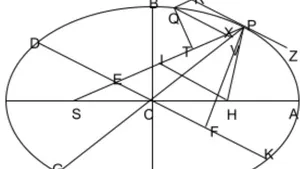
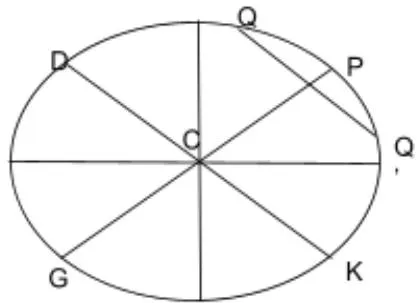
The following figure depicts the needed graphics for analysis. It looks very crowded but just in one figure it depicts all the essential parameters and the variables of our problem.
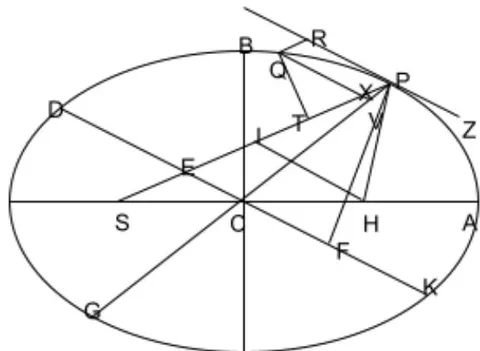
It shows the Sun, S, resides at one focus of the ellipse. The planet P moves along the elliptical curve APQ, the tangent at P is ZPR, and the centripetal force is along PS. Newton explains that at point P, if the force vanishes, the planet will move along the tangent to R. It is the centripetal force that will move R back to Q on the ellipse.
From Galileo's experiments, a body under the influence of central force will travel a distance proportional to the acceleration times the square of the traveled time. Conversely in time, , this acceleration, is proportional to , divided by .
Meanwhile, for any centripetal force, Newton proved that the line of force sweeps equal areas in equal times. This allowed him to describe the time geometrically by an area proportional to the time. That is . Therefore, the acceleration is given by
1. Newton's lemma:
Proof is given in Appendix A.
- and are similar, hence
- Apollonius: Prop 15, Book1
Aside from the proofs given in [7], Appendix B provides a little simple proof.
4. The shape QRPX is quadrilateral,
Thus, the last four equations yield,
5. Apollonius: Prop 31, Book7
Proof is given in Appendix C.
- and are similar, hence
Substituting from Eqs. (1.2) and (1.7) into (1.8) gives
Now, Eqs. (1.6) and (1.9) yield
In the limit Q approaches P. Consequently V and X will approach P. That is
Using the above equation in Eq. (1.10) gives
Here, is the latus rectum of the ellipse. Finally, Eq. (1.1) results in,
In words, the centripetal force is inversely proportional to the Sun/Planet radius squared.
Kepler's Third Law
Newton then gave a proof to Kepler's third law – the orbit's period is proportional to one and half the power of the ellipse major axis diameter. Herein, we provide a proof that is a little variant from Newton's.
Newton has shown that for any centripetal force, a planet will sweep an area proportional to time. Thus from the diagram, the area swept for the infinitesimal time, , is
\begin{array}{l} \text {Swept area in \delta t = SP\cdot QT\Rightarrow} \\\text {rate of Swept area = SP\cdot QT / \delta t} \end{array}\tag{1.14}Since ellipse area = π · CB · AC, then the time period T is
Squaring each side of Eq. (1.15) yields,
Substituting for QT from Eq.(1.12) into the above gives
Since , the above can be simplified to
Equation (1.13) implies and therefore, makes (1.18)
That is the orbit's period squared is proportional to the cube of the ellipse semi axis diameter.
Appendix A
Newton's Lemma
Proof: is the foci of the ellipse from which we draw parallel to . Ellipse reflection property, [8], states . Therefore, . Hence is equal sided triangle and .
Moreover:
Since HI parallel to RPZ and thus to DK and since SC=CH, then SE=EI. Therefore
or,
Chord Bisector
Apollonius Proposition 15
The eccentric circle is that one that shares the ellipse's major axis. Herein, we project the ellipse points , , , and onto , , , and on the eccentric circle. Consequently, the lines and become two perpendicular diameters in the eccentric circle. The point on the is mapped onto on the line so that is perpendicular to the diameter , hence
Notice that is similar to , thus
Likewise is similar to , thus
(B.2)
The above two equations give
Substituting from (B.1) yields
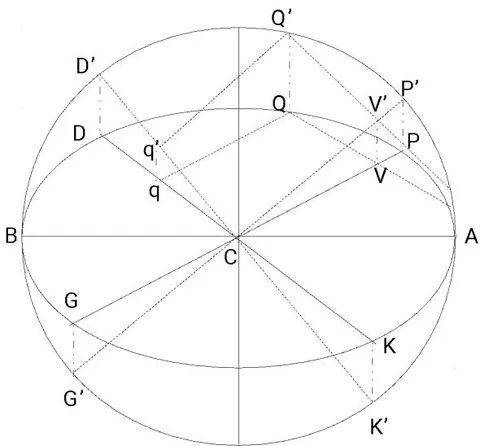
What remains is to relate QV to . We know that QV is parallel to DC, so from Q we draw a parallel to PC until it meets DC in q, therefore Cq=QV. Project q onto point on , and it is straight forward to prove that . Now is similar to , Thus
Substituting in (B.5) results in
But implies that
Parallelogram area Equivalence Apollonius Proposition 31 Book 7 With reference to Fig. 3 below, we introduce two proofs.
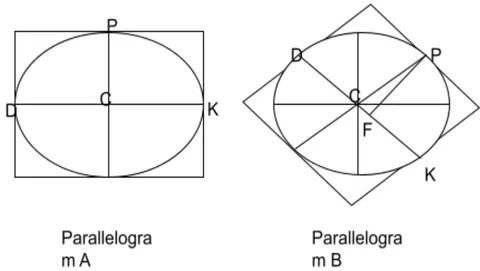
Method 1: geometric algebra
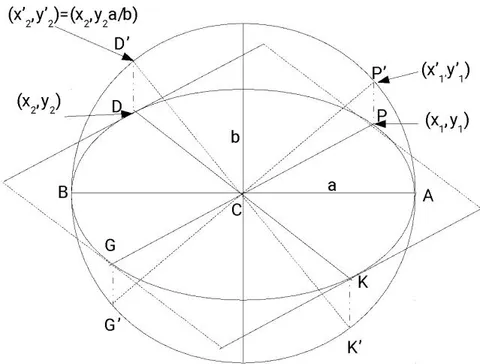
Let and be the points on the eccentric circle from which their projection and on the ellipse are obtained. The coordinates of and are then given by
and,
Since and then and are perpendicular and thus the area enclosed by and . Therefore the area enclosed by CP and as desired.
Method 2: vector analysis: In Fig. 3b, let P and D denote the points and respectively. The area PCD is then given by the cross product of vectors CP and CD. Thus
Conflict of Interest
The authors declare no conflict of interest.
Ethical Approval
Not applicable
Data Availability
The datasets used in this study are openly available at [repository link] and the source code is available on GitHub at [GitHub link].
Funding
This work did not receive any external funding.
References
Cite this article
Related Research

Special Issue
Launch a focused special issue to highlight research, emerging trends, and expert insights in your academic field.