



IntelliPaper
Abstract
In today's society, the demand for clean energy is essential. Traditionally, renewable sources such as hydropower, wind, and solar have provided sustainable solutions. Photovoltaic (PV) systems generate electricity from sunlight using semiconductor PV cells, which have been effective for over 30 years. The efficiency of PV cells depends on irradiance (solar photon intensity) and temperature. Higher irradiance boosts efficiency, while higher temperatures reduce it. Despite their low voltage outputs, PV systems can be optimized with DC-DC Ultra Lift Luo converters to meet load requirements, improving system efficiency. The Ultra Lift Luo converter, a type of DC-DC converter, offers a higher voltage conversion gain than conventional boost converters. This converter belongs to the Luo converter family, which uses advanced techniques to achieve high voltage gain and efficiency. Solar irradiance fluctuates throughout the day, impacting PV cell output. Maximum Power Point Trackers (MPPTs) adjust the system's operating point to sustain peak efficiency. This study aims to design AI controllers for MPPT management. In addition, we evaluate the performance of Artificial Neural Networks (ANN) and Recurrent Neural Networks (RNN) with three datasets to determine the most efficient AI controller for optimizing solar energy systems.
Explore Digital Article Text
I. INTRODUCTION
Historically, energy production mainly involved burning fossil fuels like coal, oil, and natural gas. This process converted their chemical energy into heat, which was then used to generate electricity through various methods. Unfortunately, relying on fossil fuels has significantly increased harmful greenhouse gas emissions, particularly carbon dioxide, over the past 70 years, worsening global climate change. To reduce these environmental impacts, there is a growing movement towards cleaner and more efficient energy conversion methods, especially photovoltaic (PV) systems .
PV systems convert sunlight directly into electricity using PV cells. However, the voltage output from PV cells is usually low, requiring DC-DC converters to boost the voltage levels. The DC-DC Ultra Lift Luo converter is crucial in this context. This converter not only increases the voltage output but also matches the impedance between the PV system and its connected load, addressing a key challenge in optimizing PV system efficiency .
Solar irradiance, which measures the intensity of sunlight photons, varies throughout the day. At the same time, ambient temperature changes based on environmental conditions, affecting the PV system's performance. To maximize energy capture and efficiency, a Maximum Power Point Tracker (MPPT) is used. The MPPT adjusts the PV system's operating point in real-time to ensure it operates at its maximum power point (MPP), where the output power is optimized. This adjustment is critical as it aligns with the varying maximum voltage curve of the PV cells throughout the day. The MPPT signal guides the DC-DC Ultra Lift Luo converter, which uses components like Insulated Gate Bipolar Transistor (IGBT) diodes to control its duty cycle. By modulating the duty cycle, the converter adjusts the output voltage to match the load requirements effectively .
Given the non-linear and dynamic nature of solar irradiance (G) and temperature (T), traditional time-domain controllers may not efficiently manage these variations. Therefore, artificial intelligence (AI) controllers offer a more effective solution. This study considers two AI controller methods: Artificial Neural Networks (ANN) and Recurrent Neural Networks (RNN). These AI controllers excel in handling non-linear changes in input values from PV cells, optimizing control efficiency, and enhancing overall system performance .
The shift from fossil fuel-based energy generation to renewable sources like PV systems represents a significant step towards sustainability. By integrating advanced technologies such as MPPTs, DC-DC converters, and AI controllers, we can effectively harness solar energy while maximizing efficiency and minimizing environmental impact.
This paper is structures as: Section II: PV System Description and Modeling
Detailed description of the modeled 213.15-Watt PV array.
Explanation of the basic block model of PV arrays.
Discussion on the construction and operation of solar cells based on p-n semiconductor junctions.
Inputs (G and T) and outputs (voltage output and power output) of the PV array model.
Methods used for simulating and characterizing the PV system under different conditions.
DC – DC Ultra Lift Luo Converter Design and Model.
Section III: Methodology of ANN Controller
Introduction to artificial intelligence (AI) controllers.
Description of Artificial Neural Network (ANN) model used.
Explanation of how this AI ANN controller is implemented for optimizing the PV system, particularly focusing on its ability to handle non-linear and dynamic inputs (G and T).
Section IV: Methodology of RNN Controller
Introduction to artificial intelligence (AI) controllers.
Description of Recurrent Neural Network (RNN) model used.
Explanation of how this AI RNN controller is implemented for optimizing the PV system, particularly focusing on its ability to handle non-linear and dynamic inputs (G and T).
Section V: Results and Discussion
Presentation of the results obtained from the ANN and RNN controllers.
Comparative analysis of the performance of ANN and RNN in optimizing the PV systems.
Discussion on the strengths and weaknesses of each AI controller method.
Interpretation of the results in relation to the efficiency and effectiveness of PV system optimization.
Section V: Conclusion
Summary of the key findings from the study.
Contributions to the field of renewable energy and PV system optimization.
Recommendations for future research directions.
Closing remarks on the potential impact of using AI controllers in enhancing PV system performance.
II. SYSTEM DESCRIPTION AND MODELING
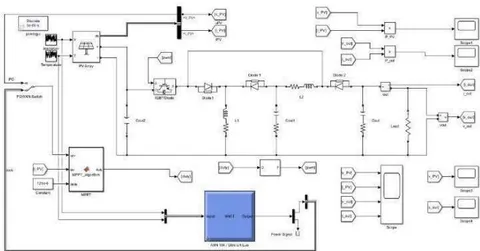
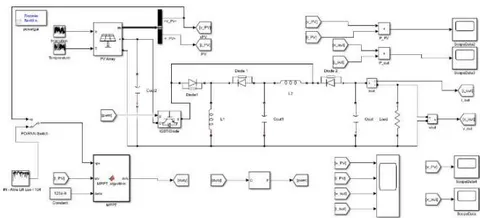
We present a comprehensive description of the PV system model, detailing its components and the integration of ANN and RNN controllers. Block diagrams are included to illustrate the proposed models. The PV array model receives inputs of Solar Irradiance (G) and Temperature (T) and has two outputs for the ANN controller: Output Voltage and Output Power, and one output for the
RNN controller: Output Voltage. A DC-DC Ultra Lift Luo Converter is employed, with the MPPT playing a crucial role in maximizing power output by adjusting the operating point. The reference voltage (Vpv) is generated based on calculations and predictions from ANN or RNN algorithms. The PV system is directly connected to a fixed load. The block diagrams in Fig. 1 and Fig. 2 visually clarify the system's architecture and control flow [8-10].
2.1 Mathematical Solar Array Modeling
The single-diode model is commonly used for simulating photovoltaic (PV) cells. This model includes the following components:
Photo-current source ( ): Represents the current generated by the solar cell when exposed to sunlight.
Diode (D): Models the p-n junction of the solar cell, providing a path for the recombination of charge carriers.
Series Resistance ( ): Represents the resistive losses within the cell.
Shunt Resistance ( ): Represents leakage currents within the cell.
The equivalent circuit of a PV cell using the single-diode model can be represented as:
Where:
I is the output current of the PV cell.
is the photo-generated current.
is the current through the diode.
is the shunt leakage current.
In this research, we concentrate on the design and modeling of a 213.15-Watt photovoltaic (PV) array, a critical component for solar energy systems. The PV array is made up of interconnected solar cells that convert sunlight directly into electricity. The main inputs for the array are solar irradiance (G) and temperature (T). Solar irradiance, which measures the intensity of sunlight falling on the PV array in watts per square meter (W/m ), leads to higher photo-generated current with increased irradiance. Temperature, measured in degrees Celsius ( C), represents the surrounding ambient temperature and impacts the efficiency and output of the PV cells, with higher temperatures typically reducing efficiency. The key outputs of the PV array include the voltage output (V), representing the electrical voltage produced and influenced by both irradiance and temperature, and the power output (P) for the ANN controller, indicating the total electrical power generated by the PV array, calculated as the product of the voltage and current produced by the PV cells [11-13].
Understanding how the PV array operates across different levels of solar irradiance and temperature is essential to gauge its performance capabilities. Through simulating the PV array model in diverse environmental scenarios, we can anticipate its responses and refine its design to achieve optimal efficiency .
This research centers on intricately modeling a 213.15-Watt PV array, highlighting its fabrication using p-n semiconductor junctions and its responsiveness to solar irradiance and temperature changes. The voltage and power outputs serve as key indicators of the PV array's operational efficiency, pivotal for its integration into renewable energy setups. Precise modeling facilitates AI-driven predictions and improvements in the PV array's performance across diverse environmental settings .
2.2 Modeling and Simulation of 213.15W PV Array
The photovoltaic (PV) array used in the designed PV system was carefully selected from the MATLAB/Simulink toolbox for simulation purposes. This selection provides detailed information about the array's electrical properties and includes visual aids demonstrating its performance under different temperature and irradiance conditions. Fig. 3 displays a graphical representation of the chosen PV array model from MATLAB/Simulink, illustrating its response to varying environmental factors. Additionally, Table I outlines specific electrical parameters that characterize the PV array, offering a clear understanding of its capabilities and performance metrics under diverse operational scenarios [16-17].
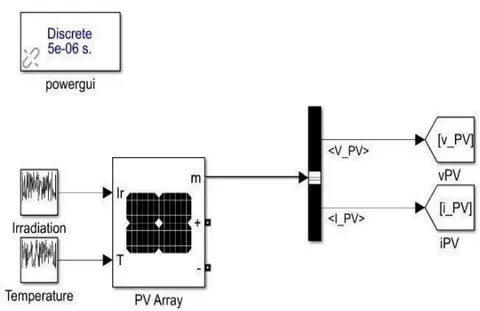
Table I: Electrical Characteristics Of The Pv Module
| Description | User-defined |
| Maximum power | 312.15 W |
| Voltage at Pmax (Vmax) | 29.00 V |
| Current at Pmax ( ) | 7.35 A |
| Short Circuit current ( ) | 7.84 A |
| Open circuit voltage | 36.30 V |
| Temperature coefficient Ki | 0.102 A/ |
The Voltage-Current (V-I) characteristics curve demonstrates how the voltage and current output of the PV array relate to each other under specified conditions, shown in Fig. 4. At a temperature of , this curve indicates that the current output remains stable until the voltage approaches a certain threshold (close to the open circuit voltage), beyond which the current decreases significantly [18].
The Voltage Power (V-P) characteristics curve illustrates how the power output of the PV array changes with varying voltage levels, specifically at temperatures of and , as depicted in Fig. 5. Typically, this curve exhibits a peak that signifies the maximum power point (MPP), where the PV array operates most efficiently. Beyond this point, the power output declines as the voltage continues to increase [19-20].
The Voltage Current (V-I) characteristics curve, depicted in Fig. 6, illustrates how the output current of the PV array changes with varying voltages under different levels of sunlight intensity. Higher levels of irradiance generally result in increased current outputs, while the overall shape of the curve remains consistent across varying irradiance levels.
The Voltage Power (V-P) characteristics curve for specified irradiance levels illustrates how the power output changes with voltage under varying sunlight intensities. Like the temperature-dependent V-P curve shown in Fig. 7, the curve influenced by irradiance also exhibits a peak at the maximum power point. Higher irradiance levels lead to higher peak power values, highlighting the direct relationship between sunlight intensity and PV array performance in generating electrical power.
2.2.1 Collecting Data
A thorough simulation using MATLAB/Simulink was undertaken to evaluate the performance of the custom-defined PV array. The objective was to assess how the PV array responds across different levels of solar irradiance (G) and temperature (T), specifically examining its maximum voltage (Vmax) and maximum power (Pmax) outputs. The insights gained from these simulations are essential for gaining a deeper understanding of the efficiency and operational behavior of the PV array .
1) Simulation Parameters
Solar Irradiance (G): Represents the strength of sunlight reaching the PV array, typically quantified in watts per square meter (W/m ).
Temperature (T): Indicates the surrounding environmental temperature near the PV array, measured in degrees Celsius (°C).
1) Simulation Parameters
Diverse Conditions Covered: The PV array model underwent simulation across a wide spectrum of solar irradiances and temperatures to encompass various environmental scenarios.
Utilization of Simulink: MATLAB/Simulink was employed for conducting simulations, utilizing the detailed PV array model available within the software toolbox.
Data Collection: A total of 104 data points were generated from these simulations, with each point corresponding to specific combinations of solar irradiance (G) and temperature (T). For each data point, the maximum voltage (Vmax) and maximum power (Pmax) values were recorded.
The outcomes from the simulations, encompassing Vmax and Pmax values across different conditions, offer significant insights into how the PV array performs under diverse environmental scenarios .
The data gathered through MATLAB/Simulink simulations provide a comprehensive perspective on how the PV array functions across various levels of irradiance and temperature. This information is essential for refining and maximizing the efficiency of PV systems in practical settings. By comprehending how environmental factors influence PV output, it becomes possible to make more accurate projections and improvements for renewable energy applications .
2.3 DC-DC Ultra Lift Luo Converter Model
The DC-DC Ultra Lift Luo converter represents a sophisticated power electronics component engineered to effectively convert and control voltage levels. It is specifically tailored for applications in photovoltaic (PV) systems, where there is a requirement to elevate the typically low and unregulated output voltage to a level that is suitable for practical use .
2.4 Converter Design and Operation
Voltage Lift Technique:
Arithmetic Progression: In basic voltage boosting designs, the output voltage incrementally increases through sequential steps, adhering to a systematic arithmetic pattern. This method ensures a gradual and predictable rise in voltage levels, typically in straightforward voltage conversion and regulation mechanisms.
Geometric Progression: The Ultra Lift Luo converter enhances voltage amplification by utilizing geometric progression. This method results in greater and more efficient increases in output voltage, making the process significantly more effective.
Components and Circuit Design:
The converter employs inductors, capacitors, diodes, and switches arranged strategically to achieve precise voltage alteration according to operational needs. This configuration ensures efficient transformation of electrical energy, maintaining stability and reliability throughout the conversion process, crucial for achieving the intended voltage output reliably and effectively.
The converter's function is based on switching processes that regulate how energy is stored and released in its inductors and capacitors. This controlled energy management leads to a gradual increase in output voltage, which follows a systematic and incremental pattern, akin to an arithmetic progression .
2.5 Advantages Over Traditional Converters
Higher Voltage Gain
Traditional converters such as Boost, Cuk, and SEPIC are often constrained by their limited ability to increase voltage. In contrast, the Ultra Lift Luo converter stands out for its capability to achieve significantly higher voltage spans, leveraging a geometric progression mechanism that enhances its efficiency and performance in voltage transformation applications .
Reduced Harmonics:
Excessive harmonics are problematic as they can interfere with operations and decrease power system efficiency. The Ultra Lift Luo converter effectively mitigates harmonics, resulting in a cleaner and more efficient power output that enhances overall system performance.
Improved Power Factor:
Conventional converters often struggle with undesirable high-power factors, which can result in inefficiencies within the system. In contrast, the Ultra Luo converter is specifically engineered to optimize and maintain a more favorable power factor. This design enhancement ensures that the converter operates more efficiently, minimizing energy losses and improving the overall performance and reliability of the power system.
Higher Efficiency:
The converter enhances efficiency through effective reduction of current ripples, resulting in decreased energy losses and improved overall system performance. By ensuring smoother and more stable current flow, the converter minimizes heat generation and switching losses, optimizing energy usage. This enhanced efficiency not only conserves energy but also enhances the reliability and longevity of connected equipment. Reduced current ripples also contribute to maintaining high power quality, ensuring consistent and reliable operation of electrical systems. Overall, these advancements underscore the converter's ability to operate more efficiently while meeting stringent performance standards and enhancing system reliability.
Higher Voltage Span:
This converter's capability to achieve a broader voltage range makes it well-suited for applications needing significant voltage increases, such as linking photovoltaic systems to external loads.
2.6 Practical Application in PV Systems
Unregulated PV Output:
PV systems typically produce an unregulated output voltage that can vary with changes in solar irradiance and temperature. This unregulated output is often insufficient for directly powering loads or integrating with the grid.
Voltage Regulation:
The Ultra Lift Luo converter plays a vital role in elevating the voltage output of PV systems to a stable, regulated level, making it adaptable for a wide range of applications. This controlled voltage enhancement is essential to ensure the consistency and reliability of power supplied by the PV system, meeting the requirements of different electronic devices and systems. By maintaining a steady output, the converter enables efficient utilization of solar-generated electricity, enhancing overall system performance and reliability .
Connection to External Loads:
Utilizing the Ultra Lift Luo converter optimizes the PV system's ability to deliver consistent and reliable power to external loads. This converter guarantees that the voltage output meets specified standards, thereby improving the overall dependability and operational effectiveness of the PV system .
The Ultra Lift Luo converter is designed with the following key components:
1. Switch
Insulated Gate Bipolar Transistor (IGBT) functions as a semiconductor switch crucial for regulating the converter's duty cycle and operational efficiency.
2. Diodes
Standard diodes (D1, D2) are essential components within the circuit, facilitating current flow in one direction while blocking reverse current to maintain proper operation and prevent undesired electrical feedback.
3. Energy Storage Components:
Inductors (L1) are utilized to store energy in the form of a magnetic field, facilitating consistent current flow and enhancing the stability of the electrical system. This ensures reliable operation by minimizing fluctuations and maintaining a steady flow of power through the circuit.
Capacitors (C1, C2) also store energy but primarily smooth out voltage fluctuations, ensuring a consistent power supply. Both capacitors have identical values (C2 = C1), contributing equally to the stability and efficiency of the circuit's operation.
The converter employs the ultra-lift technique to consistently elevate the output voltage above the PV array's input voltage. This method incrementally increases the voltage in a geometric progression, ensuring that the output remains positively offset from the input. This design feature guarantees efficient power transformation, essential for maximizing the converter's performance in various applications. It ensures reliable operation by maintaining a stable and suitable output voltage, thereby optimizing the overall efficiency and functionality of the system .
The operational dynamics and behavior of the Ultra Lift Luo converter are defined by the set of equations below, which outline its functionality and how it responds to input parameters:
Transfer Gain (K) represents the ratio of the output voltage (Vo) to the input voltage (Vin), elucidating how the converter amplifies the voltage from the input to the output:
The connection between the input voltage (Vin), output voltage (Vo), and transfer gain (K) is defined by a mathematical equation that outlines how changes in Vin affect Vo, scaled by the factor K. This equation provides a quantitative understanding of how the converter amplifies the input voltage to produce a desired output voltage, crucial for determining its operational characteristics and efficiency in various applications:
The output current (Io) in the circuit can be determined using Ohm's law, which states that the current flowing through a conductor between two points is directly proportional to the voltage across the two points and inversely proportional to the resistance between them:
The DC-DC Ultra Lift Luo converter is an advanced and efficient device designed to elevate voltages without inverting them. It harnesses components like IGBTs, diodes, inductors, and capacitors to achieve substantial voltage increases while ensuring outputs are free from ripples and disturbances. The operational equations it employs are crucial for engineers to effectively design, optimize, and assess the converter's functionality in diverse applications, especially when paired with PV systems. These equations provide insights into how the converter manages voltage transformation, ensuring reliable and efficient power conversion from photovoltaic sources to meet varying electrical demands .
The DC-DC Ultra Lift Luo converter's operational concept is elucidated by its block diagram, illustrating its key components and how electrical energy moves through the system. This schematic in Fig. 8 offers a comprehensive view of the converter's architecture, showcasing the interplay among components that include IGBTs, diodes, inductors, and capacitors. Understanding these interactions is essential for grasping how the converter achieves efficient voltage elevation without inversion, which is pivotal for its application in diverse electronic and energy systems [39].
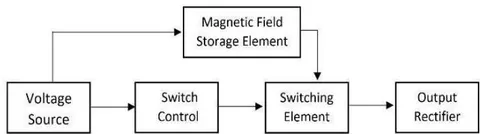
The block diagram components and descriptions: PV Array (Input Voltage Source):
The PV array produces a low and unregulated DC voltage as it converts solar energy into electrical power, which serves as the initial DC input voltage for the converter.
Switch Control:
The component referred to as the Insulated Gate Bipolar Transistor (IGBT) integrates control circuitry responsible for managing the switching function. Through switch control, it modulates the IGBT's duty cycle, thereby regulating energy transfer and directing the switching element to control the voltage conversion process effectively.
The inductor (L1) plays a critical role in the circuit dynamics by harnessing and storing energy within its magnetic field when the switch is turned on.
When the switch deactivates, the inductor releases this stored energy, which helps in stabilizing the current flow and enabling efficient voltage amplification. This cycle of energy storage and release ensures smooth operation of the circuit, minimizing fluctuations and optimizing performance. By managing the flow of electrical energy, the inductor contributes significantly to maintaining stability and enhancing the overall efficiency of the circuit, supporting its function in various electronic applications .
Capacitors (Energy Storage):
Two capacitors, C1 and C2, of equal value, function to store and filter energy within the circuit. They work together to ensure a steady output voltage, smoothing fluctuations and minimizing ripple effects, thereby contributing to a consistent and stable electrical output .
Diodes:
Diodes D1 and D2 serve the purpose of facilitating current flow in a single direction while preventing reverse flow, ensuring efficient energy transfer and supporting voltage elevation by maintaining a unidirectional current path.
2.7 Output Rectifier and Filter
The setup includes capacitors and supplementary diodes designed to guarantee that the output voltage remains stable, devoid of noticeable fluctuations, thereby supplying a consistent high DC voltage to the load.
From equation 3, we computed the output voltage of the DC source, applying Vpv = 10V to the input of the DC-DC Ultra Lift Luo converter. Initiating our block diagram test with a 50% duty cycle, we observed an output voltage of Vo = 32.87V. This result aligns with the findings illustrated in the simulation design depicted in Fig. 4 [43]. It confirms the converter's ability to efficiently increase the voltage from its initial input, demonstrating its practical functionality in real-world scenarios. The successful outcome underscores the converter's capacity to deliver stable and amplified DC voltage outputs, validating its suitability for applications requiring robust voltage elevation with minimal ripple and high efficiency, as illustrated through comprehensive testing and analysis.
With the DC source providing an input voltage (Vpv = 10V) and applying the designated duty cycle to the DC-DC Ultra Lift Luo converter, we utilize this data to compute the anticipated output voltage (Vo = 32.87V). This calculation hinges on the converter's operational parameters and the relationship between input voltage, duty cycle, and resulting output voltage, as outlined in the converter's specifications and operational principles.
The transfer gain (K) and the equations previously outlined offer insights into how the input voltage relates to the output voltage, elucidating the conversion mechanism. By leveraging these equations, one can comprehend the transformation process from the input to the output voltage within the operational framework of the system.
Now, set up the equation:
Cross-multiply to solve for D:
Verify the Gain (K)
Now substitute D = 0.533 back into the gain formula to verify:
The calculated gain K matches our initial calculation, confirming that .
This computation validates the recorded output voltage of 32.87V when supplied with a 10V input and operated at a 50% duty cycle, affirming the accuracy of the simulation's outcomes.
Fig. 9 depicts the experimental setup and simulation outcomes using a block diagram. The results confirm that by employing a 50% duty cycle, the converter effectively increases the input voltage of 10V from the DC source to 32.87V as demonstrated in the Ultra Lift Luo converter's output [45].
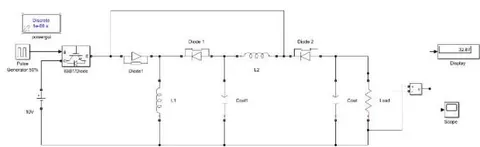
The analysis and evaluation using calculations and block diagrams are consistent with the simulation outcomes, confirming the efficacy of the Ultra Lift Luo converter in elevating the voltage from a DC source. This converter efficiently enhances the input voltage, delivering a stable and elevated output voltage suitable for a wide range of applications .
The Ultra Lift Luo converter stands out for its efficiency in elevating voltage levels. Fig. 10 illustrates how its output voltage rises swiftly and consistently, demonstrating superior performance compared to conventional converters like Cuk or Boost, which frequently experience overshooting and extended stabilization phases. Both theoretical calculations and simulations confirm the converter's robustness, highlighting its suitability for integrating photovoltaic systems with external loads that demand stable, regulated higher voltages [47-49]. This capability ensures reliable power supply adaptation, crucial for applications requiring consistent energy delivery without fluctuations, thus enhancing the overall reliability and efficiency of renewable energy systems in practical use scenarios.
III. ARTIFICIAL NEURAL NETWORK (ANN)
Artificial Intelligence (AI) controllers are becoming more prevalent in enhancing the effectiveness and efficiency of photovoltaic (PV) systems. One effective method involves integrating Artificial Neural Networks (ANNs) to optimize the Maximum Power Point (MPP) tracking of PV arrays. This AI-driven approach helps improve overall system performance by dynamically adjusting to changing environmental conditions and maximizing energy output from solar panels .
The artificial neural network (ANN) utilized in this proposed design leverages the Levenberg-Marquardt algorithm, renowned for its efficacy and precision in resolving intricate nonlinear least-squares problems. The ANN configuration and application within the PV system are delineated below, elucidating its operational framework and how it optimizes system performance:
3.1 ANN Structure and Training
3.1.1 Input Variables
Solar Irradiance (G): Denotes the measure of solar energy received per unit area at a given location and time, influencing the photovoltaic (PV) array's electricity generation capacity.
Temperature (T): Signifies the environmental heat surrounding the photovoltaic (PV) array, impacting its operational efficiency and output performance.
3.1.2 Network Architecture
The Artificial Neural Network (ANN) is structured with three fundamental layers: an initial input layer that receives data, a middle-hidden layer where computations and transformations occur, and a final output layer that yields the network's results.
Input Layer: At the outset of the network, this foundational layer accepts and processes incoming data elements G and T, representing solar irradiance and ambient temperature, respectively.
Hidden Layers: The hidden layers in the neural network consist of a carefully crafted arrangement of 10 neurons, designed to capture and encapsulate the intricate and nonlinear relationships between input and output data. This configuration is tailored to effectively model the complexity inherent in the system, ensuring robustness in pattern recognition and prediction tasks. While the number of hidden layers can vary, the choice of 10 neurons in each layer for this specific setup underscores the aim to achieve optimal performance in handling the diverse and dynamic nature of the input variables. These hidden layers act as intermediaries, transforming raw data into meaningful representations that facilitate accurate decision-making and system optimization in various applications, including those demanding nuanced processing of data like photovoltaic system management.
Output Layer: The final layer of the neural network functions as the ultimate stage where predictions for both maximum power (Pmax) and maximum voltage (Vmax) are computed. It consolidates and interprets the complex computations from earlier layers, culminating in precise forecasts that are essential for fine-tuning and enhancing the operational efficiency of photovoltaic systems across a spectrum of environmental conditions. This layer plays a critical role in translating the neural network's analytical capabilities into actionable insights, enabling effective management and optimization of photovoltaic system performance .
3.1.3 Training Algorithm
The Levenberg-Marquardt Algorithm is chosen for its adeptness in managing intricate data relationships and nonlinearities. Its superiority lies in rapidity and precision, outperforming alternative training methods, thus ideal for applications demanding real-time responsiveness. Training with this algorithm revolves around fine-tuning neural network parameters—such as weights and biases—to minimize the disparity between forecasted and observed Maximum Power Point (MPP) values, ensuring optimal performance in photovoltaic systems .
MATLAB/Simulink serves as the platform for simulating and training the Artificial Neural Network (ANN). The neural network undergoes training using a comprehensive dataset encompassing diverse combinations of solar irradiance and temperature inputs. This approach ensures that the network learns effectively and can generalize its predictions to new, previously unseen data points. The integration of MATLAB/Simulink facilitates rigorous testing and optimization of the ANN's performance, making it well-suited for enhancing the efficiency and reliability of photovoltaic systems through accurate Maximum Power Point Tracking (MPPT) capabilities.
3.2 Selecting the Artificial Neural Network (ANN) Structure
In our envisioned setup, we harness the capabilities of an Artificial Neural Network (ANN) to oversee and enhance the Maximum Power Point (MPP) of the photovoltaic (PV) array. This involves utilizing inputs such as solar irradiance (G) and ambient temperature (T) to optimize performance. The ANN's structure and its seamless integration into the PV system are delineated as follows:
Input Layer: The input layer of the artificial neural network (ANN) consists of two neurons specifically designed to handle key variables: Solar Irradiance (G) and Temperature (T). These neurons serve as initial points of entry for integrating environmental data into the ANN, facilitating its capability to interpret and forecast outcomes influenced by fluctuating levels of sunlight intensity and ambient temperature. By processing these crucial environmental factors, the input layer plays a pivotal role in enabling the ANN to make informed decisions regarding the optimal operation of systems such as photovoltaic (PV) arrays. This foundational layer ensures that the network can effectively adjust and adapt its predictions in real-time, enhancing its ability to maximize the efficiency and performance of PV systems under diverse environmental conditions.
Output Layer: The output layer of the neural network comprises two neurons dedicated to key outputs: Voltage (V) and Power (P). These neurons play a critical role in providing the ultimate computed values from the neural network, representing the expected voltage and power outputs based on the operational parameters and environmental conditions of the system. They serve as the final stage in the network's decision-making process, translating complex input data, such as irradiance levels and temperature variations, into actionable voltage and power predictions essential for optimizing the performance of the system in photovoltaic (PV) applications.
Hidden Layer: The hidden layer of a neural network comprises interconnected neurons that use weighted connections to link the input and output layers. The number of neurons in this layer is pivotal, defining the network's ability to model complex nonlinear relationships between input data and desired outputs. More neurons enhance the network's capacity to learn intricate patterns and correlations within data. This layer serves as an intermediary, processing input signals to generate meaningful output predictions based on learned patterns and relationships from the training data. Its role is critical in enabling the network to effectively interpret data and make accurate predictions in various applications.
Network Training: The network is trained using the Levenberg-Marquardt algorithm, renowned for its effectiveness in handling intricate nonlinear challenges with precision. To establish the ideal hidden layer neuron count, a trial-and-error methodology is employed. This involves iteratively adjusting the network's structure until optimal performance is achieved. The training dataset encompasses diverse G and T values, ensuring the ANN can adeptly handle varying operational scenarios. This methodical approach guarantees the network's robustness and reliability in predicting outcomes, leveraging its ability to discern complex patterns and relationships inherent in the input data .
Weighted connections: During training, the weighted connections between the input variables (G and T) and the neurons in the hidden layer are adjusted to improve the accuracy of predicting output values (V and P). This adjustment process is essential for optimizing how the neural network interprets and integrates the input variables, thereby enhancing its ability to forecast voltage and power outputs accurately. This optimization is particularly critical in applications such as solar energy optimization, where precise predictions of voltage and power are vital for maximizing system efficiency and performance under varying environmental conditions. Adjusting these weighted connections ensures that the neural network can effectively capture and utilize the relationships between inputs and outputs, improving overall predictive capability and reliability in practical deployment scenarios.
Prediction of Outputs: The ANN predicts voltage (V) and power (P) by processing input data, optimizing PV system efficiency through continuous adjustment to the Maximum Power Point (MPP). This adjustment dictates the duty cycle for the DC-DC Ultra Lift Luo converter, regulating the Insulated Gate Bipolar Transistor (IGBT) switch. This process ensures maximum renewable energy capture by aligning PV system voltage with load resistances, thereby enhancing overall system performance and energy utilization efficiency.
Influence of Hidden Layers: The efficacy of the ANN hinges on its architecture, particularly the layout of hidden layers and neurons. Experimentation determines the ideal setup for precision and rapidity. In PV systems, these layers play a crucial role in maximizing MPPT efficiency. By meticulously adjusting their configuration through iterative assessment, accuracy, responsiveness, and overall system efficiency are optimized. This method not only bolsters PV system reliability and performance but also promotes the integration of renewable energy solutions in real-world scenarios, marking a significant step toward advancing sustainable energy technologies.
In our simulation framework, the ANN is implemented on MATLAB/Simulink, utilizing the Levenberg-Marquardt algorithm for training and validation. The structure of the ANN, depicted in Fig. 11, includes an input layer for solar irradiance (G) and ambient temperature (T), a hidden layer optimized for neuron count, and an output layer for voltage (V) and power (P). This setup is designed to optimize Maximum Power Point Tracking (MPPT) in PV systems, leveraging neural networks to ensure robust performance across varying environmental conditions. The integration of AI through MATLAB/Simulink's graphical tools facilitates the design, simulation, and analysis of dynamic systems, effectively integrating ANN models with MPPT algorithms and DC-DC converters. Post-training, the ANN provides forecasts of V and P outputs under different irradiance and temperature scenarios, essential for improving the overall efficacy and efficiency of PV systems in renewable energy applications.
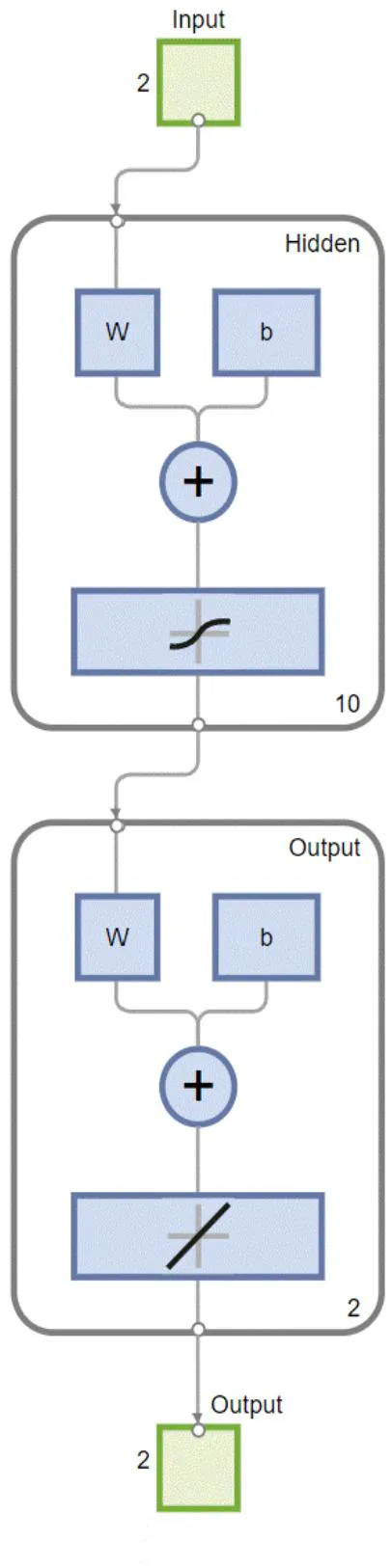
Incorporating an Artificial Neural Network (ANN) for Maximum Power Point (MPP) tracking in PV systems marks a notable advancement in system efficiency. Through precise forecasting of the MPP using inputs like irradiance and temperature, the
ANN guarantees optimal PV array operation. Training the ANN involves iterative adjustments, supported by the Levenberg-Marquardt algorithm, which effectively manages the PV system's nonlinear traits. Utilizing MATLAB/Simulink facilitates thorough simulation and testing, verifying dependable performance under diverse conditions. This approach not only enhances accuracy in predicting MPP but also underscores the ANN's capability to streamline renewable energy utilization, making it suitable for practical implementation in various solar energy applications.
To optimize the ANN controller's performance in tracking the MPP of the PV system, various random data sample sets (104, 201, and 1001 points) were rigorously compared to determine the most effective choice for achieving optimal efficiency in MPP tracking.
3.3 Data Sample Sets
104 Random Data Samples:
The ANN controller was trained using an initial dataset that encompassed diverse combinations of irradiance (G) and temperature (T) values, ensuring comprehensive coverage across a wide spectrum of operational scenarios.
201 Random Data Samples:
A larger dataset was curated to introduce greater variability, aiming to enhance the training accuracy and the ANN's ability to generalize across different scenarios.
1001 Random Data Samples:
A substantially increased dataset was curated to encompass a wider range of input variations, enabling the ANN to discern more complex correlations between the input parameters (G and T) and the resultant outputs (V and P). This approach aimed to enrich the model's ability to capture nuanced patterns and optimize its predictive capabilities in solar energy applications.
After completing the training of the ANN controller using each of the three datasets, their performance was evaluated and compared based on specific criteria:
Accuracy:
The accuracy and reliability of the ANN controller in accurately determining the maximum power point (MPP) by analyzing the provided irradiance and temperature data inputs. This measurement gauges how effectively the controller can predict the optimal operating conditions for maximizing power output from the photovoltaic system under varying environmental factors.
Efficiency:
The effectiveness of the PV system's performance in maximizing energy output using the ANN controller to track the MPP. This capability enhances energy harvesting efficiency, leading to improved overall performance and greater sustainability in harnessing solar energy resources.
Generalization:
The ANN controller's capacity to effectively generalize its predictions to unfamiliar data points, demonstrating its resilience and versatility in varying conditions.
The evaluation of the three datasets (104, 201, and 1001 random samples) resulted in accuracy rates of 91.0380% for 104 samples, 91.1141% for 201 samples, and 92.3221% for 1001 samples. It was found that the ANN controller trained with 1001 random samples outperformed others, benefiting from its ability to capture finer patterns and ensuring superior precision and effectiveness in maximizing the MPP.
Training the ANN with a broad and varied dataset markedly improved the PV system's performance. Among the data sets tested, the ANN trained with 1001 samples proved most effective, ensuring robust and dependable operation under diverse conditions and maximizing efficiency in tracking the MPP.
Upon analysis, the ANN controller trained with 1001 random data samples was integrated into the PV system to ensure consistent MPP tracking, optimize power output, and maintain efficiency across varying environmental conditions.
Utilizing MATLAB/Simulink for simulation and training offered a solid foundation to develop and validate the ANN controller, confirming its efficacy for practical implementation in real-world scenarios.
VI. RECURRENT NEURAL NETWORK (RNN)
To improve the PV system's efficiency, an RNN was implemented, leveraging its internal feedback loops to effectively manage time-varying and nonlinear data. This capability is crucial for real-time MPP tracking, enhancing the overall performance and efficiency of the PV array compared to traditional methods.
Feedback Mechanism:
Unlike conventional feedforward neural networks, RNNs utilize feedback loops that enable information retention across sequential steps. This cyclic mechanism empowers the network to preserve context and effectively manage the dynamic and nonlinear characteristics inherent in PV system inputs, distinguishing it as a suitable choice for real-time applications where temporal dependencies are critical.
Training Algorithm:
The training of the RNN involves the application of the Mean Squared Error (MSE) algorithm, a widely adopted method for regression tasks that aims to minimize the squared differences between predicted and actual values. MATLAB/Simulink serves as the platform of choice for implementing and training the RNN, utilizing its robust features to manage intricate simulations and AI training processes effectively.
4.1 RNN Architecture
Input Layer: In the initial stage, the RNN's input layer is configured to intake two specific variables: Solar Irradiance (G) and Temperature (T). These variables are crucial inputs that influence how the RNN processes data, allowing it to adapt and optimize its performance based on varying solar and temperature conditions in real-time applications.
Hidden Layers: The RNN architecture includes 4 hidden layers, with each layer housing 10 neurons. These layers are interconnected to facilitate the network's ability to recognize patterns over time and comprehend intricate correlations within the data, accommodating temporal dynamics and nonlinear interactions effectively.
Output Layer: The output layer represents the culmination of the network's computations, producing a single variable, Voltage (V), which plays a pivotal role in determining the maximum power point (MPP) parameters essential for optimizing photovoltaic system performance. This voltage output is intricately calculated by the RNN through its thorough examination of input data, particularly solar irradiance (G) and temperature (T). Designed with precision, the network operates to forecast and fine-tune this crucial variable, ensuring it aligns optimally with real-time environmental fluctuations. By doing so, the RNN-equipped system achieves superior efficiency in energy harvesting, adeptly adjusting to diverse environmental conditions to maintain robust MPP tracking. This capability not only enhances the overall operational reliability of the PV system but also underscores its adaptability in maximizing renewable energy utilization. Through its sophisticated configuration, the network effectively contributes to the advancement of sustainable energy technologies, leveraging complex algorithms to manage and optimize energy production from solar sources. This integrated approach ensures that the PV system operates at peak efficiency, translating environmental inputs into precise voltage adjustments that enhance overall energy output. In essence, the output layer's function extends beyond mere voltage generation; it represents a critical component in the intelligent management of photovoltaic systems, where accuracy in MPP tracking is paramount for sustainable and effective energy utilization. Thus, the RNN's ability to process and adjust voltage outputs in response to changing environmental variables underscores its role as a cornerstone technology in modern renewable energy applications, paving the way for more efficient and reliable solar power solutions.
Accuracy: The Recurrent Neural Network (RNN) is poised to deliver heightened precision in forecasting the Maximum Power Point (MPP), owing to its capacity to adeptly manage non-linear and time-varying input fluctuations. Photovoltaic (PV) systems manifest non-linear tendencies due to intricate interplays among variables such as solar irradiance (G), temperature (T), and resultant electrical attributes like voltage and current. Leveraging recurrent connections, RNNs excel in capturing these intricate correlations, enabling them to preserve information across sequences of inputs and navigate temporal dependencies effectively. This capability positions RNNs as robust tools for optimizing PV system performance by ensuring accurate MPP tracking under varying environmental conditions, thus enhancing the reliability and efficacy of solar energy utilization.
Response Time: Integrating RNNs into PV systems significantly improves response times compared to conventional ANN controllers due to their inherent recurrent architecture. This design feature allows RNNs to process sequential data and past information, facilitating rapid adaptations to changes in solar irradiance and temperature. By swiftly adjusting parameters to optimize energy capture efficiency, RNNs enhance the overall performance and reliability of PV systems across diverse environmental conditions. This advancement holds substantial promise for advancing renewable energy technologies, ensuring more effective utilization of solar resources and reinforcing the feasibility of sustainable energy solutions in real-world applications.
Efficiency: Efficiency in photovoltaic (PV) systems is significantly bolstered by the integration of Recurrent Neural Networks (RNNs), primarily through their ability to optimize Maximum Power Point (MPP) tracking and swiftly adjust to changes in environmental conditions. This integration results in more precise energy capture and overall system efficiency improvements. By enhancing MPP tracking accuracy, RNNs ensure that PV systems operate at peak performance levels, thus maximizing the economic viability of solar energy while promoting environmental sustainability. This technological advancement represents a pivotal stride in advancing solar PV technology's capabilities and reliability, underscoring its role in facilitating greater adoption of renewable energy sources worldwide.
4.2 Develop and Train the RNN
Fig. 12 illustrates the development process of the RNN model using MATLAB/Simulink, where critical components such as feedback loops and multiple hidden layers are integrated. The training of the RNN involves utilizing a diverse dataset encompassing various irradiance and temperature inputs, aimed at refining the network's performance through the Mean Squared Error (MSE) algorithm. This approach ensures that the RNN can effectively learn and adapt to the dynamic patterns inherent in solar irradiance and temperature data, enhancing its predictive capabilities. The use of MATLAB/Simulink provides a robust platform for implementing and fine-tuning the RNN model, enabling thorough testing and validation to optimize its functionality for real-world applications in PV systems.

The implementation of an RNN to track MPP in PV systems marks a notable stride towards enhanced efficiency. Unlike conventional ANNs, the RNN integrates feedback loops in its internal architecture, enabling better management of the dynamic and nonlinear characteristics of input variables such as solar irradiance and temperature. This capability empowers the RNN to achieve more accurate and responsive adjustments, thereby optimizing energy harvesting and reinforcing its suitability for evolving environmental conditions in solar energy applications.
Harnessing the RNN's functionalities through MSE algorithm training in MATLAB/Simulink enhances the PV system's ability to accurately track MPP. This approach ensures peak performance, effectively maximizing power output and overall system efficiency across varying and unpredictable environmental conditions.
To achieve optimal training and performance of the Recurrent Neural Network (RNN) controller for Maximum Power Point (MPP) tracking in the PV system, we conducted a thorough comparison using various random data sample sizes. The objective was to identify the sample size that best enhances efficiency in MPP tracking. The comparison involved datasets comprising 104, 201, and 1001 random data points to determine the most effective configuration for achieving superior MPP tracking accuracy and efficiency.
• 104 Random Data Samples:
This initial dataset consists of fewer samples, facilitating rapid training but potentially restricting the network's capacity to generalize effectively to unseen data points.
• 201 Random Data Samples:
A moderate-sized dataset strikes a balance, aiming to enhance the network's performance beyond what's achievable with a smaller dataset, while still managing to maintain a reasonable training time.
• 1001 Random Data Samples:
A substantial dataset covering extensive input conditions enables the RNN to grasp intricate patterns and correlations more comprehensively, potentially resulting in heightened accuracy and efficiency in its operations.
The RNN controller underwent training using the Mean Squared Error (MSE) algorithm within MATLAB/Simulink across all three data sample sets. During training, adjustments were made to the network's parameters to minimize errors in predicting the output voltage (V) based on varying input values of irradiance (G) and temperature (T).
- Accuracy:
The accuracy of the RNN controller in forecasting the Maximum Power Point (MPP) under changing irradiance and temperature inputs.
- Efficiency:
The effectiveness of the PV system's performance utilizing the RNN controller to optimize the MPP, evaluated through the maximum power generation achieved.
- Generalization:
The RNN controller's capability to effectively handle novel data points, demonstrating its resilience and flexibility in adapting to varying conditions.
The evaluation of three different data sample sizes (104, 201, and 1001 random samples) indicated that the RNN controller trained with 1001 random data samples exhibited the highest performance. This larger dataset allowed the RNN to capture more complex patterns, resulting in enhanced accuracy and efficiency in maximizing the system's maximum power point (MPP) tracking.
Training the RNN with a wide-ranging and inclusive dataset markedly improved the PV system's operational effectiveness. Among the various training options explored, the RNN controller trained with 1001 data samples proved optimal, ensuring superior efficiency and consistent performance across diverse environmental scenarios.
Based on these results, the RNN controller trained with 1001 random data samples was integrated into the PV system. This implementation guaranteed consistent MPP tracking, optimal power generation, and efficient operation across varying environmental conditions. MATLAB/ Simulink facilitated robust simulation and training, validating the RNN controller's efficacy for practical deployment in real-world scenarios.
V. RESULTS AND DISCUSSION FOR ARTIFICAL NEURAL NETWOEK VS RECURRENT NEURAL NETWORK
In Table II, employing a P&O controller achieved an efficiency of 90.8290%. Introducing an ANN controller with 104 samples increased efficiency to 92.7422%, 92.9241% for 201 samples, and 94.8043% for 1001 samples, surpassing the P&O controller's performance. The significant improvement from 104 to 1001 samples highlights the critical role of a larger and diverse dataset in effectively training the ANN controller. Integrating ANN controllers, particularly with extensive sample sizes, markedly enhances PV system efficiency compared to conventional P&O controllers. These findings underscore the efficacy of AI techniques in maximizing power output and enhancing overall system performance across diverse environmental conditions. Implementing an ANN controller for MPP tracking in PV systems notably improves overall efficiency compared to traditional P&O methods. The benefits of larger training datasets are evident in the ANN's enhanced ability to accurately predict and track MPP under varying environmental conditions, ensuring optimal system operation and energy yield.
Table II: Comparison of all used Ann Controllers
| No. | Controller Type | Efficiency |
| 1 | No controller | 80.7254% |
| 2 | P&O | 90.8290% |
| 3 | ANN using 104 Random samples | 92.7422% |
| 4 | ANN using 201 Random samples | 92.9241% |
| 5 | ANN using 1001 Random samples | 94.8043% |
Table III illustrates that employing a P&O controller yielded an efficiency of 90.8290%. Introducing an RNN controller with 104 data samples resulted in an increase to 92.5256%, followed by improvements to 95.8761% and
97.7182% with 201 and 1001 samples, respectively, outperforming the P&O controller. This notable enhancement from 104 to 1001 samples underscores the critical role of a larger and more diverse dataset in effectively training the RNN controller. Integrating RNN controllers, particularly with larger sample sizes, significantly boosts PV system efficiency compared to conventional P&O controllers. These findings underscore the efficacy of AI techniques in maximizing power generation and enhancing overall system performance under varying environmental conditions. Implementing an RNN controller for MPP tracking alongside a DC-DC Ultra Lift Luo converter in PV systems substantially improves overall efficiency compared to traditional P&O methods, particularly with expanded training datasets. These outcomes highlight the RNN's superior capability to precisely predict and maintain MPP under diverse environmental conditions, emphasizing the pivotal importance of dataset size in optimizing performance.
Table III: Comparison of all used Rnn Controllers
| No. | Controller Type | Efficiency |
| 1 | No controller | 80.7254% |
| 2 | P&O | 90.8290% |
| 3 | ANN using 104 Random samples | 92.5256% |
| 4 | ANN using 201 Random samples | 95.8761% |
| 5 | ANN using 1001 Random samples | 97.7182% |
VI. CONCLUSION
In conclusion, our study successfully implemented AI-based ANN and RNN controllers using MATLAB/Simulink to optimize PV system performance. We compared these controllers using varied sample sizes and integrated them with a DC-DC Ultra Lift Luo converter for voltage boosting and impedance matching. Both ANN and RNN controllers predicted maximum output voltage based on nonlinear inputs like irradiance and temperature. The RNN showed superior accuracy and efficiency, especially with a 1001-sample set, highlighting its robust MPP tracking capability. Future research should explore larger data sets and diverse AI approaches to further enhance PV system efficiency and reliability in real-world applications, advancing renewable energy technology effectively.
{"image_source":{"path":"images/5ad15a7a2b60293d1eb1bb2eab781e5875c0ba6ae874e63b93e5de8a12cfa2af.jpg"},"content":"","chart_caption":[{"type":"text","content":"Fig. 4: V-I characteristics curves of the PV array at a specified temperature"}],"chart_footnote":[]} {"image_source":{"path":"images/791f0d20774d945434c2bc0d7b1be4c46f39b002ca095835725ff3474b160ee9.jpg"},"content":"","chart_caption":[{"type":"text","content":"Fig. 5: V-P characteristics curves of the PV array at a specified temperature"}],"chart_footnote":[]}
{"image_source":{"path":"images/bafb6e88427eb4f681806119829e8d0fc2a8a6c7db6fa036a2ac97055d4df241.jpg"},"content":"","chart_caption":[{"type":"text","content":"Fig. 6: V-I characteristics curves of the PV array at a specified irradiance"}],"chart_footnote":[]} {"image_source":{"path":"images/2f8ece044e41dc39ae657106ab95e20a77f1c8f09ac138bf07f4906f8b4baa60.jpg"},"content":"","chart_caption":[{"type":"text","content":"Fig. 7: V-P characteristics curves of the PV array at a specified irradiance"}],"chart_footnote":[]}
{"image_source":{"path":"images/5a8958f582fafebf0ac8257409a8a524a3f89801f1c1bbc8638f69052876327a.jpg"},"content":"","chart_caption":[{"type":"text","content":"Fig. 10: Ultra Lift Luo Converter Time VS Voltage@50% Duty Pulse Generator"}],"chart_footnote":[]}
Conflict of Interest
The authors declare no conflict of interest.
Ethical Approval
Not applicable
Data Availability
The datasets used in this study are openly available at [repository link] and the source code is available on GitHub at [GitHub link].
Funding
This work did not receive any external funding.
References
Cite this article
Related Research

Special Issue
Launch a focused special issue to highlight research, emerging trends, and expert insights in your academic field.