

IntelliPaper
Abstract
A study was conducted to assess the performance of sugar beet in humid tropical regions and to identify varieties/ hybrids, suitable to tropical conditions. The experimental material consisted of 30 sugar beet genotypes, including twenty-two varieties and eight hybrids. The experiment was laid out in RBD with three replications. Analysis of variance revealed significant differences among the twenty-two varieties and the eight hybrids for all the characters studied. Madhur recorded the highest root length of 7.43 cm among varieties and Red Star (Sakura) (7.41 cm) among hybrids. The highest root diameter of 5.33 cm was also recorded by Madhur and Ruby Queen (Tokita) (5.25 cm), Detroit Dark Red (5.16 cm) and Mahyco Lal ӀІ (5.15 cm) were statistically on par with it. The hybrid Red Star (Sakura) recorded the highest root diameter of 5.50 cm, which was on par with Ragini (5.32 cm). Madhur, among varieties and Red Star (Sakura), among hybrids recorded the highest root length (7.43 cm, 7.41 cm), root diameter (5.33 cm, 5.50 cm), root weight (118.05 g, 91.27 g), root: shoot ratio (4.42, 3.61) and yield per plot (5.68 kg, 4.27 kg), respectively. The varieties, Madhur, Tetra and Ruby Queen (Tokita) were early with a crop duration of 96 days, while the hybrids, Red Star (Sakura), Red Horse and RK 777 were early with a crop duration of 98 days. Madhur and Red Star (Sakura) were adjudged as the best performing variety and hybrid respectively, suitable for growing under humid tropical conditions.
Explore Digital Article Text
I. INTRODUCTION
Sugar beet (Beta vulgaris L.), known by various names, viz. beet, red beet, table beet, garden beet, etc., is a cool season root vegetable crop, belonging to the family Amaranthaceae. It is indigenous to Southern Europe (Campbell, 1979). During 8000 B.C., beet cultivation began in Mesopotamia, later in Asia minor and spread to Mediterranean region (Biancardi et al., 2012). Sugar beet is a highly productive, popular root vegetable, grown mainly for its fleshy, enlarged roots, with variable shapes-globular, cylindrical, top like and flattened. It is a rich source of carbohydrate (9.56 g 100 g ), protein (1.61g 100g ), dietary fibre (2.8 g 100g ), vitamin A (33 IU 100g ), vitamin C (4.9 mg 100g ), folate (109 g 100g ) and minerals viz., potassium (325 mg 100g ), sodium (78 mg 100g ), phosphate (40 mg 100g ), calcium (16 mg 100g ), zinc (0.35 mg 100g ) and iron (0.80 mg 100g ) (Chawla et al., 2016). The main nitrogen pigment present in sugar beet known as betalains comprising of red coloured -cyanin and yellow coloured -xanthin have antioxidant property (Singh and Hathan, 2014), anti-inflammatory effect (Neha et al., 2018), hepatoprotective and anti-cancer properties (Chhikara et al., 2018).
Sugar beet is generally grown during the winter season since good quality tubers, rich in sugar with intense red colour, are obtained during cool weather, when temperatures vary between 18.3 °C and 21.1 °C (Nath et al., 1987). Cultivation of sugar beet has not become popular in tropical regions, while the demand is increasing due to its nutritional and health benefits. Sugar beet has a minimum cost of cultivation and gives bumper production with higher market value, but the crop remains neglected. The major reason is lack of awareness about scientific production as well as production technology under varying climatic conditions (Gaharwar et al., 2017). Identification of a variety/ hybrid, suited to the growing condition is most important for successful commercial cultivation. Hence the present investigation was taken up with the objective to assess the performance of sugar beet in humid tropical regions and to identify varieties/ hybrids, suitable to tropical conditions.
II. MATERIALS AND METHODS
2.1 Experimental site
The present investigation was carried out at the Department of Vegetable Science, College of Agriculture, Vellayani, Kerala, India during 2019-'20. The experimental field was located at about 8.5° North latitude and 76.9° East longitude, with an average altitude of 29.00 m above mean sea level. The area enjoys a warm humid tropical climate and the average rainfall during the cropping season was 3.62 mm. The average minimum and maximum temperatures were 23.83°C and 32.36°C respectively and the average relative humidity varied from 57.90% to 106.00%. The principal soil type of the site was red loam belonging to the Vellayani series, texturally classified as sandy clay loam.
2.2 Plant materials
Thirty genotypes of sugar beet, consisting of 22 varieties and 8 hybrids were collected from public and private sectors. The details of the sugar beet varieties and hybrids used for the experiment are given in Table 1 and Table 2 respectively.
2.3 Experimental design and layout
The experiment was laid out in a Randomized Complete Block Design (RBD) with three replications. The seeds were sown at a spacing of 45 cm x 20 cm with 50 plants per plot and a plot size of . The season of cultivation was October to February.
2.4 Cultivation
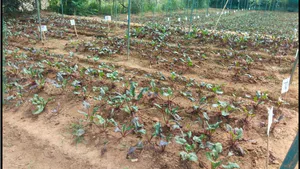
Seeds of 22 varieties and 8 hybrids of sugar beet were sown in protrays filled with growing media composed of coir pith and vermicompost in the ratio 1:1 (Plate 1). Twenty-one days old seedlings were transplanted into the main field at a spacing of 45 cm x 20 cm in raised beds. Farmyard manure was applied@20 t ha as basal. N, P and K were [email protected] t ha as basal. Remaining [email protected] t ha was applied as top dressing, when the plant started growing vigorously. Weeding was done at regular intervals. Intercultural operations such as shallow hoeing and earthing up was done to facilitate root growth. General view of the experimental field is shown in Plate 2.
2.5 Observations Recorded
The observations were recorded from five randomly selected plants from each plot in each replication for the characters viz. root shape (IPGRI, 1995), root length, root diameter, root weight, root: shoot ratio, yield per plot and crop duration.
2.6 Statistical Analysis
Statistical analysis was carried out for varieties and hybrids individually using MS-Excel, WASP 2.0, OPSTAT and WINDOSTAT. For estimation of different statistical parameters, following procedure and formulae were adopted:
Analysis of Variance
The mean values observed for root and yield characters of fifteen plants (5 plants per plot per replication) were recorded and tabulated. The observations recorded were subjected to ANOVA (Panse and Sukhatme, 1985) for comparison among various treatments and to estimate variance components.
ANOVA for each character
| Sources of variation | Degrees of freedom | Mean sum of squares | F ratio |
| Replication | r-1 | MSR | MSR/MSE |
| Treatment | t-1 | MST | MST/MSE |
| Error | (r-1) (t-1) | MSE | |
| Total | rt-1 |
Where, r = number of replications
t = number of treatments
MSR= mean sum of replication
MST= mean sum of treatments
Where, Student's 't' table value at error degrees of freedom at a level of significance.
III. RESULTS AND DISCUSSION
Tables 3 and Table 4 present the mean values for root and yield characters of sugar beet varieties and hybrids respectively. Significant differences were observed among the varieties and among hybrids for root and yield characters such as root shape, root length, root diameter, root weight, root: shoot ratio, yield per plot and crop duration.
3.1 Root shape
Among the 22 varieties, fifteen viz., Madhur, Detroit Dark Red, Ruby Queen (Nisco), Tetra, Ruby Queen (Tokita), Mahyco Lal II, K 5340, K 5343, Red Ruby, Red star (Condor), K 5341, Ruby Queen (Suvarna), Rachna, Ruby Queen (Sulthan) and Indam Ruby Queen exhibited circular shaped root, five viz., Lallan, Pure seeds, BV 20, BV 21 and Ruby Queen (Pradham Seeds) exhibited narrow elliptic shaped roots and two viz., Crimson Globe and Royal displayed broad elliptic shaped roots. Four hybrids viz., F1 Kingdom, Red Star (Sakura), RK 777, and Ragini exhibited broad elliptic shaped roots while F1 Kestral, Red Horse, Remo and Red Bull displayed narrow elliptic shaped roots. Ruboczki et al. (2015) reported sufficient variation among genotypes for root shape in sugar beet. Most of the varieties were circular in shape, which is favoured by not only the processing industry, but also the fresh market. Baranski et al. (2001) studied the diversity in a collection of 40 accessions of garden beet and reported circular root shape as the most common.
3.2 Root length
Among varieties, the longest root of 7.43 cm was recorded by Madhur, while the shortest by Lallan (3.03 cm). Among hybrids, the longest root of 7.41 cm was recorded by Red Star (Sakura) while the shortest by Red Bull (3.43 cm). These results are in consonance with Patel et al. (2015) and Coutinho et al. (2018) that considerable differences occur among sugar beet cultivars for length of root.
3.3 Root Diameter
The highest root diameter was observed for Madhur (5.33) and Ruby Queen (Tokita) (5.25 cm), Detroit Dark Red (5.16 cm) and Mahyco Lal II (5.15 cm) were statistically on par with it. The lowest diameter of 2.77 cm was recorded in Lallan. The mean root diameter was 4.33 cm. The average root diameter of hybrids ranged from 3.02 cm to 5.50 cm, with a mean of 4.36 cm. The highest root diameter was recorded in Red Star (Sakura) (5.50 cm), which was on par with Ragini (5.32 cm). The lowest root diameter of 3.02 cm was recorded in Red Bull. Varietal variation for root diameter in sugar beet was earlier reported by Coutinho et al. (2018). Root diameter has a positive effect on root yield, which is in line with the findings of Dongarwar et al. (2018) in radish. Yasaminshirazi et al. (2020) reported that roots with a diameter of 5 cm to 13 cm are considered for determining marketable yield in sugar beet. According to Baranski et al. (2001), market roots in garden beet defined roots with 4 to 8 cm diameter. The rapid increase in root width in radish is attributed by Alam et al. (2010) to translocation of more photosynthates from leaves to root.
3.4 Root Weight
Root weight ranged from 20.52 g to 118.05 g for varieties, with an overall mean of 57.63 g. The highest root weight was observed in Madhur (118.05 g), while the lowest in Lallan (20.52 g) (Fig. 2). Among the hybrids, the root weight ranged from 29.70 g to 91.27 g, with a mean of 62.80 g. The highest root weight was recorded in Red Star (Sakura) (91.27 g) and lowest in Red Bull (29.70 g) (Fig. 4). Root weight is a primary character to be considered in any crop improvement programme, as it directly contributes towards yield. Yield is influenced by growth and the potential of a cultivar or hybrid. Among the varieties and hybrids, the genotype with the longest root and the highest root diameter recorded the highest root weight also. This is in conformity with the results of Yasaminshirazi et al. (2020). Maximum root weight might be because of the genetic capacity of the genotype to make available higher assimilates for root development.
Cultivar differences in root length, root diameter and root weight are in line with the results obtained by Ijoyah et al. (2008), Patel et al. (2015) and Sharma (2013) in sugar beet; Poleshi et al. (2017) in carrot; Alam et al. (2010), Poudel et al. (2018) and Dongarwar et al. (2018) in radish. This could be attributed to the difference in genetic makeup of the different varieties and ecological conditions. In the case of hybrids, higher root weight per plant was due to more number of leaves for photosynthesis and efficient utilization of these photo synthates, might have enhanced the better root length, root width and root yield per plant. This is in agreement with the findings of Patel et al. (2015) in sugar beet and Alam et al. (2010) in radish.
3.5 Root: Shoot Ratio (Weight Basis)
The highest root: shoot ratio was recorded by Madhur (4.42) and the lowest by BV 21 (0.77). Among the hybrids, the highest root: shoot ratio of 3.61 was recorded by Red Star (Sakura) and the lowest by Red Bull (1.54). Similar varietal variation in root: shoot ratio was reported by Sharma (2013) in sugar beet.
3.6 Yield per plot
The highest yield per plot of 5.68 kg was recorded by Madhur and the lowest by Lallan (1.03 kg) (Fig. 1). The mean yield per plot was 2.14 kg. The average yield per plot of hybrids ranged from 1.67 kg to 4.27 kg, with a mean of 3.04 kg. The highest yield per plot was recorded by Red Star (Sakura) (4.27 kg) and the lowest by Red Bull (1.67 kg) (Fig. 2). According to Sharma (2013), root yield per plot is one of the most desirable traits with the highest consideration in any sugar beet breeding programme. Significant variation in yield per plot might be due to the difference in root length, root diameter and root weight, which are the important components of yield. These findings are in line with those of Sharma (2013) in sugar beet.
3.7 Crop Duration
Crop duration of varieties ranged from 96 days to 130 days. Early crop of 96 days duration was observed in Madhur, Tetra and Ruby Queen (Tokita). The varieties, Ruby Queen (Pradham Seeds), BV 20, BV 21, Pure Seeds, Ruby Queen (Sulthan), Rachna and Lallan were late to harvest (130 days). Among the hybrids, Red Star (Sakura), Red Horse and RK 777 recorded early crop (98 days) and Red Bull, late (130 days). Difference in crop duration may be due to the genetic composition of the genotypes. Ijoyah et al. (2008) linked the time of maturity to the genetic control of the sugar beet varieties, thus the difference in the length of time taken to remain at the vegetative phase before roots are initiated and become mature
IV. CONCLUSION
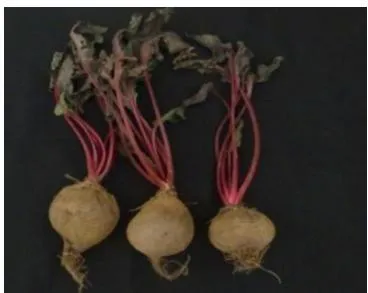
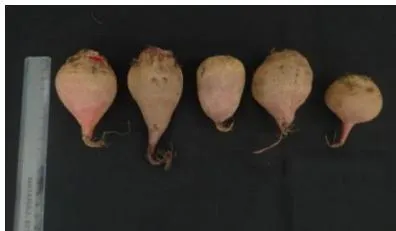
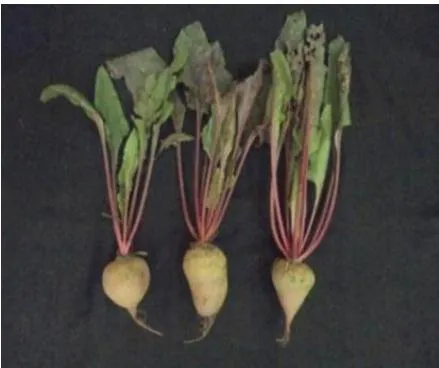
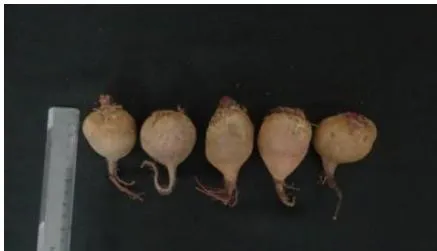
Based on the mean performance of the varieties and the hybrids for root and yield characters, Madhur, among varieties and Red Star (Sakura), among hybrids recorded the highest root length (7.43 cm, 7.41 cm), root diameter (5.33 cm, 5.50 cm), root weight (118.05 g, 91.27 g), root: shoot ratio (4.42, 3.61) and yield per plot (5.68 kg, 4.27 kg), respectively (Plates 3 and 4). Hence Madhur and Red Star (Sakura) were adjudged as the best performing variety and hybrid respectively, suitable for growing under humid tropical conditions.
Conflict of Interest
The authors declare no conflict of interest.
Ethical Approval
Not applicable
Data Availability
The datasets used in this study are openly available at [repository link] and the source code is available on GitHub at [GitHub link].
Funding
This work did not receive any external funding.
References
Cite this article
Related Research


Special Issue
Launch a focused special issue to highlight research, emerging trends, and expert insights in your academic field.