



IntelliPaper
Abstract
Bangladesh has been suffering from nutrition aspects, food-importing, biodiversity weakening, and cultivable land deduction. Bangladesh has been accepted the challenge of ‘production intensification’ for its gradual increasing people. More employment opportunity can be produced through ‘beekeeping-key crop joint enterprise’, Bangladesh can export more beekeeping products and agricultural biodiversity can be enhanced along with fulfilling nutritious aspect including food security. The research work by utilizing control and treatment plots counting 4 sample districts with 20 beekeepers and 32 Mustard farmers considering Apis mellifera. 125 GBP establishment cost and 315 GBP returns have been outcome through the investigation and 2.52 B/C, 152 IRR, £1413.70 NPV were found from the experiment. Mustard yields were increased by 11%, 13%, 15%, and 9% from the treatment plots established in Sirajgonj, Pabna, Faridpur, and Kushtia districts respectively (comparing equal 400 ha ‘control Mustard plot’ for each district). The extra incomes (considering honey production from Mustard crop) were 840020 GBP, 153280 GBP, 21840 GBP, and 2340 GBP in Sirajgonj, Pabna, Faridpur, and Kushtia districts, respectively. In the case of the whole of Bangladesh data, the best box establishing year was 2016-17 (134795; total beebox established), and the best honey production year was 2015-16 (1256149 kg) compare to other years. Whereas, the lowest bee box establishment year and honey production year is 2019-20 with 96,980 bee box number and 560869 kg honey (less than half compared to 2015-16). Black cumin and Mustard fields are utilizing better than other crops.
Explore Digital Article Text
Introduction
Bangladesh is positioned between and north latitude and and east longitude and it is one of the developing countries situated in South Asia. Bangladesh possesses a area with 161.4 million populations (BBS, 2016) and growth rate (BBS, 2020). The present cultivable land area is 8,100,000 ha. In 2025, the population will stand as 190 million and Bangladesh has to provide 30.15 million M ton food from 6,900,000 ha cultivable land. In 2050, Bangladesh will possess 4,800,000 ha cultivable land and will face the challenge to feed its (assumed) 250 million people providing 40.25 million M ton food (DAE, 2020). Although Bangladesh has taken the challenge to feed the nation praisefully, more pragmatic steps is needed for future concern.
The total ‘Gross Domestic Product’ of this country is led by industry , agriculture , and services along with a GDP growth rate. It is a matter of concern that, of people still live beneath the low poverty line and below upper poverty line. Moreover, 2.7 million economically active jobless people have been turning into a burden for this country (BBS, 2018). The following GDP generated sector is Agriculture and mainstream people linked with various agricultural practices. In Bangladesh, people prefer rice cultivation historically but though rice is the key species generally grown in Bangladesh, it is anticipated that some other rural activities among Bangladeshi farmers and community would be beneficial. Apiculture and ‘beekeeping-main crop joint enterprise’ can be referred to as profoundly lucrative here, as this operation ensures stronger quality products, lower initial investments, and higher profitability especially (Islam et al., 2016).
“Beekeeping- (honeybees) pollinated crops joint enterprise”- is showing bright horizon within Bangladeshi agriculture and this enterprise is possible to embrace by any level of education, gender, age, marital status, and religious people. Maximum rural areas are promising for beekeeping or bee box establishment during flowering seasons of various bee pollinated crops in Bangladesh. As part of the farmer motivation program implemented by the ‘Bangladeshi Government through the Department of Agricultural Extension (Ministry of Agriculture)’, ‘beekeeping- key crop joint undertakings data recording’ has been introduced since 2015-16. ‘Beekeeping with insect-pollinated crops’ could be brought a major shift in the overall agriculture of Bangladesh. This business, along with natural methods, aims to increase biodiversity and many farmers are already engaged and supported in this activity. Moreover, the subject is important because:
(1) There are fascinating prospects for the incorporation of apiculture with insect-pollinated crop cultivation regarding accessibility, sustainability, and food security.
(2) Biodiversity and the smooth protection of the environment are very important for Bangladeshi agriculture nowadays.
(3) The small farmers’ community is being formed and there is an enormous prospective for improving the welfare of poor farmers by interacting with this undertaking. There are multidimensional ways to involve more and more people in this business.
(4) Bangladesh may meet the demand for nutrition from further honey production integrating with key crop cultivation and may export honey, honey by-products.
Thus, under apiculture-main crop joint enterprise there is the immense potentiality to prove these pollinated crop areas ensuring food safety. Besides, the Research Project links to and interacts with some contemporary debates believed by common Bangladeshi people. The researcher wants to respond to the interrogation: “Can beekeeping brings enhancement regarding overall production of insect-pollinated crops through the combined beekeeping-crop production joint system in Bangladesh?” and “does ‘beekeeping’ become an excellent way of income generation or poverty reduction also touching the issues like food security and sustainability for the Bangladeshi people?”
Moreover, the recorded data is showing that beekeeping practice remains ‘stable to decrease’ in figure with consecutive years (as per the fellow’s investigation). Therefore, the fellow felt the interest to re-investigate the sustainability of the ‘Beekeeping-key crops joint enterprise’ in Bangladesh.
Methodology
Research Design
The study was conducted during the 2019–2020 academic year at the Field Science Laboratory, Royal Agricultural University, located in Cirencester, Gloucestershire (GL7 6JS), United Kingdom. The research design was constructed on focusing to make a link between introducing ‘mobile beekeeping’ as an income diversification for beekeepers and bee pollinated crops and as a way of pollination of key crop species in Bangladesh. The researcher bears interest in his mind is to evaluate how such intervention could create an impact on nutrition security in local communities along with food safety measures. The following issues were considered while concentrating to build up the research design:
Taking strategy for covering insect pollinated crop area (400 ha land along with beekeeping integration (with 200 bee boxes), analyzing the production for both ‘crops and honey’ from the land, and considering further steps for sustainability of this enterprise. Here, 4 districts are going to be considered as the representative locality of Bangladesh along with interpreting the data based on control and treatment design.
Making prospects and progress analysis of beekeeping integration with selected crops based on the last 4 to 8 years data considering various bees pollinated key crops of Bangladesh.
Considering improvement assessment and evaluation of overall productions and outcomes from this enterprise.
Biodiversity, income generation (employment opportunity assessment) and Nutrition aspect.
Concentrating on ‘resilient strategy’ and ‘policy implementation’ for more expansion of this integration.
Therefore, the experimental design is built with both quantitative and qualitative nature. The whole research design is going to be illustrated and depicted gradually with a systematic progress addressing chapter by chapter.
Study Area and sampling
The fieldwork associated with this Research Project attempts to investigate the cost and benefits of beekeeping in Sirajgonj, Faridpur, Pabna, and Kushtia districts as representative samples selecting from the 64 total districts of Bangladesh (Fig. 2.1). So, fieldwork was conducted in these districts considering both control and treatment design, and the researcher fixed up Mustard fields for his field work activities as a representative crop that was selected from other bee-pollinated key crops of Bangladesh. one representative map showing 4 districts in the map of Bangladesh given in the following:
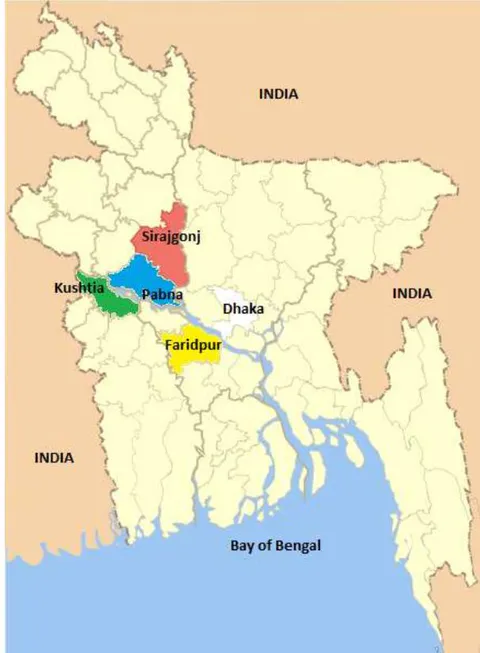
Study area identified in Bangladesh map
These 4 representative districts are selected based on the following criteria and one districts grading representing in Table 2.1:
Where (in which districts) 1. Mustard, 2. Litchi, 3. Onion, 4. Coriander, 5. Mango and 6. Black cumin fields (maximum specific bee-pollinated crops) are being used as bee-pollinated crops with beekeeping enterprise in an integrated way.
Minimum 200 bee boxes are being established and 400-500 ha Mustard land were covered by these boxes from the year 2015-16 to 2019-20 (last 5 years).
The district choosing parameters were fixed based on ‘high to low’ mustard cultivation level and ‘high to low’ productivity considering the last 4-8 years data (mustard plus honey conjugate production).
| District Category or Grade | Cultivated Mustard crop area (ha) | Apiculture covered mustard area (ha) | Number of established bee box | Representative District |
|---|---|---|---|---|
| A | 50,000 | 17,000 | 16,700 | Sirajgonj |
| B | 30,000 | 5,000 | 5,600 | Pabna |
| C | 8,500 | 2,500 | 2,800 | Faridpur |
| D | 6,500 | 1,000 | 350 | Kushtia |
Making District Grades based on average of last 5 years data (2015-16, 2016-17, 2017-18, 2018-19, 2019-20, Season: winter, Crop: Mustard).
Study Species
In case of crop or plant species
A wide-ranging variety of bee pollinated crops or plants is existing throughout the country; the important species are Brassica napus L. (Rapeseed) and Brassica campestris (Rapeseed or field mustard), Brassica juncea (mustard) and Brassica nigra (Black Mustard), Litchi chinensis Camb. (Litchi), Mangifera indica (Mango), Moringa oleifera Lam. (Drumstick), Helianthus anus L. (Sunflower), Nigella sativa (Black cumin or Black seed), Coriandrum sativum L. (Coriander), Allium cepa (Onion), Sesamum indicum (Sesame), Ziziphus zizyphus (Jujube)- (along with some species of Sundarban: World’s largest Mangrove forest) are very common.
These plant species are well fitted with ‘mobile beekeeping’ but all the above-mentioned species may not do well enough when beekeepers usually set their bee boxes in huge numbers in an enterprising way.
Therefore, this research paper has tried to cross-check concerning feasibility with these crop species if beekeeping is well fitted with these aforesaid crops or not. In this case, the researcher has given much focus especially on the crops: Mustard (all Brassica genus considered here as Mustard), Black cumin, Coriander, Onion, Mango, and Litchi and has given most of his emphasis on Mustard crop.
In case of bee species
There are mainly 4 types of bee species available in Bangladesh from which people generally collect honey: Apis florae, Apis dorsata, Apis cerana, and Apis mellifera; along with some trigona genus. Apis mellifera and Apis cerana are used as ‘beekeeping activities’ with main crops in an integrated way.
The researcher came to know by following other papers and practical experiences that, Apis mellifera is more productive than that of Apis cerana.
Maximum mobile beekeeper groups use and prefer Apis mellifera for their enterprise.
There are some barriers to set up and to take care of the Apis cerana bee boxes (in a condense way within the main crop fields).
The researcher selected Apis mellifera for conducting his research for these logics and he identified and selected only Apis mellifera ‘bee keepers group’ and avoided Apis cerana beekeepers for his fieldwork. One treatment and control plot was established during the period of research presented in Table 2.2.
| Design | Established Bee Box Number: | Mustard Area Covered by bee boxes | Remarks |
|---|---|---|---|
| Treatment | 200 | 400 ha with 200 bee boxes | Bee species: Apis mellifera. Crop: Mustard Data Year: 2015–16 to 2019–20. |
| 1-3 Control | 0 | Control= 400 ha (exclude of bee boxes) | |
| Total treatment plot = 400 ha*4 districts with 200*4 bee boxes | |||
| Total control plot = 400 ha*4 districts (without bee boxes) | |||
| Total number of beekeepers group = 5*4 districts = 20 | |||
| Total number of land owner/farmer = 8*4 districts = 32 | |||
The Respondents
The respondents were used in this Research purpose (5 categories):
Mobile Beekeepers: 20 beekeepers’ groups (from 4 different districts) were given interview with the researcher.
Mustard Crop Field Owners/farmers: The researcher has taken opinion from 32 beekeeping corresponding farmers from previously mentioned 4 districts. Here, 32 is the total number of land owners/farmers. 16 are from control plot (land) and other 16 land owners are from treatment plot (land).
Sub Assistant Agricultural Officer (SAAO) at Upazilla (Sub-district level): 10 SAAO were helped to this fieldwork by providing their practical observation and suggestions including making validation of beekeeper’s experiences related to technical terminology.
The 8 Developers or SAAO from 4 aforesaid districts were also respondents in these fieldwork activities for providing districts’data who are engage in’district level office’of Department of AgriculturalExtension”
Upazilla Agriculture Officer: Such kind of 10 offices was selected and taken interview regarding their way of motivation and they were selected from the whole of Bangladesh.
In this research activity, the fellow has selected 5 beekeeper groups and 8 farmers for each sample district and total number of bee keepers groups and farmers were 20 and 32 respectively. The semi-structured interview was taken with them to collect the data and simple questionnaires were designed for the first two categories of respondents and these two groups of respondents were the main focus of the fellow.
Fixing and selecting the “size and structure” of beehive
It was significant to select and fix the characteristic of the bee box before the beginning of the fieldwork because the technical terms could make confusion and the ideas generally go different area to area and ‘beekeepers to beekeepers’. In this circumstance, the researcher needed to be ensured for the exact setting of his parameters regarding standardization and further calculation. During the period of research, the 8-11 frames consisting simple bee boxes are selected for fieldwork presented in Fig. 2.2.
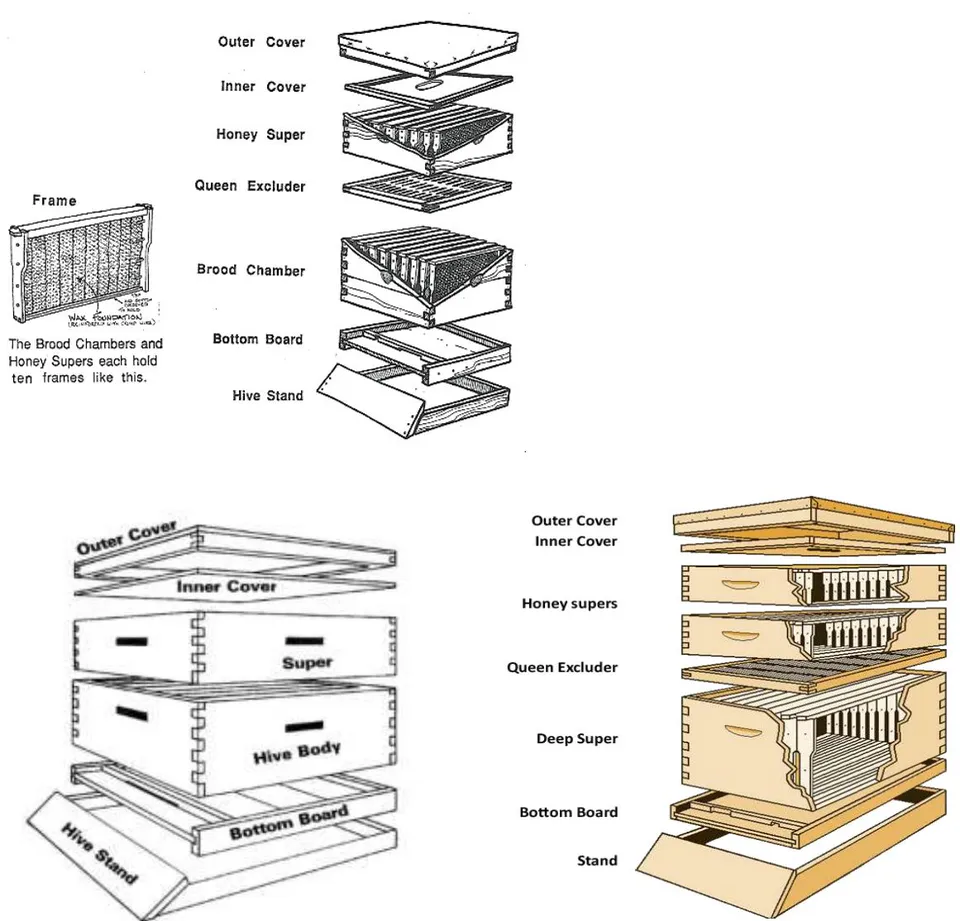
The 8-11 frames consisting simple bee boxes are selected for fieldwork
The bee boxes were observed deeply from total 20 beekeeper groups and characteristics of the bee boxes ensured that:
Number of frames (average 8-11 frames for per box mid medium to high medium sized).
There was approximately the same space within all of the boxes.
What beekeepers are mentioning by hive/colony (as a sense of box per colony is meant by per box with single queen).
Box’s stuff material or wood type (mainly consist of jackfruit or mango tree wood)
Numbers of bees per box (average assumption): more than 20,000 bees
How many crops area really covered by these bee box (researcher has selected 200 boxes per 400+ha crop land and this ratio was same for all of the 4 selected sample districts).
Data Collection
Primary data were analyzed from the respondents (including District level agriculture office of Sirajgonj, Faridpur, Pabna, and Kushtia, directly and from the other departments like crops field services horticulture, and planning wings of DAE, Bangladesh). Some secondary data were collected from DAM, AIS, BIRTAN, BIA, Institute of Nutrition and Food Science, University of Dhaka including some small-scale industries related to honey business. Primary data were collected through questionnaire survey. Apis mellifera bee species is used for calculating the investment and return of beekeeping. Materials and methods were followed based on feasibility progress while beekeeping was practicing with bee-pollinated key crops from 4 selected districts and these districts should represent the overall scenario of Bangladesh regarding this apiculture crop integration enterprise.
Moreover, food security, nutrition aspects for the common people, prospects, etc. other significant issues were kept deeply under consideration and concentration. Data were also collected from BSCIC, Bangladesh Beekeepers Welfare Cooperative (Bengali: Bangladesh Mou Chashi Kalyan Somity). Therefore, the fellow used both the primary and secondary methods of data collection.
Currency value is calculated in
£(GBP) assuming, GBP.
Data collection period was early December 2019 (bee box setup time winter 2019) to September 2020 (including various secondary and supportive information collection period).
Cost and Benefit factors of beekeeping
Average charge issues or different costs of Beekeeping (year-round) per box (or per colony) for Apis mellifera are presented in Table 2.3.
| Cost of items | Type of cost | Parameter | |
|---|---|---|---|
| Total bee cost with bees and queen bee | Wooden box with 8–11 frames (30 £ to 63 £) | Fixed cost | Jackfruit wood bears high demand and price with best quality. (Lowest box cost 42 £ to highest 75 £). Per frame is sold 6–7 £ |
| 2-2 | Bee colony with queen bee (10–14 £) | ||
| Feed (Sugar) 2,000 to 3,000 £ cost for 100 to 200 boxes (Feeding is done for 5–6 months in a year) | Variable cost | Cost estimated based on per box through general arithmetic division | |
| Labour | Family supplied | Variable cost | Cost is same up to 200 boxes and more (counting 2 persons permanent and 2-person daily basis+ leader beekeepers). Cost estimated based on per box through general arithmetic division. |
| 2-2 | Hired assistant took 60–90 £ for per active month (season), Some other assistant takes salary 6–8 £ on daily basis. | ||
| 2-2 | 2,000 £ labour cost was for lodging boarding purpose for per 5 men. | ||
| Fixtures (bee veil 6£, Hand gloves 6£, Knife 2£, Brush 1£, Buckets 1£, Smoker 6£, water holder 1£, stand 2£, container 3£, net 1£, filter 1£, bottle 2£ and so on etc.) | Fixed cost | Cost is same up to 200 boxes. Cost estimated based on per box through general arithmetic division. | |
| Honey extractor machine and other minor processing equipment cost (New honey extractor price = 70 £); calculation assuming one bee group is starting their business with 25 boxes. | Fixed cost | Cost is same up to 200+ boxes. Cost estimated based on per box through general arithmetic division. | |
| ((Continuation)) | |||
| Cost of items | Type of cost | Parameter | |
|---|---|---|---|
| Transportation (for 150–200 boxes 200–250 £, at least 2–3 times transportation is needed). | Variable cost | Cost is same up to 150–200 boxes. Cost estimated based on per box through general arithmetic division | |
| Paying cost to corresponding farmers or land owners. For 100–150 boxes the paying cost was 20£ | Variable cost | Cost is same up to 200–400 ha of land or mutual conducting process with farmers | |
Financial Analysis
The costs and benefits of beekeeping were calculated for one-year year-round (2019-2020) and were evaluated through general financial techniques. The mean value of costs and benefits were measured for calculation of Net Present Value (NPV), Internal Rate of Return (IRR), Return of Investment (ROI), benefit and cost ratio, and correlation of yield and cost variables.
[Where “r” is the discount rate as the rate of inflation or interest rate, “t” is the period of the project or enterprise or the figure of years in the upcoming the cash flow, F is the future cash flow or value, PV is the present value]
IRR % = i
[IRR % can be achieved when sum of NPV becomes 0]
Discount Factor formula: or
Discount Factor
Where, discount rate, number of years, number of compounding time of a discount rate per year.
Here, PV is meant present value or Initial Investment Cost .
NPV is the net present value,
is the discount rate and FV is future value.
NPV calculated at discount rate and IRR percentage can be attained when the sum of NPV is 0. ROI is a yearly return of investment and
B/C is the ratio of present value benefit and cost, or Benefit Cost Ratio .
Entire data were calculated by using MS Excel 2016 and SPSS Version V27.
Results and discussion
Socio-economic distribution of beekeeper/Basic Profiles of Beekeepers
Number of total Beekeepers group (Leader Beekeepers): from aforesaid 4 districts. Some basic profiles of beekeepers were identified during research were presented in Table 3.1.
| Subject | Parameters | Numbers | Remarks |
|---|---|---|---|
| Age of the Beekeepers (Leader of the group) | 18–29 years | 4 | |
| 30–50 years | 10 | ||
| more than 50 years | 6 | ||
| Educational Status of the Beekeepers | bellow secondary | 7 | |
| secondary –to-higher secondary | 8 | ||
| more than higher secondary | 5 | ||
| Length of Beekeeping Farms or Beekeeping experience | less than 5 years | 4 | |
| 5 years to 12 years | 12 | ||
| more than 12 years | 4 | ||
| Occupational Status of the beekeepers | full profession | 17 | |
| part time profession | 3 | ||
| Training Status of the Beekeepers | Well Trained (NGO/Gov.) | 9 | |
| Basic Trained (local NGO) | 7 | ||
| Trained from trained or experienced beekeepers | 4 | ||
| Total bee box number owned by beekeeping groups (n=20) | less than 150 boxes | 4 | |
| 150 to 250 boxes | 8 | ||
| more than 250 boxes | 8 | ||
| Home district of the leader beekeepers (....part or Division of Bangladesh) | Khulna, Satkhira | 14 | |
| Khulna, Jessore | 2 | ||
| Dhaka, Munshigonj | 2 | ||
| Sirajgonj, Rajshahi | 2 | ||
| Number of assistant beekeepers in group | 1–4 person | 12 | |
| more than 4 persons | 8 |
From Table no. 3.1, data reveals that beekeeper groups selected from these research areas kept more than 150 boxes by maximum groups. They came from Satkhira district. Maximum groups consist with 1-4 assistant beekeepers and they have taken the profession as full time occupation. Maximum beekeepers’ age was 30-50 year and most of them experienced in this sector for around 12 years. It seems a good number of beekeepers are well educated.
Socioeconomic status of engaged Mustard Farmers
Mustard land area was 400 ha with 4 land owners/farmers for control plot and another 400 ha land was selected with another different 4 land owners/farmers for treatment plot for each of the representative districts.
| Subject | Parameters | Land owner or farmer under (Numbers, Total Number = 32) | Remarks: [(8 farmersX4 districts= 32) and (16X2=32)] | |
|---|---|---|---|---|
| 3-4 | Control (n = 16) Farmers without Beekeeping | Treatment (n = 16) Farmers with Beekeeping integration | ||
| Age | 18–34 years | 8 | 5 | |
| 35–54 years | 6 | 6 | ||
| more than 54 years | 2 | 5 | ||
| Educational status | less than secondary | 10 | 9 | |
| secondary to higher secondary level | 4 | 5 | ||
| more than higher secondary level | 2 | 2 | ||
| Total Land Area Owned (Mustard + other crop land) | less than 40 ha | 5 | 6 | |
| 40 ha to 150 ha | 7 | 5 | ||
| more than 150 ha | 4 | 5 | ||
| Length of farming experience | less than 10 years | 8 | 5 | |
| 10 to 25 years | 6 | 6 | ||
| more than 25 years | 2 | 5 | ||
| Attitude to beekeeping enterprise to their fields | highly positive | 2 | 5 | |
| Positive | 6 | 8 | ||
| Negative | 4 | 0 | ||
| does not enough knowledge | 4 | 3 | ||
| Practice on High Yielding Variety (HYV) cultivation of different crops | practicing highly | 4 | 6 | |
| moderate practicing | 8 | 8 | ||
| does not practicing HYV | 4 | 2 | ||
| Occupation beyond farming | full time farmer | 14 | 12 | |
| other business with farming | 2 | 4 | ||
Table 3.2 depicts the basic profile of the farmers who are engaged with providing their Mustard land for beekeeping undertaking. Farmers’ education level was generally under secondary level but a good number of them express their positive attitude towards beekeeping-key crop joint enterprise. Maximum farmers possessed more than 40 ha Mustard land belongs to them. Table more implies that a good number of farmers who are doing cultivation with moderate variety to HYV. Fig. 3.1 represented the year-round time distribution-maintained movement of mobile beekeepers (Common orientation scenario of bee boxes in the key crop fields).
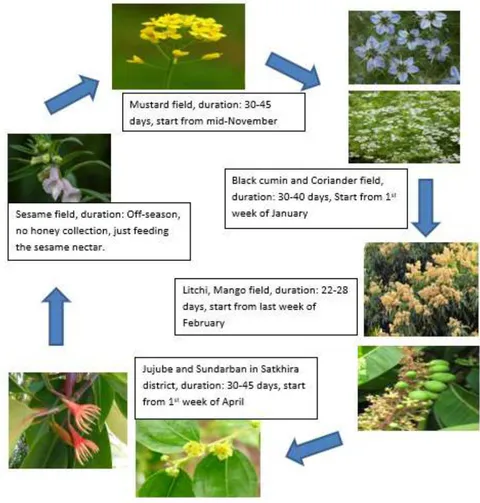
Year-round time distribution-maintained movement of mobile beekeepers (Common orientation scenario of bee boxes in the key crop fields)
Cost and Return of Beekeeping
Average cost of Beekeeping
Average cost of Beekeeping per year (year-round) per medium sized box (or per colony) for Apis mellifera: (Establishment cost for the starting year) showing in the Table 3.3.
| Cost of items | Cost (GBP) | Type of cost | Remarks | |
|---|---|---|---|---|
| Cost of items | Cost (GBP) | Type of cost | Remarks | |
| Total bee cost with bees and queen bee | 65 | Fixed cost | Parameters and basements were described in Methodology part | |
| 1-4 | 13 | Variable cost | ||
| 1-4 | Family supplied | 15 | Variable cost | |
| 2-2 | Hired | |||
| 1-4 | 5 | Fixed cost | ||
| 1-4 | 7 | Fixed cost | ||
| 1-4 | 15 | Variable cost | ||
| 1-4 | 5 | Variable cost | ||
| Total | 125 £ | |||
Table 3.2 states that was the average establishment cost of beekeeping enterprise using Apis mellifera species (considering year-round operation and medium sized colony).
Returns from beekeeping
Table 3.4 presented the returns from beekeeping using Apis mellifera (considering at least 3 crops, yearround & per box/colony).
| Return items | Calculation | Remarks | ||
|---|---|---|---|---|
| 2-4 | Amount (kg) | Price (GBP/kg) | Value (£) | |
| Honey | 48 | 4.75 | 228 | Per kg honey price varies from 1.5£ to 10£ depending on business linkage. |
| Beeswax, Comb and Comb Honey | 5 | 3 | 15 | Comb honey is gaining popularity. |
| Colony or Total box | 1 set | 65 | 65 | Bees’ number generally increases each year. One frame sells for 6–7£. Box lasts 10–14 years with good wood. Royal jelly (10 gm) ≈ 25£; queen bee ≈ 25£; pollen ≈ 70–80£ per kg. |
| 1-4 Properties (tools, accessories) and other income | avg. | avg. | 3 | |
| 1-4 Royal jelly, pollen, propolis venom | avg. | avg. | 4 | |
| Total | 315 £ | |||
Therefore, the researcher can conclude from table 3.4 that 315 GBP is the average return from beekeeping for Apis mellifera species.
3.5 Gross Return, Net Return, IRR, ROI, NPV, and Ratio Calculation:
Net return (here, as data are counted based on single year).
B/C ratio (gross return/cost).
B/C ratio will increase up to 10–15 years.
NPVB (Net Present Value; based on Benefit) calculation discount rate, up to 6 years:
| Time period (year) | 1 | 2 | 3 | 4 | 5 | 6 |
|---|---|---|---|---|---|---|
| Cash flow (Gross Return basis) = | £ 315.00 | £ 335.00 | £ 370.00 | £ 420.00 | £ 460.00 | £ 500.00 |
| NPV = | £ 1,413.70 | |||||
| Discount Factor | 0.9090909 | 0.82644628 | 0.751315 | 0.683013 | 0.620921 | 0.564474 |
Table 3.5 addresses the Net Present Value associated with beekeeping business. NPV was calculated based on discount rate as Bangladeshi financial institutes do not provide more than . B/C ratio will show promising figure up to 12–15 years. Assuming 315 GBP incomes, NPV revealed 1413.70 GBP for 6 consecutive years. Discount Factors (DF) are showing systematic indications from beekeeping enterprise.
Productivity of the bee boxes
A comparative study was conducted for the productivity of the bee boxes showing in Table 3.6.
| Net Return counting from 2nd year onward (Year-Round= at least 3 seasons) (Single box making cost 65£) | |
|---|---|
| Lowest: Beekeeper can start with 5 boxes. Minimum establishment cost is 300 GBP and Net return will be 700–800 GBP with B/C = 2.33 (avg). | For 100 Boxes: Total honey value = 15,000£ Operational cost = 5,000£ B/C = 3.0 |
| From 50 boxes: 1500 kg (Mustard) + 400 kg (Coriander/Black cumin) + 250 kg (Litchi) + 350 kg (other) = 2500/50 = 50 kg/box. Total honey value=9,500£ MINUS 3,500£ (operational cost) = 6,000£ (net return). B/C= 2.71 | Highest Found: From 200 boxes: where gross income was 32,000 £ and operational cost= 8,000£ B/C = 4.00 |
Correlation Discussion
Furthermore, the correlation between box number and profit is 0.995093 with positive figure. So, income generation and established box number are highly correlated with each other. This enterprise goes with 6-7-month operation and the rest of the time the beekeepers expense their period through feeding and managing the honeybees. These kinds of activities are also part of their total activities.
Profits start to increase from the second year onwards beyond the first-year establishment cost. Some beekeepers make small groups by summing up themselves and thus make an increase in their total box numbers. From the second year, beekeeping cost starts to relate with lodging cost, transport cost, labour cost, and bee management cost including feeding.
KG unit gets more preference than that Liter’s honey production unit all over the country. The correlation graph reveals that more box numbers lead to more profit. Honey price varies from 1.5 GBP to 11 GBP (per kg honey price). If beekeepers able to do good linkage or better marketing options, they can get double or more than double the price for their honey.
Again, environmental and overall weather condition is a very crucial factor for honey production from the relevant flowers. Generally, beekeepers show anxiousness in the rainy season.
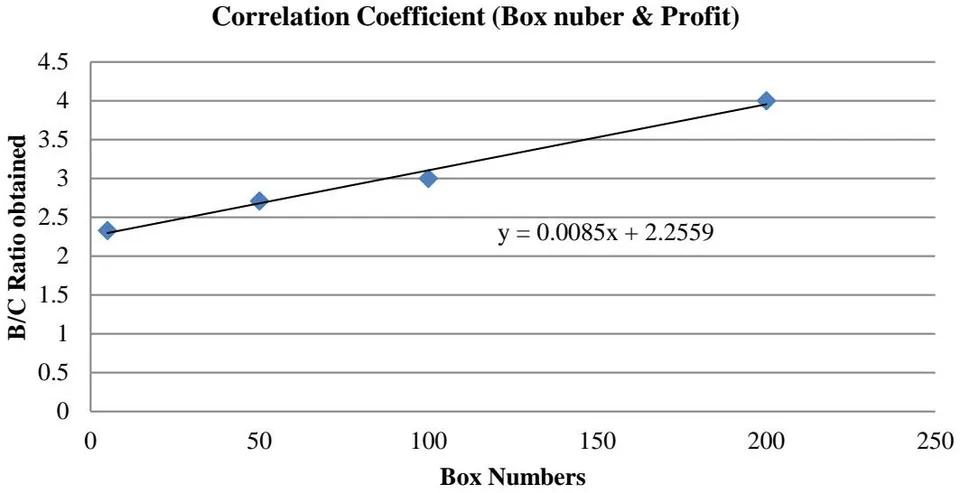
Correlation between box number and profit (0.995093)
Therefore, everything depends upon ‘maximum crop species coverage’ or year-round more movement of beekeepers, present environmental condition, linkage status, and farmers’ assistance in overall beekeeping management.
Treatment and Control
A representable data from treatment and control plots during the research period represented in Table 3.7.
| SL | Experiment District | Treatment Plot (200 bee boxes in 400 ha Mustard land) | Treatment Plot (without bee box, 400 ha Mustard land) | Yield increase (%) compared with control plot | ||
|---|---|---|---|---|---|---|
| 3-6 | Production (M ton) Mustard | Yield (M ton/ha) | Production (M ton) Mustard | Yield (M ton/ha) | ||
| A | Sirajgonj | 592 | 1.48 | 548 | 1.37 | 11% |
| B | Pabna | 584 | 1.46 | 532 | 1.33 | 13% |
| C | Faridpur | 572 | 1.43 | 512 | 1.28 | 15% |
| D | Kushtia | 588 | 1.47 | 552 | 1.38 | 9% |
District’s total Production and Yield of Mustard and Comparison
A comparative study of the district wise total Production and Yield of Mustard were represented in Table 3.8.
| Sl | Area | 2019–20 | 2018–19 | 2017–18 | 2012–13 to 2016–17 average | ||||
|---|---|---|---|---|---|---|---|---|---|
| 3-10 | P | Y | P | Y | P | Y | P | Y | |
| A | Sirajgonj | 52680 | 1.45 | 50575 | 1.23 | 48560 | 1.20 | 46410 | 1.10 |
| B | Pabna | 31470 | 1.45 | 29555 | 1.24 | 25987 | 1.20 | 23550 | 1.22 |
| C | Faridpur | 8500 | 1.42 | 8090 | 1.30 | 7510 | 1.15 | 7315 | 1.10 |
| D | Kushtia | 7510 | 1.46 | 6750 | 1.45 | 5530 | 1.40 | 5490 | 1.33 |
| Bangladesh | 568765 | 1.42 | 521638 | 1.31 | 477268 | 1.27 | 468300 | 1.21 | |
Data Source: Crops wing and Field Services wing of DAE.
Evaluating Extra Income (district wise, 2019-20, from only Mustard field)
During research, one evaluation was carried out, which represent in the Table 3.9.
| Sample Districts | Sirajgonj | Pabna | Faridpur | Kushtia | Bangladesh (Total) |
|---|---|---|---|---|---|
| Mustard cultivated Total land (ha) | 52680 | 31470 | 8500 | 7510 | 568765 |
| Mustard land under beekeeping enterprise (ha) | 25905 | 3410 | 1060 | 395 | 92484 |
| Mustard Land without beekeeping (ha) | 26775 | 28060 | 7440 | 7115 | 476281 |
| Mustard yield from “land under beekeeping” (M ton/ha) | 1.52 | 1.51 | 1.49 | 1.53 | – |
| Average Mustard yield (M ton/ha) | 1.45 | 1.45 | 1.42 | 1.46 | 1.42 |
| Total Mustard production (M ton) | 76386 | 45631 | 12070 | 10964 | 807643 |
| Total Mustard production from “land under beekeeping” (M ton) | 39375.6 | 5149.1 | 1579.4 | 604.35 | 134102 |
| Mustard price from “land under beekeeping” (Million GBP) | 19.6879 | 2.5746 | 0.7898 | 0.3022 | 67.051 |
| Box number established in mustard field | 17980 | 3550 | 5330 | 295 | 66397 |
| Honey production from Mustard (kg) | 210005 | 38320 | 5460 | 585 | 476767 |
| Price of produced honey (Million GBP) (Base: around 4£ per kg) | 0.84002 | 0.15328 | 0.02184 | 0.00234 | 1.90707 |
| Total production value from “land under beekeeping” (Million GBP) | 20.528 | 2.728 | 0.812 | 0.305 | – |
| Mustard price from beekeeping excluded land (GBP) | Only Mustard’s value as same as whole district; per M ton Mustard price = 500 GBP | ||||
| Extra Income from “land under beekeeping” compared to | 840020 £ + | 153280 £ + | 21840 £ + | 2340 £ + | Extra product |
| beekeeping excluded/control land (GBP) | Value added* | Value added* | Value added* | Value added* | (Honey) value: |
| (4.60%) | (4.0%) | (4.70%) | (4.0%) | 1907068 £ | |
*Value added from increased Mustard’s yield (4.60%, 4.0%, 4.70%, 4.0% respectively). Mustard price = 500 GBP per M ton.
Table 3.7 shows that Mustard yields were increased by , , , and from the treatment lands (plots) established in Sirajgonj, Pabna, Faridpur, and Kushtia districts respectively (comparing other 400 ha control Mustard land or plot for each district).
In Table 3.8, Mustard’s total production (of these districts) were analyzed where it is clear that Mustard yield was 1.10 to ton/ha (average) from these districts (before 2016-17) but the yields have been increased in the recent years as 1.42 to 1.46 (average from the districts). We can find the same type of outcome while considering the whole Bangladesh Mustard yield.
Table 3.9 consists of detailed information linked with extra income evaluation from the ‘beekeeping-key crop joint enterprise. For this purpose, the fellow has selected the previously mentioned 4 districts from a total of 64 districts of Bangladesh. Besides this, whole Bangladesh was addressed in the right-hand last column in this table.
The table outlines that the figures 25905, 3410, 1060, and 395 were the total beekeeping covered Mustard land (unit:ha) from Sirajgonj Pabna, Faridpur, and Kushtia districts (respectively, & for the year 2019-20). Respectively the established box numbers were found as 17980, 3550, 5330, and 295 from the full territory of these districts. Profits were evaluated considering per M ton Mustard price as 500 GBP and per kg honey price as 4 GBP both for the sample district and the whole of Bangladesh. The extra income was calculated only from ‘honey production’ and only for ‘mustard crop’. The extra incomes (only considering honey production from Mustard crop) were 840020 GBP, 153280 GBP, 21840 GBP, and 2340 GBP in Sirajgonj, Pabna, Faridpur, and Kushtia districts, respectively. This amount added extra value with Mustard prices in these districts along with , , , and increased yield in Mustard (considering the sequential name of the districts). The figure would become 1.90707 million GBP as extra income from beekeeping enterprise only from Mustard’s honey regarding the whole territory of Bangladesh.
Honey Production Scenario with years in Bangladesh
Calculation and Data Analysis basement
| Crops | GBP/kg Honey | Remarks |
|---|---|---|
| Mustard | 3.00 | Avg. 3.60–3.70 GBP/kg honey, Considering both: Apis mellifera & Apis cerana Any size of box (So, it is better to use per colony) |
| Black cumin | 6.00 | |
| Coriander | 4.00 | |
| Onion | 3.00 | |
| Mango | 3.00 | |
| Litchi | 5.00 |
Year: 2016–17 (Whole Bangladesh Beekeeping Data)
| Crops | Cultivated Land (ha) | Land under beekeeping (ha) | Number of established bee box | Honey Production (kg) | Honey price (GBP) |
|---|---|---|---|---|---|
| Mustard | 551,150 | 145,427 | 78,955 | 756,453 | 2,161,294 |
| Black cumin | 14,791 | 9,057 | 12,343 | 125,523 | 717,274.3 |
| Coriander | 47,085 | 11,256 | 15,477 | 176,365 | 671,866.7 |
| Onion | 213,200 | 788 | 401 | 320 | 914.2857 |
| Mango | 160,136 | 550 | 755 | 3,194 | 9,125.714 |
| Litchi | 26,990 | 5,625 | 26,864 | 121,702 | 579,533.3 |
| Total | 1,013,352 | 172,703 | 134,795 | 1,183,557 | 4,140,009 |
Bee box establishment and Honey production scenario in 2016–17
Year 2017–18: (Whole Bangladesh Beekeeping Data)
This year box establishment and honey production target were fixed according to the previous year achievement.
| Crops | Land Cultivated (ha) | Land Under Bee culture (ha) | Honey Box Set Up Target (No.) | Establish Honey Box Number | Honey Production Target (kg) | Honey Achieved (kg) | Extra Value of Honey (£) |
|---|---|---|---|---|---|---|---|
| Mustard | 477,260 | 92,059 | 80,000 | 65,591 | 700,000 | 512,320 | 1,463,771 |
| Black cumin | 12,142 | 2,611 | 13,400 | 8,915 | 114,000 | 22,158 | 126,617.1 |
| Coriander | 39,591 | 4,050 | 16,000 | 12,192 | 180,000 | 32,444 | 123,596.2 |
| Onion | 135,338 | 140 | 515 | 621 | 1,040 | 1,167 | 3,334.286 |
| Mango | 159,859 | 165 | 1,200 | 1,222 | 3,510 | 1,295 | 3,700 |
| Litchi | 27,000 | 5,050 | 27,590 | 37,129 | 128,490 | 174,579 | 831,328.6 |
| Total | 851,190 | 104,075 | 138,705 | 125,670 | 1,127,040 | 743,963 | 2,552,348 |
Bee box establishment and Honey production scenario in 2017–18
Source: Control Room archive, Field Services Wing, Crops wing, Horticulture wing, Planning wing of Department of Agricultural Extension, and AIS.
Year 2019–20 recent beekeeping data interpretation
A brief scenario showing in the Table 3.13, which represent honey production against bee box establishment in 2019–20.
| Crops | Cultivated Land (ha) | Land under beekeeping (ha) | Number of Bee Boxes | Honey Production (kg) |
|---|---|---|---|---|
| Mustard | 568,765 | 92,484 | 66,397 | 476,767 |
| Black cumin | 12,824 | 3,097 | 7,142 | 16,395 |
| Coriander | 45,103 | 4,140 | 10,892 | 34,412 |
| Onion | 211,143 | 422 | 552 | 895 |
| Mango | 152,404 | 570 | 650 | 1,885 |
| Litchi | 21,242 | 923 | 11,347 | 30,515 |
| Total | 1,011,481 | 101,636 | 96,980 | 560,869 |
Bee box establishment and Honey production scenario in 2019–20
Crop wise and colony wise performance
Respective crop and colony wise performance are presented in Table 3.14 (It is better to say colony as box size differs and bee species differs considering whole Bangladesh):
| Crops | Individual box | Whole country basis performance | ||||
|---|---|---|---|---|---|---|
| 3-7 | performance (kg/box) | 2015–16 | 2016–17 | 2017–18 | 2018–19 | 2019–20 |
| Mustard | 30 | 10.20 | 9.60 | 7.80 | 8.18 | 7.18 |
| Black cumin | 8 | 10.41 | 10.17 | 2.49 | 3.15 | 2.29 |
| Coriander | 8 | 11.46 | 11.39 | 2.66 | 3.66 | 3.16 |
| Onion | 5 | 1.10 | 0.80 | 1.89 | 1.23 | 1.62 |
| Mango | 5 | 4.65 | 4.23 | 1.06 | 2.80 | 2.90 |
| Litchi | 5 | 4.84 | 4.53 | 4.70 | 5.58 | 2.69 |
Year 2015–16 to 2019–20 (crop wise details, whole Bangladesh Beekeeping data)
| Crop | Parameter | 2015–16 | 2016–17 | 2017–18 | 2018–19 | 2019–20 |
|---|---|---|---|---|---|---|
| Mustard | Beebox established | 60968 | 78955 | 65591 | 78405 | 66397 |
| Honey produced (kg) | 756453 | 756453 | 512320 | 641567 | 476767 | |
| Blackcumin | Beebox established | 8724 | 12343 | 8915 | 6918 | 7142 |
| Honey produced | 125523 | 125523 | 22158 | 21777 | 16395 | |
| Onion | Beebox established | 52 | 401 | 621 | 390 | 552 |
| Honey produced | 490 | 320 | 1167 | 480 | 895 | |
| Coriander | Beebox established | 13204 | 15477 | 12192 | 13632 | 10892 |
| Honey produced | 267072 | 176365 | 32444 | 49934 | 34412 | |
| Mango | Beebox established | 652 | 755 | 1222 | 657 | 650 |
| Honey produced | 186 | 3194 | 1295 | 1842 | 1885 | |
| Litchi | Beebox established | 16471 | 26864 | 37129 | 30667 | 11347 |
| Honey produced | 106425 | 121702 | 174579 | 171080 | 30515 | |
| Total | Beebox established | 100071 | 134795 | 125670 | 130669 | 96980 |
| Honey produced (kg) | 1256149 | 1183557 | 743963 | 886680 | 560869 | |
| Honey produced( ton) | 1256.149 | 1183.557 | 743.963 | 886.68 | 560.869 |
Bee box establishment and Honey production scenario (2015–2020)
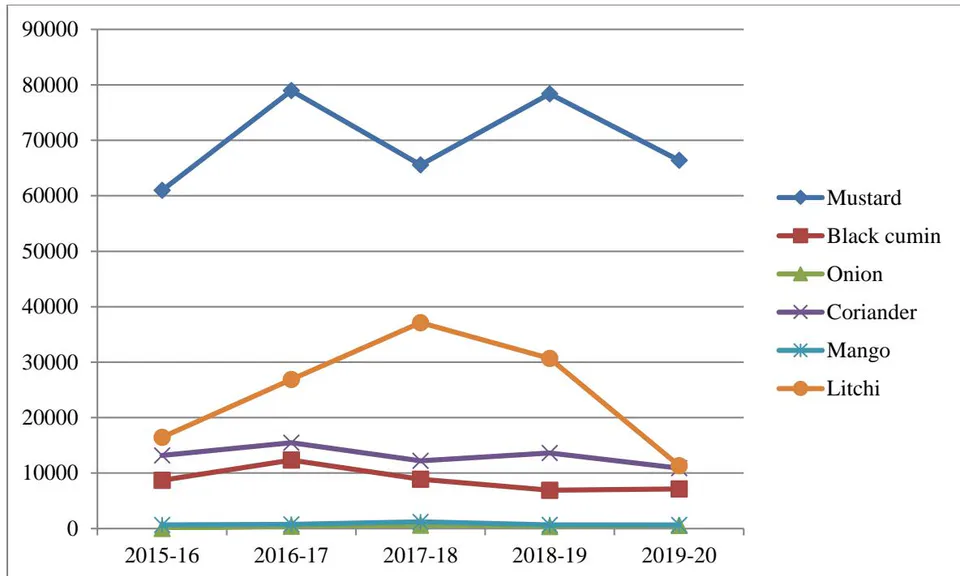
Established box number year by year (Total Bangladesh)
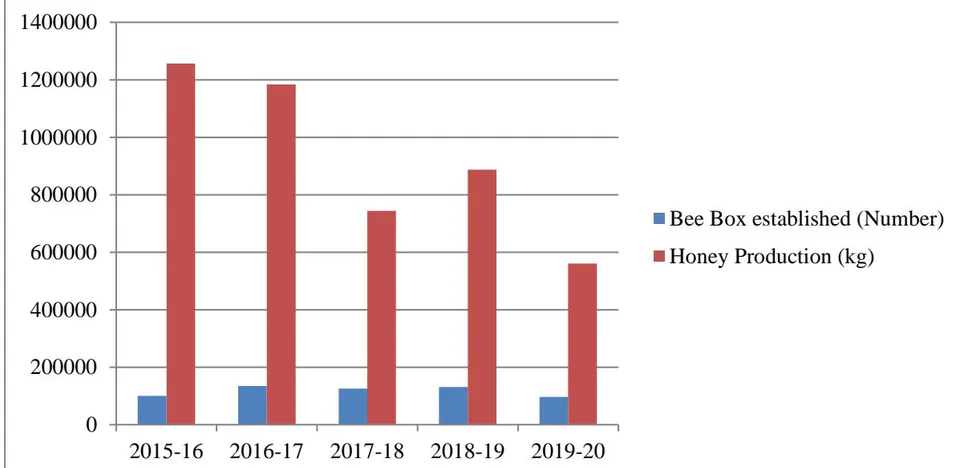
Year wise bee box establishment number and honey production
Data Interpretation
Table 3.15 and Fig. 3.3 & 3.4 discuss about established bee box number and honey production addressing all the feasible main crops and data counted for whole Bangladesh for the year 2015–16 to 2019–20. The fellow considers here mainly the bee box number rather than honey production as an increased number of bee box outputs more amount of honey proportionally. In the case of Mustard fields, although bee box number seems to be increased from 60,968 (2015–16) to 66,397 (2019–20) but best performance got in the year 2016–17 (established box number: 78,955). Another good figure was achieved in 2018–19 season (78,405). In the case of Black cumin, the ‘maximum established box number’ was found in 2016–17 and it was 12,343 in number whereas we see in the recent 2019–20 the figure as 7,142. Within Onion crop, the bee box was established as only 52 in 2015–16, whereas the box number reached at peak (621) in 2017–18. Considering Coriander crop, the highest box was established in 2016–17 (15,477) and the curve (Fig 3.4) shows the uniform establishment of bee boxes in Coriander fields.
In case of Mango and Litchi fields, the highest box was established in 2017–18 in both cases, and the figure was 1,222 (Mango field) and 37,129 (in Litchi fields). In recent years, box establishment numbers turn in to 650 (in Mango fields) and 11,347 (Litchi fields) which indicate the decreasing rate of box establishment both for Mango and Litchi fields in Bangladesh. Therefore, researcher can conclude that honey production performance was good from Mustard, Black cumin, and Litchi fields. The best box establishing year was 2016–17 (134,795; total bee box established), and the best honey production year was 2015–16 compared to other years. Whereas, the lowest bee box establishment year and honey production year is 2019–20 with 96,980 as bee box number and honey (less than half compared to 2015–16). Honey production is affected by bee box number and thus it is involved with price and income generation for the country.
Limitations identified by beekeepers
During the problem-ranking exercise conducted through interviews with beekeepers from the treatment plots, several key limitations affecting beekeeping practices were identified. Based on respondents’ perceptions, five major barriers were ranked according to their relative importance as described in the Fig. 3.5.
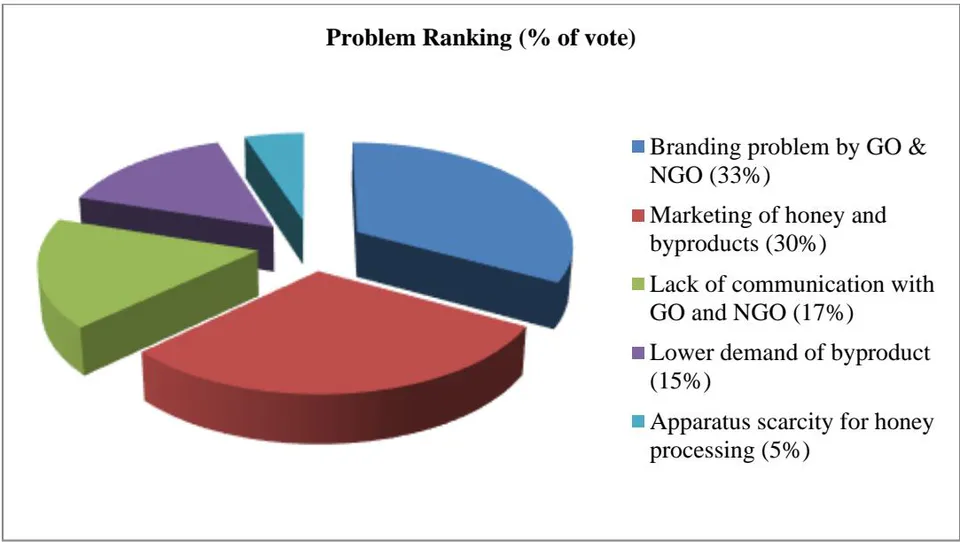
Problems ranking in beekeeping
Inadequate motivation, branding, and promotional support from GO and NGOs
Ranked 1st of votes) Poor advertisement and limited recognition of beekeeping as an entrepreneurship hinder its expansion
Lack of strong marketing channels for honey and by-products Ranked 2nd of votes) Weak market access reduces income potential and discourages enterprise growth.
Weak institutional linkage with GO and NGOs: (17% of votes) Limited coordination restricts access to technical and financial support.
Low demand for certain bee by-products: (15% of votes) Affects diversification and overall profitability of beekeeping operations.
Collectively, these findings highlight that institutional support, marketing infrastructure, and market development remain critical challenges to the sustainable growth of beekeeping enterprises.
Beekeeping A Shining Prospect for Bangladesh
The scope of integrating beekeeping with insect-pollinated crops in Bangladesh demonstrates considerable variation across crop types (Table 3.16; Fig. 3.6).
| Crops | Avg. Cultivated Area (ha) | Avg. Land under beekeeping (ha) | Coverage (%) |
|---|---|---|---|
| Mustard | 532,391 | 101,190 | 19.0% |
| Black cumin | 13,239 | 4,800 | 36.0% |
| Coriander | 43,927 | 6,400 | 15.0% |
| Onion | 210,000 | 600 | 0.29% |
| Mango | 160,000 | 570 | 0.36% |
| Litchi | 25,500 | 4,000 | 16.0% |
| Sunflower | Fully potential | ||
| Jujube | Fully potential | ||
| Sesame | Fully potential | ||
| Bee-pollinated compatible species | Remarks/ Outcomes |
|---|---|
| Sunflower, Groundnut, Sesame | Researcher has found 13% yield increase and SAU has shown that it is possible to increase the production up to 30% in Bangladeshi agriculture. |
| Ginger, Turmeric | Comeback of using ‘mustard oil’ like a tradition of Bangladesh and will make less pressure on sunflower & palm oil export. Various mustard oil processing industries have been established newly. |
| Cauliflower, Chili, Pumpkin, Bottle gourd, Carrot, Radish, Bean, Peas, Potato, Tomato, Drumstick | Bangladesh is using less pesticide in recent years compared to last decade. There remains opportunity to use less pesticide as insecticides are generally applied less amount in beekeeping areas according to the researcher’s interview section. |
Integration of Beekeeping with Compatible Crops for Sustainable Agricultural Intensification and Ecological Balance
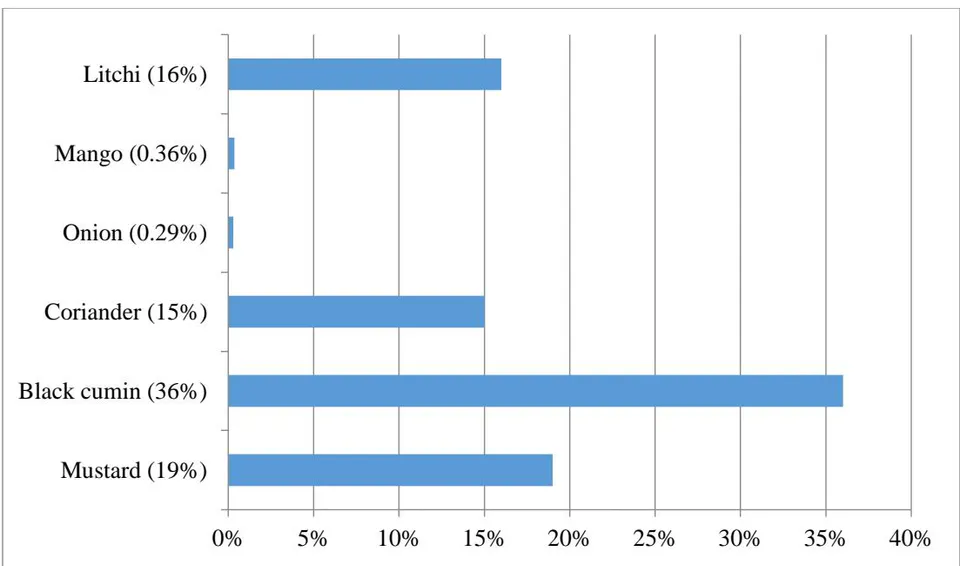
Percentage coverage of land under beekeeping
Domestic market analysis (Table 3.18) reveals significant variation in honey value depending on floral source, with comparatively higher prices for black cumin, litchi, and Sundarban-origin honey. The findings suggest that improved processing, branding, and market access could substantially enhance domestic price realization and overall sector performance.
| Crops | GBP/kg Honey | Remarks |
|---|---|---|
| Mustard | 3–4 | Avg. 3.60–3.70 GBP/kg honey |
| Black cumin | 7–10 | Considering both: Apis mellifera & Apis cerana |
| 1-2 Coriander | 3–5 | |
| Onion | 3–4 | Any size of box (So, it is better to use per colony) |
| 1-2 Mango | 3–4 | |
| 1-2 Litchi | 4–6 | |
| Jujube | 3–4 | |
| Sundarban | 8–10 | |
| Sesame | No income |
| SL | Issues | Additional Information |
|---|---|---|
| I | Price of per kg honey in international market is: 3.53 USD | Bangladeshi honey quality ensures good grade internationally. Honey value could be increased more after good processing. |
| II | China achieves first position at honey production with 27.5% share; New Zealand stands first in honey exporting with 11.1% and USA stands first in honey import with 20.9% share. | Bangladesh holds 83th position in honey export and 66th position in honey import. |
| III | Bangladesh is exporting honey to Japan, Australia and going to export some European Union. | Bangladesh exported 200 M ton honey to Japan (with 64.5% sharing compare to its total honey export) and in 2020, has taken contract to export 400 M ton honey there. |
| IV | From exported honey, Bangladesh earned 15342000 USD, and it expensed 119 million USD for importing honey. | 60% to 74% Bangladeshi market is being led by various Indian honey companies. |
| V | Agreement is going to be contacted with various countries, especially in EU countries. | Slovenia produces 2000 M ton honey but demand is 30000 M ton. Therefore, Slovenia made contract with Bangladesh. |
| VI | Wax and propolis values are getting high prices and demands are being drawn more attention to the international market. | per packet pollen consists 600 gm pollen and price stand as 30 to 40£, Royal Jelly per 10 gm = 25£, the queen bee price 25£. Bee queen can lay egg about 6–7 months but it is possible to utilize a queen bee to lay egg up to 5 years. Wax can be used in cosmetics industries. |
Global Trade Scenario of Honey and Beekeeping By-products
Nutrition, Food Security, and Sustainability Issues of the Beekeeping-Key Crop Joint Enterprise
Bangladesh continues to face significant nutritional challenges, particularly among children and women, as highlighted by national indicators of stunting, wasting, anaemia, and low dietary diversity (Table 3.20). Low per capita consumption of fruits and vegetables further exacerbates micronutrient deficiencies. In this context, beekeeping offers both direct and indirect nutritional benefits. Honey, although classified as a carbohydrate, contains a wide range of bioactive compounds including vitamins, minerals, antioxidants, enzymes, and organic acids, contributing to energy supply and health promotion. Moreover, enhanced pollination through beekeeping supports increased production of nutrient-rich fruits, vegetables, pulses, and oilseeds, thereby strengthening dietary diversity.
| SL | Nutrition Profile |
|---|---|
| 1 | The national prevalence of stunting for under five years is 36.2 percent, which is 25 percent higher than the average for developed nations. About 6.2 million (41 percent) of the 15 million children below 5 years of age in Bangladesh are stunted. The 14.4 percent waste prevalence of Bangladesh’s under-five is also higher than the 8.9 percent average of developed countries. |
| 2 | In Bangladesh, the mortality rate for children under 5 is 53 per 1,000 live births; almost 45% of these infant deaths are due to different types of malnutrition. 55.3 percent of children under 6 months are predominantly breastfed in Bangladesh. The low birth weight prevalence of 27.8 percent in Bangladesh in 2015. |
| 3 | The adult population of Bangladesh is still facing the challenge of malnutrition. Compared to 9.3 percent of women, 39.9 percent of women of reproductive age have anaemia and 10.3 percent of adult men have diabetes. Five percent of women and 2.3 percent of adults, respectively, have obesity. |
| 4 | A Bangladeshi person takes 47 gm vegetables per day whereas A South Korean takes 686 gm and A Japanese take 450 gm vegetable per day. Besides, per head fruit production is only 40 gm for Bangladesh whereas the figure is 287 gm for Thailand. |
Some quick facts about nutrition profile of Bangladesh
Government organizations under the Ministry of Agriculture have made notable contributions to the promotion of beekeeping and pollination services (Table 3.21). Departments such as DAE, DAM, and AIS have implemented training programs, distributed beekeeping equipment, facilitated farmerbeekeeper linkages, and improved data collection systems. Research and academic institutions, including BARI, BINA, and agricultural universities, have supported varietal development and preliminary research on pollination and biodiversity. Collectively, these initiatives have laid an institutional foundation for integrating beekeeping with crop production systems.
| SL | Performance of various governmental departments |
|---|---|
| 1 | There is a project from DAE named “Improved seed production, storage and distribution of improved pulse-oil-species varieties in farmer-level (3rd phase). The project aims that only good seed production can increase by 20% more production. It is providing training on beekeeping. 2000 beeboxes were distributed from this project. Even, they are managing to hire experts from the USA for beekeeping training. |
| 2 | Beekeepers’ name listing is going on throughout DAE. |
| 3 | Field Services Wing is collecting all data through control room, Horticulture, Crop and Planning wings are doing great. |
| 4 | The researcher interviewed with 10 UAO from 10 different Upazilla Agriculture Offices of Bangladesh concerning how UAO generally build rapport among farmers, beekeepers, and honey dealers. What the UAOs can do more for strengthening the connections especially for the beginners. Every Upazilla Agriculture Offices provide needed advice to the beekeeping-interested person. |
| 5 | AIS, DAM; these two departments are related to agricultural information dissemination and crops’ marketing, respectively. |
| 6 | BARI, BINA are research institutions, BADC seed producer and, BIRTAN is nutrition-related department. These departments provided effective varieties or suggestion that linked with beekeeping. |
| 7 | Universities like BAU, SAU, DU conducted some preliminary research related to pollination, biodiversity, or beekeeping. |
Performance of various government organizations
The beekeeping-key crop joint enterprise has strong implications for national food security. Food security in Bangladesh is often narrowly associated with cereal production, despite the country’s heavy dependence on imports of pulses, oilseeds, and spices. Beekeeping contributes to food security by enhancing yields of pollinator-dependent crops and stimulating increased production of fruits and vegetables. As such, the enterprise supports a broader interpretation of food security that incorporates nutrition, sustainability, and ecosystem services. DAE (2019) shows that Bangladesh has to import more than of pulse-oil-spices against its domestic production. Beekeeping will not only bring honey production, it will trigger an increase in production in pulse-oil-spices crops along with fruit and vegetable production.
Specialized institutions such as BSCIC and BIA have played a pivotal role in the development of the beekeeping sector (Table 3.22). Their contributions include training large numbers of beekeepers, introducing improved bee species, facilitating acess to credit, and establishing processing facilities. The initiation of honey processing infrastructure and quality testing has improved market credibility and value addition. However, challenges remain, including a limited number of active beekeepers, inadequate accreditation mechanisms, and insufficient processing and equipment manufacturing capacity.
| SL | Issues | Remarks |
|---|---|---|
| 1 | BSCIC introduced beekeeping in 1977 with Apis cerana. It introduced Apis mellifera in the last decades of the last millennium. | BSCIC has taken initiative to provide ID cards to the enlisted beekeepers for ensuring their professionalism and to protect amalgamation against other intermediary group eradication. |
| 2 | 25000 people have taken beekeeping training from BSCIC (including female). 200000 people are engaged in beekeeping and honey industries. | 70000 more are going to be added under project implementation governed by BSCIC. |
| 3 | Bangladesh possesses near about 2000 beekeeping farms and 18000 beekeepers are doing their business directly or indirectly. | The active beekeeper number is poor, near about only 1500. |
| 4 | There are 7 beekeepers’ development-related organizations in Bangladesh. There are 7 non-governmental honey-processing centers in Bangladesh. | Government is establishing its first honey processing industry at Dhamrai, Dhaka. It is associated with Denmark with machinery support. This plant is adept to make good quality and 200 BDT more value is being deserved to increase. |
| There are only 2 beekeeping accessories/apparatus producing industry. (all are non-governmental) | The number of small cottage industries should be increased related to honey production and processing. | |
| 5 | Bangladesh has no accreditation board for support for this sector. | “medex” is helping a lot. BCSIR helped to check the quality in its laboratory and declared that honey is quality honey. It is very crucial to fight in international market. |
| 6 | BSCIC is providing loans for the starters at 9% simple undertaken the project 2012-17 by budgeting 93600000 BDT. | This project helped the beekeeper’s lot. |
| 7 | BIA is a research agency founded in 1981 to conduct beekeeping studies and extension policies. | It has research centers; demonstration centers and maintains links with other countries. It has carried out many training activities. |
Contribution of BSCIC and BIA
Several non-governmental organizations have complemented government efforts by providing training, credit, and equipment support to beekeepers. Organizations such as PROSHIKA and MUS have demonstrated effective engagement in promoting beekeeping livelihoods, although the overall number of active NGOs remains limited. Expanded participation from NGOs could significantly enhance outreach, innovation, and inclusiveness in the sector.
Effective coordination among government agencies, NGOs, research institutions, and development organizations is essential for scaling up the beekeeping-key crop joint enterprise (Figure 3.7). Platforms such as honey fairs have increased public awareness and consumer trust in honey products. Strengthened interinstitutional collaboration across crop production, nutrition, marketing, and social development sectors—including youth and women-focused agencies—would further improve sustainability, income generation, and nutritional outcomes.
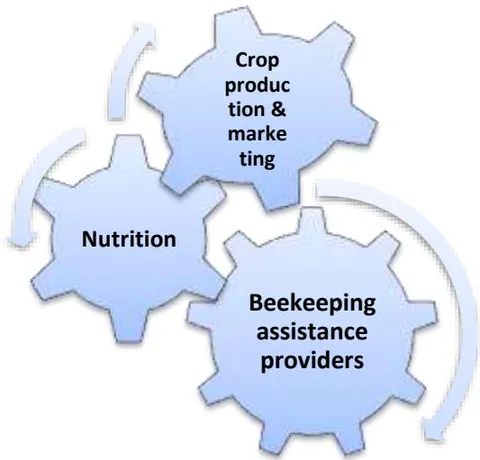
Coordination among the institutions and departments
Acknowledgements
The authors sincerely express their heartfelt gratitude to the Department of Agricultural Extension, under the Ministry of Agriculture, Government of the People’s Republic of Bangladesh, for granting permission and providing the necessary support and resources to carry out this study.
Conclusions
The beekeeping-key crop joint enterprise has emerged as a promising pathway for agricultural diversification, income generation, and ecological sustainability in Bangladesh. Evidence from field observations and stakeholder interactions indicates that this integrated approach enhances crop productivity, particularly in pollination-dependent crops such as black cumin, while contributing to biodiversity conservation, nutritional security, and rural employment. Despite its strong potential, the expansion of this enterprise remains slower than expected due to persistent misconceptions among landowners, limited market access, and operational challenges associated with mobility and management of beekeeping activities. Field-level experiences demonstrate that initial resistance from farmers—especially in mango, coriander, and onion production systems—often diminishes once productivity gains become visible. Repeated invitations to beekeepers in subsequent seasons suggest a gradual shift in perception, highlighting the importance of demonstration effects and farmer-to-farmer learning. The study further confirms that honey derived from specific crops, particularly black cumin, holds strong domestic and international demand, reinforcing the commercial viability of crop-specific beekeeping integration.
Overall, the findings underscore that beekeeping is not merely a honey-producing activity but a multifunctional enterprise capable of strengthening food security, supporting ecosystem services, and generating employment. With appropriate institutional support, market development, and policy alignment, the beekeeping-key crop joint enterprise can play a meaningful role in enhancing agricultural sustainability and contributing to national economic growth. To fully realize the potential of the beekeeping-key crop joint enterprise, several strategic measures are recommended:
i) Market channels for honey and beekeeping by-products should be strengthened to ensure fair pricing, value addition, and reduced dependency on intermediaries. Establishing honey processing centers, by-product industries, and beekeeping equipment manufacturing facilities would enhance quality control, market competitiveness, and export readiness.
ii) Expanded training programs, technical advisory services, and starter-level accessory support are essential, particularly for new and small-scale beekeepers. Special emphasis should be placed on engaging rural women through family-based beekeeping models that link income generation with nutrition and empowerment outcomes. Improved availability of beekeeping accessories at the local level would further reduce entry barriers.
iii) Coordinated efforts among government agencies, research institutions, cooperatives, and non-governmental organizations are critical. Utilizing existing farmer groups, IPM and ICM clubs, and cooperative platforms can accelerate dissemination and adoption. Policy measures should also facilitate direct market access for beekeepers, enforce quality standards, and address adulteration risks through regulatory oversight.
Finally, increased investment in research is necessary to address emerging challenges related to climate change, land scarcity, disease management, and sustainable hive mobility. Awareness-building initiatives at community and institutional levels should highlight the ecological, economic, and social benefits of beekeeping integration, including the manageable nature of modern bee species. A renewed national focus on data generation, monitoring, and strategic planning—similar to earlier successful initiatives—could catalyze a new phase of growth in this sector.
Declaration
Conflict of Interest: The authors declare that they have no conflict of interest.
Funding statement: The study was funded by “Meeting to Undernutrition Challenge” (MUCH) Fellowship Program 2019 which is financially supported by the United States Agency for International Development (USAID) and the European Union (EU). This fellowship is one of the MUCH core capacity building programmes aiming to support government officials to deepen their knowledge and expertise on food and nutrition security.
Conflict of Interest
The authors declare no conflict of interest.
Ethical Approval
Not applicable
Data Availability
The datasets used in this study are openly available at [repository link] and the source code is available on GitHub at [GitHub link].
Funding
This work did not receive any external funding.
References
Cite this article
Related Research

Special Issue
Launch a focused special issue to highlight research, emerging trends, and expert insights in your academic field.