


IntelliPaper
Abstract
This work, based on the hypothesis of the existence of a pair of heavy fermions produced by the decay of an X-boson of cosmological origin, presents a possible mechanism for the formation of ordinary matter, which is not based on symmetry-breaking fields or massive decays on high-energy scales. The model shows that, under specific conditions, the pair of heavy fermions can spontaneously fractionate into three fermion-antifermion pairs, giving rise to the observed structure of matter. Unlike models in which leptons and quarks arise through spontaneous symmetry breaking and interactions mediated by Higgs fields, this model shows that matter could originate from a quantized electromagnetic decay process based on conservation laws and topological constraints.
Explore Digital Article Text
I. GENERAL INTRODUCTION
It is usually assumed that in immediately after the Big Bang at a time , the universe was extremely curved, hot and dense [1] and when the universe cooled from to , the conditions became optimal for forming the building blocks of matter, quarks and leptons. The confinement of quarks then began, which aggregated to give rise to protons and neutrons.
This scenario in no way explains how and why quarks and leptons were formed, hence why particles in nature are what they are and protons are not elementary particles as was mistakenly believed until the mid-twentieth century. Currently there are several approaches that try to justify the existence of matter as we observe it but in no case has there been an attempt to give an answer to why quarks, particles with fractional charge, exist why their origin is still a mystery .
In addition, the current model suggests seeking an explanation of the origin of matter using accelerators with higher and higher energies, thus experimentally finding increasingly heavy and complex particles, but preventing us from examining rare processes at medium-low energy, which could instead open new perspectives in understanding the origins of matter.
In this paper we propose a model developed using the principles of the Bridge Theory (BT) [3], [4] which is a quantum-relativistic electromagnetic theory capable of proposing a complex phenomenology that suggests the existence of a primordial generating particle, which for the moment we call X. The X-particle should have been produced in great abundance in the early stages of the creation of space-time; its creation, as the model suggests, could have induced the production of primordial hydrogen.
The model that will be examined is only a first step, but it shows that the direct electromagnetic interaction that characterizes the BT, when applied to a pair of fermions produced in the decay of a primordial neutral boson, produces a spontaneous phenomenon that we call "fractionation" capable of breaking the pair of original particles into three pairs of elementary particles in two different ways. In one case, the charges of fractionated particles are compatible with those of up and down quarks, in the other with those of electrons and neutrinos, so in both cases with first-generation elementary particles. The model assigns an extremely small charge value to neutrinos, which is still unknown for the moment. The fractionation process is named X as in the case of the primordial X-particle.
II. AN INTRODUCTION TO BRIDGE THEORY
BT derives from the demonstration [5], [6] of a conjecture [7] concerning the presumed role that the transverse component of the Poynting vector of a dipole source would have in localizing energy and momentum in the form of a "quantum" formally and quantitatively in accordance with quantum theory. The quantum is formed during an interaction between two charged particles whose energy and momentum are completely transformed into the energy and momentum of an "exchange photon". This is a phenomenology described in the references [3] and [4], according to which a pair of interacting particles, regardless of their electric charge value , produce a Dipole electromagnetic Source (DEMS) that localises in its source zone an energy and a momentum in agreement with that of an exchange photon, whose wavelength corresponds to the minimum interaction distance achieved by the particles. The value of action associated with such a direct free electromagnetic interaction is the Planck constant , with , equal to the reciprocal value of the Sommerfeld constant. The theoretical value of the Sommerfeld's constant was first calculated for free interactions between particles in Ref. [6], subsequently the value was revised and corrected according to the angular dimensions of the interacting charges [3], and more recently calculated in the context of the formation model of hydrogen atoms [8] and for hydrogenoid atoms with different atomic number values [9], demonstrating that the Planck action is not a true fundamental constant, because it depends on the electromagnetic coupling value , the Sommerfeld constant, that varies, even if slightly, according to the external forces acting on the system.
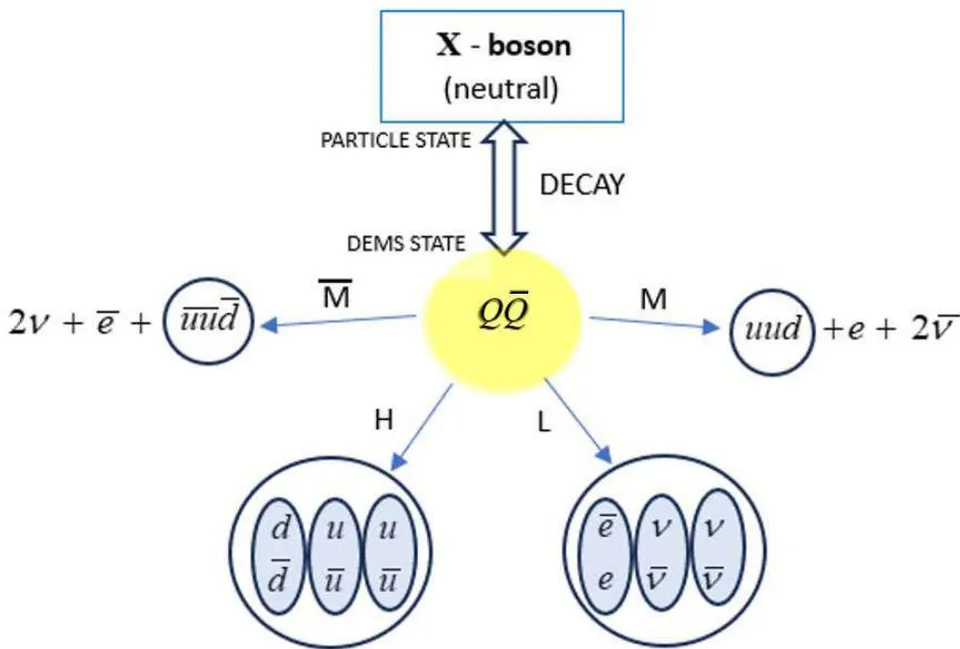
Following the BT, we will show that hypothesising the existence of a X-particle energetically in balance with the DEMS produced by the interaction of a virtual pair of fermions : , if the pair have an unit of charge equal to that of the proton , the cross on the charge distinguishes the charge of the proton from that of the electron without cross, provided that the two particles have sufficient interaction energy to give rise a pair proton-antiproton , the pair undergoes a spontaneous fractionation following two equiprobable channels giving rise to two distinct groups of three pairs of elementary particles.
The first group consists of three pairs of particles with fractional charges in the quark-antiquark form , the second group consists in three pairs of leptons, one pair electron-positron and two pairs of electronic neutrino-antineutrino in the form .
Since in this model neutrinos are expected to have an extremely weak but not zero fractionary electric charge, because they must be able to interact electromagnetically even if weakly with other matter, the electron and positron consequently have a lower charge value than that of the proton unit.
III. STRUCTURE FUNCTION OF TWO INTERACTING CHARGE FRAGMENT
Starting from the principle of BT that all DEMS formed by the interaction of a pair of elementary particles are associated with a value of action expressed in Dirac form, one formally describes the process that gives rise to the action in a DEMS formed by the particles with an Abelian operator that returns the value of action of their interaction.
Considering the virtual interacting pair forming a DEMS with the same mass energy of the X-particle, one assumes that when the two particles interact, an expanding electromagnetic bubble delimited by the emitted spherical wave of wavelength is formed.
Inside the bubble, a spontaneous fragmentation of the original pair occurs, breaking the primitive DEMS into three sub-DEMS, each produced by the interaction of a pair of particles , with fractionary charges and , where with i=1,2,3 are the fractionary dimensionless charges such a that
In general, taken two particles , the corresponding action is given by
with c speed of light and electromagnetic structure constant of the action, corresponding to the reciprocal value of the coupling constant between particle and field , calculated by the expression
in which the function
is the field structure of the transversal component of the Poynting vector of the electromagnetic field of the DEMS produced by the two interacting particles (Cf. Ref. [9]).
Using Eq. (2) for pair of particles , from Eq. (3a) and (3b) it appears that the action associated with the interactions between:
- proton - antiproton
- electron - positron
is in both cases the same, because the structure constant associated to pairs of particles is independent of their electric charge. Equation (3a) can be represented as a function of the ratio between the dipole moment length per unit of charge R and the wavelength of the DEMS.
Therefore, using the Eq. (2), the value of the action calculated in Gauss units for an interaction between a pair during the fractionation is given by
with
From Eq. (5), (6) and (7) it results
For a free electromagnetic interaction between a pair of charged particles, i.e., without external constraints acting on the DEMS, the ratio was been calculated numerically using a stochastic method described in Ref. [3] and [7] and its value it is known exactly . Using this ratio the value of the structure constant is . Each external constraint acting on the pair during their direct interaction produces a variation of the value of the ratio and consequently of the structure constant as proven in Ref. [8] for the electron-proton capture and [9] for the interaction of the orbital electrons with the atomic nucleus.
{"image_source":{"path":"images/0e663134009d96ecd63f7c9b481d331d5766ea74d415e3ca0be46372fa696ed8.jpg"},"content":"","chart_caption":[{"type":"text","content":"(a)"}],"chart_footnote":[]} {"image_source":{"path":"images/ba76a675f5e08294b59f3450e09b8983958c39803df5aee3066a5f34a494d685.jpg"},"content":"","chart_caption":[{"type":"text","content":"Figure 1"},{"type":"text","content":"(b)"}],"chart_footnote":[]}
{"image_source":{"path":"images/c5bd52459795fa37f9d83f48842582acd67b22ba1e6c46ac622a715b13ab7d8b.jpg"},"content":"","chart_caption":[{"type":"text","content":"(c)"}],"chart_footnote":[]} {"image_source":{"path":"images/e850c99546f7e24b353ae8c080145cc50440176ef3e27f73d7e23ef0c655d425.jpg"},"content":"","chart_caption":[{"type":"text","content":"(d)"},{"type":"text","content":"Figure 1: field structure (4) of the transversal component of the Poynting vector. (a) for the direct interaction of pairs "},{"type":"equation_inline","content":"u"},{"type":"text","content":"; (b) for the direct interaction of pairs "},{"type":"equation_inline","content":"dd"},{"type":"text","content":"; (c) for the direct interaction of "},{"type":"equation_inline","content":"ud"},{"type":"text","content":"; (d) for the direct interaction of "},{"type":"equation_inline","content":"ud"},{"type":"text","content":". In letters (c) and (d) there are differences that are not graphically appreciated."}],"chart_footnote":[]}
IV. FRACTIONATION OF THE UNIT PROTON CHARGES: SOLUTIONS L AND H TO BUILD THE PARTICLES OF THE UNIVERSE
When two charged particles interact freely, the DEMS produced continues to exist regardless of the distance achieved by the two moving away particles. The DEMS produced, by means of the specific value of action that must remain constant over time, entangles the two particles inside of the electromagnetic spherical bubble bounded by the emitted wavefront, so that any action suffered by each of the two particles, produces a coordinate and instantaneous variation on the other particle as well (See Ref. [4]).
For a DEMS produced by two virtual interacting particles the action must be conserved, therefore, the following basic principles apply:
A. The total action is a constant value of the DEMS. Considering a fractionation of the pair of particle in three sub-DEMS with a small loss of action provided that the total energy of the system remains unchanged, using equations (9) the total action of the three cells must not exceed in value the total action of the primary bubble.
B. The total charge is conserved. The total fractional charge must be equal to that original:
C. In nature protons are primordial particles formed by three quarks of which two quarks have the same value of fractionary charge. Considering this abundance, two of the three charge fragments obtained must have equal value of charge:
The three previous conditions (A-B-C) are summarized by the systems:
The equations (13a) can be transformed in the form
The third inequation of the first system (13b) has solutions in the interval for a negative charge generator and in the interval for a positive charge generator and solutions respectively and for the corresponding associated equations. Therefore, considering that in the act of fractionation a small but finite amount of action is lost through a variation in the charge values of the fragments, but not in the energy that is conserved, we can write
analogously for a positive generator with in both cases where is a tiny non-zero charge constant for each pair of solutions . Considering that among all the infinite particular solutions inside the intervals and S, the values and must be those that minimize the difference of action between the initial action and the final total action satisfying the Eq. (10), only the extremes of the intervals and S satisfy exactly these conditions, therefore, the final solutions can be written in the form for the negative
generator and for the positive generator. The superscriptions (-) or (+) at right of the values of charge with theirs eventual multiplicity expresses the charge tendency (CT) defined as a scalar dimensionless multiple , which is the defect or excess of electric charge respectively to the solutions obtained in Eq. (13b) using instead of inequalities their associated equations. The CT at the moment does not define an exact value of the charge.
Using the two pairs of generators and the first two equations of the Eq. (13b), one obtains the complete sets of the charge fractionated divided into anticharge and charge for hadronic and leptonic type
by demonstrating how the solutions obtained for the systems in Ec. (13) are unique and depend on charge and action conservation.
To analyse the meaning of the solutions achieved in Eq. (13), one defines as hadronic the solutions in which we have three fractional values of the generator in agreement with the existence of two flavours of quarks
and leptonic the solutions
where all particles in addition to the declared charge value have a CT, i.e. the charges are not exactly equal to the usual declared values. Considering that the CT changes in signs if the sign of the unitary generator changes, CT allows all the cells to get a part of the total energy of the primordial DEMS allowing them to evolve energetically. It is important to highlight that in this model all neutral interactions must have total zero tendency to conserve the total charge, in general the sum of the CT of the particles involved in the reaction channel must have the same tendency before and after the reaction.
For the solutions (15a) and (15b) the immediate consequence is that the proton must have a value of charge an amount greater than the unit charge of the positron, for coherence by reopening a discussion on the real neutrality of atoms and molecules [10], [11]. This allows us to suppose that the true unit of charge is that of the proton and not that of the electron, although experimentally difficult to distinguish from that of the proton, because it is obtained by fractionation from that of the proton.
To describe hadrons in Eq. (15a), the CT is not an essential formalism because hadrons, unlike neutrinos, have enough charge to interact with each other and the CT could only be significant by studying the behaviour during interactions between non-elementary particles, a study that is beyond the scope of this article. In this context, it is sufficient to know that there exists a fractionation mechanism that leads hadron charges not to have the declared charge value but to have marked positive or negative tendencies that can affect their way of interacting. In fact, the CT could be responsible to define the colour charge of quarks, allowing a direct interaction between quarks of the same type, an example for stable particles could be the proton .
The three charges can be considered equivalent to that u-RED, u-GREEN and d-BLUE, where the CT sign is chosen in such a way that the resulting proton formed by the three quarks taken together can form a particle of exact unit charge with zero tendency in accordance with QCD and with a charge only slightly greater than that of the electron.
Since the use of the CT notation for the hadronic solution currently appears redundant, we will use it only when and if necessary.
V. MIXED SOLUTIONS: DIRECT ATOMS FORMATION
The solutions of the systems in Eq. (13a) provides for two fundamental charging solutions . In Eq. (14) the final solutions obtained by assigning corresponding values to and to have been considered, thus assigning the same type of solution. For example, and , obtaining for the other two solutions respectively ( , ) and ( , ). In this way, the two original particles are fractionated into three pairs of elementary particles, exactly as in reality where the particles are created in pairs (See Eq. (15a) and (15b) in the previous paragraph).
However, there is no obvious reason not to consider mixed solutions within the DEMS itself. Thus, a particle can be fractionated hadronically and a particle in a lepton way or vice versa. This possibility would lead to the formation of the mixed matrices:
and its symmetric
obtained with a mixing of compatible solutions H and L. The choice of which of the two matrices is the anti-matrix is arbitrary, in this context the one containing the elementary particles of ordinary matter compatible with the existence of hydrogen atoms has been chosen as the matrix and the one containing the particles compatible with the existence of antihydrogen atoms has been chosen as the anti-matrix.
In this case one could have the coexistence in a same electromagnetic bubble of the constituents of a proton or antiproton and of three leptons violating the principle of creation in pairs of the particles associated to the sub-DEMS.
This may be possible if the fractionation occurs by single particles and not by pairs, in this case the mixed bubble does not violate the invariance of the total charge, of the spin of the bubble and does not violate the invariance of the sum of the baryon and lepton numbers
but it would seem to violate the action conservation principle (A), in fact, Eq. (7) shows that the fractionation process is completely invariant in the action only if it occurs in pairs. On the other hand, the inequality of equation (10) confirms that a small part of the action is lost due to the fractionation for the appearance of the CT, which also happens if the fractionation occurs not in pairs but in single particles, exactly as in the asymmetric fractionation characterized by the mixed solutions (16) and (17) which is invariant-action only if the interaction occurs between groups of particles, with each group formed in such a way as to have a total unitary charge. In this case, one supposes that the charges of the quarks remaining confined together and interacting among them, can produce a proton. The electron remains alone because the two low-charged neutrinos have the possibility of escaping by subtracting a lot of energy from the lepton group, thus making it more likely that it will be captured by the proton and the formation of a hydrogen atom [9].
This process suggests that if one collects all solutions with the different charged particles in the X-matrix below
Considering the presence in spacetime of a sufficient number of particles produced by the X process, it is possible to obtain invariant DEMS in action, formed by two groups of particles in direct interaction, each with a total integer charge. The groups are obtained by aggregating the different elementary particles available in the X matrix in a different way. Each group corresponds to a possible non-elementary particle.
Extending these considerations, charge groups can be produced using the elementary particles in the matrix (19) in such a way that the initial charge values can be reproduced forming new particles as for example , or , , , and so on, but there is also the possibility of produce heavy groups with fractional charges of successive generation as , and , or , and , or particles with charge greater than one as . These are just some of the possible groups and others, all in accordance with the symmetry of the Standard Model are possible and can be connected to quarks belonging to the second and third generations or later. In this sense, it is possible that the generations following the third differ from the previous generations only in the energy content, but if the energy required to operate the DEMS exceeds the mass energy of the primordial neutral boson X, the generations following the third will not be possible.
This model is the only one that can be used to maintain unchanged the charge and action during the formation of a DEMS between two charge groups.
The X-matrix (19) puts in evidence a perfect symmetry in particles-antiparticles primary production with an abundance of two neutrinos for each hydrogen atom and two antineutrinos for each antihydrogen atom, having four neutrinos for each pair of hydrogen-antihydrogen. Considering that at the current stage it is not yet possible to know where and when anti-hydrogen disappears, starting from Eq. (19) could be interesting in the future to try to draw all possible scenarios able to describe the universe.
IV. DISCUSSION AND CONCLUSIONS
Considering that by using the Eq. (7) and (8), the quantum energy of a DEMS produced by the interaction of two proton unit charge is given by and that the value of the Planck action depends by the value of the dipole ratio and by the value of the square of the interacting unit charge, exist two possibility to modify the value of the quantum energy of the DEMS: modify the dipole ratio acting on the dipole length R or on the wavelength ; modify the value of the square of the unit charge involved in the interaction. The former, modify the structure function of the DEMS but can be produced only under the action of external constraints, the last, since the fractionating is a spontaneous internal process, occurs under the action of internal constraints that not modify the structure constant but only the charge distribution of the fragments, reducing the total action involved. In fact, Eq. (9) is verified for an exact fractionation in which the charge tendency is equal to zero, but assuming a non-zero charge tendency , only Eq. (10) with a strict inequality can be verified, while preserving the total charge of the system. Therefore, considering a tendency value of the charge at the limits of experimental measurability, the reduction of the action value produced by Eq. (10), although instrumentally imperceptible, reduces the total action and energy value of DEMS. However, since the energy must be conserved, the wavelength will undergo a shift towards blue such as to keep the final energy unchanged, also raising the action value, at the expense of the structural constant. In fact, the charging tendency value is expected to be extremely small. This agrees with the possible presence of a charge value associated with neutrinos, without which in BT they could not gain mass. An experimental way to determine the CT is to measure the neutrality of the hydrogen, because the charge of an electron is and then, that of a proton , in such a way that .
The mechanism of spontaneous fractionation presented demonstrates a new framework for the generation of fermionic matter based exclusively on the properties of the electromagnetic field. Unlike conventional models rooted in symmetry breaking dynamics and massive decay of the gauge boson, this model proposes an intrinsic structure of matter formation that emerges from fundamental constraints of charge and action. This provides a basis for reasoning within new scenarios about hydrogen dominance and the presence of three generations of fermions, using only electromagnetic interaction. However, the identification of the X particle, i.e. the boson that has the expected role of generating hadrons and leptons, in the early universe and in the experimental reality of accelerator physics, will be fundamental.
In fact, the model developed is able to justify the existence in the universe of four different fermions and four different antifermions , each associated with a fractional charge and with properties similar to those experimentally known in nature and predicted by the Standard Model. Excluding the value of the mass of the electron, which is well known, it could be interesting to estimate in a consistent way the masses of quarks and neutrinos, but at the current stage of development of the research work, the results are not yet obtainable from the model.
As seen above, the introduction of the CT allows us to suggest a mechanism that justifies the existence of the colour charge of quarks, giving in this case the possibility to two apparently identical particles to interact electromagnetically by binding to each other. Unfortunately, exact calculations can only be developed after an estimate of the charging trend value.
Finally, it may be interesting to consider that following the model, matter and antimatter would have as a distinctive characteristic the sign of the charge generator, when the sign is positive the fractionation produces particles, when the sign is negative the fractionation produces antiparticles. So the electron would be the antiparticle of the positron, this for a hydrogen-filled universe means that there are as many protons as electrons, so since the proton is made up of three quarks defined all as particles and one electron defined as antiparticle, defining a number of asymmetry matter-antimatter , a hydrogen atom would be formed by a particle (proton) with and an antiparticle (electron) with , unless the negligible presence of neutrinos and antineutrinos in pairs, this would solve the problem of matter-antimatter asymmetry in the universe in terms of particles-antiparticles asymmetry, in fact, hydrogen would consist of a particle and an antiparticle with an asymmetry resolving in conceptual terms the apparent asymmetry matter-antimatter in favours of matter in the universe.
The fact that the matter-antimatter asymmetry can be considered equal to zero, however, does not solve the problem of the absence of antihydrogen in the early universe. However, the author believes that the identification of a candidate particle to be the X-boson would allow to obtain a scale factor capable of assigning a mass to quarks and neutrinos, helping to find a way to understand the baryon asymmetry of the universe.
Funding Statement: This study is not supported by grants.
Conflict of Interest declaration: The author declare that they have no affiliations with or involvement in any organization or entity with any financial interest in the subject matter or materials discussed in this manuscript.
Ethical Conduct: In these studies, no procedures involved human participants.
Data Availability Statements: The presented article is not associated with any experimental data nor with theoretical data calculated using models. All necessary data is present in the text or associated references.
Conflict of Interest
The authors declare no conflict of interest.
Ethical Approval
Not applicable
Data Availability
The datasets used in this study are openly available at [repository link] and the source code is available on GitHub at [GitHub link].
Funding
This work did not receive any external funding.
References
Cite this article
Related Research


Special Issue
Launch a focused special issue to highlight research, emerging trends, and expert insights in your academic field.