

IntelliPaper
Abstract
With the digging out of the real meanings, we defined the Ultimate Space, Subspace and Subspace Isolator. We defined Unit Object and Unit Object Flow. We also defined the Scale Time, Existence Time; Unit Object Time (UOT), and Unit Object Flow Time (UFT). By defining the Law of Unit Object Existence, we revealed that a Unit Object exists only in “Now” moment. Before “Now” is the passed time trajectory no longer existing, after “Now” is the future time hasn’t come to true yet. There are new concepts related to the space and time never mentioned by anybody before. When one does not know the real meaning of space and time, how can he combine time and space as a weapon? How can he manipulate space-time?
Explore Digital Article Text
I. INTRODUCTION
"We have a weapon that no one has a clue what it is. And this is the most powerful weapon in the world, which is more powerful than anyone even close." (1) President Donald Trump said on April 9, 2025.
On April 14, 2025, Michael Kratsios, Director of the White House Office of Science and Technology Policy, stated that "Our technologies permit us to manipulate time and space. They leave distance annihilated, cause things to grow, and improve productivity." (2)
So, what exactly is this thing that "can manipulate time and space", or this "time-space weapon"? It sounds like a prop from science fiction, very mysterious, very grand, very scary, and incredibly powerful. What secrets does it contain?
Let us explore and think about it in this article.
Ideas
The sentence "manipulate time and space" contains a verb and two nouns. The verb is "manipulate," to manipulate and control. The nouns are "space" and "time." So, we must first figure out: What exactly is space? What is time? Then we can understand what kind of things can manipulate time and space? Let's discuss these questions one by one.
1.1 Space
Please close your eyes and think about it: What is the "space" you perceive as?
Searching for "space", we can see a wide variety of definitions. All of them make sense, but none of them touch upon the essence of space. Let's take a quick look at one of them:
"Space is a three-dimensional continuum containing both position and direction. In classical physics, physical space is usually conceived of as having three linear dimensions. Modern physicists generally consider physical space to be part of an unbounded four-dimensional continuum called spacetime that extends over time."
This is to treat space as an ordinary object with volume. It also adds many things that have nothing to do with space. But it does not touch upon the essence of space.
We use "cosmic subtraction" to define space. Subtract the universe in front of us, remove the sun, the earth, the Milky Way, the nebula, and all other celestial bodies from the universe one by one; remove light, wind, animals and plants, even thoughts, everything from the universe, and the remaining empty container with nothing in it is space.
This "space" is a place where all the things stored in it can be taken out one by one, and these taken out things can be put back one by one.
Basically, space is an empty volume with nothing in it. Anything can be placed in it according to certain rules.
So, we define space like this:
Space concept consists of the following three parts:
Ultimate space,
- Subspace (also called space when without confusion, a part of the ultimate space),
- Subspace isolation (also called isolation, Some kind of existence used to distinguish sub-space from ultimate space.)
The ultimate space is "the place that can accommodate anything after taking away everything from the universe in front of us". This includes the so-called Big Bang and everything it produced, including all celestial bodies, electromagnetic waves, thoughts, visible and invisible things, all things with or without mass, including everything in the space outside the Big Bang.... In short, everything is taken away, and what is left is a place that has nothing but can accommodate anything.
The ultimate space is so huge that we don't know its beginning and end. Even if people use the so-called Big Bang imagination, they can't find the edge of the ultimate space, nor can they know the beginning and end of the ultimate space. Therefore, the ultimate space can be tied to time, but it is meaningless. If time is tied to the ultimate space, then it is impossible for people to know the beginning and end of this time. People can't use the scale of time to measure unknown things, such as the place outside the so-called Big Bang universe.
The ultimate space has no form and no mass, so people have no way to change its state, and certainly can't bend it! What are you bending? Bend "nothing"?
Although the ultimate space is right in front of us, we cannot touch it. The ultimate space is all around us, and we are in this space we can only feel it, but cannot touch it. Everything, including imagination, is contained in the ultimate space. The process of all things and their processes occur, develop, born, and die in the ultimate space.
The huge ultimate space itself is a whole. Changing any part of it requires changing the whole. However, due to the hugeness of the ultimate space, it is impossible to obtain that huge energy to change its state. It is impossible to bend, split, decompose, or fold it, etc.
We say the ultimate space doesn't have time, because we don't know the start or end time of it. Or if one argues, ultimate has a time. Then, what does this time exist for? It can't tell us any useful information. It also can't change, can't separate into small pieces of time. Anything that exists inside the ultimate space has its own existing time.
A subspace is a smaller space separated out from the ultimate space according to something existing in the space. It is part of the ultimate space, so it has all the properties of the ultimate space. If there is no this "something" object, there is no such existing time. In the absence of confusion, subspace can be called space.
All subspaces constitute the ultimate space.
The most important thing to note here is not to regard objects existing in space as space itself! Light travels along curved geodesics, and it is the geodesics that are curved, not space. Why are geodesics curved? Because something inside the area of the space caused the curve of the geodesics. It is not space that is curved, but some factors such as gravity that make the geodesics curved. Confusing "space" with "matter existing in space" is a major failure of contemporary physics! It is a mockery of the great scientists who buried their heads and followed Einstein.
Subspace isolation, or simply isolation, is the boundary that separates subspace from ultimate space.
If ultimate space is likened to a huge treasure chest, subspace is one of the various grids in it, and the edge of each grid is subspace isolation.
Some of these subspace separations are tangible, some are intangible, some are completely or partially overlapping, and some are completely independent. "Separation" can be a certain substance, a certain mathematical division, or a certain idea. It can be a certain physical means, or perhaps an intangible product of some thought or imagination... or even a combination of the above.
"Isolation" also has its own form, defined by the things in it.
When discussing space, be careful not to attach the segmentation attribute of "isolation" of subspace to the space itself.
Houses are common subspaces isolated by materials such as building materials. "Thousands of miles of sharing the same moon-lady" is an imaginary subspace isolated by moonlight. "Parallel space" is a subspace that is used as "isolation" by imagination and has not been confirmed to exist.
Depending on the purpose of our research, the division of subspaces can also be varied and diverse, and even completely or partially overlapped.
For example, if there is a magnet in space, then there are many ways to divide the subspace related to this magnet: one is to divide the subspace that contains the volume of the magnet according to its volume, and the other is to divide the magnetic field space according to the some extent range of influence of the magnetic field of this magnet. These two subspaces are of course different. If the magnet is moved to another position, the subspace itself remains unchanged and is still at the same originally located position, but it is no longer the subspace that contains the magnet; and the new subspace that contains the magnet is already in the new subspace position where the magnet is located now.
The same thing happens if we replace the magnet with a celestial body. If something like a geodesic appears because of the existence of this celestial body, then when the celestial body moves to another place, the geodesic will also move with it. The original space is now empty, and nothing has changed there.
Generally speaking, we talk about subspace rather than ultimate space. For example, the space between the Earth and the Moon. Ultimate space is the entirety of space, while subspace is a part of ultimate space. The ultimate space contains everything we know and do not know, but it is not full. Its subspace, because it is part of the ultimate space, has the ability to contain anything. But having this ability does not mean that we can put anything into this subspace at any time. It is conditional. For example, in the subspace occupied by the earth, you cannot put another planet into this subspace.
1.2 Time
As is customary, we should first introduce the various wonderful theories of time that our ancestors have had. Let's choose a definition from the dictionary. The simplified definition of "time" in the Oxford Dictionary is as follows:
As a noun:
- The existence and events of the past, present and future as a whole continue indefinitely. 2. A point in time measured in hours and minutes after midnight or noon.
As a verb:
- To plan, schedule, or arrange the time for (something) to happen or be done.
- To measure the time taken by (a process, activity, etc., or a person who performs the process, activity, etc.).
The most important thing is the first meaning as a noun. Please take a closer look: "The existence and events of the past, present and future as a whole continue indefinitely." Doesn't it feel a bit mysterious, fancy, grand and incomprehensible?
We can search for various definitions of "time" on the Internet, and then think about it: What is the exact definition of "time?"
When people can't even clearly explain what the basic independent "time" is, but mix time and space together to use. Isn't it ridiculous?
III. OUR CONCEPT OF TIME
We believe that time has two faces: scale time, and the trajectory time of things existence, referred to as existence time. Here the meaning of “things” includes all kinds of events.
We use "existence time" to describe "things," and use "scale time" to measure the "existence time."
Scale Time is a ruler created and used by Earthlings to measure time. The time concept of Earthlings first comes from the natural rotation phenomenon of the Earth. Scale time is gradually developed by Earthlings according to the rotation of the Earth as day, year, hour.... Scale time is a noun that describes the length of time, and a verb that measures the length of time. These are both very easy to understand concepts.
So, what kind of time can the scale time be used to measure? Of course, it cannot be used to measure an empty space, as we have discussed before. We can only use the scale time to measure the existence time of the object that exists in space!
How do we measure the time of things that exist in space? When something—let us call it thingA—does not exist, we certainly cannot measure it. Once thingA is born, we can label it with the time of existence and start to measure it with scale time.
From the above reasoning process, we can see that "scale time" is a measurement ruler tool defined by humans, and used to measure the "existence time" of the sequential process of the occurrence and development of an object.
In terms of application, strictly speaking, "scale time" is just a unit of measurement to measure time, a standard ruler. It is only used to measure the existence time, and does not belong to the "existence time" itself. The "scale time" commonly used by humans now is just a ruler of existence time defined by earthlings, which strictly measures the process of things in order according to the occurrence, development, evolution, and end of things, and is an unchangeable ruler of existence time.
The traditional definition of scale time is: to use a specified unit of measurement to measure the existence of an object in an irreversible order from the beginning to the end, in the order in which the object occurs and develops. This is the definition of scale time generally accepted by ordinary people, and almost all human beings use this definition of "time" to communicate.
This is like when a person is born, time is used to record his birth, and then as he grows up, he is constantly measured using a time scale that everyone accepts until he dies. When this person grows to 5 years old, the measured time can only reach 5 years, and this person has only existed for 5 years. With each additional year, the measured time of this person increases by one year, and his existence also increases by one year. This way of calculating the existence time of things is irreversible. Even if the person's biological age grows from birth to 10 years old, and then regresses from 10 to 1 year old, the measurement of time is still 0 to 20 years old. When this person dies, the measured time can mark his death time, and the measurement after death will calculate how long this person has been dead according to the agreed time unit. But the living existence time of this person ends at the time he dies.
The actual units of "scale time" are defined by earthlings. They define the units of scale time such as year, month, day, and hour, etc. based on the relative motion of the earth and the sun. If we encounter an alien who has just arrived from a distant planet, he will not know our concepts about time scales, such as year, month, day, and so on. Because it is the Earthling who defines them according to the relative movement of the Earth and the Sun, they are native products. Aliens are not familiar with the Earth. At the beginning of their arrival, they don't know these relationships. Say "one year" to a new arriving alien, or "a light-year," he will not know what you are saying. When people on Earth talk about the measurement units related to "scale time", they understand what the other person is talking about.
For example:
Question: What time is it now?
Answer: 12 o'clock.
The meaning of the definition of the concept of "time" of the Earth is closely related to "scale time." Terms such as years, months, days, etc. not only represent the concept of time, but also act as a recognized scale to measure and use. The more mankind evolves, the more precisely the time scale is defined. On the contrary, if thousands of years ago, somebody said "0.001 seconds," no one would know what he was saying. At that time, there was no demand for using such a short time.
When scale time is used to measure objects, several important concepts preside: "moment" and "time interval." "Moment" refers to a certain point in time, such as now, noon, and so on. A time interval can be determined by comparing two different moments, the length of which between is the value determined by these two moments, such as 8:00 to 12:00.
However, "existence time" can only be measured and described sequentially using "scale time."
Existence Time
"Existence time" is the "time" of something's existence in our usual sense.
Existence time can be explained as "the historical trajectory of something's existence from the beginning to the end", or simply called "existence time".
According to the understanding of space described above, the ultimate space is too huge for humans, and humans cannot find the beginning and end time of the ultimate space. And all subspaces are part of the ultimate space, so of course we cannot know the beginning and end of the ultimate space from them.
Subspace is part of the ultimate space. It is not separated from the ultimate space, but separated by things contained in the ultimate space. Therefore, subspace, like the ultimate space, cannot be measured by time.
Why do we need to divide subspaces? Because subspace is defined by something that exists in some location of the ultimate space. We need to describe this something in the subspace. Subspaces are separated from the ultimate space according to certain conditions of what they contain, and have a certain degree of isolation, so some subspaces can be traced back to the occurrence, change, or end of the division of the subspace. The time of the subspace is attached to the events and things that exist in the subspace. Therefore, we naturally know:
Existence time is only related to things that are in space, and has no direct relationship with space itself. Every event or thing in the universe has different periods of occurrence, development, and end. If we want to describe something, we need to know the specific time trajectory of these different periods relative to the "now" moment.
Existence time applies to all different things. When the process of something speeds up, it's because the rate of existence time of that thing has changed, not because "time" in general has changed (which implies a uniform change in the rate of time for all things). Each specific thing has its own unique existence time and its own unique rate of progress time. Because there is a unified, standard scale of time to measure the rate of all different existence times, we can know the speed of change in the progress of each thing. A person's pulse is normally 65 beats per minute; after running, his pulse becomes 90 beats per minute. Note that the change in this number is because the individual's rate of time has changed. Only under a constant time scale can we know the change in this person's existence time, that is, the change in the speed of the universally recognized time trajectory. If the time measured by the scale of time changes with different events, can we still accurately measure anything?
Therefore, space has no time attribute and has no direct relationship with time. Time acts on things within the subspace, not on the subspace itself.
The subspace constantly adjusts its position as the things contained in it move. When things move to a new position, the subspace moves to the new position. In fact, the isolated movement of the things moves to the new position, and the space itself remains part of the unchanging ultimate space and never moves.
From a philosophical perspective, existence time is an "absolute background" of the existence of things and an indispensable element in describing the process of things. Everything in the universe is performed against this background. Existence time accompanies everything and exists in all activities in the universe, but never deliberately expresses itself. It is unique and omnipresent. When we need it, it appears; when we don't need it, it hides. It can be said that it is such a special background material, or it can be said that it is a ubiquitous concept that can be used everywhere.
Existence time must be linked to things in the subspace. Scale time is a measure of the sequential progress of the existence time of things contained in the subspace.
Consider this question: If multiple twins were traveling on the same spaceship, would they age at the exact same rate? What if one of the twins developed a disease?
Above are common sense. Now we get into some ideals even we have not sensed before. They will let us understand the time concept from a brand-new way.
IV. UNIT OBJECT AND UNIT OBJECT FLOW
Existence time is actually a historical description of the existence of an object that has passed. And the real existence of a thing is at the "now" moment. The future time of a thing is just an expectation or prediction of the development of the thing, an expectation or prediction of the thing that has not yet happened, and does not really exist in the real world.
The Relationship between Existence and Time from the Perspective of a Person's Growth Process Assume that the 7 small pictures in Fig. 1 are a diagram of Li Si's life growth process.
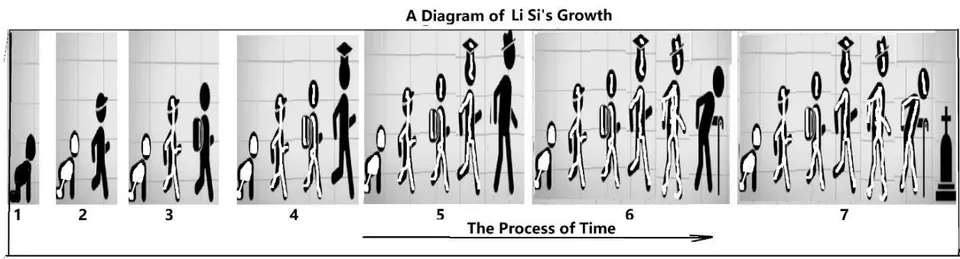
Fig. 1: Diagram of Li Si's Growth
In Frame 1 of Fig. 1, Li Si enters this world, and thus, his existence time begins to exist for Li Si. In Frame 2, Li Si grows into a child. The front figure of frame 2 represents Li Si as a child in the present moment, while the back figure represents Li Si as a baby at the last moment before the present moment (also the previous present moment in Frame 1). Because this baby no longer exists, but merely a historical memory of Li Si, he is depicted as a hollow image.
In frame 3, Li Si's "Now" has progressed a step further and he has become an elementary school student. The baby and child Li Si have become historical memories and no longer exist. In frame 3, two virtual images are used to represent his historical existence.
Similarly, from Frame 1 to Frame 7, the "Now" moment in each successive frame represents Li Si's actual past existence; as time passes, the "Now" in each frame rolls into the past, and the "Now" in the next frame becomes Li Si's true existence. This rolling replacement of the "Now" moment into the future continues endlessly, gradually accumulating traces of Li Si's historical existence into an increasingly rich history, as clearly seen in the gradual accumulation of virtual images from Frame 1 to Frame 7.
After Li Si's death, his time continues to move forward, frame by frame, through the "Now" moment, accumulating ever more historical traces and memories.
- Summarizing the evolution of Li Si's life, we can begin to appreciate the traces of time and the mystery of the existence of objects:
- Only after Li Si appeared and existed in the world, did times related to Li Si come into being;
- Li Si exists only in the present moment, the "Now" moment;
- Li Si's past is the historical trajectory of Li Si's past and his no longer existing history. This trajectory becomes longer as Li Si's existence increases;
- Li Si's future doesn't yet exist; it's merely the next moment that Li Si's "Now" can reach. We expect Li "Now" to smoothly and normally progress to his next future "Now," but it's entirely possible that Li existence at this "Now" moment undergoes a dramatic change, such as the transition from frame 6 to frame 7 in Fig. 1. During this change, Li life disappears, but his information and various other states persist. All the information about Li life from frames 1 to 7 becomes a historical record. Li Si himself continues to exist in a different state in the rolling river of time. Let's have a more in-depth discussion from a more general perspective.
4.1 Unit Object
We define a Unit Object as something that can exist independently. A man, a car, a planet, etc. are all Unit Objects. The "Li Si" we discussed earlier is also such a unit object.
Using the conclusions drawn from Li Si's above discussion to describe unit objects, we know that the time and existence related to unit objects are: unit objects exist at the "Now" moment; the past of unit objects is its historical trajectory, but it no longer exists in reality; the future of unit objects is the expectation of the rolling evolution of objects from the "Now" to the next moment, and it also does not exist at the "Now" moment.
A unit object is not just a single thing; it is more often a unit object composed of a collection of multiple unit objects. A typical example is that a human is composed of countless molecules and atoms. A large unit object can be broken down into smaller unit objects, or many unit objects can be aggregated into a single unit object. A unit object has various levels of complexity, and can be inclusive or combined. A typical example is when we view the Earth as a unit object, the countless unit objects on Earth, such as humans, animals, and so on, are all contained within this unit object - the Earth.
Various celestial bodies, including the Earth, are composed of countless different units. On the one hand, these celestial bodies themselves can also be considered individual units.
The world is a collection of units, composed of countless different units.
Units make up the world. The laws governing these units are the fundamental laws of the universe. When we discuss the nature of units, their duration should also conform to the laws governing their existence: that is, they exist only in the present moment.
The world exists only in the present moment.
4.2 Definition of the Law of Unit Object Existence
Law of Unit Object Existence: In the process of evolution from birth, through the past, to the present, and into the future, a Unit Object exists only in the moment of "Now."
We call this existence time as UOT.
Specifically:
A unit object begins its own time memory from the moment of its birth, the "Now" moment. The past of a unit object is the time memory of the events of its evolution, which has passed and no longer exists.
The future of a unit object is a prediction of the state that does not yet exist, an expectation of a possible future state.
The "Now" moment of a unit object is the moment of its true existence. This "Now" moment continuously rolls forward into the future, leaves a no longer existing trajectory behind.
4.3 The Temporal Progression of a Unit Object
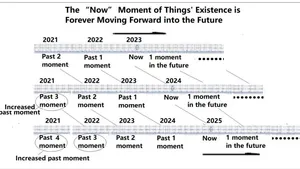
Consider dividing the growth process of a unit object into intervals, such as "a year" or "a day." We call the day this unit object exists "today," the day that just passed "yesterday," the upcoming day "tomorrow," and the day after "the day after tomorrow." Similarly, we call the countless days after tomorrow "the future," and the time from "yesterday" to the day this unit object was born "the past." Therefore, all past time is the historical trajectory of the unit object's past existence, a time when it once existed but no longer exists. The future is not the time when this unit object existed, but rather an unrealized expectation of its future existence. The only time that a unit object truly exists is the present moment!
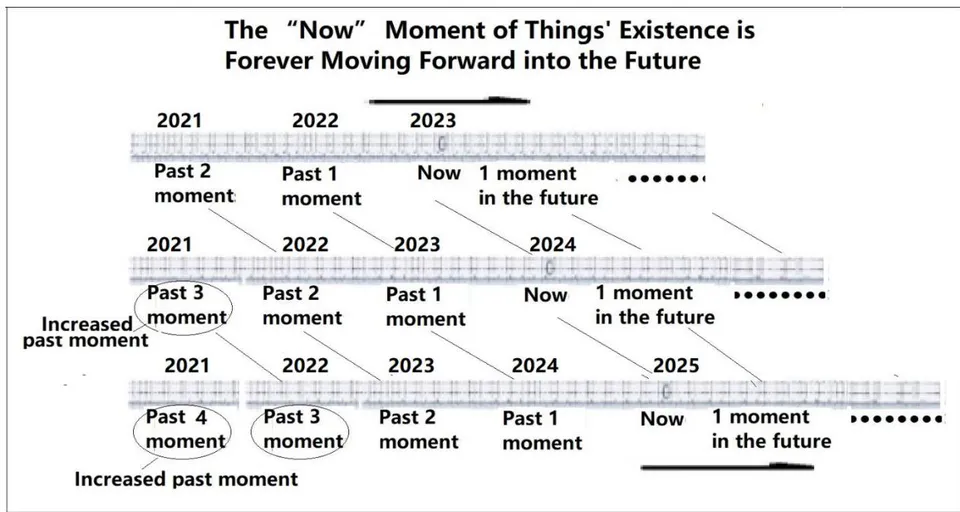
Fig. 2: The "Now" moment of existence of a unit object is progressing as things progress in "year" moments Fig. 2 illustrates a unit object, born in 2021, progressing year by year from the "Now" moment of 2023 to 2024, one moment in the future. The unit object's overall time advances one moment into the future. The history of this unit object also adds the "past three moments" in the left edge of the middle row in the diagram
The bottom row of the diagram shows the unit object progressing from 2024 to 2025. With each step, the "Now" moment advances one moment into the future, and the final history of this unit object adds a record of a past moment. Thus, the unit object evolves moment by moment, accumulating history. The result of this evolution is that the unit object always exists in the "Now" moment, its future is always just one possible development, never exists, and its past leaves an increasingly long historical trajectory from the "Now" moment to its birth. This is the law of evolution of unit objects.
4.4 The growth rhythm of unit objects
Linking the time of unit objects with the rate of their evolution would easily blur the distinction between time and the rate of their development. Time is a standard measure used by all humans, but the time associated with individuals varies from one object to another.
To this end, we propose the new concept of the tempo of development of unit objects to distinguish it from concepts such as time dilation. For example, if an astronaut returns younger than his twin brother who stayed on Earth after a spacecraft travels, we cannot say that time has slowed down for him (Because time is only a constant measure). Rather, we should say that his aging tempo has been slowed down by the impact of the flight.
Conversely, if there is no unchanging time scale, how can we know how fast objects change? Only by measuring with an unchanging time scale can we measure the different rhythms of objects happening and developing.
The scale of time is constant, but the paces of growth of unit objects change with changes in their environmental conditions. These changes shouldn't be interpreted as changes in the velocities of time for those unit objects. For example, if Li Si's heart rate is 200 beats per minute while running, compared to 60 beats per minute at other times, we shouldn't say that the velocity of time has changed while Li Si is running. Instead, we should understand that it's the unchanging scale of time that measures the change in Li Si's heart rate as the intensity of his exercise changes.
Wouldn't it be more reasonable to say that each unit object has its own growth rhythms, and unit objects are not exactly the same. Just as my heart rate is 60 beats per minute, while the average person's is 74 beats per minute, there are always some equal and some different rhythms. When certain conditions change (such as running), the rhythms of these people's hearts change. This cannot be attributed to a change in time itself affecting each unit object, but rather to the influence of something else (in this case, running). It's not that time itself has changed, but rather that the relative rhythm of the unit object has changed. When people use time to describe this change, they are measuring it on an unchanging time scale, thus knowing the relative rhythm of each unit object. If time changes with the changes in the rhythms of different unit objects, then people have no accurate scale to measure the rhythms of unit objects, and therefore cannot measure the differences in the rhythms of different unit objects, or under different conditions.
How long is the "Now" moment?
This is a profound question worthy of more in-depth study.
The "Now" moment refers to the actual duration of a unit object's existence, and it's not easily determined. For example, if Li Si's arm is broken in a car accident at a certain minute, should the "Now" describing Li Si's accident be defined as "minute"?
We haven't figured out the relationship between the "Now" moment and the rhythm of things. We also haven't yet figured out how to determine the actual duration of the "Now" moment for a unit object. There are profound implications here, and interested readers are encouraged to join us in this study.
4.5 Unit Object Flow
A unit object flow is a flowing group composed of a large number of identical unit objects. Rivers, starlight, and so on are examples of unit object flows. Rivers are composed of a large number of flowing individual water molecules, while starlight is composed of a large number of moving individual photons. Unit objects and unit object flows are two complementary concepts that we define.
Previous research on unit object flow has been largely incomplete. Unit object flows refer to groups composed of many units. Previously, unit object flows were studied and discussed from a holistic perspective, treating them as unit objects, leading to some debatable arguments.
We specifically define unit objects and unit object flows to study individual objects and groups of similar objects separately, in order to further understand the nature of existence and time.
World line graphic expression of unit object flow: The propagation, existence and historical trajectory of unit object flow in spacetime.
The world line graphical representation of unit object flow is completely different from the world line representation of the aforementioned unit object.
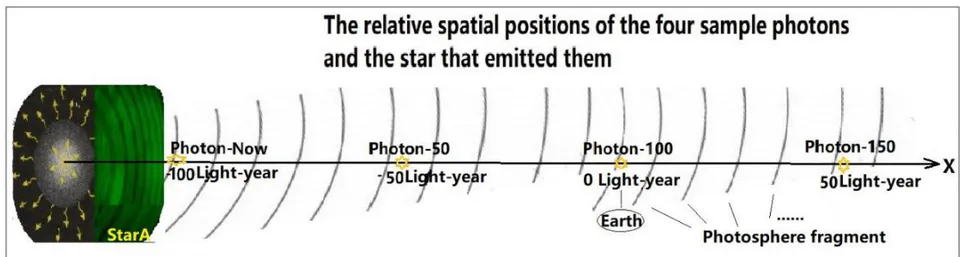
Fig. 3 below shows observations and studies of multiple sample photons emitted by StarA at different times. The photons emitted at different times form a vast ball of light centered on StarA, filled with countless photons.
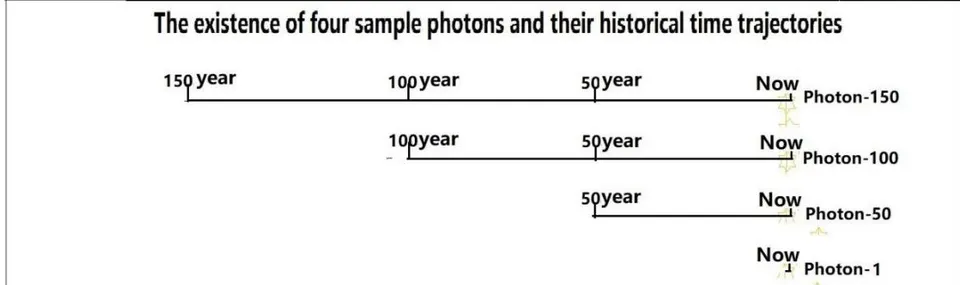
Fig. 3: Preliminary study of the distance and historical time trajectories of four samples of a unit object flow (here, the photon stream of StarA).
The image on the left of the upper frame in Fig. 3 represents a StarA located 100 light-years from Earth. Assuming that StarA is 200 years old. From its birth, it continues emitting photons to the surrounding space in all directions. Drawing an X-axis in one direction as shown in the upper frame of Fig. 3 We put the names of the photons we are studying at the upper of X-axis, and the distance between the photon and the Earth at lower of X-axis.
Suppose the Earth is 100 light-years away from Star A. Drawing an X-axis in one direction. This axis is densely packed with photons emitted by StarA at various times. The Earth, where is the observer's position is, is used as the coordinate origin. Four of these photons, emitted at different times—150 years ago, 100 years ago, 50 years ago, and now—are selected as sample photons and are named Photon-150, Photon 100, Photon-50, and Photon-Now. The upper frame of Fig. 3 shows the evolution of Photon-150's position.
When this photon was emitted from StarA 150 years ago, it was at Photon-Now's position in the diagram. Fifty years later, it was at Photon-50's position, and Photon-100 appeared at Photon-Now's position, and so on. Finally, these four sample photons are now at the "Now" positions shown in Fig. 3 lower frame.
In this unit photon flow, each unit photon rolls forward from the present moment to a new position at the next moment, while the old position is occupied by the later moment emitted photon from Star A. That is, after the unit photon rolls forward to the next position, the old position is filled by the later emitted and arrived unit photon. This is totally different from the progress of a single unit object.
The historical trajectory time of the unit object flow is shown in the time trajectory diagram in the lower frame of Fig. 3. For each unit photon in the unit photon flow, its historical trajectory and "Now" moment of existence are no different from those of normal unit object events. From this figure we can see that it is not easy to combine time and distance together to draw in one time-space figure. Interested readers can refer to our try in (1-4), and other related work (5-11).
Compare the above description in Fig.4 to the famous light cone in Fig.4 below:
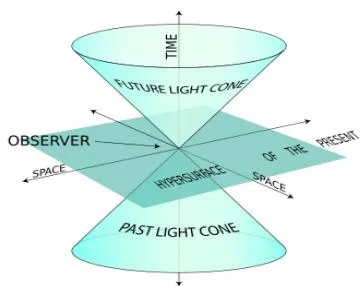
Fig. 4: The latest image of a light cone from Wikipedia (11)
Simply compare this diagram with the previous unit object flow diagram 4, where the observer is at the "present" position, namely, Earth's location. For StarA observed from Earth, only the light emitted by StarA 100 years ago can illuminate Earth at the "present" moment; other past and future light cones do not exist. Of course, there are many problems with this, so we won't address them one by one here.
A further point requires discussion: these descriptions are all about the "light" emitted by celestial bodies, not the celestial bodies themselves. A celestial body cannot move at the speed of light. So, focusing only on "light" without discussing the celestial body that emits this "light" cannot correctly describe the relationship between space and time. What is the significance of the light cone?
Three-dimensional light images, such as the light cone, cannot represent anything in the universe that is not "light." All light originates from a light source. Does studying light mean that we can study all light sources? What if Li Si doesn't emit light? Can you use the light-cone to describe any celestial body itself, not its light?
Compare the above description to the orbit of the unit Earth around the Sun in Fig. 5 below. In its orbit around the Sun, the unit Earth always exists only at a single point on its trajectory. But the Sun's countless photons are always filled with the whole surrounding space.
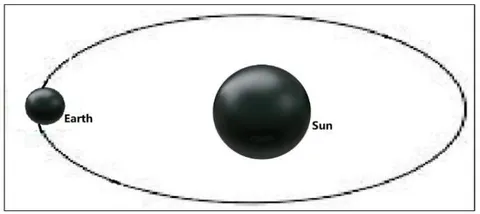
Fig. 5: There is only one Earth or one Sun at any given moment in the moving Earth's orbit around the Sun
This is the fundamental difference between unit objects and unit object flows: a unit object has only one real moment of existence, namely "Now", while a unit object flow is composed of a large number of unit objects that exist at every moment, emitted at different times and last a very long time.
By the way, again, talking about spacetime, space is an empty location host everything. How can an empty space have time? The unit object located in the space has time, not space itself has time. Ultimate space is so huge, the beginning and ending time can't be known by anybody. So, add time, even scale time to this empty space is meaningless.
V. THE EXISTENCE TIME OF UNIT OBJECT AND THE UNIT OBJECT FLOW - THE COMPLETE PICTURE OF TIME
The existence of a moving unit object is a fragmented sequence of constantly evolving moments of existence. From the perspective of a unit object's existence, it is an accumulation of a continuously progressing, "present," fragmented historical trajectory.
How do we calculate the existence of a static unit object? Is its fragmented existence based on its developmental laws, its rate of aging, or other factors?
The progressive rate of the existence of a unit object is somewhat like the concept of differential equations; we haven't fully grasped it yet. Even if a unit object is static, it only exists in the "present" moment; the past is history, and the future has not yet arrived.
We refer to the existence time of a single unit as UOT. UOT is the actual "present" fragment of time in which the unit truly exists. The historical trajectory of the existence time of a unit is referred to as UOTH. It does not include UOT.
The time fragment of UOT is not constant. First, for different units, each has its own UOT. And for the same unit, its duration may change as various conditions change.
The existence time of a unit flow is completely different from UOT. It is a continuous whole of unit objects over a very long period. Because it calculates the time of a large collection of unit objects, its existence time is also a collection of a large number of UOTs. Simultaneously, it is also a description of the continuous evolutionary historical trajectory of this entire UOT collection. We refer to the existence time of a unit flow as UFT.
Thus, we have seen the complete picture of time, which can be summarized as follows:
- Scale-time is the only ruler created by humankind to measure time. Based on the relative changes in the movements of the sun and earth, and other materials at our disposal, humans have defined different intervals of time, such as years, months, days, and hours, to measure UOT and UFT. This scale spans the ages, describing everything at hand regarding the state of time. It uses the year 1 AD as its origin, depicting the existence of all things within this scale.
Scale-time is merely a ruler of time. Of course, this ruler was gradually created by humankind, and therefore its existence in various states can be traced. However, these existence times describe the evolutionary state of the scale itself during its formation process and have no special relation to any object it measures.
- Existence time is a specific description of the existence of various people or things. With the birth of a thing, the existence time of things related to that thing also appears and continues to increase.
- Based on our research on unit object and unit object flow, existence time must be divided into the existence time of Unit Object (UOT) and the existence time of Unit Object Flow (UFT).
- A UOT does not perish. Even if the unit object associated with that UOT no longer exists, the UOT that recorded that unit object continues to exist.
- UFT describes a group of events consisting of a large number of identical unit entities. The number of unit entities within these groups is often unimaginably large. Previously, people often treated unit object flow time and unit object time as equivalent. However, there are actually many differences between the two. Previously, people were not clear about the fundamental difference between scale time and existence time, nor did they distinguish between UOT and UFT, or even have a clear concept of the difference between the two. Therefore, it was impossible to clearly explain the existence time of things.
With these basic concepts in mind, we can easily identify some concepts that have been distorted by our predecessors. For example, the relationship between space and time. How can an eternally existing, empty space be interchanged with the existence of time attached to things? Something like a light cone describes a unit flow, a collection of a large number of photons. It cannot describe the existence of a unit object.
On the concept of binding time and space together to discuss space-time. In scientific research, we try to separate various related factors and study them clearly, and then study the things that have been studied separately together. Space and time should also be studied in the same way.
However, in recent years, the physics community has been discussing space and time together. Because this is what Einstein advocated. And Einstein's idea was copied from Minkowski's 1908 paper "Space and Time"
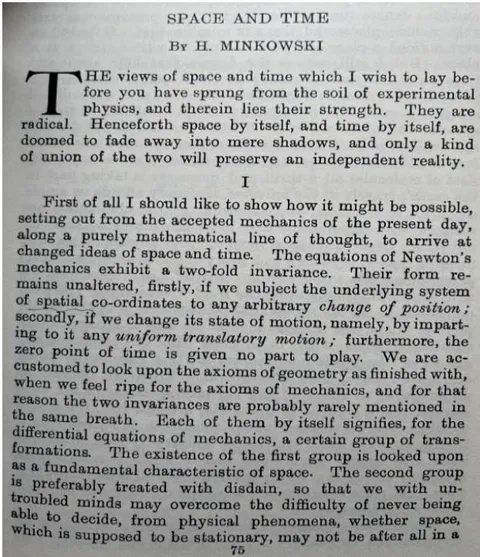
Fig. 6: Minkowski's 1908 paper "Space and Time"
Here the first paragraph from Minkowski is such: "The views of space and time which I wish to lay before you have sprung from the soil of experimental physics, and therein lies their strength. They are radical. Henceforth space by itself, and time by itself, are doomed to fade away into mere shadows, and only a kind of union of the two will preserve an independent reality."
First of all, Minkowski and Einstein did not understand what is the real meaning of "space" and of "time," because there was no concept of UOT and UFT before, how can they understand what is the real meaning of time? And "space-time?"
I don't understand how time can appear in a blank space. Please tell me the meaning of time appearing in a blank space. I also don't know how time can be combined with empty space. Does it make sense to combine time with the empty "nothing"? If we insist on combining time with the ultimate space, what is the meaning of this connection? This combination does not know the starting point and end point of the ultimate space, nor can it describe a small space that has not been defined by subspace isolation, so it has no practical value.
Time only makes sense when combined with something that exists in space. In other words, time is connected to space through things that exist in space. Time never connects to space directly. Time can never be directly connected to space.
About Space-Time Weapon
In summary, the direct combination of time and space is meaningless. Combining the "emptiness" of space with time is to combine time with nothing. Can this combination succeed? Does this combination have any meaning?
From this, we can see that "time-space weapons" are a fantasy without understanding the nature of space and time. There is no scientific content and no practical value.
"Space" cannot be manipulated because "emptiness" cannot be manipulated. "Time" is essentially a rate of the trajectory of the course of events related to something existing in space, and this rate only can be changed by the change of the thing itself.
Trump and Kratsios may want to manipulate the rate of evolution of things in space. I don't know how this sci-fi weapon works. But obviously no one can manipulate the empty space. The scale time is a ruler that can't be changed. The existence time is attached to something existing in space. Each thing has its own existence with a specific development rate for this thing. Its kind of a description of the thing, not the life or essence of the thing. How can one change it with space?
A unit object exists only at "Now" moment. Trump and Kratsios don't even have the ideal of this existence moment, how can they manipulate it?
On the other hand, if there really is such a space-time weapon, why build new fighters and research new weapons? Just manipulate this space-time weapon to kill all the guys you don't like! What's the point of negotiating? Just order them to surrender.
VI. CONCLUSION
Space relates to the existence and time of things within it. That is, space cannot directly relate to the existence time of anything; the relationship between them is completely independent. Therefore, space cannot influence time. Time, in turn, cannot influence empty space. Space is devoid of everything and cannot influence anything. Do not confuse the interactions between things existing within space, or the interactions arising during the evolution of things themselves, and impose them on the "empty" space itself.
Time, on the other hand, exists because of the existence of things. Without things, there is no existence time for those things; things must exist in some subspace. Only after things exist can their existence time be measured in terms of scale time. If the rate of evolution of this existence time changes, it is due to changes in the things themselves, and is obtained by measuring in terms of scale time and comparing it with the existence rates of other units of things.
Existence time is essentially descriptive, describing different evolutionary states of things. It cannot, in turn, influence the evolution of things.
When we examine existence time from the perspective of unit things and the flow of unit things, we arrive at entirely different conclusions. Unit things that can only exist in the "now" moment cannot be manipulated. How long is the "now" moment exactly? We don't know yet; further research is needed. But we do know for certain that the existence time of unit things is only this "now" moment; the past is history, and the future has not yet arrived. There is no previous research on the existence of such things. In other words, the concept of time has never been clearly understood by humankind.
Given this, what ability do humans have to manipulate time, which they themselves don't even fully understand?
Humans cannot manipulate time and space.
Conflict of Interest
The authors declare no conflict of interest.
Ethical Approval
Not applicable
Data Availability
The datasets used in this study are openly available at [repository link] and the source code is available on GitHub at [GitHub link].
Funding
This work did not receive any external funding.
Cite this article
Related Research


Special Issue
Launch a focused special issue to highlight research, emerging trends, and expert insights in your academic field.