





IntelliPaper
Abstract
A simple high-performance liquid chromatography coupled with fluorescence detection (HPLC-FL) method has been developed for the simultaneous determination of the phenoxy herbicides 2,4-dichlorophenoxyacetic acid (2,4-D) and 2,4,5-trichlorophenoxyacetic acid (2,4,5-T). Chromatographic separation was achieved on a C18 column using a methanol/phosphate buffer (80:20, v/v, pH 3.0) mobile phase under isocratic conditions, using a flow rate of 1.0 mL min⁻¹. Detection was performed at an emission wavelength of 575 nm and an excitation wavelength of 553 nm, taking advantage of the native fluorescence of both herbicides.
Under the optimised conditions, 2,4-D and 2,4,5-T were completely separated with retention times of approximately 36 and 48 s, respectively. Calibration curves were linear within the concentration ranges of 55.3–442.1 mg L⁻¹ for 2,4-D and 63.9–511.0 mg L⁻¹ for 2,4,5-T, with correlation coefficients of 0.9922 and 0.9976, respectively. Limits of detection were 1.36 mg L⁻¹ for 2,4-D and 1.57 mg L⁻¹ for 2,4,5-T, whereas limits of quantification were 4.11 and 4.77 mg L⁻¹, respectively.
The applicability of the proposed methodology was evaluated using three environmental water samples fortified at two concentration levels of both herbicides. Recoveries ranged from 95.2 to 111.1% for 2,4-D and from 90.2 to 110.7% for 2,4,5-T, with relative standard deviation values lower than 1% in all cases. The proposed method provides a rapid, simple and reliable alternative for the simultaneous determination of phenoxy herbicides in environmental waters and demonstrates that both analytes exhibit measurable native fluorescence under the chromatographic conditions employed.
Explore Digital Article Text
Introduction
Phenoxyacetic herbicides constitute one of the most widely used groups of agrochemicals worldwide for the selective control of broadleaf weeds in agricultural and non-agricultural environments . Among them, 2,4-dichlorophenoxyacetic acid (2,4-D) remains one of the most extensively applied herbicides because of its effectiveness, low cost and broad applicability in crop protection programs . Although the use of 2,4,5-trichlorophenoxyacetic acid (2,4,5-T) has been restricted or prohibited in many countries, this herbicide continues to acquire environmental attention due to its historical use, persistence and potential occurrence in soils and aquatic systems .
The extensive application of phenoxy herbicides has resulted in their detection in surface waters, groundwater, agricultural runoff and other environmental compartments . Consequently, reliable analytical methodologies are required for monitoring these contaminants in environmental matrices. In addition to environmental concerns, exposure to phenoxy herbicides has been associated with adverse effects on aquatic organisms and potential risks to human health, emphasising the need for sensitive and selective analytical approaches .
Several analytical methodologies have been proposed for the determination of phenoxy herbicides, including gas chromatography (GC), high-performance liquid chromatography (HPLC), capillary electrophoresis and liquid chromatography coupled to mass spectrometry (LC-MS) . Among these techniques, HPLC remains one of the most versatile and widely employed approaches because of its suitability for polar and thermally unstable compounds. However, many reported methodologies require sophisticated instrumentation, extensive sample preparation procedures, or derivatisation steps to improve detectability .
Fluorescence spectroscopy represents an attractive alternative for analytical determinations due to its inherent sensitivity, selectivity, simplicity and relatively low operational cost . The fluorescence properties of aromatic compounds are strongly dependent on their physicochemical environment, including solvent composition, pH, molecular aggregation and microenvironmental interactions, which may significantly affect fluorescence emission processes and analytical performance .
In recent years, our research group demons trated the applicability of solid-surface fluorescence (SSF) methodologies for the determination of 2,4-D in different matrices. Direct determination of 2,4-D in environmental waters was successfully achieved using sodium dodecyl sulfate as fluorescence-enhancing agent, obtaining excellent analytical sensitivity and satisfactory recoveries in natural water samples . More recently, the same analytical strategy was successfully extended to bee products, confirming the potential of native fluorescence methodologies for monitoring this herbicide in complex matrices . Nevertheless, under the experimental conditions employed in those studies, 2,4,5-T did not exhibit a sufficiently intense fluorescence response to allow its direct analytical determination.
The photophysical behaviour of aromatic compounds may change substantially when the surrounding medium is modified. In chromatographic systems, the presence of organic solvents and different pH conditions can alter molecular interactions, ionisation equilibria and non-radiative deactivation pathways, leading to significant changes in fluorescence intensity . Therefore, chromatographic environments may provide favourable conditions for fluorescence emission that are not observed under conventional spectrofluorimetric methodologies.
HPLC remains one of the preferred techniques for the determination of phenoxy herbicides due to its versatility, reproducibility and compatibility with aqueous environmental samples. Different detection systems, including UV, diode-array and mass spectrometric detectors, have been reported for the determination of these compounds.
High-performance liquid chromatography coupled with fluorescence detection (HPLC-FL) combines the separation capability of chromatographic techniques with the sensitivity and selectivity of fluorescence measurements . Despite the extensive use of HPLC for herbicide analysis, studies concerning the simultaneous determination of 2,4-D and 2,4,5-T by native fluorescence detection remain scarce. Moreover, little information is available regarding the influence of chromatographic conditions on the fluorescence behaviour of these phenoxy herbicides.
Considering these aspects, the aim of the present work was to develop a rapid HPLC methodology coupled with native fluorescence detection for the simultaneous separation and determination of 2,4-D and 2,4,5-T in environmental water samples. Particular attention was devoted to evaluating the fluorescence behaviour of both herbicides under a methanol-rich acidic mobile phase. Under the optimised experimental conditions, both compounds exhibited measurable native fluorescence signals and were successfully separated in less than one minute, enabling their rapid determination without derivatisation procedures.
Materials and methods
Reagents
Methanolic stock solutions of 2,4-dichlorophenoxyacetic acid (2,4-D) and 2,4,5-trichlorophenoxyacetic acid (2,4,5-T) (1.0 × 10⁻2 mol L⁻¹, Sigma-Aldrich, St. Louis, MO, USA) were prepared and stored at 4 °C in amber glass bottles. Working standard solutions were prepared weekly by appropriate dilution of the stock solutions with methanol.
Phosphoric acid (Biopack, Buenos Aires, Argentina) was used for the preparation of the phosphate buffer solution (1.0 × 10⁻² mol L⁻¹). The pH was adjusted using a Model EA940 Orion Expandable Ion Analyser pH meter (Orion Research, Cambridge, MA, USA).
All solutions were prepared using ultrapure water (18.2 MΩ cm) obtained from a Milli-Q EASY Pure RF purification system (Barnstead, IA, USA).
Instrumentation and chromatographic conditions
A Shimadzu high-performance liquid chromatography system (LC-20AT, Shimadzu Corporation, Kyoto, Japan) equipped with an RF-20Axs fluorescence detector and a CTO-10ASvp column oven was employed throughout this work. Chromatographic separations were performed on a C18 column (150 mm × 4.6 mm i.d., 5 μm particle size) under isocratic conditions.
The mobile phase consisted of methanol and phosphate buffer (80:20 v/v). The phosphate buffer concentration was 1.0 × 10⁻² mol L⁻¹ and its pH was adjusted to 3.0. The mobile phase was delivered at a flow rate of 1.0 mL min⁻¹, while the column temperature was maintained at 25 °C. The injection volume was 25 μL and the total chromatographic run time was 1 min. Before chromatographic analysis, all mobile phases evaluated during method development were degassed by microwave-assisted treatment to remove dissolved gases and ensure baseline stability.
Fluorescence detection was performed at an emission wavelength of 575 nm (excitation wavelength of 553 nm). Excitation and emission bandwidths were both set at 10 nm and the detector was operated in high-sensitivity mode. Before chromatographic determination, environmental water samples were filtered through 0.45 μm membrane filters and then directly introduced into the HPLC system without any preconcentration procedure.
Sampling and sample treatment
Three environmental water samples were collected from different locations along the Quinto River basin in San Luis Province, Argentina. Sampling sites were selected to represent areas potentially affected by urban and peri-urban activities.
Sample M1 was collected approximately 4 km upstream from the urban area (33°36'31.54"S, 65°34'43.73"W). Sample M2 was collected at the outlet of the urban area (33°44'34.56"S, 65°22'15.69"W), while sample M3 was obtained from the Nuevo River, a tributary flowing into the Quinto River (33°44'43.31"S, 65°21'56.28"W).
Water samples were collected in polyethylene containers previously rinsed with deionized water. Upon arrival at the laboratory, samples were filtered through 0.45 μm membrane filters to remove suspended particulate matter and stored at 4 °C until analysis. All analyses were performed within 48 h of sample collection.
Before chromatographic analysis, filtered samples were directly injected into the HPLC system without additional clean-up treatment, digestion, derivatisation or preconcentration step.
Results and discussion
Optimization of chromatographic conditions
Several chromatographic variables were evaluated in order to obtain rapid separation and adequate fluorescence responses for both phenoxy herbicides. Special attention was devoted to the composition of the mobile phase and pH, since these parameters can strongly affect both chromatographic behaviour and fluorescence emission.
Initially, different methanol/phosphate buffer mixtures were investigated under isocratic conditions, including 50:50, 60:40, 70:30, 80:20, 90:10 and 95:05 (v/v). At methanol contents below 80%, longer retention times and lower fluorescence responses were obtained, particularly for 2,4,5-T, whose signal became difficult to distinguish from the baseline at low concentration levels. An increase in methanol content improved peak intensity and chromatographic efficiency for both analytes.
The best analytical performance was achieved using a 80:20 v/v methanol/phosphate buffer mixture. Under these conditions, symmetrical peaks, satisfactory fluorescence responses and complete chromatographic separation were obtained. Although the 90:10 composition further reduced retention times, peak distortion and baseline instability were observed, compromising analytical performance.
The effect of mobile phase composition on the analytical response is shown in Figure [fig:figure1]A.
The influence of pH was evaluated in the range 2.0–5.5 using phosphate buffer solutions. The highest analytical signals and best chromatographic performance were obtained at pH 3.0. At higher pH values, signal intensity decreased and peak shapes became less satisfactory. The influence of pH on the fluorescence response is presented in Figure [fig:figure1]B.
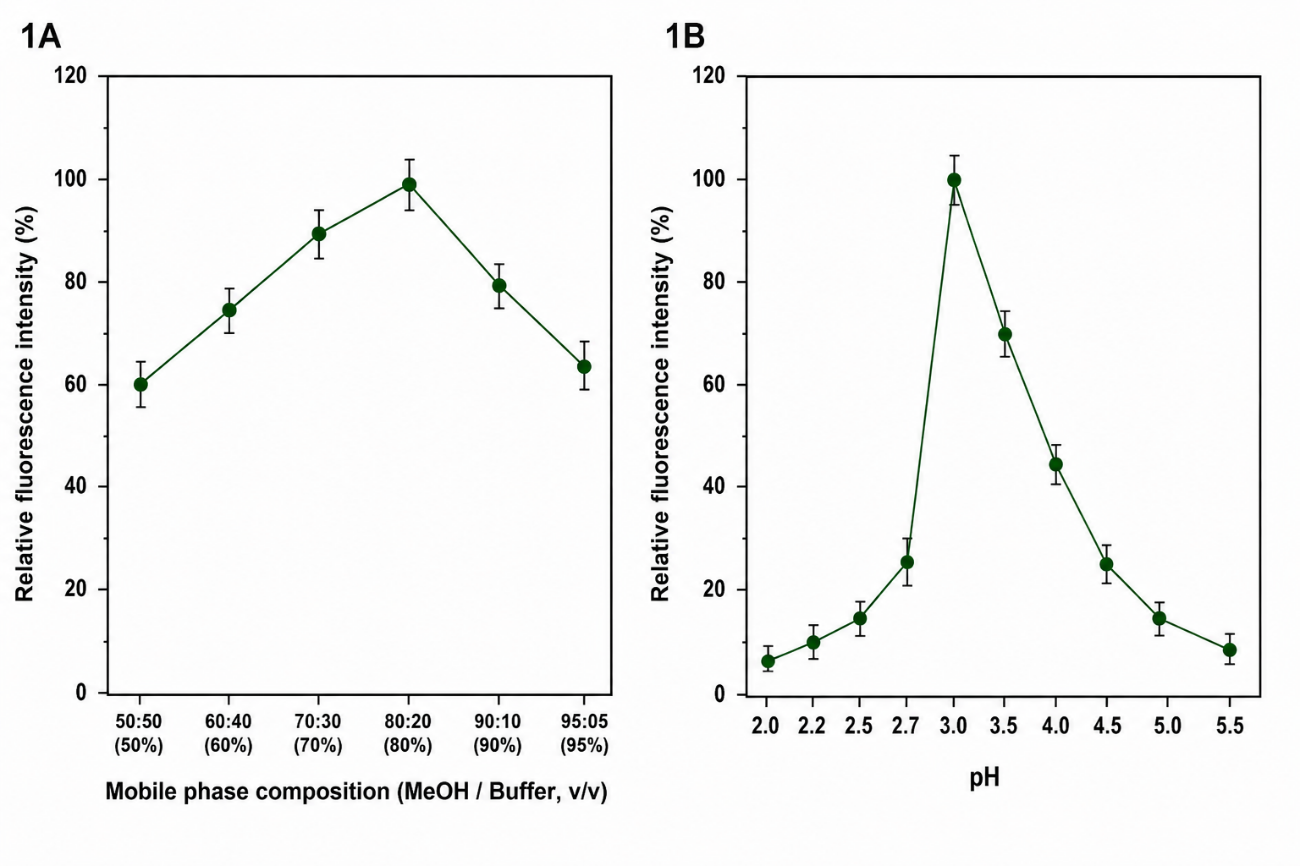
This behaviour may be attributed to changes in the ionisation state of the phenoxy herbicides, which influence both their chromatographic retention and fluorescence response. To achieve optimal analytical performance, detection parameters were selected based on signal-to-noise enhancement. An emission wavelength of 575 nm and an excitation wavelength of 553 nm provided the best compromise between sensitivity and baseline stability for the simultaneous determination of both analytes.
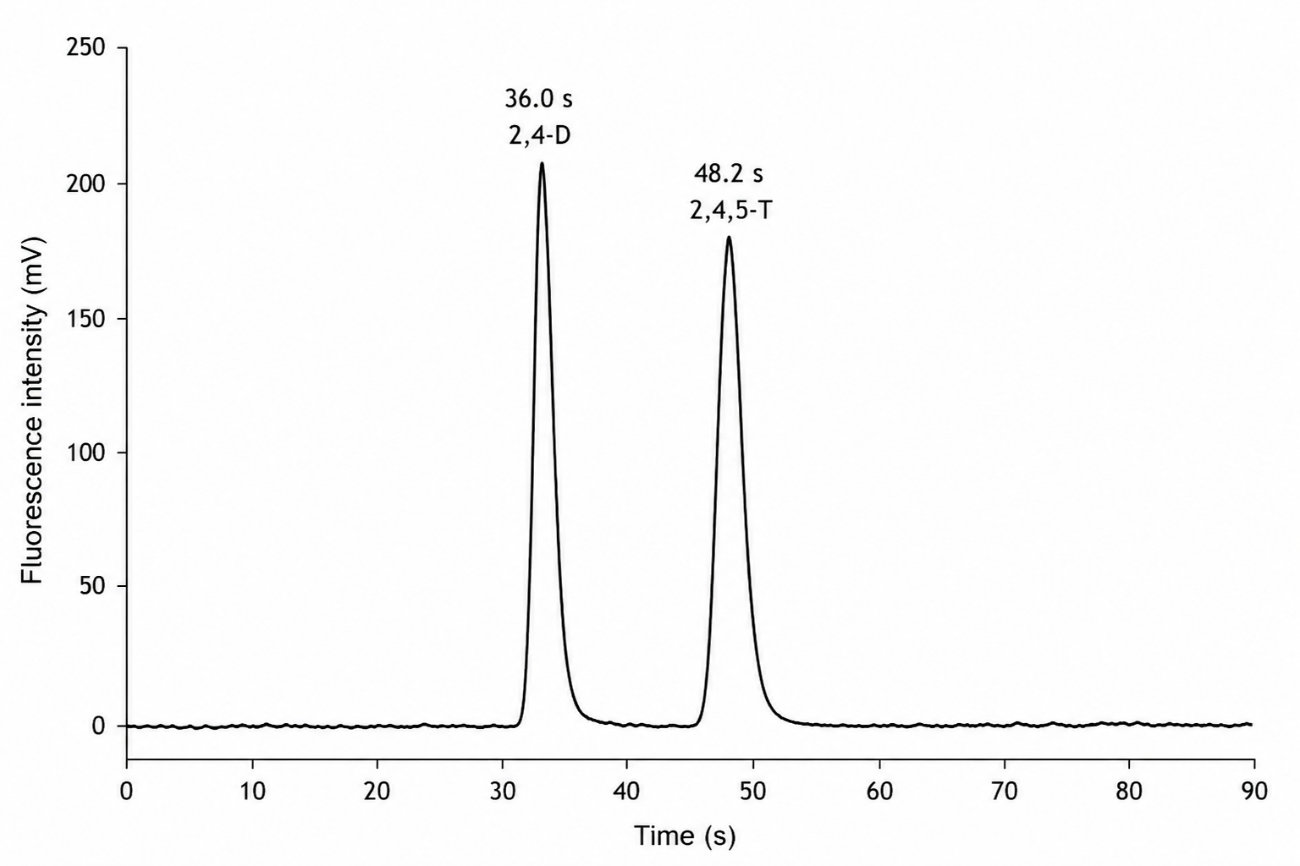
Under the optimised conditions, 2,4-D and 2,4,5-T were completely separated with retention times of 36 and 48.2 s, respectively. An important observation was the appearance of a measurable native fluorescence signal for 2,4,5-T, which had not been analytically useful under previously reported solid-surface fluorescence conditions. The methanol-rich acidic chromatographic environment therefore appears to play a decisive role in promoting fluorescence emission from this herbicide.
A chromatogram obtained under the optimised experimental conditions is shown in Figure [fig:figure2]. Baseline separation of both herbicides was achieved in less than one minute, highlighting the potential of the proposed HPLC-FL method for rapid simultaneous analysis.
Chromatographic behaviour and native fluorescence of 2,4-D and 2,4,5-T
Under the optimised chromatographic conditions, complete separation of 2,4-D and 2,4,5-T was achieved with retention times of 36 and 48.2 s, respectively. The short retention times obtained demonstrate the suitability of the proposed HPLC-FL method for rapid analysis while maintaining satisfactory chromatographic resolution. A representative chromatogram obtained for a standard mixture containing both herbicides is shown in Figure [fig:figure2].
An interesting observation was the measurable native fluorescence response exhibited by 2,4,5-T under the optimised chromatographic conditions. Previous studies performed by our research group using solid-surface fluorescence methodologies reported a very weak fluorescence emission for this herbicide, which prevented its direct quantitative determination. In contrast, under the methanol-rich acidic chromatographic environment employed in the present work, a well-defined chromatographic peak with satisfactory signal intensity was obtained.
This behaviour may be associated with changes in the microenvironment surrounding the analyte molecules. The high methanol content of the mobile phase and the acidic conditions employed may reduce non-radiative deactivation pathways and favour emission processes, thereby enhancing the native fluorescence response of 2,4,5-T. Similar solvent-dependent effects on fluorescence emission have been reported for other aromatic compounds containing halogenated substituents.
The fluorescence behavior observed under the chromatographic conditions employed in the present work differs from that previously reported under conventional spectrofluorimetric conditions. The high methanol content and acidic pH of the mobile phase may alter the microenvironment surrounding the analyte molecules, modifying ionization equilibria and solvent–solute interactions. Such effects can influence radiative and non-radiative deactivation pathways, leading to measurable changes in fluorescence intensity and spectral distribution. These phenomena may explain the analytically useful fluorescence response observed for 2,4,5-T under the optimized HPLC conditions.
Analytical performance
The analytical performance of the proposed HPLC-FL method was evaluated under the optimised experimental conditions. Calibration curves were constructed using standard solutions of 2,4-D and 2,4,5-T and exhibited good linear relationships between fluorescence intensity and analyte concentration within the investigated ranges.
The analytical figures of merit obtained for both herbicides are summarized in Table [tab:table1]. Correlation coefficients higher than 0.99 were obtained in all cases, confirming the satisfactory linearity of the proposed method. Limits of detection and quantification were calculated according to IUPAC recommendations as 3.3 and 10 times the standard deviation of the blank divided by the slope of the calibration curve, respectively.
| Parameter | 2,4-D | 2,4,5-T |
|---|---|---|
| Linear range (mg L–1) | 55.3–442.1 | 63.9–511.0 |
| Regression equation | y = 456.96x + 53.64 | y = 455.52x + 49.62 |
| Correlation coefficient (R2) | 0.9922 | 0.9976 |
| LOD (mg L–1) | 1.36 | 1.57 |
| LOQ (mg L–1) | 4.11 | 4.77 |
Analytical figures of merit for the determination of 2,4-D and 2,4,5-T by HPLC coupled with native fluorescence detection (n = 3).
Although the sensitivity achieved was lower than that reported for previously developed solid-surface fluorescence methodologies, the proposed HPLC-FL approach allowed the direct determination of both phenoxy herbicides in environmental waters with minimal sample handling. The satisfactory analytical performance obtained, together with the absence of derivatisation and preconcentration steps and the very short analysis time, demonstrates the suitability of the method for routine monitoring applications.
Although the sensitivity achieved is lower than that attainable by advanced mass spectrometric methodologies, the proposed HPLC-FL method provides a rapid, simple and cost-effective alternative for screening and routine monitoring applications where moderate concentrations of phenoxy herbicides are expected.
Application to Environmental Water samples
The applicability of the proposed methodology was evaluated using three environmental water samples collected from different locations within the Quinto River basin. Preliminary analyses indicated that concentrations of the target herbicides were below the working range of the method. Therefore, recovery studies were carried out by fortifying the samples with known amounts of 2,4-D and 2,4,5-T (Table [tab:table2]).
| Water Sample | Herbicide | Added (mg L–1) | Found (mg L–1) | Recovery (%) | RSD (%) |
|---|---|---|---|---|---|
| M1 | 2,4-D | 110.52 | 115.83 | 104.8 | 0.24 |
| 221.04 | 238.94 | 108.1 | 0.18 | ||
| M2 | 2,4-D | 110.52 | 109.42 | 99.0 | 0.81 |
| 221.04 | 235.85 | 106.7 | 0.23 | ||
| M3 | 2,4-D | 110.52 | 105.21 | 95.2 | 0.66 |
| 221.04 | 245.18 | 111.1 | 0.38 | ||
| M1 | 2,4,5-T | 127.75 | 120.85 | 94.6 | 0.43 |
| 255.49 | 282.33 | 110.7 | 0.49 | ||
| M2 | 2,4,5-T | 127.75 | 126.47 | 99.0 | 0.84 |
| 255.49 | 270.82 | 106.0 | 0.29 | ||
| M3 | 2,4,5-T | 127.75 | 115.18 | 90.2 | 0.36 |
| 255.49 | 277.21 | 108.5 | 0.56 |
Recovery studies for the determination of 2,4-D and 2,4,5-T in fortified environmental water samples.
RSD = Relative Standard Deviation (n = 3).
Quantification was performed using the corresponding external calibration curves under the optimised chromatographic conditions. Recovery values ranged from 95.2 to 111.1% for 2,4-D and from 90.2 to 110.7% for 2,4,5-T. Mean recoveries were 104.2% and 101.5% for 2,4-D and 2,4,5-T, respectively.
The satisfactory recoveries obtained for both analytes demonstrate the accuracy of the proposed methodology, whereas the low relative standard deviation values (RSD \< 1%) confirm its excellent precision and repeatability. These results indicate that matrix effects were negligible in the studied samples under the experimental conditions employed.
An additional advantage of the proposed methodology is the minimal sample treatment required. Environmental water samples were analyzed after simple membrane filtration without extraction, digestion, derivatisation or preconcentration procedures, contributing to a rapid and straightforward analytical workflow.
Greenness Considerations
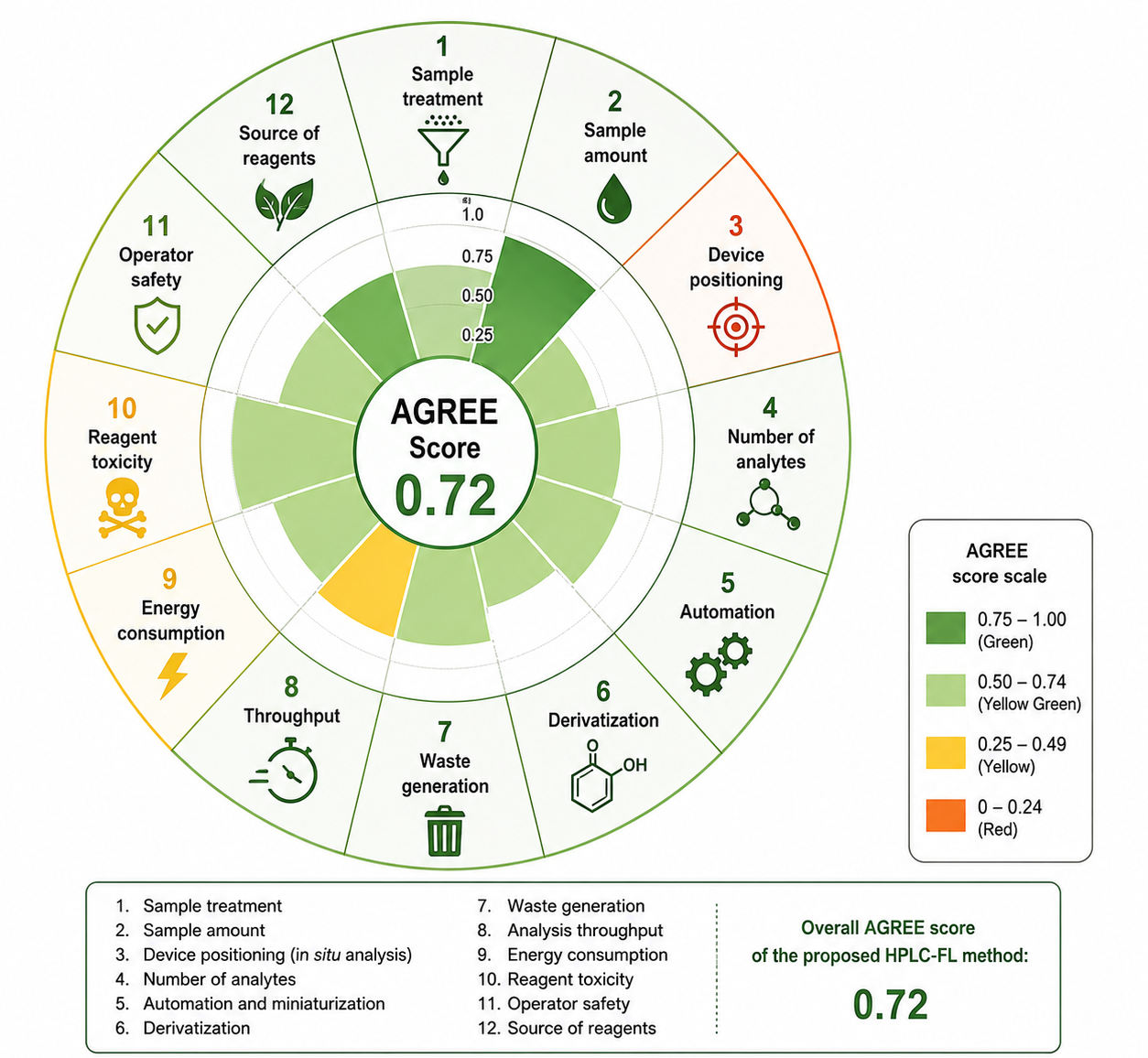
The environmental impact of the proposed analytical methodology was also considered. Sample preparation was particularly simple, consisting only of membrane filtration before chromatographic analysis. No extraction, digestion, derivatisation, clean-up or preconcentration procedures were required, reducing reagent consumption, analysis time and waste generation.
The proposed HPLC-FL method employed a low sample volume (25 μL) and provided complete chromatographic separation of both analytes in less than one minute, contributing to high analytical throughput. Furthermore, the direct injection of environmental water samples minimised sample manipulation and reduced the risk of analyte losses or contamination.
Although methanol was used as the principal organic component of the mobile phase, the relatively short chromatographic run time reduced solvent consumption per analysis. Therefore, the proposed methodology presents favourable green analytical characteristics associated with minimal sample treatment, low sample consumption, absence of derivatisation procedures and rapid chromatographic separation.
Conclusions
A rapid and straightforward HPLC method coupled with native fluorescence detection was successfully developed for the simultaneous determination of the phenoxy herbicides 2,4-D and 2,4,5-T in environmental water samples. Under the optimised chromatographic conditions, both analytes were completely separated in less than one minute and quantified without derivatisation procedures. The proposed methodology provided satisfactory analytical performance, including good linearity, adequate limits of detection and quantification, excellent repeatability and satisfactory recoveries in fortified environmental water samples.
A particularly relevant finding of this work was the observation of a measurable native fluorescence response for 2,4,5-T under the methanol-rich acidic chromatographic conditions employed. Previous fluorescence methodologies developed by our research group allowed the determination of 2,4-D but did not provide an analytically useful signal for 2,4,5-T. In contrast, the chromatographic environment used in the present study enabled the detection and simultaneous determination of both herbicides. The proposed methodology combines rapid chromatographic separation, minimal sample treatment and direct fluorescence detection, representing a simple and cost-effective alternative for routine screening of phenoxy herbicides in environmental waters. Furthermore, the results demonstrate that chromatographic environments may significantly influence the fluorescence behaviour of phenoxy herbicides, opening new perspectives for the development of fluorescence-based methodologies for related environmental contaminants.
The authors gratefully acknowledge the financial and institutional support provided by the Universidad Nacional de San Luis (UNSL), the Consejo Nacional de Investigaciones Científicas y Técnicas (CONICET) and the Instituto de Química de San Luis (INQUISAL-CONICET).
Conflict of Interest
Ethical Approval
Not applicable
Data Availability
Funding
This work did not receive any external funding.
References
Cite this article
Related Research

Special Issue
Launch a focused special issue to highlight research, emerging trends, and expert insights in your academic field.
