


IntelliPaper
Abstract
This paper proves that Goldbach's conjecture is true. The proof uses Gaussian modular arithmetic to calculate the number of pairs of odd numbers, KT , whose sum is a given even number, n, as well as, the number, KE, of those that can potentially contain prime numbers. Next, a probabilistic model with a binomial probability distribution is de ned, which will be applied to KE to calculate a function f(x) for the expected value, E(X), where X is the number of pairs formed by two prime numbers. Finally, the analysis of this function, f(x), will allow us to prove that the conjecture is true.
Explore Digital Article Text
I. INTRODUCTION
In 1742 the Prussian mathematician Christian Goldbach wrote a letter to Leonhard Euler, see [1], and proposed the following conjecture.
Definition 1. Goldbach's conjecture states that:
"Every even number greater than two can be expressed as the sum of two prime numbers".
Note that, Goldbach's conjecture only requires the existence of two prime numbers whose sum is an even number greater than two. Naturally, if there is an even number that cannot be obtained by adding two prime numbers, this even number will be a counterexample to the conjecture.
In the 283 years since its inception, many mathematicians have attempted to prove the conjecture from various angles.
Empirical verification has shown that all even numbers, up to , hold the Goldbach conjecture. See [2].
Recently, an empirical approximation of the conjecture was published. This approximation sets an upper bound on the probability that a very large number, , is a counterexample to the conjecture. Thus, it rules out the existence of counterexamples in practice. See [3]. It would require the use of heuristic reasoning to accept this last statement because it is impossible to prove empirically.
Currently, the conjecture remains unproven.
In this paper, we will use congruences modulo 6 from Gaussian arithmetic, see [4], to accurately calculate the number of pairs of odd numbers that could potentially contain prime numbers and add up to a given even number, .
Then, we will use a binomial probability distribution to calculate a function for the expected value, , where is the number of pairs formed by two prime numbers. With this, we will prove that the conjecture is true.
The paper is organized as follows:
In Section 2, The Conjecture from the Perspective of Gauss's Modular Arithmetic; we will use Gauss's modular arithmetic to analyze the conjecture.
In Section 3, Probabilistic Model and Expected Value, we will define the probabilistic model and apply its probability distribution to calculate based on the number of effective pairs, .
Finally, in Section 4, The Final Theorem; we will use the function calculated in the previous section, to prove that the conjecture is true.
Notation
(1) : Set including zero.
(2) : Prime number.
(3) : Set of prime numbers
(4) : Non-prime number.
(5) : Set of non-prime numbers.
(6) : The quantity of .
(7) : Cartesian Product of sets.
(8)
(9) , , and also,
(10) ,
(11) : The quantity of , belonging to
(12) : The quantity of , belonging to
(13) : The quantity of , belonging to
(14) : the total number of pairs of odd numbers, whose sum is a given even number,
(15) : Effective pairs that can potentially contain prime numbers.
Remark 1. Simplification of subsequent calculations.
(a) For the sake of brevity in the rest of this paper, we will refer to even numbers as , instead of writing or , since we know that the sum of two odd numbers is always an even number.
(b) In general, all even numbers considered in this paper will be , which will allow us to simplify expressions containing negligible numbers compared to . Only in examples, tables and figures, used for support or reference, will use numbers with small values.
(c) In general, is slightly higher than , but the difference becomes negligible when increases. Furthermore, only the prime numbers 2 and 3 do either or , so we will consider that , where will be 1 and 5.
II. THE GOLDBACH'S CONJECTURE FROM THE PERSPECTIVE OF GAUSS'S MODULAR ARITHMETIC
In this section, we will use congruences, modulo 6, from Gaussian arithmetic to analyze the conjecture.
First, let's review some of the key concepts and properties of modular arithmetic modulo 6, see [4] and [5].
Definition 2. General definition of congruences, modulo :
is congruent to , modulo , , if , with .
The congruence modulo is an equivalence relation, because it has the properties reflexive, symmetric, and transitive and, therefore, the residue classes form a partition of .
In this paper, we will make and denote the residue classes as , with .
The choice of meets the following two criteria:
(a) Keep odd and even numbers in separate sets.
(b) There are 6 classes of residues, modulo 6. , , , , and . See notations (9) and (10). All primes are odd, except for 2. And , the rest of the numbers in this class are multiples of 3, so all the others odd numbers are distributed between and .
Regarding the proof, the relevant property is that the congruence preserves the addition, i.e. we can add the residue classes according to the following table:
| Add | [0]_6 | [1]_6 | [2]_6 | [3]_6 | [4]_6 | [5]_6 |
| [0]_6 | [0]_6 | [1]_6 | [2]_6 | [3]_6 | [4]_6 | [5]_6 |
| [1]_6 | [1]_6 | [2]_6 | [3]_6 | [4]_6 | [5]_6 | [0]_6 |
| [2]_6 | [2]_6 | [3]_6 | [4]_6 | [5]_6 | [0]_6 | [1]_6 |
| [3]_6 | [3]_6 | [4]_6 | [5]_6 | [0]_6 | [1]_6 | [2]_6 |
| [4]_6 | [4]_6 | [5]_6 | [0]_6 | [1]_6 | [2]_6 | [3]_6 |
| [5]_6 | [5]_6 | [0]_6 | [1]_6 | [2]_6 | [3]_6 | [4]_6 |
This table shows the following sums whose result is an even number:
(i) or .
(ii) or .
(iii) or .
Now, to analyze the conjecture and calculate the total numbers of pairs, , and effective pairs, , we will use Figure 1, which is a fundamental and recurring reference here.
In the figure 1, we must look at:
On the horizontal axis, we have:
(1) number of diagonal elements (pairs).
(2) positioning of the diagonal elements.
(3) . Summands belonging to
On the vertical axis, we have:
(1) number of diagonal elements (pairs).
(2) positioning of the diagonal elements.
(3) . Summands belonging to
Note that, the total number of pairs of the sum for a given even number .
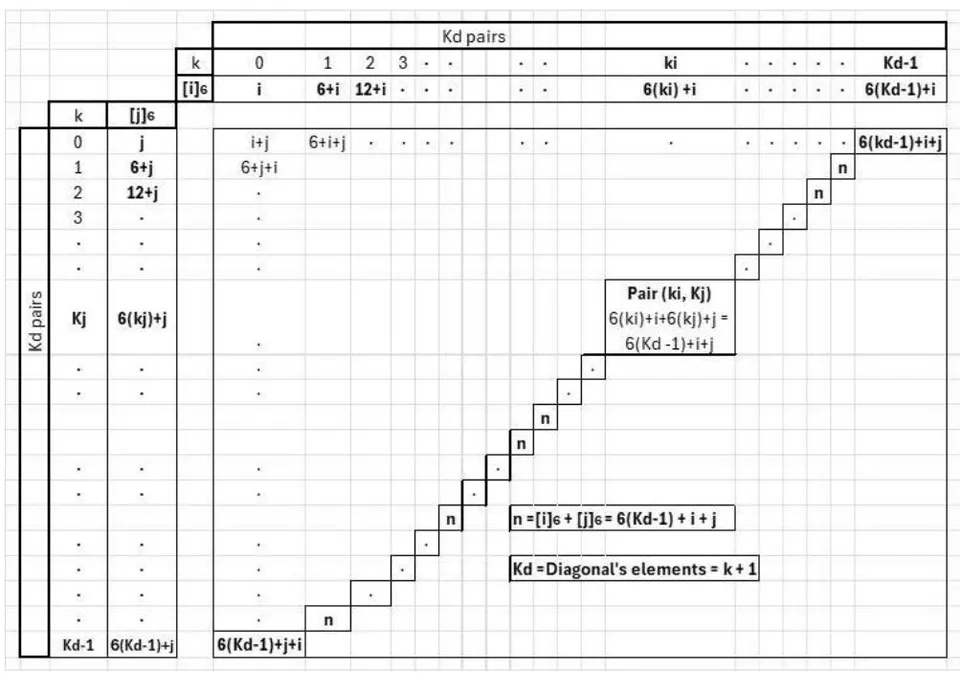
Figure 1: Template for calculating , and , when we know , and .
This figure is a template which allows us to easily calculate the number of pairs for each sum , with and or 5 depending on the elements of the sum.
Proposition 1. The number of pairs, , whose sum is a given even number , is as follows:
(i) For ; .
(ii) For , .
(iii) For , .
Proof. Table 1 and Figure 1 show that
If we set and or 5 as appropriate and, take into account, that , we get:
(i) or .
(ii) or .
(iii) or .

Now, let's calculate the set of effective pairs, that can potentially contain two prime numbers.
Proposition 2. The number of effective pairs, is either or .
Proof. Bearing in mind that only contains one prime, 3.
In all sums that have one of the addends belonging to , then there will be at most one effective pair. As follow:
(a) Sum : It has a single pair (3, 3).
(b) Sum : It has a single pair for all that is prime number.
(c) Sum : It has a single pair for all that is prime number.
So, in this type of sum we will have either 1 or 0 effective pairs.
Now, for the other 3 sums, either , or , all elements of the diagonal are effective pairs, since, as mentioned in remark 1, all primes, except 2 and 3 belong to and .
In summary, is either or .
Remark 2. In the next section and according to the criterion of simplifying, see remark 1, we will consider and .
III. PROBABILISTIC MODEL AND EXPECTED VALUE
First, we should note that the model does not need to calculate the exact number of prime pairs, not even get close to it.
According to the Conjecture's definition, 1, we only need to prove that , where "the number of pairs of prime numbers, whose sum is equal to ", so we are going to find a discrete function that minimizes the lower bound of , for any .
This function will be the expected value, , of the probability distribution of the mathematical model that we are going to build.
Definition 3. The proposed model is a probabilistic model with a binomial distribution and expected value:
This value is obtained from the probability distribution outlined in the following proposition.
Proposition 3. The random variable follows a binomial distribution, with parameters and , whose expected value is
Proof. According to [6] and [7]
An experiment, and an event associated with it, with probability, , is called a Bernoulli trial. If we repeat the experiment n times independently and define the random variable number of times A occurs, with fixed for all repetitions, then, follows a binomial distribution.
Therefore, if we define a mathematical model as follows:
(a) We take, as a Bernoulli trial, an experiment consisting of adding the elements of a pair of numbers , the result of which is a number , where and , see Figure 1. And, also, we define the event as "Pair whose elements are prime numbers" with some probability to be defined.
(b) We repeat that trial according to the following process:
(i) From their Cartesian product, notation (8), the first elements of sets and , we take the elements whose sum is a given even number, , which correspond to the diagonal of the figure 1.
(ii) And now, we define a random variable "the number of pairs containing two prime numbers" where , is one of them with probability .
We can apply the binomial distribution to this model if it meets the following assumptions:
(1) Each element of the diagonal, , whose sum is , is independent of the others, and we consider them to be so because:
(i) The actual distribution of prime numbers is unknown. While it is clearly chaotic, it is not random: decreases with as the primes become increasingly separated, although they sometimes appear to cluster together.
(ii) The sum of the elements of , must add up to , i.e. ; therefore, as increases, decreases and vice versa. This compensates for the non-randomness of the distribution of prime numbers. See figure 2 and, in particular, the line of averages.
(iii) Furthermore, given the magnitude of and , if we wanted to further ensure the independence of the Kd pairs, we could work with a random sample of them. For example, selecting pairs at random would result in the same probability, , as we will see later. Therefore, it is unnecessary to use a sample to calculate the probability.
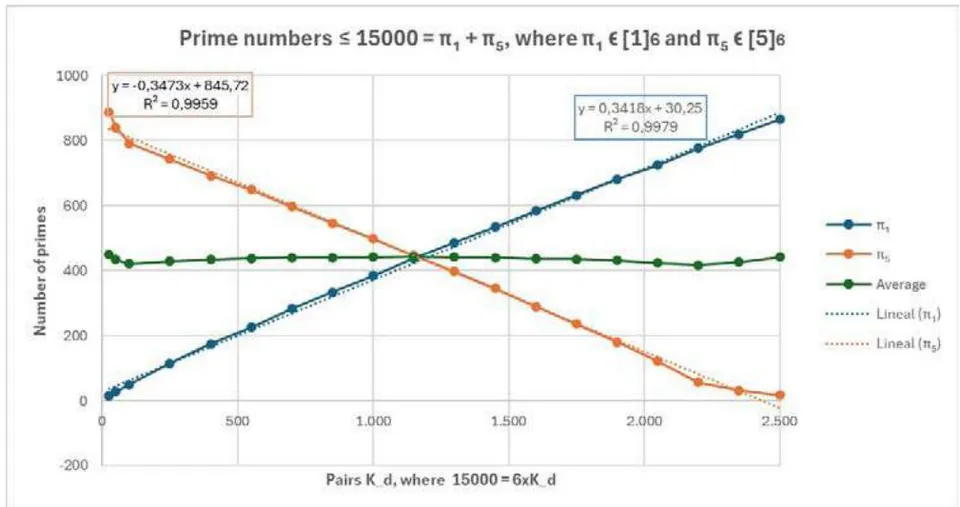
Figure 2: , i.e. effective pairs.
(2) We only have two possible outcomes: with probability and with probability .
(3) The probability that the pair contains 2 prime numbers, , must be equal for all pairs.
As we will see below, the probability of each pair depends on its position on the diagonal, so it is different for each pair.
Fortunately, our objective of minimizing and the degree of freedom given by the definition of the conjecture 1, allows us to overcome this problem, assigning the smallest of the calculated probabilities to all pairs.
In the following calculations, we will consider the simplifications in remark 1.
Let be any pair on the diagonal , figure 1, and we want to calculate the probability that its elements are prime numbers.
As and , we can consider that the probabilities, and are independent and we will use the multiplication principle of probabilities, [7], and we get:
Now, we will use the relative frequency to calculate and , since, when is extremely large, the relative frequency converges to probability, [7].
Note that, the number of prime numbers is divided equally between and . See Remark 1.
So, Due to the symmetry with respect to the main diagonal, , in Figure 1, we get:
Therefore,
The Prime Numbers Theorem, [8], states that , and becomes greater than as increases. So, applying it to we get:
and simplifying; we get: .
As we can see, depends on the pair's position on the diagonal and it is variable.
Due to the degree of freedom mentioned above, and since we want to minimize , let's assign the minimum value of to all pairs, thereby ensuring that they all have the same value, as required by the binomial distribution, which will also be minimal.
To calculate this minimum value we will use the Fermat's Theorem for differential calculus, [9].
Setting and taking into account that , and we can write:
So, calculating the first derivative and setting it equal to zero we get the minimum of this function at , which corresponds to . Value that could be expected due to symmetry and the function is positive within the specified range, . See figure 3
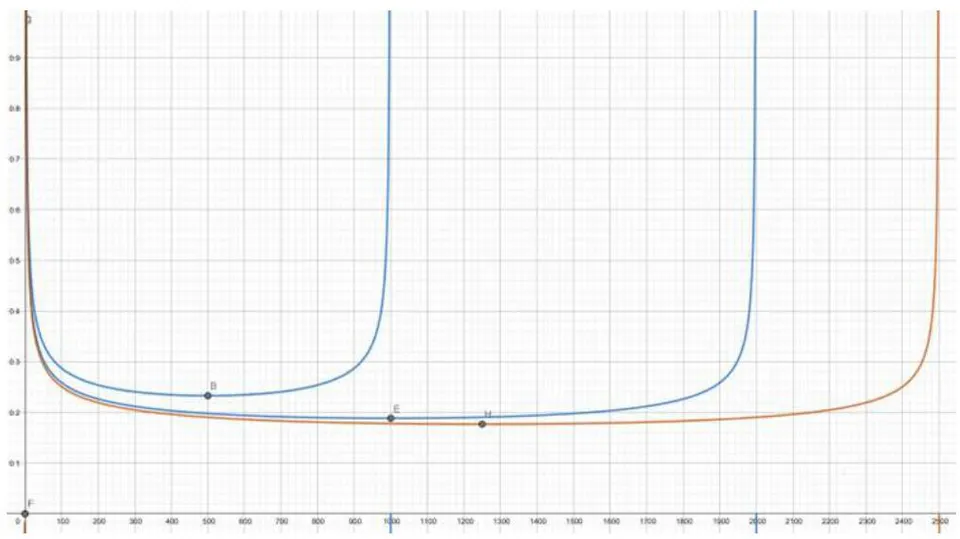
Figure 3: , and 2, 500.
Where ; and .
Then, the value for all pairs is: .
And the expected value will be: .

Remark 3. As mentioned in point (iii) of the previous proposition, to increase the independence of pairs , we could randomly eliminate , then, the sample of would contain prime numbers. However, the odds remain unchanged, since:
(i) Random deletion preserves the symmetries of Figure 1, because it only reduces its dimensions.
(ii) So, to calculate probabilities, we can use the formulas from Proposition 3 for relative frequency, but weighted by the factor and we get:
And the factor can be eliminated, so the result is the same as that of the aforementioned proposition. For this reason, it is not necessary to use the random sampling process.
IV. THE FINAL THEOREM
Theorem 1. Goldbach's conjecture is true.
Proof. In proposition 3, we obtained that: .
This discrete function minimizes the lower bound of , since, in that proposition, we have simplified some values and, in addition, we take the minimum probability value, , for all pairs. Therefore, we can state that: .
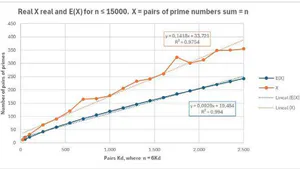
in figure 4, we can see that, not only is below , but the difference becomes greater as increases.
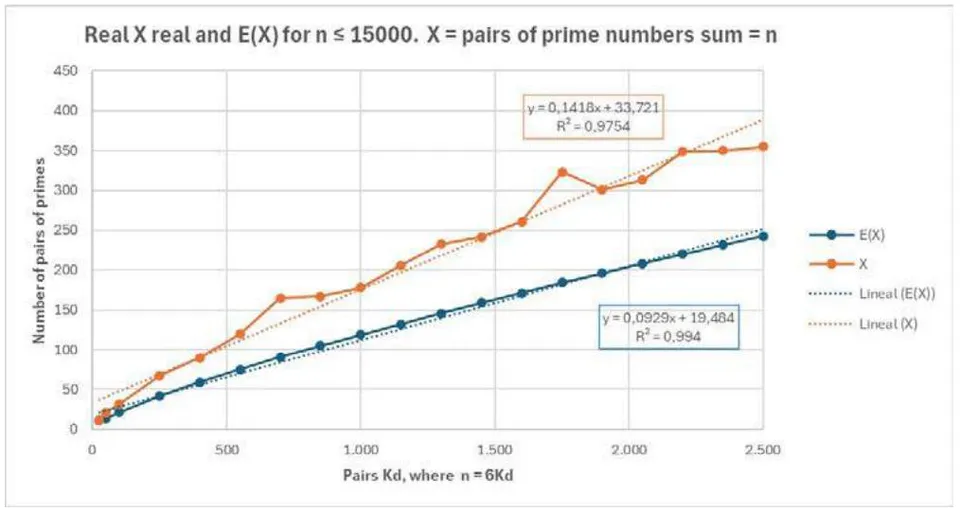
Figure 4: Real vs , with and
Finally, we just need to prove that, within the range of interest, and always increases as increases. To do this, we could proceed either graphically or analytically.
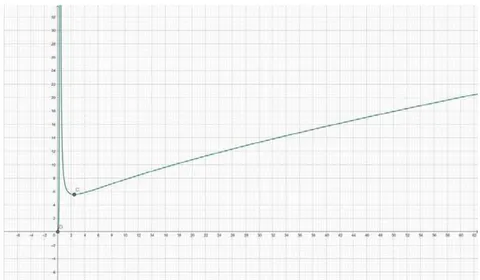
Figure 5:
Graphically, Figure 5 shows the function and prove that it only has a minimum at , . And, then, the function increases "ad infinitum".
Analytically, we define:
So, calculating the first derivative and setting it equal to zero, we get a minimum at , from which the function increases.
In both cases, the conclusion is the same: Goldbach's conjecture is true.

ACKNOWLEDGMENTS
I thank God for giving me the ability to enjoy mathematical challenges. Above all, I thank Him for giving me a family that always encourages me to persevere. My wife, Marisa; my son Emilio and my daughter Pilar; their respective spouses, Michelle and Carlos; my grandchildren Gabriel, Carlos, Pablo and Pilar.
A very special thank you to Ramón Carbo-Dorca, Institute of Computational Chemistry and Catalysis, Universitat de Girona, Girona, Spain, for their valuable comments and reviews on this paper.
Conflict of Interest
The authors declare no conflict of interest.
Ethical Approval
Not applicable
Data Availability
The datasets used in this study are openly available at [repository link] and the source code is available on GitHub at [GitHub link].
Funding
This work did not receive any external funding.
Cite this article
Related Research

Special Issue
Launch a focused special issue to highlight research, emerging trends, and expert insights in your academic field.