






IntelliPaper
Abstract
The tensor structure of triangulated categories will be considered in derivedcategories of étale sheaves with transfers performed the tensor product of categories in the finite correspondences category considering the product underlying of schemes on a field A total tensor product on the category is required to obtain the generalizations on derived categories using pre-sheaves, contravariant and covariant functors on additive categories of the type or to determine the exactness of infinite sequences of cochain complexes and resolution of spectral sequences. Then by a motives algebra, which inherits the generalized tensor product of , is defined a triangulated category whose motivic cohomology is a hypercohomology from the category , which has implications in the geometrical motives applied to bundle of geometrical stacks in field theory. Then are considered the motives in the hypercohomoloy to the category A fundamental result in a past research was the creation of lemma that incorporates a 2-simplicial decomposition of in four triangular diagrams of derived categories from the category, this was with the goal to evidence the tensor structure of Now in this research we consider a theorem that relates the hypercohomology groups obtained with the spectrum through the its singular homology taking components and the homotopy in the action of the symmetric group on the derived category Finally will give a crystallographic space-time model of simplicial type from the microscopic aspects that define it, and will be established under the dualities in field theory and the hypercohomology Nisnevich groups that the vertices in decomposition of the space are equivalent to the field waves, for example gravitational waves.
Explore Digital Article Text
I. INTRODUCTION
The category , is Abelian [1] and therefore has enough injectives and projectives that can be used to create the conditions for the invariant presheaves of homotopy required to realization of the commutative diagrams in – homotopy of morphisms in the category , of finite schemes X, and Y. For example, we have the correspondence between simplicials and the corresponding diagrams of – morphisms in the category .
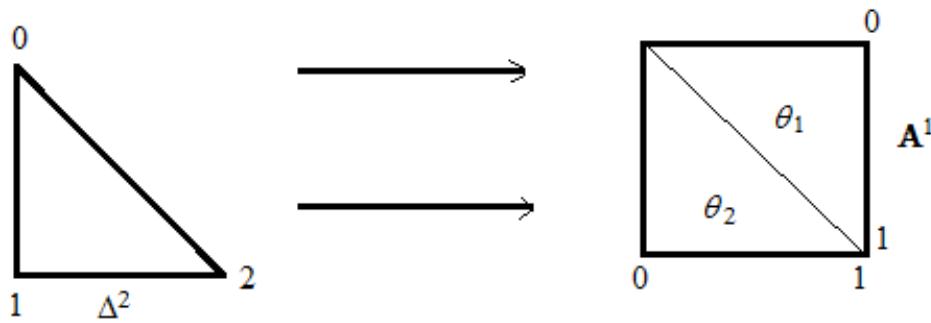 Figure 1.2: Simplicial decomposition of
Or considering , we have the correspondence:
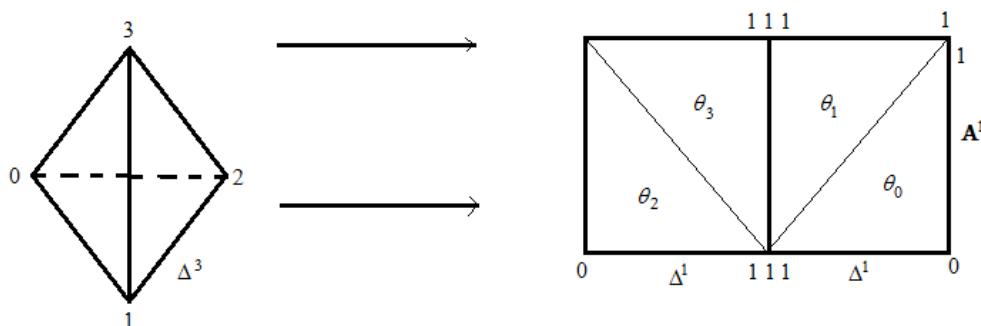 Figure 2: Simplicial decomposition of .
This case will be used to obtain a general diagram that can be induced to the category DQFT, from a scheme of associated motives to a scheme X, (which is the class of , which is clearly modulus – homotopy in an approximate triangulated category , constructed from the derived category of .
We consider the following corollary to homotopy invariant presheaves and deduced from the fact that for every smooth scheme X, exists a natural homomorphism (is to say a homotopy) which explained a diagram that belongs to the correspondence planted in the figure 1, or as factor of the correspondence planted in the figure 2. Likewise we have:
Corollary 1. 1. , is a chain homotopy equivalence.
Then in the motives context and after of demonstrate the equivalences (in –homotopy) of the correspondences morphisms of injectives and projections, we can to have the motives scheme equivalence , for all X, which helps to establish in a general way that any –homotopy equivalence , induces an isomorphisms , considering inverses.
II. INDUCING A TOTAL TENSOR PRODUCT FROM DERIVED TENSOR PRODUCTS FOR THE REQUIRED DERIVED CATEGORIES
We consider A, a small additive category and we define , to be the category of all additive presheaves on A, on all conformed additive functors:
which is an Abelian category. We suppose that A, has an additive symmetric monoidal structure (tensored) or given by , such that
which means that , commutes with all direct sums , corresponding to the presheaf
in . If , is a ring we can define , to be the Abelian category of all additive functors
Then we write , for the functor with correspondence rule
which is called representable. Then by [3] a representable preshea , is a projective object of , where every projective object of , is a direct summand of a direct sum of a representable functor, and every F, in , has a projective resolution.
The idea is consider the homotopy category established by all , such that the tensor product , can be established to a total tensor product on the category , of bounded above cochain complexes
Our considerations of , is realized by the requirement due as follows: if X, and Y, are in A; then the tensor product , of their representable presheaves should be representable by the tensor product of schemes .
Here is when we can appreciate the possibilities of extend , to a tensor product:
commuting with . Then if , of bounded above cochains complexes as (6) are the chain complexes as (6) are the chain complex , can be defined as the total complex of the double complex . As has been mentioned and considering , can be extended the tensor , to a total tensor product on the category . This could be the usual derived functor if , is well balanced and our construction is parallel. This last considering the corresponding homotopy.
Likewise, if , then is quasi-isomorphism the application:
with P, a complex of projective objects. Any such complex P, is called a projective resolution of C, and therefore any other projective resolution of C. is homotopic chain to P.
Example. 2.1. We can consider the simplicial , and the factor diagram given by:
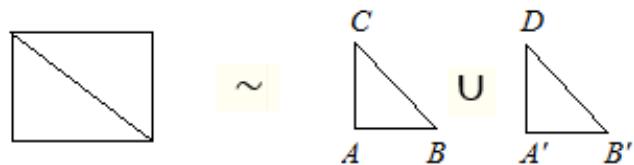 Then from
, and , we can to have the equivalence between morphisms
Of fact, (10) is a –homotopy equivalence. Then we have the diagram figure 2.
Likewise, if , and
is a projective resolution too, we have with structure , that:
Then result several properties of extensions of mappings , to the mappings
Other properties are obtained in the extension of projective resolutions.
The important result is given by the following proposition.
Proposition 2.1. The derived category , equipped with , is a tensor triangulated category. Proof. [3].
The definition of the category , is the space of projective elements:
Likewise, the category , of projective objects in , is additive, symmetric, monoidal and , is equivalent to the chain homotopy category [4, 5]. Likewise, this category is a tensor triangulated category under .
Then the conclusion of the proposition 2.1, is followed from the natural isomorphism
in , of . This is seemed through the fact of that always that
in the example.
Now in the étale sheaves context, also is obtained that the derived category of bounded above étale sheaves of R –modules with transfers is a tensor triangulated category.
The tensor product of the derived category of bounded above complexes of étale sheaves of -modules , preserves quasi-isomorphisms. Also the category of bounded above complexes of étale sheaves of -modules with transfers is a tensor triangulated category [6, 7].
In particular, and by a motives algebra in the derived category of étale sheaves of module with transfers, the operation
is invertible. Then , are bounded above complexes of locally constant étale sheaves of -module , is quasi-isomorphic to , which is their total tensor product of complexes of étale sheaves of -modules. Indeed, we consider the morphism , of bounded above complexes of presheaves of -modules with transfers. Then in particular for étale sheaves we have , then we have
It is a quasi-isomorphism for . Now if , is a locally complete étale sheaf of –modules then , is a quasi-isomorphism for every étale sheaf with transfers . But , in , and using the a natural mapping of presheaves given by , where every , having the right exactness of , and , and being , are bounded above complexes of locally constant étale sheaves of –module then , is a quasi-isomorphism.
Similarly as with the étale sheaves, a presheaf with functors F, is a Nisnevich sheaf with transfers if its underlying presheaf is a Nisnevich sheaf on Sm/k. Clearly every étale sheaf with transfers is a Nisnevich sheaf with transfers. In motives with Q-coefficients with transfers we have result:
Lemma 3.1. Let , be a Zariski sheaf of -modules with transfers. Then , is also an étale sheaf with transfers.
Proof. [3].
Then is deduced from theorem that characterizes the Nisnevich sheaves [2, 3,6] whose category , and the before lemma 3.1, the following corollary.
Corollary 3.1. If , is a presheaf of -modules with transfers then .
For other side, the construction of a derived category as such , is parallel to the construction of . If k, admits regularizations of singularities then , allows us to extend motivic cohomology to all schemes of finite type as a cdh, hypercohomology group.
If , we we showed that , and , are equivalent [3]. Likewise, , is a derived category which is a tensor triangulated category. The same is applicable in the Nisnevich topology for derived category .
Likewise, , and therefor in , we have:
In particular the derived category , of bounded above complexes of Nisnevich sheaves with transfers is a tensor triangulated category under . Then by the proposition that says that , is projective if
Then we have in the motives context
Likewise, we can to define the category , to be the thick subcategory of , generated by the motives , where X, is smooth over k. Objects in , are the effective geometric motives, which will be the objects that we require in our motivic cohomology, that we obtain for resolution of the decomposing of in in homotopy of morphisms in the category .
IV. DEVELOPMENT OF THE MOTIVIC COHOMOLOGY REQUIRED
From the lemma 3.1, and corollary 3.1, (considering the theorems of characterization of Nisnevich sheaves of - modules with transfers), and the following definition of Motivic cohomology on -coefficients:
Def. 4.1. For any abelian group A, we define the étale (or Lichtenbaum) motivic cohomology of X, as the hypercohomology of ,
If , then , due to that . If , then
when . Also considerations on prime integers to the characteristic of k, are considered [2, 3].
Then the étale (or Lichtenbaum) motivic cohomology , is defined to be the etale hypercohomology of the complex :
Theorem 4.1. Let , be a perfect field. If , is a bounded above complex of presheaves of -modules with transfers, then , and
for every , in . In particular we have .
Proof. [2, 3].
Now we consider the vanishing of components of the right functors.
Under considerations of the before section the tensor product as presheaf of étale sheaves can have a homology space of zero dimension that vanishes in certain component to the right exact functor.
from the category PST , of pre-sheaves of R-modules with transfers to the category of étale sheaves of R-modules with transfers. Therefore, each derived functor given , vanishes on homology space , for certain étale complex [8, 9].
Therefore, all functors , are acyclic. By this way, is demonstrated the functor exactness and resolution in modules inducing the tensor product , (tensor triangulated structure) to a derived category more general than .
We consider the following lemma concern to the vanishing of a presheaf , of -modules with transfers.
Lemma 4.1. Fix Y, and we have (24). If F, is a presheaf of of R -modules with transfers such that , then , .
The geometrical motives required in our research are a result of embeds the derived , (geometrical motives category) in the derived category , considering the category of smooth schemes on the field k.
Also as discussed and exposed in [8] all functor , induces a tensor operation on the category , making that itself is a tensor triangulated category. Likewise, explicitly in , this give us the functor:
V. RESULT
Under several considerations and studies realized in the book chapter [8] and the motivic cohomology treatment given in [2, 3, 6, and 10] as the embedding theorem in , we can consider the following triangulated diagram:
which has implications in the geometrical motives applied to bundle of geometrical stacks in mathematical physics, as has been studied and showed in .
Theorem 5.1 (F. Bulnes). Suppose that M, is a complex Riemannian manifold with singularities. Let X, and Y, be smooth projective varieties in . We know that solutions of the field equations , [8, 11, and 12] are given in a category , (see [11]). Solution context of the quantum field equations for , is defined in hypercohomology on Q-coefficients from the category , defined on a numerical field k, considering the derived tensor product , of presheaves. Then the following tensor triangulated diagram is true and commutative:
Proof. [8].■
The category , has a tensor triangulated structure and the tensor product of its motives is . Remember that the triangulated category of geometrical motives , is defined formally inverting the functor of the Tate objects, which are objects of a motivic category called Tannakian category [12].
We enunciate the following result important in the technical detail of the topologies required to DQFT. Theorem 5.2. If , then
is an equivalence of tensor triangulated categories.
Proof. [12]. ■
We want to apply the considerations of before sections to give a tensor triangulated category to a quantum version of motivic cohomology on étale Sheaves, from – simplicial that shows the – homotopy in an approximate triangulated category , which for every Nisnevich sheaf with transfers that is an every étale sheaf with transfers, is a category . The Nisnevich detail in the derived category is due to the importance in motivic homotopy theory of that the objects of interests are "spaces", which are simplicial sheaves of sets on the big Nisnevich site that is the category Sm/k.
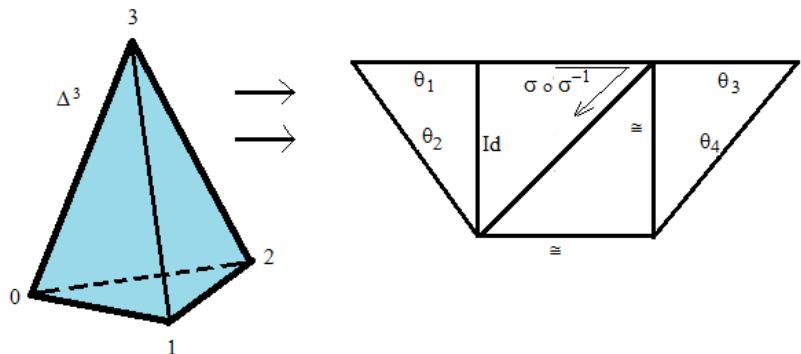 Figure 4: 2-Simplicial decomposition of , for DQFT.
In reality we consider two topologies for aspects of localization and covering.
We have the following commutative diagram in the geometrical motives context that are useful to link the derived category DQFT.
Lemma 5.1. The following diagram is commutative
Proof. [13]. ■
The following aspects were considered before of its demonstration.
We say that a diagram in , is homotopy commutative if every pair of composites , ith the same source and target are – homotopic. Any homotopy invariant presheaf with transfers identifies – homotopic maps, and converts a homotopy commutative diagram into a commutative diagram.
We consider , which is zero (see lemma 21.9 [3, 13]). Very helpful was the fact of the singular homology [14] to start homotopy.
An corollary of the diagram (29) can be the re-interpretation from the étale sheaves and Simplicial decomposition of , for DQFT, considering their spectrum of its singular homology. We consider from category of motives the following proposition worked in :
Proposition 5.1. If X, is any scheme of finite type over k, then
Proof. [15].■ In the demonstration of (30) is considered the hyper-cohomology groups , which represent the spectrum of the corresponding singular homology. This spectrum can be a projective vector bundle used to work singularities. Oscillations and singularities can be the same in motivic cohomology? The answer is yes, although in duality.
Also is very helpful the following theorem.
Theorem 5.3 (Projective Bundle Theorem). Let , be a projective bundle associated to the vector bundle , of rank . Then the canonical mapping
is an isomorphism in the category , and p, is the projection onto the factor .
Proof. [15].■
Likewise we have the orthogonalizing composition :
Oscillations and singularities can be the same in motivic cohomology?
We consider the following theorem proved in [12].
Theorem (F. Bulnes) 5. has the decomposing in components , that are hypercohomology groups corresponding to solutions as -states in , for field equations .
In the before theorem was proved that the oscillations of H-states are the solutions of a big field equations class where these solutions are hyper-cohomology groups to superposition of H-states, considering a Hitchin base . By duality in field theory, particle and wave are equivalent. Then oscillations are singularities in the space-timetoo. In our category of motives are undistinguishable. This can be demonstrated in terms of singular cohomology considering the proposition 5.1, where is clear that:
Then considering the proposition 5.1, the theorem 5.3, and the homotopy, between , and , onto its diagram, we can give a version of the theorem 4.2, in the context of the group , on , which is chain homotopic to the trivial action.
Corollary 4.1. The action of the symmetric group , on , is -homotopic to the trivial action. Hence it is trivial in the category , and on the motivic cohomology (hyercohomology) .
Proof. [15]. ■
Theorem 4. 4. We consider . This has a decomposing in components , that are hypercohomology groups to solutions as -states in , to field equations . on singularities. Proof. We consider the last triangle directly from diagram (29):
and we express this in the context of the singular homology components , and using its Spec relation given by (33) we have the triangle:
But
which are in the space . Then by the corollary 4.1, the action of , on , extends to an action on , fixing . Then all states are in . Finally we can consider , in the triangle context (34). Then can to define solutions in , due to that, we need solutions for dda = 0. as cotangent vectors [12]. But this is obtained in the derived category . ■
V. APPLICATIONS.
Example 6.
- Rotations around of some vertex (sources) produce oscillations of H-states which in presence of electromagnetic fields or only one magnetic field produce a field torsion accompanied of gravitational waves. To quantum gravity, we want to obtain a spectrum in the dual considering the triangle given in (26), whose geometrical motives will be stacks of holomorphic bundles.
Example 6. 2. In much topological models of the space-time, are proposed some types of algebraic tools based on schemes in which the discrimination of singularities within objects is based on the space-time-spin group [17, 18]. Such topological objects possess an homotopy structure encoded in their fundamental group and the related , multivariate polynomial character variety contains a plethora of singularities somehow analogous to the frequency spectrum in time structures [17].
Example 6. 3. In the QFT-applications, the singular homology groups of , for DQFT, are dual to the corresponding H-states in , to the motivic co homology corresponding to the representation of the cosmic Galois group as was demonstrated in the theorem 4. 2, [13].
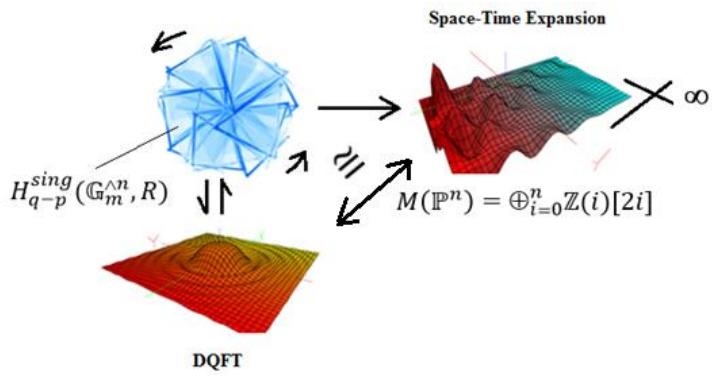 Figure 5: Triangle (35) and the Chow ring of the hypersurface modeled considering the space-time expansion, we will consider this sequence as a sequence of coherent sheaves in . The Cohomology of coherent sheaves is the same that the cohomology to étale sheaves.
VI. CONCLUSIONS
This help us to have a quantum field theory of simplicial geometry and construct model of the Universe on the simplicial frameworks and establish morphism of homotopy commutative relations which can induce to a hypercohomology to the solution of some field equations and aspects of gravitationat least in a microscopic level. For example, we consider ones of the field theories as the Schwinger-Dyson equation in three-dimensional simplicial quantum gravity, established by the paper novedous triangle relations and absence of Tachyons in Liouville string field theory [19], where could be contained in the derived category , or the diagrams of the Polyakov string theory [20], with Polyakov integrals as intertwining operators between strings and particles (sources as vertices); can be used the simplicial geometry and its decomposition in triangulated diagrams of schemes belonging to the category , and morphisms between schemes of the category , all with the total tensor product on the category ,as example its component elements , to obtain the generalizations on derived categories using sheaves (étale or Nisnevich) or pre-sheaves and contravariant and covariant functors on additive categories to define the exactness of infinite sequences and resolution their spectral sequences. The advantages from the tensor triangulated category to a quantum version considering a motivic cohomology on étale Sheaves is the respective factorization algebras in QFT, where is necessary consider the combined observation measures from many components with an commutative property for their diagrams between their derived categories. Likewise the theorem 4. 4, the -homotopy in theaction of the symmetric group on the derived category ,is trivial and on corresponding motivic hypercohomology too.
Conflict of Interest
The authors declare no conflict of interest.
Ethical Approval
Not applicable
Data Availability
The datasets used in this study are openly available at [repository link] and the source code is available on GitHub at [GitHub link].
Funding
This work did not receive any external funding.
References
Cite this article
Related Research


Special Issue
Launch a focused special issue to highlight research, emerging trends, and expert insights in your academic field.
