

IntelliPaper
Abstract
In a new version of the aquatic-ape theory, Homo sapiens evolved directly from isolated chimpanzees on Galapagos-like volcanic islands in western Africa. The theory explains human features such as the lack of fur, the ability to accumulate subcutaneous blubber, the large brain, and bipedal locomotion. It fits well with principles of evolution, and with anatomy, physiology, genetics, geography and geology. But it does not fit with hominin fossils. This calls for an alternative hypothesis: humans evolved without fossils being formed, and supposed hominin fossils are all misunderstandings. I have studied the published literature, and am convinced that some of the most famous fossil evidence is false: Bones of the Lucy skeleton are probably modern, taken from a burial vault near the discovery site. The Laetoli footprints are probably from Homo sapiens of Pleistocene age. The footprint layer has been covered up to protect it, so geological misinterpretations have not been noticed by visitors. The Turkana Boy Homo erectus skeleton is probably not a fossil, but is a mutilated child of the Congo atrocities of 1885-1908, whose bones were planted at Nariokotome to be discovered by scientists. The Little-Foot skeleton of Sterkfontein Cave is a composite, including probable human foot bones from a medical school. The century-old story of human evolution on the savanna is like an historical fiction novel, in which details need to be invented to make the story educational, interesting, and convincing to readers. Fossils have been required, to quell the unscientific belief in creationism.
Explore Digital Article Text
I. INTRODUCTION
Paleoanthropologists study fossils, which they use to write the story of human evolution. The fossils they need are found in dry parts of Africa. Western Africa lacks mammal fossils, because the hot and humid climate there causes bones to decay before fossilization can occur.
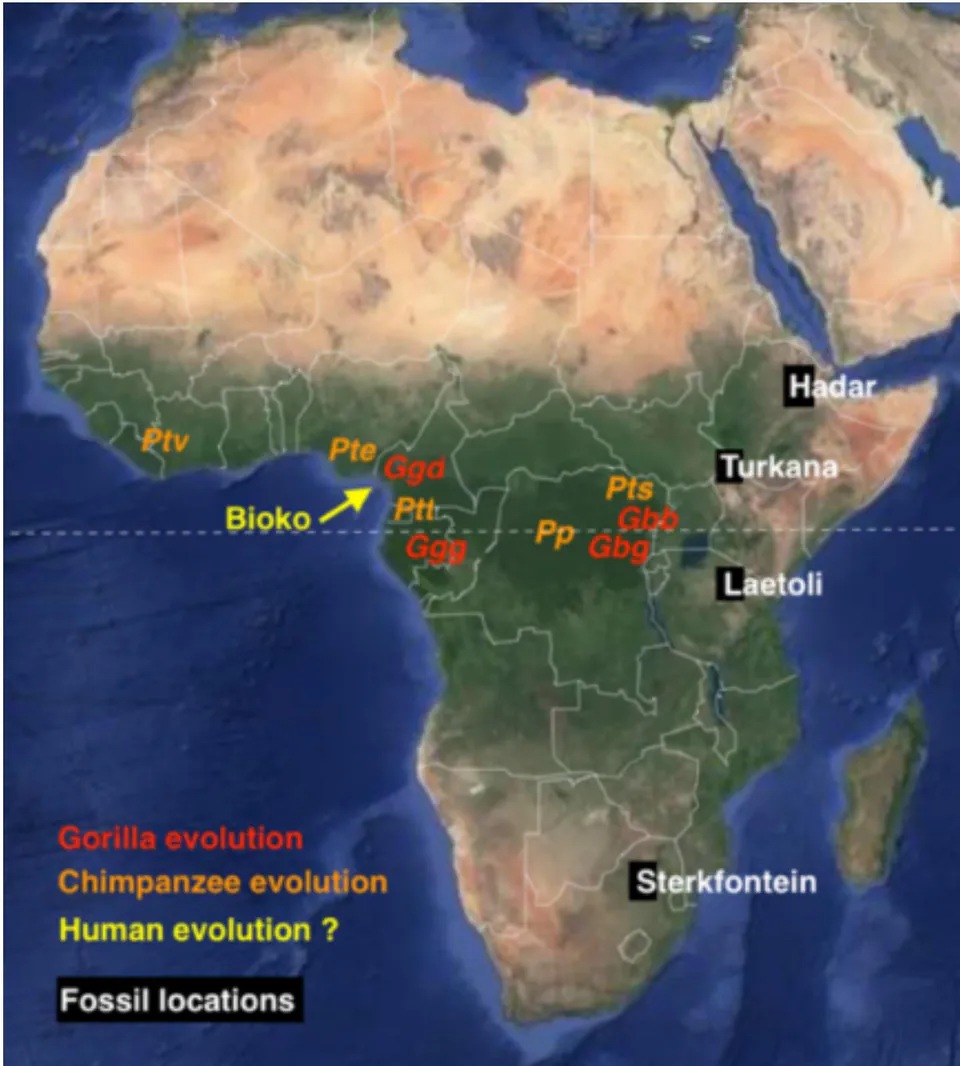
We know from DNA that chimpanzees are our closest relatives, and gorillas are our next closest. Over the past 10 Ma, gorillas have evolved in four different locations (Fig. 1) into four different taxa (Gorilla gorilla gorilla, Gorilla gorilla diehli, Gorilla beringei beringei, Gorilla beringei graueri). Similarly, chimpanzees have evolved in five different locations into five different taxa (Pan troglodytes verus, Pan troglodytes vellerosus, Pan troglodytes troglodytes, Pan troglodytes schweinfurthii, Pan paniscus). There are no fossils in any of these humid areas.
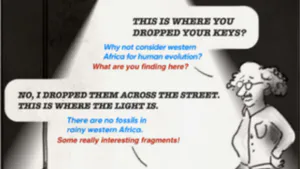
Where did humans evolve? Paleoanthropologists tell us that it was in arid eastern Africa, where fossils can be found. I think that is a cognitive bias, an example of The Streetlight Effect (Fig. 2).

Why did humans evolve? There is no clear answer. A survey (1) among life-scientists shows that there is no consensus as to the evolutionary cause of any of the remarkable human traits, such as naked skin, large brain, subcutaneous fat, external nose, and bipedal locomotion.
Human traits can all be explained by the unorthodox aquatic-ape theory, in which humans evolved from a chimpanzee-like ancestor during a period of semiaquatic habitat (2, 3). Now a new version of the aquatic-ape theory has been published (4), with humans evolving in western Africa, in a scenario similar to evolution of animals on the Galapagos Islands. In this theory, a few chimpanzees rafted to barren islands of newly formed proto Bioko. There was no forest where they stranded, and they were forced to live on a marine diet. They adopted a semiaquatic habitat, and become bipedal by wading in seawater to gather shellfish and seaweed. Like many marine mammals, they lost their fur, and evolved fat cells for producing subcutaneous blubber. They evolved large brains from the omega-3 fatty acids of the marine diet. All other human features can also be explained in this way. The theory fits well with principles of evolution, with geology, geography, and with human and chimpanzee anatomy, physiology, and genetics. But it does not fit well with hominin fossils—that paleoanthropologists tell us are human ancestors.
Since learning about the aquatic-ape theory, I have studied the primary literature on the most important hominin fossils. Fossils have been needed to argue against the non scientific belief in creationism. But I think the savanna story and the fossils that support it are incorrect. I see that key fossil evidence has been invented, like details in a historical fiction novel, needed to make an educational story convincing and interesting. Here I show why some of the best known hominin fossils should no longer be believed.
Non-scientific practices in paleoanthropology
Ape fossils are rare. There has never been reported a fossil bone of the gorilla or the chimpanzee. Three teeth of a chimpanzee were once found near Lake Turkana in Kenya (5), but I think they were planted there to fool scientists.
Because of the rarity of ape fossils, paleoanthropology has special practices to encourage more people to look for them and find them. Some of these practices go against good science, in which evidence should be reproducible by impartial scientists. Three of the practices that are especially problematic are: 1) the acceptance of surface-finds, 2) the prevention of hands-on study by outsiders, and 3) the lack of blinding in age-determination studies.
The acceptance of surface-finds
Most hominin fossils are surface-finds. A fossil is found lying loose on a layer of known geologic age, and nothing more is found by digging. A fossil can only lie exposed that way for a few years before it either found or is destroyed by weathering.
A surface-find is not good scientific evidence, because it is easily falsified, and cannot be verified or obtained again. Any type of irreproducible evidence should be subject to doubt. But in paleoanthropology, a finder's claims are not questioned. A scientist may suspect that a fossil find was not legitimate, but a public accusation could not be proven and would ruin the reputation of the accuser.
In contrast to hominins, dinosaur bones and complete skeletons are abundant. They are found by looking for a fragment lying loose on the ground. But this is not a surface-find. The searcher moves uphill to where the fragment is eroding out of the sedimentary layer, and then excavates complete bones. For dinosaurs, the claim that a fossil bone or partial skeleton was found loose on the ground would not be taken seriously.
The prevention of hands-on study by unbiased scientists To encourage fossil hunting, the finder of a hominin fossil has exclusive rights to study it. The finder can prevent independent scientists from seeing the material until the finder's team is finished publishing (6, 7). The finder's study can go on for decades. Even afterwards, the material is too valuable and fragile to allow outsiders to handle it. They must work with photographs, replicas, and descriptions of the original materials.
The finder selects specialists to study the fossil material. These scientists are not impartial. If they cast doubt on the material's authenticity or suitability, it will spoil the team's chance for important publications. Chemical and physical tests that might disprove a fossil's authenticity are not carried out.
Specialists glue fragments together in suitable positions. This involves decisions about how the fragments should fit, and how to fill in missing pieces. These decisions can determine such things as brain size and upright stance. Once glued, it is not possible for others to propose alternatives. Any objection to the exciting results would appear to be motivated by envy.
Lack of blinding in age-determination studies
When minerals or rocks are radiometrically dated, the result will not be publishable if it is not sufficiently precise, or if the date is outside the range of acceptable ages. Publishability trumps reliability. To make the results publishable, it is often necessary for scientists to ignore parts of the data that would spoil the final result. Deletion of some data is no secret to those who do the dating, but it is rarely mentioned.
I know from geological experience with isotopic dating, that radiometric dates are often incorrect because of observer expectation bias. I think that for a radiometric date to be trustworthy, it should be obtained by workers who do not know what age is preferred. Ideally, the material should be dated twice, in independent laboratories. This is never done.
A critical look at published reports of famous human fossils.
Java Man
Eugène Dubois was a Dutch anatomist who collected fossils. After reading about the concept of a missing link, he moved to Java in 1887 "obsessed with finding it and winning scientific fame and fortune." (7), p 29). He succeeded: in 1891 he announced Java Man. It consisted only of three items, which were not actually found together: a femur (thigh bone), a tooth, and a skullcap.
Discussions of Java Man greatly contributed to the awareness and status of paleoanthropology. Within 10 years, almost eighty books or articles had been published on this topic. Most scientists who saw Dubois' three items rejected his claims that these were human fossils. Therefore, he kept them hidden away for several decades.
Peking Man
Peking Man was a missing-link sensation in the 1930's. The fossils consisted of skull fragments from as many as 15 individuals, found together with stone tools. High-quality casts and scientific descriptions were made. But somehow, all the original material was lost in 1941, and has never been found (7). Paleoanthropologists currently assign both Java Man and Peking Man to Homo erectus.
Piltdown Man
Piltdown Man was a missing link found in England in 1912. It consisted of a skull with a large braincase and a protruding jaw, that confirmed the assumption that the large brain evolved before other human features. Despite some doubt, it was accepted for almost 40 years, and then proven to be a hoax. The pieces actually came from the cranium of a human, and the jaw of an orangutan. They had been broken so that they might fit together. They were stained to look old, and dirt was cemented into the cracks. A long canine tooth was filed down, to make it look human.
The trickster was Charles Dawson, an amateur archeologist and respected solicitor. He claimed to have gotten the main pieces from the Piltdown gravel pit. He planted additional bones and tools at the locality, and led experts to where they could be discovered. It was later shown that Dawson owned a collection of false artifacts (8).
Three anatomy experts who studied the original material constructed the braincase to be 1070 cm , much smaller than it actually was. They saw human-like features in the jaw, and ape-like features in the cranium. No one today doubts that these were honest errors in judgment. They received British knighthood, largely as a result of their contribution to the scientific status of England. Some scientists were skeptical, but no one could suggest that the fossil was a hoax.
It was fluorine testing that finally debunked Piltdown Man. Bones absorb fluorine from the ground over time, so ancient bones should be rich in fluorine (9). Bones from the same individual buried in the same sediments will have absorbed about the same amount of fluorine. After the scandal of Piltdown Man, one might expect that fluorine testing would be required for all hominin fossils. But there is no incentive to carry out a fluorine test, or a carbon-14 analysis, or look for DNA, because such tests require destruction of a small amount of the fossil material.
Piltdown Man generated immense public interest that boosted the science of paleoanthropology. Several hundred scientific papers were published. It was often mentioned by the media in 1925 during the famous Scopes monkey-trial, where an American school teacher was accused of teaching evolution. Fossils were needed to argue against the unscientific belief in creationism.
Lucy (Hadar, Ethiopia)
The Lucy skeleton was found by Professor Donald C. Johanson on Sunday, November 24, 1974, in Hadar, Ethiopia. In Johanson's books (10, 11, 12) it is clear that the bones were a surface-find, with nothing found by digging. Yet on the web page of the Institute of Human Origins (IHO), which Johanson founded in 1981, he is shown excavating a bone (Fig. 3).

Lucy's Story was written to imply that some of the bones were found by digging (13):
Within moments, he spotted a right proximal ulna (forearm bone) and quickly identified it as a hominid. Shortly thereafter, he saw an occipital (skull) bone, then a femur, some ribs, a pelvis, and the lower jaw. Two weeks later, after many hours of excavation, screening, and sorting, several hundred fragments of bone had been recovered, representing 40 percent of a single hominid skeleton.
Much less than 40 percent of that skeleton was actually found, and nothing was found by excavation. But this misleading information is useful against creationism, and therefore benefits science. We might call it a noble lie. My complaint is that misinformation pervades paleoanthropology and is used against the aquatic-ape theory, which is also science.
I think the discovery of the Lucy bones was a Piltdown-type hoax. I contend that it is impossible for a partial skeleton to be lying loose on the surface in a badlands terrain like Hadar. Bones are buried and preserved in a horizontal layer of sediment. As that layer is eroded on a hillside, rain removes only a centimeter or so at a time. A few fragments of weathered bone loosen, and are washed downhill, while the remaining bone stays covered in the horizontal layer. In the next rainstorm, the first fragments are washed away and a few new ones are loosened. Sometimes a large part of a bone with rock matrix can tumble down the hill, but never a collection of bones with no rock matrix from a single individual.
Finding many bones at once, with nothing found by digging, verges on the miraculous. I think that the bones were planted by Johanson's student Tom Gray in order to fool him and to help him. Here you can read the first two pages of Johanson's book Lucy's Legacy. It is a long citation, but it is important. Since outsiders are not allowed access to original fossil material, this is the sort of evidence that we must use (12), p. 3-4).
Lucy's Legacy by Donald C. Johanson and Kate Wong
Never in my wildest fantasies did I imagine that I would discover a fossil as earthshaking as Lucy. When I was a teenager, I dreamed of traveling to Africa and finding a "missing link." Lucy is that and more: a 3.2-million-year-old skeleton who has become the spokeswoman for human evolution. She is perhaps the best known and most studied fossil hominid of the twentieth century, the benchmark by which other discoveries of human ancestors are judged.
Whenever I tell the story, I am instantly transported back to the thrilling moment when I first saw her thirty-four years ago on the sandy slopes of Hadar in Ethiopia's Afar region. I can feel the searing, noonday sun beating down on my shoulders, the beads of sweat on my forehead, the dryness of my mouth—and then the shock of seeing a small fragment of bone lying inconspicuously on the ground. Most dedicated fossil hunters spend the majority of their lives in the field without finding anything remarkable, and there I was, a thirty-one-year-old newly minted Ph.D., staring at my childhood dream at my feet.
Sunday, November 24, 1974, began, as it usually does for me in the field, at dawn. I had slept well in my tent, with the glittering stars visible through the small screen that kept out the mosquitoes, and as sunrise announced a brilliant new day, I got up and went to the dining tent for a cup of thick, black Ethiopian coffee. Listening to the morning sounds of camp life, I planned with some disinclination the day's activities: catching up on correspondence, fossil cataloging, and a million other tasks that had been set aside to accommodate a visit from anthropologists Richard and Mary Leakey. I looked up as Tom Gray, my grad student, appeared.
"I'm plotting the fossil localities on the Hadar map," he said. "Can you show me Afar Locality 162, where the pig skull was found last year?"
"I have a ton of paperwork and am not sure I want to leave camp today." "Can you do the paperwork later?"
"Even if I start it now I'll be doing it later," I grumbled. But something inside — a gut sense that I had learned to heed — said I should put the paperwork aside and head to the outcrops with Tom.
The first sentence is clearly false. Johanson made it clear in the second sentence, and in the last sentence of the second paragraph, that he had always dreamed of finding an earthshaking missing link. Tom Gray drove him to the place where his dream came true. The Lucy bones were lying in such a way that (12, p. 7): "a single desert thunderstorm could have washed them off the plateau, over a cliff and into oblivion, forever."
Johanson immediately decided that this was a female Australopithecus, and they named it Lucy. As he wrote in his first book (10, p. 18):
The camp was rocking with excitement. That first night we never went to bed at all. We talked and talked. We drank beer after beer. There was a tape recorder in the camp, and a tape of the Beatles song "Lucy in the Sky with Diamonds" went belting out into the night sky, and was played at full volume over and over again out of sheer exuberance. At some point during that unforgettable evening—I no longer remember exactly when—the new fossil picked up the name of Lucy, and has been so known ever since, although its proper name—its acquisition number in the Hadar collection—is AL 288-1.
Within a few days, Johanson contacted government authorities and arranged for a press conference (12), p. 8). After publicly announcing such a sensational success, it would be difficult for Johanson to doubt his fossil's authenticity. But we should doubt it. In 2015, experts studying a Lucy replica suspected that a neck vertebra belonged to a baboon. One of them flew to Ethiopia to study the original material, and confirmed their suspicion (15).
It took paleoanthropology 40 years to discover that mistake. But the abstract of the published paper included a sentence to downplay the scandal (15): "This work does not refute previous work on Lucy or its importance for human evolution, but rather highlights the importance of studying original fossils, as well as the efficacy of the scientific method."
The Lucy-bones were found in an obvious place that had been visited many times before. In his memoir, geologist Jon Kalb wrote: (14, p. 151):
The Lucy locality, L288, was surrounded by a cluster of seven other fossil localities mapped by Dennis Peak and myself. At one time or another in 1973, probably everyone in camp had walked across L288, Johanson included.
Gray's friends may have known that these bones were planted there, and that Gray took Johanson out to find them. Johanson wrote how Gray announced the recovery of the Lucy fossils to others in the team (10, p. 17):
"Cool it," I said.
But about a quarter of a mile from camp, Gray could not cool it. He pressed his thumb on the Land-Rover's horn, and the long blast brought a scurry of scientists who had been bathing in the river. "We've got it," he yelled. "Oh, Jesus, we've got it.
We've got The Whole Thing!"
The Lucy bones were found toward the end of the 1974 field season, after little else of interest had been found. The same thing had happened in 1973. Johanson and Gray were together, when Johanson made a sensational find that saved the 1973 field season from failure (11), p. 82:
Day after day I scrambled around in the stifling heat. But if there were hominids to be found, they were keeping themselves well hidden. After several weeks of exploring, I had exhausted most of a grant that was supposed to have lasted two years, and had nothing to show for it. I wondered how I was going to explain that to the NSF.
Then, near the limit of our time in the field, Hadar suddenly fulfilled its promise. While surveying late one afternoon with a colleague named Tom Gray, I uncovered what looked to be a monkey's proximal tibia—the top end of a shinbone. A few yards away, I noticed a distal femur—the lower end of a thighbone—lying in two pieces on the ground. I put the two pieces of femur together, and then carefully fit them against the tibia. That they matched perfectly was not surprising, since they were the same color, lay next to each other, and thus might be expected to form the knee joint of a single individual. What was surprising—astonishing, in fact—was the way they fit together. The thigh and shin bones met at an angle, the femur slanting outward. There was only one living primate endowed with such a knee joint. Human femurs angle outward in order to give balance for walking on two legs. I could scarcely believe the evidence in my hands. If our preliminary dating of the Hadar deposits was correct, I was holding the knee joint of a hominid over three million years old: the earliest record of a bipedal ancestor yet discovered.
Johanson then wanted a modern human femur to compare with this 3 Ma-old one. He and Gray knew just where to get one, only a short walk from their camp. As Johanson explained in his previous book: (10, p.159):
"I have to have a femur."
By that time we had arrived at the burial mound. It was a loosely made dome of boulders and was probably a good many years old, because one side had fallen away. I looked in. There was a large heap of bones inside—a family burial place. Lying on the top, almost asking to be taken, was a femur. Tom took it. We looked around. There was no one in sight. Tom put the bone in his shirt and carried it back to camp. That night I compared it with the fossil. Except for size, they were virtually identical.
The burial vault had probably been raided earlier, since a femur was now lying on top. The fossil knee-joint and the Lucy bones are said to be smaller than those of a human, but so was the cranium of Piltdown Man. The geologist Jon Kalb shared camp with Johanson's team on the day Johanson supposedly discovered the knee joint. Kalb noted irregularities with Johanson's behavior and his registration of this fossil discovery. Kalb summarized his suspicions by writing: "there was something rotten in Denmark" (14, p.105).
My current hypothesis is that Gray returned to this burial vault, carefully chose some human bones, and planted them and some baboon bones near the pig-skull locality, in order to guarantee that the 1974 field season would be successful. This hypothesis might now be tested by analyzing the bones for fluorine, carbon 14, or DNA.
If the Lucy bones are indeed true fossils, they were nevertheless a surface-find, that is now being misrepresented on IHO's webpage (13). Johanson made it clear how desperate he was to succeed. It is naïve to accept Johanson's claim that these fossils are from the KH-1s sandstone, between the Kada Hadar Tuff and Confetti Clay, and are therefore as old as 3.2 Ma.
Laetoli footprints (Tanzania)
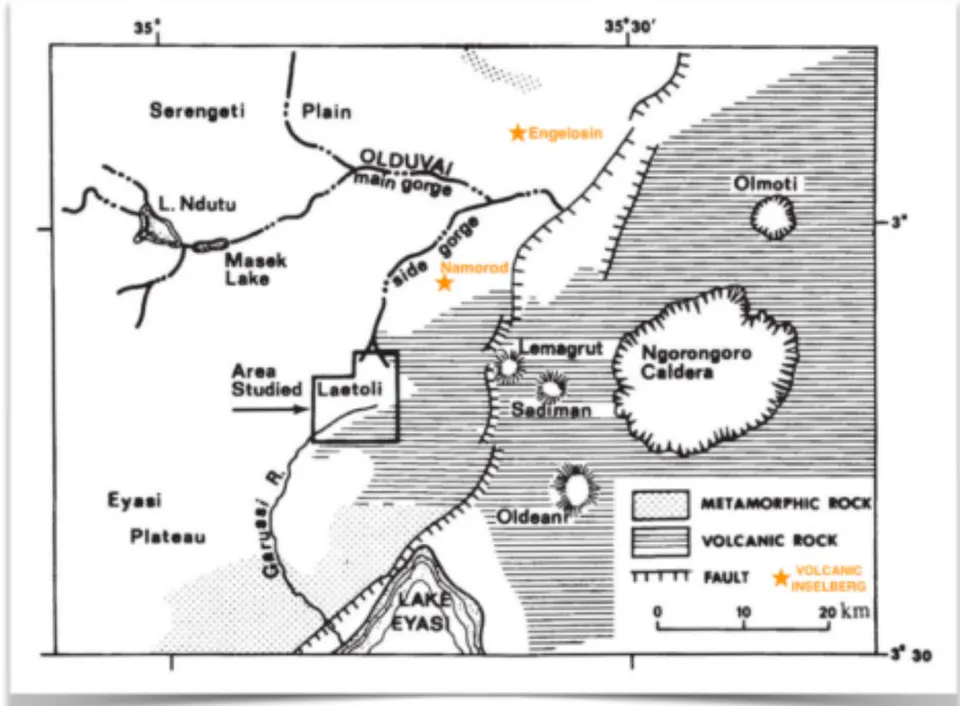
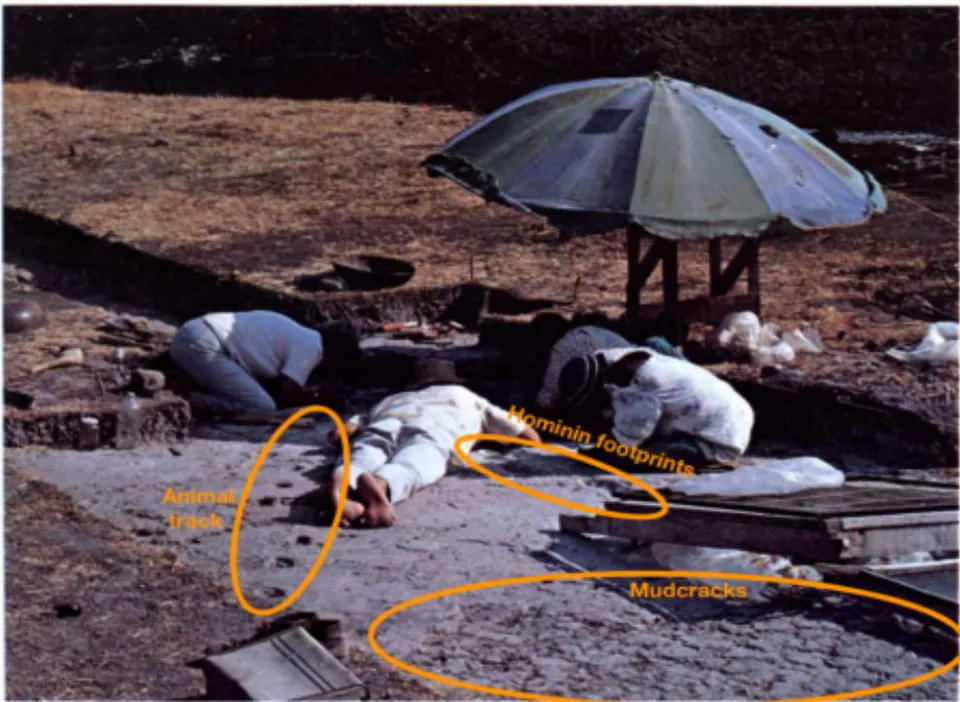
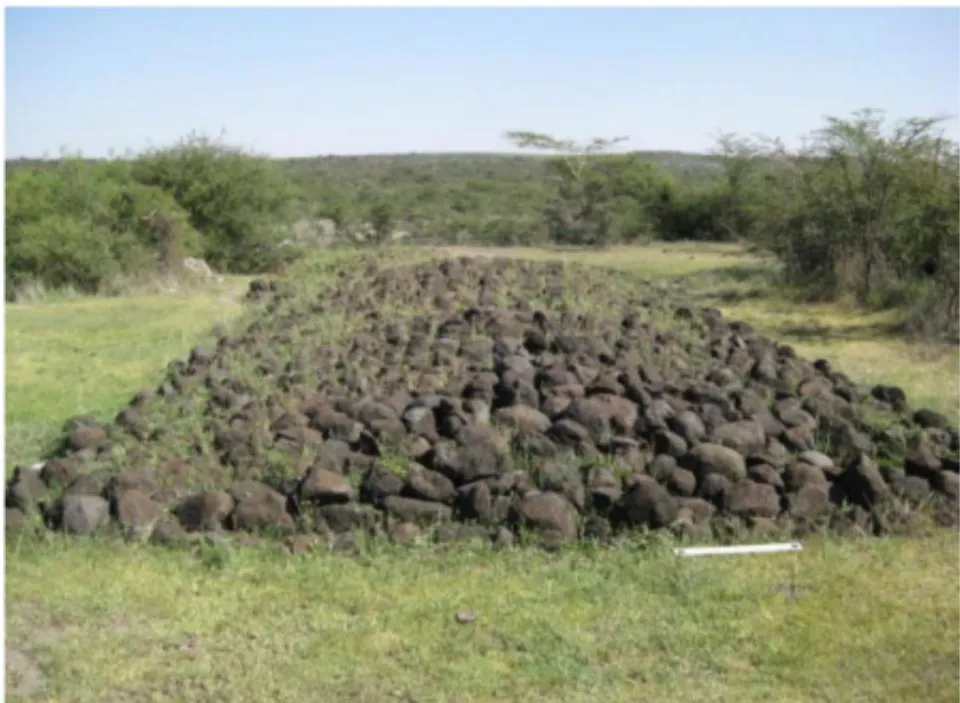
Thousands of animal tracks, together with footprints of bipedal hominins, were discovered at Laetoli, south of Olduvai Gorge (Figs. 4, 5) in 1978. The tracks were said to be about 3.5 Ma old. They were published by Mary Leakey and geology professor Richard Hay, first in an article in Nature in 1979 (16), and then in an article in Scientific American in 1982 (17). Already in 1979, before independent scientists could visit the site, Leakey and Hay had the hominin footprints covered up by soil and boulders to protect them (Fig. 6). They have remained covered since, only opened a few times to remove acacia trees and document the damage that soil and tree roots had caused (18).
The cover-up made it difficult for independent geologists to study the footprint layer, and no one has corrected what I think are significant errors in the geological interpretation. I have studied the published works on Laetoli and Olduvai (19, 20, 21, 22, 23, 24, 25, 26, 27, 28, 29, 30, 31, 32, 33, 34, 35). I contend that the 3.5 Ma dating of the hominin tracks is invalid, because the rock layers are sedimentary, not volcanic. I think the footprints are Homo sapiens, similar to fossil footprints that occur near Lake Natron, about 100 kilometers to the northeast (36). A local animal tracking expert engaged by Mary Leakey thought that the Laetoli animal tracks looked modern (24), p. 7), and they have never been properly described or identified.
The reburial mound prior to removal of boulders
Figure 6: The footprint layer was covered up in 1979 by soil and boulders, purportedly to protect it.
The cover-up also kept visiting geologists from seeing it. (Photo from Getty Conservation Institute, 18).
The footprint layer is one of 18 layers, averaging about 1 centimeter thick, that are perfectly flat and horizontal. Over half of the layers show animal tracks, pits from raindrops, and mudcracks. One layer shows hominin footprints. The obvious geological hypothesis would be that these were muds on the margin of a large shallow lake. In the rainy season, a layer of mud is deposited and tracks are made by animals near the lake. In a dry period, the layer dries and hardens, while mudcracks form and the tracks are preserved. In the next rainy season, the process is repeated, and this can easily occur 18 times. The minerals of such sedimentary layers have different source ages, all older than the layers themselves. The minerals can be dated, but they do not give the age of the layers.
The lake-margin hypothesis was never mentioned in the publications by Hay. His explanation was outlandish: each thin layer represented a volcanic eruption that left an ash-fall on a smooth flat landscape (16, 17). After each eruption, there came enough rain to moisten the ash and make it cohesive and able to record tracks, but not enough rain to wash the ash away. It hardened to form the rock called ash-fall tuff. But there is no ash preserved (23), and no angular volcanic shards in these supposed tuffs. The layers are carbonate-rich, like lake sediments and unlike volcanic ash (24). There are rounded sand grains (35), typical of sediments. Hay wrote that most of the layers have a "polygonal fracture pattern", which in his photograph (his figure 4, 24) looks like the mudcracks of sediments. Such fractures are unknown in tuffs. Mudcracks and rounded grains would be easily seen by visitors if the rocks were not covered.
The dated minerals show a spread of radiometric ages, which also argues against the layers being from volcanic eruptions of about the same age. But Alan Deino, who did the dating, simply accepted Hay's volcanic interpretation. He also accepted the conclusion from the dating study decades earlier in the same laboratory, that the layer of footprints was about 3.5 Ma old (31, p. 78). To improve the precision of the previously determined ages, he analyzed 325 feldspar mineral grains from different layers. First he threw out 23 of his analyses, because they were inappropriately young. Then he threw out 119 because they were inappropriately old (31, p. 80):
Of the remaining 302 analyses, many are simply too old to reflect a true eruptive age. These are most likely xenocrysts, acquired immediately prior to or during the eruptive process, or during transport to the site of deposition. At Laetoli, where the current dating effort, as well as prior work, indicates that the oldest strata of the Laetoli Beds are 4.2–4.4 Ma, a cutoff of 4.7 Ma is used to classify 119 grains as 'obvious xenocrysts.' The most precise of these ( 3% error in age) are up to 600 Ma, with prominent modes at 7.6, 6.5, and 5.5 Ma.
He used the grains that gave the ages and precisions that he needed to publish this paper. The others he called xenocrysts, or foreign grains in volcanic rocks. He did not describe or show any thin-section pictures of rocks or mineral grains. I think all his analyses are actually correct, including the young and old ones. But they are all detrital grains in sedimentary rocks, and he should have thrown them all out.
I contend that the beds of Laetoli are sedimentary, which makes the ages invalid. There is one valid dating result: a 2.3 Ma age of the volcanic basalt of the Ogol Lavas (see Fig. 7, right column). However, I am convinced that Hay misinterpreted the position of the Ogol Lavas, by thinking that they occur above some beds. Neither Hay nor others discuss exactly which beds the lavas supposedly occur above. Also at Olduvai Gorge, Hay interpreted some Ngorongoro volcanics to lie above some layers of Bed I (see Fig. 7, left column). Louis Leakey wrote that Hay was probably wrong about that stratigraphic position (19, p. 2).
Anyone can see that the footprint layer at Laetoli is covered up. Only a geologist who has studied the regional literature would be able to see that geologic information at Laetoli and Olduvai is covered up and that the Laetoli ages are incorrect.
The incorrect ages have led to regional geologic problems. The Olduvai Gorge (see Fig. 4) cuts through the horizontal beds of the Serengeti Plain like a mini version of the Grand Canyon. Unlike the Grand Canyon, there is no published geologic map or cross-section showing the beds and their continuity. This is because the incorrect Laetoli dates make a map and cross-section impossible. It is like the M. C. Escher waterfall: the beds at Laetolil are supposedly old, at a low level, while similar beds at Olduvai are young, at a high level. To put more distance between Olduvai and Laetoli, at least mentally, geologists now call the Laetoli land surface the Eyasi Plateau instead of the Serengeti Plain (as in Fig. 4).
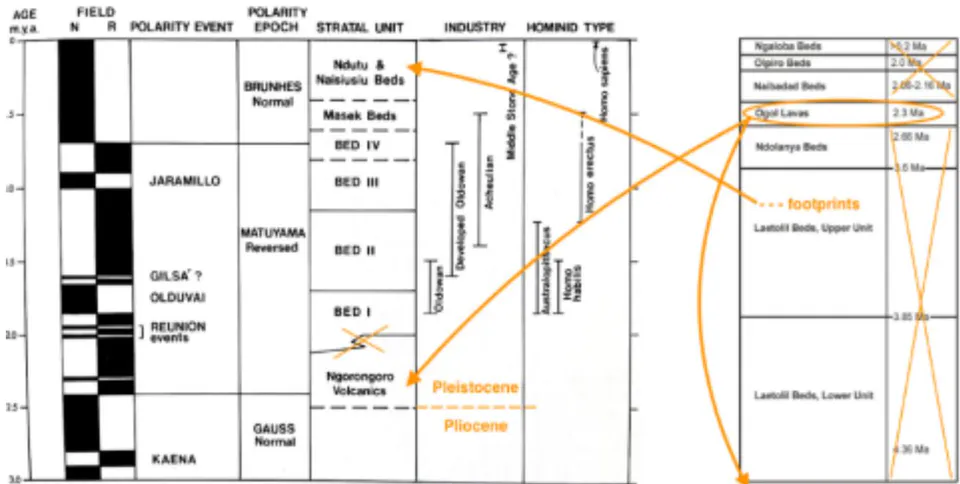
The academic books (19, 21, 24, 27, 28) that one needs in order to study the geology of Olduvai and Laetoli are expensive and not easily available. Few independent geologists have gotten involved in the regional geology there. As I read the scientific papers in these books, I notice the avoidance of obvious geological hypotheses, types of data, and routine descriptions. Key omissions have helped keep the incorrect 3.5 Ma age covered up until now. Only a geologist with all the sources could notice that the information is missing:
Geological maps and cross sections of the beds of Olduvai and the beds of Laetoli. • The hypothesis that the ash-fall tuffs could be sedimentary and not volcanic. • The hypothesis that Hay's "polygonal fracture pattern" could be sedimentary mudcracks.
Chemical analyses (whole-rock, trace-element, and isotopes) of the supposed ash fall tuffs, which would be needed to properly show they are volcanic and not sedimentary.
Thin-section descriptions and photomicrographs of the dated rocks and minerals, which would be needed to show volcanic ash-fall origin.
Information on the stratigraphic position of the Ogol Lavas, and contact relationships of these lavas with supposedly underlying beds.
My hypothesis is that the layers and animal tracks at Laetoli are of Pleistocene age, and the footprints are Homo sapiens. Geological data that would show this have been covered up, just as the geological features at the Laetoli tourist locality have been covered up by soil and boulders.
Protsch discoveries
Reiner Protsch was a respected German anthropology professor whose career ended in disgrace in 2004. Some of the fossil material he had dated was taken from him and sent to an independent laboratory for testing. It was shown that he had faked discovery locations and dates of bones for decades, in order to publish exciting scientific results (37, 38, 39).
His Hahnhöfersand Man, supposedly from a bog in northern Germany, was not a fossil at all. Neither were two other of his discoveries, the Binshof-Speyer Woman and the Paderborn-Sande Man. A 50-million-year-old primate fossil that Protsch had said was from Switzerland was actually from a previously known site in France.
Protsch's background was at Olduvai Gorge and Laetoli. As part of his Ph.D. thesis at UCLA in 1973, he dated a Homo sapiens fossil that had once been thought to be from the million-year-old Bed II of Olduvai (see Figure 6). It was debunked by fluorine analysis, and then Protsch helped to correctly date it, at about 17,000 years old (40, see 22, p.165). In a later report (41), Protsch noted that there were location discrepancies and missing fossil items in the Laetoli area (see 34, p.143, p.147). He must have realized that errors in paleoanthropology can go uncorrected, and that falsehoods can lead to success.
Turkana Boy (Nariokotome, Kenya)
Turkana Boy is the most complete skeleton of a hominin ever found. It was found in 1984 in the dry Nariokotome River valley, just west of Lake Turkana, Kenya (42). The braincase of 880 cc is smaller than a modern human's, but otherwise the bones and teeth are strikingly human.
The skeleton is described in a book of scientific papers The Nariokotome Homo erectus skeleton, edited by Alan Walker and Richard Leakey (42). The skeleton was determined to be a boy that was about 12 years of age when he died, possibly because of a tooth infection (43, p.53, 7, p.24). Although he lived about 1.5 Ma ago, the bone proportions are similar to modern Africans, and unlike Neanderthals or modern Eskimos (7, p. 161).
A detailed account of the discovery and context are available in a popular-science book by Walker, co-authored by his wife Pat Shipman, an anthropology professor: "It is my story, but she wrote most of the words." (7), p. xii). Turkana Boy was discovered by the hominin fossil hunter Kamoya Kimeu. Here is how Walker and Shipman described the discovery (46) p. 11):
He went to an improbable place, a little hill on the opposite bank of the sand river, near a small acacia tree and a good-size salvadora tree.... Not only had the place been trampled and scuffed and walked over, but it wasn't much of an erosional surface anyway, not a place to find fossils.
Kamoya went anyway. And amidst the litter of black lava pebbles and dried leaves and sticks, he found a piece of hominid frontal bone. It was the size of a matchbook and the color of the pebbles. Lord knows how he saw it. He picked it up because it was lying loose on the surface, and then he turned it over. To him, it was obviously a fragment of bone from the cranial vault, the bony covering of the brain. The inside was smooth, from the impression of a large brain – not as it would be on a pig or gazelle but as it would be on a hominid. He knew from the thickness that it was Homo erectus, the species that immediately precedes modern humans.
How did Kimeu know that this piece was a Homo erectus, and not a modern human fragment? And how did he know that more of the fossil could be found by digging in that little hill? Since Kimeu began working for the Leakey family in 1960, he has shown an uncanny ability to find sensational hominin fossils. He said on various occasions that hominins talk to him in a mystical language, Kikishwa (7, p.22). Scientists think it is quaint when people have unscientific beliefs.
Kimeu found the fragment on August 22, 1984, and reported to Alan Walker and Richard Leakey, who were in Nairobi. They arrived the next day by private plane, to a landing strip that Kimeu had previously prepared (7, p.12). Kimeu and his coworkers excavated the skull bones in a few days, and nearly all the other bones within four weeks. The first results were published in Nature in 1985 (44).
The skeleton is remarkable, because it lacks bones of the hands and feet. All the vertebrae were present, except the upper six vertebrae of the neck. Why were these particular bones not found?
Here is my hypothesis: The skeleton was not a Homo erectus at all. It was one of thousands of children who had been killed and mutilated in the Congo Free State between 1885 and 1908. Those atrocities were carried out under orders of King Leopold II of Belgium. To terrorize families, soldiers routinely cut off a hand or foot of a child. Hands were delivered to the soldiers' superiors, as proof of their work. Hundreds of Congo children survived and many were photographed with a missing hand. But many others had their heads, hands, and feet chopped off. These missing parts are a sort of fingerprint to these Congo corpses. Maybe the ghost of one of these boys moved his bones to Nariokotome, and then used the language Kikishwa to tell Kimeu where to find them.
Walker glued the fragments of the cranium (calvaria) in the field, working together with Leakey's wife (7, p.19). The pieces were "corrected by adjusting the glue joins." They made the braincase appropriate for a Homo erectus. Here is Walker's description of that process (45, p.328):
The calvaria was recovered from the disturbed surface sediment and desert lag at Nariokotome. Only the facial skeleton was seen in situ and that was embedded in the roots of an Acacia tree. The individual skull bones were assembled in the field by gluing many fragments with Durofix (Rawlplug Ltd.) Most of the nearly 70 pieces did not have much adhering matrix, but any still present was removed in the laboratory using pneumatic
Airscribes (Chicago Pneumatic Corp.) The individual bones were then reassembled into the calvaria and the slight distortion in the curvatures of the fossilied bones were corrected for as much as possible by adjusting the glue joins.
The facial skeleton was said to be dug out of the 1.5 Ma layers, in other words in situ. But this bone had roots of an Acacia tree growing in it. Roots grow in soil, and bones in soil can only survive for a few thousand years at most. So I do not accept that this is in situ. Photographs (42, p. 94b, 94c) of supposedly in situ bones show that they lie in coarse deposits, not in the 1.5 Ma-old layers, which are fine-grained mudstone. These coarse deposits would be moved and replaced during occasional floods in the Nariokotome River within a few hundred years at most.
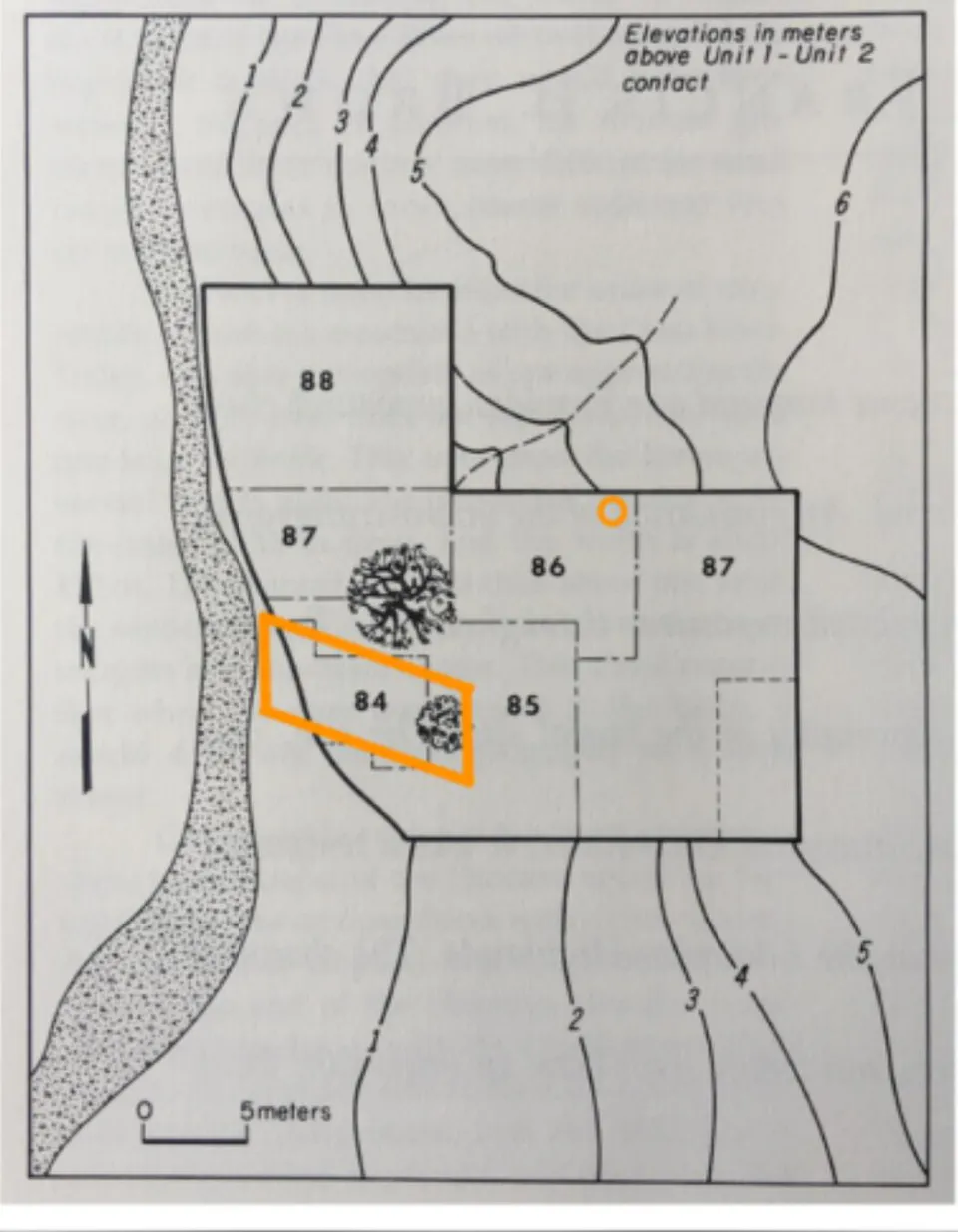
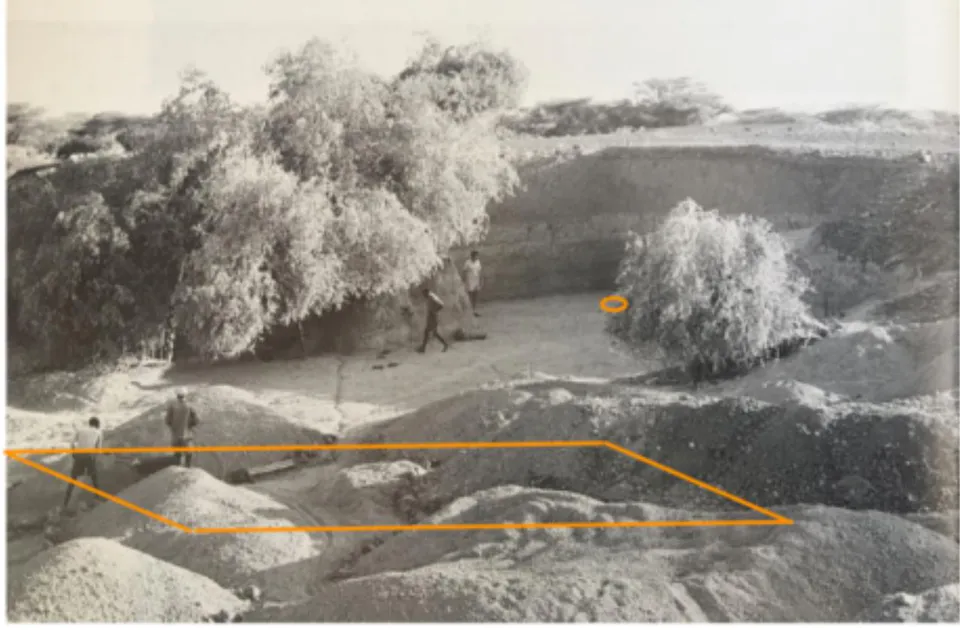
The 1.5 Ma mudstone layers were excavated after the bones were found (Fig. 7). Many paleoanthropologists visited while the layers were being excavated in 1985-1988 (7, p. 23). Hippo, tortoise, and catfish bones were found in those layers, but nothing more of the boy's skeleton. The debris from this excavation was dumped in mounds, about where the bones had been taken from the little hill in 1984 (Figs. 8, 9). The excavation documented the geological and environmental conditions of the supposed source of the fossils.
By 1985 it was clear that the skeleton was missing hands and feet, and neck bones. Mary Leakey thought that they might be found by further excavation (7, p.23). In 1986, Kimeu and coworkers did find a few more bones, about 15 meters away from the little hill (see Figs. 7, 8). They were hand, foot, and a vertebra, from a juvenile, just what was needed. But Walker determined that they were not from Turkana Boy. I think he had to write about these bones, because they were known to the others. But he wrote about them without using the words hand, foot, or neck (43, p.46):
A word must be said here about three bones that may belong to the skeleton but were situated a long way from the main hominid concentration. These bones are definitely metapodials of a juvenile mammal. If they are hominid, then two are first metacarpals and the other is a first metatarsal. They were found in 1986 about 15 m northeast of the main hominid concentration. Nearby was an immature vertebra that was thought to be hominid but, when cleaned, proved not to be. All three metapodial bones are from immature individuals and lack their epiphyses and articular ends. What remains of the details of morphology is sufficient to cast doubt on their hominid status, but they cannot be securely placed in another taxon either. That they were widely separated from the main concentration of hominid bones is yet another hint that they might not belong to the hominid skeleton.
My hypothesis is that these new hand and foot bones, and one vertebra, came from the grave of some other boy. I think they were planted to be discovered during the excavation in 1986 to match the defective skeleton from the little hill. But they didn't match. So we have bones of two different juveniles here: one with no hands and feet, and the other with no bones of the body, only hands and feet.
FIGURE 3.1.
Plan of the NK3 excavation showing areas worked in the 1984–1989 excavation seasons. Locations of the profiles are indicated by the dashed lines within the excavation area.
(below) The Nariokotome excavation in 1986, after two year's of work. Eventually, we moved 1,500 tons of sediment by hand and we recovered 40 per cent of the boy's skeleton.
Modern bones are hard and porous and do not feel like fossils. But Walker made the bones heavy and hard, by saturating them in plastic that filled the pores. He wrote: "The bones are relatively hard, by and large, but a plastic preservative (vinyl acetate solution) was used to make them stronger." (42, p.434). This process also made it impossible for anyone to later carry out carbon-14 dating, or DNA-analysis, or fluorine testing.
Experts who studied these bones were told that they were 1.5 Ma old. They were not given evidence that might cause doubt. For example, the original teeth were not actually seen by the expert who studied them. Casts of the teeth and jaw had been made in Nairobi, where the originals were kept. Walker and Shipman had this statement from the expert: (7, p. 149.)
"They were really nice, sharp casts," she remembered later, "quite beautiful. I could see every tooth on at least one side. There were nice X rays of the mandible. You could see everything."
Turkana Boy was actually the second Homo erectus skeleton that was found. The first was a mature woman, found east of Lake Turkana. Walker and Shipman wrote (7, p.128):
Kamoya first noticed the fragments of skull and teeth, which he knew immediately were hominid, in 1973, though it took some years before we unraveled their meaning. They were terribly broken up and they seemed to be scattered over an area roughly the size of a football field. That was bad enough, but the area was liberally sprinkled with other fossils too: crocodiles, turtles, hippos, antelopes, elephants, giant baboons, and giraffes, all in hundreds of pieces. In all, the team collected enough fossils to fill five museum drawers (wooden boxes about two and a half feet long by one and a half feet wide) to a depth of several inches and left piles of very large or otherwise obviously nonhominid bones at the site.
Like the Turkana Boy, this skeleton also turned out to be defective: all the bones, except the skull, were damaged by excessive bone growth (7, p.128). Walker concluded that this Homo erectus woman suffered from Hypervitaminosis A, a sickness that causes bone growth. Walker was impressed that as early as 1.5 Ma years ago, a sick woman was kept alive by the care of others (7, p.134). I suspect that these were human bones from a modern grave, and that the healthy skull bones belonged to a different individual, not the woman with the diseased body. Did these bones come from the Congo? And the three chimpanzee teeth that Kimeu found 30 years later (5, p.108) south of Lake Turkana – did they come from the Congo, where chimpanzees currently live? It seems unlikely that chimpanzees ever lived in the arid region of ancient Lake Turkana.
Together with the bone fragments of the sick Homo erectus woman, there were about 40,000 fragments (7, p.128) of crocodiles, turtles, hippos, antelopes, elephants, giant baboons, and giraffes. Maybe these are still in five museum drawers and can be tested. The larger bones were left in piles at the site and not saved – do fossil bones associated with Homo erectus have so little value?
It does not seem geologically reasonable that such an assortment of bones and fragments could occur in this way. I think that Kimeu was playing games with gullible scientists by breaking and planting modern bones. Maybe if there had been some kangaroo bones, scientists would have questioned whether any of them really belonged there. Kimeu has been involved in the discovery of some of the world's most important hominin bones, beginning with the famous "Zinj" found by Mary Leakey in Olduvai Gorge in 1959.
Little-Foot (Sterkfontein Cave, South Africa)
In South Africa there is a region of limestone caves with crevasses and small openings to the surface. Animals have fallen in and died. There are bones of large monkeys, hyenas, leopards, and bovids. There may be human bones. Some of the bones were transported by streams in the caves, some were covered by rock falls, and all are cemented by limestone dripstone. Bones are visible in the cave walls, and more can be found by excavating. Cave-fill of this type is chaotic, and dating is uncertain.
A few of the caves are being touted as The Cradle of Humankind. They are registered as an UNESCO World Heritage Site. The Sterkfontein Cave is currently the leading paleoanthropological tourist attraction in Africa, with 15 guided tours a day, year round. The most famous fossil from Sterkfontein is the skeleton called Little-Foot.
In the 1920's, miners blasted out some of the limestone. Bones lying outside of the caves were taken away by visitors as souvenirs. In the 1970's, some of these bones were saved at Wits University. In 1994 the paleoanthropologist Ronald J. Clarke found a few human like foot bones in storage, and then in 1997 he found more, including parts of lower legs at the Wits University Medical School (48, video time 1:45). Foot bones of hominins are typically missing. Clarke realized that with these human-like foot bones as a starting point, he could make a more complete Australopithecus skeleton than any that had been made before.
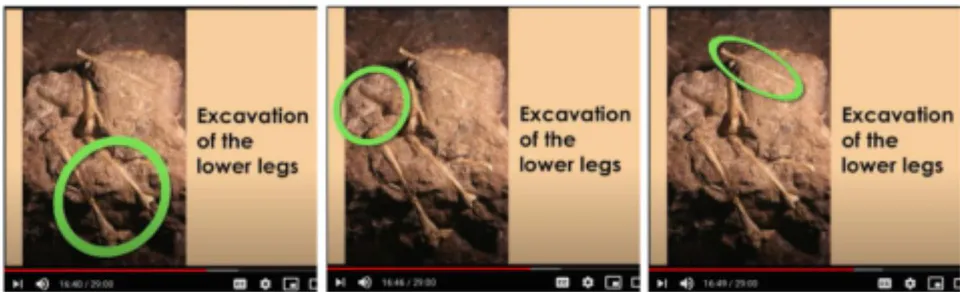
Clarke explained the project in a lecture at CARTA, the Center for Academic Research and Training in Anthropogeny, in California. The lecture is available on Youtube. Here is my exact transcript of five minutes of his lecture (49) (video time 13:55-18:54) and three screen shots (Fig. 10):
In 1978, miner's rubble such as this was removed from this very deep shaft, which we call the Silberberg Grotto in Sterkfontein Cave. It was taken to the surface and the fossils were developed out of it. They were cleaned out of the rocks and put into bags and boxes.
One day in 1994 I was looking through one of these boxes when I found this ankle bone that I recognized as being an Australopithecus ankle bone. And this was quite astonishing because there were no other fossils, not even a single tooth or tooth fragment, of an Australopithecus from that particular part of the cave.
And then I found more. There's the ankle bone that I found among these the other bones that fitted in front of it leading down to the big toe. And what was important about it, as I said, that it showed that it had this slightly divergent big toe. Now at the time I and Philip Tobias published this, and Owen Lovejoy was very skeptical, and said we were, this was patently absurd to say it had a divergent big toe. But now with Ardipithecus, he's found that that has an even more divergent big toe.
Then in 1997, I found more of the same foot, several more foot bones, and the lower part of a tibia, a shin bone. Not only, here they are put together, and compared to the same region in a modern human foot and lower leg. Not only that, but I found a piece of tibia from the other side, and part of another foot bone from the other side.
So I had the lower legs and the feet from the left and the right side. And I said if that's the case, the rest of the skeleton must be down there in the cave. So I gave this piece of tibia to my two assistants Stephen Motsumi and Nkwane Molefe and said go into the cave with torches and see if you can find anywhere that that will fit on. After one and a half days of searching, they found the spot. There's the piece in his hand and there's where it fits on.
So we began excavating. There's the slope on which it was found, just in this spot here. We began excavating, and we uncovered the lower legs, up to the knee joints here, and we uncovered the lower thigh bones. This is the radius of a monkey, lying next to it.
And when we got up to here there was no more. And we carried on and we carried on up the slope and didn't find any more. And we were in a state of despair. And we said "How can this be? You cannot have two lower legs side by side and not the rest of the skeleton."
And obviously we couldn't make this public. We worked in secrecy. We didn't want to make this public and make fools of ourselves by saying we'd got a complete skeleton, when we'd only got the lower legs. So we kept looking and we kept chiseling away month after month in this solid rock. This is solid very very hard rock.
And then I realized that there was a cavity beneath this skeleton. And I remembered this saying of Sherlock Holmes who said. "When you've eliminated the impossible, whatever remains, however improbable, must be the truth." And the impossible was that there could not be any more of the skeleton. That was impossible. It was unthinkable. It had to be there! So the improbable was that it was situated beneath a thick layer of stalagmite.
We chiseled through that stalagmite, and we got the rest of the skeleton. Firstly the skull. And these are the stages in revealing the skull. The back of the mandible here and part of the cheekbone. And next to it was the upper arm bone, the humerus. A bit more cleaning and a bit more and then we got this and then this is the final stage of the cleaning. A complete skull with the jaw in articulation and the humerus next to it.
We continued up the slope, and to our delight we got the arm and the hand. Here's my hand next to it for comparison, showing you how the fingers are curled across the palm.
My hypothesis is that Little-Foot skeleton was put together from four different individuals: 1. From Wits University Medical School storage: Homo sapiens ankle-bones and foot bones.
From the cave: lower legs, knee joints, lower thigh bones, and an arm bone that were all found together. Although the arm bone was in correct position relative to the legs, Clarke could not use it, because it was too long. He did not say the word "arm": it was "the radius of a monkey".
From elsewhere in the cave: a skull and arm of suitable length.
From a third location in the cave: another arm and a hand.
Clarke gave this lecture in 2010 to professional paleoanthropologists of CARTA. I doubt that anyone asked about the monkey arm bone. Such a question would be uncomfortable for paleoanthropologists. CARTA has decided not to include an aquatic-ape paper (4) on their list of 2807 publications (50). That paper would be uncomfortable for paleoanthropologists to read.
Clarke had the attitude of a successful paleoanthropologist: the fossils that we need must exist, so we will do what we must to get them. "...that there could not be any more of the skeleton. That was impossible. It was unthinkable. It had to be there!" He knew that with the foot bones from the medical school they could eventually make a nearly complete skeleton. But it took many months to find appropriate bones. "We worked in secrecy. We didn't want to make this public and make fools of ourselves by saying we'd got a complete skeleton, when we'd only got the lower legs."
In 1979, Clarke had helped with the Laetoli footprint layer (his bare feet are seen in my Fig. 3). There, too, they worked in secrecy._Then the layer was covered up, and the secrecy was maintained.
II. CONCLUDING REMARKS
For scientific claims that cannot be repeated or reproduced by impartial scientists, the default hypothesis should be that the claims are incorrect or even possibly falsified. But in paleoanthropology, there seems to be no place for this sort of normal scientific skepticism. It is considered impolite or unprofessional for a paleoanthropologist to suggest that a fossil-find might be a hoax.
I think that one-time fossil finds, especially surface-finds, should be highly suspect. The bone material may be modern, like Piltdown Man, and therefore not too old for DNA analysis or carbon-14 dating. Hominin bones and other fossils from the same sedimentary layers should be fluorine tested, to help demonstrate that the hominin bones actually came from those layers.
The century-old story of human evolution on the savanna is a story. It is like a historical fiction novel, in which details have been invented to make the story more educational, interesting, and convincing to readers. Fossils have been needed to argue against the unscientific belief in creationism. Only a few people have been aware of the false fossil evidence that I have uncovered. Most paleoanthropologists have put doubts aside, to publish papers that advance their careers within the paradigm of the science. Now we have DNA analyses that convincingly prove human evolution, so fossils are no longer needed for that purpose. It is time to actually test all of the claimed hominin fossils.
Conflict of Interest
The authors declare no conflict of interest.
Ethical Approval
Not applicable
Data Availability
The datasets used in this study are openly available at [repository link] and the source code is available on GitHub at [GitHub link].
Funding
This work did not receive any external funding.
References
Cite this article
Related Research


Special Issue
Launch a focused special issue to highlight research, emerging trends, and expert insights in your academic field.