


IntelliPaper
Abstract
Everyone seeks to experience a more loving and authentic Life, as if it were something that, through poetry, allows us to open the doors of a sacred temple, where a mystical celebration is about to begin. It may be a mystery to be experienced, the unio mystica or enlightenment through “experiences, listening, and poetic encounters.” Can alternative poetic work inspire the search for enlightenment? Can it bring elements that help us cast a different gaze upon Life? Challenging poetic-philosophical reflections lead us to suggest that we can experience a more loving and authentic Life. Alternative poetic art can help us enter the gates of a sacred temple, where a mystical poetic celebration can take place and where, without realizing it, we can experience the mystery of mystical poetic union through listening, encounter, and experiences that can enchant us and help us encounter God.
Explore Digital Article Text
Unio Mystica: Experience of a Rosicrucian Poet
ABSTRACT: Everyone seeks to experience a more loving and authentic Life, as if it were something that, through poetry, allows us to open the doors of a sacred temple, where a mystical celebration is about to begin. It may be a mystery to be experienced, the unio mystica or enlightenment through “experiences, listening, and poetic encounters.” Can alternative poetic work inspire the search for enlightenment? Can it bring elements that help us cast a different gaze upon Life? Challenging poetic-philosophical reflections lead us to suggest that we can experience a more loving and authentic Life. Alternative poetic art can help us enter the gates of a sacred temple, where a mystical poetic celebration can take place and where, without realizing it, we can experience the mystery of mystical poetic union through listening, encounter, and experiences that can enchant us and help us encounter God.
Introduction: Rosicrucian Mystical Experience
Everyone seeks to experience a more loving and authentic Life, as if it were something that, through poetry, allows us to open the doors of a sacred temple, where a mystical celebration is about to begin. It may be a mystery to be experienced, such as experiencing the Rosicrucian mysticism of which I have been a student since 1978.
As for the mystery, the Ancient and Mystical Order of the Rose Cross (Amorc) (2011) notes that the origin of the term “mystical” lies in the “study of the mysteries of life,” and by “mystical” it means the “study of the laws that govern the universe, nature, and human beings. On a practical level, it represents the application of these laws” (Amorc, 2011, p. 189), which involves spiritual or divine communication.
Communication involves harmonizing with ourselves, with others, with the Planet, and, seeking to go further, also with the cosmic plane, with God. Faced with such a challenge—how to communicate with the spiritual plane and seek to attain divine communion, also known as unio mystica, the mystical union—Enlightenment. “The ideal of mysticism is the final attainment of conscious union with the Absolute, or the Cosmic” (Amorc, 2011, p. 190). Mystical union can encompass communication with God.
In the sense of associating communication with mystery, from the Rosicrucian perspective of Amorc, Mazzucco (2020) proposes that communication “a mystical art”—occurs on various levels, from speech and writing to silence. Even people who do not speak the same language can communicate through gestures, in a poetic way, through the heart. Smiles, handshakes, and hugs signal a “harmony we feel in our hearts and the desire to achieve it together with others”: this is the encounter that helps build communication through “listening, both internal and external,” which suggests something mysterious. On the other hand, the present times “are often characterized by a lack of listening,” being more “an attempt to be right than a search for and preservation of truth” (Mazzucco, 2020, pp. 5–9).
What stands out is “listening, both internal and external,” “silence,” “poetic form, through the heart,” “harmony,” “to realize it,” and “encounter,” which reveals a certain conceptual similarity with the artistic work to be analyzed: “Experiences, Listening, and Poetic Encounters” —an alternative and innovative visual poetics that involves the creative process of the Rosicrucian author himself (Uhry, 2025), while also seeking to establish a bridge with other fields of knowledge (mysticism; communication; religious studies).
These are complemented by the Lopes Prelude (2025, pp. 19–25), on which this article is enriched.
Methodology
The methodology adopted is an experiential account, based on Husserl’s (2001) phenomenological method (Zitkoski, 1994), in which the researcher must “turn toward oneself” (Zitkoski, 1994, p. 18), that is, “philosophical reflection [is] directed toward the ‘self’ [...], ‘toward oneself and, within oneself, to seek.’” Thus, “one must constitute oneself as something of one’s own, a being that uses wisdom, one’s own knowledge, which, although directed toward the universal, is acquired by oneself” (Husserl, 2001, pp. 19–20). This is complemented by an essayistic methodological approach and focuses on both alternative poetic innovations and the relationships between art and other areas of knowledge, such as mysticism, communication, the study of religions, and the philosophy of life, for which the aforementioned poetic works, the cited bibliography, and indicatory research techniques are utilized (Braga, 2008, pp. 74–88; Ginzburg, 2007) and discourse analysis (Greimas; Landowski, 1986).
The Rosicrucian poetry collection “Experiences, Listening, and Poetic Encounters” originated on Facebook (“Encounters and Enchantments with Nature”), where visual poetry in the form of original photographs is posted alongside reflective poetic texts and illustrated with photographic imagery to compose this experimental poetic work. Does this raise the question of whether an alternative poetic work can influence poetic production and, through poetry itself, inspire the search for enlightenment? Can experimental poetry provide elements that help us cast a different gaze upon Life?
Rosicrucian Poetic Experience
Regarding the terms highlighted and referred to by Mazzucco, the current world leader of Amorc (“listening,” “encounter,” and “realizing it”), might they be related to a mystical conception reflected in alternative poetics? When analyzing Poetic Experiences, Listenings, and Encounters, one notices a certain similarity between these terms and the title of the collection. Regarding what is proposed to reflect on the poem “Experience”:
[A poet is not just poetry:
he sings, dances, philosophizes, reads, art’s
gossips, tap-dances, thinks, the lexicon master’s
tries his hand at painting, photography, metric…]
A poet is sensitive, pan-lexical, In action
to the (dis)enchantments of Life,
reflecting on arrival & departure Life’s
and seeking to provoke reflection. (Uhry, 2026a, p. 26)
In “experience” (poem), which is similar to the term “realizing it” (to experience it), the term “refléxìo” also appears—a concept of a mirror that is placed before us, reflecting us and, at the same time, prompting reflection. And, upon reflecting on the poem, the poet's first image is of someone who experiences life sensitively and is conscious of life and death (“arrival & departure”) and of the charms and disillusions of Life. An alternative poetic experience?
Poetic Encounter
Upon Lopes (2025) analyzing the work, Uhry seems to be experiencing a journey through life, taking walks during which he meditates and captures images, observing everything and everyone incessantly. In the same way that he experiences the quest for selfknowledge; by pausing to observe the people he encounters (“Learning [surprises]”):
There are people with souls loving and meditative / which gives them an enchanting radiance / and their halo emerges like an aura. (Uhry, 2026a, p. 43)
This is a perception of an encounter, which drives the desire to share the reflections, feelings, and wonders evoked by these Experiences, moments of listening, and poetic encounters. The first impression is that the entire aesthetic work is placed at the service of an un d, adamantine ethical stance: the author uses his verses as a persuasive strategy, a way to seduce the reader to communicate a mystical worldview, a characteristic that must be properly understood and described.
Let's take a brief look at how this works. Some poems at the beginning of the book consist of stanzas that are repeated with slightly modified lines, or with the order changed, achieving an interesting poetic effect. An illustration of this technique can be found in the three poems derived from two stanzas presented at the beginning, each with its own title: “First Verse: Apprentices” and “Second Verse: [Waves]” in Uhry (2025, pp. 27–29).
Everything unfolds as if the author were in search of increasingly refined images to express similar ideas. As the reader explores the work, they begin to realize that this quest by the poet reappears and renews itself in each poem, observable as a semantic effect of the mobilization of different poetic mechanisms.
Poetic Metaphysics?
Ultimately, reading the collection of poems reveals a general pattern reiterating the same poiesis: a consistent set of ideas linked to a mystical vision of the universe that recurs in nearly every poem, as if the author were gradually drawing closer (and drawing us closer), through simple verses, to highly complex mysteries.
To quote the poet's own words, each poem “is a faint reflection of the communicable” (“Poetic Experience [Unio mystica]”) in Uhry (2025, p. 36). Perhaps for this reason, each of his poems revisits the same themes in a different way, incessantly. Each poem is a rosebush; the arrangement of the various rosebushes guides the reader along a defined path; and the entire book can thus be beautifully described as “a fragrant rose garden on the spiritual path” (“Kindness [of the soul]”) in Uhry (2025, p. 68).
This true poetic metaphysics immediately imposes itself on the reader's consciousness through the famous phrase coined by the poet Ferreira Gullar: “Art exists because this life is not enough.” For both Gullar and Uhry, it is a matter of viewing art in general, and poetry in particular, not as an end in itself, but as a passage to another dimension of existence. But, starting from this common ground, the difference between the two is significant. Ferreira Gullar explains: “The function of art is to invent reality. Art is the vision of things we do not know. Art is something that did not exist before. Life is invented. The world is inexplicable” (Gullar, 2024).
Gullar sees art (and poetry) as the invention of another world, to which we can attribute meanings—unlike what happens with the “real” everyday world, which we know but cannot explain. This would be the primary function of art, according to this view: to freely create explanations for the inexplicable.
For Uhry, however, poetry (and art) continues to serve as a bridge, but not for the construction of another, invented reality, but rather for the discovery, within the depths of each person, of a transcendent dimension, a kind of true truth, pre-existing everything we are capable of seeing and touching in our daily lives.
Unlike what Gullar said, poetry, for Uhry, cannot communicate what is essentially “inexplicable” or “incommunicable”—nor is that its function. This impossibility is articulated in the poem “Poetic Experience [Unio mystica]”:
[Poems in the Wind – the basic idea is post:
everything that can be said is lost to the wind
emotions, expressions of the soul-subtle touches
the word is dead; it belongs to the past, it’s done
the experiential here and now is incommunicable
only silence expresses the depth, the essence lovable]. (Uhry, 2026a, p. 32)
There are several other examples of this viewpoint in the work. Let us look at the last stanza of “First Poetic Experience”:
Poet, a pretender on the outward
Poetic howl feigns pain's love
Insight brings Light, Love
A true poem comes from inner ward. (Uhry, 2026a, p. 61)
The reference to Pessoa's famous poem “Autopsychography” (2003, p. 164) serves to highlight the distance between the view of poetry as the construction of an “invented” reality—as a mode of discourse that grants access to a “make-believe” universe—which the Portuguese poet seems to share with Ferreira Gullar.
On the other hand, there is the view that sees poetry as an almost ritualistic element, a key to the search for the immanent truth within each person, through reflection and meditation that unites the individual essence with the universal whole. The search for truth is essential to understanding Uhry's poetry, whereas Gullar and Pessoa do not seem concerned with any truth; on the contrary, they apparently propose an escape from the real world, facilitated by the imaginary world of art.
While for Pessoa and Gullar, poetry and art are additions to an insufficient world, for Uhry they are instruments for the sought-after emptying of an excessive world—a world to which we have always been subjected, out of habit and carelessness. This is stated in no uncertain terms in “Conditionings [memory]”:
We need unlearn to what is essential learned.
Many planetary conditioning our life guided.
We need to re-evaluate so that we can grow spiritually growing.
Human and ecological, towards the stars, towards infinity. (Uhry, 2026a, p. 93)
In Uhry's own poetic practice, the renunciation of the excessive world of words occurs through the denunciation of all that is appearance and exteriority—the dimension of “form”—and through the simultaneous affirmation of what in poetry (and in people) is immanence and interiority—the dimension of “content.” This is what we read in the poem “For the Primacy [of Loveliness]”:
“ Poetic ocean—riverbanks: loveliness, hatred.
The river of form, of the effects of words and their poisons.
Rivers of content: Light, love, beauty, spiritual truth. (Uhry, 2026b, p. 40)
Poetic Creation and Existential Creation
A parallel is suggested between poetic, creative creation and ethical, existential creation. Just as the poet must renounce the superficial and formal dimension of language to exalt its meaningful dimension, every human being must choose, amidst life's sufferings, to love the essence of all things and of other human beings, which connects us all to the divine. Consider, for example, these excerpts from the poem “To Love [To Hate]”:
[Nothing stops us from becoming enraged,
not only to act on human hatred itself,
always a sorrowful endeavor: keeping hatred alive.
Under the pretext of discord, anger… Do you want? (..)]
II
Choice: within us, creative, supportive and loving
lives and planet; the best of us –exploring or denying? […] (Uhry, 2026b, p. 42).
In general, in Lopes (2025) perception, Uhry's ethos is serene, suggesting that he positions himself, discursively, on a high vantage point from which he can contemplate the madness of the world with detachment and the same compassion he employs in his verses. At times, he may raise the tone of his discourse, as if offering readers a raw portrait of our own reckless behaviors. There is a passage from the poem “Setbacks [competition]” where this tone is evident:
[Brings many wounds our passage of live:
Crawling or flying to surviving.
Others simply want to survive crises and wars.
A challenge that has lasted for age.
For some, to hell with it! Life ‘rips them off’ – it’s dure;
For others, good heavens! Life is futile – it’s time agony.
Which only gets worse with agedness. (Uhry, 2026b, p. 42)
Listen: The Experience as a Mystical Poet
Uhry is a Rosicrucian mystical poet who cares for his readers, striving in every poem to point the way to the Rosicrucian spiritual path. Perhaps the key to understanding is provided right at the beginning in the poem that serves as the epigraph to the first part, “I. Poetic Experiences,” in which a visual poem is followed by “Experiences [we rise]”:
The loving quest poetic experiencing:
Embracing the soul
Ecstasy in calm meditation goal
The unio mystica poetic whilst experiencing. (Uhry, 2026a, p. 17).

Everything makes grow spiritually. Apprentices on the rise!
[Grateful for the experiences of El Tatio da Vida come arise.
Everything has to teach us. The challenges of the battle:
Within oneself, the waves of joy and pain justle! (..)] (Uhry, 2026a, p. 23).
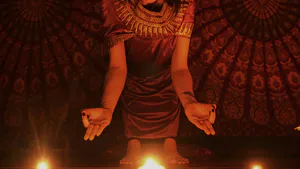
In visual imagery 1, the poet chose an image of joy—almost an epiphany—set in the desert, avoiding the visual imagery of—all bundled up—freezing at twelve degrees below zero, the “pain [that] takes hold”! Furthermore, the earlier “listening through experience” stands out here, which can be related to the mystical union in the conscious communion of souls with the infinite arid desert—a concept that can be conceived as “the final attainment of conscious union with the Absolute, or the Cosmic” (Amorc, 2011, p. 190), which suggests an idea that would be achieved poetically (“poetic unio mystica”).
The expression unio mystica can be related to the ancient Judeo-Christian context. For Nogueira (2011), unio mystica denotes the human spirit's desire for communion with the divine. Religious scholars distinguish two strands:
- Some understand mystical communion as the fusion of the mystical soul with its God, and the consequent dissolution of all preexisting individuality.
- The other strand defines the experience of unio mystica as an ecstatic contemplation of the divine by the soul, through ritual practices, without any loss of identity (Nogueira, 2011).
The Amorc also refers to “cosmic communion,” related to “enlightenment” in the sense of “Light of the mind, more precisely universal understanding,” since “Cosmic Enlightenment results in harmonization with the Cosmic Intelligence that permeates our being” and “Enlightenment is the highest form of cosmic communion” (Amorc, 2011, p. 145), which is similar to the concept of mystical union.
This suggests that the poetry analyzed seems closer to the second strand of unio mystica, as it proposes “calm meditation” and “poetic experiences” as ritual paths to the communion of the human with the divine, with no indication of a loss of individuality in this communion, and this can be read in various poems throughout the book:
Consciousness with the Great Poet—harmony (“Eros [Thanatos]”). (Uhry, 2026b, p. 98).
“The Earth with the Cosmic harmonizing [Consciousness [God]].” (Uhry, 2026a, p. 62).
To be compassionate, to be at one with God (“Walking, meditating [dream]”). (Uhry, 2026a, p. 68).
The idea of “harmony,” a term related to the concept of Illumination (Amorc, 2011, p. 145), is a recurring term in the analyzed poetry: it evokes the perception of a whole whose parts continue to exist—precisely, in a “harmonious” manner with one another: orderly arrangement, agreement and understanding, coherence, pleasant combination, etc. There is no notion here—nor could there be—of any fusion between the parts in the formation of the whole.
Furthermore, it seems to conceive of the unio mystica, unlike both traditions mentioned, not only as communion with some transcendental entity—which it does not exclude from its concept—but also as communion with nature and with all of humanity. This is what emerges in the verses of “Blessed [Love]”:
With love, the blessed heart in attention:
let divine and compassionate love flowing:
feel Divine communion in cool of the morning
when the Sun has not yet blessed the soul.
The poetic-loving vibration that a good Life way. (..)
II
The most important thing in Life is love.
Compassion may arise
because of miraculous poetry.
Just as profound peace grows,
infinite happiness grows emerge from
harmony with God and all beings. (..)
(Uhry, 2026b, pp. 51-52).
Here there is also “profound peace,” a Rosicrucian concept like harmony: “It is the harmony of the human being's attunement to the Cosmic, which produces a warm wave of contentment throughout the Being.” (Amorc, 2011, p. 209). And, likewise, in this verse from the poem “Friendship [life]”: “The quest: harmony with all and the father-of-All” (Uhry, 2025, p. 54). Or in the poem “ To grow [enchanting]”:
We can win and be enchanted,
[Beauty and living beings are what life asks us to be singed
to harmonize with the beauty of nature and repair
reconnected to our Divine Essence, in poetry, in prayer,
and the exuberance of beings.
and whatever from your hearts glowing. (..)]. (Uhry, 2026a, p. 39).
Another prominent feature of this poetic conception is that the communion with the proposed “Divine Essence” is not merely an ascent, but also a return to the universal origin of all things, which becomes clear in a poem such as “Souls [the invisible threads]”:
Human souls—united
From the source—Universal Soul—are at here create.
There is an invisible thread that us all linked. (..) (Uhry, 2026a, p. 111).
Moreover: since we are all interconnected and are expressions of the “Universal Soul,” each of us is a soul-personality who is potentially... a poet! As it says in “Purpose [problems]”:
(..) the path your inner Poet shows you following:
your Divine spark is in harmony with God. (Uhry, 2026, pp. 75-76).
This suggests that the poetic unio mystica is, therefore, not at all individual, even though it must be sought in the innermost depths of each person: it is radically universal. This is what is implied in “Free themselves [dream]” in Uhry (2025, p. 47):
“ Beings who become enlightened free themselves
from the bonds of religion, race, ideologizations,
school, family, society, and social conditioning
and even of ideology and philosophy.
They adopt a cosmic, multi-planetary perspective,
They love, meditate, and are compassionate.
By harmonizing with the Divine and all beings in life,
They become One with Existence with consciousness. (Uhry, 2026a, p. 44).
Here it becomes clearer what is meant by unio mystica—Enlightenment: becoming “One with Existence itself” by loving, meditating, being compassionate, harmonizing with God, which is considered “A dream” that allows one to “comprehend the void, attain selfawareness,” and “free oneself.” Understood in this way, it can be a mystical listening, the fruit of an encounter lived to the fullest in which there is the experience of liberation from “conditionings, ideologies, philosophies” (Uhry, 2025, p. 47) through the experiences of love, meditation, compassion, and understanding. What the poet considers a dream!
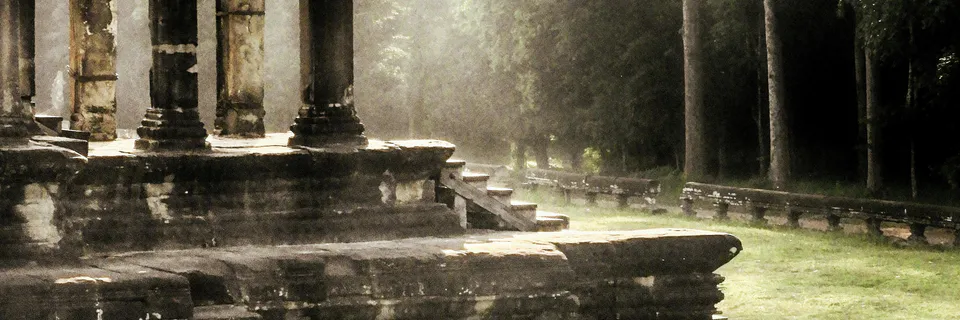
Also, in “III. Poetic Listening” follows Visual Poetics 2, in which—as follows—there is more poetry related to meditation and consciousness and to “diving into the soul”:
Poetic Listening: our search deep and aesthetic
[Blows of voices and variations reflecting the unio poetic.
From the poet & reader, a dive profound into the soul.
Ecstasy in calm poetic listening cool]. (Uhry, 2026c, p. 12).
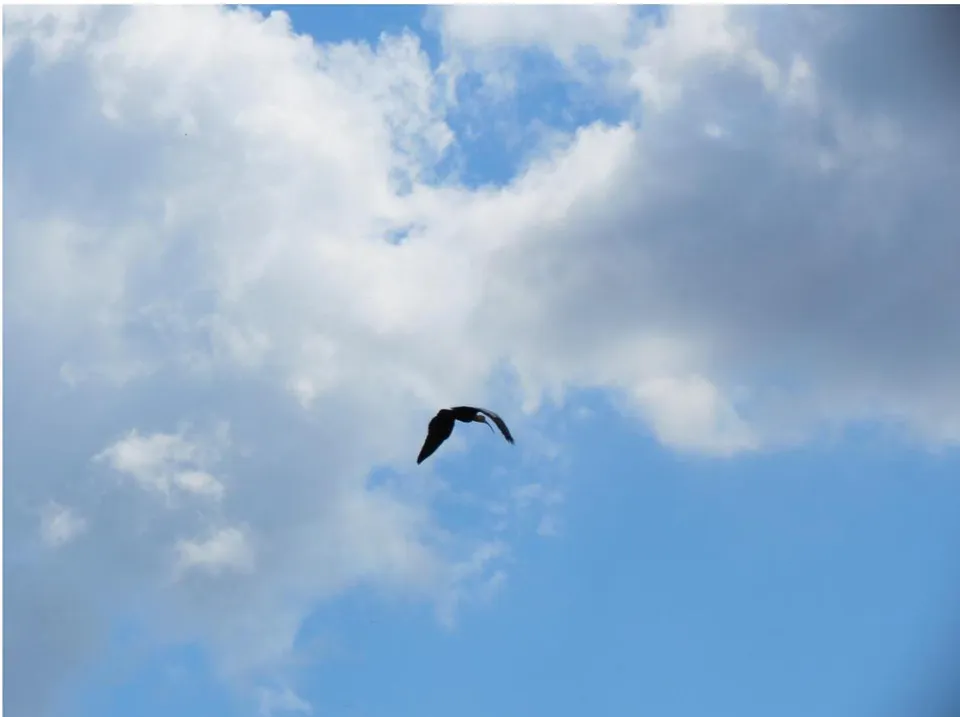
As I look at the sky, I can see the wings opening the path
[In the emptiness of thought, I hear to the clouds flight path.
Without leaving a trace in the inner sky meditative.
The poet's heart happy amidst the clouds and the blue reflective]. (Uhry, 2025, p. 124; Uhry, 2026c, p. 12).
This is how Uhry offers us, through the sequence of his poems, a practically direct representation of what I imagine to be his meditation process (one of the practices he always focuses on in his poems), in a play of associations of ideas always guided by the search for unio mystica with humanity and the universal spirit through listening, encounters, and poetic experiences of a mystical Rosicrucian poet.
In the “Poetic Encounters” section, there is a black-and-white photo next to the poem “Life [Bear Witness]”:
[…] I vividly recall the moment of flight. I have learnt
Giving oneself fully to whatever we are facing, I learnt.
Am I happy? Yes, right now, flying happily.
In the face of pain, bear witness! Even happy or unhappily].
(Uhry, 2026a, p. 104).
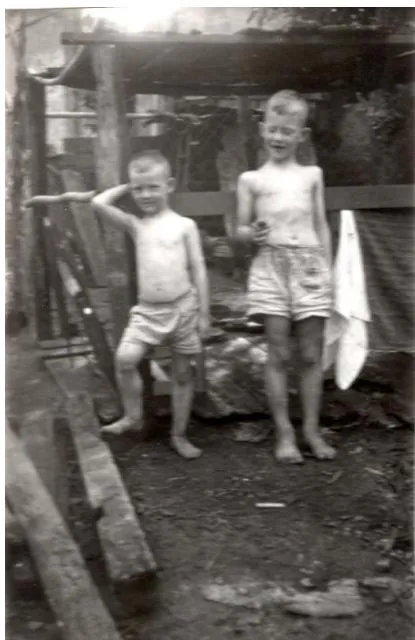
Figure 3 shows the boy poet alongside his older brother, a memory of building their first home—a “moment of flight” in which he learned to “immerse oneself in whatever we are facing”—and depicts him “tired from the arduous work” and “flying happily,” in ecstasy, as he witnesses the accomplishment! It is noted that the verses reflect the mystical values of the Rosicrucians.
Final Thoughts
Thus, unlike the aforementioned Fernando Pessoa, Uhry could never write poems as heteronyms. He does not merely write his texts; he truly relives them as his Inner Poet, the boy.
And that is where the innovative structure of intercalated stanzas, adopted in “experiences, listening, and poetic encounters” seems to fit. In each poem, the stanzas located on the left side—where reading always begins—are, as a rule, those that introduce the theme focused there and propose the theses that the speaker wishes to communicate about it. The stanzas on the right-hand side—where the reading naturally flows next present variations from those on the left: sometimes they complement or elaborate on what was said earlier, as in this excerpt from “Setbacks [competition]”:
In life, we can direct our vibration.
[Direct them toward health, dialogue, and cooperation.
Direct them toward spirituality, love, and education.
Direct them toward ecology, arts, poetic creation. (…). (Uhry, 2026b, p. 47-48).
Also, poems present contrasting theses, opinions that, at first glance, seem to diverge from those the poet stated on the left side of the page. The poem “Sharing [opening]” provides an example:
What I want to attract to the Planet, I am sharing
[The verses are whatever my fancy taking.
to the country, to me, to you and to all beings in mind:
Everyone has their own pleasures in mind. (…)] (Uhry, 2026a, p. 99).
However, a less superficial look soon reveals that there is never an insoluble contradiction between the stanzas on the left and those on the right. What exists is the proposition of a dialogic poetic structure, as if the speaker were conversing with himself.
Finally, Lopes (2025) feels that reading of Experiences, Listening, and Poetic Encounters has brought about a lasting transformation, in a way he cannot yet describe: I only know that, after this profound, enchanting experience that lived poetry provides us, we, its readers, will be able to close the temple doors, descend the staircase that will return us to daily life—and open the doors to a new awareness of Life (adapted from Lopes (2025, p. 25).
These reflections suggest that we can experience a more loving and authentic Life. With the book “Cosmic connections”, Taylor (2024) has made research in this way about the “poetry in the age of disenchantment”. It suggests that poetic art can help us enter the gates of a sacred temple, where a mystical poetic celebration can take place, and where, without realizing it, we can experience the mystery of mystical poetic union through listening, encounter, and experiences that can enchant us and help us encounter God; or, who knows, made cosmic connections with Divine.
Conflict of Interest
The authors declare no conflict of interest.
Ethical Approval
Not applicable
Data Availability
The datasets used in this study are openly available at [repository link] and the source code is available on GitHub at [GitHub link].
Funding
This work did not receive any external funding.
Cite this article
Related Research

Special Issue
Launch a focused special issue to highlight research, emerging trends, and expert insights in your academic field.