


IntelliPaper
Abstract
The study focused on the visibility of websites of agricultural research institutes in Nigeria. A purposive sampling technique was employed to select 34 agricultural research institutes. The specific objectives were to assess the online visibility of these websites and identify the types of agricultural activities showcased. Secondary data were collected using webometric tools such as SEO tools, Moz, Similarweb, and Ahrefs. The research adopted a mixed-method approach, incorporating both quantitative and qualitative data analysis. Quantitative data were analyzed using IBM SPSS (Statistical Package for the Social Sciences), while qualitative data were analyzed using Atlas.ti version 8. The results revealed that the websites of ARMTI, CIFOR, NAERLS, NSPRI, WARDA, FRIN, IFPRI, ICRISAT, NIFOR, NAPRI, NIFST and ICRAF agricultural research institutes had high visibility. The most frequently mentioned words included "research," "food," "capacity," and "development," reflecting the key activities of some agricultural research institutes. Additionally, the coefficient of global rank showed a positive correlation with website visibility, while visit duration and bounce rate exhibited negative correlations. The study concluded that the high and moderate levels of website visibility were associated with the sharing of links and content, as well as maintaining an active presence on social media platforms. It recommended that agricultural research institutes leverage social media platforms such as Twitter, Facebook, and LinkedIn to promote website content and drive traffic, thereby enhancing online visibility and engagement.
Explore Digital Article Text
I. INTRODUCTION
Website visibility is an indicator of how visible a website is in the organic search results when queries are entered into search engines. It refers to the ease and effectiveness with which a search engine crawler can find and index a webpage (Weideman 2009). Ojokoh and Akinola (2017) stated that visibility considers two parameters: number of external links and number of referring domain. Weideman (2009) stated that external links are hyperlinks on webpage B, linking to webpage A, where webpage A is the one currently under consideration. Many external links from other websites in the same community makes a positive contribution to website visibility. A webpage coder has very little control over the quantity and quality of external links, but the website owner could canvass for external links from other high-quality websites. The referring domains (ref. domain) are pages on different websites that points to resources in the target domain. It is a domain for links that redirect visitors to the target website. One referring domain can have more than one link to different pages on a website, for example a link in a referring domain to Postgraduate School of University of Port Harcourt, and another link in the same domain to School of Sciences of the same Institution. Ahrefs and Majestic, having a weighted score of 50%, can be used to determine the visibility of websites (Kunosic et al. 2019).
According to Patel (2015), one important aspect of visibility is search engine optimization (SEO). SEO is the process of improving the quality and quantity of website traffic by increasing the visibility of a website or a web page in a search engine's unpaid results. This can be achieved through a combination of on-page and off-page optimization techniques, such as keyword research, meta tags, and backlink building. Also, another important aspect of visibility is the use of social media. Social media can be used to promote a website and increase its visibility through the sharing of links and content, it can be used to engage with users and build a community around a website, which can also help to increase visibility.
Website visibility is important for several reasons, including increasing website traffic and improving search engine rankings. When a website has good visibility, it means that it appears high in search engine results, making it more likely for users to find and visit the site. This can lead to an increase in website traffic, which can in turn lead to more sales, leads, and conversions. Again, websites that are visible on search engines are more likely to be considered reputable and credible by users. Website visibility is also important for businesses because it can help to improve brand awareness and reputation. When a website is visible on search engines, it can help to establish the business as a leader in its industry, which can help to build trust and credibility with potential customers. Furthermore, visibility can help to generate interest and engagement from potential customers and help to build relationships with them. In addition, website visibility can also affect how users perceive the website. A website that is visible on search engines is often seen as more professional, reliable, and trustworthy than a website that is not. This can have a positive impact on the user's experience and increase the likelihood that they will return to the site in the future (Rosario, 2021).
II. STATEMENT OF THE PROBLEM
The insufficient number of change agents or development facilitators assisting millions of development beneficiaries serves as a clear indication of the need for media help. According to Davis et al. (2019), Nigeria has a workforce of over 7,000 public agents, with an extension agent to farmer ratio of between 1:5,000 and 1:10,000. Using a website is unavoidable if any progress is to be made quickly, and the web presence of agricultural research institutes play an essential role for all key actors. Like university websites that attracts students, academics, funding, and make these institutions widely known through E-learning programs and open access initiatives, while spreading knowledge beyond physical boundaries (Razak et al., 2019), websites of agricultural research institutions should be visually appealing, polished, and professional to reflect the institutions' services and mandates. It should help users' complete tasks quickly through on-site search and keep them engaged by suggesting relevant content, while minimizing dead ends. The websites should be fast, correct, and perform as intended, and should be built to web standards, rigorously proofed, and regularly tested for speed or functionality issues. But most of the agricultural research institutes have dormant websites, the few that are not dormant, are not visible enough. This agrees with Ogege (2011) who stated that Nigeria is well recognized for having abandoned websites, and among parastatals, agencies, and ministries, only a select few have an amazing record in building websites that are really useful, while numerous others merely have websites that maintain static home pages. At such, the required collaboration is not there, for instance, between the academia, the industries, government, societies, professional associations, etc. These websites of the agricultural research institutes are not visible enough to reflect the true image of the various research going on in the research stations. The study therefore examines the visibility of agricultural research institutes in Nigeria.
III. OBJECTIVES OF THE STUDY
This study aimed to address the following objectives:
i. Ascertain the online visibility of the websites of agricultural research institutes.
ii. Identify the types of agricultural activities that are visible on the websites of the agricultural research institutes.
Hypothesis of the Study
: Webometric indexes do not influence the online visibility of the websites of agricultural research institutes.
IV. METHODOLOGY
This study employed a descriptive research design. This type of research design was employed because the nature of the study required the collection of quantitative and qualitative data from the entire population on webometric factors using webometric tools and the result would provide a detailed understanding of each sample in the entire population of the study. The study was undertaken in Nigeria. Between the latitudes of and and the longitudes of and is where Nigeria is found in West Africa. It covers 923,768 square kilometers in total. The Republics of Niger and Chad border it to the north; the Republic of Benin borders it to the west; and the Republic of Cameroun borders it to the east all the way to the Atlantic Ocean's coastlines, forming the southern limits of Nigerian Territory (Akinwale et al. 2023).
The study's population comprised of 34 national and international agricultural research institutes drawn from the six (6) geopolitical zones in Nigeria. Purposive sampling technique was employed to select the 34 national and international agricultural research institutes in Nigeria.
The study employed secondary data collection. The secondary data for the study were collected through the use of webometric tools such as SEO (Search Engine Optimization) tools, Moz, Similarweb, and Ahrefs. These webometric tools can be accessed online through their URL links.
The researcher designed a research brief and employed the following procedures:
Step 1: Access the link online for Ahrefs: https://www.ahrefs.com.
Step 2: Enter the institute's URL into the accessed link in step 1.
Step 3: Retrieve the required information for the institutes.
V. RESULTS AND DISCUSSION
5.1 Visibility of Websites of Agricultural Research Institutes in Nigeria
Table 1 shows the extent of visibility of the websites of agricultural research institutes in Nigeria. The websites of ARMTI, CIFOR, NAERLS, NSPRI, WARDA, FRIN, IFPRI, ICRISAT, NIFOR, NAPRI, NIFST and ICRAF agricultural research institutes had high visibility with scores ranging from 63% to 86%. The websites of CRIN, IAR, IITA, ILRI, NIHORT, NVRI, NRCRI, NCAM, NACGRAB, NIOMR, NISS, NIFFR, CIMMYT and CIP agricultural research institutes had moderate visibility with scores ranging from 39% to 62%. The websites of IART, LCRI, NWRI and RMRDC agricultural research institutes had low visibility with scores ranging from 15% to 38%.
The high and moderate extent of visibility could be as a result of positive user experience and continuous website updates with new research findings, trainings, trends, and events. This agrees with the findings of Pant & Pant (2017) who reported that websites with larger number of engaging pages are associated with higher visibility. Also, the high and moderate extent of visibility can be associated with sharing of links and contents, as well as maintaining an active presence on social media platforms such as facebook, twitter, linkedIn, youtube, instagram, etc., thereby building links and generating traffic to the websites. This agrees with the findings of Zhang & Cabage, (2016) who claimed that social media can be a useful tool for generating traffic quickly and that link building and social media both increase website traffic and profitability. The high and moderate extent of visibility suggests that when agricultural information users such as the government decision-makers, agricultural policymakers, planners, researchers, educators, students, program managers, field staff, and farmers make queries for information on search engines, only the visible websites will appear on search engine result page. For example, when a user is looking for information on the use of fertilizers in maize production, they may use keywords such as "maize," "fertilizer application," and "yield improvement." An agricultural research institute that has conducted research on the use of fertilizers in maize production and uses these relevant keywords in their content strategically or have RSS field on their website and social media handles with notifications being sent on every content uploaded and updated, search engines are more likely to display the website in the search results, increasing its visibility to the users, and the website can also attract organic traffic from such users and establish themselves as a reliable source of information on the subject.
| S/N | URL | Visibility Score (%) | Remark |
| 1 | www.armti.gov.ng | 75 | High |
| 2 | www.crin.gov.ng | 60 | Moderate |
| 3 | www.cifor.org | 85 | High |
| 4 | www.frin.gov.ng | 67 | High |
| 5 | www.iar.gov.ng | 46 | Moderate |
| 6 | www.iart.gov.ng | 30 | Low |
| 7 | www.iita.org | 55 | Moderate |
| 8 | www.ilri.org | 60 | Moderate |
| 9 | www.ifpri.org | 71 | High |
| 10 | www.icrisat.org | 71 | High |
| 11 | www.lcrimaid.gov.ng | 15 | Low |
| 12 | www.nihort.gov.ng | 55 | Moderate |
| 13 | www.nwrikd.edu.ng | 38 | Low |
| 14 | www.napri.gov.ng | 69 | High |
| 15 | www.nvri.gov.ng | 55 | Moderate |
| 16 | www.nrcri.gov.ng | 55 | Moderate |
| 17 | www.ncamng.org | 50 | Moderate |
| 18 | www.nacgrab.gov.ng | 45 | Moderate |
| 19 | www.niomr.gov.ng | 55 | Moderate |
| 20 | www.nifor.gov.ng | 69 | High |
| 21 | www.niss.gov.ng | 50 | Moderate |
| 22 | www.nifst.org | 71 | High |
| 23 | www.naerls.gov.ng | 75 | High |
| 24 | www.nspri.gov.ng | 75 | High |
| 25 | www.niffrng.org | 60 | Moderate |
| 26 | www.rmrdc.gov.ng | 38 | Low |
| 27 | www.africarice.org | 75 | High |
| 28 | www.worldagroforestry.org | 71 | High |
| 29 | www.cimmyt.org | 55 | Moderate |
| 30 | www.cipotato.org | 56 | Moderate |
Source: Researcher, 2023 Low (15-38), Moderate(39-62), High (63-86)
*Data were available for only 30 Agricultural Research Institutes
5.3 Activities on the Websites of Agricultural Research Institutes
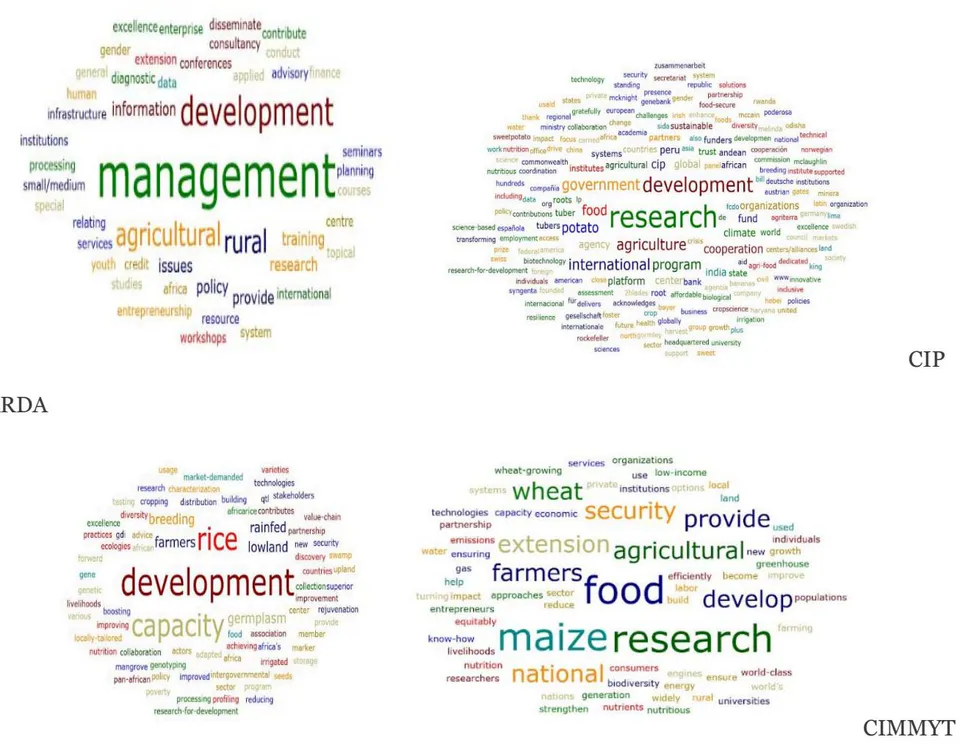
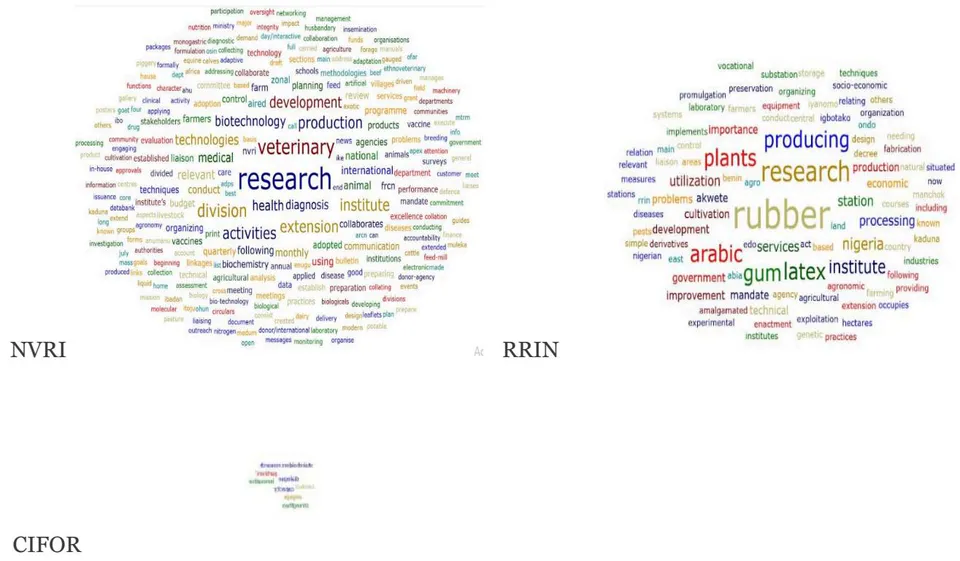
Figure 1 shows the word cloud depicting the activities of the agricultural research institute. The size of the word determines how frequently it was mentioned. The boldest of all the words is the most mentioned word indicating the most prominent activity. "Research" was the most mentioned word for CIP, FIIRO, FRIN, IART, IAR, IFPRI, IITA, NCRI, NAPRI, NRCRI, NSPRI, and NVRI agricultural research institutes. In the case of WARDA and ICRISAT "development" was the most mentioned word. "Food" was the most mentioned word for CIMMYT and NIFST agricultural research institutes. "Capacity" was the most mentioned word for CRIN, while "livestock" was the most mentioned word for ILRI. "Agricultural", "genetic", "fish", "palm", "marine", "soil", and "production" were the most mentioned words for NAERLS, NACGRAB, NIFFR, NIFOR, NIOMR, NISS, and NIHORT respectively. Findings revealed that "research" was the most mentioned word for CIP, FIIRO, FRIN, IART, IAR, IFPRI, IITA, NCRI, NAPRI, NRCRI, NSPRI, and NVRI agricultural research institutes, demonstrating that research is an important part of their activity. In the case of WARDA and ICRISAT, "development" was the boldest word. This implies that these institutes main focus is agricultural development, which entails enhancing and advancing agricultural methods and technologies. Also, the word tag for CIMMYT and NIFST agricultural research institutes was "food", this suggests that these institutions are engaged in research and initiatives concerning food production, food security, and food technology.
Furthermore, ARMTI was associated with the word tag "management". This suggests that ARMTI concentrates on studies and initiatives pertaining to agricultural management, which could entail things like agricultural policy, resource management in the agricultural sector, farm management methods, and agribusiness management. The use of the word "management" underlines the institute's focus on efficient and effective management procedures in agriculture. Also, the word tag for CRIN was "capacity", which implies that CRIN focuses on strengthening the abilities and knowledge of farmers, researchers, and agricultural practitioners as a way of building capacity in the agricultural sector. The word tag for ILRI was "livestock". This demonstrates the expertise of ILRI in research and activities pertaining to raising livestock, including animal health, breeding, and production. The word tag for NAERLS was "agricultural", which implies that NAERLS works on several facets of agriculture, including agricultural policy, extension services, and rural development. The most mentioned word for NACGRAB was "genetic". This suggests that NACGRAB engages in genetic research as well as projects including crop improvement, genetic resources, and plant breeding. Furthermore, the most mentioned word for NIFFR was "fish". This implies that NIFFR focuses on studies and initiatives pertaining to fisheries, aquaculture, and aquatic resources. The most mentioned word for NIFOR was "palm". This demonstrates that NIFOR concentrates on studies and initiatives pertaining to the growth of palm trees, the production of palm oil, and palm-derived goods. The most mentioned word for NIOMR was "marine". This implies that NIOMR focuses on studies and initiatives pertaining to the management of marine ecosystems, marine biology, and marine resources. For NISS, the most mentioned word was "soil", which suggests that NISS concentrates on studies and tasks pertaining to soil science, soil fertility, and soil preservation. In the same vein, the most mentioned word for NIHORT was "production", which demonstrates that NIHORT focuses on studies and initiatives pertaining to the cultivation of horticulture crops, such as fruits, vegetables, and ornamental plants. The most mentioned word for RRIN was "rubber", which implies that RRIN focuses on studies and initiatives concerning rubber production, rubber tree cultivation, and rubber processing. The institute's work focuses on generating novel rubber tree kinds, enhancing rubber tree farming practices, researching rubber processing techniques, and addressing issues unique to the rubber industry.
Although the word cloud might reveal some of the most significant activity taking place within agricultural research institutes, it does not indicate that these activities are open to the public. According to Clement et al., (2021), the visibility of agricultural research institutes operations is affected by several factors, including their communication plans, outreach initiatives, publishing of research results, interaction with stakeholders, and information distribution through their websites, conferences, journals, and other platforms. Agricultural research institutes can effectively drive traffic to their websites by making the most mentioned words keywords for their websites' contents, thus, increasing their online visibility.
ARMTI
technology security zusammenarbeit state, private, state, country, system, system, system, system, system, system, system, system, system, system, system, system, system, system, system, system, system, system, system, system, system, system, system, system, system, system, system, system, system, system, system, system, system, system, system, system, system, system, system, system, system, system, system, system, system, system, system, system, system, system, systems
WARDA
CIMMYT
CRIN crop capacity development growth improved improvement inclusive solutions oil affordable advice soil stea boosting climate kola access agronomy drive delivery employment extension foster practices nutritious food cropping coffee science-based agri-food enhance cocoa cashew business root rice innovative zamask train sudeno-sahelian several stations rainforest integrate role swamp talk partnerships/new demonstrations delivering farmers present society technical help gov designed amelioration fields can trial documentation responsible used plateau info stakeholders soil policy kaduna bio-technology-living production vision summary enterprise done stakeholders soil policy kaduna information plog expert shortly technologies colleges awi communities technology environment bio-medicinel events related human colleges conducts benefit center utilization advocate better international therapy edo themes conduct benefit workshops high conservation station institute resource livelihoods relevant working hydrology high academic moist conservation station institute oyo form improve ecotourism policies nothering moist management college forest guinea afolk various infoedfrin touch generation sokoto badan fries bio department nasarawa mokwa sakpoba need afforestation dead nigeria sustainable isagu derived patency nutrition and wildlife extension services advocacy achieved welcomed on-site zerie zerie services advocacy achieved welcomed outstations improved savanna local resources findings focus busse important will kano appropriate savanna local resources findings focus busse important will pathology borne collaboration use federal field transfer provides overall students including home collaboration use federal field economics hubs page support metrics collaborates audit-delivery contact south ebony programs hill onigamberi visits plays entomology gombe area environmental organizations end development contributes departments around forests ogobomosho twitter tree niger-leaves-financial benin people centers groups natural products protection incubation managers nigeria's delivery future modeling participants skills publications lead communication degraded delivery future modeling participants skills researchers internationally trimmedia onne mission montane umualia mechanization locally north makers mission montane umualia science us madaguri shelterbelt southern specialized
FIIRO institutions increased husbandry, multicultural women, foundations of life and evaluation. meloko-aspe, environmental, governance, government, governance, economic, welfare, infrastructure, funding, foreign, economic, welfare, infrastructure, funding, foreign, economic, welfare, infrastructure, funding, foreign, economic, welfare, infrastructure, funding, foreign, economic, welfare, infrastructure, funding, foreign, economic, welfare, infrastructure, funding, foreign, economic, welfare, infrastructure, funding, foreign, economic, welfare, infrastructure, funding, foreign, economic, welfare, infrastructure, funding, foreign, economic, welfare, infrastructure, funding, foreign, economic, welfare, infrastructure, funding, food & life science, technology, community development, research, international agriculture, agricultural research, institutional investment in Nigeria national resources aguniquidae. The country's technology development is a key focus on the international agriculture and research. The country's technology development is a key focus on the international agriculture and research. The country's technology development is a key focus on the international agriculture and research. The country's technology development is a key focus on the international agriculture and research. The country's technology development is a key focus on the international agriculture and research. The country's technology development is a key focus on the international agriculture and research. The country's technology development is a key focus on the international agriculture and research. The country's technology development is a key focus on the international agriculture and research. The country's technology development is a key focus on the international agriculture and research. The country's technology development is a key focus on the international agriculture and research. The country's technology development is a key focus on the international agriculture and research. The country's technology development is a key focus on the international agriculture and research. The country's technology development is a key focus on the international agriculture and research. The country's technology development is:
FRIN wheel operated milk tuba sprayer modern revolution productivity pre-harvest pesticide 50% style supervise self-propelled postharvest new material new nutritional regular regulated system surface found biotech materials found biologics and materials biologics projects passed material/extractor area hydro-cleaner per boiler zone prototype continenternal foods been adopted affordable export monitoring practice sustainable multi- island economy review regumes day flakes adoptable management/region reflex international agricultural programme reports fund compacts the United national mandate agriculture crop Africa programme green dead activities the United national mandate agriculture crop Africa programme colaborations university annual crops research infrastructure collaboration university annual crops research enhance alliance improved its industry production of a major agricultural development utilization extended extension boom production data values ekt efficient introduction fishing tractor electric plantar following farm contractor agricultural development utilization sub-stations collaborative west irrigation crop farm maize artemisia product value established open pvc lands appropriate varieties cotton ahmadulla pig/mc/mc/mc/mc/mc/mc/mc/mc/mc/mc/mc/mc/mc/mc/mc/mc/mc/mc/mc/mc/mc/mc/mc/mc/mc/mc/mc/mc/mc/mc/mc/mc/mc/mc/mc/mc/mc/mc/mc/mc/mc/mc/mc/mc/mc/mc/mc/mc/mc/mc/mcm suitability descriptor biotechnology evaluation council cowpe/sorghum planning training institute biological bio-digesterment and agree delivery coordinate hepe transformed greenhouse ecology collective contaminants especially one harvester release transformation text establishment generate/harassing waste transformation tropical programmes varietal
IART
IAR yielding people pearl organization reality non-profit combating operators needed malawi yields solar proceed extra-early india chickpea farmers principals acrisat approach solutions hybrid groundnut industries catalyst developing impact afatoxin andhra making focus farming holistic institute millet market critical commercial watersheds high oil tropics militates international national communities telangana rural seed subsistence women
ICRISAT ifprisystemsareas research ifprisystems areas investments research-based partnerships research-based partnerships research-based partnerships research-based partnerships research-based partnerships research-based partnerships research-based partnerships research-based partnerships research-based partnerships research-based partnerships research-based partnerships research-based partnerships research-based partnerships research-based partnerships research-based partnerships research-based partnerships research-based partnerships research-based partnerships research-based partnerships research-based partnerships research-based partnerships research-based partnerships research-based partnerships research-based partnerships research-based partnerships research-based alliances research-based alliances research-based alliances research-based alliances research-based alliances research-based alliances research-based alliances research-based alliances research-based alliances research-based alliances research-based alliances research-based alliances research-based alliances research-based alliances research-based alliances research-based alliances research-based alliances research-based alliances research-based alliances research-based alliances research-based alliances research-based alliances research-based alliances research-based alliances research-based alliances research-based organizations ever research-based organizations ever research-based organizations ever research-based organizations ever research-based organizations ever research-based organizations ever research-based organizations ever research-based organizations ever research-based organizations ever research-based organizations ever research-based organizations ever research-based organizations ever research-based organizations ever research-based organizations ever research-based organizations ever research-based organizations ever research-based organizations ever research-based organizations ever research-based organizations ever research-based organizations ever research-based organizations every
IFPRI capitality strategy biotechnology focuses markets enables cassava giving environment look effective breeding science better activities reduces priority income private resources quality people improve rural farmers lives yields agribusiness sub-saharan crop projects part biological aim and child's education address communities farming creation crp products agriculture access agricultural impact important advantage essential social women managing nutrition across research hazard focus world africa food work improved one plant resistance adaptation development iita can natural improving policy need national reduce sustainable youths along livelihoods crops yes key change climate-resilience allow allows greater value health sector areas healthy partners hunger material making enhancing security line investors project nutritional million education poor soil business climate management creating nares productivity partnerships production selected using biggest information combating improvement africa program rainforests tropical degraded solutions european reducing resource breakthroughs among around biodiversity chains
IITA
Visibility of Websites of Agricultural Research Institutes in Nigeria programmes makes from facilities healthcare information factors business business business business business business business business business business business business business business business business business business business business business business business business business business business business business business business business business business business business business business business business business business business business business business business business business business usiness product product product product product product product product product product product product product product product product product product product product product product product product product product product product product product product product product product product product product product product product product product product product product product product product product product Product
ILRI system equipment/equipment maintenance documentation accession equipment departmental institutional adoption design productivity manufacturing machines individual operational operations project management business development fishing media research media fishing media research media research media research media research media research media research media research media research media research media research media research media research media research media research media research media research media research media research media research media research media research media research media research media research media research media research media research media research media research media research media research media research media research media researchMedia researchMedia researchMedia researchMedia researchMedia researchMedia researchMedia researchMedia researchMedia researchMedia researchMedia researchMedia researchMedia researchMedia researchMedia researchMedia researchMedia researchMedia researchMedia researchMedia researchMedia researchMedia researchMedia researchMedia researchMedia researchMedia researchMedia researchMedia researchMedia researchMedia researchMedia researchMedia researchMedia researchMedia
NAERLS
NCRI application regeneration acquisition department adapted various medicinal technology economic exploration varieties collaborative established distribution need and collaboration diversity registration quality samples materials among chicken accessions livestock not carry recalcitrant institute release africa conservation animal university farmers indigenous plant sent tree information breeding different collected seeds seed research project storage country dioscore agricultural seeds etc will be titled potato duplicates goats centre nigeria development achatina traits african activities genetic and nacgrab bank fisheries orchard biotechnology include geneomics mitochondrial biotechnology resources germplasm field plants specimens centre's naming dna crops field plants specimens centre's committee collection genebank species unit characterization breeders establish viability brazil year national crop utilization west safety breeds capacity edition locally selected garden evaluation banking fruit following conserved maintenance programmes breed management farm gene well molecular respectively training one global institutes cargo preservation germination poultry case germination home ibadan institutions
NACGRAB routinely regulation rabbit/swine high-quality industry natural industry general form/family breeds/retains procedures russels/retains studies operations recovery production health recovery factors gast postgraduate acquisition formulation size maintenance land pure maintaining land use postgraduate acquisition postgraduate postgraduate postgraduate postgraduate postgraduate postgraduate postgraduate postgraduate postgraduate postgraduate postgraduate postgraduate postgraduate postgraduate postgraduate postgraduate postgraduate postgraduate postgraduate postgraduate postgraduate postgraduate postgraduate postgraduate postgraduate postgraduate postgraduate postgraduate postgraduate postgraduate postgraduate postgraduate postgraduate postgraduate
NAPRì wheat investigation improvement barley milk agricultural production accessible food crops green genetic problems
LCRI procedure potential shapes used fabrication soap sizes rust medium well extract improved spot country training processing mandate dehulled variety salt cake agricultural varieties required desired wheat services institute beniseed flour low activities states farming tons heat extension institute practices system sugarcane yield oil research systems areas brown add production seed sesame department technologies castor development water container can materials soybean method include baking different seeds rice ncri farmers national method cereals ash mix development etc sugar high developed federal butter extraction remove preparation days crop released badeggi pour following cut mixture content management various yielding tolerated thoroughly vegetable best assess amort azfa yield assess 75-89 addition audit reduced biaga bene investigments mengue important rivers 42%-63 post-harvest 77-91 reduces assessment trained abstracts affairs achieveivers almost assistance atmosphere transplantation anfes agreement asana yield assess redund redund redund redund redund redund redund redund redund redund redund redund redund redund redund redund redund redund redund redund redund redund redund redund redund redu nd
NIFFR trustees, sunny reduction study specific non-profit scientific/training suggestions trustees, sunny reduction study specific non-profit scientific/training suggestions trustees, sunny reduction study specific non-profit scientific/training suggestions trustees, sunny reduction study specific non-profit scientific/training suggestions trustees, sunny reduction study specific non-profit scientific/training suggestions trustees, sunny reduction study specific non-profit scientific/training suggestions trustees, sunny reduction study specific non-profit scientific/training suggestions trustees, sunny reduction study specific non profit scientific/training suggestions trustees, sunny reduction study specific non profit scientific/training suggestions trustees, sunny reduction study specific non profit scientific/training suggestions trustees, sunny reduction study specific non profit scientific/training suggestions trustees, sunny reduction study specific non profit scientific/training suggestions trustees, sunny reduction study specific non profit scientific/training suggestions trustees, sunny reduction study specific non profit scientific/training suggestions trustees, sunny reductions in 30th 20th 20th 20th 20th 20th 20th 20th 20th 20th 20th 20th 20th 20th 20th 20th 20th 20th 20th 20th 20th 20th 20th 20th 20th 20th 19th 19th 19th 19th 19th 19th 19th 19th 19th 19th 19th 19th 19th 19th 19th 19th 19th 19th 19th 19th 19th 19th 19th 19th 19th 18th 18th 18th 18th 18th 18th 18th 18th 18th 18th 18th 18th 18th 18th 18th 18th 18th 18th 18th 18th 18th 18th 18th 17th 17th 17th 17th 17th 17th 17th 17th 17th 17th 17th 17th 17th 17th 17th 17th 17th 17th 17th 17th 17th 17th 17th
NIFST
NIFOR increased findings emphasis human government extended extended follows fundamental and natural resources infundable and unaffiliated 1960s3% systems consequent adequate contemplated activities industrial industry departments second that proposed economics including agronomical undertaken area industrial departments second that planting administration followed above additional lands palms past funds decided part major agricultural methods national administration improving and contemporary period trade east research appropriate administration a forest colonial conference end-africa methods institutica's benefits inefficient coast farming fabrication of agriculture production net african cultivation taken into diseases approved products development palm oil and agricultural practices policy large discussions difficult bicycle esthered farmers mandate west mr oil rich countries kingdom important organizations far-west beginning economic management held abak station nigeria world expanding indices consultation group formal information ecology wargy now belgian improvement nfor establishment husbandry factory enable body called attention processing board expansion upon control conflict war conduct department harvesting consideration effects carried by-products acquired for scale control conflict war conduct department harvesting consideration effects della came case involving breeding crop export 20th improved considerable currently effect include breeding competition from farming across donations depression federal design circumstances commodities concerned developed financial independence economy developments facility financed future goals theoretical structure source zonal training human facing research skilled increased enactment educational, highly equally servicom resources graduate education adequate advantage publications practitioners journal economic republic graduates practical agreements pertaining transformation matters technology fertilizers environmental establishment enforcement needs body ranks agricultural professional members regulating skills database units relevant formulating registered members attained collaboration public registered academic quality lots fellows nigeria membership challenges national services conducting academic quality development regulate soil institute practice corporate news register galleries seeking management seeking responsibility methods gillies cooperate nigerians become mandate departments rapid locally educate nation's enacted persons advise high production qualifications knowledge supply neclassical sustainability art food based nation related realities media ethics standards dead charged establishment food according will crop prerogatives organogram uss standards dead meet world control international prescribe february testing latest concerned meet drive promote affiliate council philosophy union privileges federal association acquired associates consistent event international registration member attainment us capacity established examination may scientific uphold qualification background/case internationally laws established team recovery produce needed prerequisite provides upcoming military museum mRNA institution country industrial federal energy substance federal energy substance federal energy substance federal energy substance federal energy substance federal energy substance federal energy substance federal energy substance federal energy substance federal energy substance federal energy substance federal energy substance federal energy substance federal victoria, using temperature, specific water, utilization well provision forecasting/prediction echorsounding, socio-economic processes sustainable shipyard dry wislia product, hydrogen fabrication, territorial strata structure administration high meteorology dollar veritas effect shrada wet mandate extension biological lagos laboratories conducting technological species physical coastal departments installed information research specially equipment beyond water fishing equipped aquaculture beds improved wells sampling institution orange fisheries oceanography including prevention breeder safety sea construction board safety sea materine brackish resources development services characteristics vessel according to the BAC analysis bureau climate consultation technology account equipment health global effective deposits design exploitation designed management environment fishery management accounts much operations received environment fishery management accounts much operations land abundance establishment multi-purpose/combination headquarters healthy implements institutes/Taiwan main measures operations level order
NIOMR testing pawpaw ornamental resources concerned appropriate building among mission disease developed etc added well scientists plant horticulture division otukpa indigenous agricultural waste generation evaluation adopted multiplication establishment quality seeds tea control agro-ecological technology varieties value activities improvement principles flour income handling technologies http improved program farming tropical practices processing citrus horticultural utilization materials post-harvest orange techniques crops airvingia training production mango institute using organic acchieveements priper station training mango products importance compost read mushroom pineapple plantain/banana dry species plants farmers soap research fruits fruit vegetable high season zone orgunit development juice project tomato services system economic development www orchard seed seedlings needed genetic product different management exotic nigeria nihort nursery food days across local storage vegetables plantain programme systems produced national sustainable crop planting land making marketing objective national maintenance natural variety extension kano acres
NIHORT system systems responsible well microbiology kano information industries formulations users' providing agriculture testiary successfully perishable findings project trials pesticides along achievements post-harvest livestock logos fabricators target resources potato issues ideas carry small inspectors projects flour pulses techniques skills apart processes control materials harvest durable handlers rispr's organizations testing workers stored activities addition extension structures fruits exporters meat states various agencies level appropriate farmers value-skill equipment etc dried design experiments two another loss facilities training storage department responsibility areas establishment attachment field officers facilities nspri area consultancy dissemination evaluation may commodities postharvest institute products conduct test/roots chain developing senior build production agricultural unit road quality processors analyses provide building students improvement pcrd preservation/atmosphere safety construction establish mandate development food crops including programmes advisory markets data national fish new development food crops post developed institute's vegetables impact kins charged primary engineering produce capacity standards traders ibadan status collation industrialists crop technologies handling packaging fabrication large entomology include industrial related services processing analysis improve maintenance units adoption farmers' smoking equipment categories studies methods operations departments tubers fisheries conducts remarkable headed pilot categories studies methods operations departments tubers fisheries conducts remarkable technology forin nigeria effective export management outreach time model chips director product fabricated marketing farm institutions programme assessment great planning multidisciplinary functions cereal member-local programs assessment great planning laboratories collaboration specifically community ginger problems pandysam train headquarters physical prevention stakeholders parameters
5.3 Regression Analysis of Webometric Indexes Influencing the Visibility of Websites of Agricultural Research institutes in Nigeria
The result in Table 2 shows the regression analysis of webometric indexes on the extent of visibility of websites of agricultural research institutes in Nigeria. The Semi log functional form was chosen as the lead equation based on the highest value, number of significant variables, and correct signs (+, -). The value of 0.561 indicates 56.10% variation in the extent of visibility explained by the independent variables. From table 4.6, two (2) out of the eight (8) variables used in the analysis were statistically significant. Global rank correlated positively (3.653; P<0.05) with visibility of the websites. The relationship was significant at 0.05 level. Visit duration correlated negatively (-21.029; P<0.05) with visibility of the websites. The relationship was significant at 0.05 level. The null hypothesis was therefore accepted that the webometric indexes does not influence the extent of visibility of the websites of agricultural research institutes in Nigeria.
The coefficient of global rank was found to have correlated positively with visibility of website. This implies that as the global rank increases (indicating higher global visibility or recognition), the extent of visibility of websites of agricultural research institutes in Nigeria also increases. In their research on the impact of organic traffic on user engagement and global rank of airline websites, Sakas & Reklitis (2021) found a positive correlation between user engagement and global rank, indicating that user engagement helps the airline website's global rank to increase. The coefficient of visit duration was found to have correlated negatively with visibility of websites. This suggests that as the visit duration increases (indicating longer time spent on the websites), the extent of visibility of these websites decreases. However, this does not conform to a priori expectation as visit duration should enhance visibility. According to Graus et al. (2015), longer visit duration signify that visitors are engaging with the website content and finding it beneficial. Increased user engagement measures, such as reduced bounce rates and better click-through rates, can result from users browsing a website for longer periods of time, which signals a good user experience that leads to improved visibility. In the same vein, Drivas et al. (2020) stated that longer loading time for websites impact user experience negatively because it reduces the visit duration of website patrons thereby increasing the bounce rate.
Findings revealed that the coefficient of bounce rate had a negative correlation with visibility of websites. Although it was not significant, but it suggests that websites with lower bounce rates tend to have better visibility or higher levels of online presence. According to Ilbahar & Cebi (2017), search engines frequently give preference to websites that keep visitors engaged, resulting in improved visibility. Websites that provide relevant and valuable content, aligning with user expectations and intent, tend to have lower bounce rates. These websites may provide a seamless user experience, engaging visitors and encouraging them to explore more. Furthermore, user experience may be improved, and bounce rates can be decreased on websites with easy navigation. Visitors are more likely to remain longer and interact with the content of a website if they can easily access different areas, discover the information they need, and navigate to it. Better visibility is more likely to be given to websites that have a solid structure (Panda et al., 2015).
| Variables | Parameters | Semi Log + | Double Log | Linear | Exponential |
| (Constant) | 37.890(0.846)* | 1.985(1.735) | 40.296(2.408) | 1..513(3.246) | |
| Country Rank | 1.762(0.937) | 0.001(0.027) | 3.345E-5(0.541) | 3.381E-7(0.196) | |
| Global Rank | 3.653(2.237)* | 0.121(2.907)* | 1.571E-6(1.840)*** | 3.912E-8(1.645) | |
| Total Visits | 1.730(0.192) | -0.080(-0.349) | 8.025E-5(1.365) | 1.776E-6(1.084) | |
| Pages per visit | -14.594(-0.872) | -0.430(-1.007) | 0.460(0.196) | -0.015(-0.234) | |
| Bounce Rate | -6.889(-0.508) | -0.366(-1.056) | 0.010(0.067) | -0.001(-0.307) | |
| Visit Duration | -21.029(-2.709)* | -0.405(-2.042)*** | -2.274(-3.274)* | -0.049(-2.404)* | |
| Speed | -0.769(-0.054) | -0.185(-0.512) | 0.122(0.137) | 0.000(-0.016) | |
| Keywords | 2.884(0.558) | 0.153(1.158) | -0.001(-0.324) | -2.041E-5(-0.366) |
VI. CONCLUSION
The study concluded that the visibility of agricultural research institute websites varied across different institutes, with some achieving high visibility, others moderate, and a few experiencing low visibility. The high and moderate levels of visibility were linked to the active sharing of links and content, as well as maintaining a presence on social media platforms such as Facebook, Twitter, LinkedIn, YouTube, and Instagram, which facilitated link-building and increased website traffic. Additionally, the study highlighted that the size of words in the word cloud reflected their frequency of mention, with the most prominent activities represented by words such as "research," "development," "food," "capacity," "livestock," "agricultural," "genetic," "fish," "palm," "marine," "soil," and "production." Furthermore, the findings indicated a positive correlation between global rank and website visibility, meaning that institutes with higher global recognition had greater online visibility. However, visit duration showed a negative correlation with visibility, suggesting that websites with longer user engagement did not necessarily achieve higher visibility.
VII. RECOMMENDATIONS
The study recommended that agricultural research institutes actively utilize social media platforms such as Twitter, Facebook, and LinkedIn to promote their website content and drive traffic. Regular sharing of research findings, updates, and engaging content on these platforms can enhance visibility and attract a wider audience. Additionally, adopting search engine optimization (SEO) strategies, improving website content quality, and fostering link-building collaborations with relevant institutions can further strengthen online presence. Institutes should also monitor website analytics to assess engagement patterns and optimize their digital strategies for better visibility and accessibility.
Conflict of Interest
The authors declare no conflict of interest.
Ethical Approval
Not applicable
Data Availability
The datasets used in this study are openly available at [repository link] and the source code is available on GitHub at [GitHub link].
Funding
This work did not receive any external funding.
References
Cite this article
Related Research


Special Issue
Launch a focused special issue to highlight research, emerging trends, and expert insights in your academic field.