



IntelliPaper
Abstract
Background of study: Vanillin is a white crystalline compound which is a phenolic aldehyde with a balsamic flavour. It is widely obtained from vanilla bean-pods amongst very many other sources. This compound and some of its derivatives possess diverse activities including anticancer, anti-inflammatory, antioxidant , antibacterial and antifungal amongst others. Hence, the import of this study.
objectives: The growing concerns about the deleterious actions of free radical oxygenated species (FROS) in the human body have become a huge concern to scientific world. These chemical species continually devastate the human cells, tissues and organs leading to different patho-physiological conditions and neurodegenerative disorders. Also, the noticeable microbial resistance to antibiotics and antifungal drugs have prompted the search for lead compound(s) with the aim of chemically modifying its/their molecular structure(s) or synthesizing other compounds from reactions involving them such as Schiff base synthesis. The search for novel pharmaceutically active compounds with the aim of ameliorating these conditions led to the choice of vanillin.
Methodology: Vanillin was subjected to the Schiff base synthesis. It was reacted separately with amines (aromatic and aliphatic amine) leading to the bases in the presence of acid. The melting points, refractive indices and optical rotations of the vanillin and the Schiff bases were obtained. The antioxidant activity (IC50) of the lead compound and bases was determined employing the DPPH (2, 2-diphenyl-1-picrylhydrazyl hydrate) bench-top assay test. Comparison of the obtained antioxidant activities was done to determine if any improvements could be noticed in the synthesized bases. Also, the agar-in-hole diffusion method was adopted for screening vanillin and the synthesized bases against Bacillus subtilis, Staphylococcus aureus, Escherichia coli, Pseudomonas aeriginosa and Candida albicans for antibacterial and antifungal activities respectively.
Results: The identities of the synthesized Schiff bases have been revealed to be vanillyl butyl imine (W) a new ketimine referred to by the trivial name-Walatimine and vanillin-2,4-dinitrophenyl hydrazone (Vdnp) respectively using a combination of physico-chemical determinations and IR spectral technique. Vanillin and (W) demonstrated marginal antioxidant activity of IC50 of 0.52 and 0.50 µg/mL respectively while Vdnp gave a remarkably significant IC50 of 0.48 and which compare favourably with 0.46 µg/mL elicited by Vitamin C (a standard antioxidant drug). The antibacterial and antifungal activities elicited by both W and Vdnp were concentration-dependent. Furthermore, Vdnp was comparably more bacteriostatic than W against the test bacteria though it was inactive against Ps. aeriginosa. However, vanillyl butyl imine (W) was slightly more anti-candidal against C. albicans than vanillin-2,4-dinitrophenyl hydrazone (Vdnp).
Conclusion: The results from this study indicate that vanillin-2,4-dinitrophenyl hydrazone (Vdnp) obtained from the condensation reaction of vanillin and an aromatic amine affords a comparably better antioxidant activity than W obtained from vanillin reacting with an aliphatic amine. Both W and Vdnp demonstrated remarkable antibacterial and antifungal activities hence, these two synthesized Schiff bases can be lead candidate compounds in the search for newer and more efficacious antioxidant and antimicrobial agents and in further structural activity relationship studies (SARS) and as well as in formulation studies in drug development.
Explore Digital Article Text
I. INTRODUCTION
Vanillin is one of the most popular and widely used aromatic flavouring compounds found as a glycoside in the fruits of natural vanilla. The main source of vanilla is the bean or pod of the tropical vanilla orchid, Vanilla planifolia but also found in Vanilla fragrans, Vanilla pompona and Vanilla tahitensis. It was discovered amongst the Aztecs of Mexico by the Spaniards who introduced it to Europe in 1520 and is now cultivated around the world in countries such as Mauritius, Seychelles, Madagascar, Java, Ceylon, Tahiti, Guadeloupe, Martinique and Indonesia amongst many others. In 1874, Ferdinand Thompson and Wilhelm Haarman synthesized vanillin from coniferin, a glycoside of isoeugenol found in pine bark. Currently, synthetic vanillin is used as an intermediate in the chemical and pharmaceutical industries for the manufacture of herbicides, antifoam agents, drugs such as papaverine, L-methyldopa, L-dopa, trimethoprim and also in the production of fragrances and flavoring agents [1][2][3][4]. Many derivatives of vanillin have shown good antibacterial properties against gram (+) and gram (-) microbes.
Vanillin is also known to have antioxidant properties due to their strong free radical scavenging properties and derivatives obtained from its reduction, O-demethylation, oxidation and acetylation respectively gave between marginal and moderate antioxidant activities using the bench-top assay with DDPH reagent . The increasing application of antibiotics in healthcare has thrown up the risk of growing resistance as multi-drug resistance bacterial pathogens are rising and there is a growing need for stronger and more effective antibiotics. Hence, the need to explore for novel alternatives. Similarly, for fungal infections therapy which also suffers from resistance occasioned by multi-drug resistant fungi thereby making a search for newer antifungal drugs/agents inevitable. Schiff base was first reported by Hugo Schiff in 1864. It is also known as imine which is a pharmacophore containing the azomethine group (-HC=N-). It can also be referred to ketimine or aldimine or hydrazone or aziridine. The ketimines in particular are used as anesthetic agents in animals after their introduction in 1970 by Federal Drug Administration (FDA) in America. This drug is employed by emergency responders on agitated patients or to calm them and as well as in treating depression and suicidal thoughts in patients.
Imines or Schiff bases are the products formed in condensation reactions of ketones or aldehydes with amines and generally take place in the presence of acid or base or heat. The formation of a Schiff base is a reversible reaction that is usually completed by the separation of product or removal of water or the both. It is best carried out at mild acidic pH. It can be hydrolyzed back to their aldehydes or ketones and amines by aqueous acid or base. The mechanism involves the addition of a nucleophile (amine) to the carbonyl group. The amine reacts with the aldehyde or ketone to form an unstable compound called carbinolamine which undergoes dehydration catalyzed by acid, thus loses water. Schiff bases are one of the most widely used organic compounds in the production of pigments, dyes, catalysts and polymer stabilizers. Reports exist which show that these compounds exhibit a wide range of biological activities including antioxidant, antibacterial, antifungal, anti-malarial, antidepressant, anti-proliferative, anti-inflammatory, anticancer, antipyretic, anti-diabetic and antidepressant properties [6] [[7] [8] [9][10]. Schiff bases with anthracene and pyrene units have reportedly been found to be antibacterial against Bacillus cereus, Esherichia coli and Pseudomonas aeruginosa in in-vitro studies while benzothiazole-based Schiff ligands were bacteriostatic against Staphylococcus aureus [11]. Furthermore, cinnamyl Schiff bases have shown antifungal activities against Candida albicans and Aspergillus fonsecaea [12]while phenylenediamine containing Schiff bases and those with metallic ions such as zinc, chromium, copper and manganese have demonstrated radical scavenging activity [13]. Consequently, this present research was designed to synthesize Schiff bases using vanillin, a compound with an aldehydic group (-HC=O) and two different amines separately. One, a straight chain aliphatic amine (butyl amine) while the other was aromatic (2,4-dinitrophenyl hydrazine). The synthesized Schiff bases were screened for antioxidant activity (IC ) using the DPPH reagent and the agar-in-hole diffusion method was employed in determining the anti-bacterial and antifungal sensitivity properties. Comparison of results obtained was done with values given by vanillin and the synthesized Schiff bases and as well as the positive controls such as Vitamin C (antioxidant drug), chloramphenicol (antibiotic) and fluconazole (antifungal drug) with a view to determining if any improvements could be noticed in the targeted biological activities of the synthesized Schiff bases.
II. MATERIALS AND METHODS
2.1 Reagents/chemicals
Both DPPH (2, 2-diphenyl-1-picryl hydrazyl hydrate) and vanillin were sourced from Tianjin Kernel Chemical Reagent Company, China and Sigma Aldrich Chemicals, Germany respectively while chloramphenicol, fluconazole and Vitamin C tablets were obtained from Fidson Healthcare PLC, Nigeria. Reagents namely, acetic acid (glacial), acetone, butyl amine, ethanol, ethyl acetate, 2,4-dintrophenyl hydrazine, hydrochloric acid, methanol, n-butanol, n-hexane, petroleum-ether and toluene were purchased as AnaLAR Grade Chemicals from British Drug House Chemicals Limited, Poole, England.
2.2 Solubility/Dissolution tests for vanillin
Vanillin (0.03 g) was added to 3 mL of each of the following solvents namely, dilute HCl, distilled water, ethyl acetate, ethanol, petroleum ether, n-hexane, n-butanol and methanol separately and observation was made for complete dissolution (solubility) or otherwise.
2.3 Determination of melting point
Vanillin (0.04 g) was filled to a quarter of the length of a micro-capillary tube and the melting point determined using an Electro-thermal Melting Point apparatus (Electro-thermal Engineering Limited, England).
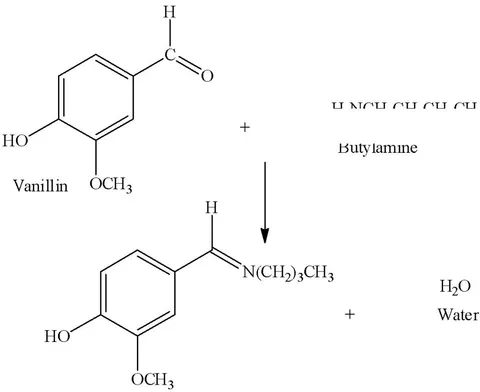
2.4 Synthesis of vanillyl butyl imine (Walatimine)
This Schiff base was synthesized as described by with slight modifications. Butyl amine (3 mL) was added to 30 mL of glacial acetic acid to give a mixture. To this mixture was a solution of vanillin (3 g in 10 mL glacial acetic acid) added drop wise whilst stirring and the reaction mixture (green colour) was heated under reflux (glass chamber) for 8 h. At the completion of reaction, the yellow product mixture obtained was allowed to cool over crushed ice possibly for crystallization to occur. The mixture in the absence of the formation of crystals was then concentrated down in vacuo on a rotary evaporator (920H-Flaswk, Switzerland) at 40 °C to dryness.
Determination of optical rotation and refractive indices of vanillin and the synthesized vanillin Schiff bases.
This is done by using a polarimeter (ADP-220, Bellingham Stanley, England) and a refractometer (WAY-15, Abbe, England). Each sample (0.05 g) was dissolved in methanol (10 mL). The tube of the polarimeter was filled with distilled water and the machine subsequently zeroed. The tube was then refilled with 5 mL of sample and the optical rotation and was measured at the wavelength ( ) of sodium D line (589.3 nm) at 20.5 °C. Similarly, the refractive index of sample was obtained on a refractometer at the wavelength ( ) of sodium D line (589.3 nm) at 20.5 °C [16] [17].
2.5 Antioxidant activity
Spectrophotometric determination of antioxidant activity using DPPH reagent Substances which are capable of donating electrons or hydrogen atoms can convert the purple-coloured DPPH radical (2, 2-diphenyl-1-picrylhydrazyl hydrate) to its yellow-coloured nonradical form; 1, 1-diphenyl-2-picryl hydrazine [18][19]. This reaction can be monitored by spectrophotometry.
2.6 Preparation of calibration curve for DPPH reagent
This experiment was carried out as described by both with some modifications. DPPH (4 mg) was weighed and dissolved in methanol (100 mL) to produce the stock solution (0.004% w/v). Serial dilutions of the stock solution were then carried out to obtain the following concentrations viz, 0.0004, 0.0008, 0.0012, 0.0016, 0.0020, 0.0024, 0.0028, 0.0032 and 0.0036% w/v. The absorbance of each of the sample was taken at 517 nm using the Ultra-Violet Spectrophotometer (Jenway 6405, USA). This machine was zeroed after an absorbance had been taken with a solution of methanol without DPPH which served as the blank. Determination of the antioxidant activity of vanillin, synthesized Schiff bases and Vitamin C 2 mg of sample was mixed with 50 mL of methanol. Serial dilutions were carried out to obtain the following concentrations; 0.0004 mg mL , 0.0008 mg mL , 0.0012 mg mL , 0.0016 mg mL and 0.0020 mg mL using methanol. 5 mL of each concentration was incubated with 5 mL of 0.004% w/v methanolic DPPH solution for optimal analytical accuracy. After an incubation period of 30 minutes in the dark at room temperature (25 ± 2 °C), observation was made for a change in the colour of the mixture from purple to yellow. The absorbance of each of the samples was then taken at 517 nm. The Radical Scavenging Activity (RSA%) or Percentage Inhibition (PI%) of free radical DPPH was thus calculated:
is the absorbance of the control reaction (DPPH solution without the test sample and is the absorbance of DPPH incubated with the sample. Vanillin /synthesized Schiff base/Vitamin C concentration providing 50% inhibition ( ) was calculated from a graph of inhibition percentage against the concentration of the vanillin/ synthesized Schiff base /Vitamin C [21][22][23]. Vitamin C was used as a standard antioxidant drug.
2.7 Antimicrobial Tests
The micro-organisms used in this study, namely; Bacillus subtilis (NCTC 8432), Staphylococcus aureus (NCTC 4532), Escherichia coli (NCTC 1065), Pseudomonas aeriginosa (ATCC 4675) and Candida albicans (NCYC 2436) were clinically isolated from specimens of diarrheal stool, abscesses, necrotizing fascitis, osteomyelitis, urine, wounds and vaginal swabs obtained from the Medical Laboratory, University of Uyo Health Centre, Uyo.
The clinical isolates were collected in sterile bottles, identified and typed by convectional biochemical tests and then refrigerated at at the Microbiology and Parasitology Unit, Faculty of Pharmacy prior to use. The hole-in-plate agar diffusion method was used observing standard procedures for bacterium and fungus respectively. The inoculum of each micro-organism was introduced into each petri-dish (Pyrex, England). Cylindrical plugs were removed from the agar plates by means of a sterile cork borer (Pyrex, England) to produce wells with diameter of approximately 5.00 mm. The wells were equidistant from each other and the edge of the plate . Concentrations of 20 mg mL of vanillin, 10 mg mL and 20 mg mL of synthesized Schiff bases were introduced into the wells. Also, different concentrations of 5 g mL chloramphenicol (Fidson Healthcare Chemicals, Nigeria), 1mg mL of fluconazole (Fidson Healthcare Chemicals, Nigeria) and aqueous methanol (1:1) were introduced into separate wells as positive and negative controls respectively . The experiments were carried out in triplicates. The plates were left at room temperature for 2 h to allow for diffusion. The plates were then incubated at for 24 h. Zones of inhibition were measured in millimetre (mm).
2.8 Thin-layer chromatography of vanillin and synthesized Schiff bases
A portion of each solid sample (0.03 g) dissolved in methanol (2 mL) was applied on a 20 cm x 10 cm silica gel analytical plate (Merck, Germany) and then developed in a toluene: acetone: water (10:20:1) mixture in a chromatographic tank until optimal separation was observed [5].
The retardation factor ( ) was then computed thus:
2.9 Infra-red spectroscopy of vanillin and synthesized Schiff bases
Each sample (0.03 g) was analyzed for IR characteristics using the FTIR 84005 Spectrophotometer (Shimadzu, Japan). Ultra-violet/visible spectroscopy of vanillin and synthesized Schiff bases A portion of each sample (0.03 g) was analyzed for UV/VS absorption characteristics using the Jenway 6405 UV/VS Spectrophotometer.
III. RESULTS Table 1: Preparation of calibration curve for DPPH reagent at 517 nm Blank Absorbance of 0.004%w/v DPPH reagent: (0.911)
| Concentration | Average (± 0.004) | absorbance |
| 0.0004 | 0.069 | |
| 0.0008 | 0.169 | |
| 0.0012 | 0.237 | |
| 0.0016 | 0.321 | |
| 0.0020 | 0.391 | |
| 0.0024 | 0.445 | |
| 0.0028 | 0.537 | |
| 0.0032 | 0.652 | |
| 0.0036 | 0.703 |
{"image_source":{"path":"images/c52e430e1ff894f513d59ec31476f50d49b210f2d989317a74b91263c9134087.jpg"},"content":"","chart_caption":[{"type":"text","content":"Figure: Graph of absorbance against concentration of methanolic solution of DPPH reagent"}],"chart_footnote":[]}
| Sample | 0.0008 mg mL | 0.0016 mgmL | 0.0024 mgmL |
| Vitamin C | 0.066 | 0.064 | 0.062 |
| Vanillin | 0.272 | 0.270 | 0.269 |
| W | 0.251 | 0.230 | 0.164 |
| Vdnp | 0.082 | 0.073 | 0.071 |
Table 3: Radical scavenging activity (percentage inhibition%) of samples at different concentrations and IC
of samples (±0.02)
| Sample | 0.0008 mgmL-1 | 0.0016 mgmL-1 | 0.0024 mgmL-1 | IC50(μg mL-1) |
| Vitamin C | 92.65 | 92.76 | 92.86 | 0.46 |
| Vanillin | 70.14 | 70.36 | 70.47 | 0.52 |
| W | 72.23 | 74.25 | 82.11 | 0.50 |
| Vdnp | 91.20 | 91.78 | 91.99 | 0.48 |
| Test microbe | vanillin 20 mg L-1 | W 10 mg mL-1 | W 20 mg L-1 | Vdnp 10 mg mL-1 | Vdnp 20 mg mL-1 | Chloramphenicol 5 μg mL-1 | MeOH/ H2O (1:1) |
| B. subtilis (NCTC 8432) | 32.21 | 16.23 | 30.16 | 21.26 | 38.31 | 46.01 | 5.00 |
| S. aureus NCTC 4532) | 29.23 | 15.11 | 32.19 | 25.32 | 35.22 | 45.23 | 5.00 |
| E. coli (NCTC 1065) | 30.65 | 18.20 | 29.12 | 26.22 | 37.21 | 47.45 | 5.00 |
| Ps. aeriginosa (ATCC 4675) | 27.24 | 19.45 | 30.64 | 5.21 | 5.10 | 26.12 | 5.00 |
Key: The zone diameter recorded is zone of inhibition + size of cup (zone of inhibition +5.00) mm Refer to Table 2.
NCTC - National Collection of Type Cultures, Central Public Health Laboratory, Colindale Avenue, London NW9, UK.
ATCC- American Type Culture Collection, Washington, DC.+
| Test microbe | vanillin 20mg L-1 | W 10 mg mL-1 | W 20 mg L-1 | Vdnp 10 mg mL-1 | Vdnp 20 mg mL-1 | Fluconazole 1 mg mL-1 | MeOH/ H2O (1:1) |
| C. albicans (NCYC 2436) | 22.21 | 15.32 | 28.23 | 14.12 | 24.34 | 43.54 | 5.00 |
Vanillin: ; mol. wt. (152.15 g/mol); white crystals (solid); m.pt. (81-83 °C); (1.5776); (0 °); (246 nm); (0.64); FTIR (cm ):1145 (-C-O-C), 1587 (-Ar-C=C), 1664 (-C=O), 2917 (-CH stretching) and 3289 (-Ar-OH).
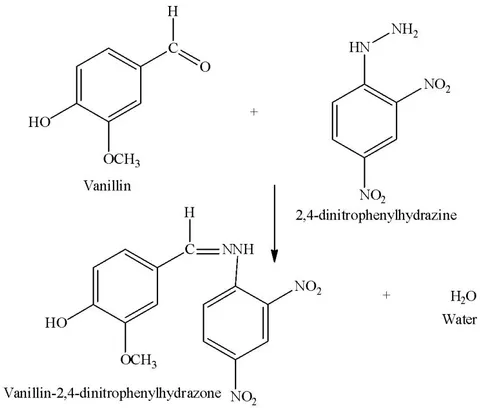
Vanillyl butyl imine (Walatimine) W: ; mol. wt. (207.08 g/mol); yellow compound; (1.5880); (o °), (412 nm); (0.81); FTIR (cm ): 875 and 921 (finger print region, alkyl bending mode), 1145 (-C-O-C), 1583 (Ar-C=C), 1691 (-HC=N, of imine), 2917 (-CH stretching) and 3288 (-Ar-OH). Vanillin-2,4-dinitrophenyl hydrazone (Vdnp): ; mol. wt. (332.27 g/mol); pale brown resin; (1.5984); (o °); (308 nm); (0.60); FTIR (cm ): 1145 (-C-O-C), 1355 (-O N group), 1567 and 1601 (-Ar-C=C), 2917 and 2918 (-CH stretching) and 3291 (-Ar-OH).
IV. DISCUSSION
4.1 Spectroscopic analyses
Vanillin is a white crystalline compound with pleasant and balsamic fragrance. Some monographic determinations were done in this study where the identity, purity, integrity and suitability substance were established. The compound was observed to be soluble in ethanol, ethyl acetate, n-butanol, n-heaxane, methanol and water when heated. However, it was insoluble in petroleum ether, dilute hydrochloric acid and dilute sulphuric acid. The observations and the determined melting point and refractive index values are consistent with those in literature and those obtained in an earlier study [5]. The UV absorption characteristic at (246 nm) indicates the presence of electron clouds over -Ar-C=C, -OH, -OCH3 and -HC=O pharmacophores while retardation factor R_F (0.64) shows that vanillin is moderately polar and likewise retarded on the silica gel. The IR spectrum of vanillin shows absorptions at 1145,1587, 1664, 2917 and 3289 cm−1 which are diagnostically characteristic of -C-O-C, -Ar-C=C,-C=O, -CH and -Ar-OH groups respectively. The condensation reaction between vanillin and butyl amine led to the synthesis of a yellow compound which has been identified by as vanillyl butyl imine by a combination of physico-chemical determinations and the IR spectral technique and hereby coded as W. It has a slightly pleasant flavour. Comprehensive data-based library searches of organic compounds were done and hence it is safe to infer that the compound is novel and hereby referred to by a trivial name Walatimine. It is a Schiff base which belongs to the class of compounds known as ketimines or aldimines. These compounds are obtained by condensation reactions between amines and carbonyl moieties such as ketones or aldehydes in the presence of an acid or base and under heat. The UV absorption at (412 nm) which is comparably higher than that of the vanillin shows the presence of electrons de-localized over -Ar-C=C, -OCH3, -HC=N (imine) and -Ar-OH chemical species while the retardation factor R_F (0.81) shows that this Schiff base is comparably non-polar on account of the butyl group (-CH2)3CH3 which makes the compound more lyphophilic and hence weakly retarded on an apparently hydrophobic silica gel plate. The IR spectral matrix of W shows stretchings at 875 and 921, 1145, 1583, 1691, 2917 and 3288 cm−1 which are characteristically diagnostic of alkyl bending modes (finger print region), -C-O-C (ether linkage), -Ar-C=C,-HC=N (imine),-CH and -Ar-OH respectively. Also, in a somewhat similar fashion, the condensation reaction between vanillin and 2,4-dinitro phenyl hydrazine resulted in a pale brown product which has been identified to be vanillin-2,4-dinitro phenyl hydrazone (Vdnp) using similar techniques as mentioned above. This Schiff base belongs to the class of compounds referred to as hydrazones or aziridines. The UV absorption at (308 nm) is higher than that of vanillin at 246 nm but less than that of W at 412 nm. However, the electron densities are found over -O2N, -Ar-C=C, -OCH3, -HC=N and -Ar-OH chemical species inherent in the compound while the retardation factor R_F (0.60) is indicative of this compound being more adsorbed onto the silica gel than the vanillin at 0.64. This observation is not surprising because the two nitro groups (on the second benzene ring) and -OH (on the first benzene ring) both contribute to making the synthesized hydrazone more polar hence, more greatly retarded on the silica gel analytical plate. Furthermore, the IR spectral matrix of vanillin-2,4-dinitro phenyl hydrazone (Vdnp) shows absorptions at 1145, 1355, 1587, 1601, 2917, 2918 and which correspond to the presence of -C-O-C (ether linkage), (nitro group), -Ar-C=C, -CH bending modes and -Ar-OH chemical entities respectively. Moreover, the presence of the two (nitro group) being electron withdrawing chemical entities will predispose the characteristic -Ar-C=C and -CH absorptions to higher IR peaks (especially in the second benzene ring) as can be seen in the IR spectrum of the synthesized hydrazone. The determinations of physical parameters are important in identifying compounds. Physical constants such as refractive index and optical rotation are used in the qualitative and quantitative analyses of substances. Also, these parameters are employed to confirm the purity, identity, integrity of active substances and as well as monitor the progress of reactions. In this study, both physical parameters were measured at the wavelength ( ) of Na-D light (589.3 nm) and a temperature of . In addition, the refractive index of a substance is an indication of the number, type of atoms and chemical groups (species) in the substance. Each atom or group in the substance contributes to its refractivity which adds eventually to the refractive index of the substance. Furthermore, refractive index can be used to monitor the progress of chromatographic separation by measuring the refractive indices of the effluent solvents employed. The pro-drug, vanillin and both synthesized Schiff bases gave refractive indices of 1.5776, 1.5880 and 1.5984 respectively. Furthermore, it was observed that all the compounds demonstrated optical rotation of implying that the compounds do not have chiral centers hence, are optically inactive. In addition, none of these compounds will demonstrate laevorotation (-) (ability of a compound to rotate plane of light in anticlockwise direction) or dextro-rotation (+) (ability of a compound to rotate plane of light in clockwise direction)[16][17].
4.2 Antioxidant assays
In absorption spectrophotometry, it is germane that a calibration curve be prepared for the reagent to be employed in the assays. Hence, this was done for DPPH (2, 2-diphenyl-1-picryl hydrazyl hydrate) reagent with the aim of ascertaining its purity and suitability for use in the antioxidant determinations. The Beer-Lambert's Law is for such determinations [19][32].
The calibration curve obtained indicates that the underlying principles behind the aforementioned Law were fulfilled as the curve (Figure) shows a straight line which passes through the origin. The reduction of the DPPH radical was determined by taking its absorption at a wavelength of 517 nm. It was observed that the absorbance of DPPH decreased as the concentration of added free radical scavenger (vanillin/Schiff base/Vitamin C) increased which suggested that the DPPH reagent was being reduced (Table 2), On the other hand table 3 shows radical scavenging activity (RSA%) or percentage inhibition (PI%) and the computed IC values of vanillin/Schiff base/Vitamin C. The RSA% is an indicator or a measure of the antioxidant activity of vanillin/Schiff base/Vitamin C. Interestingly, vanillin, and vanillyl butyl imine (W) both demonstrated moderate antioxidant activity (IC ) of 0.52 and 0.50 μg mL respectively. However, W being more lyphophilic because of the presence of the butyl group –(CH ) CH has a slightly better activity than the vanillin because the 4-carbon aliphatic long chain will ensure that the compound gets to the active or allosteric sites relatively faster where the pharmacological action of anti-oxidation is effectuated. Vanillin-2,4-dinitro phenyl hydrazone (Vdnp) showed a significantly remarkable antioxidant activity at 0.48 μg mL which compares favourably with that of Vitamin C (a standard antioxidant drug) at 0.46 μg mL It could be inferred that the product (Vdnp) of condensation reaction between vanillin and an aromatic amine such as 2,4-dinitro phenyl hydrazine slightly enhances the antioxidant activity of vanillin than that it forms with a straight chain aliphatic amine such as butyl amine. Vanillin like most low molecular weight phenolic compounds possess weak or in some instances moderate antioxidant properties [5]. This sweet smelling fragrant compound also has proven to demonstrate anticancer, anti-inflammatory and neurone-protective activities [33]. Hydrazones have been reported to possess anti-infective activity [34]. Asides the DPPH test for determining the antioxidant activity of compounds include the hydrogen peroxide, nitric oxide, conjugated diene, superoxide, phosphomolybdenum, peroxynitrile and xanthine oxidase assay methods amongst many others .
4.3 Antibacterial sensitivity tests
The microbes employed in the sensitivity tests reflected the antibacterial spectrum encompassing two (2) gram positive bacteria namely, B. subtilis and S. aureus and two (2) gram negative bacterial species namely, E. coli and Ps. aeriginosa. The results displayed on the Table 4 show that vanillin was remarkably suppressive or bacteriostatic of all the four microbes at 20 mg m L while the antibacterial activities recorded by both W (vanillyl butyl imine) and Vdnp (vanillin-2,4-dinitro phenyl hydrazone) were concentration-dependent at 10 and 20 mg m L respectively as reflected on Table 4. The higher the concentration, the better the activity.
Generally, both bases demonstrated good antibacterial activities as can be seen on Table 4. However, W was noticeably and remarkably suppressive of Ps. aeriginosa at both concentrations while Vdnp was inactive. This observation was surprising because Ps. aeriginosa, a gram negative bacterium is well known for its unique resistance to antibacterial agents. This resistance is believed to be due to the nature of the cell envelope of the organism which unlike gram positive organisms possess a sophisticated three-layered envelope which does not allow the permeation of external agents [37]. It can be inferred from these observations that both bases could be promising lead compounds in the search for newer antibacterial agents for treatment and management of bacterial infections.
4.4 Antifungal activity
The antifungal screening was done with C. albicans and generally the three compounds displayed somewhat remarkable anti-candidal activities at the concentrations tested. Vanillin was tested at 20 mg m L while W and Vdnp were screened at both 10 and 20 mg m L respectively. Similarly, the antifungal activity demonstrated by the two Schiff bases are concentration-dependent as can be seen on Table 5. However, it is noted that W was slightly more anti-candidal than Vdnp.
V. CONCLUSION
This study reports for the first time the synthesis of vanillyl butyl imine (W), a new ketimine from Schiff base synthesis. It has been given the trivial name Walatimine. This compound demonstrated a moderate antioxidant activity ( ) of 0.50 as vanillin at 0.52 g mL .
However, vanillin-2,4-dintro phenyl hydrazone (Vdnp) gave a significant antioxidant activity ( ) of 0.48 g mL which compare favourably with that shown by Vitamin C at 0.46 g mL Vanillyl butyl imine (W) demonstrated remarkable antibacterial activities against the bacteria tested including Ps, aeruginosa, a organism noted for its resistance to anti-infective agents. Also it was slightly more anti-candidal than vanillin-2,4-dintro phenyl hydrazone (Vdnp). It is noteworthy that both W and Vdnp could be lead compounds in the search for newer antioxidant and antimicrobial agents and in further structural activity relationship studies (SARS) and as well as in formulation studies in drug development.
Consent for publication
None
Funding
None
Conflict of interest
The authors declare no conflict of interest financial or otherwise.
ACKNOWLEDGEMENTS
The authors acknowledge the assistance of the Department of Pharmaceutical and Medicinal Chemistry, University of Uyo, Nigeria for the use of its Jenway 6405UV/VS. The efforts of Mr E. U. Akpan of the Department of Pharmaceutical Microbiology and Biotechnology, University of Uyo, Nigeria is hugely appreciated. We also grateful to university of Ibadan, Nigeria for the use its IR-FTIR 8400 Spectrophotometer (Shimadzu, Japan).
Conflict of Interest
The authors declare no conflict of interest.
Ethical Approval
Not applicable
Data Availability
The datasets used in this study are openly available at [repository link] and the source code is available on GitHub at [GitHub link].
Funding
This work did not receive any external funding.
References
Cite this article
Related Research


Special Issue
Launch a focused special issue to highlight research, emerging trends, and expert insights in your academic field.