




IntelliPaper
Abstract
India’s electricity generation started based on technologies available in XIX century on coal. Strating with XX century oil and natural gases were introduced as new sources for energy production being mainly used for transport and industry. Like in other countries the energy sector was heavily regulated and under state control until last decade of XX th century. The actors of the market like electricity production plan, transmission and distribution networks, gas, oil and coal extraction industry were mainly state -owned. Strating with 1991 Indian federal government launch important reforms on economic sector in order to increase the importance of market economy, these reforms affecting also the energy sector. The Electricity Law issued in 1991 and lately amended was the first step for cease state monopoly on power generation allowing also the other companies state or private to step into this sector and to start generation without special license. Still at that time the state maintains its monopoly on transmission and distribution networks. The reforms continued and new Electricity Act adopted in 2003 enlarge the energy sector reforms allowing private investments also in transport and distribution networks having the final scope a better protection of the clients through competition. Present century due the global commitment of reducing GHG and CO2 emission determinate India to follow the general orientation through renewable energies.
Explore Digital Article Text
I. INTRODUCTION
India's electricity generation began in the 19th century based on technologies available at that time, primarily using coal. Starting in the 20th century, oil and natural gas were introduced as new sources for energy production, mainly used for transport and industry. Like in other countries, the energy sector was heavily regulated and under state control until the last decade of the 20th century. Market actors such as electricity production plants, transmission and distribution networks, and the gas, oil, and coal extraction industries were mainly state-owned.
Starting in 1991, the Indian federal government launched significant economic reforms to enhance the role of the market economy, which also impacted the energy sector. The Electricity Law, enacted in 1991 and subsequently amended, was the first step towards ending the state monopoly on power generation. This law allowed other companies, whether state-owned or private, to enter the sector and begin generation without requiring a special license. However, at that time, the state maintained its monopoly on transmission and distribution networks.
The reforms continued, and the new Electricity Act adopted in 2003 expanded the energy sector reforms. It allowed private investments in transmission and distribution networks, with the final goal of better protecting consumers through increased competition.
In the present century, due to the global commitment to reducing GHG and CO2 emissions, India has followed the general trend towards renewable energies.
II. LITERATURE REVIEW
In their 2011 work, "Analysis of Competition and Market Power in the Wholesale Electricity Market in India", Umesh Kumar Shukla and Ashok Thampy analyze the market structure and competitiveness of the wholesale electricity market in India, identifying potential reasons for the rise in electricity prices.
S. Prabhakar Karthikeyan et al, in "A review on market power in deregulated electricity market" publish in 2013, provide an extensive overview of market power, detailing various indices used in market power analysis and the progression of research and development in this field.
In their 2019 study, "Assessment of Power Exchange-Based Electricity Market in India", Furkan Ahmad and Mohammad Saad Alam investigate the effectiveness and liquidity of the Power Exchange. They focus on the current state of India's energy infrastructure and the various energy contracts on the Indian Power Exchange."
Kartikeya Singh, in the article "Transforming India's Power Sector", written in 2019 for the Center for Strategic and International Studies (CSIS), highlights the critical structural problems within India's power sector and advocates for the establishment of a national electricity market. The author points out the inefficiencies associated with long-term bilateral power purchase agreements and the financial burdens which these places on state-owned utilities. The report recommends several reforms to enhance resource efficiency, reduce costs, and better integrate renewable energy into the national grid."
In "The Competitive Effects of Transmission Infrastructure in the Indian Electricity Market", published in 2021, Nicholas Ryan studies market integration, efficiency evolution, and transmission constraints that limit trade between regions."
The World Energy Investment 2024 report by the International Energy Agency (IEA) highlights the rapid growth of clean energy investments in India, driven by ambitious targets set by the country. In 2023, India experienced a remarkable 7.8% growth in GDP, making it the fastest-growing major economy in the world. This economic expansion will lead to a significant rise in energy demand, which is projected to surpass that of all other regions by 2050.
The report outlines India's efforts to decarbonize its energy system and diversify its energy sources to meet these rising demands.
"The State Electricity Transition (SET) 2024 Report" by the Institute for Energy Economics and Financial Analysis (IEEFA) and Ember evaluates the progress of 21 Indian states in their shift towards clean electricity. It identifies Gujarat and Karnataka as leading states in successfully incorporating renewable energy into their power sectors. Conversely, the report highlights significant challenges faced by states like Jharkhand and Bihar. It emphasizes the necessity of enhancing state-level regulatory frameworks to ensure an effective transition to clean electricity across the country.
III. ASSIGNMENTS
3.1 Legal framework and Regulatory Authorities
The Indian Electricity Act of 2003 provides the overarching framework for electricity regulation in India. It encompasses all aspects of the electricity sector, including production, transmission, distribution, and sale, as well as purchase agreements and associated tariffs.
According to the law, the electricity sector is under the supervision of central and state commissions. Decisions made by these commissions can be contested through a specially created Appellate Tribunal for Electricity (APTEL).
The regulatory framework for India's electricity market was set by the Common Minimum National Action Plan for Power.
This plan laid the foundation for regulatory bodies at both the national level, through the Central Electricity Regulatory Commission (CERC), and at the state level, through State Electricity Regulatory Commissions (SERCs).
Indian legislation designates the Central Electricity Regulatory Commission (CERC) as the primary regulatory body in the electricity market. Established through the Electricity Regulatory Commissions Act of 1998 and continuing under the Electricity Act of 2003, CERC's primary responsibilities include:
☐ Regulate the tariffs for electricity generated by companies owned or controlled by the state.
☐ Regulate the tariffs for electricity produced by private companies.
☐ Manage and supervise the interstate transmission of electricity and its tariffs.
☐ Issue licenses for interstate transmission and trading, as well as to advise the Central Government on the development of the National Electricity Policy and Tariff Policy.
☐ Develop Grid Code and Grid Standards.
☐ Set and enforce standards for quality, continuity, and reliability of service provided by licensees.
3.2 State Electricity Regulatory Commissions (SERC)
The Electricity Regulatory Commissions Act of 1998 provides the legal framework for the creation of regulatory authorities in Indian states and territories.
Their main role is to resolve conflicts between electricity market participants (generators, transmission companies, distribution companies, and end clients) and to issue regulations for market operations.
Commissions' boards, usually composed of three members, are appointed by state governments based on the advice of the Chief Justice and the state High Court."
State Electricity Regulatory Commissions main attributions are:
-
Regulate the acquisition of electricity by distribution companies
-
Facilitate electricity transmissions between states
-
Issue transmission and distribution licenses for state territory
-
Establish the rates for electricity wholesale, transmissions and distribution within state limits
-
Merge state-level grid codes with the national grid code formulated by the Central Electricity Regulatory Commission.
-
Promote the environmental policy in connection to the electricity sector
-
Substitute the civil courts in connection with the issues regarding electricity sector divergencies, being able even to issue decisions for fines and recovery amounts orders Each of the 26 States of India has its own regulatory commissions
3.3 India energy generation, transmission and distribution operators
3.3.1 Electricity generation
India currently has an installed capacity of approximately 411.64 GW, making it the third-largest producer and consumer of electricity in the world. While coal remains the primary source of power generation, renewable energy sources have significantly increased in recent years, now accounting for more than one-third of the total energy produced.
Parmar Akshay (Parmar, 2023) made the top nine hierarchization of power generation companies in India as below:
National Thermal Power Corporation Limited (NTPC)
NTPC, based in New Delhi, is the largest power generation and distribution company in India, with an installed capacity of about 71,600 MW."
The company supplies electricity to all economic sectors: industrial, commercial, and domestic.
Tata Power Company Limited
Tata Power Company Limited, based in Mumbai, has an installed capacity of about 14,076 MW, making it one of the largest integrated power companies. As an Indian multinational company, it supplies electricity to all economic sectors, utilizing a diverse mix of energy sources, including coal, gas, and renewables.
Adani Power Limited
Adani Power Limited, based in Ahmedabad, has a generation and distribution capacity of about 13,760 MW. It supplies energy to all economic sectors and is a privately owned company.
JSW Energy Limited
Founded in 1994 in Mumbai, JSW Energy Limited is a power producer with an installed capacity of about 6,564 MW. Similar to the companies mentioned above, it supplies electricity to all economic sectors using a variety of energy sources, including coal, gas, solar, wind, and hydro.
Reliance Power Limited
Reliance Power Limited, founded in 1995 in Mumbai, has an installed capacity of 6,000 MW. It utilizes coal, gas, wind, solar, and hydro sources to generate electricity. The company supplies power to all economic sectors.
National Hydro Electric Power Corporation Private Limited (NHPC)
National Hydro Electric Power Corporation Private Limited (NHPC), incorporated in 1975, has an installed capacity of about 5,175 MW. It is the second-largest state-owned electricity producer, primarily focused on hydroelectricity. The company is based in Faridabad, Haryana.
3.3.2 Sembcorp Energy India Limited
Sembcorp Energy India Limited, founded in Gurgaon in 2008, has an installed capacity of 4,770 MW. The company's clients span all economic sectors, and it uses various sources to produce electricity."
Calcutta Electric Supply Corporation Limited (CESC)
CESC, founded in 1899 in Kolkata, has an installed capacity of 3,840 MW and supplies electricity to over 3 million consumers in the region, covering all economic sectors.
Torrent Cables Limited
Torrent Cables Limited, founded in 1991 in Ahmedabad, Gujarat, has an installed capacity of 1,400 MW and supplies electricity for industrial, commercial and domestic clients.
3.3.3 Electricity transmission
The development of the electricity sector in India is primarily the responsibility of both central and state authorities.
Transmission at the central level is managed by POWERGRID, while at the state level, it is handled by state power generating companies (GENCOS) and power transmission companies (TRANSCO). These entities typically transport electricity at voltages above 220 kV."
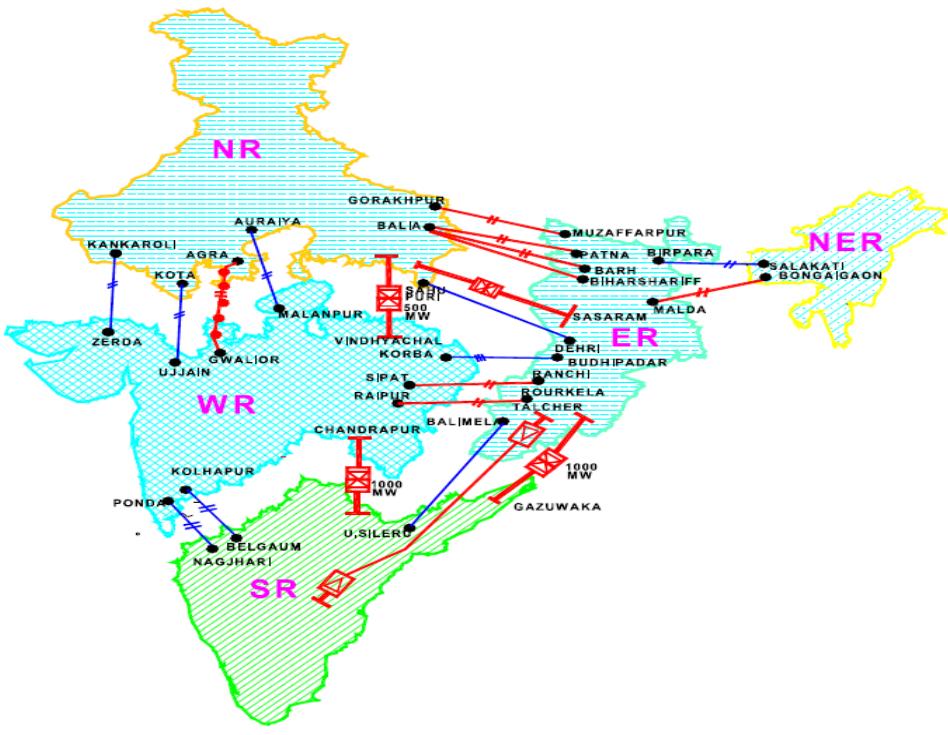
India's transmission system is split into five regions following geographical areas:
-
Northern (NR)
-
Eastern (ER)
-
Western (WR)
-
Southern (SR)
-
North Eastern (NW)
 Source: World energy council
The Northern, Eastern, Western, and North-Eastern regions of India are synchronously interconnected, forming a single grid known as the Central Grid, with a capacity of approximately 110,000 MW. The Southern region, however, is connected to the Central Grid asynchronously via High Voltage Direct Current (HVDC) links.
India's electricity network operates synchronously at a nominal frequency of , with an allowable range between and . The power grid in India is synchronously interconnected with Bhutan and asynchronously connected with Nepal, Bangladesh, and Myanmar.
Power Grid Corporation of India Limited (POWERGRID), based in Gurgaon, is a state-owned transmission company responsible for bulk electricity transmission with a network of about 150,000 km. Incorporated in 1989, its major shareholder is the Indian Government. Currently, it is the largest utility company in India, operating about 86% of inter-regional networks. POWERGRID manages approximately 176,000 circuit kilometers of transmission lines and around 275 substations, reaching a transformation capacity of about 514,000 MVA.
3.3.4 Electricity distribution
The electricity distribution system in India consists of substations, distribution lines, and transformers, which ensure the delivery of electricity from transmission lines to final consumers. The distribution network is organized under Distribution Companies (DISCOMs), which play a vital role in the efficient functioning of the electricity supply chain. Their main tasks can be summarized as follows:
☐ Electricity Distribution: DISCOMs are responsible for distributing electricity from the point of generation (power plants or renewable energy sources) to final clients.
☐ Infrastructure Maintenance: DISCOMs maintain and upgrade the distribution infrastructure, including transformers, poles, wires, meters, and other equipment.
☐ Metering and Billing: DISCOMs install and maintain electricity meters at consumer premises to measure consumption accurately.
☐ Consumer Services: DISCOMs provide various services to consumers, including new connections, disconnections, meter replacements, and addressing consumer complaints or grievances. They also offer program for energy efficiency, demand-side management, and rewards for adopting renewable energy.
☐ Revenue Collection and Management: DISCOMs are tasked with collecting consumers payments for the electricity consumed. They implement strategies to minimize revenue losses due to theft, non-payment, or inefficiencies in billing and collection processes. Revenue management is critical for the financial sustainability of DISCOMs and the overall energy sector.
☐ Regulatory Compliance: DISCOMs operate under regulatory frameworks established by government authorities or regulatory commissions. They must comply with regulations related to service quality, consumer rights, tariff structures, safety standards, and environmental regulations.
☐ Integration of electricity generated from renewable sources: As India aims to increase the share of renewable energy electricity production, DISCOMs play a pivotal role in integrating this electricity generated by solar and wind into the grid. This involves managing fluctuations in generation, grid stability, and balancing supply and demand.
☐ Data Management and Analysis: DISCOMs gather and analyze data related to electricity consumption, load patterns, system performance, and consumer behaviour. This data is used for planning, forecasting, and optimizing operations to enhance efficiency and reliability.
Although India's electricity distribution system has made notable advancements, it still encounters numerous obstacles. Substantial losses in transmission and distribution persist, primarily due to technical deficiencies and theft, which continue to be significant issues. Insufficient infrastructure in rural regions presents difficulties providing consistent electricity access to isolated communities. Moreover, the financial sustainability issues faced by DISCOMs, along with regulatory limitations, impede investments in infrastructure enhancements and modernization efforts.
The Indian government has implemented various initiatives aimed at overcoming these challenges and improving the efficiency of the distribution system. The Ujwal DISCOM Assurance Yojana (UDAY) endeavours to bolster the financial stability of DISCOMs by restructuring their debts and fostering operational effectiveness. The Integrated Power Development Scheme (IPDS) concentrates on reinforcing urban distribution infrastructure, whereas the Saubhagya scheme strives for universal household electrification, specially focusing on rural regions.
Looking ahead, India's electricity distribution system is on the verge of significant transformation.
Continued investments in infrastructure, technology, and policy adjustments are imperative to improve effectiveness, dependability, and environmental sustainability. Initiatives involving intelligent grid technologies, incorporating advancements such as smart meters, sensors, and automation, show potential in streamlining energy distribution and curbing losses. Additionally, integrating renewable energy into the distribution grid will be crucial for achieving energy security and sustainability goals.
To summarize, India's electricity distribution system is undergoing a fundamental transformation to meet the evolving needs of its rapidly expanding economy. Through collaborative endeavours,
Graphic 2 innovative approaches, and targeted investments, India strives to construct a resilient and efficient distribution network that drives progress and prosperity nationwide.
3.4 Today Market
According to information published by India's Ministry of Power on July 31, 2023, India is the third-largest producer and consumer of electricity in the world, with an installed capacity of 423.35 GW. As of 2021, India ranked fourth globally in installed wind turbine and solar power capacity. The federal government's policy aims to achieve complete electrification for all residential consumers."
According to S&P Global, BP Statistical Review World Energy 2022, India is the world's third-largest electricity producer and consumer, with a production capacity of 423.35 gigawatts.
Since gaining independence, India has seen its power generation capabilities expand over 100-fold, yet the surge in demand has outpaced this growth due to rapid economic development. Indian companies involved in the energy sector have also gained international recognition, exemplified by Oil and Natural Gas Corp. Ltd.'s 14th place ranking in the S&P Global Platts Top 250 Global Energy Rankings for 2022. In June 2021, to further support sustainable energy projects, the Export-Import Bank of India (Exim Bank) extended a US$100 million line of credit to Sri Lanka.
This financial support is dedicated to enhancing solar energy projects, aiming to meet 70% of Sri Lanka's energy requirements with renewable resources by 2030.
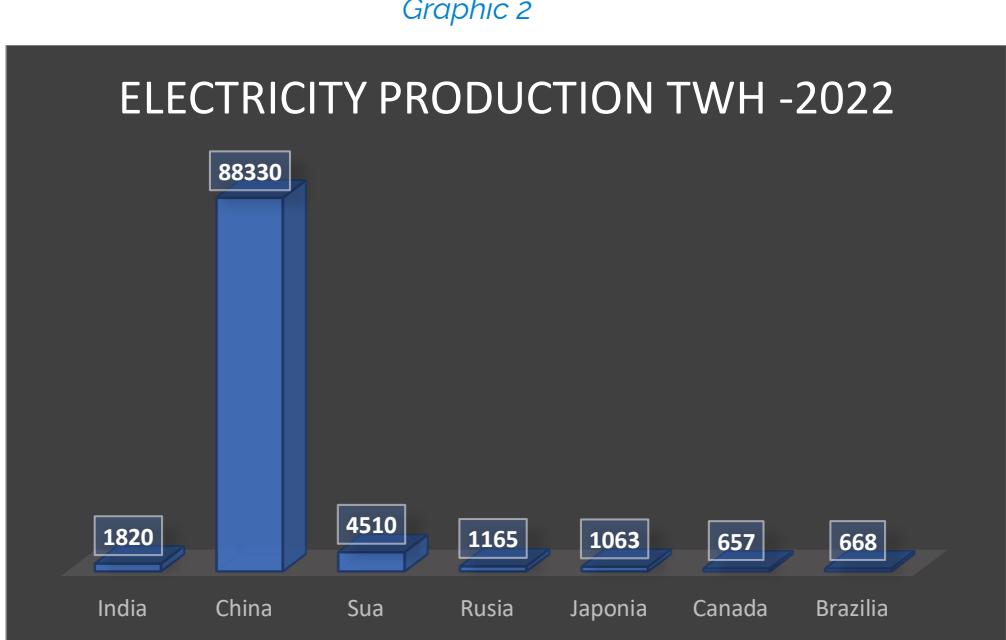 Source: Own graphic based on India's Ministry of Power data
The Minister of Power BP Statistical Review, in the fiscal year 2023, India experienced its highest power generation growth in over three decades, with an 8.87% increase, reaching 1,624.15 billion kilowatt-hours (kWh). As of July 2023, in fiscal year 2024, India had already generated 585.47 billion units (BU) of power. Between fiscal years 2010 and 2023, the country's electricity production grew at an annual compound growth rate of 4.75%. The Union Budget for 2022-23 earmarked US$ 885 million (Rs. 7,327 crore) for the solar power sector, covering grid-connected, off-grid, and PM-KUSUM projects. The target for electricity production from conventional sources for fiscal year 2024 is set at 1,750 BU, including 1,324.11 BU from thermal, 156.70 BU from hydro, 46.19 BU from nuclear sources,
215 BU from renewables (excluding hydro), and 8 BU imported from Bhutan. As reported by the Ministry of Power, India's electricity consumption reached 130.57 billion units (BU) in April 2023.
Additionally, the Nathpa Jhakri Hydro Electricity Station, managed by Satluj Jal Vidyut Nigam (SJVN), surpassed its previous monthly record of power generation, increasing from 1,213.10 million units to 1,216.56 million units as of July 31, 2021."
{"image_source":{"path":"images/321c997592c48d8c3e34550083841e81516e0f124e3f8e6bb83406fc3660fb10.jpg"},"content":"","chart_caption":[{"type":"text","content":"Graphic 3."}],"chart_footnote":[]}
Source: Own graphic based on BP Statistical Review, Ministry of Power, News Articles data
Table 1: Power plant installed capacities are presented in Table 1.
| Source | Installed capacity 31 $^{st}$ July 2023 |
| Coal thermal power plants | 205.89 GW |
| Gas thermal power plants | 25.03 GW |
| Lignite thermal power plants | 6.62 GW |
| Diesel thermal power plants | 0.58 GW |
| Renewables power plants | 130.88 GW |
| Hydro power plants | 46.85 GW |
| Nuclear power plants | 7.48 GW |
Table 2: The electricity production mix for 2023 is shown in the table below:
| Electricity production mix2023 | % |
| Coal, gas and oil | 56.25 |
| Hydro | 11.6 |
| Nuclear | 1.76 |
| Renewables | 30.91 |
{"image_source":{"path":"images/152fb1e5fa57a8bea6ea11ff6e2764c29d8b801b978cd31325cbce95f6bdaf01.jpg"},"content":"","chart_caption":[{"type":"text","content":"Graphic 4."}],"chart_footnote":[{"type":"text","content":"Source: Own research"}]} As development strategies for the electric market, the India Brand Equity Foundation (2023) identifies the following directions:
☐ Increased control on electricity generation costs by reducing the transport expenses between electricity plants and resources
☐ Reliable fuel sources for securing electricity production either from the national market or import
☐ Diversification of technologies used for electricity generation
□ Creation of smart grids
3.5 SWOT analysis of India's electricity market
| StrengthsDiverse Energy Portfolio: India possesses a wide array of energy sources, with a particularly fast-expanding renewable sector that has seen significant investments in solar and wind energy. Additionally, traditional sources such as coal and hydroelectric power remain crucial components of the energy mix. | OpportunitiesInnovation and Technology Adoption: India's electricity sector is ripe for the incorporation of advanced technologies, including smart grids, energy storage systems, and blockchain for energy trading. The adoption of these innovative solutions presents significant opportunities to enhance |
| Proactive Government Policies: The government has implemented several initiatives to enhance the electricity sector. The Ujwal DISCOM Assurance Yojana (UDAY) is designed to improve the financial health and operational efficiency of electricity distribution companies. In addition, the National Solar Mission is a major initiative aimed at significantly increasing the country's renewable energy capacity, with ambitious targets to boost solar energy production. These policies reflect a comprehensive approach to reforming and expanding India's energy landscape.Increasing Electricity Demand: India's rapid economic growth is driving an escalating demand for electricity across various sectors. This growing need for power underscores the attractiveness of the electricity market for continuous development and investment. The increased consumption is fueled by industrial expansion, urbanization, and an improving standard of living, all of which contribute to a robust and dynamic energy sector that promises substantial opportunities for investors and developers alike.Expanding Renewable Energy Sector: India is implementing one of the largest renewable energy expansion programs in the world, aiming to significantly increase its green energy capacity. Currently, renewable sources such as solar, wind, and hydroelectric power already make up a significant portion of the nation's total energy production. This ambitious program is set to further enhance the contribution of renewables, reducing reliance on fossil fuels and promoting sustainable development. The government's commitment to renewable energy is evident through substantial investments, policy support, and initiatives designed to integrate more green energy into the national grid. | the stability, reliability, and efficiency of the power grid. Smart grids can optimize energy distribution and consumption, energy storage systems can provide backup power and balance supply with demand, and blockchain technology can ensure transparent and secure transactions in energy trading. These technological advancements are set to play a crucial role in modernizing India's electricity infrastructure and supporting sustainable energy management.Capital Influx: There is a notable increase in interest from international investors and substantial support from global climate funds, creating significant opportunities for financing new projects in India. This influx of capital is particularly beneficial for the renewable energy sector, enabling the development and expansion of solar, wind, and other green energy initiatives. The financial backing from these sources not only supports the growth of renewable energy projects but also aids in achieving India's long-term sustainability goals and reducing carbon emissions.Development of Microgrids: The push towards decentralized energy systems, including the establishment of microgrids, can substantially enhance energy access in rural and underserved regions. Microgrids enable localized generation and distribution of electricity, reducing reliance on central grids and promoting energy independence. This decentralized approach not only provides a more resilient and reliable power supply to remote areas but also supports community-based energy solutions and fosters local economic development. By improving energy access and infrastructure, microgrids contribute to the overall stability and sustainability of the energy network.Encouraging Policies and Regulations: Ongoing reforms and robust government support for policies that promote energy efficiency and the adoption of clean energy technologies are essential. These measuresare driving the development of a more modern and sustainable energy infrastructure in India. By encouraging investments in renewable energy and implementing regulations that prioritize sustainability, the government is paving the way for an energy system that is both efficient and environmentally friendly. This supportive policy environment not only aids in reducing carbon emissions but also enhances energy security and paves the way for future innovations in the energy sector. |
| WeaknessesMajor Energy Transmission Losses: The electricity sector endures significant losses during transmission and distribution, primarily caused by outdated infrastructure and insufficient implementation of modern technological advancements in various regions. These losses are exacerbated by inefficient grid systems, lack of real-time monitoring, and inadequate investment in upgrading the existing network. As a result, a considerable portion of generated electricity never reaches consumers, leading to increased operational costs and reduced overall efficiency in the power supply chain.Economic Fragility of State-Owned Utilities:The financial instability faced by state-owned distribution companies significantly hampers their ability to operate effectively. This economic weakness affects their capacity to maintain and upgrade infrastructure, invest in advanced technologies, and manage operational costs efficiently. Consequently, the overall efficiency and reliability of the electricity supply chain are compromised, leading to higher costs and potential service disruptions for consumers.Dependence on Coal-Fired Power Plants:The substantial reliance on coal-fired power plants presents serious obstacles to sustainability efforts. It also makes the market vulnerable to the risks associated with fluctuating coal prices and potential regulatory changes aimed at curbing carbon | ThreatsImposition of Stringent Environmental Norms: The introduction of more stringent environmental norms is expected to significantly raise operational costs for traditional power plants. This could compel a rapid shift towards alternative energy sources, requiring substantial investment in new technologies and infrastructure. Additionally, these norms may lead to increased compliance costs, operational challenges, and a need for enhanced emission control measures, thereby driving the electricity sector towards more sustainable and eco-friendly practices.Sensitivity to Economic Downturns: The electricity market's revenues are highly vulnerable to changes in economic conditions. During economic downturns, decreased industrial and consumer activity can lead to a significant drop in electricity demand, thereby reducing revenue and stifling growth prospects. This sensitivity to economic fluctuations can result in financial instability for utility companies, affecting their ability to invest in infrastructure, technology, and maintenance, ultimately impacting the reliability and efficiency of the electricity supply.Disruption generated by the Rise of Renewable Energy: As renewable energy sources become more affordable and widely adopted, traditional electricity markets, especially those heavily reliant on fossil fuels, |
| emissions. This dependence hinders the transition to cleaner energy sources, increases environmental impact, and creates economic uncertainty due to the instability of coal markets and the possibility of stricter environmental regulations in the future.Complicated Regulatory Framework: The expansion of the electricity sector is often obstructed by a complicated and at times inconsistent regulatory framework. This complexity can significantly slow down the decision-making process, creating bureaucratic hurdles that deter foreign and private investors. Additionally, the lack of regulatory coherence and clarity can lead to uncertainty and risk, further discouraging investment and innovation within the sector. | face substantial disruption. This shift challenges the economic viability of conventional power plants, leading to potential declines in market share and profitability. The increasing competitiveness of renewables necessitates adaptation and innovation within the traditional energy sector to remain relevant amidst a rapidly evolving energy landscape.Policy and Political Instability: Fluctuations in political leadership and frequent policy changes can lead to significant regulatory uncertainties. This instability can affect long-term investment decisions, as investors may become wary of unpredictable shifts in regulations and policy direction. The resulting uncertainty can undermine sector stability, hinder planning and development, and create a volatile environment that is less conducive to sustained growth and innovation within the industry. |
IV. CONCLUSION
India's electricity market has undergone substantial transformation, shifting from a predominantly state-controlled sector to one that embraces private investment and competition.
This transformation has been driven by policy reforms designed to liberalize the market, improve efficiency, and address sustainability challenges in response to global climate change commitments.
The Electricity Act of 2003 brought substantial changes by allowing private investments in power generation, transmission, and distribution. The Central Electricity Regulatory Commission (CERC) and State Electricity Regulatory Commissions (SERCs) oversee the sector, ensuring regulatory compliance, setting tariffs, and resolving disputes, which has improved market transparency and efficiency.
However, the Indian electricity market contends with several challenges, including the economic fragility of state-owned utilities, a heavy reliance on coal, and a complex regulatory environment that can deter foreign and private investments. Additionally, the market's vulnerability to economic downturns and the increasing competitiveness of renewable energy sources threatens the traditional energy sector.
Innovative technologies such as intelligent grids and energy storage systems can enhance grid stability and efficiency.
Decentralized energy systems, such as microgrids, can enhance energy access in rural areas. Additionally, ongoing policy reforms and international investments are stimulating the increase of the renewable energy sector, aligning with India's sustainability objectives.
Despite facing considerable obstacles, India's electricity market has the potential for remarkable growth and transformation. With strategic investments and robust policy support, India can develop a resilient and sustainable electricity sector that supports its rapid economic development and environmental commitments.
Conflict of Interest
The authors declare no conflict of interest.
Ethical Approval
Not applicable
Data Availability
The datasets used in this study are openly available at [repository link] and the source code is available on GitHub at [GitHub link].
Funding
This work did not receive any external funding.
References
Cite this article
Related Research


Special Issue
Launch a focused special issue to highlight research, emerging trends, and expert insights in your academic field.
