





IntelliPaper
Abstract
Dilemma-based learning (DBL) and Gamification are two educational techniques that, have received the attention of both educational theorists and the educational community in general in recent years. The purpose of this article is to present a didactic scenario for the teaching of the 3rd Junior High School Literature course entitled "With emotion or logic?". This scenario was designed and implemented within the Erasmus+ program "Gamified Introduction to Gamification". The innovation of the scenario lies in its student-centered nature and, above all, in the utilization of the principles of Dilemma-based learning and Gamification. The students, acting within a framework of collaborative activities, both digital and non-digital, managed to approach the objectives of the scenario to a very satisfactory degree.
Explore Digital Article Text
I. INTRODUCTION
Dilemma-based learning, as an educational approach based on Kohlberg's (1969) theory of ethical development, focuses on using dilemmas to improve students' reasoning skills. A dilemma, whether ethical or not, can be defined as an internal dialogue about confusion between two propositions within a situation (Shapira-Lishchinsky, 2010). These two propositions contain valid arguments from two equivalent options and unpleasant outcomes, often equally equivalent (Harding, 1985). In the classroom, dilemmas facilitate group discussions and guide students in making logical decisions by prioritizing not only the accumulation of knowledge about a topic but also the recognition that dilemmas can have multiple solutions (Caruana, 2021). The primary goal of the dilemma is to allow students to explore the boundaries of autonomous rational thinking, to cultivate mature decision-making and problem-solving skills. Dilemma-based learning combines pedagogical concepts such as cooperative learning, the ethic of care, and self-regulation. It has been applied to a variety of subjects such as Religion, History, Languages, and Personal, Social, and Career Development (Wood et al., 2007) as well as Chemistry (Rahmawati et al., 2022). In an educational context, Settelmaier (2003) presents dilemmas in various forms, including problem-solving, role-playing, film, and storytelling, and considers their careful selection based on the teaching objectives to be a necessary condition.
One of the now classic definitions of "Gamification" using game design elements in non-game environments (Deterding et al., 2011). Kapp (2012) defines Gamification as using game-based mechanisms, aesthetics, and thinking to engage people, motivate action, promote learning, and solve problems. The definition of the concept changes slightly depending on the author, but the basic idea remains the same: Gamification is approached as a tool to increase engagement in an activity by using game features, providing enjoyment and fun (Andrade et al., 2016). Although Gamification has been applied in a wide range of scientific fields, such as Economics and Management (Hamari et al., 2014), most studies focus on the educational context, where researchers seek to utilize game elements with the ultimate goal of improving the effectiveness of the learning process and improving student motivation (Kapp, 2012). Indeed, a series of empirical data has confirmed the value of this methodological design and the positive influence it exerts on the emotion and motivation to learn (e.g. Albertazzi et al., 2019), on the pursuit of academic achievements (Huang, Hew & Lo, 2019), and on the level of acquired knowledge and cognitive skills (Vlachopoulos & Makri, 2017). Game elements (e.g. points, levels, missions) can transparently depict goals, lead learners through guided paths towards the goal, and give learners direct feedback on their performance (Krath et al., 2021). Despite the general initial enthusiasm for the results of Gamification as an educational practice within real educational situations some studies are characterized by moderate optimism while highlighting concerns and, or objections about the scope of the positive effect. In this context, Toda et al. (2017), in the meta-analysis they conducted on seventeen (17) studies related to the subject, identified four points of concern regarding student interest, the improvement of their performance, the appearance of undesirable behaviors and the stability or not of the innovation of the approach over time. In any case, designing effective gamified interventions is not practical in itself but requires both theoretical knowledge of the hitherto unexplored cognitive, emotional and motivational mechanisms through which Gamification achieves its impact (e.g. Sailer & Homner, 2020), and appropriate choices regarding the structures, mechanisms and principles to be applied (Dichev & Dicheva, 2017).
Dilemma-based learning and Gamification reserve a new role for the teacher who implements them. Teachers function as student subject advisors, coordinate resources and facilitate the learning process (Donnelly & Fitzmaurice, 2005). Their focus is not only on solving problems but on developing critical thinking skills, creative approach, teamwork, oral communication and social skills (Martí-Parreño et al., 2021). Teachers should use probing questions to create an open learning environment in which students are encouraged to provide creative and adequately reasoned solutions. Group discussions and respect for other perspectives are, according to Caruana (2021), effective ways to explore different opinions and solutions. In any case, it is necessary to adapt the above teaching methods to the available resources, the subject matter and the dynamics of each class (Sánchez-Mena & Martí-Parreño, 2017).
II. THE SMALL-SCALE PARTNERSHIP GIG-GAMIFICATED INTRODUCTION TO GAMIFICATION AND THE DIGITAL APPLICATION DIBL
The Small-Scale Partnership entitled: "GIG-Gamificated Introduction to "Gamification" (2021-2-EL01-KA210-SCH-000050330), consists of 29 partners (schools and Directorates of Education of the Peloponnese Region with the assistance of two partners from the European Union). The partnership had three main goals: familiarization with student-centred educational methods, creative use of the game, and application of the principles of dilemma-based learning through the digital application "Dibl" in the context of each cognitive subject. The scenario presented in detail below was prepared in an initial version by colleague Angeliki Oikonomopoulou. It was implemented during the implementation of a training action within the framework of the partnership in February 2023. A year later, it was adapted, modified, assumed its current form and content, and was implemented and evaluated by the writer in the context of action research implemented within the program.
III. TEACHING SCENARIO: "WITH EMOTION OR LOGIC?"
3.1 Rationale of the Scenario
According to the curriculum of the High School Literature course (Y.A. 13203/D2), the strengthening of students' reading skills, the engagement of learners with the literary text, and the critical consideration of attitudes and behaviours are an integral part of the general directions for teaching design. The activities of this proposal constitute an attempt to implement an innovative practice based on dilemma and
Gamification within the directions of the curriculum.
3.2 Purpose, Expected Learning Outcomes and Research Questions
The purpose of the proposed Scenario is to cultivate teaching practices, literacies and knowledge about language and the world under the light of the "rhombus" model while at the same time exploiting the students' identities in the context of teaching "Life and State of Alexis Zorba" of the cognitive subject of the 3rd Grade of Secondary School Literature (for a detailed presentation of the model, see Koutsoyiannis, 2012).
Regarding learning outcomes, students are expected at the level of knowledge:
-
Recognize the distinct character elements of the two heroes, the narrator and Alexis Zorba.
-
Compare the two characters of the text.
Regarding the level of attitudes:
-
Discover special elements of their character.
-
Reflect on the influence that logic and emotion have on people when making decisions.
Regarding the level of skills:
-
Actively participate and collaborate during the implementation of the scenario.
-
Produce a discourse by creatively utilizing the elements provided by the excerpt.
-
Come into contact with the utilization of dilemmas in the educational process through the Dibl platform
-
Be introduced to gamified learning through various digital and non-digital tools.
Following this, the research questions of the work can be formulated as follows:
-
What is the degree of achievement of the scenario's objectives?
-
Did the utilization of the dilemma and the Gamification techniques contribute achieving the scenario's objectives?.
3.3 Implementation of the scenario
The implementation of the teaching scenario took place in the school's computer lab and lasted two (2) teaching hours. A Word file - worksheet was placed on the desktop of each of the eight workstations in the computer lab, which containing the individual activities and the links to the digital resources.
3.3.1 1st Teaching Hour
The students had already read the text and had watched selected excerpts from the ERT program "Like an old photo" about the real Zorba. That way they had a first impression of the hero's presentation in the book and in the documentary respectively. The following question was the first put to the students, as both an impetus and introduction to the new topic was the recall of knowledge regarding the above.
"Recall one piece of information about each of these characters and note it on the worksheets given to you".
The information recalled by the students was written on slips of paper and glued to a cardboard that had been posted on the classroom notice board. Then, they were read by the teacher, in order to disseminate the relevant information (5 min).
The students then watched an excerpt from the film" Alexis Zorba"by Michalis Cacoyannis (https://www.youtube.com/watch?v=2y1QHpmystk), presenting the narrator's acquaintance with Zorba. They compared the two scenes orally and commented on what piqued their interest (5 min).
The students were then divided into pairs based on their positions in the computer lab. They were asked to work together to identify words and phrases in the text that convey the characteristics of the two characters. They had the opportunity to enrich the produced material with their own words that display each character, based on its presentation in the original text. The words and phrases that the students chose from the text were recorded in the collaborative tool Answergarden. The two following links were given (one for the narrator, one for Zorba) with the instruction that each word and phrase should be written and submitted alone and that it should not exceed 40 characters. They then discussed the result of the task assigned to them, applying the "Save the last word" technique (15 min).
Characterization of the narrator
Characterization of Alexis Zorba
Students in groups of two, as in the previous activity, were asked to answer questions (e.g. In your life, do you operate based on logic or emotion?) concerning their character - attitude to life by applying the think-pair-share technique (15'):
The Dilemma
3.3.2 2nd Teaching Hour
At this stage, the students participated in the digitized version of the dilemma on the dibl educational platform. The following was given as a starting scenario for the activity:
"In the excerpt from Nikos Kazantzakis' novel "Life and State of Alexis Zorba", two different human types are presented: the narrator, a man of logic, and Alexis Zorba, a man who operates on instinct and emotion. Which of the two types above would you choose as a role model in your adult life? (10')
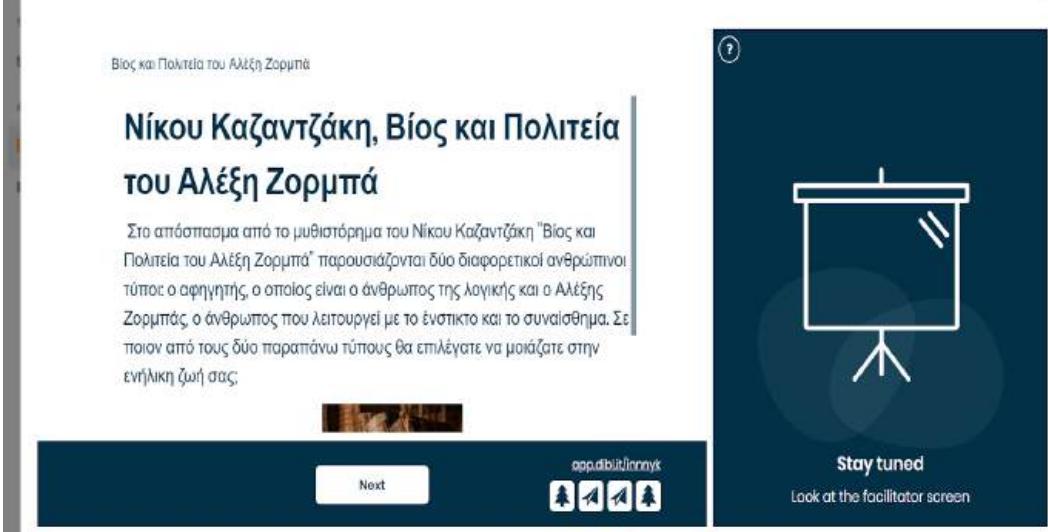 Figure 1: Image from the first "page" of the Dibl application
Note: The teacher starts the session, and each group connects via the relevant link in the worksheet on the computer desktop. The teacher coordinates the groups and determines the pace of transition from one "page" to the other. Initially, the scenario on which the dilemma will be posed is displayed. Each group will choose the type whose action expresses it most and then select one of the proposed (by the teacher) options. Then, each group will have the opportunity to justify, in a short text, the choice they made.
2nd activity
After the Dibl activity, during the second teaching hour, the students were divided into two groups depending on the answer they had given to the dilemma. They started preparing for a debate with the aim to support their position in favor of logic or emotion respectively. Each group, after studying Article 1 and Article 2, discussed, recorded and organized its statements (15 min). Then, the groups presented their statements alternately with the other group. At the same time they were trying to refute the statements of the opposing group (5 min). In the first phase, the teacher helped the students to capture the statements by providing the necessary feedback. In the second phase, he coordinated the debate. He also took on the role of judge with the aim to identify one group as the winner based on the number and variety of arguments (20 min).
Evaluation of the teaching scenario (5 min) (see in detail below on page 6).
The teacher gave the following creative writing task options of approximately 200 words (and possible clarifications to any questions) (5 min):
-
You are the narrator. On a page in your diary, please write down the reasons that led you to decide to take Zorba with you.
-
You are Zorba. On a page in your diary, please write down the reasons that prompted you to approach the narrator and ask him to take you with him.
3.4 Extensions - Script Adaptations
This teaching application could:
-
be interpreted about the meanings of an additional excerpt from the same work.
-
be interpreted about the meanings of another work (e.g. Hamlet).
-
be implemented with other collaborative tools (e.g. Padlet).
3.5 Procedures for Evaluating the Implementation of the Scenario
The progress of the implementation of the scenario and the degree of achievement of the objectives of the scenario were assessed by the teacher both by completing a relevant evaluation rubric to record the individual characteristics of the students' participation and by studying and evaluating the deliverable material from the creative writing exercise of the last activity. Additionally, the students completed their self-evaluation rubric.
Note: A detailed presentation of the implementation of the teaching scenario, the role of the teacher and the description of the technical and digital tools can be seen here.
IV. EVALUATION - CRITICISM OF THE IMPLEMENTATION OF THE SCENARIO
A vital limitation of the proposed teaching scenario is the need to utilize the school's computer lab, as several computers (10-12) are required to implement the planned activities. Also, the teacher's ability to access the digital tools, especially the Dibl platform, is deemed necessary. Finally, the time required to prepare for the implementation of the teaching scenario is quite long, while its timing requires the constant vigilance of the teacher.
However, the general conclusion that could be formulated after implementing the scenario is that it was an effort with a highly satisfactory degree of success. Based on the teacher's evaluation rubric with regard to the "dilemma" on the Dibl platform, it was recorded that the platform was functional and the students handled its environment without encountering any particular difficulty. Regarding the Gamification, the Answergarden platform and the Save the last word techniques, it seems that they helped cultivate the interest of the students and contributed to the smooth implementation of the scenario. At the same time, the debate created a pedagogically charming and constructive competition between the two groups of students. At the same time, the students were excited with the use of digital tools and, most importantly, they managed to present a synthesis of both orally and in the assignments they submitted two essential elements: on the one hand, various aspects of the personality of each hero and, on the other, the influence they believe that emotion and logic exert in their own lives.
From the numerical representation of the student's answers in the evaluation rubric (on a twenty-point scale), in combination with the evaluation of the assignments submitted, exciting findings are recorded, such as the ones presented in the table below:
Table 1: Average performance (on a twenty-point scale) by objective category
| Knowledge | Skills | Attitudes | Interest in the course |
| 14,42 | 13,88 | 14,08 | 16,88 |
More specifically, the average performance score at the cognitive level was 14.42. At the same time, the students considered that their skills (13.88) and attitudes (14.08) were cultivated to a satisfactory degree. However, they rated their interest during the implementation of the scenario much higher (16.88).
Findings mentioned above are the first indication that the techniques of dilemma-based learning and Gamification have yielded results, mainly at the level of knowledge acquisition and rise in the learners' interest. In any case, it is necessary to note that this was an isolated attempt on a small sample of students. An additional study on a larger sample with similar research questions would be conducive to accurately capturing the degree of success of the implementation of this scenario and, above all, the degree to which the use of the dilemma and the Gamification techniques contributed to the goals of the scenario being met.
Conflict of Interest
The authors declare no conflict of interest.
Ethical Approval
Not applicable
Data Availability
The datasets used in this study are openly available at [repository link] and the source code is available on GitHub at [GitHub link].
Funding
This work did not receive any external funding.
References
Cite this article
Related Research



Special Issue
Launch a focused special issue to highlight research, emerging trends, and expert insights in your academic field.
