


Abstract
Smart retail technologies have a significant impact on the emotions of customers in a phygital environment, such as a smart store. This study assessed how and if these technologies act as emotional trigger/source with impacts on the emotional customer experience (ECX). These technologies appeared to enhance convenience, saving time, and improving the overall shopping experience. The novelty and fascination of these technologies, as well as the resulting concept of smart stores (“just-walk-out” concept), often led to surprise and excitement among customers. These mostly positive emotions were often triggered by the self-service aspects and functionalities of the smart retail technologies Ambivalent or negative emotions arose from the omission of human interaction or the threat to customers' privacy. In summary, the study found that smart retail technologies can create a positively designed customer experience through a novel, seamless process, time saving and reducing friction during the entire customer journey. These lead to emotions such as surprise, happiness, or excitement, which trigger an overall contentment in customers. The disruption of privacy, ignorance of existing technologies can lead to negative ECXs, expressed through worry or discontentment. Implications over hospitality, tourism, and other service contexts are provided along with recommendations for future research.
Explore Digital Article Text
I. INTRODUCTION
Innovative smart retail technologies enable brick-and-mortar retailers to differentiate themselves from online providers through new customer experiences. These so-called "phygital" (physical + digital) providers, which offer customers a physical environment with digital elements and vice versa, enable customers to shop more efficiently and conveniently (Fauser et al., 2023). While traditional retail stores have functional aspects, their prices, the environment of the store or interactions with employees represent the main benefits for the customer; phygital concepts create novel benefits for customers in the retail sector, such as time saving or seamless and personalized shopping experiences (Chang et al., 2023).
This trend results in concepts such as smart stores, which embrace this phenomenon and use smart technologies to save customers from waiting in queues, while also obtaining behavioral data and customer purchase histories (Denuwara, Maijala, and Hakovirta, 2021). Amazon Go is considered a pioneer in the field, having opened the first smart store in Seattle, Washington in 2016. This store is based on the "just-walk-out" concept and allows customers to make their purchases and leave the store without interacting with a cashier or scanning the selected products (Suk et al., 2022). This process is enabled by artificial Intelligence, which is anchored in the store and uses various sensors and cameras to track the customer's movements throughout. The customer then receives an invoice via their previously registered Amazon account and automatically pays for the products, completely digitally (Grewal, Roggeveen, and Nordfält, 2017).
Functionality is often given the highest priority, but emotions play an extremely important role in new phygital environments when it comes to increasing customer satisfaction and loyalty. As a result, everyday experiences can become special and touch the customer emotionally (Chang et al., 2023). There are scant studies that deal with the perceived emotions in such a phygital environment. Surprise, joy, and enthusiasm are emotions that can occur in the customer, especially during initial contact with these novel concepts. However, the study of negative emotions during the phygital customer experience has been neglected. Technology bugs, long loading times, mediocre images, pixelated augmented reality and weak Wi-Fi signals are examples that can evoke negative emotions (Batat, 2022). Accordingly, the different emotions experienced during a phygital customer experience require additional study to avoid negative emotions, enhance positive ones, and determine the appropriate context for smart retail. Further, a better understanding of the emotional triggers and the resulting customer behaviors is needed to optimally design phygital customer experiences.
1.1 Objective
This study investigated the emotional customer experience (ECX) in a phygital environment. It examined emotions that occur in customers through the experience in a smart store. Specifically, the study assessed the triggers underlying these emotions and the resulting customer behavior. This study assessed these issues with a review of the literature, customer reviews, which were examined for emotions, triggers, and behaviors using a nethnographic analysis. The following research questions emerged: What impact do innovative smart retail technologies in novel phygital concepts such as Amazon Go, have on the ECX? Which smart store-related emotional triggers cause specific emotions in the customer? Which emotions caused by smart store-related triggers are perceived and which customer behaviors result from it?
II. BACKGROUND
The following sections provide relevant terms and theoretical background derived from the relevant literature; this overview provides the rationale for the design and implications of the current study.
2.1 Customer journey
As emotions can occur throughout the entire journey, the customer journey concept was determined as an important theoretical concept. New technologies and phygital concepts continue to influence and change the customer's journey by creating new touchpoints (Roe et al., 2022).
The existing literature includes various definitions and terms from "customer journey", "consumer journey" or "customer decision journey". Based on Towers and Towers (2021), the term "customer journey" was used due to the greatest frequency of the expression in relevant literature. This customer process illustrates the connection between the customer journey and the customer experience as it represents the totality of all stages. It depicts the different customer experiences (previous, current, and future) with the respective stages (pre-purchase, purchase and post-purchase), as well as the corresponding touchpoints and resulting behavior (Lemon and Verhoef, 2016).
Thus, the concept indicates that a single customer experience consists of three stages. In each stage, the customer interacts with the company, resulting in certain behaviors, such as the search for information in the pre-purchase stage, the actual purchase process, and the use of the product in the post-purchase stage. Current experiences, together with previous experiences, form customer feedback, whereby experiences are examined and evaluated to determine whether future contacts with the company will take place. If this feedback is deemed negative, the customer may switch companies. Positive experiences increase the likelihood of future contacts, eWOM, and future experiences with the company (Harrington, et al., 2019). A totality of these customer experiences forms the customer journey; it should be noted additional behaviors such as choosing alternatives (pre-purchase), contacting the company (purchase) and reflection (post-purchase) may be part of this journey (Dellaert, 2019).
While the traditional customer journey model appears to assume a relatively linear process, additional phases or stages are often described in the literature, such as (1) search, (2) purchase, (3) experience, and (4) reflection (Dellaert, 2019), as well as the division of the decision-making process into awareness, consideration, evaluation, and action (Farah and Ramadan, 2017). However, these subdivisions of the various phases appear to differ primarily in terminology. In this context, touchpoints are described as all direct and indirect firm-customer interactions throughout the customer journey (Boyd, Kannan, and Slotegraaf, 2019) and divided into brand-owned, partner-owned, customer-owned, and social/external/independent (Lemon and Verhoef, 2016). These interactions can be directly influenced by the company (e.g., brand-owned, and partner-owned) or indirectly by the company (e.g., customer-owned, and social/external/independent). These touchpoints can take place in a physical/offline, a digital/online, or a phygital environment. For companies, it is critical to understand the key touchpoints to optimize them.
2.2 Evolution and definition of customer experience
While diverse customer experiences form the totality of the customer journey, the evolution of this process was elucidated due to studies of the construct for several decades in marketing, retailing and service management (Lemon and Verhoef, 2016). A unique or positively designed customer experience is of enormous importance for companies, influencing differentiation and other positive effects such as satisfaction and loyalty, positive word-of-mouth, more frequent visits or higher profits (Bagdare and Jain, 2013). Conversely, a negatively designed customer experience can lead to company switching, negative word-of-mouth or consumer complaints (Harrington, et al., 2019).
Pine and Gilmore (1998, p. 97) described the experience as the "fourth economic offering" above commodities, goods, and services. Experiences are perceived individually by the customer, which creates a higher degree of differentiation. In addition, it adds an emotional, spiritual, and intellectual level to the experience. This experiential marketing perspective described the customer as a rational as well as emotional buyer. Schmitt (1999) defined a multidimensional approach, which included the five experience types: sensory, affective, creative cognitive, physical, and social-identity to define the customer experience. Brakus et al. (2009) described the four dimensions as sensory, affective, intellectual, and behavioral, whereas, Bagdare and Jain (2013) described emotional dimensions as joy, mood, leisure, and distinctive.
Thus, various scholars and practitioners have established definitions, and many include cognitive, emotional, behavioral, sensory, and social components (Brakus, Schmitt, and Zarantonello, 2009). The cognitive dimension deals with cognitive processes that are intended to evoke creative and problem-solving experiences in the customer (Brun et al., 2017). Companies create this by surprising, intriguing, and provoking the customer (Schmitt, 1999). Perception through the senses (sight, sound, touch, taste, and smell) form the sensory dimension. Stimulation of these senses is sought by companies to encourage buying behaviors (Schmitt, 1999; Hermes and Riedl, 2021). The behavioral dimension aims to show the customer different behaviors, lifestyles or habits that can be adopted. These are intended to show the customer alternative solutions and enrich the experience (Schmitt, 1999; Brun et al., 2017). Social interactions with other individuals, such as customers, employees, or friends and relatives, constitute the social dimension of customer experience (Brun et al., 2017). This concept is tied to the concept of co-creation with staff-consumer interactions as well as co-creating retail innovations (Roberts and Darler, 2017). These interactions strengthen customers' social behavior, create a sense of belonging, and sustain or perpetuate links between companies and consumers (Nasermoadeli, et al., 2013). The emotional dimension (referred to as the affective dimension) (e.g., Schmitt, 1999; Brun et al. 2017) describes the emotions experienced by the customer throughout the customer journey, their triggers, and the resulting customer behaviors.
Accordingly, a holistic conceptualization of the customer experience can be defined as a multidimensional construct that focuses on a customer's cognitive, emotional, behavioral, sensory, and social responses to a company's offerings throughout the customer journey (Lemon and Verhoef, 2016). This includes both direct and indirect interactions with the company, its products, services, or individual parts of the organization and applies to service and product providers (Wu and Gao, 2019). The framework conditions of the customer experience should also include items such as the existing technology that the customer uses (McCarthy and Wright, 2004) as these technologies influence and transform the individual dimensions of the customer experience, implementing new touchpoints and re-configuring existing ones (Roe et al., 2022).
2.3 Emotional customer experience (ECX)
The emotional customer experience (ECX) is eminently important as a part of the overall experience with a significant influence on performance indicators such as satisfaction, loyalty intentions or willingness to buy (e.g., Bustamante and Rubio, 2017; Ou and Verhoef, 2017). These emotions can be directly evoked during the customer journey through stimuli in both direct and indirect ways. As a result, the experience can be positively influenced by positive emotions but can also be negatively influenced by negative emotions. According to Lemon and Verhoef (2016), the "ECX" is one of the five dimensions of the general experience sometimes referred to as the affective dimension. The different definitions of the customer experience use different terms such as "emotion", "mood" or "affect" to define the dimensions of the customer experience (Johnson and Stewart, 2005). According to Bustamante and Rubio (2017), slightly positive or negative moods become more intense positive or negative emotions. Scholars define customer emotions as a mental state related to a specific reference point such as an object, event, or person. Moreover, these emotions are experienced in relation to situations or goals, which has an impact on the person's well-being or personal goals (Johnson and Stewart, 2005). In the customer experience, Lemon and Verhoef (2016) divided the touchpoints by type (brand-owned, partner-owned, customer-owned, and social/external/independent) with only a certain number of touchpoints that can be influenced directly or indirectly by the company. Emotions are often experienced in the short term and therefore frequently take place at the point of sale. They are perceived individually, situationally, and culturally dependent. Hence, targeted stimuli from companies also have different effects on different customers (Ou and Verhoef, 2017). The ECX is a holistic construct that encompasses positive and negative as well as ambivalent, mixed, and neutral emotions.
Emotions influence the information processing of customers, their well-being, and affect customer behavior (Gaur, Herjanto, and Makkar, 2014). Positive emotions such as happiness, joy and enthusiasm are loyalty drivers and lead to loyalty intentions in customers (Ou and Verhoef, 2017). They have a direct effect on the customer and on their intention to buy the company's product/service again. According to Iglesias et al. (2011), the affective/emotional dimension has the greatest impact on loyalty behavior, should be a high priority, and determines the affective commitment between brand and customer that triggers true brand loyalty.
2.3.1 Emotion classification
In the marketing and consumption context, three primary typologies of emotions have emerged. Izard (1977) described ten fundamental emotions (Anger, Contempt, Disgust, Distress, Fear, Guilt, Interest, Joy, Shame and Surprise) tied to Differential Emotions Theory. Plutchik (1980) suggested eight basic emotions consisting of acceptance, anger, anticipation, disgust, fear, joy, sadness, and surprise. Russell and Mehrabian (1974) assumed three independent and bipolar dimensions: pleasure-displeasure, arousal-nonarousal, and dominance-submissiveness.
Building on these foundations, emotion classifications were adapted and modified for various industries. As a result, emotion sets for retail and grocery shopping have been established (Laros and Steenkamp, 2005; Richins, 1997; Suk et al., 2022; Wu and Gao, 2019) All emotions mentioned, as well as emotional phrases, appear likely to play a role when considering the ECX in phygital environments. The structure or hierarchy of the listed emotions is as follows: Superordinate level of emotions (in bold), including positive and negative emotions. Next are the basic emotions (in italics) and the subordinate levels with specific emotions/phrases (i.e., Laros and Steenkamp, 2005).
Positive/Pleasant Emotions: Contentment/contented, fulfilled, satisfied, pleased, cool*; Excitement/excited, eager, thrilled, enthusiastic, awesome*, fascinating*; Gratitude/grateful, appreciated; Happiness/optimistic, happy, proud, relieved, thrilled, funny*; Joy, joyful, delighted, cheerful; Love/loving, sentimental, warm-hearted; Optimism/optimistic, encouraged, hopeful, anticipated; Peacefulness/calm, peaceful, relaxed, relieved; Surprise/surprised, amazed/amazing*, astonished.
Negative/Unpleasant Emotions: Anger/angry, annoyed, contempt, frustrated, irritated, hostility; Discontent/unfulfilled, displease/displeased, unhappy, disgusted, dissatisfied; Disappointment/disappointed, upset; Envy/envious, jealous; Fear/scared, afraid, panicky; Loneliness/lonely, homesick; Sadness/depressed, sad, miserable, distressed, helpless, nostalgia; Shame/embarrassed, humiliated, guilty, embarrassed, ashamed; Worry/nervous, worried, tense; Bad*, hateful*, concerned*, threatful*, tired*
Note: * Represent emotional phrases that describe the customer's feelings, affect, perception or attitude.
2.4 Phygitalization
New technologies and the resulting concepts create novel experiences, change existing touchpoints or create new ones. Due to ever-evolving digital technologies, the term "phygital" (physical + digital) has emerged over the last few years (Johnson and Barlow, 2021). It corresponds to an environment where a novel consumption experience is brought together from digital and physical elements (Batat, 2022). According to Ballina, Valdes, and Del Valle (2019), phygital is a symbiosis of physical and virtual space. Phygital allows the customer to interact simultaneously on- and offline, leveraging the strengths of both worlds (Banik, 2021) and generate a more holistic experience (Mikheev et al., 2021). This enables switching between physical and digital settings throughout the customer journey (Batat, 2022).
Well-known approaches that integrate phygital elements in retail are contactless payment systems, interactive touchscreens (Johnson and Barlow, 2021), digital concierge services (Batat, 2022), intelligent shopping carts, self-checkout systems, or augmented reality (Chang et al., 2023). These innovative technologies help companies enhance shopping and customer experiences, while improving business processes to reduce operational costs and increase revenue. In doing so, retailers can differentiate themselves from online suppliers and provide customers with new experiences. Johnson and Barlow (2021) separated phygital concepts into two ideal types, called automated sensing technologies and simulated in-person experiences. Automated sensing technologies, automate diverse processes of customers in physical environments, using digital sensory technologies (e.g., smart stores, such as Amazon Go). Here, the customer can complete their purchase without a traditional cashier or self-checkout, by downloading an app and creating an account to enter, select and exit the store with their chosen products (Suk et al., 2022). Disruptive payment processes or long waits are primary sources of customer dissatisfaction in retail and are eliminated using digital sensing technologies and artificial intelligence (Johnson and Barlow, 2021). Augmented and virtual reality technologies import digital elements into the physical world and vice versa to create simulated in-person experiences. One example is trying on clothes via augmented and virtual reality technologies, which can take place from the customer's home. This can also refer to other products that are visually displayed; these new phenomena provide innovative customer experiences and modify the customer journey and experience.
2.4.1 Impact on the customer journey and experience
The phygital concept has an impact on the customer journey, the experience, and influences the individual perceptions of the experience, including the emotional dimension. Recent published studies have examined the basics of phygital and provide insights into its impact on existing customer journey approaches (e.g., Ngarmwongnoi et al., 2020; Mele et al., 2021).
Mele et al. (2021) considered the customer journey and experience in phygital concepts with respect to younger consumers. In this context, the emotional, behavioral, and social responses were considered particularly influential during the phygital experience. By switching between online and offline interactions, the boundaries between the physical and digital worlds become increasingly blurred (Mele et al., 2021). This process is leading to an evolution of the customer journey from a linear process to a very dynamic, fuzzy loop (Ngarmwongnoi et al., 2020). The customer journey becomes a dynamic process consisting of the following elements: connect, explore, buy, and use. This leads to an overlap of different touchpoints, replacing the formerly linear process. Innovative technologies and new concepts change how customers search for products or companies, how they select alternatives, use products, or how they carry out the payment process (Hoyer et al., 2020). As a result, emerging technologies create extended value for the customer through these emerging and reconfigured touchpoints. Mele et al. (2021) described the phygital construct as "phenomenological microworlds of events, interactions, relationships, and emotions", which significantly influences customers' emotions and behaviors (p. 429). Batat (2022) extended this concept, suggesting a "holistic ecosystem and integrative framework" and summarized the phygital customer experience framework where customers move back and forth between physical and digital interactions (Batat, 2022, p. 11). In summary, driving forces, connectors, and pillars ensure that the tangible and intangible needs of customers can be better satisfied. Tangible needs describe the quality, price or functionality of the product or service, while intangibles are reflected by emotional needs.
Thus, the growing influence of phygital on the customer journey can be described as powerful. New technologies are creating new touchpoints by combining physical and digital dimensions. By switching between these dimensions, an extremely dynamic loop is created, which impacts the emotional and social experiences of customers. Emotions play a special role here, as they are particularly impacted by novelty.
2.4.2 Smart stores and Amazon Go
"Phygital" smart stores have emerged, using artificial intelligence (AI), big data, and the Internet of Things to create novel customer experiences (Suk et al., 2022). Smart retail describes an intelligent retail system with connectivity between smart technologies and humans in a physical store. In the front-end, this technology is used to redefine the customer experience through intelligent application shelves or smart hardware, such as interactive changing rooms (Roy et al., 2018). On the back-end, these technologies are used to mine customer data, capture behavioral data and purchase histories (Wu and Cheng, 2018; Denuwara, Maijala and Hakovirta, 2021). Examples for smart retail stores include Amazon Go, SmartMart, Metro Group Future store, Boekhandels Groep Nederland (BGN) (Chang et al., 2023), and Lidl shop box (Fauser et al., 2023). Based on the recent reports, "the global smart retail market size was valued at USD 30.25 billion in 2022 and is expected to grow at a compound annual growth rate (CAGR) of 29.1% from 2023 to 2030" (Grand view research, 2023). According to Fan, Ning, and Deng (2020), smart retail stores can be defined as brick-and-mortar stores that use smart retail technologies to provide customers with a personalized, immersive, and interactive shopping experience (Chang et al., 2023). Smart retailing offers a sense of flexibility that traditional retail does not (Roy et al., 2018). For retailers, this offers the advantages of monitoring, controlling, optimization, and autonomy. For customers, this results in advantages such as time savings or greater flexibility.
2.5 Emotion sources and customer behavior
Even with routine grocery shopping, emotions that occur during this customer journey can influence purchasing behavior and loyalty. While the ECX in service offerings is often influenced by the staff interactions or the physical environment, the factors influencing the affective level of customers in a grocery shop are different (Wu and Gao, 2019). These sources of emotion have been called emotional triggers; novel smart retail technologies can be seen as triggers. The novelty of these technologies can create positive emotions such as surprise, joy, or enthusiasm, while technological failures such as bugs, long loading times or weak Wi-Fi signals can create negative emotions (Batat, 2022).
Emotional triggers appear to be different in phygital concepts. Technologies in general appear to influence the individual dimensions of the customer experience and thus the emotional one (McCarthy and Wright, 2004). Due to a "lack of interpersonal communication in smart retail", human-machine interactions are increasingly taking place and can be seen as an emotional trigger (Fan, et al., 2020, p.879). Fan, et al. considered self-service (based on innovative technologies) as a trigger for an ECX as it shortens the time customers spend in the shop, eliminates the need for the entire transaction process, and reduces mental stress for customers. Suk et al. (2022) described self-service as a smart store attribute that can be seen as an emotion trigger. This includes seamless service, capture, and no cash acceptance. In this context, the functionality that includes QR code scan, camera sensors or the app needed to enter the smart store are also mentioned as a dimension. Frictionless payment, checkout or staff replacement are summarized in the dimension "No Humanity" and similar to the human-machine interactions mentioned above. Shoplifting, data protection, facial recognition and ceiling monitor are combined as attributes in the "Privacy risk" dimension (Suk et al., 2022). When investigating the ECX in smart stores, emotional triggers must be assessed to be able to concretely assign perceived emotions and evaluate them.
2.5.1 Customer behaviors
Earlier studies have analyzed the impact of ECX on customer behavior and found significant effects. In general, positive emotions lead to prosocial behaviors such as cooperation, helping and altruism (Bagozzi et al., 1999). Negative emotions lead to switching, avoidance, withdrawal, and destructive behaviors in customers (De Hooge, 2017). Customers who experience positive emotions during the customer journey tend to recommend the product/service or company to others and revisit intentions. Conversely, negative emotions can lead to complaints as well as a stronger memory of these negative emotions (particularly, if tied to core experience attributes) (Kim and Jang, 2016). While satisfaction, purchase behavior and loyalty are frequently studied, simple repurchasing is not considered as loyalty. Customer satisfaction is often seen as a precursor to loyalty intentions and is significantly influenced by the emotions that occur during the customer journey (Tsaur, Chiu, and Wang, 2006).
These relationships appear across many sectors with similar results. In phygital concepts, the literature does not provide sufficient detailed research concerning customer behavior. While in traditional retail, re-shopping or positive word-of-mouth are positive behaviors, in novel concepts behaviors can be the context specific as levers for eWOM, blogging or sharing creative images (Wu and Gao, 2019). To close this gap, the consideration of customer behavior in phygital concepts such as smart stores is essential to determine possible deviations from traditional retail concepts.
III. METHODOLOGY
This study applied an ethnographic approach; this form of research focuses on researching online cultures and communities (Kozinets, 2010). This approach examined online customer reviews to retrospectively examine the ECXs with Amazon Go.
Online review platforms such as TripAdvisor and Yelp provide a narrative and detailed description of the customer's store experience. These websites offer customers the opportunity to comment, share travel ideas/pictures and give reviews on businesses and destinations (Berezina et al., 2016). This process allows researchers to interpret customer emotions, their triggers, and any resulting behaviors, which are given in a natural setting (Kozinets, 2010; Wu and Gao, 2019). Moreover, review platforms provide an opportunity for alignment and adaptation with retail and grocery shopping (Yu, Li, and Jai, 2017; Wu and Gao, 2019). TripAdvisor and Yelp were selected for their relevance and their unique level of access and information; TripAdvisor is the largest virtual travel community and Yelp is the largest online community for small, local businesses (Xiang et al., 2017).
The study focused on the Amazon Go pilot project in Seattle, Washington, due to its opening date (2016) and the highest number of reviews (n=374) on TripAdvisor and Yelp. To ensure the most up-to-date information, reviews between 2016 and 2023 were analyzed. These reviews were aggregated with four additional elements. These four elements included the star rating, rating date, number of reviews posted and gender of the reviewer (if specified). Reviews without a detailed description of the experience and reviews that were written months after the actual experience were excluded, as these reduce the accuracy of the description (Lee, Law, and Murphy, 2011). Very neutral reviews without emotional phrases or perceived emotions were removed, as they did not represent the ECX in this study. After these limitations, 80.21% of the reviews (300/374 reviews) remained.
3.1 Data analyses
Using the integrated retail emotion set provided earlier (based on previous studies), concrete emotions and emotional phrases were used to examine customer reviews on the experience. This process considered emotions perceived by the customer during the experience, resulting emotional triggers, and customer behaviors (Wu and Gao, 2019).
Based on earlier studies (Fan, et al., 2020; Suk et al., 2022) and the data examined, the emotions triggered by the smart store experience were grouped into the following dimensions: Functionality, No Humanity, Self-Service, and Privacy. These contain smart store attributes and can be considered as emotion triggers (Wu and Gao, 2019). In this context, the "Functionality" dimension included properties of smart stores, such as tracking, automation, sensors, and scan. "No Humanity" included the components staff replacement, payment, checkout, and human-machine interactions, while "Self-Service" included all time saving aspects, as well as no lines, no waiting, and no cash. Surveillance, monitoring, shoplifting, data collection and privacy issues, form the "Privacy" dimension.
These four dimensions contain sub-dimensions based on the following procedure:
Customer reviews were converted into CSV format and analyzed for word mentions, sentiment analysis, and word networks using the text mining method in the programming language "R". Most frequent words, sentiment analysis, and word networks are summarized in the appendix.
Reviews were classified into positive, negative, and ambivalent emotions based on sentiment analysis of the words and phrases present in the reviews, as well as a structured manual content analysis.
With the help of the sentiment analysis, word networks, and a structured manual selection, emotions were assigned to the respective reviews and various emotion triggers. The emotions were divided into basic and sub-emotions (Laros and Steenkamp, 2005). The trigger dimensions were formed into sub-dimensions. Seven different customer behaviors were evaluated and assigned to the respective reviews.
Coding of the results to ensure an evaluation of the most important results was organized into tables and diagrams for an overview; listed in the appendix.
IV. RESULTS
Among the reviews, the average star rating was 4.38 stars. Based on the number of reviews written by critics, it can be assumed that the vast majority are genuine (O'Connor, 2010). 131 were from male reviewers, 161 from female, and 82 with no indication of gender.
4.1 Received customer emotions
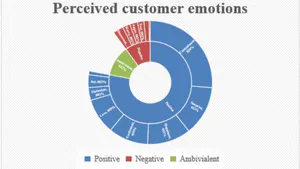
Amazon Go triggers emotions in customers throughout the customer journey. Emotions triggered by sources, that can be specifically assigned to Amazon Go are visually depicted in Figure 1. The perceived emotions were divided into positive, negative, and ambivalent (percentage represented by the inner ring). The outer ring shows the exact sub-emotions in the corresponding color (positive = blue; negative = red; ambivalent = green), with the respective percentages.
From a compiled emotion set consisting of 18 emotions, customers expressed positive emotions in 234 cases (78%), negative emotions in 30 cases (10%) and ambivalent emotions in 36 cases (12%). Ambivalent emotions describe mixed positive and negative emotions at the same time, which coexist and can conflict with each other; an example of this is pleasurable regret (Wu and Gao, 2019). The most frequent emotions were contentment (26.33%), surprise (13%) and happiness (11.33%). Other positive emotions were excitement (10.33%), love (9.33%), optimism, joy (with 3.33% each), and gratitude (1%) in this context. Negative emotions of discontentment (2.67%), worry (2%) and anger (2%) were the most common, followed by fear (1.67%), disappointment (1.33%) and sadness (0.33%). Overall negative emotions were a comparatively low percentage.
Perceived customer emotions {"image_source":{"path":"images/7a4d24e7336ccd2c42900f3cf295d852728d7505903812f48a88ea37b9c23280.jpg"},"content":"","chart_caption":[{"type":"text","content":"Figure 1: Amazon Go perceived customer emotions (figure by authors)"}],"chart_footnote":[]}
Emotions in the master list that were not present in the evaluations were peacefulness, shame, envy, and loneliness. This does not imply that these were not present, only that they were not present in the data analyzed. All perceived emotions are listed in summary form with values, percentages, and other relevant information in the appendix. For a more precise understanding, sample sentences of the respective emotions were also summarized in the appendix (Table 2).
4.2 ECX evoked by emotion triggers
As discussed earlier, the dimensions "Functionality", "No Humanity", "Self-Service", and "Privacy" were examined based on Suk et al. (2022), Fan et al. (2020), and others. These trigger dimensions were presented individually, with the corresponding resulting emotions (positive, negative, and ambivalent) and the breakdown into these basic emotions.
Among these, "Functionality" was the most frequently occurring dimension with 53% triggered by the functionality of the Amazon Go smart technologies, such as tracking, automation, sensors, and scan, or the perception of the overall concept. This dimension was followed by "Self-Service" trigger dimension at 23%; this includes all time-saving aspects. The third most frequent dimension (16%) was "No Humanity" (staff replacement, payment, checkout, and human-machine interactions). "Privacy" was the smallest with only 8%; surveillance, monitoring, shoplifting, data collection and privacy issues were the triggers for mostly ambivalent or negative emotions. In the following sections, the individual trigger and basic emotions are presented in more detail.
4.2.1 Trigger dimension: Functionality
"Functionality" was the most frequent emotional trigger dimension. Expressed in 160 cases, 91.25% were positive, 6.25% negative and 2.50% ambivalent emotions appeared to be triggered in customers.
Figure 2 shows the percentage distribution. Similar to the total number of emotions, contentment (34.38%) was the most frequent. Statements like "...amazing! We couldn't believe it actually worked! Instead, it was all super easy. Amazon is light years ahead" or "The concept is great, and it works efficiently. I enjoyed the shopping experience" show how positive the emotions were regarding the overall concept and functionality of Amazon Go. Happiness (14.38%) and Surprise (13.13%) were again the second and third most common. Negative or ambivalent emotions were hardly recorded. With three mentions each out of 160 cases, the negative emotions disappointment and fear (1.88% each) were the most frequent followed by anger and discontentment (1.25% each) with two mentions each.
Amazon Go's functionalities generated customer contentment through emotions such as surprise, excitement, or happiness. These results indicate that the smart store concept triggered positive emotions that were rarely experienced by customers before. While failures of these technologies can lead to negative emotions, the high percentage of positive emotions within this dimension supports a positive influence of the functionality on the ECX.
{"image_source":{"path":"images/1a2452609c10bcc8138ea01f2d3f2c377e573166816aaba8a3c8a5c756d310b7.jpg"},"content":"","chart_caption":[{"type":"text","content":"Figure 2: Emotion trigger: Functionality (figure by authors)"}],"chart_footnote":[]}
4.2.2 Trigger dimension: Self-Service
The "Self-Service" trigger dimension was the second most common dimension, with 69 cases. Here, a clear positive reaction can be seen with 82.61% positively triggered emotions. In comparison, negative emotions were triggered by self-service sources in 11.59% and ambivalent emotions in 5.8%. As shown, contentment (18.84%) and surprise (17.39%) were the two most frequent positive emotions in this dimension.
Many of the customers were positively surprised by the simplicity and the absence of queues: "It is an amazing experience. The grocery store is so easy to shop with no lines" or "Not only the technology is cool but also saving time with cashless and no checkout line". Similarly, the time saving ("just-walk-out" concept) positively reinforced the ECX within this dimension. Love and excitement were expressed in 10 cases each (14.49%), reinforcing this positive connection, followed by happiness (10.14%), joy (4.35%) and optimism (2.90%) as positive emotions. Negative emotions, anger, fear, or discontentment (2.90% each), were also perceived due to self-service: "Not sure what all the buzz is about. I've really never waited in a convenience store line so not sure what the big deal is". In addition, the negative emotions of disappointment and worry were apparent with 1.45% each.
{"image_source":{"path":"images/11f2b2af2713aec5d9fe448eeaeb885af3c87a41a6183203d0d5d506159cd065.jpg"},"content":"","chart_caption":[{"type":"text","content":"Figure 3: Emotion trigger: Self-Service (figure by authors)"}],"chart_footnote":[]}
Self-service attributes of Amazon Go were a trigger for a positive ECX. Particularly, aspects of saving time or avoiding traditional queues often triggered positive emotions such as contentment or surprise. Rationale provided were a seamless and personalized shopping experience that reduces customer journey friction.
4.2.3 Trigger dimension: No Humanity
Figure 4 provides an overview of the trigger dimension "No Humanity" with a higher variation in the ECX. 62.50% of emotions triggered were positive connected to the aspect "No Humanity", 16.67% negative, and 20.83% ambivalent. The higher percentage of negative and ambivalent responses indicated this trigger dimension cannot be clearly assigned to a positive or negative orientation of the customer experience.
Contentment (22.92%) and surprise (12.50%) in this dimension had the highest percentage. Overall, 48 cases were tied to aspects of this trigger dimension and considered to be the source of an emotion. Other positive emotions were gratitude, happiness, and excitement (6.25% each), and joy (4.17%). Love and optimism had the smallest share (one mention each). Negative emotions especially worry, and discontentment also occurred, reflecting 6.25% each. Anger and sadness were each perceived by 2.08%.
{"image_source":{"path":"images/e12d9d37f64218d782b4c52227a7fecafa9bc4289bffb4aee5c0c4efdffb4758.jpg"},"content":"","chart_caption":[{"type":"text","content":"Figure 4: Emotion trigger: No Humanity (figure by authors)"}],"chart_footnote":[]}
Two contradictory statements show how differently aspects such as staff replacement influence the ECX. The concern about fewer human interactions was shown by statements "... a lot of people will lose their jobs because of this kind of technology, which I don't want to support. Less human interactions with each other only turn us to alienate each other!" Conversely, the satisfaction or contentment of avoiding interactions in retail were expressed "the introvert in me LOVES this! Just walk in, take what you want, leave! No interaction". This resulted in a high percentage of ambivalent emotions (20.83%) within this trigger dimension. Interactions with checkout staff in grocery stores were often seen as annoying, which creates a positive feeling with Amazon Go. However, this also triggered a kind of worry in customers, as no help was available in case of problems.
4.2.4 Trigger dimension: Privacy
With only 23 cases, the smallest trigger dimension was "Privacy" (Figure 5). A clear distinction from the previous trigger dimensions is apparent. Ambivalent emotions were perceived by 78.26% of customers. Negative emotions were perceived in 17.39%, while positive emotions were only experienced by 4.35%. Concern about the invasion of privacy was perceived by 8.70%, but made up the largest share of negative emotions; anger and discontentment each accounted for 4.35%. In total, only 4.35% positive emotions were reported in the "Privacy" dimension. The ambivalent emotions were revealed by statements like "It's a strange concept not to pay as you walk out. It almost feels like you are stealing" or "Such a weird experience to feel like you're shoplifting and just walk out of the store". The concept of "just-walk-out" may leave customers with an uneasy feeling. For many of the reviews, this was their first experience with a smart store like Amazon Go.
{"image_source":{"path":"images/2bc581c9189cb60f7c2769ab4535d6e5d44fdd00813d33a3585a0b83a18065ca.jpg"},"content":"","chart_caption":[{"type":"text","content":"Figure 5: Emotion trigger: Privacy (figure by authors)"}],"chart_footnote":[]}
Privacy aspects within the Amazon Go customer journey can be assigned the lowest proportion of emotions. However, this trigger dimension should not be underestimated, as negative or ambivalent emotions within this dimension can lead to a negative ECX. Doubts arose with statements "Amazon knows more and more of your behavior, records, and stores data of you, etc. I don't know yet, what exactly I should think about this..." Additionally, the continuous monitoring by the cameras and sensors installed in the store caused mixed emotions and led to the high percentage of ambivalent received emotions.
4.3 Resulting customer behavior
Not all customer reviews studied had explicit resulting behaviors. Out of 300 reviews studied, 155 provided behavioral responses (shown in Figure 6). Seven behavioral intentions emerged: Active positive or negative recommendation, revisiting or not revisiting, expressed needs/problems, feedback for improvement, and the desire for a store in the vicinity.
{"image_source":{"path":"images/3741b8c8d3eec393073c0debf0c2a1700633440d6b48e5052e7eaf792c5edab4.jpg"},"content":"","chart_caption":[{"type":"text","content":"Figure 6: Resulting customer behaviors (figure by authors)"}],"chart_footnote":[]}
Table 1 illustrates the number of mentions of customer behaviors and shows which ECXs they connect with. Active positive recommendation was the most frequent behavior of customers (37%). 89.66% of this behavioral response resulted from a positive ECX. 26 reviewers would visit Amazon Go more often if available near their place of residence: "Hope to see these everywhere soon!" or "It was a great experience, and I can't wait until they bring these stores out to Texas". 92.31% of customer behavior followed a positive ECX, due to many of the reviews created by tourists who visited Amazon Go for the first time. 16% expressed needs or problems with the experience and 13% expressed active revisit intentions. Both behaviors show a positive ECX with 68% (store in vicinity) and 95% (revisiting) result from positively perceived emotions. Only 2% provided an active negative recommendation. Six percent of the behaviors consisted of "Not revisiting", resulting out of negative emotions (55.56%) and 9% provided feedback for improvement.
Expressing needs/problems and giving feedback for improvement were behaviors that mostly arose from positive ECXs, which was surprising. Expressed problems or needs often were tied to the Amazon Go app or checking in for friends and relatives. Accordingly, positive recommendation, store in vicinity, expressed needs/problems, revisiting, and feedback for improvement behaviors can clearly be assigned to a positive ECX with not revisiting and negative recommendations resulting from a negative ECX.
| Number of mentions | Positive ECX | Negative ECX | Ambivalent ECX | |
| Positive recommendation | 58 | 89.66% | 1.72% | 8.62% |
| Store in vicinity | 26 | 92.31% | 0.00% | 7.69% |
| Express Needs/Problems | 25 | 68,00% | 20.00% | 12.00% |
| Revisiting | 20 | 95.00% | 0.00% | 5.00% |
| Feedback for improvement | 14 | 78.57% | 7.14% | 14.29% |
| Not revisiting | 9 | 33,.3% | 55.56% | 11.11% |
| Negative recommendation | 3 | 0.00% | 100.00% | 0.00% |
4.5 Comparison of the results with relevant literature
The results imply that smart retail technologies in phygital concepts can have a strong influence during the customer journey and thus on the ECX. Smart retail technologies act as triggers for mostly positive emotions, through excitement or surprise, which leads to overall contentment due to the functionality and self-service aspects of the "just-walk-out" concept. The privacy aspects or the lack of human contact can lead to ambivalent or even negative ECXs.
It can be stated that technologies, especially smart retail technologies, influence emotions and the ECX (Fan, et al., 2020; Lemon and Verhoef, 2016). The results confirm the occurrence of positive, negative, neutral, and ambivalent emotions during the customer journey, and the attribution of these emotions to technology-based trigger dimensions such as "Functionality", "Self-Service", "No Humanity" and "Privacy". Supporting earlier research, Suk et al. (2022) suggested a stronger perception of positive emotions/hedonic benefits compared to negative or ambivalent emotions during experiences in smart stores. This study also confirms that negative emotions can be caused by technological errors, such as scanning the QR code or bill delivery (Batat, 2022).
Consistent with Fan, et al. (2020), this study showed that human-machine interactions can positively influence emotional customer engagement. Inferentially, this finding found the absence of humanity to be a predominantly positive emotional trigger. However, the dimension self-service (one of the biggest influences on the positive ECX) was primarily due to the aspects of time saving and the elimination of queues.
Results supported Johnson and Barlow's (2021) comment on new self-service, such as smart retail technologies, assisting to reduce the "pain of payment" and the associated negative emotions. Privacy risks were the most concrete source of negative emotional experience in smart stores due to constant targeting, tracking, and monitoring. Gregorczuk (2022) suggested a lack of transparency by the providers was one of the main causes. However, the our findings that the feeling of shoplifting evokes negative emotions in customers was something not demonstrated in previous studies.
The impact of the ECX dimension on customer behavior has received substantial investigation. Due to the gap of studies in the phygital environment, other industries (retail, tourism, hospitality, and other services) were applied. Significant impact was found between a positively designed ECX and loyalty intentions such as positive word-of-mouth, repeat purchases or a higher willingness to buy (Ou and Verhoef, 2017; Brun et al., 2017). Similarly, this study identified active positive recommendation or revisiting as two of the biggest behaviors of a positive ECX. In contrast, behaviors such as expressing the desire for expansion of smart stores and the high number of needs/problems expressed was an outcome of positive emotions (68% in this study). While these behaviors were previously thought to be based on negative emotions (Wu and Gao, 2019), this deviation could be the novelty of the concept, which causes unique needs for the customer. Behaviors based on a negative ECX can amount to switching companies, negative word-of-mouth, or complaints (Wu and Gao, 2019). Similar behaviors were found here, as negative recommendation and not revisiting were identified as the main behaviors for negative ECX.
When considering the totality of the customer experience, it should be noted that the emotional or affective dimension is only part of the totality (Grönroos, 2006). Other factors such as cognitive, behavioral, sensory, and social responses during the customer journey should also be considered (Lemon and Verhoef, 2016). Accordingly, customer outcomes and resulting behaviors cannot be based solely on perceived emotions.
The study's results indicated a predominantly positive emotional image of customers in relation to smart stores; however, this should not be taken as standard. The perceived emotions and their triggers should also be considered critically, as individual interactions and touchpoints can trigger multiple emotions throughout the entire customer journey (Wu and Gao, 2019). However, the study results found linear strands of triggers connected to particular emotions, which led to a particular customer behavior tied exclusively to customer perceived emotions. While cognitive, behavioral, sensory, and social responses were not tested directly (i.e., Grönroos, 2006), outcomes from this study should be interpreted with consideration that emotions are perceived personally, situationally, individually, and culturally dependent (Ou and Verhoef, 2017).
V. CONCLUSION
Smart retail technologies such as artificial intelligence (AI) or the Internet of Things (IoT) can significantly impact the emotions of customers in a phygital environment. These technologies act as an emotional trigger and have a direct and mostly positive impact on the ECX by enhancing convenience, saving time, and improving the overall shopping experience. The novelty and fascination of these technologies, as well as the resulting "just-walk-out" concept often led to surprise and excitement among customers and tied to the expression of contentment. The mostly positive emotions were often triggered by the self-service aspects, functionalities of the technologies, and the overall concept (Fan, et al., 2020; Suk et al., 2022). Ambivalent or negative emotions arose from the omission of human interaction or the threat to customers' privacy evoking emotions such as discontentment, worry or even anger. A positively designed ECX often resulted in behaviors such as positive active recommendation, the desire for more stores in vicinity, and revisit. A negatively designed emotional experience led to negative recommendations or the non-revisiting of customers.
In summary, smart retail technologies can create a positive customer experience through a novel/seamless process, time saving, and reducing friction during the journey, leading to emotions such as surprise, happiness, or excitement, which trigger overall contentment. Retail and other service providers should be cautious that the disruption of privacy or ignorance of existing technologies can lead to negative ECXs, expressed through worry or discontentment.
5.1 Implications
This study contributes to the literature on ECX in phygital environments. First, this study identified the specific emotions that occur in smart stores such as Amazon Go, which are divided into positive, negative, and ambivalent emotions. Specifically, the consideration of negative and ambivalent emotions in such an environment expands the existing literature, which so far has mostly focused on positive emotions. Second, the mapping of these perceived emotions to the smart store related trigger dimensions expands the current view of emotional triggers in a phygital concept. Finally, the identification of customer behaviors resulting from ECXs, whether positive, negative, or ambivalent, also contributes to these gaps.
Studies of this kind in the existing literature were mostly based on the totality of the customer experience (no consideration of the individual dimensions) and the findings in this study assist in creating a more complete framework (Batat, 2022), how it applies to younger consumers (Mele et al., 2021), as well as the observation of advantages/benefits and disadvantages/costs (Suk. et al., 2022) as recommended by earlier authors.
Online customer reviews can help managers better understand ECXs. These provide a critical, informative, and direct source for examining customer experiences (Wu and Gao, 2019). From this analysis, the customer journey can be experienced from the customer's point of view and the respective touchpoints, which are directly connected to the company, can be evaluated, and concretely improved.
In addition to providing cost savings in terms of reducing personnel costs (Polacco and Backes, 2018), these new technologies can greatly improve the service to the customer and lead to the generation of positive customer experiences. Avoiding negative emotions as well as creating positive emotions should be a primary target of every successful company (Batat, 2022) to increase positive customer behaviors, such as loyalty intentions or positive recommendation (Harrington, et al., 2019).
The implementation of smart retail technologies can help avoid negative emotions and create positive ones by eliminating unpleasant processes of the customer, such as waiting in queues. Through a better understanding of emotional triggers, negative emotions such as discontentment, worry or anger, as well as their triggers, such as low human interaction, and privacy risk can be minimized. Greater transparency in privacy can be an important factor for many customers (Gregorczuk, 2022). Low human interaction indicated a source of potential negative emotions, but this may be lower priority as the non-existent staff in smart store concepts was considered pleasant by many customers. The analysis of customer behaviors such as feedback for improvements or needs and problems of customers can provide valuable design insights. Accordingly, improvements via simplification can be made within the application or the entry for guests. These inconveniences need to be addressed by smart store providers, such as simplifying account opening or other technology-based challenges. An uncomplicated app as well as a general understanding of the concept are essential to not deter customers before they even enter the store. By obtaining all customer and purchase data, customers can be addressed in a more individual and personalized way after the actual purchase to generate repeat purchases.
The positive aspects/emotions should not be ignored; firms should not only strive for negative emotions avoidance but also for the enhancement of the positively emphasized elements to enhance the elements of surprise and delight to preserve positive emotions. Insights from this study can assist managers to positively integrate smart technologies into a phygital concept with an understanding of positive trigger dimensions (functionality, self-service and partially no humanity) while improving the negative aspects such as privacy. In the future, these technologies can be implemented in a holistic concept as well as partial or hybrid in a variety of settings (i.e. hospitality, tourism, retail and other service contexts).
5.2 Limitations and future research directions
This study is not without limitations. Firstly, only single store reviews were inductively assessed. Future research should assess additional stores, different contexts, and compare different providers of smart stores to improve generalizability (Yu, et al., 2017). Second, the limited available dataset (n=374) and low numbers of negatively perceived emotions provides opportunities for additional research. A more detailed investigation of the ECX in smart stores is needed using quantitative approaches, datamining, and other methods. These would provide information on consumer characteristics for more personalized approaches. Further study of cognitive, behavioral, sensory, and social responses provides opportunities to enhance our understanding of smart technologies in the retail space
Conflict of Interest
The authors declare no conflict of interest.
Ethical Approval
Not applicable
Data Availability
The datasets used in this study are openly available at [repository link] and the source code is available on GitHub at [GitHub link].
Funding
This work did not receive any external funding.
References
Cite this article
Related Research


Special Issue
Launch a focused special issue to highlight research, emerging trends, and expert insights in your academic field.