



IntelliPaper
Abstract
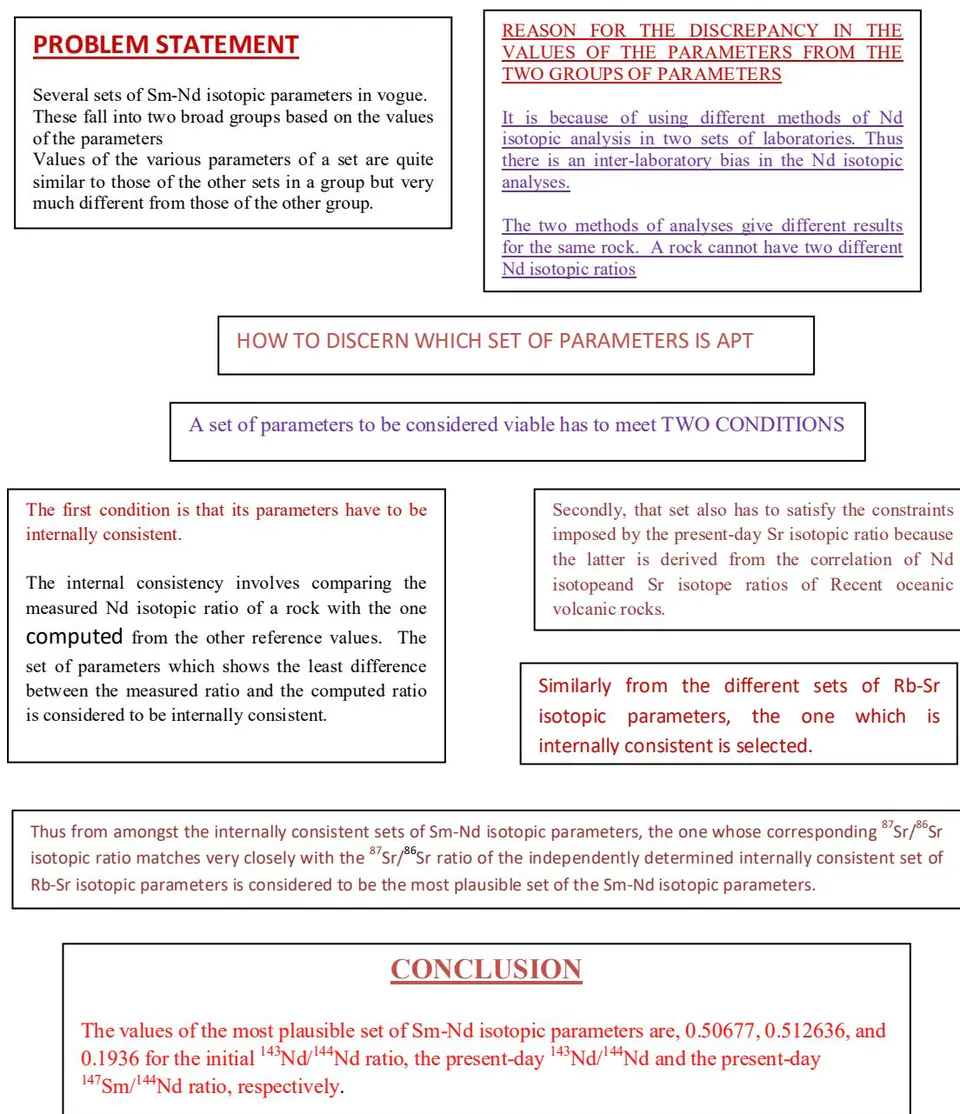
These sets of isotopic parameters basically fall into two broad groups based on their values. The values of the parameters of various sets in each group are quite similar to each other but distinctly different from those of the other group. These parameters are also related to the Rb-Sr isotopic parameters because the latter are partly derived from the Sm-Nd isotopic parameters. As for instance but for the correlation between 87Sr/86Sr and 143Nd/144Nd ratios of recent oceanic basalts the present-day 87Sr/86Sr ratio couldn’t be determined. So the most apt or plausible set of Sm-Nd isotopic parameters has to be not only internally consistent but also has to be consistent with the Rb-Sr isotopic parameters. In this paper I have shown how to distinguish internally consistent sets of Sm-Nd isotopic parameters and then how to pick up the one from those which is consistent with the Rb-Sr isotopic parameters as well. The one test of the internal consistency is that in which the measured present-day Nd isotope ratio matches very closely with the one computed from the other reference values. Then from the internally consistent sets, the one which is also consistent with the Rb-Sr isotopic parameters is considered to be the most plausible set of Sm-Nd isotopic parameters. The values of parameters are, 0.50677, 0.512636, and 0.1936 for the initial 143Nd/144Nd ratio, the present-day 143Nd/144Nd and the present-day 147Sm/144Nd ratios, respectively.
Explore Digital Article Text
I. INTRODUCTION
The values of the parameters in each group are quite similar to each other but distinctly different from those of the other group.. The moot question - which is the best or the most appropriate set of Sm-Nd isotopic parameters for the Planet Earth cannot be answered in isolation from the Rb-Sr isotopic parameters as the latter are partly derived from the former and the two isotopic systems are thus interrelated and interdependent with each other. One thing that will determine which set of the parameters is the most appropriate does not depend on how precisely the isotopic ratios were measured but how the isotopic parameters of both the isotopic systems were determined – that is, by what method and from what source material, and how well they satisfy the internal constraints.
II. DETERMINING Sm-Nd ISOTOPIC PARAMETERS FROM CHONDRITES OR ACHONDRITES
The chondritic meteorites, of all the meteorites, are the most primitive and undifferentiated planetary objects. Naturally, these should be considered the best representatives of the Solar Nebula. Their importance also lies in the fact that these are the only primitive planetary objects and almost of the same age as the Earth on which we can lay our hands and analyze them. Obviously chondritic meteorites should be used to define the Sm-Nd isotopic evolution of the Solar Nebula. But most of the chondrites were subjected to severe shocks and brecciation (Cf. Minster et al., 1982) soon after they were formed, and that has disturbed their isotopic system. Also many of the chondrites show signs of secondary alteration by the action of water (Ebihara et al., 1982; Macdougal et al., 1984). Because of this, they do not yield well defined Rb-Sr or Sm-Nd isochrons. The achondrites, on the other hand though highly differentiated objects, yield very precise isochrons both for Rb-Sr and Sm-Nd systems. As the Sm/Nd ratio of achondrite Juvinas (0.3072) (Lugmair et al., 1975c) is comparable to that of the chondrites (0.3081) (Masuda et al., 1973; Masuda, 1975), and their Sm–Nd isochron age also is very similar to that of the Earth (Lugmair, 1974), the isotopic characteristics of Juvinas, therefore, could be used to define the isotopic parameters of the Solar System/Planet Earth.
2.1 Sm-Nd isotopic parameters from the continental rocks and the achondrite Juvinas
DePaolo and Wasserburg (1976a, 1976b) showed that initial Nd isotopic ratios of old intrusive continental rocks of various lithologies, mostly silicic rocks, ranging in age from 3.8 Gyr to 1.00 Gyr and young continental basalts with few exceptions fall within error on the chondritic evolution line. This indicates that continental silicic rocks throughout the geologic history appear to have been derived from a single uniform widespread reservoir having REE characteristics of ordinary chondrites. They termed this reservoir as chondritic uniform reservoir, CHUR, which in their opinion resides most probably in the mantle. They consider CHUR an important reservoir and representative of the Planet Earth, whose Sm-Nd isotopic characteristics closely proximate that of the Juvinas achondrite.
DePaolo and Wasserburg (1976a, 1976b), therefore, claim to use the isotopic characteristics of the Juvinas achondrite to define the Sm-Nd isotopic parameters of CHUR. However, they used the values of 0.1936 for the ratio, for the initial ratio and 0.511836 for the present day ratio . They asserted that these values are based on the isotopic characteristics of Juvinas (Lugmair, 1974, pers. comm.; Lugmair et al., 1975 b). They contended that this value is much lower than, and differs significantly from what was reported by Lugmair (1974, pers. comm.); and is considered as the best revised estimate for the ratio of the Juvinas as per the personal communication of Lugmair (1974) to them. However, he in his paper (Lugmair, 1974) reported only the initial ratio , and the age of the Juvinas, which are , and Gyr, respectively. He derived these values from the internal isochron of Juvinas; and there is no reference to the Nd isotopic ratio, or the ratio of Juvinas. Lugmair and Scheinin (1976c) reported a very similar initial ratio from Angra dos Reis achondritic meteorites. They analyzed various mineral fractions of the meteorite and obtained an initial ratio of , and an isochron age of Gyr which are very similar to those of Juvinas as determined by Lugmair (1974).
Further, no reference of the initial or the present-day values as used by DePaolo and Wasserburg (1976a) is found in any of the subsequent publications of Lugmair (Cf. Lugmair et al., 1975a; Lugmair et al., 1975b; Lugmair et al., 1975c; Lugmair et al., 1976a, Lugmair et al., 1976b). The initial ratio, and the measured Nd isotopic ratio of the Juvinas as reported by Lugmair et al. (1975b, 1975c) are significantly different from those suggested by DePaolo and Wasserburg (1976). Later,
Lugmair et al. (1976a) gave revised values for the initial ( ) ratio, and the measured ratio by dating the bulk sample of Juvinas, which respectively is 0.50677±0.00010, and 0.512636±0.000040. They stated that these are updated values and are a little lower than the ones given earlier by Lugmair et al. (1975b, 1975c). The value of the present-day ratio of Juvinas seems to be revised again as Stosch et al. (1984) used a little lower value of 0.512566 for this ratio. However, all the values for the Sm-Nd isotopic parameters obtained by dating the Juvinas by Lugmair and his associates are quite different from those used by DePaolo and Wasserburg (1976a) in their model.
2.2 Sm-Nd isotopic parameters from chondrites and Juvinas achondrite
Subsequently, Jacobsen and Wasserburg (1980) analyzed five chondrites and Juvinas achondrites for their , and ratios. These samples defined an isochron which indicated an initial ratio of at 4.6 Gyr. Based on this data, they suggested a new set of present-day Sm-Nd isotopic parameters for CHUR. Those values are 0.511836 for , and 0.1967 for . It may be noticed that the values of two of the parameters are slightly different from those used by DePaolo and Wasserburg (1976a). The value for the present-day Nd isotopic ratio is the same, whereas the value for the initial Nd isotopic ratio is slightly lower, and that for the present-day ratio is slightly higher. They also stressed that they consider these parameters to be self-consistent. Jacobsen and Wasserburg (1984) analyzed five more chondrites and the achondrites Moama and Angra dos Reis for investigating their Sm-Nd isotopic systematics. They reported that the isotopic data obtained from these meteorites is consistent with the previously reported reference values for CHUR of , . However, the value of 0.511847 for the ratio reported here is slightly higher than the one previously reported by them (Jacobsen and Wasserburg, 1980). Also this set of values for the Sm-Nd isotopic parameters for the CHUR/Planet Earth based on the analysis of chondrites by Jacobsen and Wasserburg (1980, 1984) are quite different from those derived from the achondrite Juvinas by Lugmair (1974) and Lugmair et al. (1975b, 1975c). This gives the impression that chondrites are somewhat different from the achondrites with respect to their Sm-Nd isotopic evolution. However, this is not the case as shown by the work of Benjamin et al. (1987) on chondrites. They dated some chondrites by the Sm-Nd method of dating. They showed that chondrites define an isochron corresponding to an age of Gyr with an initial Nd isotopic ratio of , which is very much consistent with the initial ratio of Juvinas (0.506705 for a 4.56 Gyr age). Also, Amelin and Rotenberg (2004) reported almost identical results from their Sm – Nd isotopic investigation of chondrites. They analyzed 34 samples of phosphate fractions and chondrules from six ordinary chondrites and one carbonaceous chondrite for studying their Sm-Nd systematics. These samples defined an isochron which yielded a date of Myr, and an initial ratio of . They also suggested a median ratio of based on the compilation of the published data of chondritic whole rock Sm – Nd analysis. From this value and the Sm – Nd isochron, they derived the present-day CHUR value of .
III. TEST OF THE INTERNAL CONSISTENCY OF THE Sm-Nd ISOTOPIC PARAMETERS
It appears that the results of Sm-Nd isotopic analysis for the chondrites from the two sets of laboratories are quite different. So what is the reason for the results from the two sets of laboratories to be so different? The most likely reason for this is the inter-laboratory bias because of the different ways of carrying out analysis for Nd isotopic compositions (Faure, 1986; Faure and Mensing, 2004). This inter-laboratory bias has rendered the comparison of Sm-Nd isotopic data from different laboratories very difficult. Ideally, no matter what method is used for analysis, the end result should be the same.
However, it is not the case. Therefore, the important point here is which of the two sets of reference values should be considered credible for the Planet Earth isotopic parameters. In order for any set of Sm-Nd reference values to be considered viable, it is important to see that not only they are internally consistent but they also should satisfy the constraint imposed by the present-day Sr isotopic ratio. Jacobsen and Wasserburg (1980) had contended that the reference values that they have proposed for the Sm-Nd Planet Earth parameters are self-consistent. But they did not show how and on what basis these values were considered to be self-consistent. One test to check the self-consistency of the reference values, in other words, to see how well they satisfy their internal constraints, involves comparing the measured Nd isotopic ratios with those computed from the other reference values as shown in the table below. However, this test by itself should not be considered as the sole criterion for judging the plausibility of the parameters because they also have to satisfy the constraints imposed by the Rb-Sr isotopic parameters. But it excludes those from consideration which do not satisfy the internal constraints.
The following table shows the computed and measured Nd isotopic ratios from the data of Jacobsen and Wasserburg (1984), DePaolo and Wasserburg (1976a), Lugmair et al. (1976a) and Amelin and Rotenberg (2004). Table showing the difference between the measured and computed Present-day Nd isotopic ratios
| Jacobsen and Wasserburg (1984) | DePaolo and Wasserburg (1976a) | Lugmair et al. (1976a) | Amelin and Rotenberg (2004) | |
| Present-day ratio (measured): | 0.511847 | 0.511836 | 0.512636 | 0.512637 |
| Initial ratio: | 0.505828 | 0.50598 | 0.50677 | 0.50665 |
| Present-day ratio | 0.1967 | 0.1936 | 0.1936 | 0.1964 |
| Decay constant: | 6.54E-12/Yr | 6.54E-12/Yr | 6.54E-12/Yr | 6.54E-12/Yr |
| Time elapsed: | 4560000000 | 4560000000 | 4560000000 | 4560000000 |
| Initial ratio (Computed): | 0.20265441 | 0.19946057 | 0.19946057 | 0.202345331 |
| produced in 4.56 Gyr (Computed): | 0.00595441 | 0.005860570. | 00586057 | 0.005945331 |
| Present-day ratio (Computed): | .51178241 | 0.511782412 | 0.51263057 | 0.512595331 |
| Diff. between the computed. and measured ratios: | 0.000064588 | 0.000053588 | 0.000005430 | 0.000041669 |
The above table shows that the present-day Nd isotopic ratios computed from the reference values proposed by Jacobsen and Wasserburg's (1984), DePaolo and Wasserburg (1976a) and Amelin and Rotenberg (2004) are much smaller than their measured ratios which means that the difference between the two ratios is very high. Whereas in the case of those proposed by Lugmair et al. (1976a), the computed and measured ratios are quite similar. The difference between the two ratios in the former case is almost ten times greater than that in the case of Lugmair et al. (1976a). This shows that the Nd isotopic parameters proposed by Jacobsen and Wasserburg (1984), DePaolo and Wasserburg (1976a) and by Amelin and Rotenberg (2004) are not internally consistent as they do not satisfy their internal constraints. So this leaves the reference values suggested by Lugmair et al. (1976a) only in contention for viability as it seems to satisfy its internal constraints.
IV. RELATIONSHIP BETWEEN THE PRESENT-DAY Nd AND Sr ISOTOPIC RATIOS OF RECENT ROCKS
In fact the most important point in evaluating the aptness of the Sm-Nd isotopic parameters is the relationship of the Nd and Sr isotopic ratios of recent rocks. So before considering any reference values for the Sm-Nd isotopic parameters for the Planet Earth, the relationship between the Nd and Sr isotopic ratios of recent rocks have to be evaluated first.
The Rb-Sr isotopic parameters for the Planet Earth, unlike the Sm-Nd parameters, cannot be determined directly from the meteorites – chondrites or achondrites, because they have been subjected to differentiation and/or alteration after their accretion from the Solar Nebula which has caused the fractionation of volatile elements such as Rb and Sr. As a result, Rb-Sr isotopic evolution in meteorites has deviated from their normal evolutionary course. Because of this, meteorites in general are not considered as very good representatives of the Solar Nebula with respect to the Rb-Sr isotopic evolution. However, it is the relationship of the present-day Sr isotopic ratios with Nd isotopic ratios of Recent oceanic basalts which has helped in deducing the Rb-Sr isotopic parameters for the Planet Earth/Solar Nebula. Richard et al. (1976) showed that in Recent oceanic basalts, isotopic ratios have an inverse correlation with their corresponding isotopic ratios. DePaolo and Wasserburg (1976b, 1977) showed a similar inverse correlation between initial Nd and Sr isotopic ratios of young volcanic rocks (zero age) from both oceans and continents. These rocks included MOR tholeiitic basalts, continental flood basalts, oceanic island basalts and a few other volcanics from the continent. However, on the correlation diagram, Nd isotopic ratios were shown as normalized to the present-day Nd isotopic ratio of Juvinas (0.511836) (DePaolo and Wasserburg, 1976a). According to them the strong correlation between the initial Nd and Sr isotopic ratios of young basalts indicates that the Rb-Sr and Sm-Nd fractionation events are correlative and caused by the same process. Therefore, they took the ratio corresponding to the present-day ratio of Juvinas of 0.511836 on this correlation diagram as the present-day ratio of the Planet Earth. They thus suggested 0.7045 as the present-day ratio of Planet Earth. Using this ratio and BABI (0.69899) (Pappanastassiou and Wasserburg, 1969) as the isotopic ratio of the Planet Earth at the time of its formation, and the decay constant of 1.39 E-11 Yr-1, they calculated the present-day Rb/Sr ratio of the unfractionated mantle/Planet Earth to be 0.029. They further estimated the present-day ratio of the Planet Earth to be 0.0839.
All`egre et al. (1979) viewed the correlation between Nd and Sr isotopic ratios of the Recent oceanic basalts as of geochemical significance because it could be used to deduce the present-day Sr isotopic parameters for the Planet Earth. They maintained that as the Earth has chondritic REE distribution, and as the Juvinas achondrites have nearly unfractionated Sm/Nd ratio, the Sr isotopic ratio corresponding to the present-day Nd isotopic ratio of the Juvinas achondrite on this relation, therefore, should closely proximate the Planet Earth/planetary value. Following on this assumption, they suggested that the ratio of 0.70478 ± 0.00008 corresponding to the present-day value of 0.511836 of Juvinas achondrite (DePaolo and Wasserburg, 1976a) on this relation, should be regarded as the planetary value. They further added that this value along with the initial Sr isotopic ratio of 0.69899, and of corresponds to the present-day Rb/Sr ratio of 0.031 and of 0.090 for the Planet Earth.
Later, All`egre (1982) referred to the inverse correlation between the Sr and Nd isotopic ratios of recent oceanic island basalts and ridge basalts as the reference array for the whole Earth. Further, he used the value of 0.51264 (Lugmair, 1976a) instead of 0.511836 (Cf. DePaolo and Wasserburg, 1976a; Cf. Jacobsen and Wasserburg, 1980) for the present-day ratio for deducing the present-day Sr isotopic ratio of the Planet Earth from this relation. This led to a slight revision of his previously suggested value of 0.70478 for this parameter. His new revised reference value for this parameter is , which corresponds to the present-day ratio of 0.09 for the Planet Earth.
V. Nd ISOTOPIC EVOLUTION FROM THE INITIAL Nd ISOTOPIC RATIOS OF ARCHEAN ROCKS
Gargi (2012) came out with a novel computer model (herein referred to as SG Model) to infer the isotopic characteristics of the source reservoirs of igneous rocks using Rb/Sr and ratios only. This model makes it possible to determine the Rb-Sr isotopic characteristics of a source reservoir with respect to its as well as isotopic ratio. However, the SG model also contains other relations by which the model age and the beginning Sr isotopic ratio of a rock can be determined without requiring the direct input of ratio, or the decay constant, . The SG model is a purely theoretical model, and is internally consistent as it is not dependent on any data from meteorites or terrestrial rocks; and the model is derived using hypothetical rocks of various ages.
The SG model is based on the relationship of Rb/Sr and ratios. The basic premise of the model is that the two cosmic ratios, Rb/Sr and , have been evolving with time because of the decay of , and the resulting accumulation of since the time nuclides first manifested in the universe about 542 Gyr ago (Cf, Gargi, 1987; Cf, Gargi, 2005; Gargi 2019). Similarly it was further assumed that no was produced by nucleosynthesis in the interior of the stars, and all of the nuclides in the Universe manifested in space-time. Therefore, the isotopic evolutions of and have always been complementary and integral to each other since the time first appeared in the universe. Stated otherwise, it means that all of the nuclides in the universe are of radiogenic origin, that is, they owe their origin solely to the decay of , and no was ever produced by any means other than the decay of (Cf, Gargi, 2005, Gargi 2019), such as by nucleosynthesis in the interior of the stars as is commonly believed by many astrophysicists. It follows then that at a certain point of time in the past the ratio must have been null. Because of the continuous decay of into its daughter isotope of , the , Rb/Sr and ratios have been evolving continually with time. These ratios evolving with time form the basis of the SG's model for characterizing the source reservoir of igneous rocks and for determining the model age and the beginning Sr isotopic ratio of rocks. The evolution of these ratios through time was calibrated by plotting Rb/Sr ratio against ratio of hypothetical rocks of various ages on the X-Y plot.
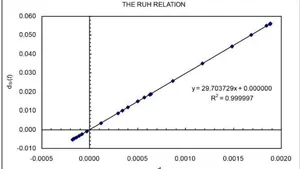
In order to formulate this model, initially, values of certain parameters, such as the Rb-Sr isotopic parameters of the Planet Earth, age of the Earth, and the decay constant, , etc. had to be presumed which were later modified by using the interplay of the constraints imposed by the various parameters on each other. The presumed values were within the range of the values found in literature. The interplay of the mutual constraints made it possible to define the final values of the parameters. To see the effect of the mutual constraints on the various parameters a relation was required in which all those parameters which have a bearing on the cosmic Rb-Sr isotopic evolution are involved. As was mentioned earlier, that the and ratios are not random ratios resulting from the nucleosynthesis but are complementary to each other because of the decay of and the resulting accumulation of since the time first manifested in the Universe. So as per this premise, before any had manifested in the Universe, there should not have been any . Therefore, in a relation where the X entity is dependent on the ratio and the Y entity is dependent on the ratio, the linear array formed by two such entities in an X-Y plot should go to the point of origin, that is, the value of the Y-intercept should be NULL because if there is no , there cannot be any . Such a relation was provided by the Ruh relation in the SG model (See Figure 1). The significance of this relation is that it is the only relation in which all those parameters which have a bearing on the Rb-Sr isotopic evolution are involved. Because the SG model is in fact a single computer program based on the MS Excel Spreadsheet program, therefore, any change in any of the parameters affects the whole spreadsheet and all the relations it comprises. In order to determine the final values of the various parameters their values were changed by hit and trial method and their effect was observed on the linear array of the Ruh relation. This was done until the linear array formed a NULL Y-Intercept or was as close as possible to the NULL value. That is how the final values of the various parameters were determined.
{"image_source":{"path":"images/fcf9681cb1b799dd5afaa00f6f441216b328dfb0a87fac45f941af871600a95a.jpg"},"content":"","chart_caption":[{"type":"text","content":"Figure 1: Shows the Ruh relation formed by plotting the dw ratio on the X-axis against the "},{"type":"equation_inline","content":"d_{}(t)"},{"type":"text","content":" ratio on the Y-axis. The X-axis entity "},{"type":"equation_inline","content":"d_{w}"},{"type":"text","content":" is dependent on the "},{"type":"equation_inline","content":"{}^{87}Rb/{}^{86}Sr"},{"type":"text","content":" ratio and the Y-axis entity "},{"type":"equation_inline","content":"d_{}(t)"},{"type":"text","content":" is dependent on the "},{"type":"equation_inline","content":"{}^{87}Sr/{}^{86}Sr"},{"type":"text","content":" ratio. The linear array formed by this correlation passes through the point of origin."}],"chart_footnote":[]}
VI. TEST OF THE INTERNAL CONSISTENCY OF THE Rb-Sr ISOTOPIC PARAMETERS
However, the confirmation about these Rb-Sr isotopic parameters as being apt and plausible comes from the fact that the model yields the age and initial Sr isotopic ratio of well dated meteorites and rocks from the youngest to the oldest that match very closely with their published results. Values of the parameters from no other set than those used in this model produce such results. The validity and authenticity of the Rb-Sr isotopic parameters as given by the SG model is further confirmed by the test of the internal consistency in which the difference between the measured and the computed values of the present-day from the various sets of Rb-Sr parameters is compared. The table below shows that of all the sets of parameters, the difference between the computed and measured present-day ratios is the least only in the case of the SG model. Thus the reference values of the various parameters as used in this model are internally consistent, and satisfy all the internal and external constraints.
Table showing the differences between the measured and computed Present-day isotopic ratios
| Gargi (2012) | DePaolo and Wasserburg (1976b) | All`egre (1982) | |
| Present-day ratio (measured) | 0.704698 | 0.7045 | 0.7047 |
| Initial ratio: | 0.69878 | 0.69899 | 0.69898 |
| Present-day ratio | 0.089442 | 0.084 | 0.09 |
| Decay constant used: | 1.408E-11/Yr | 1.39E-11/Yr | 1.42E-11/Yr |
| Time elapsed: | 4550000000 | 4550000000 | 4550000000 |
| Initial ratio (Computed): | 0.09535954 | 0.08948418 | 0.096006862 |
| produced in 4.55 Gyr (Computed): | 0.00591754 | 0.00548418 | 0.006006862 |
| Present-day ratio (Computed): | 0.704697539 | 0.704474175 | 0.704986862 |
| Diff. between the comptd. and measured ratios: | 0.000000461 | 0.000025826 | -0.000286862 |
The values of the Rb-Sr isotopic parameters for the Planet Earth such as the beginning ratio, present-day ratio, ratio, and Rb/Sr ratio, as proposed by Gargi (2012), are 0.69878, 0.704698, 0.089442, and 0.031, respectively. Gargi's (2012) model, and the parameters used to define the model are consistent with the decay constant, for , and the age of the Earth being equal to 1.408 EXP-11/Yr, and 4.55 Gyr, respectively.
However, for the discussion here, the parameter of interest is the present-day ratio as it has been derived from the present-day ratio of the Earth. Both Allegre et al. (1982), and O'Nions et al. (1979) proposed the value of 0.7047 as the present-day $^{87}\mathrm{Sr}/^{86}\mathrm{Sr}$ ratio for the Planet Earth. They deduced this value from the inverse correlation of $^{143}\mathrm{Nd}/^{144}\mathrm{Nd}$ with $^{87}\mathrm{Sr}/^{86}\mathrm{Sr}$ ratios of recent oceanic basalts. To derive this value, Allegre (1982) used the value of 0.51264 for the present-day ratio (Cf. Lugmair, 1976a), whereas O'Nions et al. (1979) used the value of 0.51265, which also is very similar to that of Lugmair (1976) value.
As the present-day Sr isotopic ratio for the Planet Earth obtained by using the present-day ratio suggested by Lugmair (1976) matches very closely with the one given by the SG model, the reference values for the Sm-Nd isotopic parameters for the planet Earth suggested by Lugmair (1976), therefore, should be considered as the most appropriate and plausible parameters.
VII. CONCLUSION
For any set of the Sm-Nd isotopic parameters to be considered the most appropriate and plausible it has to be internally consistent as well as it also has to be consistent with the Rb-Sr isotopic parameters as these are partly derived from the former. I have shown in this paper how to pick the internally consistent sets of Sm-Nd isotopic parameters from amongst the several such sets in vogue, and then how to pick the one from amongst these sets which is also consistent with the Rb-Sr isotopic parameters. So based on this analysis, the set of the Sm-Nd isotopic parameters given by Lugmair (1976) is considered to be the most plausible and appropriate. The values of these parameters are, 0.50677, 0.512636, and 0.1936 for the initial ratio, the present-day and the present-day ratio, respectively. These values are consistent with the present-day ratio of 0.704698 as given by Gargi (2012). It further shows that the decay constant for of 1.408E-11/Yr given by Gargi (2012, 2019) is the most plausible decay constant. It also shows that achondrites yield better results than chondrites for the Sm-Nd isotopic parameters. Thus the values of the most plausible set of Sm-Nd isotopic parameters are, 0.50677, 0.512636, and 0.1936 for the initial ratio, the present-day and the present-day ratio, respectively.
Note: This work was not supported by any Grant or funds from any source.
Conflict of Interest
The authors declare no conflict of interest.
Ethical Approval
Not applicable
Data Availability
The datasets used in this study are openly available at [repository link] and the source code is available on GitHub at [GitHub link].
Funding
This work did not receive any external funding.
References
Cite this article
Related Research


Special Issue
Launch a focused special issue to highlight research, emerging trends, and expert insights in your academic field.