






IntelliPaper
Abstract
Alternative and Natural Medicine are nonmedical techniques and therapies that help a client heal faster and use non-medication for the mind, body, and soul. Also, Holistic perspectives provide a framework for understanding how sentient beings, including humans, perceive and interact with the world. In the Holistic study, these guidelines are for us to follow, and they are the: The Six Universal Reality Dimensions, as presented in the Theory of Holistic Perspective, they describe the fundamental aspects through which all sentient beings perceive and engage with reality.
Explore Digital Article Text
I. INTRODUCTION
Alternative medicine goes with Integrative Medicine. It has modalities to combine healing methods. These modalities can intermix with modern-day medicine. If the family physicians approve of it. That is alternative medicine, and does it work?
The term "alternative medicine" is subjective. While doctors in one part of the world might regard a practice as mainstream, doctors elsewhere might view the same practice as alternative.
The term "alternative medicine" describes any form of medicine or healing that does not fall into conventional medical practice. In the U.S. it refers to forms of medicine that are not widely accepted or practiced by medical doctors. Some types of alternative medicine have been around for hundreds and even thousands of years.
Is alternative medicine the same as complementary medicine?
Alternative Medicine: This describes medical systems or practices that function as a replacement Trusted Source for conventional medicine. An example of this would be a person using energy healing for a condition rather than mainstream treatments.
Complementary Medicine: This describes nonconventional medical approaches as a complementary or positive addition to conventional treatment. For example, a person who experiences migraine may take conventional pain medications but also attend biofeedback sessions.
Integrative Medicine: This describes an approach to medicine that combines conventional and less conventional methods in a coordinated, evidence-based way.
Holistic Medicine: This refers to treatment that considers a person's health as a whole, rather than focusing on one organ or bodily system. Some types of alternative, complementary, and integrative medicine are also holistic.
Natural Medicine: Naturopathy, or natural medicine, is a form of alternative medicine with a deep history of traditional philosophies and practices and natural treatment options for patients. It aims at stimulating the body's self-healing capacity and promotes a concept of going back to an innate balance. It involves the treatment and prevention of health disorders through the use of natural therapies, methods, and materials.
Other Alternative Medicine
Mind-body therapies focus on the relationship between the mind and body to help treat or manage a condition. This includes Life Coach, Health Coach, Holistic Coach, Reiki, and Chakra healing.
Biological Therapies: Biologically based therapies use substances such as plants and foods to improve health or treat conditions.
Dietary Supplements and Vitamins. See a CAM or Integrative practitioner who can offer a dietary care plan.
Botanicals: The use of plants or plant compounds for medical benefits. There are examples of Trusted Sources of plants that people use to treat symptoms including Cannabis, evening primrose oil, curcumin, which comes from turmeric allicin, which comes from garlic, and valerian root conditions.
Popular examples include Botanicals:
cannabis
evening primrose oil
curcumin, which comes from turmeric
allicin, which comes from garlic
valerian root
Biofield Therapies These therapies aim to help people by manipulating invisible energy fields. This would include Acupuncture, Acupressure, and Auricular Therapy.
Body-Based Therapies can be used along with Hypnosis involves someone going into a deep state of relaxation and focusing on suggestions a clinician makes while the person is in a hypnotic state. The aim is for the suggestions to help change a person's mental state, resulting in health benefits. Yoga is like meditation; yoga is a mind-body exercise that originates in spiritual practices. It involves moving through sequences of poses and stretches while also focusing on breathing. People around the world practice yoga to promote mental and physical well-being. Yoga also has beneficial health work lowers stress, improves sleep, improves balance, manages anxiety or depression, reduces neck and lower back pain, manages weight, alleviates the symptoms of menopause, and reduces the symptoms of chronic conditions, it is also a Mind-body and spiritual exercise.
or more parts of a person's body for therapeutic benefits. Common examples include Massage therapy, Reflexology therapy and chiropractic therapy.
- Whole Medicine Systems: Has been involved over hundreds of years. The most well-known methods include: (TCM) Traditional Chinese
Medicine, Ayurvedic medicine, and Homeopathic medicine.
Holistic Perspectives: This provides a framework for understanding how sentient beings, including humans, perceive and interact with the world.
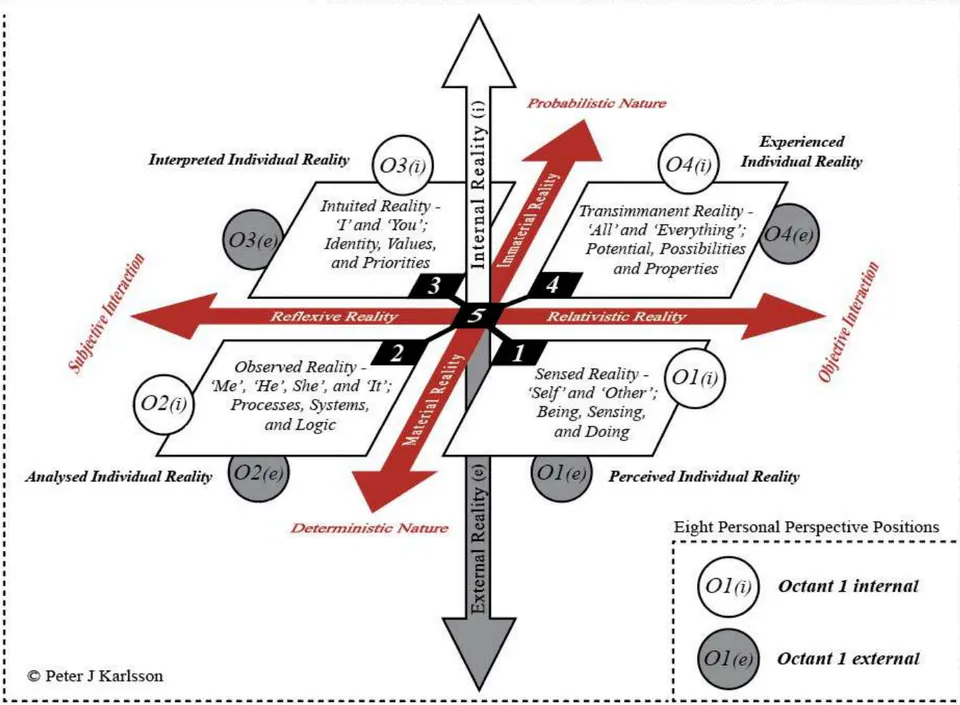
Key Components of the Theory of Holistic Perspective
The Eight Personal Perspective Positions outlined in the Theory of Holistic Perspective form the basis for developing a nuanced understanding of reality through diverse perspectives. These positions emerge from the intersection of three axes in a three-dimensional Cartesian coordinate system, signifying the only perspectives a sentient being can adopt. Each position generates Personal Truths about reality, facilitating the emergence of Shared Truths among individuals who perceive or believe in something similar. These perspectives are:
Sensed Reality (Internal and External): Involves the perception of the world through our senses (e.g., sight, touch, smell), forming the basis of our understanding of reality. This is our immediate, sensed experience, expanded through Witnessing Awareness exercises.
Observed Reality (Internal and External): Deals with understanding cause-and-effect relationships through processes, systems, and logic, forming our Analyzed Individual Reality. Causality Awareness exercises help explore and expand this reality.
Intuited Reality (Internal and External): Concerns the interpretation of meaning, narratives, and mental models relating to values, priorities, and ethics. This is our Interpreted Individual Reality, deepened through Mindfulness Awareness exercises.
Transient Reality (Internal and External): Encompasses understanding the full potential and infinite possibilities inherent in ourselves and the world, forming our Experienced Individual Reality. Open Awareness exercises are designed to explore this reality.
Holistic frameworks are centered around the concept that all beings simplify reality by intuitively assigning three of the six universal dimensions to their experiences, particularly when interacting with their environment.
Six universal reality dimensions
The Six Universal Reality Dimensions, as presented in the Theory of Holistic Perspective, describe the fundamental aspects through which all sentient beings perceive and engage with reality. The spectrum of our experiences and understandings.
Material and Immaterial- Existence/space: This dimension differentiates between what is tangible and physical (material) and what is conceptual or ideational (immaterial). It encompasses the physical objects and substances in our world as well as the thoughts, ideas, and concepts that do not have a physical form.
Internal and External- Interconnections/ holons: Incorporating the Internal and External dimension with the concept of holons, which are entities that are simultaneously whole and parts of another whole, highlights our interaction with reality through nested layers of complexity. Holons exemplify how we perceive and influence our internal experiences and the external world. This distinction aids in understanding the interconnectedness of self with broader systems, emphasizing that our internal perceptions (thoughts, feelings, and intuitions) and external actions (interactions with the environment and others) are integral parts of a continuous spectrum of reality. By recognizing this we can better navigate the boundaries and interconnections between the internal and external, appreciating the complexity and interdependence of our existence.
Relativistic and Reflexive– interaction/time: Relativistic Reality relates to the objective interaction of inanimate objects, following physical and natural laws, devoid of interpretation. The "Law of Least Resistance" describes this kind of interaction. This dimension is always in the present moment.
Reflexive reality in contrast, involves subjective interactions based on intent, free will, and personal interpretation. The "law of eliminating discrepancies" describes this kind of interaction. This dimension is always in the past or future. By becoming aware of how these dimensions influence our perceptions, we can better navigate the challenges and opportunities presented.
Understanding Biases and Mental Models: The Theory of Holistic Perspective enriches our approach to understanding biases and mental models by emphasizing the conscious recognition of how we intuitively assign the six universal reality dimensions to our experiences. This enhanced awareness is fundamental in identifying potential blind spots and limiting beliefs that can obscure our perception of reality. By acknowledging these automatic cognitive processes, we can begin to challenge and expand our mental models, paving the way for a more accurate and inclusive understanding of the world around us.
Seeing True Reality: The Theory aims to encourage a more holistic view of reality by recognizing and integrating the material and immaterial, the internal and external, and the relativistic and reflexive dimensions of experience. This holistic viewpoint acknowledges the complexity and interconnectedness of all aspects of reality, encouraging a deeper appreciation for the ways in which we can experience and understand our existence.
Promoting holistic decision-making: In promoting holistic decision-making, the Theory not only enhances personal growth and understanding but also equips us to navigate the complexities of modern life with greater empathy, compassion, and effectiveness. By embracing its framework, we can make healthy decisions for a fuller appreciation of the diverse facets of reality, leading to outcomes that are beneficial for ourselves and the broader community. The holistic perspective website offers a great deal of information that offers in-depth of how Holistic measures can be used for the client's healing process. Please check out the graphs on how the holistic perspective works.
Theory's Relevance:
It stands as a guide for personal and societal evolution. It equips us to comprehend and navigate the tide of technological innovations and societal transformations. Advocating for growth, empathy, and environmental stewardship. By deepening our understanding of cognitive processes, biases, and our mental models of the world, the Theory empowers us to face modern complexities with informed, ethical decision-making. Emphasizing the well-being of all life and our planet's health.
Case Studies for Alternative Medicine
Evidence-Based Complementary and Alternative Medicine in Current Medical Practices. "The health-seeking behavior of people, especially in developing countries, calls for bringing all CAM healers into the mainstream by providing them with proper training, facilities, and backup for a referral. Evidence-based CAM or (EBCAM) therapies have shown remarkable success in treating diseases. It necessitates the integration of modern CAM systems in terms of evidence-based information sharing. Although a synergistic effect of interaction between the two systems works large gaps in EBCAM still exist and are worth further studies to develop evidence for the best CAM practices for the common goal of improving the health of people". Evidence-based complementary and alternative medicine (CAM),5 goes over the section of the PubMed Search box, type: Diabetes Mellitus, Type 2. Then filter to: Complementary Medicine and/or Dietary Supplements under Subjects. This strategy will produce results for alternative treatments for diabetes. For evidence-based articles, and for the filter under Article Type to: Randomized controlled trial, meta-analysis, and clinical trial.
II. CONCLUSION
The two case studies will help doctors and practitioners determine the individuals to make a clear and concise care plan that will need pacific techniques and therapies for their healing needs. Also, please go to the Holistic Perspectives website, which is the rules that are listed under the title Holistic Perspectives.
Conflict of Interest
The authors declare no conflict of interest.
Ethical Approval
Not applicable
Data Availability
The datasets used in this study are openly available at [repository link] and the source code is available on GitHub at [GitHub link].
Funding
This work did not receive any external funding.
References
Cite this article
Related Research

Special Issue
Launch a focused special issue to highlight research, emerging trends, and expert insights in your academic field.

