



IntelliPaper
Abstract
Introduction: Generally, atrial flutter leads 2:1 to the ventricles. It rarely leads 1:1, with states of cardiogenic shock. Due to the very fast ventricular rate.
Objetives: To present patients with atrial flutter, with 1:1 atrioventricular conduction. Explain diagnostic methods. Review production mechanisms. Define the causes of presentation in exposed. patients. Mention the behavior and treatment.
Methods: The following were taken in to account: Electrocardiogram with heart rate greater tan Identification of atrial flutter waves. Determination of 1:1 atrioventicular conduction. Typing of heart disease. Evaluation of hemodynamic status. Age and sex. Then we proceded to treatment and behavior.
Results: Ten patients were observed. Average age 57 (22-72). Ischemic heart disease 4; chronic rheumatic 2; chronic cor pulmonale 2; dilated cardiomyopathy 1 and pre-excitation syndrome 1. Average atrial rate 257 (240-270). Hemodynamic instablity 6. Treatment: electrical cardioversión 5; Amiodarone 2; Digoxin 1; descontinuation of Digoxin 1 and spontaneous 1. Vagal maneuver was performed in 5. Digoxin precipitated the arrhythmia in 1,in the rest it was triggered spontaneously.
Conclusion: The mayority of cases had heart disease. The arrhythmia can be confused with ventricular tachycardia and paroxismal supraventricular tachycardia. Vagal maneuvers help in the diagnosis. Depending on the state of hemodynamic stability, it card be treated with antiarrhythmics or electrical cardioversión.
Explore Digital Article Text
Introducción: Generalmente, el Aleteo auricular, conduce 2:1 hacia los ventrículos. Raras veces conduce 1:1, con estados de choque cardiogénico, debido a la muy rápida frecuencia ventricular.
Objetivos: Presentar pacientes con aleteo auricular con conducción auriculoventricular 1:1. Exponer los métodos de diagnóstico. Revisar los mecanismos de producción. Definir las causas de la presentación en los pacientes expuestos. Mencionar la conducta y Tratamiento.
Métodos: Se tomo en cuenta: Electrocardiograma con frecuencia cardíaca mayor a 250. Identificación de las ondas de aleteo auricular. Determinación de la conducción auriculoventricular 1:1. Tipificación de la cardiopatía. Evaluación del estado hemodinámico. Edad y Sexo. Se procedió al tratamiento y conducta.
Resultados: Se observó 10 pacientes. 9 varones, edad media 57 (22-78). Cardiopatías: Isquémicos 4; reumáticos crónicos 2; cor pulmonale crónico 2; cardiomiopatía dilatada 1 y síndrome de preexcitación 1. Frecuencia auricular media 257 (240-270). Inestabilidad hemodinámica 6. Tratamiento: cardioversión eléctrica 5; Amiodarona 2; Digoxina 1; descontinuación de Digoxina 1. Espontanea 1.
Se practicó maniobra vagal en 5, La digoxina precipitó la arritmia en 1, en el resto se desencadenó espontáneamente.
Conclusión: La mayoría de los casos, tenía una cardiopatía. La arritmia, puede confundirse con la taquicardia ventricular y la taquicardia paroxística supraventricular. Las maniobras vagales ayudan en el diagnóstico. Según el estado de estabilidad hemodinámica, se tratará con antiarrítmicos o con cardioversión eléctrica.
I. INTRODUCCIÓN
El Aleteo auricular (ALA), es una arritmia cuya característica es la contracción rápida de las aurículas a una frecuencia entre 220 y 370 por minuto y cuya causa es un movimiento circular en las aurículas (1).
La frecuencia de esta arritmia es variable según las series efectuadas a nivel hospitalario o a nivel general de la población. Así, en Estados Unidos se ha determinado que la incidencia es 88/100000 personas por año y que se presentan 200000 nuevos casos anualmente (2). En las series hospitalarias, en España es de 1,5 por mil (3), en México es del 3,8 por mil (4). En el Hospital No 1 de la Caja Nacional de Salud de La Paz Bolivia es alta, llegando a 6 por mil en un informe (5) y al 9 por mil, en otro reporte (6).
En esta arritmia, la frecuencia auricular es muy rápida, generalmente 300 por minuto; todos estos impulsos llegan al nodo auriculoventricular, pero solo uno de dos pasará a los ventrículos, produciéndose así una conducción A.V, 2:1; por lo que la respuesta ventricular es regular y con una frecuencia de 150 por minuto. (7).
Raras veces, existe una conducción de todas las contracciones auriculares a los ventrículos, entonces se presenta un ritmo ventricular muy rápido con una frecuencia de 240 a 300 por minuto. Esto es más probable, cuándo la frecuencia auricular esta por debajo de 300 por minuto, puesto que el nodo auriculoventricular, no puede conducir tan rápidamente, que permita una frecuencia ventricular superior a 270 por minuto. Si todas las ondas auriculares pasan a los ventrículos, entonces la conducción A-V, será 1:1. (8)
En esas condiciones, puede presentarse inestabilidad hemodinámica, con estados de choque cardiogénico, por la mucha rapidez de la frecuencia ventricular (9).
Por lo cual, en este trabajo observacional, los objetivos son: Presentar pacientes que presentaron ALA con conducción A-V 1:1. Exponer los medios empleados para su diagnóstico. Revisar los mecanismos por los cuales se produce esta forma de conducción.
Tratar de definir los motivos por los cuales se produjo esta arritmia en los pacientes presentados. Informar sobre la conducta y tratamiento, que se siguió en esos casos.
II. METODOS
Durante la práctica hospitalaria, se observó a 10 pacientes en los cuales se presentó la arritmia en cuestión; tomando en cuenta los siguientes datos: Electrocardiograma con frecuencia ventricular mayor a 250 por minuto, ya sea con el QRS ancho o angosto.
Se identificó la presencia de aleteo auricular, con los siguientes parámetros (10): frecuencia auricular entre 220 y 370, ondas auriculares exactamente regulares e iguales entre sí, tanto en forma, amplitud y duración, sin línea isoeléctrica (ondas semejando "dientes de sierra"). Ondas F. Se cuantificó la frecuencia auricular del ALA Cuando no se podía definir exactamente las ondas F, se procedió a efectuar maniobras vagales, que enlentecieron la frecuencia ventricular y posibilitó ver claramente dichas ondas (11). Se valoró el estado hemodinámico del paciente, para efectuar tratamiento de urgencia. La cardiopatía del paciente fue determinada así como la edad y el sexo.
También se indagó si el paciente recibía alguna medicación cardioactiva. Finalmente se procedió al tratamiento correspondiente.
III. RESULTADOS
En la Tabla No. 1, pueden verse los datos generales de los 10 pacientes.
Tabla No. 1: Datos De 10 Pacientes Con Aleteo Auricular Y Conducción A-V 1:1
| Caso. | Edad | Sexo | Cardiopatía | Estabilidad Frecuencia hemodinámica | Tratamiento Auricular |
| 1 | 61 | M | Cor pulmonale Cr. | Inestable | Cardioversión |
| 2 | 57 | M | Cardiomiopatia | Estable | Amiodarona IV |
| 3 | 67 | M | Isquémica | Inestable | Espontaneo |
| 4 | 40 | F | Reumática Cr. | Estable | Digoxina |
| 5 | 35 | M | Reumática Cr. | Inestable | Cardioversión |
| 6 | 70 | M | Isquémica | Estable | Amiodarona IV |
| 7 | 70 | M | Isquémica | Inestable | Cardioversión |
| 8 | 78 | M | Cor pulmonale Cr. | Estable | Dc. Digoxina |
| 9 | 79 | M | Sind. Preexcitación | Inestable | Cardioversión |
| 10 | 68 | M | squémica | Inestable | Cardioversión 10 68 Isquémica Inestable 250 Cardioversió |
La edad media fue 56. Hubo 9 varones. Cor pulmonale cónico, tuvieron 2 pacientes; Cardiopatía isquémica 4; Cardiopatía reumática crónica 2; Cardiomiopatía dilatada 1 y Síndrome de preexcitación 1. Inestabilidad hemodinámica presentaron 6 pacientes (60%) y 4 estuvieron estables. La frecuencia auricular media fue 257. Se hizo cardioversión eléctrica en 5 pacientes con inestabilidad hemodinámica, obteniéndose reversión a ritmo sinusal, en otro también inestable, disminuyó la frecuencia cardíaca en forma espontanea y la conducción A-V pasó a 2:1 cuándo se preparaba para cardioversión. En dos pacientes estables se usó Amiodarona intravenosa con reversión a ritmo sinusal. En una paciente con cardiopatía reumática crónica, estable se controló la frecuencia cardíaca con Digoxina. En otro paciente con cor pulmonale crónico, la digoxina desencadenó la arritmia, en el cual se descontinuó el medicamento y pasó a ritmo sinusal.
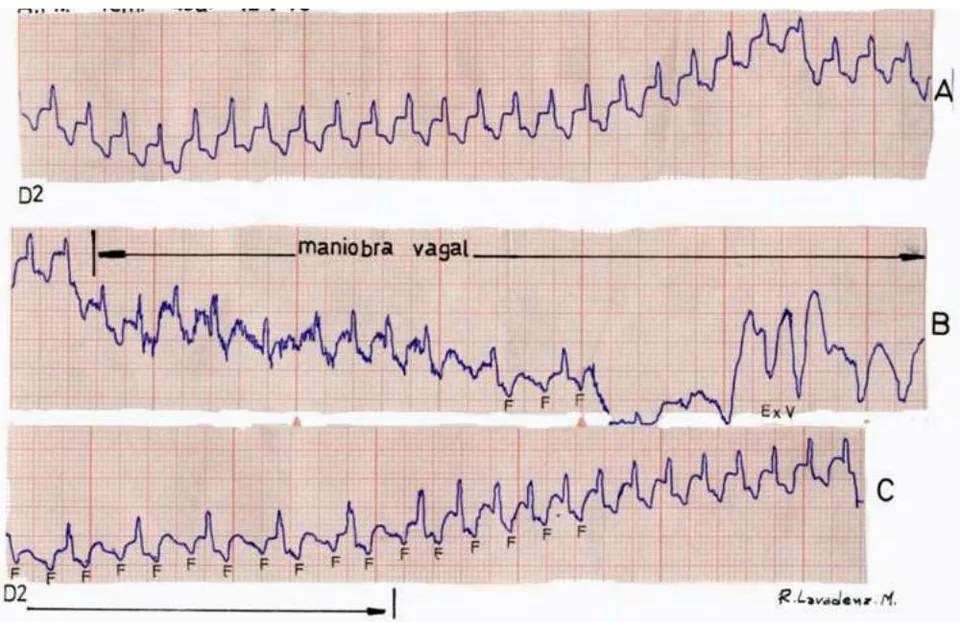
El diagnóstico se estableció por maniobras vagales en 5 pacientes, lo cual permitió ver las ondas de aleteo auricular; en los otros cinco, el diagnóstico se consiguió por el análisis de la frecuencia cardíaca y por visualización de las ondas de la arritmia auricular.
En las siguientes figuras puede verse lo acontecido en algunos pacientes.
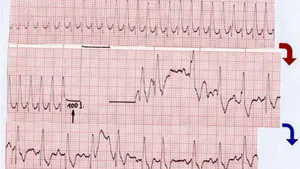
{"image_source":{"path":"images/6d4d2e625cd13c5740fd44ceb8210b65133e76ff6aceda94327be6e72090101d.jpg"},"content":"","chart_caption":[],"chart_footnote":[]} {"image_source":{"path":"images/47af6ea5e51147c47245e848b1b4892bd616e4463c5cd7a91b6cc8e507b02180.jpg"},"content":"","chart_caption":[{"type":"text","content":"Figura No 1: Taquicardia con FC de 270 y QRS ancho. En V1 el complejo QRS es monofásico, con onda positiva; en V6 el complejo QRS tiene una morfología rS; en V2 se ve un polifasismo, en V3 al final de la onda S, existe una onda amplia positiva y negativa, que tiene la misma frecuencia que el QRS. Como el paciente estaba inestable, se procedió a la cardioversión eléctrica."},{"type":"text","content":"Figura No. 2: Mismo paciente de la figura No.
- Trazos continuos: Trazo superior, la arritmia de inicio con una frecuencia de 270. Trazo del medio, Choque eléctrico con 100 J. que consigue revertir a ritmo sinusal, con QRS polifásico y con una duración de 0,12 " de Segundo y FC de 110. Trazo inferior. Ritmo sinusal con imagen de bloqueo de rama"}],"chart_footnote":[]}
IV. DISCUSION
En 10 pacientes, se presentó un ALA con conducción A-V 1:1. En los mismos, solo en un paciente, la digoxina fue el medicamento desencadenante de la arritmia; en los otros nueve pacientes, el ALA, se desencadenó espontánamente, probablemente por la severidad de las cardiopatías subyacentes.
Esta arritmia no es muy frecuente, pues en 47 casos de ALA, se encontró dos con conducción A-V 1:1 (4%) (5). Kawabata y cols en 109 pacientes, encontraron 8 (7%) (12).
Cuando esta arritmia se presenta, plantea dificultades de diagnóstico y de tratamiento, porque se confunde con la taquicardia paroxística supraventricular y con la taquicardia ventricular; de la primera se diferencia por la frecuencia ventricular y por la visualización de las ondas de ALA, que son características y tienen una frecuencia igual a la de los ventrículos; de la taquicardia ventricular, se diferencia por ausencia de disociación A-V y por otros parámetros propios de la taquicardia ventricular, que se exponen en los distintos algoritmos para el diagnóstico (13), la confusión existe porque la onda de ALA deforma y ensancha el QRS, haciendo que se piense en una taquicardia ventricular, pero la frecuencia ventricular que es muy rápida (mayor a 250 por minuto), descarta la arritmia ventricular. De cualquier manera, son las maniobras vagales, al disminuir la frecuencia ventricular, las que consiguen que se vean las ondas de ALA (14).
Los mecanismos de producción de la arritmia en cuestión, son muchos y algunos no bien demostrados. Uno de ellos, es que aumenta la conducción en el nodo A-V (15); otro es el que menciona que el periodo refractario del nodo A-V, se acorta (16), lo cual posibilita que cada impulso auricular se trasmita a los ventrículos.
También se ha indicado, que se produce un enlentecimiento de la frecuencia auricular (17), esto a su vez ocasiona la penetración de los impulsos auriculares, después de la terminación del periodo refractario del nodo A-V. En periodos de esfuerzo físico, se prolonga la longitud del ciclo auricular por activación simpática (18), hecho que produce el desarrollo de ALA con conducción A-V 1:1 y frecuencias ventriculares muy rápidas Los antiarrítmicos por su efecto proarrítmico, pueden provocar ALA con conducción A-V 1:1; Los casos informados son de los siguientes fármacos: Adenosina (19) Vernakalant (20), Flecainida (21), Disopiramida (22), Propafenona (23). Las causas para el efecto proarritmico, sería en el caso de la adenosina, el aumento del tono simpático (24) Luego, algunos antiarrítmicos están contraindicados en pacientes con cardiopatía estructural (25), entonces, cuando pese a eso se administran, sucede enlentecimiento de la frecuencia auricular (26), disminución de la velocidad de conducción auricular (27) en suma: prolongación de la longitud del ciclo del aleteo auricular (28).
Lo que sucede es que, con la intención de revertir una fibrilación auricular, se usan-10-antiarrítmicos, que luego provocan ALA con conducción A-V 1:1 (29). También se usan antiarrítmicos, cuando se quiere enlentecer la frecuencia cardíaca para ver mejor las ondas del ALA; como se informó un caso, en un paciente con ALA 2:1, al que se administró adenosina, para confirmar el diagnóstico; pero se aceleró la frecuencia ventricular y el ALA pasó a una conducción A-V 1:1, con hipotensión, que no fue persistente, mejorando la conducción A-V y las condiciones hemodinámicas del paciente (30): el mismo propósito, se hubiera cumplido, sin complicaciones, con una maniobra vagal.
Otras causas menos frecuentes de esta arritmia, se han informado en casos de pruebas de esfuerzo (31), asociada a endocarditis (32) o hipertiroidismo (33) También se ha descrito presentación espontanea, sin ningún factor predisponente (34).
En cuanto se refiere al tratamiento, las guías de conducta de la Sociedad Europea de Cardiología, sobre taquicardias supraventriculares, indican que cuándo el ALA provoca inestabilidad hemodinámica, se debe efectuar cardioversión eléctrica (35); así se procedió en 5 casos de esta serie presentada, pero también en pacientes estables, si se va a controlar el ritmo, se puede efectuar cardioversión eléctrica, o fármacos antiarrítmicos. En el caso presentado por Sosa y Arce (36) debido a que tenía hipotensión arterial (Presión arterial= 80-60), tanto para el control de la frecuencia cardíaca, como para la reversión de la arritmia (ALA con conducción A-V 1:1), se debió emplear la cardioversión eléctrica.
Como dijimos en líneas arriba, la arritmia en cuestión, tratada en este artículo, debe ser diagnosticada a la brevedad posible, pues la alta frecuencia ventricular, provoca inestabilidad hemodinámica, la cual puede derivar en muerte súbita. La frecuencia ventricular muy rápida (mayor a 200), la visualización de las ondas auriculares típicas del ALA, pero, sobre todo, las maniobras vagales, son las que posibilitan ver las ondas auriculares de ALA. Con una maniobra vagal correctamente efectuada pudo haberse visto el ALA en el caso de Cereceda y Asenjo (37) y luego proceder al choque eléctrico.
En conclusión: En 10 casos de ALA con conducción 1:1, en la mayoría de ellos había una cardiopatía de cierta severidad. La cardioversión eléctrica, fue el tratamiento que se usó en 5 pacientes. Se debe diferenciar de la taquicardia paroxística supraventricular y de la taquicardia ventricular; El diagnóstico debe sospecharse y efectuar maniobras vagales, para ver las ondas auriculares. El estado hemodinámico de estabilidad o inestabilidad, es de tomar en cuenta para el tratamiento correspondiente: Cardioversión eléctrica o antiarrítmicos.
Conflict of Interest
The authors declare no conflict of interest.
Ethical Approval
Not applicable
Data Availability
The datasets used in this study are openly available at [repository link] and the source code is available on GitHub at [GitHub link].
Funding
This work did not receive any external funding.
References
Cite this article
Related Research


Special Issue
Launch a focused special issue to highlight research, emerging trends, and expert insights in your academic field.