



IntelliPaper
Abstract
God is the infinite source of knowledge and periodically reveals tiny portions of His knowledge through chosen messengers, for good of mankind. Words revealed are perfectly designed and some content are identical and some different, as per need of mankind. These revelations are shared orally by messenger with masses and in due course of time, collected, edited and released in written form as scripture. Due to gap of time and communication issues, unintentionally, some errors and contradictions, within and between scriptures, have crept in, otherwise scriptures are in truth. There are three major religions, namely Christianity, Islam, and Hinduism, and their respective scriptures are; Bible, Quran, and Veda. Since source of all scriptures is one and the same, all scriptures are complementary and in true sense have Oneness. This oneness is proved through remarkable similarities between these scriptures by examining events such as the flood, creation of man and woman, the Last Day, and commonalities of popular names like Ram. Attributes of God described in all Scriptures are identical, namely; GOD is Eternal, Unborn, Immortal, Creator of Universe(s) and everything that exists within a Universe, Omnipotent, Omnipresent, Omniscient, Subtlest of all, Unchangeable, Unique, Always Works, Source of Eternal Bliss, etc., establishing oneness of scriptures and oneness of God.
Explore Digital Article Text
I. INTRODUCTION
We learn of God from scriptures. Written scriptures are created out of Words of God; revealed or inspired. In our world, there are three major religions; Christianity (32%), Islam (26%) and Hinduism (15%); accounting for more than two third of total population. Each of these religions have their own principal scripture; Bible, Quran and Veda. Among these Veda is the oldest, next Bible and last Quran. It has been observed that there are some contradictions within every scripture, and also between scriptures, leading to different interpretations of some parts of content, including of God. Based on the in-depth analysis of scriptures, it is concluded that errors and contradictions within and between scriptures, are due to human intervention from the time of revelation, oral communication of revealed content to masses, process of writing orally communicated content with involvement of large numbers of persons, process of collection of written content and finally converting into written and approved Scripture. Otherwise, in reality, there is oneness of scriptures and oneness of God.
Let us look at some historical facts and reports about scriptures which bring out causes of errors in scriptures. Quran revelation started in the year 610 and it was revealed over a period of 23 years, ending in the year 632, year of death of Prophet Muhammad. After Words were revealed to Prophet Muhammad, he communicated orally with his community people. Then some of the followers started writing on available items like dry leaves, stones, paper, cloth, bone fragments, leather, whatever was available to them. After a gap of time, appreciating the importance of revealed content, some followers/leaders of the community undertook the process of compilation and started collecting the written content from hundreds/thousands of people. The process of compilation had started in the lifetime of Prophet Muhammad and continued after his death. Within 20 years of Prophet Muhammad's death, and 43 years after the initiation of revelation, the Quran was committed to written form, out of the revealed Words collected. However, it is known that it has not been possible to collect all the content. In one mosque, in the city of Sana'a, Yemen, manuscripts were discovered which later proved to be the most ancient Quranic text known to exist at the time. What it means is that all revealed content of the Quran is not included in the final compiled version. Further, it has been reported that the Quran, in its present form, contains about 2500 errors of spelling, syntax and grammar. Besides these kinds of errors, there are scientific errors also which unintentionally got included by the committee tasked with compiling the Quran [1]. The Bible has been compiled over a period of about 1,500 years and is a collection of 66 books and letters written by more than 40 authors. Revelation of contents of Bible to Moses is estimated to be between the 16th and 13th centuries BCE. Both the Old Testament and the New Testament have undergone many changes over time, including the publication of the King James Bible in 1611. There has been addition of several books that were discovered later. For example, the Book of Judas, dated to around 280 A.D., was found in Egypt and is believed to contain secret conversations between Jesus and his betrayer Judas [2]. It is reported that there could be around 50,000 Errors and Biblical contradictions in the Bible [3].
Vedas, after their revelation to Brahma, were passed down via an oral tradition for thousands of years before Veda Vyasa compiled them and put them in written form. Veda Vyasa has put it very clearly that he edited the Vedas so they might be assimilated by less intellectual men (Srimad-Bhagavatam 1.4.24, 1.4.25) [4]. Similarly, it is clarified that he compiled and revised Srimad-Bhagavatam (SB1.7.8), so that common men are in a position to understand scriptures. For example, in all scriptures, face of God has been mentioned and it is beautifully clarified that the conception of the virāt universal form of the God, as appearing in the material world, is imaginary. It is to enable the less intelligent to adjust to the idea of the God having form; but factually the God has no material form (SB1.3.30).
Therefore, though revealed Words are perfect, in truth and justice (Q.6:115) [5], but what has been compiled and released as scripture, can have unintentional errors, due to not correctly understanding every revealed Word. Quran makes interesting observations about scriptures which bring out that source of Words of God, in all scriptures, is one and the same and there is oneness of all scriptures:
God Knowledge is infinite and only a very small part of that infinite knowledge is revealed and hence revealed content is only largely in the form of signs (Q-42:51). Infinite Knowledge of God is excellently seen from verse "If all the trees on earth become pens, and the sea replenished by seven more seas were to supply them with ink, the Words of God would not be exhausted" (Q-31.27). This means even if one writes God's Words, in millions and millions of pages, God's Words would not be exhausted, whereas each scripture is just a few hundred or few thousand pages, a tiny fraction. Further, one point which needs to be appreciated is that even a very very small part of revealed knowledge may not be understood by the Messenger. This point has been repeatedly emphasized to the Messenger, in Quran, that if he has any doubt about revealed content to him, he should ask those who have been reading the Book before him and are knowledgeable (Q-10.94, 16.43). This point brings out that earlier revealed scriptures have similar content (Q-3.3, 10.37, 41.43) and in the new scripture revealed, some content is modified, as per the need of mankind. God effaces (deletes/erases) whatever He wills and retains whatever He wills (Q-13.38). With Him is the Mother of the Book; Eternal, Original; sublime and full of wisdom (Q-13.39, 17.58, 43.4).
The purpose of revelation, from time to time, is to set forth the Truth and confirm the Books, which have been revealed earlier, the Torah and the Gospel (Q-3.3, 41.43). Before that for the guidance of mankind; He has also revealed the Criterion (to distinguish the Truth from Falsehood) (Q-3.4). We gave Moses the Scripture and the criterion that you are guided the Right way (Q-2.53). Other Scriptures; Bible and Vedic scripture Bhagvat Puran confirm the same. For example, in the Bible it is clearly stated that "all scripture is inspired by God and is useful for teaching the truth, rebuking error, correcting faults and giving instruction for Right living (2 TIMOTHY 3.16)". "Everything written in the scriptures was written to teach us, in order that we might have hope through the patience and the encouragement which the scriptures give us (Romans 15.4)" [6]. God is author and ultimate source of scriptures (SB 10.16.44) and the Words He speaks, are in the form of revealed scriptures (SB 10.82.30).
We need to understand if Messenger may not understand revealed content, can others, involved in compiling and creating written scripture, fully and correctly understand the revealed content, the obvious answer is No. Further, research has proved that the meaning of words change depending on the context in which they are spoken [7]. There are many verses in scriptures which bring out apparent differences; but reasons for it have been very succinctly answered in the scriptures itself: Each Book (Q-3.7) has two categories of verses:
i. Absolutely clear and lucid (with message of love and peace) verses that are core of the Book.
ii. Others are ambiguous and none knows their true meaning but God. "Those in whose hearts is perversity, go about the part that is ambiguous, seeking mischief and seeking to arrive at its meaning arbitrarily, although none knows their true meaning but God" (Q-3.7) [5]. Therefore, as directed, while quoting the content from scriptures, one should ensure that content is clear and cannot be assigned multiple meanings and contradictions within and between different scriptures. With this in focus, it can convincingly be proved that there is strong evidence that there is oneness of all scriptures. Let us look at some examples of commonness of stories, events, names and attributes; to prove oneness of scriptures and oneness of God.
III. COMMONNESS OF STORIES, EVENTS AND NAMES IN SCRIPTURES
What should be considered as one of the most amazing aspects of scriptures is that in spite of scriptures revealed at different times, to different Messengers, at different locations, in different cultures and in different languages, some stories are more or less similar.
2.1 Flood of Noah (Bible/Quran) and Flood during the Time of King Satyavara (Bhagavat Puran)
The story of Noah's ark is given in the Bible (Genesis) and Quran (23.27-29). In the Bible, the story goes like this: God was sorry that he had ever made men and women and put them on earth who were wicked except Noah (Genesis 6.5). God decided to destroy all living beings. God revealed to Noah that there will be massive flood seven days from now (Genesis 7.14) and asked Noah to build a boat (Genesis 7.4) and to take selected people in the boat, male and female and every kind of animals and birds (7 pairs) and all kind of foods (Genesis 6.13). Because of the flood, everything on earth that breathed died (Genesis 7.22). After the flood was over, a new generation of Noah started (Genesis 9.7).
A similar story of flood is given in the Quran. God asked Noah to build a boat and carry those, in pairs, who have faith in HIM and only they will survive (Q 7.64, 11.36-11.48). Species in pairs were to be carried to create a new generation.
An identical story appears in Bhagavat Puran in which King Satyavara is informed by God that after seven days everything will be inundated (BP 8.24.32). God asked King Satyavara to take the boat (BP 8.24.33) and collect all kinds of herbs, seeds, seven rishis and all kinds of living entities (BP 8.24.34.35, 42), who only would survive and would create a new generation.
It is remarkable to see common features in stories from different scriptures; seven days' time, instruction to build a boat, what is to be carried in the boat and after the flood, creation of a new generation.
2.2 Creation of Man
Description of creation of Man is similar in all scriptures:
In the Bible: Then God said, "Let Us make man in our image, according to Our likeness (Genesis 1:26)". Lord took some soil from the ground and formed a man out of it; He breathed life-giving breath into his nostrils and the man began to live (Genesis 2.7).
In the Quran: We created the human being from clay, from molded mud (Q.15.26) and breathed into him HIS spirit (Q.15.29) and angels prostrated (Q.15.30).
In Bhagavata Purana: As per Vedic scriptures, Brahma, recreates living beings (SB 3.10.19-27), out of what God has already created in subtle form (SB 3.8.33, 2.5.11). Brahma evolved Man and gave him his own human form. On seeing the Man, angels who had been created earlier applauded (BP 3.20.49-51). Further human physical body is created from five fundamental elements, sky, air, fire, water and earth, building blocks of matter. Element Sky creates space, Element Air creates gaseous substances, Element Fire creates all the energies like thermal, light etc., Element Water creates liquid substances and Element Earth creates solid substances. As in the Quran and Bible, the mix of earth and water represent clay. Our body is composed of seven building blocks, namely the thin layer on the skin, the skin itself, the flesh, blood, fat, marrow and bone, and life is sustained by life breath. All the seven building blocks are made out of five elements, earth, water and fire, and the life breath is produced by three elements namely; sky, water and air (SB 2.10.31). Water element being common in seven building blocks of the physical body and life breath which sustains physical body, requirement of water becomes high for living beings. In the human body, water in the body is more than .
As can be seen, there are remarkable similarities in different scriptures about the steps of creation of man; created from clay, God gave HIS own form, God gave life breath and angels applauded.
2.3 Creation of Woman
Creation of woman is more or less similar in all scriptures: In the Bible: “God caused a deep sleep to fall upon Adam and he slept: and he took one of his ribs, and closed up the flesh instead thereof. And the rib, which the God had taken from man, made him a woman, and brought her unto the man. And Adam said, this is now bone of my bones, and flesh of my flesh: she shall be called Woman, because she was taken out of Man (Bible Genesis 2.21-23)” [6]. In the Quran: "O humankind! Be conscious of your Lord Who created you from a single soul, and out of it created its mate, and out of the two spread countless men and women" (Quran 4:1) [5]. From a single soul, first God created man and out of man created woman. In Bhagvat Puran: "In the beginning of creation, Brahma, the father of the living entities of the universe, saw that all the living entities were unattached. To increase population, he then created woman from the better half of man's body, for woman's behavior carries away a man's mind (SB 6.18.30)" [4]. As we can see, in all scriptures, the creation of woman is out of man.
2.4 Persons/Places/Calendar Months Having Name Ram/ Derived from Name Ram
Ram in Vedic Scriptures: Ram is a highly prevalent name among Hinduism. This is because Ram is the hero of popular religious books namely Ramayana authored by Valmiki and Ramcharitmanas authored by Tulsidas. Ram represents the "Sea of Bliss", one of the key attributes of God. In all scriptures, persons/places/calendar months have the name Ram/derived from the name Ram.
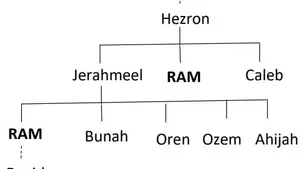
Ram in Bible: In the Bible, there are many examples of the name Ram and names derived from Ram. If one looks at the Genealogy of Jesus Christ, three key persons are Adam, Abraham and David as reported in 1 Chronicles, Matthew 1:1-17 and Luke 3:23-38. Some features of Genealogy of Jesus Christ, as seen in Fig. 1, two of his ancestors had the name Ram (1 Chronicles 2.9 and 2.25).
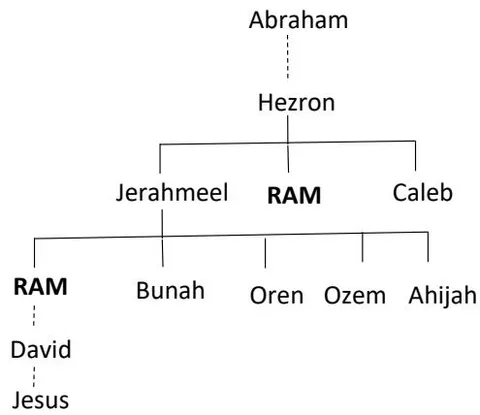
Fig. 1: Genealogy of Jesus showing two of his ancestors had name Ram [6]
There are many names in Bible which are derived from name Ram:
Abraham is considered the most respected prophet in the Bible - a model for mankind. His original name was Abram (Genesis: 17.5)
God revealed the Ten Commandments to Moses which form the foundation of the Bible. Moses's father's name was Amram (Exodus: 6.20).
Abiram, son of Eliab, rebelled against Moses (Numbers 16: 1-2).
Hiram, king of Tyre, was ever a lover of David (1 Kings 5:1).
In the twelfth year of Joram (Jehoram) the son of Ahab king of Israel, Ahaziah the son of Jehoram king of Judah began to reign (2 Kings 8.25).
King Rehoboam sent out Adoniram, who was in charge of forced labor, but the Israelites stoned him to death (2 Chronicles 10.18).
Ramiah was one son of Parosh (Ezra 10:25).
Raamah was son of Cush and Rama's sons were Sheba and Dedan (Genesis 10.7)
Elkanah was from the town/Ramathaim (1 Samuel 1.1).
| Attribute | Bible | Quran | Vedic scriptures |
| GOD ever exists (Eternal, Unborn, and Immortal) | Psalms 90.2 Eternal, forever Isaiah 40.28 Everlasting Isaiah 57.15 Lives forever Isaiah 44.6 First and Last and only God Habakkuk 1.12 Eternal John 3.16 Eternal life | 2.255, 3.2, 25.68 Ever living 2.133, 163 One God 28.88 All will perish but He 57.3 First and the Last | BG 4.6 Unborn and immortal BG 10.9 Original source of energy BG 4.13 Immortal BG 7.25 Unborn and imperishable BG 8.3 Supreme indestructible BG 8.20, 21 Eternal unmanifest supreme divine substance BG 9.13,9.18 Imperishable BG 13.12 Beginning |
| less supreme Brahman neither Sat (being) nor Asat (non-being) BG 18.54 Eternal SB 1.8.16 Unborn SB 2.9.33, 3.5.23, 24, SB 3.10, 11 Before creation only God existed BG 9.30 exists in all phases of creation (before, during and after) | |||
| GOD is Creator of Universe and everything that exists in the Universe | Psalms 90.2 creator of Universe Colossians 1.16 God Created Universe John 5.26 God source of life Ephesians 3.9 God is creator of all things Isaiah 66.2, 40.28 I myself created the whole Universe Job 38.4 God made the world Romans 1.20 [6] Ever since God created this world, his invisible qualities, eternal power and divine nature are clearly seen and perceived in the things, He has made | 20.19 Begins the creation and repeats it 46.3 Created heavens and the earth and all that is in between them, for a specified period. 6.101, 13.26 God has created everything | BG 7.4, 9.4-6 Creator and sustainer of whole Universe and all beings BG 7.10 Eternal seed of all beings BG 9.10 Creator of animate and inanimate BG 9.17 Sustainer and ruler of whole Universe BG 9.13 Prime cause of creation BG 10.8 Source of all creation, everything in the world moves because of God BG 10.32 Beginning, middle and the end of all creations BG10.39 Seed of all beings. There is no creature - moving or nonmoving-that can exist without God. SB 1.10.24 It is He who creates, maintains and annihilates of material world SB 2.5.21 God Creates SB 2.6.13-16 Everything from God SB 7.9.20 Everyone in this material Universe is manifestation of God's energy and his manifestation |
| GOD is Omnipotent (Infinite magnitude of energy and power) | Numbers 11.23 Is there a limit to my power? Romans 1.20 Eternal power and divine nature Psalms 46.10 Supreme Psalms 14.11 Almighty Job 11.7 - 8 Limitless Luke 1.37 For there is nothing that God cannot do Psalms 147.5 Great and mighty. His wisdom cannot be measured Romans 1.20 Eternal power | 2.106, 5.17 All Powerful 5.28 Lord of entire Universe 13.2 Governs entire order of Universe 29.19 - 20 God has power over everything | BG 5.29 Lord of all worlds BG 8.9 Sustainer of all BG 8.11 Indestructible BG 10.2 Supreme Lord of Universe BG 10.7 Supreme glory and super natural power BG 11.19 Unlimited Powers BP 2.6.36 Limitless SB 1.8.20 Unlimited and unequal SB 2.5.21 Controller of all energies SB 1.17.23 Infinite magnitude and Inconceivable Energy SB 1.18.20 Unlimited |
| GOD is Omnipresent (Present Everywhere) | 2 Chronicles 2.6 All vastness of heavens cannot contain him Jeremiah 23.23, Psalms 139.7 God is everywhere | 2.115 In all directions 16.52 Pervades the whole Universe 34.3 Nothing escapes Him | BG 5.15, 5.29 Omnipresent BG 2.17, 13.13 All pervading SB 8.17.09 All pervading SB 12.3.4 Unthinkable, all pervading |
| GOD is Omniscient (Most knowledgeable and knows everything) | Psalms 147.5 His wisdom cannot be measured | 6.103 Acquainted with all things 57.3 Knowledge of everything 39.46 Knew of unseen and seen | BG 8.9 All wise eternal being SB 1.8.28 Destines all actions and reactions |
| GOD is Subtle of all (finer than the finest and hence cannot be seen) | John 1.18 No one has seen God Exodus 33.20 No one can see God. | 6.103, 30.16, 12.100, 67.14 Allah is subtle 7.143 Cannot be seen by anyone 34.16 Most subtle 5.94 Beyond reach of perception | BG 8.9 Subtler than the Subtle BG 13.15 Because subtlest hence incomprehensible BG 13.16 Indivisible BG 18.18 Invisible to all BP 8.16.30 Subtle not visible to human eyes SB 2.10.34 Finer than the finest SB 5.1.1 Beyond experimental |
| SB 1.6.25 Unseen by eyes | |||
| GOD is unchangeable | Malachi 3.6 God does not change | 3.18 Unchangeable | BG 7.24 SB 1.2.11 Non-dual substance |
| GOD is Unique | Deuteronomy 6.4 The Lord is our God, the Lord is one Ephesians 4.4 There is only one Lord | 112.1 He is God, the unique one 112.5 There is none co-equal or comparable to Him | BG 10.15 Yourself alone know Yourself through Yourself BP 8.18.32 One without second BP 1.8.20 None equal to Him |
| GOD always Works | Philippians 2.13 Because God is always at work in you to make you willing and able to obey his own purpose | 6.135 God works all the time | BG 3.22 God always works BG 3.24 If God stops working, these worlds will perish SB 1.8.30 you work, though You are inactive |
BG-Bhagavad Gita [8]
- Then the king of Israel gathered the prophets together, about four hundred men, and said unto them, Shall I go against Ramoth Gilead to battle, or shall I forbear (1 Kings 22.6)?
Ram in Quran: There are names of places derived from Ram like Iram (Q 89.7) and name of the holiest month Ramadan (Q. 2.185) in which the Quran was revealed.
2.5 Last Day
Interestingly all scriptures give almost similar descriptions of Last Day that everything on earth will get destroyed. In the Bible, it is stated that "By God's word, the present heaven and earth are designated to be burned" (2 Peter 3:7, Malachi 4:1). In the Quran, it is stated that "the earth and the mountains are lifted and leveled with one blow" (Qur'an 69:14). Similar description in Bhagvad Puran: "At the time of the final devastation of the complete universe burning to ashes"( SB 3.11. 30, SB2.2. 26).
III. ONENESS OF GOD
In all scriptures, only one and same God is described, only His names are different which is very much acceptable to God. As in the Quran, God can be called by any name; all His names are beautiful (Q-17.110). Oneness of God is confirmed from the fact that key attributes of God described in all scriptures are absolutely identical, as shown in Table I.
We should readily conclude that there is only one God, and all scriptures describe the same God, as seen from common attributes of Him; like eternal, unborn, immortal, creator of Universe, omnipotent, omnipresent, omniscient, subtle of all hence not seen, unchangeable, and unique and always works.
IV. CONCLUSION
For all scriptures, there is only one source, God. God is an infinite source of knowledge and He keeps revealing some tiny content, as per need of mankind, hence all scriptures have oneness and are complementary. This is seen from remarkable commonness of stories, events, names and identical messages, establishing oneness of scriptures. All scriptures describe absolutely identical attributes of God, confirming Oneness of Scriptures and Oneness of God.
Conflict of Interest
The authors declare no conflict of interest.
Ethical Approval
Not applicable
Data Availability
The datasets used in this study are openly available at [repository link] and the source code is available on GitHub at [GitHub link].
Funding
This work did not receive any external funding.
Cite this article
Related Research

Special Issue
Launch a focused special issue to highlight research, emerging trends, and expert insights in your academic field.