


IntelliPaper
Abstract
Over the last few decades, our uderstanding of both the universe and the microscopic world has progressed remarkably. The rise of modern science, bolstered by the evolution of observational instruments, such as the Hubble and James Webb telescopes for cosmic exploration, and next-generation microscopes for the study of living organisms, has led to significant discoveries. Since the invention of the telescope, astronomers have progressively unveiled the structure and dynamics of the universe, establishing the foundations of astrophysics. In parallel, advances in microscopy have enabled the exploration of the infinitely small, revealing the fundamental mechanisms of the human body and laying the groundwork for physiology and molecular biology.
Nanotechnology has further refined telescopes and revolutionized medical care, particularly in targeted therapy and regenerative medicine. At first glance, the scales of magnitude inherent to the biological world and those governing the observable universe appear fundamentally disjointed. On one hand, molecular biology explores a microscopic universe: cells, proteins, and subcellular structures, where distances are measured in nanometers or even smaller fractions, expressed in negative powers. On the other, astrophysics deals with objects and structures whose dimensions span light-years, parsecs, and megaparsecs, corresponding to extreme positive orders of magnitude.
The systemic complexity of the human organism, much like cosmological structures, simultaneously engages the cognitive, metaphysical, and rational dimensions of the observer. Iconographic data from microscopy and astronomy transcend their purely heuristic function to reveal an intrinsic aesthetic capable of catalyzing intellectual inquiry. These representations facilitate the identification of structural correlations that go beyond simple formal analogy. The emergence of these morphological convergences between radically distinct scales raises a fundamental question: the universality of the laws governing the organization of matter.
Drawing on literature data and a comparative analysis of visual patterns, this article proposes to study the convergences between the universe and the human body, the two most complex natural systems identified to date. The central objective is to identify and characterize the multidimensional analogies that unite these two seemingly disparate disciplines. This comparative approach, which remains marginal in conventional scientific literature, moves beyond mere aesthetic observation to address fundamental questions regarding the universality of laws governing complex structures. By exploring intracorporeal architectures as reflections of cosmological dynamics, this work suggests that probing the living organism is, by extension, a means of deciphering the organizational principles that govern the very architecture of the universe.
Explore Digital Article Text
INTRODUCTION
The microscopic universe within the human body and the vastness of the cosmos seem, at first glance, to belong to two radically different realities. Exploring the human body leads us to structures such as cells, organelles, macromolecules, and protein complexes, whose sizes range from the micrometer to the nanometer scale, and even smaller, down to about m for certain atomic structures.
In contrast, astrophysics deals with objects whose sizes extend from several light-years ( m) to megaparsecs ( m), involving positively exponential orders of magnitude. These two domains therefore appear to operate in entirely separate metric regimes: one in the ultramicroscopic, the other in the ultramassive.
Although the invention of the microscope is often associated with a simple adaptation of Galilean optics [1], the history of science emphasizes instead a parallel development in lens-polishing techniques and refractive principles, which allowed for the simultaneous exploration of both extremes of the metric scale. While these two instruments were initially intended for distinct phenomenological domains, their technical evolution has revealed an unforeseen structural reality: the existence of morphological convergences transcending the opposition between the infinitely large and the infinitely small.
Beyond mere visual resemblance, these similarities, such as neural networks and cosmic filaments, or arborescent and spiral patterns, are now integrated into the theoretical frameworks of fractal geometry and network theory. These disciplines suggest that the organization of matter, whether biological or cosmological, responds to principles of self-organization and universal topological constraints. Thanks to advancements in computational imaging and multi-messenger astrophysics, these “inverted mirrors” are no longer perceived as optical coincidences, but as manifestations of a fundamental scale invariance.
The present article proposes to examine exhaustively two of the most complex natural systems identified to date: the universe and the human body, based on literature data and the analysis of visual patterns. The central objective of this study is to identify and characterize potential analogies, whether numerical, historical, morphological, structural, or technological. This comparative approach, still marginal in conventional scientific literature, raises fundamental questions regarding the universality of the laws governing complex structures.
THE MACRO AND THE MICRO: NUMERICAL INSIGHTS INTO THE COSMOS AND THE HUMAN BODY
At the subvisible scale of the human body, biological structures are organized across a wide range of sizes, from tens of micrometers down to nanometers and beyond. A typical human cell measures between 10 and 30 micrometers ( m), while intracellular organelles such as the nucleus, mitochondria, or lysosomes range from 0.1 to 5 micrometers [2]. At a smaller level, protein complexes (such as ribosomes) and macromolecules extend within the 10 to 30 nanometer range, with the DNA double helix measuring about 2 nm in diameter. Beyond that, lipid membranes have an average thickness of 4 to 5 nm, and interatomic distances approach 0.1 nm [3]. Although the human body appears compact and limited in size, it conceals an organization of staggering complexity, revealed through the scale of the numbers that characterize its biological structures.
At the microscopic level, the human nervous system is also a marvel of complexity, comprising about 86 billion neurons () [4]. These nerve cells are interconnected by a colossal number of synapses, estimated at 100 trillion (), forming an unparalleled communication network underlying thought, emotions, and vital functions.
The vascular network within the human body contains an immense number of capillaries, about 10 billion (), ensuring blood exchange with all body tissues [5].
The lungs contain approximately 480 million alveoli (), true gas-exchange units responsible for oxygenating the blood and eliminating carbon dioxide, with an exchange surface estimated between 70 and 100 m [6].
The visual system relies on an impressive structure comprising more than 250 million photoreceptors () for extremely fine visual perception; each eye contains about 6 million cones (), specialized for color vision, and nearly 120 million rods (), dedicated to night and peripheral vision [7].
The kidneys, true biological filters, contain about 1 million nephrons per kidney (), or 2 million in total (), filtering roughly 180 liters of blood daily [8].
The skin, the largest external organ, covers about 1.7 to 2 m and houses nearly 5 million hair follicles (), including 100,000 () on the scalp, as well as 2 to 4 million sweat glands (), playing a key role in thermoregulation [9].
In humans, DNA is organized into a genome containing approximately 3 billion base pairs (), distributed across 23 pairs of chromosomes and encoding the genetic information required for cellular processes [10–12]. This information governs gene expression and orchestrates protein production, fundamental to cellular structure and function.
On the other hand, the observable universe is of dizzying vastness, populated by an incredible variety of celestial objects. It is estimated to contain about 2 trillion galaxies (), each harboring on average between 100 billion () and 400 billion () stars, leading to an astronomical total of around stars, more than the total number of grains of sand on Earth [13, 14].
Orbiting these stars are planets: more than 6,000 exoplanets have been confirmed to date [15], but estimates suggest there could be up to about 100 billion planets in the Milky Way alone [16]. Meanwhile, the universe contains many compact objects such as stellar black holes, whose number in our galaxy may exceed 100 million [17], as well as neutron stars, observed in large numbers though their true galactic population is estimated at several million. On even larger scales, galaxies group into clusters and superclusters; our own supercluster, Laniakea, contains about 100,000 galaxies [18]. Finally, the universe is structured on the largest scales by cosmic filaments, true gravitational bridges stretching across billions of light-years.
Despite its relatively small size, the human body rivals the most complex systems in the universe in sophistication and structural density.
The fact that a single organ, the human brain, contains almost as many connections as there are stars in a galaxy reveal a fractal structure of complexity linking humanity and the universe.
TELESCOPE AND MICROSCOPE: A TECHNOLOGICAL SYNERGY BETWEEN THE COSMOS AND LIVING SYSTEMS
Historically, the invention of the microscope was inspired by the telescope. In the early 17th century, Galileo Galilei, after improving the astronomical telescope, adapted the same optical principle, a converging lens combined with a diverging lens, to observe the microscopic world, thus inaugurating a new era in the visualization of living systems [19, 20]. Telescopes and microscopes therefore share a common physical foundation: the capture of light, its focusing by lenses or mirrors, and the magnification of the image to reveal structures invisible to the naked eye [21, 22].
Over the centuries, these two instruments have evolved in parallel, exploiting the same technological advances. The James Webb Space Telescope (JWST) observes the universe in the infrared to detect distant galaxies and stellar nurseries hidden by cosmic dust [23]. Similarly, infrared fluorescence microscopes make it possible to image biological tissues in depth and are widely used in oncology, nephrology, and neurobiology [24].
Moreover, immunofluorescence, which relies on antibodies coupled to fluorescent markers, enables the targeting and visualization of specific cellular structures at the nanometer scale [25], just as the JWST uses filters and coronagraphs to isolate a star’s light and observe exoplanets [26].
Likewise, confocal laser scanning microscopes use tunable laser sources to generate fine optical sections, while modern telescopes employ lasers for real-time correction of atmospheric turbulence through adaptive optics [27], a technology now transferred to ophthalmology, particularly for high-precision retinal surgery [28].
ONE VIEW, TWO SCALES, TWO DOMAINS
Scientific imagery, whether derived from observations of deep space or from cross-sections of biological tissue, is often perceived as an objective representation of a reality invisible to the naked eye. Yet when certain images from astrophysics, nebulae, galaxies, cosmic filaments, are placed side by side with histological images (neural networks, cellular structures, connective tissues), a sometimes striking visual resemblance emerges. These morphological, structural, and aesthetic similarities invite deeper reflection. Some of these resemblances are illustrated in the following figures:
Stars can form magnificent patterns as they age; the Butterfly Nebula is a remarkable example. Although its gaseous wingspan extends over more than 3 light-years ( m) and its estimated surface temperature exceeds 200,000 , this planetary nebula shines intensely in visible and ultraviolet light, yet remains hidden from direct observation by a dense torus of dust [29]. The morphological appearance of this nebula is reminiscent of a cell undergoing division, whereas the size of chromatin ranges between 11 and 30 nm ( m) [30]. (Figure 1)
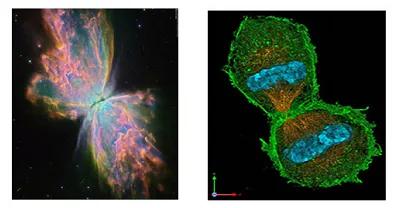
Morphological similarity between the Butterfly Nebula as seen by Hubble and a cell undergoing division. Left: The Butterfly Nebula as seen by Hubble Space Telescope. Highlighted light emitted by oxygen (blue), hydrogen (green), and nitrogen (red). Image credit: NASA, ESA, Hubble; Processing: William Ostling [29]. Right: A cell undergoing division (in telophase). New nuclear membrane forms, microtubules disappear (red), nucleolus reforms, and chromatin is present (blue) [30].
The Helix Nebula is often compared to a giant eye floating in space. Its circular structure, luminous center reminiscent of a pupil, and shades of blue and green strikingly evoke a human iris. This resemblance is so strong that it is sometimes nicknamed the “cosmic eye.” Yet the difference in scale is staggering. A human eye measures about 2.5 centimeters in diameter, whereas the Helix Nebula extends across approximately 2 to 3 light-years ( meters). What appears to be a simple bright “pupil” is in reality a dying star, and what resembles a colored iris corresponds to clouds of ionized gas expelled into space. (Figure 4) Astronomers have been fascinated by recent images from the James Webb Space Telescope, which bear a striking resemblance to a transparent cosmic skull, revealing the “brain” it appears to contain. The nebula, officially named PMR 1, was formed by an aging star expelling its outer layers. The differences between what the James Webb Telescope’s infrared instruments reveal and conceal within the PMR 1 nebula (“Exposed Skull”) are evident in this comparative image. More background stars and galaxies shine in the field of view of Webb’s Near-Infrared Camera (NIRCam), while cosmic dust appears more intensely in the light captured by the Mid-Infrared Instrument (MIRI). The central dark band that contributes to the nebula’s distinctive brain-like appearance is more visible in NIRCam images, but its apparent role in the ejection of material at the top and bottom of the nebula is more clearly seen in MIRI images. Observing the cosmos at different wavelengths of light provides a deeper understanding of how the universe functions. (Figure 5)
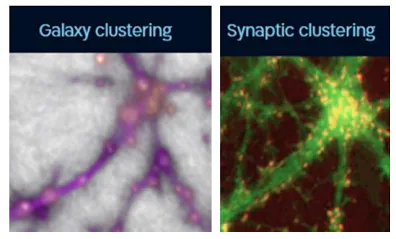
Morphological similarities between a simulated cosmic web and a neuronal culture. Left: A simulated cosmic web (violet) with filaments connecting dense nodes of galaxy clusters (pink-brown points). Image credit: NASA, ESA, and University of California, Santa Cruz (J. Burchett and O. Elek) [31]. Right: A neuronal network in culture showing a dendritic hub (green) enriched with synaptic puncta (yellow) [31].
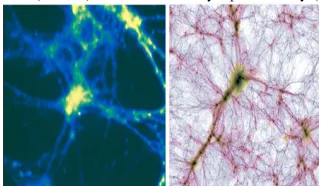
Enrichment at convergence sites in both networks. Left: Convergence sites of neuronal processes (in blue) show increased synaptic activity (in yellow). Width = 60 mm. Right: Cropped image of a thin slice through the large-scale cosmic structure from the IllustrisTNG TNG300 simulation. Credit: IllustrisTNG Collaboration (IllustrisTNG, TNG300).
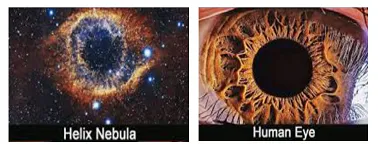
The Helix Nebula, the “Cosmic Eye,” as seen by the James Webb Telescope. The Helix Nebula (2–3 light-years wide) strikingly evokes a human iris. What appears to be a pupil is a dying star, and the colored iris corresponds to ionized gas. Image credit: ESO, VISTA, NASA, ESA, CSA, STScI, J. Emerson (ESO) [34].
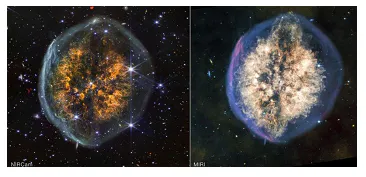
The PMR 1 Nebula, the “Cosmic Skull,” as seen by the James Webb Telescope. Image credit: NASA, ESA, CSA, STScI; Processing: Joseph DePasquale [35].
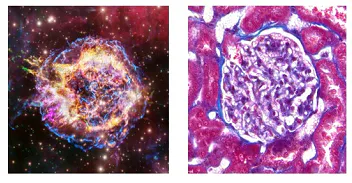
COMMON SYSTEMIC AND DYNAMIC PRINCIPLES
The human cardiovascular system ensures the continuous distribution of blood, oxygen, and nutrients through a branched network of vessels, comparable to the flows of matter and energy observed in galaxies, nebulae, or the interstellar medium [36, 37]. Similarly, the electrical signals circulating within the nervous system can be paralleled with the propagation of electromagnetic waves in space, which transmit information across vast distances [38, 39].
Moreover, gas exchange in the lungs (O/CO) recalls the cosmic cycles of transformation of interstellar gas, contributing to the birth and death of stars [40, 41]. A certain balance governs both the human body and the cosmos: in the organism, this takes the form of homeostasis, ensuring the stability of vital functions [42], while in the universe, it manifests through gravitational and thermodynamic equilibria that structure stellar and galactic systems [43].
ASTRONOMY, OPHTHALMOLOGY, AND ONCOLOGY: TECHNOLOGICAL TRANSFER BEYOND SIZE SCALES
In ophthalmology, adaptive optics, originally developed to correct atmospheric turbulence in ground-based telescopes [44], is now used in retinal surgery. It improves the precision of surgical instruments in real time by compensating for micro-eye movements and individual optical irregularities, enabling ultra-detailed visualization of the retina and its capillaries [45, 46].
Similarly, in oncology, the analysis of suspicious pigmented lesions and breast nodules indicative of potential cancer benefits from advanced imaging techniques inspired by astronomical image processing. Models originally designed to identify complex galactic structures are adapted to discriminate asymmetric, irregular, or evolving patterns in skin and breast tissue, sometimes achieving detection rates higher than those of clinicians [47–49].
NANOMEDICINE AND NANOASTRONOMY
Nanotechnology involves manipulating matter at the nanometer scale. In medicine, it has enabled major advances in the diagnosis, treatment, and prevention of diseases [50, 51]. In astronomy, it plays a crucial role in the design of instruments, satellites, and space missions [52].
Nanomedicines target cells directly, including neoplastic cells, reducing the side effects of anticancer treatments. These nanomolecules are also used in vaccination, as in COVID-19 vaccines, where lipid nanoparticles protect RNA and facilitate its entry into cells [51]. Nanomaterials serve both regenerative medicine, for the repair of tissues and organs, and astronomy, where they improve telescope precision and the performance of telescope mirrors [52].
ARTIFICIAL INTELLIGENCE: MAPPING THE HUMAN BRAIN AND DECIPHERING THE SECRETS OF THE MILKY WAY
Magnetic resonance imaging (MRI) allows for non-invasive visualization of the internal composition of the human body [53], while radio astronomy uses radio waves to probe the most distant and obscured regions of the universe [54]. In both fields, the analysis of massive, noisy datasets increasingly relies on artificial intelligence, which is used in astronomy to classify galaxies or detect exoplanets [55], and in medical imaging to enhance resolution and automate diagnoses [56].
CONTEMPLATING THE UNIVERSE: SILENT PSYCHOTHERAPY NURTURING WONDER AND SOOTHING THE MIND
Contemplating the starry sky or vast cosmic structures is not merely an aesthetic experience; it produces measurable effects on psychological and emotional well-being. Research in cognitive psychology and neuroscience has shown that this visual and mental engagement with the immensity of the cosmos induces a sense of awe, associated with reduced stress and anxiety, increased curiosity, and the development of a beneficial sense of humility [57–59].
Cosmic awe: a powerful psychological trigger — The concept of awe, a complex emotion often translated as wonder or amazement, was defined by psychologists Dacher Keltner and Jonathan Haidt as an emotion triggered by the perception of something vast, beyond one’s usual frame of reference [60]. Contemplating celestial phenomena such as the Milky Way, nebulae, or the rising Moon can evoke this type of emotional response, fostering fascination, curiosity, and introspection [61].
Proven anti-stress and anti-anxiety effects — Multiple studies have shown that experiences of awe induced by observing the night sky or cosmic scenes can reduce stress levels and improve markers of mental well-being. Experimental work has highlighted decreased anxiety and improved mood in participants exposed to images or videos of space, compared to control groups [62–64]. Observing the sky, especially in natural environments or away from artificial light, activates the parasympathetic nervous system, promoting physiological relaxation responses [65]. This experience induces a mental state similar to meditation, comparable to effects seen in mindfulness practices, with reduced cognitive and emotional activation [66, 67].
Humility and re-centering: a salutary perspective — Contemplating the unparalleled dimensions of the universe, galaxies millions of light-years away, filamentary cosmic structures, reminds us of our tiny place in an almost infinite space-time. This awareness generates what researchers call “existential humility,” which, far from causing despair, is often linked to reduced narcissism, increased solidarity, and a sense of connection to the world [68]. Cosmic experiences can reorient priorities, dissolve excessive ego, and highlight the beauty of a universe of which we are only an infinitesimal part.
Hypnotic and sensory experience — The night sky also exerts a hypnotic sensory power. The slow movement of the stars, the steady rhythm of the universe, and the gentle alternation between light and darkness create a visual scene conducive to deep relaxation. Prolonged exposure to these images—whether through telescopes, astronomical simulation applications, or simple naked-eye observation—can produce an altered state of consciousness, akin to daydreaming or meditation.
CONCLUSION
This study demonstrates that the convergence between the universe and the human body transcends simple aesthetic analogy, anchoring itself in a reality of systemic complexity and scale invariance. The analysis of visual patterns, supported by the theoretical frameworks of fractal geometry and network theory, reveals that neural structures and the cosmic web share universal topological properties of self-organization, analogously optimizing the flow of information and energy.
This porosity between the infinitely large and the infinitely small is concretely manifested through major technological transfers, such as the application of astronomical adaptive optics to retinal microsurgery or the use of galactic detection algorithms in breast oncology. While the contemplation of these "inverted mirrors" evokes a sense of wonder with genuine psychotherapeutic benefits, it primarily calls for a scientific paradigm shift. Future research should prioritize systematic quantitative morphometric analysis and the application of astrophysical multi-spectral imaging to high-resolution biomedical visualization. Understanding living systems thus amounts to deciphering the fundamental laws presiding over the architecture of the universe, unifying reason, technology, and the profound unity of nature.
Conflict of Interest
The authors declare no conflict of interest.
Ethical Approval
Not applicable
Data Availability
The datasets used in this study are openly available at [repository link] and the source code is available on GitHub at [GitHub link].
Funding
This work did not receive any external funding.
References
Cite this article
Related Research

Special Issue
Launch a focused special issue to highlight research, emerging trends, and expert insights in your academic field.