


IntelliPaper
Explore Digital Article Text
I. PROJECT JOURNEY AND PROBLEM STATEMENT
It is important to state that this study project is a product of more than five years of inclusive continuing investigations into the Libyan education system. It has been undertaken through a sequence of comprehensive studies and proposals, all aimed to rescue the LES from near collapse by finding solid phases and actions that could lead to effective growth in administrators' mindsets, educators' skills, and attitudes and reliability among executives and policy makers. The first proposed framework (NLPER-2017) was intended to raise awareness of the necessity of reform rather than propose solutions, as the problems faced by the Libyan higher and vocational education system, both public and private, are due to widespread and deeply rooted conditions that demand responsible reform action. Therefore, Elabbar (2017) proposed an exhaustive list of developmental phases designed for careful implementation over six years of gradual reform (p. 3).
This was followed by another detailed administrative proposal titled "Contextualizing the First Two Years of the Libyan Education Reform Proposed Strategies (2020–2026): Targeted Candidates and Reflective Activities" published in May 2018, which explained in detail the proposed Phase I activities of the first two years of the reform plan. The first phase aimed to involve key Libyan education officials and policy makers from Parliament, the government, and local education authorities during two years of continuing professional development (CPD). Elabbar (2018) explained that these two years of intensive reform preparations were necessary to develop educators' knowledge of education and get them ready for the proposed journey.
The two years of practice will be implemented through national training programs, intensive CPD for different scales and models, teacher education projects, detailed quality assurance workshops, short- and long-term policy workshops, and curriculum and pedagogical development (both inside and outside of Libya) aimed at joining technologies within the whole education scheme. Besides running collaborative studies, reflected focus groups, reform conferences, and seminars on such suggested reform steps are the way to obtain insights about the real conditions and possible management and further development of the reform plan. These arrangements are intended to guide policy makers, administrators, and key educational figures in implementing the main goals of the proposed phases of gradual reform.
Phase II of the planned strategy was elaborated in a comprehensive 2019 study titled "Employing the Subsequent Four Years of the Libyan Education Reform Strategy: Administrations and Contributors" which described in full detail the four remaining executive years of the reform strategy after considering the prevailing constitutional laws, existing educational regulations, calculations of population increase, and estimated project costs according to the annual budget allocations of the various ministries of education.
Elabbar (2019) demonstrated that these four years of transformational acts are concerned with extending insights and suggestions concerning how to improve constraining polices, regulations, required professional development, and QA for other education contributors. It also explained how to execute the remaining steps to begin reform on the ground, alternating between the current and proposed education systems, and explained all considerations and professional measures necessary to maintain balance between these systems during the suggested six years of reform (pp. 10–18).
In 2021, another comprehensive field study was summarized in a published paper titled "Strategic Pause on the National Libyan Education Reform Plan: Insights & Enhanced Tactics," which applied Graumann's 2020 idea of "strategic pause" to the projected reform plan and investigated the implications resulting from over ten years of instability and chaos from 2011 to 2021, and from 2017 to 2021 in particular. It also presented an in-depth assessment of the impacts of the coronavirus (COVID-19), wars, and the ongoing political conflicts which had clearly harmed the whole education system in the state of Libya.
Elabbar (2021) showed that there were still massive effects stemming from security instabilities, economic troubles, continuous political crises, and constant wars between militants, in addition to the almost total lack of teaching aids and learning facilities within the country, together with the consequences of COVID-19 and suspensions (strikes) on basic, secondary, and even vocational university education as numerous classes were deferred, cancelled, or disrupted. Also, there were long-lasting effects of unplanned changes of systems and curriculums—for example, moving secondary education "back again" from a specialized system to a general one without clear preparations—which included the deep impacts of administrative bureaucracy, time wasted through vacations and useless exams, impairments to community culture of education, leaders' attitudes toward how education should be, and harmful interference in education management, especially in some villages and towns (pp. 123–125).
Such challenges have "clearly produced unqualified leadership in both ministries" (east and west), and a huge number of decision makers have harmed the LES instead of supporting it. Other challenges include the continued absence of lifelong learning programs and catastrophic weaknesses in the training of schoolteachers, inspectors, and university educators and administrators.
In addition to such issues, Elabbar (2021) found that the consequences of the long-term electricity and fuel crises plus the high cost of living, together with a prolonged lack of cash (money stuck in banks) and other severe problems that the country has experienced since 2014, still have great negative impacts on the psychological and emotional health of students, their scientific and absorptive readiness, and the extent of the support they receive from their teachers and families.
Also, these issues have compelled many members of schools and universities to abandon scientific research and participation in professional development and training programs, which has led to widespread disappointment among teachers, inspectors, education administrators, university educators, and parents. As a result, educational awareness has decreased to the lowest level, and constructive interaction, scientific research, and problem solving have been largely neglected.
In some cases, completion of many core subjects in schools and universities has been neglected because of time wasted in the country. Elabbar (2021) also showed that "Even after announcement of the Government of National Unity (March 2021), nothing has changes except unifying the ministers' offices besides splitting the Ministry of Education into three ministries" (meaning the Ministry of Education, Ministry of Higher Education, and Ministry of Vocational Education), all for political reasons rather than for solving the clear, deep-rooted problems (p. 130).
II. PROJECT INTENDED GOALS
To restructure the suggested NLPER-2017 reform plan based on Elabbar's 2021 project outcomes as clarified and visually displayed in a "ground-up" strategic planning pyramid.
To urge decision makers and educational authorities to implement strategic reform policies with executive regulations intended to widen opportunities for tactical planning in education, implement modern education approaches, decentralize ministry control, employ dynamic leadership instead of the existing bureaucratic leadership, and engage all education stakeholders in significant of lifelong learning.
To concisely explain the proposed key reform stages to enable Libyan legislators, educators, inspectors, administrators, interested professionals, and stakeholders to reflect, develop, and share key insights and debate the desired goals.
To emphasize the necessity of preparing faculties of education to obtain project goals, plan policies, and prepare legislators, leaders, educators, TAs, and pre-service teachers to effectively accomplish this long-term national project.
To engage Libyan officials, researchers, experts, and interested members in playing important roles to support and develop the idea of gradual reform as a fundamental approach for the rescue of the LES from the expected collapse.
To raise awareness and reach a modern generation of pupils who will start a 9AM–5PM prekindergarten stage and in a separate scheme, as this suggested system seeks to begin in year eight of the reform strategy (i.e., after the seven years of gradual reform have been completed).
To sound the warning that if all Libyan authorities do not act immediately, the whole education system will be on its way to a big collapse.
To reproduce all determined NLPER-2017 VMGs and objectives in an accountable and developed perspective to handle the existing updates and expectations.
To emphasize the importance of reforming the educational management mindset and culture of leadership, and to promote impression that without developed education and responsible leadership, the chaotic and dangerous state of Libyan education will never improve.
III. BRIEF FORM OF THE LITERATURE
3.1 Education Complications in the state of Libya
The Libyan Organization of Polices & Strategies (LOOPS) (2016-NGO) conducted a great study on the LES and came away with substantial conclusions about Libyan educational challenges. The study concluded that that LES faces "poor academic achievement, poor private education; as many of these schools are 'places where meaningless education is provided;'" an absence of strategies for the educational process in Libya, and weak curricula taught in the different school stages. The study also stated, "We can rather say that i.) The Libyan curricula are not linked to a 'well-done' educational plan, and ii.) a major part of the curricula is imported from the Singaporean curricula" (representing a completely different culture and style of teaching and learning). Additionally, the study showed poor performance given the "lack of education management experts" as headmasters depend on their natural ability rather than technical management approaches to manage their schools. This causes many challenges as various school administrations experience problems in dealing with teachers, administrative hierarchies, and awareness of individual responsibilities within school administrations (pp. 15–19).
Both El-Hawat (2006, p. 215) and Elabbar (2016) claimed that most school and university education is managed by directors who apply whatever policy they personally feel is most appropriate. This point has caused conflict between schools, universities, faculties, and even departments. For example, because of the absence of executive strategies, the ministry of education (either east or west) only permits its national university directors (presidents) to apply whatever policy they individually feel is suitable for them to use.
Elabbar (2019) explained that in 1995, the Libyan Education Authority, according to its "Vers-109," revealed that the Libyan government simply provides general policy statements identifying the determinations of the school. For instance, the "curriculum must cover all activities in a school designed to promote the moral, cultural, intellectual, and physical development of students, and must prepare them for the opportunities, responsibilities and experiences of life and society, etc." (p. 66). On the other hand, but in equal context, because of unique circumstances—for instance, the suspension of teaching English as a foreign language (EFL) for long time, the interchangeable management of the whole education system, prolonged civil wars (2011–present), and corruption within the scholarships program—two different generations of EFL teachers (OGT and NGT) have emerged at the university level.
With the same EFL perspective, according to Orafi and Borg (2009), the ban on the English language has deprived teachers of training in new trends in teaching and made students struggle with unfamiliar communicative technique-based activities, such as group and pair work. Orafi (2013) also highlighted that "The students only act as listeners. The students come to the school only to listen to what the teachers say. They do not think that they should actively participate in the classroom activities to learn English" (p. 5). Alhmali (2007) has stated that the objective of educators in Libya is for students to pass exams with the highest possible scores (p. 88).
Additionally, Elabbar (2019) pointed out deep influences of the administrative bureaucracy, culture, social interference, and corruption in education management. All these problems have clearly produced unqualified leadership in decision makers in both ministries (east and west) and have exacerbated the problems of the education system overall, along with the continued absence of lifelong learning programs and catastrophic weaknesses in the declared strategies of training among school and university educators and administrators (p. 77).
3.2 Qualitative Research: Collection and Analysis
The process of qualitative research supports the researcher in collecting valuable data and findings, and it helps in obtaining the field study's main aims. Bogdan and Biklen (1998) added that "qualitative research is showed in the natural world and uses several techniques that are interactive and holistic. It supports gathering data that is rich in description of people, the investigation of topics in context, and an understanding of behavior from the participants' own frame of reference" (p. 10). Strauss and Corbin (1990) explained that qualitative research is generally defined as "any kind of research that produces findings not arrived at by means of statistical procedures or other means of quantification" (p. 17). Flick (2002) said that qualitative research is useful for exploring "why" rather than "how many" (p. 4). Also, Davis (1995) shows that qualitative research is emergent rather than "tightly prefigured" and is fundamentally interpretive (p. 429).
Holliday (2005) explained that qualitative research is "going to be 'open-ended,' to look profoundly into the participants' behaviors within the specific social settings" (p. 5). Berg (2004) showed that qualitative research "provides the framework to explore, define, and assist in understanding the social and psychological phenomena of organizations and the social settings of individuals" (p. 11).
Lincoln (2000) explained that qualitative research includes an "interpretive and naturalistic approach. This means that qualitative researchers study things in their natural settings, trying to make sense of, or to interpret, phenomena in terms of the meanings people bring to them" (pp. 3–4). Noble (2013) stated that qualitative research is a generic term that describes a group of methods, and ways of collecting and analyzing data that are interpretative or explanatory in nature and focus on meaning (p. 2). Pope and Mays (1995) described qualitative research as the development of concepts which help us to recognize social "phenomena in natural rather than experimental settings, giving due emphasis to the meanings, experiences, and views of the participants" (p. 44–45). Nigatu (2009) showed that qualitative data analysis is the range of processes and procedures whereby we move from the qualitative data that have been gathered into some form of explanation, sense, or interpretation of the situations we are investigating. Qualitative data analysis is generally based on an interpretative philosophy, and the idea is to examine the meaningful and symbolic content of the qualitative data (p. 22).
3.3 Strategic Planning and Planning Pyramid
Stephen J. Bigelow, (2020) defined strategic planning as a process in which an organization's managers identify their vision for the future and distinguish their organization's goals and objectives. The process involves establishing the sequence in which those goals should be accomplished so that the organization can reach its stated vision. Also, he explained that "Strategic planning typically represents mid- to long-term goals with a life span of three to five years, though it can go longer" (p. 2).
According to Bryson (1988), strategic planning is a disciplined effort to produce fundamental decisions and actions that shape what an organization is, what it does, and why it does it, with a focus on the future (p. 9). NMAC (2015) lists five essential steps in the planning process. While these steps are a suggestion, they are not the only "recipe for cooking up a strategic plan." Thoughtful and creative planners will add "spice to the mix" or elegance to the presentation to develop a strategic plan that best suits their organization" (p. 15). Indeed (2021) explained that a strategic planning pyramid is important for any type of organization to be successful. It helps a company/organization to generate a simple plan to reach a particular set of goals. Having a strategic plan gives an organization the foundation it needs to grow. A strategic planning pyramid is a visual tool that shows the goals of a business plan from top to bottom (p. 3).
IV. THE FIELD STUDY PRACTICAL METHODOLOGY
As stated above, this paper is a sequence of the previous proposed four linked studies which recommend gradual national reform of the entire LES to resolve the current difficulties facing the whole education sector in the state of Libya. Thus, in addition to the substantial results and contributors noted by Elabbar (2021), this qualitative research and plan will be applied through extra semi-structured interviews, focus groups (especially EFL teachers in the Faculty of Education at the University of Benghazi), needs analysis sheets for university educators and directors and schoolteachers and inspectors, in-classroom research, and Parliament and government document analysis. All will be used as field study data collection tools, and the study will reexamine relevant previously collected data from different perspectives of understanding.
Accordingly, to accomplish the study objectives, this methodology aims to do the following:
i. Qualitatively reexamine all collected interviews and focus group data, meet again with the positioned contributors (directors, key figures, policy makers, decision makers, etc.), analyze official documents and decrees, and reanalyze Elabbar's (2021) findings and recommendations. Additionally, the study will conduct further qualitative field work, focusing especially on the updates that have occurred since the previous work results, to distinguish how new developments may affect the suggested seven-year LES reform strategy. Moreover, this methodology will deeply examine the two latest books published by the Libyan House of Representatives displaying all parliamentary laws and regulations from 2014 to 2022; the study will focus particularly on education laws and regulations noted in the books, if any. Also, the study will measure the impacts of the continuing absence of education policies on the LES (particularly in EFL education) and examine the anticipated effects of the splitting of government in March 2022 into two governments.
ii. Additional field work will be conducted with various students (especially EFL students), TAs, inspectors of public and private sectors, parents, and some vocational institutes, especially the diplomatic institute of Benghazi in the Libyan Ministry of Foreign Affairs.
V. OUTCOMES OF THE FIELD STUDY
As mentioned above, the main goal of this work is to reconfigure Elabbar's (2017) proposed six-year reform plan as a seven-year plan, as this work is an outcome of the Elabbar's (2021) latest strategic pause conclusion and recommendations. This qualitative study concludes with shocking outcomes about the status of the LES at all levels, with the main results as follows:
i. The outcomes of this study project are consistent with Elabbar's (2021) findings that the whole education system in the State of Libya "may collapse" if the government, Parliament, and education authorities in the country do not take serious steps and implement fundamental measures before it is too late (p. 129). Also, this study project found additional shocking evidence about the entire education system, leadership, workers, parents, and even students.
ii. After a comprehensive investigation of the two latest books published by the Libyan House of Representatives (Parliament) which included all rules and regulations from 2014 to 2022, the study unfortunately found no rule, legislation, or any indication concerning the status of the educational system, or even any evidence or hint as to Parliament's interest regarding the circumstances facing the LES.
iii. The enormous impacts of political divisions and continuous upheavals, staff strikes, and long-term outages of electricity on education management, atmosphere, and leadership, in addition to civil wars, are displayed in the stability of the educational infrastructure.
iv. There is a definite lack of progressive education and knowledge shared by and granted to secondary-education pupils who have entered the universities in recent years. This has led to impairments in the essential cognitive skills such students need to deal with the present system, which has led to academic and administrative confusion on the part of universities in handling such challenges.
v. There are countless unqualified administrators and directors in Libyan education, and the resulting deeply rooted challenges are clearly apparent in all stages of education. There are almost no strategic or tactical polices, systematic training opportunities, or professional development programs, nor are there sufficient learning tools, aids, internet access, or even libraries.
vi. After announcement of the Government of National Unity (March 2021), nothing has changed except a reorganization splitting the Ministry of Education into three separate ministries (Ministry of Education, Ministry of Higher Education, and Ministry of Vocational Education). This was done for political reasons and did nothing to solve the deeply rooted problems that existed. Then, in March 2022, with the GNU still refusing to handle authority, Libya became a country with two governments again (with almost five ministers of education at the same time!). As a result, conflicts have increased across all sectors, especially education, and the probability of collapse is increasing unless a miracle happens.
vii. This study aims to alert all Libyan authorities that the whole education system has already started to collapse, and there is no way to recue it without real desire and immediate reforming actions. Without such action, the entire Libyan educational system will fail.
VI. FRAMEWORK OF THE SEVEN PROPOSED YEARS
The outcomes of this study have facilitated wider understanding and enabled the proposal of a clear road map for seven years of gradual reform of the different levels, personnel, and even the structure of the Libyan education system (LES). This reform plan seeks to transform the existing LES into a completely modern system while making recommendations on fixing the current exhausted system for a temporary continuation before it makes a slow disappearance. The following sections will explain the practical actions and key points of the LES reform road map using bottom-up (ground-up) preparation tactics. The suggested seven years of preparation and change should lead to a revised and improved draft constitution (for Parliament to authorize) for the modern reformed Libyan education system.
Wide-Ranging Participants, Transformation, and Implementation of the Project Purposes (3 years
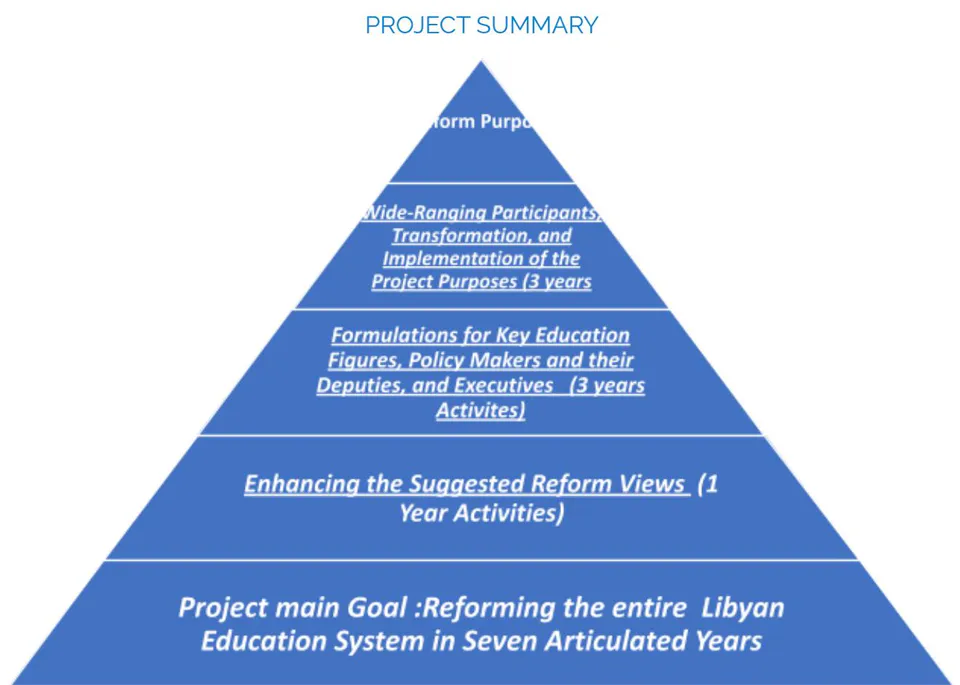
Formulations for Key Education Figures, Policy Makers and their Deputies, and Executives (3 years Activites)
Enhancing the Suggested Reform Views (1 Year Activities)
Project main Goal:Reforming the entire Libyan Education System in Seven Articulated Years
6.1 Stage 1 (One-Year Duration): Enhancing the Suggested Reform Views
This stage will comprise one year of expanding the ideas of the suggested reform plan. This will be accomplished by embracing a wide range of suggestions, welcoming researchers' feedback on the plan, running extra cooperative studies, and holding conferences, workshops, and televised debates on the proposal and its phases. Also, this stage seeks to engage capable community members such as graduates, TAs, parents, retired educators, social workers, well-known experts from inside and outside the state of Libya, and other interested experts in sharing ideas, insights, and recommendations. This year of managed events will enhance the whole recommended reform strategy. Accordingly, this stage must be administrated by authorities on a national scale to facilitate wider attendance, logistical participation, added value to the plan, and professional and social accreditations.
6.2 Stage 2 (Three Years): Formulations for Key Education Figures, Policy Makers and their Deputies, and Executives
This important stage of professional development and reform practices has been extended to three years (instead of the proposed two years) to accomplish the anticipated goals and outcomes of the mission outline. Elabbar (2017) explained that the gradual reform preparations for key education figures and policy makers aims to develop a strong base for change, and it seeks to involve the key Libyan educational figures in contributing to expert feedback on the reform plan and its required actions (p. 17). Also, this intensive training proposal requires development of educators' knowledge of schooling and perspectives regarding the wide-ranging transformation. These practices include managed professional training, CPD models, teacher education and reform training, quality assurance workshops, short-term scholarships (inside and outside the state of Libya), the use of technology, and consideration of all professional studies on the existing LES conditions. These preparations will guide participants in putting into practice the main targets of the national education reform project.
This stage involves officials, governmental policy makers, ministry and county managers, education planners, curriculum makers (contractors), teacher trainers, ministry research and training center directors, deans of universities, and all members of faculties of education, inspectors, and new graduates.
6.2.1 Managed Professional Development for the Stage Members: Core Path
These managed intensive actions emphasize the main aims and desired procedures of the LES reform strategy, and they put all targeted figures in the loop of the entire change direction. As each action should be followed by an administrative step at all levels of the plan, the following points summarize some of the recommended activities:
i. Running ongoing workshops, discussions, and training on quality assurance to emphasize its importance for reform, coupled with comprehensive continuing debate, and cascading the newest revisions and national and international conference outcomes regarding the main constraints facing the LES to reflect the suggested results on the reformed policy and executive road map for change.
ii. Managing intensive focus groups, monitoring, and service, and mind-mapping learning about the role of Libyan policy makers and key educational figures in employing the proposed strategies of transforming the LES. Such professional activities need be tracked through workshops, action research, field work, and comparative studies.
iii. Training on developing education legislations, curriculum development, critical thinking, globalization, and international education, as well as the role of CPD at all levels and in policy.
iv. Continuing training on utilizing technology in all levels of education, interactive teaching and learning, and workshops on international languages and the role of educators, teachers, inspectors, and social workers in the intended reform strategies.
v. Preparations on the significance of teachers' TV and children's education channels in education policy and regulations, as well as workshops on the role of modern administration in education development.
vi. Intensive workshops and conferences on the importance of making clear policies and regulations for selecting qualified educators, assessing in-service teachers and inspectors, and suggesting ongoing professional development and lifelong learning regulations. Also included are focused classes on how to combine school education policy, organization, and knowledge with higher education policy and regulations to ensure a smooth transformation.
vii. Holding seminars on the current reform plan and how to start the reform process, as well as scheduling research events on the difficulties facing Libyan education in terms of graduate outcomes, demands of future work markets, and how all must be reflected on the reform dynamic strategy.
viii. Including all activity outcomes in the targeted constitution for education and the reform road map to enable other stakeholders to follow up.
6.2.2 Stage Two: Anticipated Products
The anticipated outcomes of these three-year guided reform practices and leadership should achieve the following:
i. Formalize a dynamic modern constitution for the entire Libyan education system and achieve wide involvement of the entire base and structure of the reform strategy.
ii. Implement new IT and database frameworks for the entire LES to facilitate the application of the reform aims and growth; this should reflect the standpoints of the draft of education constitution.
iii. Motivate policy makers and administrators to overcome the present difficulties facing the Libyan education system, and deliver ideas and contextualize suitable processes and timelines for any intended process. Also, motivate them toward modification of attitudes and perspectives.
iv. Develop educators' and directors' views about the importance of classroom interaction, motivation, student innovation, creation, decentralization of education, teamwork, communicative learning, and incorporating CPD.
v. Develop belief among officials in the significance of quality assurance and overcoming self-interest for the sake of the nation.
vi. Set up criteria for capable teacher trainers, education researchers, materials developers, and policy reformers so they can participate in coming stages of reform.
vii. Establish strong connections with international research centers, councils, counties, and universities, and gain understanding of the latest reform studies and recommendations.
6.3 Stage 3 (Three Years): Wide-Ranging Participants, Transformation, and Implementation of the Project Purposes
The three-year transformation of policy, attitudes, qualifications, and regulations aims to put into practice the project's main goals along with the last stages of production. It also aims to include widespread contributors from schools, the vocational sector, and higher education to unify a clear national attitude toward the change.
The following points summarize the required actions, participants, and institutes that are strongly suggested to participate in this stage.
All members of the last stages should also contribute and share ideas in this stage.
6.3.1 Faculties of education
It is important to include all the reform's main goals into how our pre-service teachers gain and develop their pedagogical content knowledge, as these faculties will also require good classroom equipment, teaching aids, IT systems, modern laptops, online library access, and well-trained educators who have the ability to implement the reform along the targeted path (they should have attended stages one and two of the reform preparations).
6.3.2 Ministry of education training centers (MTCs)
Elabbar (2017) stressed that MTCs must play an important role in accomplishing the reform outcomes through a national teacher training program, action research, coaching, cascading, and transformative training in the new trend of education in the state of Libya (p. 17).
6.3.3 MTCs also must collaborate with national and international universities and county research centers that have gone through complete reform, and they must generate a bottom-up growth process for in-service teachers, inspectors, school headquarters, education administrators, and social workers to take part in framing and contextualizing the change goals and stage outputs for wider audiences.
6.3.4 Government officials
These officials are Parliament representatives, human resource educators, quality assurance administrators, and retired educators (all of whom are invited to cascade). They involve old-generation teachers, new-generation teachers, social workers, and school HQs, in addition to university educators, TAs, university deans, heads of departments, and university administrators. All such educators will want shared workshops, coaching, focus groups, and collective studies to link the main goals of the reform with practice and to unify efforts toward one goal.
6.3.5 Curriculum designers
Designers require intensive professional development on the whole reform plan, materials development, and materials adaptation to be able to achieve the following areas as mentioned by Elabbar (2017):
i. Providing space in teachers' books to enable teachers to develop activities and use ground-up activities.
ii. Requiring the university syllabus to meet the reform preparations in terms of content knowledge, use of technology, and forging of languages.
iii. Creating a core curriculum for the new generation of students who will start in the eighth year (after the seven years of reform). This core curriculum should include reading, writing, math, science, technology, Islamic studies, English language, and citizenship.
6.3.6 Role of social workers in the change
Social workers are important to the gradual change, so they should be involved in these activities. They will be required to further connect with traditional Libyan teachers and students and should be trained on preparing families and students to accept the gradual change.
6.3.7 Budget, Numbers, and Expectations
According to the ministry's unpublished report (2015), over the past 17 years, Libya has spent an annual budget of approximately 1.3 billion Libyan dinars (approximately 1 billion US dollars) for the Ministry of Education only without a clear developmental policy. This unplanned budget has led to a certain extent to corruption because it was not used to build a strong base for the approximately 1.6 million learners in schools, 289,000 learners in the vocational sector, and approximately 493,000 university students.
Elabbar (2016, 2017, p. 20–23) explained in detail the budgeting and required structure, based on the state of Libyan economic abilities and anticipation of pre-K students. Also, he explained the required tools of the modern learning environment and the importance of having well-equipped classrooms (no more than 20 students per class) and well-trained teachers and HQs. These goals can be achieved through a well-organized county system that applies the aims of this project as framework procedures.
VII. CONCLUSION
This study and outline plan came about as a result of years of comprehensive focus on the status of the entire Libyan education system and investigation of its deeply rooted complications. It thus stresses the significance of reforming the whole education system and then splitting the new generation of students (after seven years of responsible reform processes). Otherwise, the Libyan education system will keep collapsing until it reaches a stage where it is hard even to run a reform process. Finally, this work opens more doors and embraces debate for the sake of Libyan education system development.
Copyright Disclaimer
This is an open-access article distributed under the terms and conditions of the Creative Commons Attribution license (http://creativecommons.org/licenses/by/3.0/).
- Shafter Mohammed, Eshteiwi Ahmouda, and Cheptoo Ruth.(2020). "State of Higher Education in Libya: A Game Change Administrative Approach." Shanlax International Journal of Education, vol. 8, no. 3, 2020, pp. 19–23.
https://www.indeed.com/career-advice/career-development/strategic-planning-pyramid https://www.techtarget.com/searchcio/definition/strategic-planning
https://consciousgovernance.com/strategic-planning https://www.nmac.org/wp-content/uploads/2015/04/Strategic-Planning.pdf: National Minority AIDS Council Technical Assistance, Training and Treatment Division 1624 U Street, NW Washington, DC 20009 (202) 234-5120 www.nmac.org
Barbour, R. S., (2001). Checklists for improving rigour in qualitative research: A case of the tail wagging the dog? BMJ, 322(7294), 1115-1117. doi:10.1136/bmj.322.7294.1115
Qualitative Data Analysis Tilahun Nigatu (MPH) M&E and Research Manager African Medical & Research Foundation March 2009: http://www.uop.edu.pk/ocontents/Lecture%201%20B%20Qualitative%20Research.pdf
Conflict of Interest
The authors declare no conflict of interest.
Ethical Approval
Not applicable
Data Availability
The datasets used in this study are openly available at [repository link] and the source code is available on GitHub at [GitHub link].
Funding
This work did not receive any external funding.
References
Cite this article
Related Research


Special Issue
Launch a focused special issue to highlight research, emerging trends, and expert insights in your academic field.