



IntelliPaper
Abstract
In spite of the multilateral advances on human development and environment of the last 50 years, since the Stockholm Conference, and the much greater global awareness of the need for sustainability humankind is challenged by a triple planetary crisis of biodiversity degradation and loss, overexploitation of natural resources, pollution and climate change, together with considerable geopolitical strife. Here we present a set of six boundaries that we believe impede the transition to full sustainability. They are deeply rooted in human individual and collective behavioural characteristics, like selfishness and immediate gratification, developed during the mammalian and Homo sapiens phylogeny and later through civilization advancements leading to scientific, technological, economic and social developments. In turn, they influence restricted approaches to dealing with future consequences, curtailing social cooperation, limiting the common good, protecting personal gain, increasing inequality, fracturing international relations, and fragmenting the connection between human conditions and the role of the natural world. Identifying and analysing these boundaries are essential to finding possible ways to soften them so that progressive sustainability may be achieved.
Explore Digital Article Text
I. MAIN
The Stockholm Conference of 1972, was the starting point of a multilateral process on environmental diplomacy and action. Later the focus on environment and human development evolved into the three dimensions of sustainable development – social and economic development and environmental protection – in the 2030 Agenda for Sustainable Development, and its 17 Sustainable Development Goals (SDG), adopted in 2015. In the SDG, sustainable development is interpreted as a global policy focused mainly on human well-being and the associated environmental issues. Here we use the broader concept of sustainability, which is also related to the three dimensions of sustainable development. 1972 was also the year Limits to Growth was published, which modelled for the first time the unsustainability of unlimited economic growth.
In spite of the developments of the last 50 years and the much greater global awareness of the need for sustainability, food crises and extreme poverty persist in some of the least developed and fragile countries, social and economic inequalities persist or increase almost everywhere in the world, both within and between countries, and humankind is challenged by a triple planetary crisis of biodiversity degradation and loss, overexploitation of natural resources, pollution and climate change, together with considerable geopolitical strife. This paper does not deal directly with the sustainability issues or the sustainability goals and the successes and difficulties to reach them. Instead it addresses the more fundamental question of why humans have been broadly failing in their quest to reach sustainability in the last 50 years, although some progress has been achieved.
Examining planetary boundaries that constitute a risk for achieving sustainability has long been in vogue. The Stockholm Resilience Centre has championed nine boundaries that define the safe space for humanity concerning the Earth system associated with the planet's biophysical subsystems or processes . The Centre claims there is good evidence that three boundaries have been crossed, and humanity is in a region of high risk beyond the zone of uncertainty . Kate Raworth introduced a social floor of basic life support, which created a doughnut shape of irreducible boundaries for the new economics of sustainability.
Here we look at a different set of six boundaries that we believe underpin and comprehensively shape the Rockström and Raworth boundaries. This is because they are rooted in the deep causes of human individual and collective behavioural characteristics, such as selfishness and immediate gratification. They were developed during the mammalian and Homo sapiens phylogeny and later through the agricultural and industrial revolutions and the civilization advancements, leading to the scientific, technological, economic and social developments and to the cultural norms and values transmitted in the last three centuries. These causes, in turn, influence restricted approaches to dealing with future consequences, with curtailing social cooperation, with limiting the notion of the common good, with protecting personal gain even in the face of increasing inequality, with fracturing international relations, and fissuring the very indeterminate social connection between the human condition and the role of the natural world in enhancing the betterment of that condition.
Sustainability implies sustaining or being capable of maintaining the natural world at a steady state without exhausting natural resources or causing severe ecological damage, without changing the global climate and providing equal, inclusive, safe, resilient, and sustainable cooperation, settlement, and human wellbeing as envisioned in the SDG . We believe that these six sustainability boundaries influence the circumstances of the doughnut squeeze and offer a considerable challenge to achieving sustainability without rocking humanity on its self-gratification heels.
The identification of sustainability boundaries is an exercise in self-knowledge aligned with the principle of "know thyself" that was extensively used in Western and Indian philosophy. Socrates' "Know thyself", the first of three Delphic maxims inscribed in the forecourt of the Temple of Apollo at Delphi, indicates that humans must stand and live knowing their own nature . Aristotle developed the same idea by saying that "knowing ourselves is the beginning of all wisdom". We argue that identifying, analysing, and knowing the sustainability boundaries is essential to find possible ways to soften them so that some form of sustainability may be achieved. Therefore, we aim to support us all come to our senses before the decade is out.
II. SIX SUSTAINABILITY BOUNDARIES
We identify six sustainability boundaries, the first two at the individual level and the other four at the collective level.
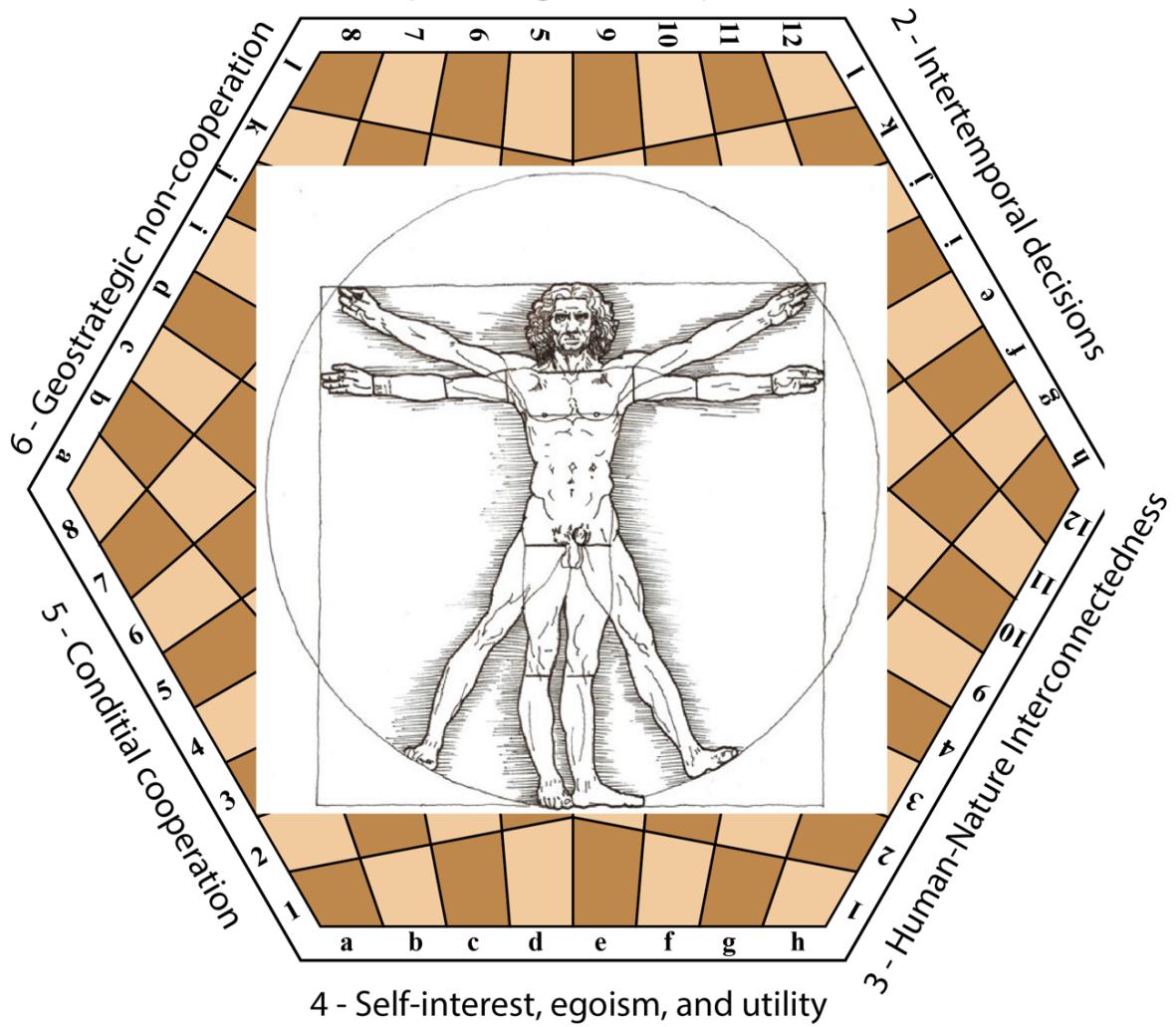
Figure 1: The six sustainability boundaries diagram. The Vitruvian Man by Leonardo Da Vinci symbolizes the centrality of humans as a reference and measure for all civilization advancements. The Yalta Chessboard exemplifies world geostrategic competition and cooperation.
The first sustainability boundary is the dopaminergic reward process. This process is located in the mammalian part of our brain that fosters basic human motivations for specific actions. Such actions concern necessities (e.g., eating, reproducing, avoiding pain, and providing pleasure) and endurance (e.g., acquiring social status, minimizing effort, and gleaning information). These actions, essential for individual survival in the most diverse life situations, are designed to assure the reproductive success of our species. Hence, they implicitly assume the principle that the species may enjoy unlimited growth. This successful growth will eventually become unsustainable in a finite planet and in a situation where, up to now, we only know about one planetary system with just one Earth-like planet .
The second sustainability boundary is related to intertemporal decisions involving decisions with consequences that have repercussions in the future. The simplest form is delayed gratification practiced by primates and other non-primate animals. Some of the current sustainability challenges, particularly those regarding the environment, natural resources, and climate change, have a relatively slow evolution compared with the duration of a social generation. Addressing such challenges depends crucially on the ability to project the future using science-based scenarios and to make the right decisions now to avoid the more grievous scenarios in the future as advised by "longtermism" . The human rate of time discounting leads to the incommensurability between the operative social time of a social generation and the time scale of most global change challenges .
The third sustainability boundary and the first at the collective level regards the cultural evolution of human-nature interconnectedness. This follows from the agricultural and industrial revolutions. Most people no longer depend directly on the natural environment and its resources for survival and wellbeing. The fact that nature, biodiversity, and ecosystem services became abstract concepts for most of the human population constitutes a profound barrier to achieving sustainability.
Unrestrained self-interest, normative egoism, and utility maximisation constitute the fourth sustainability boundary. The identification and apology of psychological egoism since the middle of the 17th century set the scene for the development of utilitarianism and the economic theories of Adam Smith, leading later to the success of mainstream economics. H. A. Simon considers utility maximisation the best-developed formal theory of rationality, which forms the core of neoclassical economics. The higher a consumer's total utility, the greater that consumer's level of satisfaction, giving them a sense of happiness and fulfilment through material possession. For the increasingly wealthy, it advances a desire for unlimited growth in the form of unrestrained consumerism. It is well established that global income and wealth inequalities are tightly connected to ecological imbalances and inequalities contributing to climate change . Recent developments in behavioural economics suggest some bias might emerge on "pure" economic decisions . These sustainability concerns related to consumer's total utility and inequality are aggravated if the consumer society runs a linear economy that transforms natural resources into waste, rather than deploying a circular economy.
The fifth sustainability boundary applies to the voluntary and conditional cooperation and free riders when humans seek to gather for the common good, particularly for the provision of public goods. The process of encephalisation in the Homo genus lineage responded to the need to create functional, cohesive, bonded social groups that were able to develop protection and cooperation within group strategies but highly competitive and aggressive behaviours towards other groups. Cultural evolution led to new concepts, such as altruism, self-interest, selfishness, and egoism, which was highly developed by Thomas Hobbes .
Among humans dealing with public goods, one finds voluntary co-operators, conditional co-operators, free-riders, defectors, or rational egoists that exploit the benefits that result from the contribution of co-operators to the common good . Many people worldwide are well informed about the risks of environmental unsustainability and contribute voluntarily with their initiatives, action, and resources to reduce them. However, others take for granted the benefits of a healthy environment, where it still exists, of ecosystem services, natural resources availability, and of a current global climate, which is still relatively stable. They are tempted to free ride because they write off the personal cost of environmental unsustainability.
The sixth sustainability boundary is geostrategic non-cooperation between major powers and their allies, resulting from colliding sovereign geostrategic interests that prevails over all other individual or collective interests. For instance, the globally disruptive impacts of unabated climate change may either promote geostrategic cooperation or be used as an instrument to foster geostrategic competition. The latter possibility is particularly relevant in the case of climate change geoengineering . The complexity of these bi-directional interactions creates considerable uncertainty about the future evolution of the interplay between geostrategy and sustainability. It includes the likelihood of war, especially between the world's major powers and their allies. War is pure evidence of unsustainability.
III. DEEPENING THE ARGUMENT
Here we present and explore the connections between the sustainability boundaries and the broader concept of sustainability, which extends the three dimensions of sustainable development - environmental, economic, and social - into much more potent themes of justice, respect, human rights, and redistribution. Furthermore, we analyse the mutual reinforcement, and relative intensity of the role played by the six sustainability boundaries in the various sustainability dimensions.
IV. SUSTAINABILITY BOUNDARIES AT THE INDIVIDUAL LEVEL
4.1 Basic Human Motivations Associated with the Dopaminergic Reward Process
Mammals evolved from therapsid ancestors more than 200 million years BP and developed a six-layer neocortex and a compartmentalization of the striatum. This arrangement allowed for enhanced cortico-striatal connectivity that contributed to the emergence of more complex brain functions, decision-making, and enhanced behavioural flexibility . The striatum is a key component of the basal ganglia in all mammals and plays a key role in action selection. These ganglia involve normal motor, cognitive, and emotional functions, motivation, and reward processing. They are incapable of reasoning, a capacity in humans and other mammals that is essentially provided by more recent cortical structures, notably the frontal and prefrontal cortex.
The most likely explanation for the strong encephalisation in the Homo genus is the social brain hypothesis that attributes it to the need to create functional, cohesive, bonded social groups to confront ecological dangers and ensure social survival . The big brain was needed to allow for the required level of sociality in the changing and somewhat unwelcoming Pleistocene climate when the Homo species lived and evolved .
During the period of encephalisation up to the present time, the basic ganglia sustained the dopaminergic reward process associated with basic human motivations for specific actions. These included the necessities of eating , reproducing , avoiding pain, and providing pleasure. It also supported resilient endurance, such as acquiring social status , minimizing effort , and gleaning information . Meanwhile, the complexity of the connectivity of the basic ganglia with the neocortex increased.
Increasing the doses is the only way to lead the nerve cells to give more dopamine. While in the pre-historic past, survival/pleasure-connected growth in population and natural resource use could be accommodated by environmental provisioning at the local and regional levels, the pace of current growth at the global level is more difficult to adjust . The dopamine reward system of the mammalian brain is common to all humans, but stimuli are highly diverse. They range from the satisfaction of the basic needs of those living in extreme poverty to the most sophisticated and exclusive goods and services accessible to the much wealthier. Nowadays, the activity of the dopamine reward system is fostered by the application of the principle of utilitarianism that is foundational in mainstream economics. As referred by behaviouralist economists , they are trying to expand neoclassical economics towards the biased world decision. In development microeconomics, the Nobel laureates Bannerjee, Duflo, and Kramer introduced the importance of a span, or "poverty-band fatigue", to commit and bind rational decisions. When this is exceeded, namely in poverty conditions, this creates a poverty trap. The most pressing demands of dopamine survival (poverty-trap) risk that in the short run- thus reinforcing our dopamine survival analysis.
4.2 Intertemporal Decisions and Time Discounting
The dopamine reward system has no built-in time dimension since it provides instant gratification . Species show a large variation in their willingness to wait for delayed rewards. This is likely caused by the diversity of adaptation responses to the selective pressures they face in their natural environment . In humans, delayed gratification is influenced by strengths in patience, willpower, and self-control. It is well known that repeated exposure to instant gratification may lead to impulsive decisions and contribute to human disorders such as obesity, gambling, and various other forms of addiction . Consumers expect to find and benefit from services, goods, and information that they want easily and as rapidly as possible. The "power of now" became a powerful and successful marketing trend. Politicians tend to adopt this perspective and often struggle to consider future generations' wellbeing in setting their priorities over decision making.
Adam Smith considered that our behaviour is determined by a struggle between two processes that he associated with "passions" and the "impartial spectator" who plays the role of an imaginary moral guardian. Most analyses of intertemporal choice in the context of economics are based on the model of discounted utility , where people weigh up the costs and benefits at different times in accordance with an exponential time discounting function (constant time discounting rate) as in financial markets .
However, the rate at which people discount future rewards decreases with the length of the delay, meaning that the personal time discounting function, instead of being exponential, is closer to a hyperbolic function . Climate change mitigation provides a good example where the choice of the time discount rate value that determines the social price of carbon is critical. The low value advocated by the Stern Report favours a rapid energy transition and addresses intergenerational concerns , in contrast with the higher values proposed by William Nordhaus.
V. SUSTAINABILITY BOUNDARIES AT THE COLLECTIVE LEVEL
5.1 The Evolution of the Human-Nature Interconnectedness and the Emergence of the Nature/Human Conundrum
We know that the relationship between humans and nature has been changing since at least the first early modern humans that settled in Europe developed the Upper Palaeolithic culture of the Aurignacian between 40000-25000 years BP. In the cave paintings that they produced, one finds an abundant and realistic depiction of various animals, while people are not widely represented. When they appear, they are primarily human fragments or human-animal hybrids . The agricultural revolution was essentially driven by the advantage of the fertility increase that led to the Neolithic demographic transition. However, it also produced several negative impacts, such as agricultural collapses due to droughts, floods, or plagues. Specialised food-crop cultivation, irrigation, deforestation, and domestication of animals modified the natural environment and separated further human relations with nature. The shift from an environment in which humans were closer to nature was enhanced by the industrial revolution and the processes of industrialisation and urbanisation .
The distinctive feature of this process is that now most people, especially in the industrialised countries, do not depend directly on the natural environment for their survival as they did in the past and as some indigenous people still do in both remote and barely populated areas.
The conquest of nature and the unlimited exploitation of natural resources promoted the ideology of the sacredness of nature and the need to create refuges of pristine land in protected areas . One of the main causes of biodiversity loss in terrestrial ecosystems is the degradation or destruction of natural habitats due to the expansion of agricultural lands and other land use changes such as deforestation and mining. Other causes are the overexploitation of resources through fishing and hunting that depletes the stocks of some species while driving others to extinction, the proliferation of invasive species, the pollution of the ocean, water resources, and soils, and climate change.
This third sustainability boundary of nature/human separateness is not an innate boundary that surged from our biological evolution. It is a collective boundary since it resulted from the Homo sapiens' cultural evolution, mainly as a result of the success of the agricultural and industrial revolutions. Various institutions relating to monitoring, managing, and measuring ecosystem disruption were imperfect in their compass. So, the boundary was allowed to flourish. We cry out for nature but turn our backs on her.
5.2 Cooperation, Self-Interest, Normative Egoism, and Utility Maximisation.
The evolutionary processes that led to the appearance of Homo sapiens very likely produced selection mechanisms at two levels of biological social organization. At the upper level, groups competed, favouring cooperative behaviour and social characteristics of a cooperative nature among the group members. At the lower level, members of the same group compete to gain personal benefit and ascendency. D. S. Wilson and E.O. Wilson observe : "Selfishness beats altruism within groups. Altruistic groups beat selfish groups."
Human cultural evolution became more distinctive and faster around 40 000 years BP, although complex cultural behaviour, like abstract thought and syntactical language, appeared earlier . It was through the interdependent processes of genetic and cultural evolution that Homo sapiens became the champion of cooperation, surpassing other species in the complexity of its cooperation and defection.
Concepts related to cooperation, such as altruism, self-interest, selfishness, and egoism, had a remarkable evolution in historical civilizations. Before altruism was coined by Auguste Comte, the moral principles of beneficence and benevolence were developed, supported, and practiced by Christianity and by other religions . Helping others, particularly the poor, the hungry, the sick, and the abandoned, is considered a redeeming virtue, and the Christian Bible frequently insists on the duty to help the poor and to share our wealth with them.
Western thinkers also valued explicitly emerging forms of self-interest. These include, for example, Thomas Aquinas, who stressed that it is legitimate for humans to seek the greatest possible happiness for themselves, in the sense of eudaimonia, and Niccolò Machiavelli observed that human beings are governed by their own self-interest:
"For men are less concerned with hurting someone who makes himself loved than one who makes himself feared because love is held by a link of obligation which, since men are wretched creatures, is broken every time their own interests are at stake".
Baruch Spinoza argued that each person should seek what is truly useful for himself and desire that which will lead him to a state of greater perfection. In the 17th century, one finds the first records of the use of the word selfishness in the English language. Presbyterians introduced the word selfish, also meaning selfishness, to qualify morally reprehensible behaviour before God and society .
Nowadays, the benefits of altruism are recognized, but hurtful aspects have also been identified , while selfishness is not considered as necessarily bad . Egoism can be either descriptive or normative. In the first case, we have the Hobbesian thesis of psychological egoism suggesting that all human behaviours are motivated by self-interest. Thomas Hobbes claimed that "of all voluntary acts, the object to every man is his own pleasure" . When writing the Latin expression nosce teipsum, which he translated as "read thyself", Hobbes concluded that by knowing oneself, one could understand others. In fact he states in the Leviathan: "but to teach us that for the similitude of the thoughts and passions of one man to the thoughts and passions of another, whosoever looketh into himself and considereth what he doth, when he does 'think,' 'opine,' 'reason,' 'hope,' 'fear,' etc., and upon what grounds; he shall thereby read and know what are the thoughts and passions of all other men upon the like occasions" .
In the second case of normative egoism, one finds ethical egoism or rational egoism. Ethical egoism is a normative thesis in which the necessary and sufficient condition for a human action to be morally right is to maximise self-interest . The definition of rational egoism is obtained by replacing morally right with rational in the previous definition.
The critical question that separates utilitarian morality and normative egoism is to what extent maximising an agent's self-interest is compatible with maximising the self-interest of other agents, especially those of the various social groups to which the first agent belongs. This question has been partially solved in the context of economics by the core of Adam Smith's thesis on capitalism, that humans' natural tendency for self-interest results in economic prosperity for all . According to the metaphor of the "invisible hand," if each person selfishly and freely seeks to satisfy his personal interest, he will contribute to society's wealth and the overall common good. Market failures of neoclassical economics can be fixed by correcting sources of failure. But corrections are becoming increasingly difficult since the failure's harmful impacts tend to increase with economic scale and, therefore, with global GDP growth .
Furthermore, corrections have been unable to strengthen the tendency to efficiently allocate the resources that provide higher levels of human wellbeing and to distribute wealth in a more equitable way within and between countries.
A more complex difficulty in the way mainstream economics deals with sustainability, results from the asynchronous evolution of civilizations since the beginning of the Holocene. The world currently shares the same economic paradigm but regions and countries exhibit a deep diversity as regards their religion, cultural, political and social background and their economic, industrial, scientific and technological level of development. Furthermore these differences are in part a consequence of world history, in particular the history of the former colonial powers and their colonies. The question is how to accommodate the quest for global sustainability with the natural wish of low and middle-income countries to reach a level of socioeconomic development similar to the more advanced economies of the Western World, allowing them to benefit from comparable levels of well-being and economic prosperity through the application of the principle of utility maximisation.
We find that the fourth sustainability boundary hinders all dimensions of the broader concept of sustainability, including justice, respect, human rights, and redistribution. Moreover, the fourth sustainability boundary creates opportunities to enhance the power of the two individual sustainability boundaries. Much of the current strength and importance of the fourth boundary results from the ability of mainstream economics to exploit the dopaminergic reward system and the high human-time discounting rate to its advantage by reaching the highest consumer's total utility. A possible way to weaken this boundary is to promote restrained forms of self-interest, normative egoism, and utility compatible with the sustainability goals.
5.3 Voluntary and conditional cooperation and free riders
Public goods are created or maintained as the result of successful concerted cooperative action. The maximisation of short-term individual self-interest would cause sooner or later their ruin to the detriment of all . However, the observed level at which people are willing to cooperate voluntarily to provide public goods is incompatible with the strict self-interest hypothesis derived from rationality and selfishness.
Economic experiments have been performed to improve cooperation in real-world situations since the pioneering work on free-riding by Bohm , where people in small groups are given some money to play public-good games . The main conclusion from these experiments is that around half of the people turn out to be conditional co-operators, who approximately match the contributions of their groupmates. About 30% are free riders that do not cooperate, while the remaining have other more complex behavioural patterns .
Experiments also show that voluntary cooperation is fragile and tends to decline in repeatedly played public goods experiments, apparently because reciprocally cooperative subjects become selfish during the experiment . Although the experimental methods have been criticized given that subjects' choices may not reveal their motivations , empirical research on the public goods games can be used to understand how to promote cooperation and curb free riding. Ostrom presented cooperation, and conditional cooperation on common resources, but only in small numbers of club members, and traditionally climate club members are from a higher number. Caleiro, de Sousa, and Andrade present cooperative and non-cooperative climate scenarios based on evolutionary game theory . These describe business-as-usual ecocides where whole ecosystems are wiped out.
One variable that is known to increase the level of cooperation strongly is the opportunity to communicate . Unidirectional communication, as in newspapers or digital media communication systems, via TV, laptops, and smartphones, are less successful than face-to-face communication, either physical or through a virtual setting. Long-term cooperation between the members of large groups is likely to be more challenging to achieve if they rely mainly or almost exclusively on unidirectional communication technologies. There are indications that the increasing reliance on unidirectional communication has a negative impact on cooperation for sustainability. An example of this situation is provided by the rise of online "echo chambers" leading to misperceptions about the scale of public support for climate change mitigation in the US . Supporters of climate action outnumber opponents two to one, but people falsely perceive the opposite is true, which reveals the deficit in bidirectional communication. This situation creates a false social reality that hinders voluntary cooperation and therefore contributes to prevent or delay strong climate mitigation policies in the US. The solution would be for people with different opinions to be available and willing to talk more to each other. The fifth sustainability boundary acts in all three sustainability components since public goods include all of them. It is likely that this boundary can be significantly softened through processes that promote voluntary cooperation for sustainability.
5.4 Geostrategic Non-Cooperation
Politically, sovereignty designates the state's supreme legitimate authority. Internationally, it supports the exercise of power and cooperation between states. The promotion and defence of the state's interests are mainly directed by its broader geostrategy, which involves military, economic, ideological, political, energy, and other strategic natural resources interests.
Progress in global sustainability issues, such as environmental protection, biodiversity loss, energy and water resources availability, natural resources sustainable use, climate change, justice and human rights depend to a large extent on international cooperation. Cooperation between China, the US, EU, and India, the world's four highest emitters of greenhouse gases with a share of 59% of global emissions in 2020, on global mitigation and adaptation efforts is essential to stop the progress of the climate crisis . US-China cooperation should lead by example since they are the two largest world economies and the two largest emitters. Both benefit from high scientific and technological development, a high potential to advance research, technologies, and commercial ventures on renewable energies, critical materials, develop negative emission innovative technologies, and other low carbon energy technologies. These advantages can be turned into areas of great power competition if geostrategic cooperation is weakened or breaks down. The sixth sustainability boundary is an obstacle to all sustainability components in its broader meaning resulting from the disruption or collapse of geostrategic cooperation, including the possibility of war, especially between the World's major powers and their allies.
The overwhelming importance of the geostrategic interests rises a further obstacle in the way to reach global sustainability. Such a goal would necessarily involve the whole of mankind and require the maximization of the long term well-being and prosperity of the one-tribe-on-the-planet social group, which is a process for which humans are not naturally prepared . Forming social groups is the foundation of human sociality, which implies that the one-tribe-on-the-planet social group is an impracticable theoretical fiction, except may be, if a very unlikely encounter with unfriendly beings from an extra-solar planetary system could awaken the one-tribe drive. Otherwise, human society is fractured by a structure of independent sovereign states with geostrategic interests that are unavoidable and unsurpassable. Reaching the goals of the three components of sustainability is bounded by the ever-changing dynamics of the geostrategic interests and objectives, especially those of the major powers and their allies.
VI. SOFTENING THE BOUNDARIES
"Knowing ourselves" is a first step to charter sagely our pathway. We identified six sustainability boundaries that hinder progress toward sustainability. The two at the individual level have their origin in our deep motivations that ensure survival and in our concept of time that gives high priority to the short-term. The remaining sustainability boundaries manifest themselves at the collective level and result mainly from our cultural evolution.
Having identified the boundaries, we can explore ways to overcome them and facilitate the journey to sustainability. These aspects will be addressed in future papers, focusing on the following:
-
How to learn to control and moderate ourselves in order to make the dopaminergic reward system more compatible with our sustainability goals.
-
How to be more engaged in intertemporal decisions regarding medium- and long-term sustainability issues.
-
How to change our collective behaviour and value systems so that the essential role of the human-nature relation for our wellbeing and prosperity is recognised and considered in our decisions and actions.
-
How to restrain self-interest, normative egoism, and utility maximisation, so that the economic system at the national and global levels is enabled to promote all the dimensions of sustainability, including equity, human rights, and justice systematically.
-
How to engage more people to cooperate unconditionally for the provision of public goods that ensures the progress of human civilization now and in the future (e.g., a continuation of wellbeing, human rights, justice, and diverse forms of prosperity)
-
How to cultivate the cooperation between people of different nations and their sovereign countries and governments so that the goal of a sustainable global society reaches the highest priority.
ACKNOWLEDGMENTS
M. de Sousa from Research Center in Political Science (UID/CPO/00758/2020), University of Minho and University of Évora was supported by the Portuguese Foundation for Science and Technology and the Portuguese Ministry of Education and Science through national funds. J. Pedersen would like to acknowledge the financial support from EEA-Financial Mechanism 2014-2021 and the Portuguese Environment Agency through the Pre-defined Project-2 National Roadmap for Adaptation XXI (PDP-2).
Conflict of Interest
The authors declare no conflict of interest.
Ethical Approval
Not applicable
Data Availability
The datasets used in this study are openly available at [repository link] and the source code is available on GitHub at [GitHub link].
Funding
This work did not receive any external funding.
References
Cite this article
Related Research




Special Issue
Launch a focused special issue to highlight research, emerging trends, and expert insights in your academic field.
