



IntelliPaper
Abstract
The classical quantum theory of Bohr does not take the theory of relativity into account. The energy levels of a hydrogen atom, derived by Bohr, are known to be approximations. In this paper, the kinetic energy and momentum of an electron in a hydrogen atom are treated relativistically. This paper predicts the existence of an n=0 energy level present in a hydrogen atom. However, the state where n=0 is not an energy level of the electron comprising the hydrogen atom. It is thought that an electron in the n=0 state forms a pair with a positron, and constitutes the vacuum inside the hydrogen atom.
Explore Digital Article Text
I. INTRODUCTION
In 1913, Bohr derived the following formulas for the energy levels of a hydrogen atom, and the orbital radius of the electron orbiting inside the hydrogen atom [1].
Here, is the rest mass of the electron, c is the speed of light, and n is the principal quantum number. Also, is the following fine-structure constant.
(3)
The subscript "BO" signifies a physical quantity predicted by Bohr.
When deriving Eqs. (1) and (2), Bohr assumed the following quantum condition.
Using this assumption, Bohr explained why the energy levels in a hydrogen atom are discontinuous.
Subsequently, quantum mechanics developed further, and it became possible to explain more complicated energy levels. However, even in quantum mechanics with improved precision, the minimum value of the principal quantum number remains at 1.
The author has previously pointed out that an energy level with n=0 exists in a hydrogen atom [2]. However, that paper did not attract much notice. In that paper, the author assumed the following relationship.
Due to Eq. (5), it is possible to identify discontinuous states that are permissible in terms of quantum mechanics in the continuous motions of classical theory.
However, it later became clear that Eq. (5) can be derived logically [3]. Therefore, this paper rewrites the originally published paper [2] based on newly obtained results.
II. A NEW QUANTUM CONDITION TO REPLACE THE QUANTUM CONDITION OF BOHR
In Bohr's theory, the energy levels of the hydrogen atom is treated non-relativistically, and thus here the momentum of the electron is taken to be . Also, the Planck constant can be written as follows [4].
is the Compton wavelength of the electron.
When Eq. (6) is used, the fine-structure constant can be expressed as follows.
Also, the classical electron radius is defined as follows.
If is calculated here,
If Eq. (2) is written using and , the result is as follows.
Next, if in Eq. (6) and in Eq. (10) are substituted into Eq. (4),
If Eq. (9) is also used, then Eq. (11) can be written as follows.
Next, if we multiply both sides of Eq. (12) by and simplify, the following relationship can be derived [5].
If Eq. (13) is taken as a departure point, the energy levels of the hydrogen atom derived by Bohr can be derived immediately.
According to the famous virial theorem, if K is taken to be the kinetic energy of the entire system, and V is taken to be the potential energy of the entire system, then the following relation holds between K and V:
The time average of K is equal to -1/2 the time average of V. Also, the sum of the time average K of the kinetic energy of the entire system and the time average of the total mechanical energy E of the entire system becomes 0. That is,
Next, if Eqs. (14) and (15) are combined, the result is as follows:
(15)
When both sides of Eq. (13) are squared, and then multiplied by ,
Hence,
(17)
The "cl" in is an abbreviation for "classical". However, from a relativistic perspective, is an approximation of the relativistic kinetic energy of the electron.
III. TWO FORMULAS FOR RELATIVISTIC KINETIC ENERGY OF PARTICLES MOVING IN FREE SPACE
Einstein and Sommerfeld defined the relativistic kinetic energy as follows [6].
Here, is the rest mass energy of the body. And is the relativistic energy.
The "re" subscript of stands for "relativistic."
According to the STR, the following relation holds between the energy and momentum of a body moving in free space [7].
Now, Eq. (20) is rewritten as follows.
Comparing Eqs. (20) and (21), the relativistic momentum can be defined as follows.
Hence,
The following relation holds due to Eqs. (19) and (23).
Based on the above discussion, it was found that the relativistic kinetic energy of particles moving in isolated systems in free space can be described with Eqs. (19) and (24).
IV. AN ENERGY-MOMENTUM RELATIONSHIP APPLICABLE TO THE ELECTRON IN A HYDROGEN ATOM
An energy-momentum relationship applicable to the electron in a hydrogen atom has already been derived in a previous paper . That relationship is derived again by another method, including the significance of the review in Section 4.
Now, consider the case where an electron at rest in an isolated system in free space is attracted by the electrostatic attraction of the proton (hydrogen atom nucleus), and forms a hydrogen atom.
The electron at rest has a rest mass energy of . When this electron is taken into the region of the hydrogen atom, it acquires an amount of kinetic energy equivalent to the emitted photon.
Both energy sources must satisfy the law of energy conservation. The energy source here has been thought to be potential energy.
However, the only energy an electron has when at rest is rest mass energy. There is no possible source for supplying the photon emitted by the electron, and the acquired kinetic energy, aside from the rest mass energy of the electron.
We take this decrease in energy to be , the energy of the photon emitted by the electron to be hv, and the kinetic energy gained by the electron to be .
For the law of conservation of energy to hold, the following relation must hold between these energies.
The author presented the following equation as an equation indicating the relationship between the rest mass energy and potential energy of the electron in a hydrogen atom .
According to this equation, the potential energy of a bound electron in a hydrogen atom is equal to the reduction in rest mass energy of that electron.
There is a lower limit to potential energy, and the range which energy can assume is as follows.
When describing the motion of a bound electron in a hydrogen atom, a term must be included in that equation for the potential energy. From this can be defined as follows.
Here, is the relativistic mass of the electron. gives the relativistic energy of the electron, but this is also the absolute energy of the electron. The "ab" subscript of stands for "absolute."
The relativistic energy of an electron in a hydrogen atom becomes smaller than the rest mass energy . That is,
The behavior of an electron inside an atom, where there is potential energy, cannot be described with the relationship of Einstein (1). Caution is necessary because it is completely overlooked in Eq. (29).
Now, referring to Eq. (19), it is natural to define the relativistic kinetic energy of an electron in a hydrogen atom as follows [3]
This paper defines as the relativistic energy levels of the hydrogen atom derived at the level of classical quantum theory. (The quantum number used here is just the principal quantum number.
Therefore, is not a formula which predicts all the relativistic energy levels of the hydrogen atom.) However, the term "relativistic" used here does not mean based on the STR. It means that the expression takes into account the fact that the mass of the electron varies due to velocity. According to the STR, the electron's mass increases when its velocity increases. However, inside the hydrogen atom, the mass of the electron decreases when the velocity of the electron increases.
Next, the relativistic kinetic energy of an electron in a hydrogen atom is defined as follows by referring to Eq. (24).
Here, indicates the relativistic momentum of the electron.
In this way, two formulas have been obtained for the relativistic kinetic energy of the electron in a hydrogen atom (Eqs. (30), and (31)).
The following equation can be derived from Eqs. (30) and (31).
Rearranging this, the following relationship can be derived.
Equation (33) is the energy-momentum relationship applicable to the electron in a hydrogen atom.
V. ENERGY LEVELS OF A HYDROGEN ATOM IN LIGHT OF THE THEORY OF RELATIVITY
In the past, Dirac derived the following negative solution from Eq. (20).
If the same logic is applied to Eq. (33), then the following formula can be derived.
However, Eq. (35) does not incorporate the discontinuity peculiar to the micro world. Therefore, Eq. (35) must be rewritten into a relationship where energy is discontinuous.
Using the relation in Eq. (13), Eq. (35) can be written as follows [2].
The following relation holds between and .
Here, is the residual part of the rest mass energy of the electron, and corresponds to the reduction in rest mass energy of the electron.
Also, the relationship of these energies can be illustrated as follows (see Fig.1) [11].
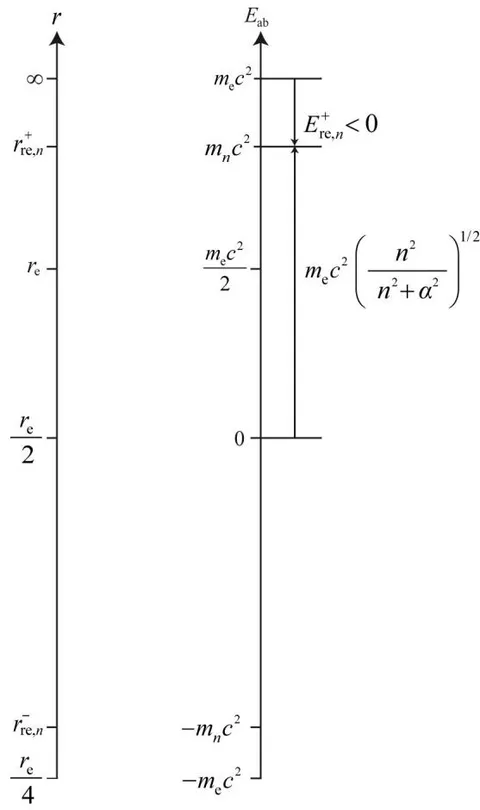
and corresponds to the decrease in rest mass energy of the electron, and ( ) corresponds to the remaining part.
The relativistic energy levels of an ordinary hydrogen atom, can be expressed as follows.
Ordinarily, there is no problem in omitting the + of . Note the difference between the relativistic energy levels of the hydrogen atom and the relativistic energy of the electron [3].
To simplify the discussion in this paper, the only quantum number addressed is n In Eq. (38), the principal quantum number n starts from o. Energy in the state where n=0 are as follows.
Next, when the part of Eq. (38a) in parentheses is expressed as a Taylor expansion,
From this, it is evident that Eq. (1) derived by Bohr is an approximation of Eq. (38).
Incidentally, in Eq. (1) for the energy levels of the hydrogen atom derived by Bohr, the energy of an electron at rest infinitely far from the proton was regarded as zero (Figure 2) [12].
The rest mass energy of the electron is not taken into account in Bohr's theory. Thus, the author derived a Eq. (38) for the energy levels of the hydrogen atom, taking into account the rest mass energy of the electron (Figure 3) [12].
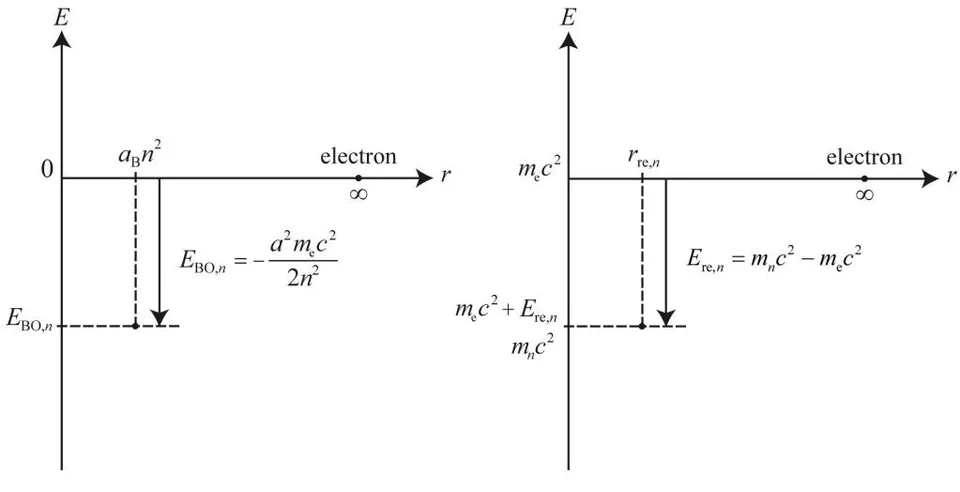
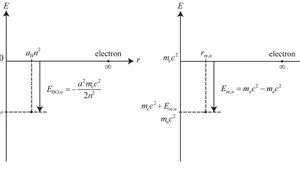
Figure 2: In Bohr's theory, the energy when the electron is at rest at a position infinitely distant from the atomic nucleus is defined to be zero.
Figure 3: According to the STR, the energy of an electron at rest at a position where is .
is given by the difference between and .
Now, the total mechanical energy of the hydrogen atom is given by the following formula.
Also, if the formula for potential energy is used, then can be written as follows.
From Eq. (42), is:
Here, if is substituted for in Eq. (42), then the r where is:
The radius r where is due to Eq. (43). Dirac predicted that the vacuum energy E satisfies the relation , but actually is the energy of the virtual electron-positron pair which make up the vacuum (Figure 4)[13].
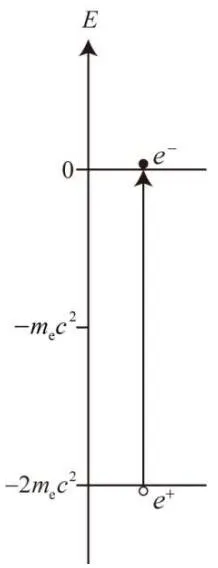
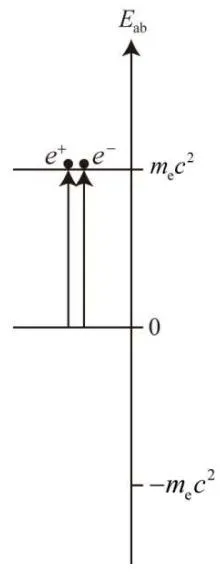
In the author's interpretation, an electron-positron pair is created because a -ray with an energy of 1.022 MeV gives rest mass to a virtual electron-positron pair at the position (Figure 4b).
Next, the following table summarizes the energies of a hydrogen atom obtained from Eqs. (1) and (38). (Table.1) [14].
| n | Bohr's Energy Levels, | This Paper, |
| 0 | — | -0.511 MeV |
| 1 | -13.60569eV | -13.60515eV |
| 2 | -3.40142eV | -3.40139eV |
| 3 | -1.511744eV | -1.511737eV |
VI. ORBITAL RADIUS OF AN ELECTRON IN A HYDROGEN ATOM
The following equation holds due to Eqs. (36b) and (43).
From this, the following quadratic equation is obtained.
If this equation is solved for ,
Next, if the electron orbital radii corresponding to the energy levels in Eq. (38) are taken to be, respectively, and ,
Also, Eqs. (48) and (49) can be written as follows [15].
In this paper, is called the orbital radius, as is customary. However, a picture of the motion of the electron cannot be drawn, even if that motion is discussed at the level of classical quantum theory. The electron in a hydrogen atom is not in orbital motion around the atomic nucleus. The domain of the ordinary hydrogen atom that we all know starts from
The negative solutions for E and r have been discussed in another paper . Therefore, that problem is not considered in this paper.
VII. DISCUSSION
A. First, if both sides of Eq. (13) are squared, and multiplied by ,
From this, the relativistic kinetic energy of the electron is,
Incidentally, the following relationship holds between and .
Equation (54) can be written as follows.
If the relationship in Eq. (55) is used here,
Next, the following formula is multiplied with the numerator and denominator,.
When this is done,
This enables derivation of Eq. (38) from Eq. (13).
B. If the energy levels derived by Bohr Eq. (1) are multiplied by the classical orbital radius Eq. (10),
Incidentally, the following equation holds due to Eqs. (42) and (30).
Finding from Eq. (59),
Next, if we calculate the denominator of Eq. (60),
Next, if we find the product of the relativistic energy levels derived in this paper (30) and the relativistic orbital radius (60),
The following relationship holds based on Eqs. (58) and (62).
The points above are summarized in the following table.
| n | |||
| 0 | — | — | — |
| 1 | |||
| n |
Table 3: Products of
and derived in this paper
| n | |||
| 0 | |||
| 1 | |||
| n |
C. Rewriting Eq. (33) into a relation for momentum yields the following.
Also, can be written as follows.
Therefore, Eq. (64) can be written:
Here, taking the ratio of the first term and the momentum of the second term on the left side of Eq. (64),
Similarly, taking the ratio of the first term and the momentum of the second term on the left side of Eq. (66),
From Eqs. (67) and (68),
The author has previously presented Eq. (13) as a new quantum condition to replace Bohr's quantum condition. However, the reason why Eq. (13) holds is because Eq. (69) holds. Therefore, Eq. (69) is actually a quantum condition to replace the quantum condition of Bohr.
VIII. CONCLUSION
As indicated by Eq. (40), Eq. (1) for the energy levels of a hydrogen atom derived classically by Bohr is an approximation of Eq. (38), the formula for the relativistic energy levels of a hydrogen atom. In Eq. (38), the principal quantum number n starts from o. Energy and r in the state where n=0 are as follows.
It is thought that an electron in the n=0 state forms a pair with a positron, and constitutes the vacuum inside the hydrogen atom.
Also, this paper has shown that the relativistic energy levels and of an ordinary hydrogen atom can be described using the following two types of formulas.
Multiplying E and r, we obtain:
As is evident from Eqs. (76) to (78), the products of the energy levels E and r of a hydrogen atom are always fixed values. In a hydrogen atom, Eqs. (70) and (71) become important quantities. Those important quantities are involved in the formulas (74) and (75) derived in this paper.
However, there is no relation between the solution derived by Bohr and Eqs. (70) and (71).
In the end, Bohr's formulas (1) and (2) are just approximations of Eqs. (74) and (75), and they are not accurate. Since the n=0 energy level is missing, quantum mechanics is an inadequate theory.
Conflict of Interest
The authors declare no conflict of interest.
Ethical Approval
Not applicable
Data Availability
The datasets used in this study are openly available at [repository link] and the source code is available on GitHub at [GitHub link].
Funding
This work did not receive any external funding.
References
Cite this article
Related Research


Special Issue
Launch a focused special issue to highlight research, emerging trends, and expert insights in your academic field.