



IntelliPaper
Abstract
The purpose of this research is to analyze prevalence and incidence studies on the seasonality of trauma epidemiology with regard to distal radius fractures through a systematic review, in which cross-sectional and longitudinal studies were selected regarding the analysis of clinical and epidemiological variables associated with fractures of the distal radius. For this, MEDLINE®, LILACS, SCIELO and PUBMED platforms were used. From a total of 45,634 articles, after applying the inclusion and exclusion criteria, 18 scientific publications were eligible among the 64 read in full. According to the review, it appears that there is seasonality in distal radius fractures according to he seasons of the year. The decreased bone strength of these patients was associated with an increased risk of fracture in 10 years and individuals from a rural environment with less hospital support have a greater chance of not having an adequate post fracture follow-up.
Explore Digital Article Text
I. INTRODUCTION
Distal Radius Fractures (DRF) are anatomically defined as those occurring within 3 cm of the radiocarpal joint, corresponding to one sixth of all fractures treated in emergency units and with great cost to the health system.
The DRF have significant epidemiological and clinical-surgical importance due to the high prevalence, that is, up to 31%. In addition, the complexity of the lesions varies according to the involvement of adjacent anatomical regions, implying different prognoses whose treatment may be different. conservative or surgical.
Observational Studies (OS) have different degrees of reliability, and can be compared to a photograph of the population (cross-sectional study) or temporal analysis of the sample in question (longitudinal study).
Thus, the present scientific dissertation aims to explain the OS of these two methodologies about the epidemiology associated with the trauma of DRF and factors implicating the seasonality of the prevalence and incidence.
II. METHODOLOGY
The methodology used was the systematic review, in which the research platforms MEDLINE® and LILACS for BIREME, PUBMED and SCIELO were used. In this context, according to the Descriptors in Health Sciences platform and with descriptors in Portuguese, English and Spanish, the following descriptors were selected: "Bone fracture" and "Radius fracture"; "Wrist joint"; "radius fracture".
The inclusion criteria corresponded to complete and available articles, from the last five years (October 30, 2016 the same date of the year 2021), only with human beings, OS of the transverse and longitudinal types and that addressed the distal third of the radius as an outcome.
Exclusion criteria were articles that did not address radius fracture, protocol validation studies, case reports and series, systematic reviews, meta-analysis, randomized controlled trials and case-control studies.
Table 1 summarizes the methodology, sample size, study design, primary outcome result, gender and age group included in the studies eligible for this systematic review.
Table 1: Methodological aspects associated with each type of study
| Author | Methodology | Sample | Study Design | Primary outcome | Sex | Age Range |
| Acosta-Olivo et al. | Cross-sectional Prospective | 114 | Obesity has been assessed to increase the severity of DRF. | There was no correlation between obesity and severity of DRF. | 30 M (26,3%) and 84 F (73,6%) | From 18 to 84 years old (average of 52,9 years old) |
| Dardas et al. | Longitudinal Prospective | 75 | The ability of distal unicortical screws to maintain operative DRF reduction in adults was verified. | Unicortical distal fixation during volar locking plate fixation effectively produced operative reductions in DRF. | 21% M and 79% F | ≥ 18 years (Average 54 ± 15 years) |
| Zhang et al. | Retrospective Longitudinal | 93 | To verify the results of the volar locking plate for the treatment of type B DRF involving the semilunar facet and compare with fractures without this involvement. | The involvement of the semilunar facet would have a slower recovery when compared to DRF without the involvement of this topography. | 63 M and 30 F | From 18 to 84 years old (median 39,8 years old) |
| Ogliari et al. | Retrospective Longitudinal | 25.454 | It aimed to explore fragility fractures in adults over 50 years of age, including DRF. | The climate can modulate the seasonality of fractures and, consequently, the use of health service resources. | 6.361 M (25%) and 19.093 F (75%) | ≥ 50 years (median 67 years) |
| Johnso et al. | Retrospective Longitudinal | 8.380 | To verify the incidence of fractures of the wrist joint in relation to the hot and cold seasons of the year. | There was an increase in the rate of this type of fracture in the coldest seasons of the year. | 2678 M and 5.702 F | From 18 to 104 years old (average 56,4 years old) |
| Zhang et al. | Longitudinal Prospective | 88 | To verify the benefit of rehabilitation regarding RML due to DRF in individuals over 65 years of age. | Benefit of rehabilitation in case of RML due to DRF with less than 3 months of fracture. | 29 M and 59 F | From 71,69 ± 6,232 years |
| Kruppa et al. | Retrospective Longitudinal | 201 | In order to determine the rate of complications of forearm fractures after treatment with intramedullary elastic nails. | Refracture, vicious junction, rupture of the extensor pollicis longus tendon, infection and limitation of range of motion. | 148 M (73,6%) and 53 F (26,4%) | From 3 to 16 years (aver- age of 9,7 years) |
| Wang et al. | Retrospective Longitudinal | 410 | Determine sociodemographic aspects associated with fractures, including DRF. | The radius (24.9%) was the most common fracture site. The most common etiology was playing basketball (34.0%) and FR (26.2%) in the 12-15 age group; playing bas- ketball (31.7%) and FR (23.0%) in the 15-18 age group. | 335 M and 75 F | From 6 to 18 years old (From 13,5 ± 3,1 years old) |
| Egund et al. | Longitudinal Prospective | 133 | The primary outcome was DASH arm, shoulder, and hand disability in the first 12 months following DRF. | Men older than 65 years with FRD were more likely to have disability after the fracture, regardless of the radiographic result. | 133 M (100%) | 21 to 88 years old (average 54 years old) |
| Baxter et al. | Longitudinal Prospective | 70.801 | It was to determine the proportion of closed DRF without medical follow-up and whether different hospitals and doctors are treating these injuries differently in terms of follow-up after initial care in the emergency de-partment. | 20.8% (n=14,742) of the fractures were treated without continuous medical follow-up after the initial care; small hospitals and living in a rural area were significantly associated with lack of follow-up. | 43.488 M (61,4%) e 27.313 F (38,6%) | From 2 to 14 years old |
| Südow and Navarro | Longitudinal Prospective | 90.970 | Determine the incidence of DRF. | Significant variation in incidence over the years with higher peaks in May (68.7/10,000 person-years) and September (73.2/10,000 person-years). | 60,3% M e 39,7% F | From 0 to 17 years (aver-age 10 years) |
| Olech et. al. | Cross-sectional Prospective | 392 | To verify if there were epidemiological changes in pediatric patients (<18 years) and adults (>18 years), comparing the period before and during the pandemic. | Decrease in the number of hospitalizations of pediatric and adult patients with DRF during the COVID-19 pandemic. | 157 <18 years and 235 ≥ 18 years | |
| Rundgren et al. | Longitudinal Prospective | 31.807 | Determine SSI after DRF surgery by different techniques (plate fixation, percutaneous pinning and exter-nal fixation). | SSI rate corresponded to rates of 5% (plate fixation), 12% (percutaneous pinning) and 28% (external fixation). | 6.648 M (21%) e 25.159 (79%) | ≥ 18 years |
| Nagai et al. | Retrospective Longitudinal | 253 | To assess the relationship between PIM, activities of daily living and subsequent falls in elderly patients with DRF. | The use of these made it difficult to improve activities of daily living and was associated with an increase in subse-quent falls. | 36 M e 217 F | ≥65 years old |
| Hooper et al. | Retrospective Longitudinal | 280 | Determine the importance of physical activity prior to DRF as well as functional outcomes through patient self-report. | Higher activity levels prior to DRF were associated with better patient-reported functional outcomes after distal radius fracture. | 36 M e 244 F | ≥ 60 years |
| Chou et al. | Retrospective Longitudinal | 88 | To determine whether patients with idiopathic PD had a worse outcome after surgery when compared to the group without PD. | Patients with idiopathic PD with DRF had a higher failure rate and shorter time to treatment failure compared to the group without idiopathic PD. | 12 M (25%) e 66 F (75%) | ≥ 18 years |
| Nagai et al. | Retrospective Longitudinal | 229 | To investigate the association between nutritional status and functional prognosis in elderly patients after DRF. | There was a positive association between malnutrition and the lower ability to resume daily activities afterwards; low serum albumin levels may in-crease the risk of subsequent falls. | 31 M (86,5%) e 198 F (13,5%) | ≥65 years old |
| Orland et al. | Retrospective Transversal | 258 | Assess the frequency with which children aged <10 years undergo potentially unnecessary closed reduction associated with sedation and costs. | 27% were considered potentially unnecessary with a cost increase of about 8 times. | 156 M (60%) e 102 F (40%) | <10 years |
III. RESULTS
According to the standardized terms of the DECS platform, a total of 45,634 articles were obtained and, after applying the inclusion and exclusion criteria, 252 publications were captured. After proper reading of the title and abstract as well as elimination of duplicates, 64 articles were selected for reading in full, with 18 being eligible for this systematic review. The flowchart (figure 1) demonstrates such steps of the methodological process.
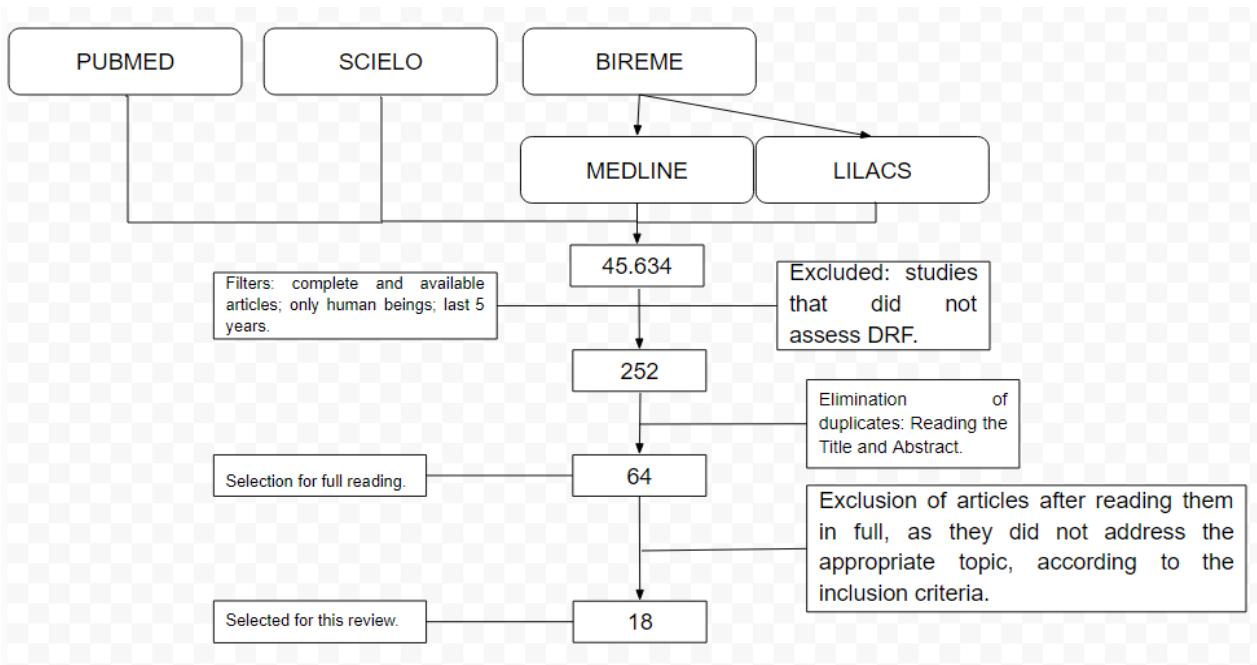 Figure 1
Table 2 explains the fracture rate according to the AO classification (types A, B and C) and the frequencies of accidents associated with the trauma mechanism.
Table 2: Rate of DRF According to the AO Classification and Mechanisms Associated With Trauma
| Author | Fracture Rate According to the AO Classification | Trauma Mechanism |
| Acosta-Olivo et al. | A (20,18%); B (32,45%); C (47,37%) | Type A fractures were the most common and the most severe type of fracture, type C, was the least common in all patients (normal weight, over-weight, obese) |
| Dardas et al. | A (40%); B (12%); C (48%) | The mechanisms most associated with trauma were falls (68%) and falling from standing height (19%) |
| Zhang et al. | B1 (60,2%); B2 (25,8%); B3 (14,0%) | Electric bicycle accidents were the most common cause (51.6%) of all injuries, followed by falls from heights (24.7%), motor vehicle accidents (18.3%) and sports injuries (2.2%) |
| Ogliari et al. | ||
| Johnson et al.. | ||
| Zhang et al. | A (19.32); B (12.50); C 65.91) | |
| Kruppa et al. | Drop (playing, jumping, skating, others) of 98.0%Polytrauma (motor vehicle accident; fall from a height of 3 m), two accidents (1.0%) No adequate trauma (osteogenesis imperfecta; juvenile bone cyst) 2 (1.0%) | |
| Wang et al. | The most common etiologies were playing basketball (27.5%) in the male group and walking (24.0%) in the female group.The most common etiologies and locations were playing basketball (34.0%) and FR (26.2%) in the 12-15 age group, playing basketball (31.7%) and FR (23.0%) in the age 15 to 18 years The most common FR fracture sites were in basketball (28.9%) and cricket (37.5%) players. | |
| Egund et al. | A (26%); B (19%); C (57%) | About two-thirds of fractures occurred after a fall from standing height.Men aged <65 years, compared to those aged ≥65 years, had a higher proportion of fractures due to trauma, including falls from height/level (30% vs 3%) and traffic accidents (13% vs 9%). |
| Baxter et al. | Closed low-grade fractures; AO classification not analyzed in the outcome | All patients approached were low-grade closed DRF |
| Südow and Navarro | ||
| Olech et. al. | ||
| Rundgren et al. | ||
| Nagai et al. | Group with PIM (N=107): A (9.3%); B (39.3%); C (51.4%) Group without PIM (N=146): A (2.1%); B (35.6%); C (62.3%) | 34 patients had subsequent falls.The PIM group reported one vertebral fracture, one hip fracture, and 22 bruises.The non-PIM group reported one clavicle fracture, one acute subdural hematoma, and 11 hematomas. |
| Hooper et al. | ||
| Chou et al. | Group with PD (N=23): A (47.8%); B (4.3%); C (47.8%) Non-PD group (N=65): A (44.6%); B (27.7%); C (27.7%) | Loss of reduction was observed in 17.4%, nonunion of the fracture in 13.0%, and persistent pain was observed after 6 months in 8.7% of patients with PD |
| Nagai et al. | A (5,6%); B (35,8%); C (58,5%) | |
| Orland et al. |
Flagged articles did not analyze the fracture rate according to the AO severity classification and/or the rate associated with trauma in its outcome.
IV. DISCUSSION
When assessing whether obesity increases the severity of DRF, in one study, it was found that there was no correlation based on a sample of 114 patients, although this population is more susceptible to fractures in this region.
A study aimed at quantifying the ability of unicortical distal screws to maintain the operative reduction of DRF in adults, in a sample of 75 patients undergoing volar fixation with a locking plate, resulted in data that corresponded to effective fixation and maintained the operative reductions in DRF, whereas it had the potential to decrease the incidence of extensor tendon ruptures in a 12-week post-surgical follow-up.
Comparing type B DRF with and without involvement of the semilunar facet treated with a volar blocking plate, we retrospectively analyzed the individuals with involvement of the semilunar facet (n=21) and the others without this involvement (n = 72), it was found that patients with DRF with involvement of the semilunar facet would have slower recovery with regard to wrist flexion, supination, ulnar deviation and greater risk of loss of both reduction and final joint step. Thus, fractures of DRF with involvement of the semilunar facet present clinical factors of severity and longer time for convalescence of the bone material.
When studying patients aged 50 years and over with a total sample of 25,454 fractures, of which 42.1% corresponded to fractures of the radius or ulna, Ogliari et al. verified that most of the injuries in this region occurred in the winter period, in which frosty days were directly associated with fractures of the radius or ulna. In addition, confirmation of the increase in accidents involving DRF in colder seasons can help direct financial resources from health services and increase the number of employees available during this period. Thus, considering the temperate climate of the study site, it can be suggested that other parts of the globe, including the southern region of Brazil, may have a similar rate of involvement, which should be corroborated by future studies and evaluated according to the possibility of greater exposure. to falls from standing height by the general population and higher risk of falls in geriatric individuals on slippery floors.
Another study looked at the profile of DRF in relation to climate, in which a retrospective analysis with 8,380 patients verified wrist joint fractures in all women and men aged 50 years, and demonstrated an increase in the rate of this type of fracture with the reduction in temperature (milder seasons of the year) and the average rate was 2.9 fractures/day out of a total of 2,922 days analyzed and an increase of 840 in the number of procedures during the winter period. Thus, in regions with a cold climate, health services can direct resources to this patient profile.
Furthermore, Range of Motion Limitation (RML) after DRF was studied in 88 geriatric patients, in whom daily rehabilitation was applied for 30 minutes for 8 weeks after the fracture, and it was verified that individuals with early stiffness (\<3 months after the fracture) had greater RML compared to those with late stiffness (>3 months). A cohort with a sample of 202 children (up to 16 years of age) addressed the complication rate of forearm fractures after treatment with stable intramedullary elastic nails, which correspond to in situ refracture (1.5%), refracture after nail removal (3.5%), vicious junction (1.0%), rupture of the extensor pollicis longus tendon (1.5%), infection 1 (0.5%) and reduced range of motion (1.0%).
Wang et al. analyzed, by means of a longitudinal retrospective study, 410 children and adolescents (aged from 6 to 18 years), whose aim was to characterize polytrauma due to sports, in which it was verified that radius fractures were the most common (24.9%) relative to other long bones. In addition, males had a significantly higher rate of fractures and associated nerve injuries, with peaks of incidence in the summer and the most associated sport was basketball (28.9%).
A prospective longitudinal study followed patients with DRF for 12 months in order to verify the future risk of fracture in two groups, that is, young versus elderly men (65 years or older), whose result associated that the second group was more prone to having a disability in working with hands, arms and shoulder ipsilateral to the injury, regardless of the macroscopic radiographic finding. Furthermore, the decreased bone strength of these patients was associated with an increased risk of fracture at 10 years.
Furthermore, another population-based retrospective longitudinal analysis sought to determine the proportion of DRF treated without adequate medical follow-up after initial care, as well as the type of medical care provided by different hospitals and physicians. And, from the analysis of 70,801 fractures, it was found that 20.8% (n=14,742) of fractures were treated without continuous medical follow-up after initial care and treatment by a small hospital emergency department, pediatric specialty or subspecialty in a pediatric emergency, were more likely to result in no follow-up. In addition, small hospitals and living in a rural area were significantly associated with non-monitoring after the injury.
A retrospective observational cohort with the aim of determining the incidence of DRF, in which 90,970 DRF were identified between the years 2005 to 2012, whose incidence rate during the entire period analyzed was 52.9/10,000 people/year, with the distribution between genders equal in the age group from 0 to 10 years old, however, higher in males from 11 to 17 years old. Furthermore, there was a significant variation in incidence throughout the year, with higher peaks in May (68.7/10,000 person-years) and September (73.2/10,000 person-years). Thus, considering that the period ob-served of higher incidences corresponds to milder temperatures, it can be suggested that such incidence may be related to sports activities or activities of greater impact.
A prospective cross-sectional study compared pediatric patients (\<18 years) and adults ( 18 years) in two moments, before and during the covid-19 pandemic, with the aim of characterizing variation in epidemiological data on hospitalization and the need for a surgical approach. The first group showed a decrease in hospitalizations (3.8%), hospitalizations with surgical treatment (11.5%) and patients undergoing conservative treatment (7.2%). The adult population showed a decrease in the rate of hospitalizations treated surgically (12.7%) and in the number of individuals undergoing conservative treatment (30.3%), while those who underwent surgical treatment with fixation by volar plate increased substantially (275%).
Rundgren et al. with the aim of determining Surgical Site Infections (SSI) after DRF surgery using different techniques (plate fixation, percutaneous pinning and external fixation), as well as factors associated with SSI in a sample of
31,807 patients, found that the rate of SSI corresponded to rates of 5%, 12% and 28%, respectively. Furthermore, it was found that the type of open fracture and being male were associated with SSI.
Nagai et al. evaluated the relationship between Potentially Inappropriate Medications (PIM), activities of daily living and subsequent falls in elderly patients with DRF, aged 65 years and over and divided into two groups (a group using PIM and a group not using PIM). The prevalence of prescriptions for PIM was 42.3% and their use hindered the improvement in activities of daily living and was associated with an increase in subsequent falls.
A retrospective cohort study included 304 adults aged 60 years or older who had isolated DRF and divided into two groups: group I with 187 participants (volar locking plate, percutaneous pinning or external fixation) and group II with 117 individuals (treated with a cast) and classified into highly and less active based on the degree of physical activity prior to the injury. The results suggested that more physical activity practiced before the injury was associated with better functional results and patient-reported self-improvement. Thus, supervised physical activity, due to the risk of falls, should be encouraged in these patients.
Another research, when evaluating Parkinson's Disease (PD) in two groups with and without the disease regarding the best outcome in patients with DRF, in which both groups underwent open reduction followed by of internal fixation, with the aim of verifying whether the PD group would have a lower result after surgery compared to non-PD patients, it was found that there was a shorter time and a significant rate of treatment failure, these being 39.1% and 4.6%, respectively.
A retrospective longitudinal study with the objective of investigating the association between nutritional status and functional prognosis in elderly patients with DRF in elderly individuals, found that a positive association between malnutrition and the ability to resume activities of daily living after DRF and low levels of albumin serum levels may increase the risk of subsequent falls, and a rate of 13.5% of patients with DRF had malnutrition.
When assessing the frequency with which children younger than 10 years old undergo a potentially unnecessary closed reduction associated with sedation for the DRF procedure and the cost implications, Orland et al. found that among 258 participants, 142 (55%) underwent this procedure and 38 children (27%) were considered potentially unnecessary with a cost increase of about 8 times the amount and the fractures could have been treated with in situ immobilization.
V. FINAL CONSIDERATIONS
It is verified that there is seasonality in the DRF regarding the seasons. The reduced bone strength of these patients was associated with an increased risk of fracture in 10 years, and individuals from a rural environment have less hospital support and a greater chance of not having adequate post-fracture follow-up. In addition, obesity was not a serious factor for DRF recovery.
Conflict of Interest
The authors declare no conflict of interest.
Ethical Approval
Not applicable
Data Availability
The datasets used in this study are openly available at [repository link] and the source code is available on GitHub at [GitHub link].
Funding
This work did not receive any external funding.
References
Cite this article
Related Research




Special Issue
Launch a focused special issue to highlight research, emerging trends, and expert insights in your academic field.
