






IntelliPaper
Abstract
This article recognizes the stages of the evolution of the European Union’s innovation policy, exposes which frameworks are applied in research on EU innovation policies, and presents a literature review on the subject within the new institutionalism and the innovation systems approach. The methodology encompassed qualitative, exploratory, descriptive, bibliographic, and documentary research. An overview of the literature is presented, particularly examining theories and models on innovation developed from the late1980s and early 1990s when the study of institutional systems and networks became more common. The literature on innovation can elucidate how it emerges, bringing a greater understanding of this phenomenon and, thus, a greater ability to find legal mechanisms for regulation and designs for its promotion. This study seeks to identify the research trends and examines the explanatory power of the systemic approach. It points out a gap in the literature, proposing an interdisciplinary research agenda that combines legal knowledge and the systemic approach.
Explore Digital Article Text
Este artigo reconhece as fases da evolução da política de inovação da União Europeia, expõe quais enquadramentos são aplicados nas pesquisas sobre as políticas de fomento da inovação (innovation policies) comunitária e apresenta uma revisão de literatura sobre o tema dentro do novo institucionalismo e da abordagem dos sistemas de inovação. A metodologia empregada ostenta elementos de pesquisa qualitativa, exploratória, descritiva, bibliográfica e documental. Apresenta-se um panorama da literatura, examinando particularmente teorias e modelos sobre inovação e seus reflexos nas políticas públicas a ela dedicadas, a partir do final dos anos 80 e início dos anos 90, quando se tornou mais comum a inclusão de ideias pertinentes a redes e sistemas. A literatura sobre inovação pode elucidar os modos como esta emerge, trazendo maior compreensão sobre tal fenómeno e, assim, maior capacidade para se encontrar mecanismos jurídicos de regulação e de desenho de programas adequados ao seu fomento. Em seguida, o trabalho busca identificar quais são as tendências de pesquisa nesses estudos, caso estejam delineadas. Por fim, este artigo examina o poder explicativo da abordagem mapeada e, diante de uma lacuna investigativa, propõe uma agenda de pesquisa interdisciplinar que combine conhecimentos jurídicos aos lindes dessa abordagem.
I. INTRODUCTION
This article offers a literature review of research on innovation policies in the European Union (EU) within the framework of the new institutionalism and the innovation systems approach. The research is part of broader interdisciplinary studies encompassing law and public administration in the field of public policies to support researchers and decisionmakers in developing legal instruments to regulate and promote innovation.
The review examines theories and models developed in the late 1980s and early 1990s when ideas on networks and systems became more common. It offers an overview that emphasizes innovation theories and models and their impact on public policies addressing the issue and may contribute to an increased understanding of how innovation emerges.
The EU understands innovation policy as "[...] the interface between research and technological development policy and industrial policy and aims to create a framework conducive to bringing ideas to market." The implementation of the "EU Framework Programmes" is in line with the shift from an understanding of innovation as a linear process to an understanding of it as a complex system, presented as an open model where companies increasingly trust the state and the cooperation with others for knowledge inflows, coming primarily from fundamental research.
This is a qualitative, exploratory, descriptive, bibliographic, and documentary research focused on innovation policies or systems built based on the new institutionalism – an approach where institutions and relationships between them are at the center of explanations for innovation and other social phenomena. A systematic bibliographic review was conducted, gathering studies published from 2007 to 2019. Also, a complementary narrative bibliographic literature review without specifying a publication period was carried out to include both classic and current studies on innovation relevant to the scope of the research.
This article is divided into five sections, including this introduction. The next section addresses the methodology employed, followed by section three, which exposes the focus of the literature examined – the EU public innovation policy, outlining the objectives of community policies. The fourth section addresses the proposed theoretical framework and the research results. The theoretical approaches most used by the literature are identified in order to place the innovation systems approach among the main analytical models of innovation. Subsequently, the study lists instruments available to explore this field of knowledge, points out its current research direction, and inquires which objects or subtopics have attracted research attention and how the literature on the subject has developed. The fifth and final section draws the research conclusions and limitations.
II. METHODOLOGY
This research adopted data collection methods based on bibliographic, systematic, and narrative research and documentary analysis of legal documents. Bibliographic research is an investigation based on published books and scientific articles , and Corbin and Strauss consider it equivalent to technical literature, such as research reports, theoretical articles, and written scientific production . In turn, documentary research can be understood as nontechnical literature.
For the literature review, two techniques were combined. The organization and discussion of innovation policies were carried out based on a systematic bibliographic review which was pre-defined and is detailed below . This review focused on studies published from 2007 to 2019. As mentioned previously, the systematic bibliographic review focused on studies on innovation policies or innovation systems built explicitly from the new institutionalism or the theory of punctuated equilibrium, also neo-institutionalist, and this was reflected in the choice of search terms. Figure 1 summarizes the procedures.
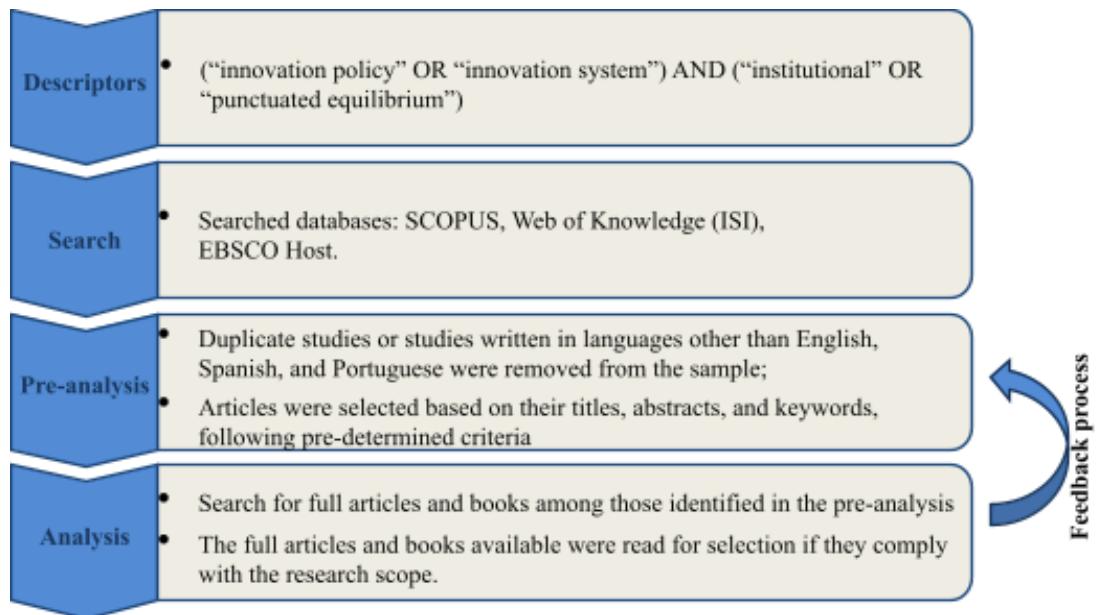 Source: Elaborated by the authors Figure 1: Stages of the systematic bibliographic review
This process consisted of the following steps:
-
The first step was the choice of search terms. Some tests were performed leading to the selected terms. The descriptors used were: ("innovation policy" OR "innovation system") AND ("institutional" OR "punctuated equilibrium").
-
In the second stage, the descriptors were applied to a search in three databases: SCOPUS, Web of Knowledge (ISI), and EBSCO Host. The search identified the descriptors in the titles, abstracts, or keywords of articles and books. When the database allowed it, the search results were limited to books or scientific articles published in peer-reviewed academic journals. The search considered studies published from 2007 to 2019. The result was exported to EndNote bibliographic management software. This step was completed in November 2020;
-
In the third step, duplicate files and those published in languages other than English, Spanish, or Portuguese were removed. A pre-analysis of titles, abstracts, and keywords was conducted to mine the data and identify and remove the studies that addressed the subject only marginally or tangentially. Therefore, at this stage, articles focused on the following topics were removed: innovation in the public service; innovation in universities; research policy; purely or quantitative studies in economics; innovation 4.0 linked to specific technologies (such as nanotechnology, blockchain, artificial intelligence, and Internet of Things); innovation demand; specific studies on public procurement; studies on Asian countries, the United States, Russia or another context other than EU countries, when not comparative with the EU; focus on regionalism within the EU; focus on the relationship between actors promoting innovation (such as Open Labs and clustering); and inter-firm innovation. Removing an article addressing one of these topics at this step did not prevent the article from being reconsidered later if its relevance for this research was verified. Articles addressing the following topics were considered: public innovation policies in the EU; broad studies (comparative or not); focus on government incentives for private sector innovation; studies in the field of Public
Administration or Public Policy; qualitative studies; studies that explicitly addressed the theoretical framework of innovation; studies that contained an explicit analysis model or research design; observed institutional changes;
- In the fourth stage, we searched the full text of the books and articles selected for an in-depth evaluation. On the few occasions when it was not possible to find the complete text directly from the databases, the studies were set apart for future thorough searches. The material retrieved was separated into two groups: studies published from 2015 to 2019 and published before 2015. When these articles and books cited a relevant study for this research, the reference was noted down to be evaluated in a new interaction, forming a recursive cycle of theoretical deepening (feedback process) until reaching a satisfactory level of knowledge.
In the search in scientific databases, 1333 texts were found. This represents the gross number of results returned in the three databases. After removing duplicate articles and those in languages other than English, Spanish, or Portuguese, this number was reduced to 968 studies. The selection through titles, abstracts, and keywords reduced this number to 90. It was not possible to find the full text of two articles, reducing the number to 88. Table 1 summarizes the evolution of the systematic review.
Table 1: Summary of the systematic bibliographic review about innovation policies Source: Elaborated by the authors
| Databases | Studies found by applying descriptors | Studies that remained after removing duplicates and in languages other than English, Spanish, or Portuguese | Selected studies after analysis of titles, abstracts, and keywords | Studies with the full text available | Selected studies | Feedback process |
| SCOPUS | 787 | 968 | 90 | 88 | 88 | Continuing |
| Web of Knowledge (ISI) | 512 | |||||
| Ebsco Host | 34 | |||||
| Search | Pre-analysis | Analysis | ||||
A complementary narrative bibliographic review was carried out in a second moment, considering studies regardless of publication date. The intention was to include classic studies addressing innovation (most dated from the early 90s) and more recent ones, selected by relevance to the research scope.
The narrative or traditional bibliographic review consisted of selecting and analyzing books and articles from electronic journals using the criteria of relevance and pertinence with the research . Some relevant references cited by the authors analyzed in the fourth stage of the systematic review constituted a starting point for the complementary narrative bibliographic review, mainly because they were repeatedly cited in different scientific works and demonstrated an impact in the field. Thus, other works were included to reach a comprehensive overview of the current research.
Given the complex scenario of EU policies to understand and delimit which community innovation policies would be considered in the literature review (i.e., which innovation policies are an object of study in the EU), it was necessary to consult a multitude of sources and documental and legal analysis, such as information on the
Community Support Frameworks, thematic community legislation, institutional information published on the entities' websites, data from the monitoring of innovation by the European Commission, documents referring to the financing process and the European Semester, among others. Among the normative acts, the following stand out: Treaty of Rome (1957), Single European Act (1987), Council Regulation (EEC) 2052/1988, Council Regulation (EC) 1083/2006, Treaty on the Functioning of the European Union (2006), the Treaty of Lisbon (2007), Regulation (EU) 1.301/2013 of the European Parliament and of the Council, and Regulation (EU) 1.291/2013 of the European Parliament and of the Council.
III. EUROPEAN UNION INNOVATION POLICIES
This section presents the EU community innovation policy, highlighting its characteristics. It offers a synthesis of the evolution of innovation policy in the European Union, mentioning the most relevant years, especially the year 2000 when the theme of innovation gained a central position among the EU's development strategies (both the Strategy of Lisbon and the Europe 2020 Strategy).
An alternative denomination for this section could be "Europeanization of innovation policies," as a growing process of institutionalization of the EU and incorporating its policies and influence for its Member States. One could say there has been an EU innovation policy since 1984, the year of the first "R&TD Framework Programme." It was the first time a common European approach to an innovation policy was evidenced. It was carried out by member states, through which the EU became an important funder of innovation activities, encouraging and influencing projects developed in collaboration between member states, most notably after 2000. Since then, many "R&TD Framework Programmes" have been completed. The eighth was the so-called Horizon
2020, a financial instrument of the EU that aims to ensure Europe's global competitiveness .
The EU has two economic and social development programs that stand out in the current century – the Lisbon Strategy (2000-2010) and the Europe 2020 Strategy (2010-2020) . They mark two distinct phases of community policies. In Barcelona in 2010, the EU countries agreed to establish a target of spending 3% of the GDP on research and development (R&D). Out of this 3%, two-thirds should come from the private sector.
In 2005, the Lisbon Strategy changed its financing instruments and coordination mechanisms. On December 13, 2007, the Treaty of Lisbon was signed, the legal basis for European research and innovation policy and the European Research Area (ERA). However, before it entered into force, scheduled for December 2009, a global financial crisis impacting member states occurred in 2008, leading to a decrease in total investment in R&D and innovation in the EU. In December 2008, the European Council announced an economic recovery plan, reaffirming that economic recovery and growth necessarily passed through the implementation of the Lisbon Strategy .
In 2010, the European Commission inaugurated the "Innovation Union" initiative to guide innovation policy until 2020, based on coordination and soft law mechanisms, gradually introduced alongside pre-existing national innovation policies. It is one of the seven flagship initiatives of the Europe 2020 Strategy, approved in June 2010, for a smart, sustainable, and inclusive economy. The European Commission aimed to improve conditions and access to European co-financing research and innovation projects . The smart economy involves investing in education, research, and innovation; sustainable means an economy based on low carbon emissions; and "inclusive" refers to social cohesion, job creation, and the reduction of poverty and inequalities . Another four flagship initiatives of the Europe 2020 Strategy are also linked to innovation: a digital agenda for Europe; resource efficient Europe; a new industrial policy for the globalization era; and an agenda for new skills and jobs.
However, in March 2010, the European Commission postponed the deadline for reaching the 3% target for 2020. Finally, in 2020, a pandemic with a great economic impact occurred. According to data from Eurostat in 2019, the EU average for public investment in R&D was 0.25% of GDP. Concerning private investments, the European average was 1.48% . Currently, the Commission monitors compliance with the national investment target in innovation in the context of the so-called European Semester.
The European Semester provides a framework for policy coordination by EU member states, guiding the discussion of their economic-budgetary plans. It also promotes monitoring at specific moments throughout the year. Member state governments provide the plans, and based on them, the Commission may present general and country-specific recommendations.
After the launch of the Europe 2020 Strategy and the Innovation Union initiative, there was a shift of focus from industrial policy to research policy.
The expectation was the inclusion of research activities developed in universities and the primacy of this type of entity in the national innovation system. Furthermore, since the Sixth Framework Programme, the structuring effect on national innovation systems has been more evident, transferring from the project or specific objective to the national level . A Framework Programme, although it is formally "one" program, actually consists of many subprograms directed at different themes, although the transversality of innovation financing can systematize its objective .
Three major guiding phases of community policy can be observed. The first, before 2000, the goals were less ambitious and aimed at increasing networks and stimulating activities at the national level. The two other phases occurred in the period established for this research: one from the beginning of the 2000s until around 2010 – this research emphasizes the period after 2007 – and another from 2010 to 2019, considering the years between 2010 and 2012 as a transition period .
Scholars such as Queirós and Carvalho, referring to research policy, divide the first phase into two others: (1.1) from the post-World War II period to 1970, characterized by sparse intergovernmental cooperation in strategic sciences; and (1.2) from 1970 to 1990, with the creation of the Framework Programs, a new instrument of Europeanization to increase the competitiveness of the EU through technological innovation . Then, the period after the 2000s is considered a single phase with a new model of Europeanization.
In the second phase, since the 2000s, there has been a growing tendency to support non-technological innovation projects, which can be seen by the growth in the set of incentive instruments. This occurs mainly and particularly in topics such as marketing, design, and organizational innovation, with a growing, but still not preponderant, space for other non-technological activities relevant to innovation, such as encouraging technology transfer and the development of skills that contribute to the innovation. In this phase, peer pressure and naming and shaming Europeanization mechanisms are used more frequently and represent greater pressure on the conduct of member states, even if it is not cogent. The so-called Open Method of Coordination (OMC) was adopted, which, as defined by the European Commission, is an intergovernmental method of cooperation that does not imply legal obligations on the part of the member states. In that decade, from the economic crisis of 2008 to 2012, there was generally a decrease in funding for collaborative R&D projects in EU countries .
The third phase was marked by the direction of the strategy around the so-called Research and Innovation Strategies for Smart Specialization (RIS3), considered a guideline to political priorities of community innovation . As mentioned above, since 2010, the focus of industrial policy has shifted to research policy and the promotion of basic research activities carried out in universities. This new framework represents a continuation of the systemic approach to innovation and an emphasis on non-technological innovation. On the other hand, it improves the policy to reinforce innovation networks and consider the particularities and strengths of each country (or region) because resources are now concentrated in areas where each member state has advantages. This strategy is controversial due to the potential path-dependent reinforcements. However, it also seeks to facilitate the insertion of companies in international innovation networks and collaboration between entities from different innovation systems, boosted by instruments to encourage the formation of clusters. Thus, it tends to adhere by reinforcing the power already established in the areas of specialization.
Adopting this strategy proved to be both forceful and inclusive. Forceful because it is established top-down from the EU political institutions as a condition for access to structural funds . It is inclusive or participatory because member states are responsible for identifying the strengths and weaknesses of each region to channel resources to certain economic areas in which the country has greater advantages compared to another country or region. In other words, the definition of specialization to allocate resources comes from the member states, with the participation of regional and local economic agents, reinforcing regional and local power. It is possible to observe a movement away from the selection and support of the so-called national champions to implement strategies that respond to interest groups and supposedly benefit from greater political sustainability.
The following instruments were encouraged: collaborative R&D programs, to the detriment of individual R&D projects; incentives for business entrepreneurship; initiatives on the public demand side; creation or encouragement of innovation networks and clustering; competitive selection of projects from research institutions; incentives for non-technological innovation in general . The current challenges indicate a) the need to coordinate innovation and research policies between member states and b) a trend toward decentralization. Table 2 summarizes the three phases mentioned.
Table 2: Phases and characteristics of the community innovation policy
| 1st phaseBefore 2000 | 2nd phaseFrom 2000 to 2010 | 3rd phaseAfter 2010 | |
| Milestones | Accession to the EU and adaptation | 2008 Crisis | Period of troikaEurope 2020 Strategy and the initiative Innovation UnionHorizon 2020Period 2014-2020 |
| Characteristics | Less ambitious goalsStimulate activities at the member state levelFocus on industrial policy | Change from the linear view to the systemic view of innovationGrowth of the set of instruments to promote innovationFocus on industrial policy | "Smart specialization" strategyRegionalization of community policiesFocus on research policy |
| Instruments | Technological innovation projectsInstruments dedicated to improving networksMission-oriented funding | Non-technological innovation projectsIncentive to marketing, design, organizational innovation, and other non-technological activities relevant to innovation, such as encouragingtechnology transfer and skills development that contribute to innovationPromotion of business entrepreneurshipCollaborative R&D programs, to the detriment of individual R&D projectsPromoting collaboration between public and private entities in R&D projects and trying to get companies involvedInitiatives on the public demand side from the middle of the decade | A certain continuity of the instruments from the previous phase, with a growing set of instrumentsNon-technological innovation projectsCreation or incentive to innovation networks and clusteringCompetitive selection of research institutions' projects to be funded by R&D public programsStrategy direction established by the EU and its choice of prioritiesIdentification of regions by member-states |
Considering the phases that the community innovation policy went through, the next section addresses the literature review.
IV. THEORETICAL STRANDS OF INNOVATION POLICIES
This section starts from the assumption that innovation generates economic development and benefits a country . However, innovation is so ubiquitous, transversal, and interdisciplinary that any claim to map it in its entirety would be too ambitious. This subsection presents an overview of the literature, particularly examining theories and models on innovation and its impact on related public policies from the late 1980s and early 1990s when it became more common to include ideas about networks and systems. The literature on innovation discusses how it emerges, expanding the comprehension of this phenomenon and the ability to find legal mechanisms for regulating and designing programs suitable for its promotion.
The theoretical foundations for innovation studies are the research works of Schumpeter and two main theoretical approaches familiar to the interdisciplinary science of public administration, public policy, and economics: neoclassical economics and evolutionary economics (or neo-Schumpeterian economics). These two theoretical approaches share the premise that innovation generates economic growth, and they recognize the importance of public policies in promoting science and technology. Investigations on the relationship between innovation and the country's performance and economic growth are abundant . From there, they follow different paths.
Neoclassical economics studies the functioning of the market. This perspective identifies that the need to encourage innovation results from market failures. The logic is that the state must address these failures since companies do not have enough incentives to innovate. This theoretical approach reflects a linear view of innovation where public policy should handle market failures by promoting scientific knowledge through basic research. Thus, investing in universities and research institutes would almost automatically result in innovation for the market. Scientific research is expected to generate economic progress almost automatically in a one-way flow, being transformed into engineering and production and, thus, into new marketable products. Because it is structured in a linear model, this view underestimates aspects related to the transformation of scientific knowledge into market innovation and economic value .
The second theoretical approach is evolutionary economics. Its premise is that decision-makers cannot deal with all aspects and process all information rationally and, therefore, resort to simplifications, automatic behaviors, and heuristics. Evolutionary economists recognize that innovations will always occur and generate diversity, which is reduced by selection. Thus, based on diversity, the elements more adapted to the circumstances will remain, leading to improvement within specific environmental stability .
If natural mutations are random and, therefore, not necessarily more advantageous in biology, the same cannot be expected of government actions. Public policies, directed and intentionally, aim to change reality to encourage the most advantageous innovations for competitiveness, given the national and community circumstances. Thus, "the evolutionary approach is particularly suited for analyzing historical processes. Evolution and history are both a complex mixture of random factors, or contingencies, and more systematic tendencies."
In public policy and its intersection with law, the evolutionary approach is the most widespread, which adopts the theoretical framework of the new institutionalism. Although there is a trend of convergence between neo-institutionalist currents, it is possible to observe a dividing line: on the one hand, there are studies on innovation, such as those included in the economic policy book "Varieties of Capitalism." These studies rely on the architecture of economic and non-economic incentives at play in each country or group of countries being compared, approaching the new institutionalism of rational choice ; on the other hand, there are studies that combine traits of the new sociological and historical institutionalism, as is the case with the theoretical approach of innovation systems . For this majority line, which has become paradigmatic in the field, innovation is understood as a phenomenon that occurs within a national system, which evolves historically and bears characteristics of being path-dependent.
The best-known example of path-dependence is the QWERTY keyboard. The choice of organizing the letters in this specific order is not the best but it has a justification based on the history of the development of the device and it is difficult to change at this point. The permanence of the QWERTY keyboard is not explained by its efficiency, but by historical selection processes that lead to path-dependency. These dependencies are important for technology, institutional processes, and understanding the evolution of national innovation systems (NISs):
Since countries differ economically, and different industries have different requirements with respect to knowledge, skills, finance, etc., the "knowledge infrastructure" that evolves in response to these needs through interaction with policymakers tends to get a distinct national flavor, which may be further strengthened by historical differences in political and institutional systems. This is not necessarily a problem as long as the country's specialization pattern doesn't give reasons for concern. However, if change is needed, such inherited patterns may easily turn counterproductive .
Joseph Schumpeter was the author who set the theoretical bases for the study of innovation . As a precursor of this idea, based on evolutionary theory, he identified business activity as the main driver of innovation and economic development. Innovation was divided into four stages: invention, stricto sensu innovation, diffusion, and imitation. According to Schumpeterian theory, economic growth occurs during the diffusion of innovation. Freeman explains diffusion as "[...] the period when imitators begin to realize the profitable potential of the new product or process and start to invest heavily in that technology."
Neo-Schumpeterian theorists continue to develop the precursor theory in line with evolutionism and the development of the systemic view of innovation, whose exponents were Freeman , Lundvall , Nelson , and others discussed below. The innovation systems approach expands the traditional linear view of innovation mentioned above. For the practice of government decision-makers, the systemic view implies different public policy designs: instead of directing resources to sectoral science or qualification policies. It requires a coordination effort to foster innovation in a transversal and diffuse way among the various governmental areas.
Freeman was a pioneer in adopting the term "national system of innovation" in the late 1980s. The author defined this system as "the network of institutions in the public and private sectors whose activities and interactions initiate, import, and diffuse new Technologies and the concept was disseminated in the 1990s by Lundvall and Nelson in subsequent empirical studies. This concept already recognized the role of institutions in innovation but highlighted new technologies as a means for innovation. Nelson's work suggested a methodological framework for comparing national innovation systems (NISs) across countries, dividing them into large high-income countries, smaller high-income countries, and lower-income countries .
Seminal works of new institutionalism were published in the early 1990s, namely "Institutions, Institutional Change and Economic Performance" by Douglas C. North , "Rediscovering Institutions" by James B. March and Johan P. Olsen , and "Governing the Commons" by Elinor Ostrom .
These studies provided a paradigm shift in socioeconomic studies at the time. Instead of focusing on how economic and social variables determine politics, using variables such as class structures and economic power, the neo-institutionalist approach pointed out that the character of political institutions of society largely determines its social and economic development .
As is often the case with widely used terms, the concept of NIS is used ambiguously, as noted by Edquist and Hommen. Several authors adopted the term NIS, but each one defined it slightly differently from the others, and resolving this question around a single definition has become somewhat unlikely . According to Edquist and Hommen, "there is, therefore, a need for theoretically based empirical research to 'straighten up' the approach and make it more 'theory-like,'" which suggests comparative studies of diverse NIS and on determinants of innovation.
The authors incorporated the characteristics they deemed most relevant in innovation – or factors that influence it – so it is challenging to distinguish what is essential and what is circumstantial in the concept. Table 3 presents some authors and their conceptual nuances, with perspectives that can be broad, narrow, or even not expressed or defined.
Table 3: Concepts and perspectives of the national innovation system (NIS)
| Author | Broad perspective | Narrow perspective | Element(s)/dimensions highlighted in the concept of NIS | Comments |
| Freeman (1987) | X | "The network of institutions in the public- and private-sectors whose activities and interactions initiate, import, modify and diffuse new technologies."48 | It focuses on networks, and although it recognizes the participation of public and private institutions, the concept is restricted to those directly linked to new technologies | |
| Lundvall (1992) | X | "[...] 'the structure of production' and 'the institutional set-up [...]. The elements and relationships which interact in the production, diffusion and use of new, and economically useful knowledge... and are either located within or rooted inside the borders of a nation state."49 | NIS integrated into the broader socio-economic system | |
| Edquist and Lundvall (1993) | X | "The national system of innovation is constituted by the institutions and economic structures affecting the rate and direction of technological change in the society."50 | Focus on constituents (leading institutions of whatever type) that can alter the direction and speed of socio-technological change | |
| Nelson and Rosenberg (1993) | X | "Organizations supporting R&D – i. e. they emphasized those organizations that promote the creation and dissemination of knowledge as the main sources of innovation. Organizations disseminating knowledge include firms, industrial research laboratories, research universities and government laboratories. [...] The set of institutions whose interactions determine the innovative performance of national firms."51 | NIS could be considered an equivalent of national I&D Systems | |
| Niosi et al. (1993). | X | "[...] A national system of innovation is the system of interacting private and public firms (either large or small), universities, and government agencies aiming at the production of science and technology within national borders."52 | While recognizing the broad participation of different institutions, it maintained the focus on science and technology, reflecting the vision of the period in which the work was produced | |
| Niosi (2002) | X | "NSIs is thus a set of interrelated institutions; its core is made up of those institutions that produce, diffuse and adapt new technical knowledge, be they industrial firms, universities, or government agencies. The links between these institutions consist of flows: knowledge, financial, human (people being the bearers of tacit knowledge and know-how), regulatory, and commercial."53 | The author develops the concept, including institutions more deeply involved, networks, information flows, and stages of innovation (production, diffusion, and adaptation) | |
| Edquist and Hommen (2008) | X | "Determinants of innovation processes - i. e. all important economic, social, political, organizational, institutional and other factors that influence the development and diffusion of innovations."54 | Maintains Edquist's (1997) definition. Focus on innovation activities (although science still does not know for sure what are the main determinants of innovation) and not on constituents (leading institutions) | |
| Costa (2016) | X | "Innovation is ubiquitous, and its sources come from different institutions. Therefore, different agents must interact in a systemic learning process rather than a unidirectional or linear one. [...]. Thus, information exchange among agents is fundamental, establishing channels through which the flow of information occurs, playing a relevant role in the innovation process."55 | The author focuses on networks and interactions |
The narrow perspective is limited to activities carried out by public entities dedicated to science and technology. The broader perspective encompasses all competencies that are cross-cuttingly related to innovation. In this research, the broad perspective of NIS is adopted to the point of recognizing and addressing the influence of Europeanization and its possible institutional changes at the heart of the innovation system.
After understanding the innovation system (or the scenario in which the government acts), we move on to the concept of the actions per se, i.e., the concept of public policies that promote innovation, henceforth "innovation policies." The term may mean both public polices intentionally designed to foster innovation and public policy that promotes it directly or indirectly, even if in an area different from its fields par excellence (science and technology), which reflects the variation between the broad and narrow perspective discussed above regarding the NIS.
Adopting the term innovation policy in the literature already hints at the model adopted in each research. This is because the term emerged later and gained acceptance concomitantly with adopting the systems view. Before that, public policy was seen in segments of science, technology, and industry, in common terms at the time, such as science policy, technology policy, and industrial policy, which were associated with innovation to be later incorporated by it. According to Fagerberg, the focus in the 1960s was on encouraging science, believing that promoting science would necessarily lead to innovation. After that, the popularity shifted to technological and political expression .
Currently, those terms are more used when referring to a specific area with defined contours, while the current reference to the political terminology of innovation denotes the transversal idea about innovation, referring to several communicating areas and including their sectoral interactions.
This terminological advance is relevant because, as May and Schedelik observed, innovation and technology are distinct, and innovation policies need to go beyond the realm of pure knowledge to be effective: "successful innovation policy does not necessarily lead to more labs and more cutting edge technology, but to actively shaping the institutions in which innovation processes take place." Innovation is a new or improved product or process that differs significantly from previous ones and has been made available to potential users (products, i.e., goods or services) or brought to use by the innovator (processes, i.e., technological or organizational improvements) . It does not occur in isolation but is integrated into a system. Despite this advance, the linear view of innovation resists in the field of public policy practice since the systemic view brings more challenges to governments in formulation, implementation, and public policy coordination.
In addition to this challenge, the systemic view teaches a lesson: that the context matters, and it is reckless to disregard it to simply copy from one country to other measures adopted in industrial policy, hoping for a similar result. Each country has a national innovation system with its own characteristics that must be considered. "It is also implied that there are no universal policy solutions or instruments that can be effectively implemented independently from the concrete context of the given country."60
A system is formed of components and the relationships among them. They must constitute a coherent unit with its own function and limits, which means it can be differentiated from the environment. The unit's properties belong to all the components, and these properties are different from those observed in the components individually. In the case of the innovation system, research has not yet developed sufficiently to list all its components and relationships, and the list of the most important ones varies geographically .
The study by Fagerberg stands out in the literature based on a systemic view. The author portrays the reciprocally interfering elements in the technological dynamics, and the NIS is the result of locally and globally influenced processes of knowledge, skills, demand, finances, and institutions . The processes, sectoral government policies, and the innovation management system (or strategic innovation management system) are observed as something dynamic.
Fagerberg points out five main NIS processes that influence innovation: knowledge, skills or competence, demand, finance, and institutions. Public policies can influence these same processes and also receive feedback from technological dynamics, making such influence reciprocal. By "technological dynamics," we mean innovation, diffusion, and use of technology. These dynamics result from external and internal factors arising from business sector activities and relationships with other social subsystems. "Society" includes government, interest groups, and non-governmental organizations. At the governmental level, the policies that influence come from different areas, demonstrating the transversal nature of innovation: research, education, health, defense, industry, regional development, public finance, justice, and others, depending on the context of each country .
In addition to the literature on NIS, it is important to present the models of the triple helix, multilevel perspective (MLP), clustering models (also derived from the evolutionary theoretical approach), and innovation systems.
Etzkowitz and Leydesdorff created the triple helix model , "[...] an innovation model in which the university/academy, industry, and government, as primary institutional spheres, interact to promote development through innovation and entrepreneurship." It studies the communication network and expectations that recreate the institutional arrangements between those three spheres, often creating new organizational formats such as incubators, accelerators, and technology transfer offices. It may be considered an analytical tool that assigns a third mission to universities to contribute to economic development .
Later developments presented quadruple and quintuple helix models, including civil society and the environment. These models were represented by partially overlapping circles, intersections, and relationships between them and reflected the discussion and incorporation of other leading actors .
In turn, MLP was born in the Netherlands, is specific to political science and international relations, and is more concerned with the study of innovation in topics related to the energy transition, changes in the socio-technical system, and those linked to sustainability . MLP starts from the premise that emerging a new technology and changing a given socio-technological paradigm depends on the interaction between processes at multiple levels. Change occurs through coevolution processes and coadaptation within and between layers of the three levels: micro, concerning niches; meso, relevant to the regime; and macro, referring to the international context .
According to this theory, regime change happens when there is a temporal coincidence between niche innovation and the pressures from the macro level on the regime to destabilize it and provoke a window of opportunity for the transition . Niches are spaces created to promote and protect innovation. The technological regime can be explained as the set of practices and rules supported by the incumbent actors and their meso and macro relationships. Finally, the macro (contextual) level encompasses macroeconomics, cultural patterns, geopolitics, resources, interests, geographic conditions, climate, and other more general elements.
Some assumptions based on Nelson and Winter are added from the differentiation between the levels. First, the macro level, called landscape, tends to change slowly and with difficulty, generally due to exogenous factors. Second, at the opposite extreme are the niches, terrain for experimentation and emergence of new technologies and radical changes. Although the niches are the gateway for "novelties" in the system, they need compatibility with the broader technological regime and its political-institutional support (the meso level) to be established. The meso level has a structure based on the past and, therefore, is more resistant to incorporating changes. So, a radically new technology, even if successful, may not go ahead if the regime does not accept it. In this sense, the state's role in facilitating this process of acceptance of new technologies by the regime – so-called strategic niche management or transition management – is crucial .
Although MLP is used to explain changes in the technological paradigm and is focused on the point of view of the company and the networks rather than policies and public administration, it explains how innovation leads to changes in paradigms and, by understanding these changes, brings lessons for the study of innovation policies. One of these lessons is suggested by Geels . The author demonstrates that innovation is generally considered as coming from new companies, i.e., start-ups that are part of the new technological paradigm and seek to modify the dominant paradigm controlled by established traditional companies (the "incumbents"). However, innovation is also born in incumbent companies that dedicate part of their activities to the new emerging paradigm. Rather than being seen as a hindrance to change, public decision-makers can see such companies as allies of this transition.
Finally, the clustering model or diamond model is presented. This model was created in economics and business studies addressing competitive advantages of nations and companies, both linked to innovation, since, according to Porter, "firms create competitive advantage by perceiving new and better ways to compete in an industry and bring them to market, which is ultimately an act of innovation."
Clusters are geographic concentrations of interconnected companies and institutions in a given industry. "Once a cluster begins to form, a self-reinforcing cycle promotes its growth, especially when local institutions are supportive and local competition is vigorous. As the cluster expands, so does its influence with government and with public and private institutions." The author concluded that clusters are crucial for nations' competitive advantage because the determinants of competitiveness are interdependent, and this systemic nature links thriving industries through vertical and horizontal relationships .
Clusters encompass an array of linked industries and other entities important to competition. They include, for example, suppliers of specialized inputs such as components, machinery, and services, and providers of specialized infrastructure. Clusters also often extend downstream to channels and customers and laterally to manufacturers of complementary products and to companies in industries related by skills, technologies, or common inputs. Finally, many clusters include governmental and other institutions – such as universities, standards-setting agencies, think tanks, vocational training providers, and trade associations – that provide specialized training, education, information, research, and technical support .
This description makes it possible to identify the points of contact between the models (Table 4). They commonly recognize the importance of interaction between different types of organizational actors. Despite the merit of the other three models, this research opted for the innovation system. The MLP is more commonly used in studies focused on the transition of the technological paradigm and on businesses. The model of helices brings the notion of the entrepreneurial university as a leading actor for innovation. It reflects its origin in analyses of Silicon Valley and indicates its normative nature. Finally, clustering focuses on competitive advantages and relationships between companies. Thus, the innovation system is broader and more universal, suitable for research in the field of public administration, and better adaptable to the reality of different contexts. Moreover, no element is lost, as the innovation system can consider the three main actors of the triple helix model or the actors of a given cluster. Only their weights are not predetermined but will depend on each context.
Table 4: Models to promote innovation
| Innovation systems | Triple helix | MLP | Clusters | |
| Innovation: How? | Systemic and evolutionary interaction among organizations and institutions | Evolutionary and dynamic interaction in a complex network system of relationships with the university, industry, and government | Entry of novelties into the system from the level of niches. The novelties become established when compatible with the above level, the technological regime, and the political-institutional support. | Geographical concentration of competition and collaboration between related companies and/or between support industries |
Having addressed the most used theoretical approaches to innovation policies, we inquire which objects or subtopics have been attracting research attention in this field and how the literature on the subject has developed. This study adopts the innovation systems approach, and the concept of innovation policies reflects this choice. It focuses on the systems, networks, and relationships among institutions involved in innovation. In addition, it is possible to cluster research dedicated to policy instruments , research that discusses the determinants of innovation processes , and research dedicated to the description and analysis of EU innovation policy, of groups of countries , or case studies of specific countries .
One of the important sub-themes is innovation policy instruments since exemplifying these instruments helps clarify the understanding of the policies. The list of instruments synthesized in Table 5 may have additions due to the creativity of public policymakers, and it is not exhaustive.
In this sense, the most recurrent instruments identified in the literature can be divided into six categories: Public Innovation and Development (I&D); promotion of academia-industry collaboration; encouraging technology and knowledge transfer; direct support to private I&D; tax incentives; venture capital funds . As direct instruments, one can identify public I&D, direct support to private I&D through public funding and public procurement or other demand-driven innovation policies. Indirect categories can be promoting academia-industry collaboration; encouraging technology and knowledge transfer; tax incentives; government-funded venture capital funds.
Table 5: Public policy instruments
| Type of instrument | Direct | Indirect | Description |
| Public I&D | X | Universities, public research institutes | |
| Academia-industry collaboration | X | Including policies for creating clusters with the participation of academia and industries; policies to encourage collaboration | |
| Workers education/training | X | Policies for education and professional training | |
| Technology and knowledge transfer | X | Including spin-off measures, entrepreneurship policies, consultancy, and technical services | |
| Private I&D | X | Direct support to private I&D and business innovation | |
| Tax incentives for I&D | X | Differentiated rates, non-incidence, exemptions, or tax deductions | |
| Venture Capital Funds | X | Funded by the government | |
| Demand-oriented innovation policies | X | Public procurement, innovation inducement prizes, and similar instruments |
Among the instruments above, the literature review showed that the latter has recently received more attention, referring to demand-driven innovation policies . The terms used to refer to these instruments have not been consolidated yet. The terms are broad-based innovation policies, systemic innovation policies, a demand-pull view, demand-oriented policy instruments, public procurement for innovation, pre-commercial procurement and, even more broadly, holistic innovation policies .
In a holistic approach to innovation policies, each of the five main NIS processes should be complementary, as the delay of one can compromise or delay the entire system. Thus, knowledge only makes sense and can be used if there is demand, funding, skills, and institutions. The same logic applies to any of the other processes.
It turns out that, in general, research on innovation policy in the EU has been sparse, approaching various and discontinuous themes. Another feature is the significant influence of practice to direct research themes, and precisely because of this influence, studies on the so-called regional innovation system have been common recently.
Regional innovation policy studies can be seen as studies of innovation systems, which can turn to NIS or research and innovation strategies for smart specialization (RIS3). Some still consider regional studies as a mixture based on the systemic view but add the importance of proximity and interorganizational geographic relationship, brought from clustering and the triple helix, for innovation development .
In recent years, there have been more investigations on the evolution of innovation policies from a historical perspective, but the number of studies is still timid and does not represent a clear trend. According to González-López and Guntín-Araújo, "the majority of evolutionary research on innovation policies starts from a normative and theoretical point of view, and in very few cases is based on empirical studies. These research works took place at the European, national, or regional level of analysis and represented case studies of a specific country or region and comparative studies.
These studies point out replicable lessons about the evolutionary changes in the last decades of the innovation policy in a specific region, such as the Basque Country , Galicia , or Wales . Research on the Basque Country was one of the first empirical studies to use path dependence analysis tools applied to the development of science, technology, and innovation policies in support of RIS3 policies. It pointed out the advantages and disadvantages of the previous experience of Basque innovation policies for the development of subsequent policies. In common, the three studies (Basque Country, Galicia, and Wales) used the literature on path dependence and the theoretical framework of historical institutionalism. As for differences observed in the studies, the first operationalized the analysis of continuity and change of innovation policies, the second used the coalition of interests, and the third presented regional studies and economic geography.
It was possible to identify the emergence of research adopting a historical and comparative perspective about Estonia, Latvia, and Lithuania between 1989 and 2010 . The analysis was extended to three countries, but the object was restricted to one specific sector of innovation policy, the scientific research funding policy. The analysis addressed how different national trajectories in this area emerge and differ over time. One of the contributions is to combine historical institutionalism with the phenomenon of institutional Europeanization.
The research by Karo and Looga on Slovenia and Estonia also stood out. The authors compared the two countries in their institutional changes of economic restructuring and their innovation policies . The study contributed to emphasize the importance of the political-administrative context (or the institutional setting of the design) and the relevance of implementing the public policy and including frameworks of the new institutionalism (called discursive). Finland and the UK were the objects of a comparative study that combined transport and innovation policies, called "innovation system in transport." The study was based on the literature on the path dependency relationship (both at the institutional and at the public policy level) with technological expectations and images of the policy problem .
V. CONCLUSION
The Lisbon Strategy (2000-2010) and the Europe 2020 Strategy (2010-2020) are two EU economic and social development programs that stand out for promoting innovation and mark three distinct phases of the evolution of incentive policies. The last one of these phases is recognized by the focus on institutional interrelationship, incentives for non-technological innovation, the trend toward decentralization, and the effort toward greater coordination of innovation policies and collaboration between the actors involved.
On the side of state governance, initiatives to promote public procurement are reflected in the recent literature on the subject.
The two main theoretical approaches for understanding innovation and policies that promote it originate from neoclassical economics and evolutionary or neo-Schumpeterian economics and inform, respectively, the linear and systemic views of the phenomenon of innovation, whose understanding is essential for policy design.
In public policy and its intersection with law, the most widespread interdisciplinary approach is evolutionary, which shares the theoretical framework of the new sociological and historical institutionalism. According to the evolutionary approach, innovation occurs within a national system, evolves throughout history, and shows characteristics of being path-dependent. Other institutionalist and evolutionary models were identified alongside the innovation systems model, such as the triple helix, multilevel perspective, and clustering models.
Research on innovation policy is dispersed, addressing varied and discontinuous topics. Another feature is the significant influence of practice to direct research themes, and precisely because of this, works on the so-called regional innovation system have been common recently. Although there have been more studies on the evolution of innovation policies from a historical perspective in recent years, they are not as many, so it is unclear if this perspective represents a trend.
Considering the frontier of research on innovation policy in the EU, there is recent research from historical and comparative perspectives. There is evidence of studies on specific regions, such as the region of the Basque country, Galicia, Wales, or studies on countries such as Estonia, Latvia, Lithuania, Slovenia, Finland, and the UK, more often comparative studies, with emphasis on the use of theoretical tools of historical institutionalism.
Studies on innovation policies benefit from the application of the literature on innovation systems. Such approaches should be expanded as a research agenda due to their explanatory power, requiring more interdisciplinary studies in the literature that combine this approach with legal analyses of regulation and the promotion of innovation.
The research limitation lies, on the one hand, in the decision to adopt bibliographic research that addressed neo-institutionalist frameworks of public policies to promote innovation; on the other hand, in the nature of the systematic and narrative review. In the first case, the knowledge extracted from the studies is subject to selection bias, even when trying to minimize arbitrariness. In the second, the choice of descriptors (words and phrases) may unintentionally exclude relevant literature. Future research could expand the selection to other theoretical strands and time frames.
Conflict of Interest
The authors declare no conflict of interest.
Ethical Approval
Not applicable
Data Availability
The datasets used in this study are openly available at [repository link] and the source code is available on GitHub at [GitHub link].
Funding
This work did not receive any external funding.
References
Cite this article
Related Research


Special Issue
Launch a focused special issue to highlight research, emerging trends, and expert insights in your academic field.
