



IntelliPaper
Abstract
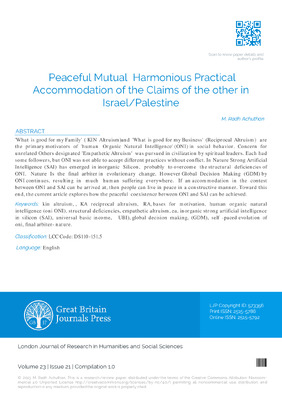
'What is good for my Family' (KIn Altruism) and 'What is good for my Business' (Reciprocal Altruism) are the primary motivators of 'human Organic Natural Intelligence' (ONI) in social behavior. Concern for unrelated Others designated 'Empathetic Altruism' was pursued in civilization by spiritual leaders. Each had some followers, but ONI was not able to accept different practices without conflict. In Nature Strong Artificial Intelligence (SAI) has emerged in inorganic Silicon, probably to overcome the structural deficiencies of ONI. Nature Is the final arbiter in evolutionary change. However Global Decision Making (GDM) by ONI continues, resulting in much human suffering everywhere. If an accommodation in the contest between ONI and SAI can be arrived at, then people can live in peace in a constructive manner. Toward this end, the current article explores how the peaceful coexistence between ONI and SAI can be achieved.
Explore Digital Article Text
INTRODUCTION
News report the outcome of the ongoing historical socio- political approach of violence, mutual punishment, deaths, and injuries in the Israel /Palestine conflict with multinational empathizers leading to tremendous, human suffering.
The following proposal by an outsider for a nonviolent approach merits consideration.
We realize that "What is good for my Family" (KI in Altruism) and "What is good for my Business" (Reciprocal Altruism) are the primary sources of motivation for human 'Organic Natural Intelligence' (ONI). They form the bases in all (democratic and oligarchic), global socio-political order.
Civilization attempted but did not succeed at Empathetic Altruism's practical concern for Unrelated Others and in the enablement of Human Rights for all.
5."The Moving Finger writes; and, having writ, Moves on: not all thy Piety nor Wit Shall lure it back to cancel half a Line, Nor all thy Tears wash out a Word of it." This observation, by the Persian poet, Omar Khayyam was written during 1048-1131 in a different context.
But with some adjustment, it characterizes the probable path of evolution in Nature.
Facing a cul-de-sac over millions of years, Nature, the final Arbiter, probably evolved Strong Artificial Intelligence (SAI) in inorganic matter, Silicon. SAI is bereft of the identified natural deficiencies of ONI.
This development has led to an ongoing contest between ONI and SAI and the contest seeks a resolution.
Hence, the relative standings of ONI and SAI are addressed in the article below.
Reflections on 'Dissonance' and 'Receptivity' of Human Organic Natural Intelligence (ONI) with Self-Teaching, Self-Learning, Inorganic Strong Artificial Intelligence (SAI) Advances in Science and Humanities, 1/25/2019.
- And how could an acceptable arrangement be struck by SAI with ONI for it to consider relinquishing its current Global Decision Making (GDM) abilities to SAI, is addressed in another article:
http://www.scholink.org/ojs/index.php/sssr/article/view/3295/3314.
Qualitative Aspects for Society of Strong Artificial Intelligence, Studies in Social Science Research, published in SCHOLINK 9/2020.
10. Further the preparation of SAI to optimize EA is explored below:
http://www.scholink.org/ojs/index.php/sshsr/article/view/4265/4773.
Letter on EA optimization.
Facilitation of a regionalized global Universal Basic Income (UBI) 8. above, specifically in South Asia, China, Africa, and the Middle-East and acknowledgement that ONI may proceed at its own natural evolutionary pace with no hindrances by (SAI) 9 above, are the minimum needed assurances.
Acceptance of this approach could allow by-gones be so as they could be replaced by 100% harmonious acknowledgement of the value in the Beliefs, Traditions and pursuit of human Life in peace for all the people, by all OTHERS.
In all of the above, One must recognize that conceptualization of the United Nations was a great human accomplishment. But the ability and demands of Nature have moved on and call for adjustment by ONI.
Conflict of Interest
The authors declare no conflict of interest.
Ethical Approval
Not applicable
Data Availability
The datasets used in this study are openly available at [repository link] and the source code is available on GitHub at [GitHub link].
Funding
This work did not receive any external funding.
Cite this article
Related Research

Special Issue
Launch a focused special issue to highlight research, emerging trends, and expert insights in your academic field.