



IntelliPaper
Abstract
Effective sharing of local resources, tools, everyday goods, and skills can change daily life. However, current peer-to-peer (P2P) systems, the majority of the time, struggle with user engagement, supply-demand mismatch, and a lack of trust. This paper surveys these models and introduces a mobile-centric sharing app using Flutter and Firebase. The design features user authentication, location-based discovery, and an in-app negotiation module with a rating system for reliability. Prototype tests show responsive interactions averaging under two seconds. Role-based access control and encrypted data exchanges address security concerns. This survey demonstrates how intelligent local platforms can optimize assets, minimize waste, and enhance community resilience.
Explore Digital Article Text
Introduction
Community-level resource sharing has been recognised as a realistic method to promote environmental sustainability and reduce household expenses. Mostly, neighbourhoods own the underutilised assets, tools, or specialised equipment that are very rarely used, which might be needed by neighbors. These exchanges take place mostly in an informal manner, like word of mouth or based on mutual trust. While these straightforward traditional approaches suffer from limited visibility, poor coordination, and inherent trust barriers. These challenges can be overcome with a formalized technology-driven platform, helping households avoid duplicating purchases, unnecessary consumption, financial loss, and spatial clutter.
The rapid growth of the sharing economy has increased the development of various digital platforms aiming to facilitate P2P exchanges. Earlier solutions heavily depended on community bulletin boards and generic online classifieds, but these methods have major problems like a lack of a standard verification mechanism, and coordination was slow and manual. Subsequent iterations leveraging social media groups improved digital connectivity but failed to adequately resolve user safety, reliability, and local relevance issues. More recent applications incorporate digital identity verification and location tracking, yet they tend to heavily favour commercial or rental transactions over genuine, community-driven cooperation. Consequently, the social nuances of neighbourhood-level sharing are often ignored.
This paper aims to outline the essential architectural and functional components of a community-focused mobile application, dubbed the Neighbourhoods Resource Exchange.” Developed using the Flutter framework, our proposed model maximises local participation by allowing residents to easily lend, borrow, and trade goods or services. It also uses the time-banking credit mechanism to incentivize active participation. The key features are geofencing, verified user profiles, peer reviews, and secure messaging, which work together to establish a trustworthy and safe environment.
This paper analyses existing literature and presents an overview of core technologies used highlights the limitations of existing applications. and proposes future directions for building an interconnected community platform.
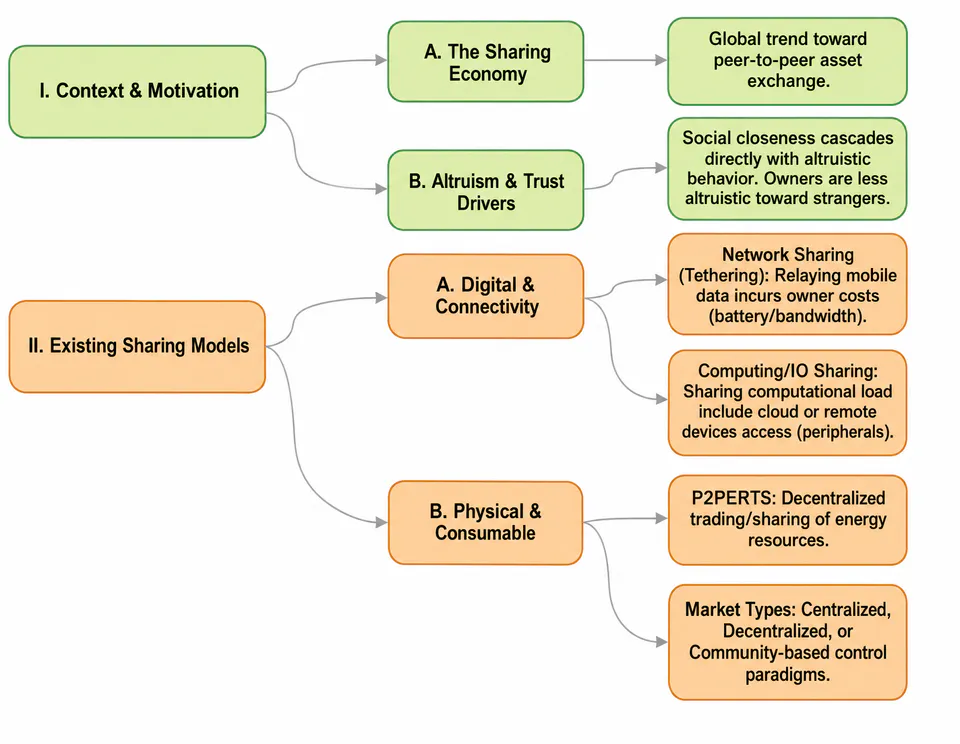
Classification of Existing Solutions
Context and Motivation
Peer-to-peer resource allocation relies heavily on modern economic theory and social psychology [3], [4]. The broader “sharing economy” represents a global transition toward decentralized asset exchange rather than pure ownership [4].
Research shows that altruistic behaviour in sharing environments is closely tied to social proximity [3]. Device and asset owners demonstrate varying willingness to lend resources based on their social relationship with the borrower. Because owners naturally perceive higher risks when dealing with strangers, dynamic risk-management and trust-building tools are strictly required to encourage broader participation [3].
Existing Sharing Models
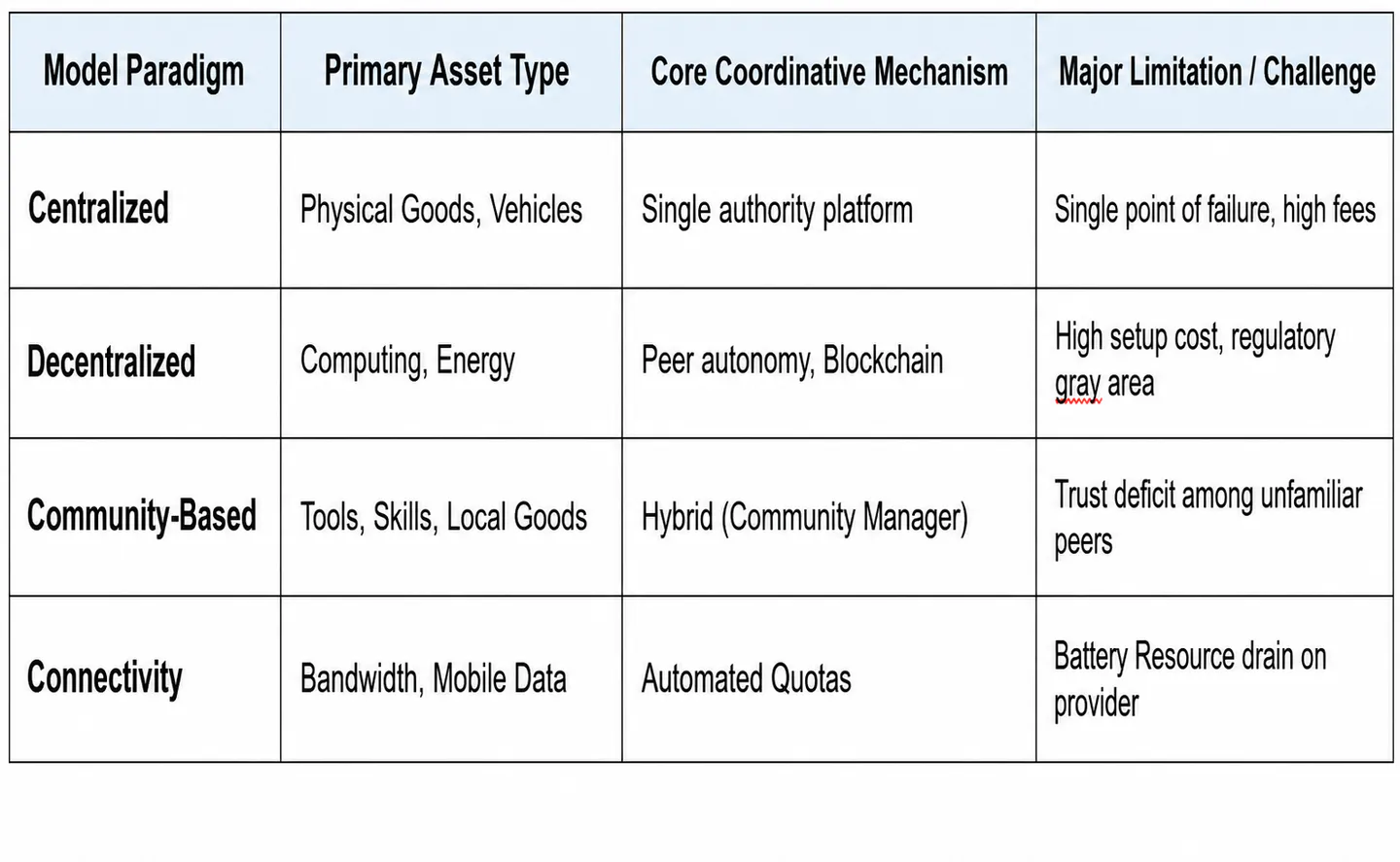
Current decentralized sharing platforms can generally be categorized based on the specific type of asset being exchanged [1], [2], [3].
Digital & Connectivity Model: In mobile ad-hoc situations, network sharing (such as mobile tethering) is common. However, it incurs distinct costs for the provider, including battery drainage and bandwidth consumption, necessitating strict quota management systems [2], [3].
Computing and I/O Sharing: This model provides resource virtualization or load balancing among local processors. Mobile devices efficiently manage limited power and memory by offloading intensive computations to nearby devices via cloudlet-based architectures [2].
Physical and Consumable Model: Systems like P2PERTS (Peer-to-Peer Energy Resource Trading and Sharing) facilitate the decentralized trading of energy grids. These frameworks have been successfully implemented in rural communities to build economic resilience and offer a solid template for managing physical community assets like tools or vehicles [1].
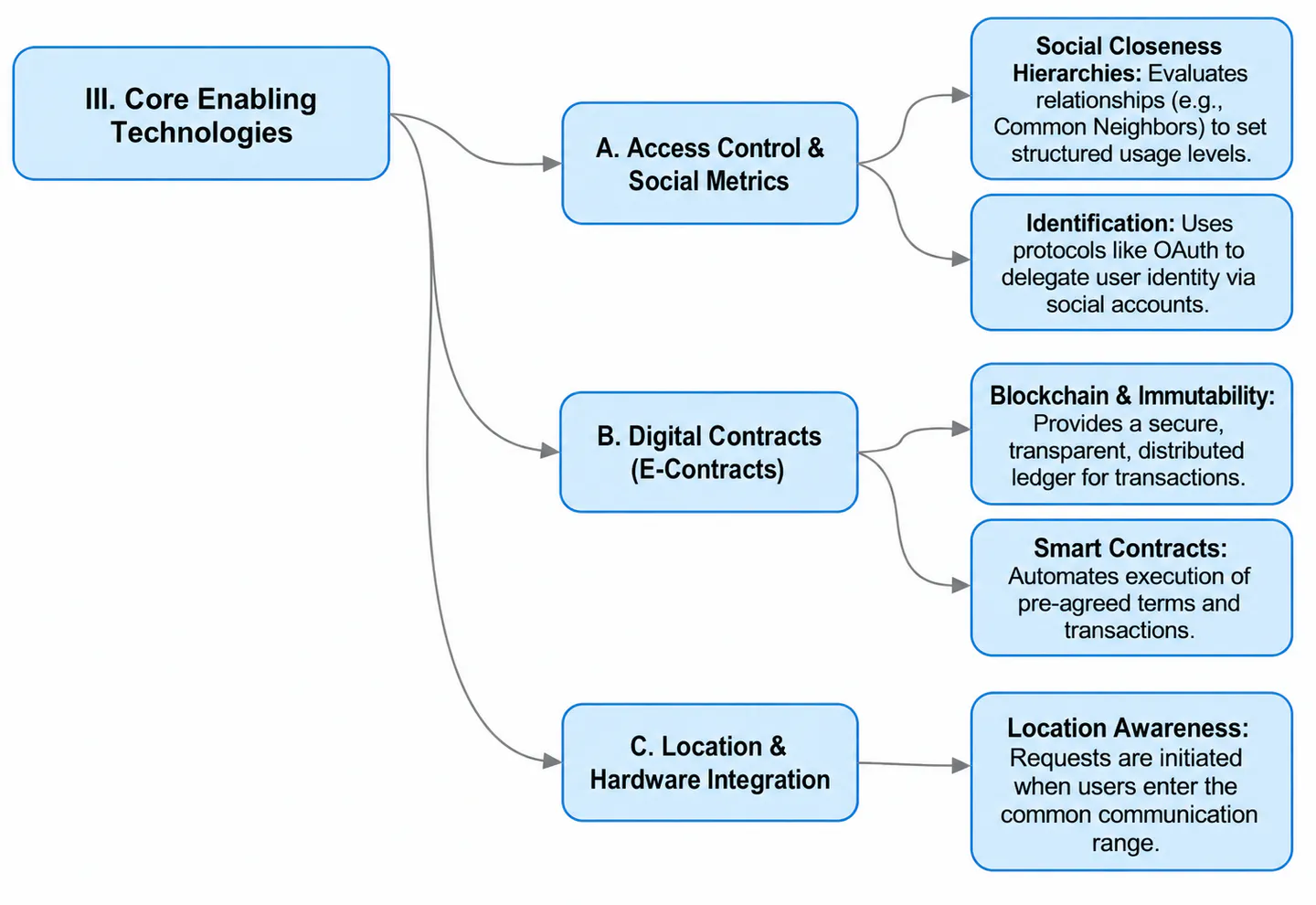
Core Enabling Technologies
Identification protocols, such as OAuth, play an important role in verifying users’ identities through established social accounts with a highly secure mechanism. This ensures high-standard security without burdening platforms with proprietary password management systems.
Furthermore, digital contracts (E-Contracts) address operational accountability. Blockchain technology provides various functionality, like a transparent, distributed ledger for logging transactions, supporting smart contracts that execute automatically once specified events or conditions are met [7].
For the deployment of the application, Flutter provides ubiquity across both Android and iOS devices from a single codebase. A highly responsive UI is needed for real-time interaction. The Firebase server is used to handle real-time metadata, trigger notifications, provideig a scalable user authentication system, and Machine Learning (ML) models analyse the transaction patterns and apply predictive analysis to improve the resource discovery mechanism and ensure user matches with relevant items more efficiently.
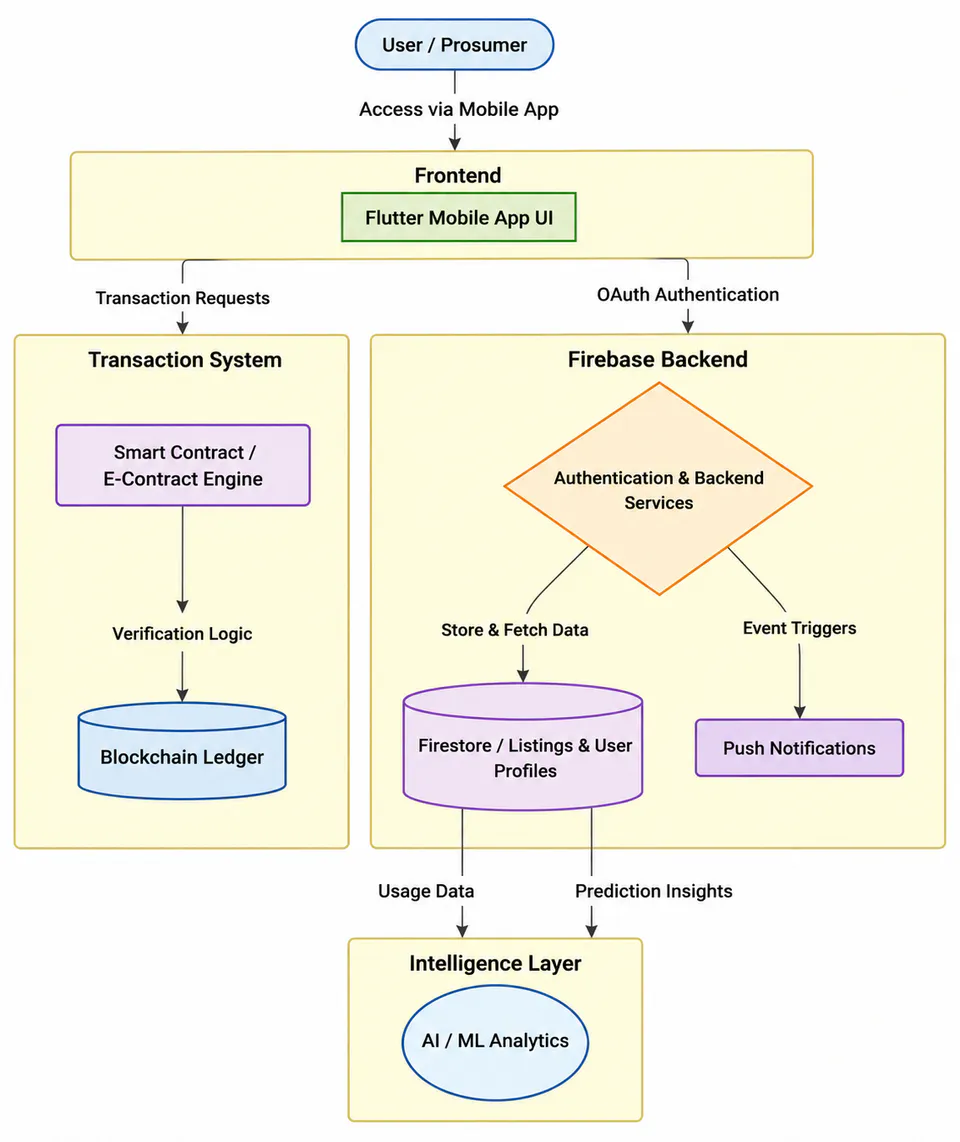
System Architecture
Limitations of Existing Applications
Various application exists, but there are several hurdles preventing them from being used in everyday neighbourhoods.
Legal Challenges
The absence of concrete legal frameworks for P2P systems in many jurisdictions remains a major barrier. Studies on P2P trading systems indicate that users frequently harbor doubts regarding their legal rights to sell or share surplus resources, as well as liability concerns over quality and safety standards [6].
Economic and Infrastructure Barriers
High initial infrastructure costs present specialized technical hurdles, particularly for decentralized ledger systems that require proprietary sensor equipment or network nodes [6]. These upfront costs often prevent the adoption of sharing platforms in financially constrained communities, even though the core concepts are highly viable in developing regions [1], [5].
Participation and Trust
A large number of potential users hesitate to participate due to fear regarding data privacy, potential security misconduct, and false listings from fake sellers. Trust must be systematically built through operational transparency. Furthermore, users often demand greater control over AI-based recommender systems, including the right to override algorithmic suggestions and opt out of behavioral data collection entirely [9].
Future Scope
To overcome the mentioned limitations, future platform iterations must focus on trustworthiness and interoperability.
Socially Aware Access Control
Future platforms should transition from static social metrics to dynamic trust modeling.
Trust Decay Models: Applications should continuously reduce in trust scores following failed transactions and policy violations.
The proposed Multi-Layered Decision Support System (MLDSS) offers a robust, modular, and scalable framework tailored for intelligent retail analytics. By integrating association rule mining, rule prioritization, anomaly detection, reinforcement learning, and time-series forecasting, it ensures interpretability, adaptability, and accuracy in decision-making [10].
Digital Contracts and Governance
Blockchain provides transparent data sharing across consumer networks [8], the attention must shift toward scalability and legal integration:
Legal Arbitration Frameworks: Bridging the gap between rigid smart contracts and local laws is necessary to allow for managed dispute resolution.
Regulatory Sandboxes: Deploying experimental environments will allow P2P platforms to operate safely while emerging legal frameworks adapt [7].
Asset Integration and Interoperability
Future platforms must embrace standardized APIs to manage mixed assets (digital, physical, and consumable) across different networks.
Multi-Layered Decision Support System (MLDSS): The MLDSS model can adaptively filter and refine search recommendations based on user interactions, seasonal demand spikes, and anomaly detection [10].
Integrating IoT devices will optimize how products and services are shared, rented, or sold.
Conclusion
Developing a functional neighborhood resource-sharing platform requires moving beyond focusing on practical, adaptable solutions. Implementation of dynamic, real-time access controls, the system ensures security and accountability. Furthermore, integrating AI specifically for the recommendation of products, allows the platform to actively respond to community needs. Ultimately, prioritizing these straightforward, robust technologies will pave the way for a sustainable, safe, and highly engaged localized economy [10].
Conflict of Interest
The authors declare no conflict of interest.
Ethical Approval
Not applicable
Data Availability
The datasets used in this study are openly available at [repository link] and the source code is available on GitHub at [GitHub link].
Funding
This work did not receive any external funding.
References
Cite this article
Related Research

Special Issue
Launch a focused special issue to highlight research, emerging trends, and expert insights in your academic field.