





IntelliPaper
Abstract
The Egyptian airspace is a crucial link between Europe, Africa, and the Middle East. With an average of over 1,000 daily flights, it is one of the busiest airspaces in the region. However, the current airspace structure and air traffic management system face significant challenges in meeting the growing demand for air travel, leading to congestion, delays, and safety concerns. Therefore, there is a need for a more efficient and effective airspace structure to enhance air traffic management, workload and meet the future needs of the aviation industry.
Explore Digital Article Text
I. INTRODUCTION
Airspace structure can be used as a procedural mechanism for a priori separation and organization of en-route air traffic. Although many studies have explored novel structuring methods to increase en-route airspace capacity, the relationship between the level of structuring of traffic and airspace capacity is not well established. To better understand the influence of traffic structure on airspace capacity, efficiency, and safety.
The current en-route airspace design is centered around predefined airways, sectors and ground-based Air Traffic Controllers (ATCo). Although enhancements to air traffic systems and procedures have led to incremental capacity improvements, the current centralized system architecture has been widely reported to be nearing saturation levels (N. A. Doble, R. Hoffman, et al., 2008).
To keep pace with the ever growing demand for air transportation, it is necessary to investigate novel methods of organizing and structuring traffic to increase en-route airspace capacity. However, a fundamental relationship between the level of structuring of traffic and resulting properties, such as efficiency and safety, is not well established, and different studies in this field report seemingly contradictory findings (Joint Planning and Development Office, 2007).
Free-Flight researchers, for instance, advocate that higher densities can be achieved through a reduction of traffic flow constraints and structure, whereas other studies argue that capacity would benefit more from a further structuring of airspace. This dichotomy suggests that airspace structure and capacity are invariably tied together. The relationship between these two variables, however, is not well understood, i.e., does more or less structuring lead to higher capacity? Or, is there a transition point, where a further increase in capacity will require a switch from one approach to the other? (J. Klooster, S. Torres, et al., 2010).
In this paper make a scientific research proposal titled a proposed structure for the Egyptian airspace.
II. CURRENT EGYPT AIRSPACE
Egypt Airspace is including 6 sectors are basic controlling units of air traffic flow management and capacity sectors Figure (2.1). They were originally designed according to some predefined rules such as historical, geographic considerations, the density of airports in the sector, or just according to experience. Sectors have essentially remained unchanged in terms of geometric shape and the total number of sectors inside Egypt airspace. However, along with rapidly increasing air traffic flow, fixed sectors cannot accommodate varying traffic flows anymore; several problems have appeared, such as unbalanced workload distribution across different sectors, with overload in some sectors and very sparse flow density in others, increasing point of conflict between aircraft and improper sector numbers, which means too many open sectors in off-peak time periods and too few sectors during busy times or too little flight time in a single sector for some flights.
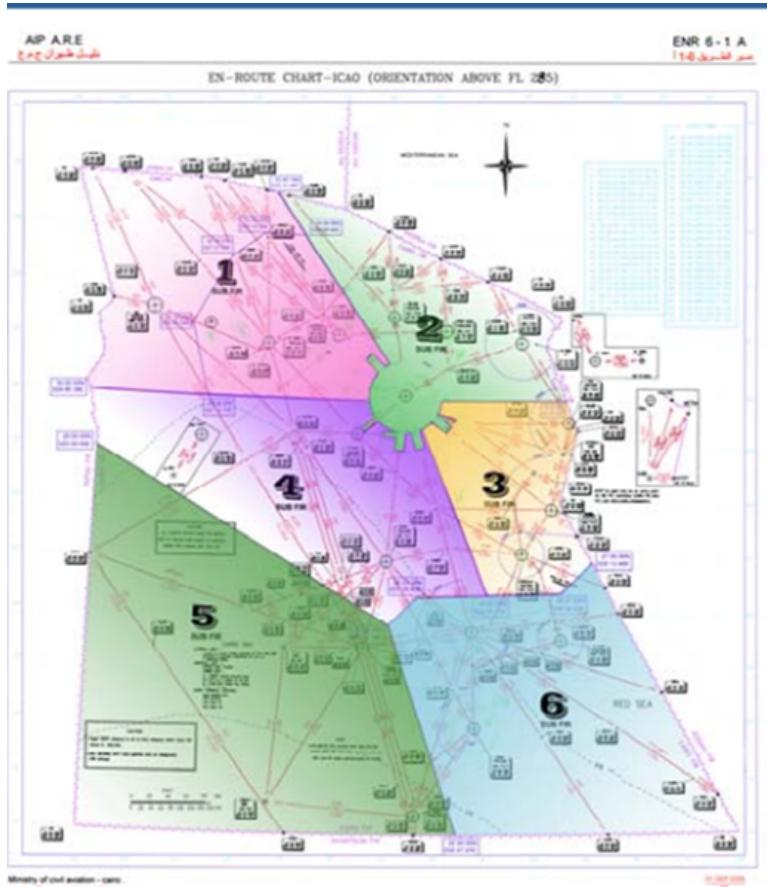 (Source: Egyptian Aeronautical Information Publication (AIP) SEP. 2009) Figure (2.1): Egypt airspace sectorization
Keep in mind air traffic is rerouted to avoid climate sensitive areas. This rerouting of flights leads to a changing traffic distribution. Density of traffic in the sector also may be rerouted to another sector to avoid conflict between aircraft. rerouted is made in case of activity military area, sufficient airspace to be used for military operations is considered to be an area that can accept a certain number of aircraft (depending on the military mission) at any time for the purpose of training, weapons testing, development of strategic and tactical capabilities or any other reasons. The sectorization of airspace enables air traffic controllers to guide aircraft in a safe and efficient way. Balanced operational performance, controller workload, procedure design or capacity management as well as territorial aspects are key factors triggering airspace sectorization.
III. ATC WORKLOAD
Air traffic controllers (ATCs) tasks are cognitively complex in nature and the mental workload is a dominant safety-related consideration in the air traffic controller domain. Throughout the literature, signification relationships between extremes of workload (under load, high workload, and overload) and a decline in controller performance, such as an increase in operational errors, have been consistently reported (cox-fuenzalida, 2007).
One is to compute basic air control load, which is the workload unavoidable under the condition of certain airspace structure and air control rules, however, conflict situation in air space. The other is reallocate computation of air control load, which is workload resulting from resolving flight conflict among aircraft, given certain airspace structure and air control condition.
Total sector workload within time slice t is expressed as follows, according to the equation below:
Equation below is used to calculate the ATC workload.
Where denotes total ATC workload within time slice , denotes total ATC workload on route within time slice , denotes basic air control load on route within time slice , denotes reallocated air control load on route within time slice .
IV. A PROPOSED STRUCTURE FOR THE EGYPTIAN AIRSPACE
New airspace design will help air traffic controllers from workloads and more safety for air traffic. For example we can as fast procedure to make new sectorization of the sectors see finger (4.1).
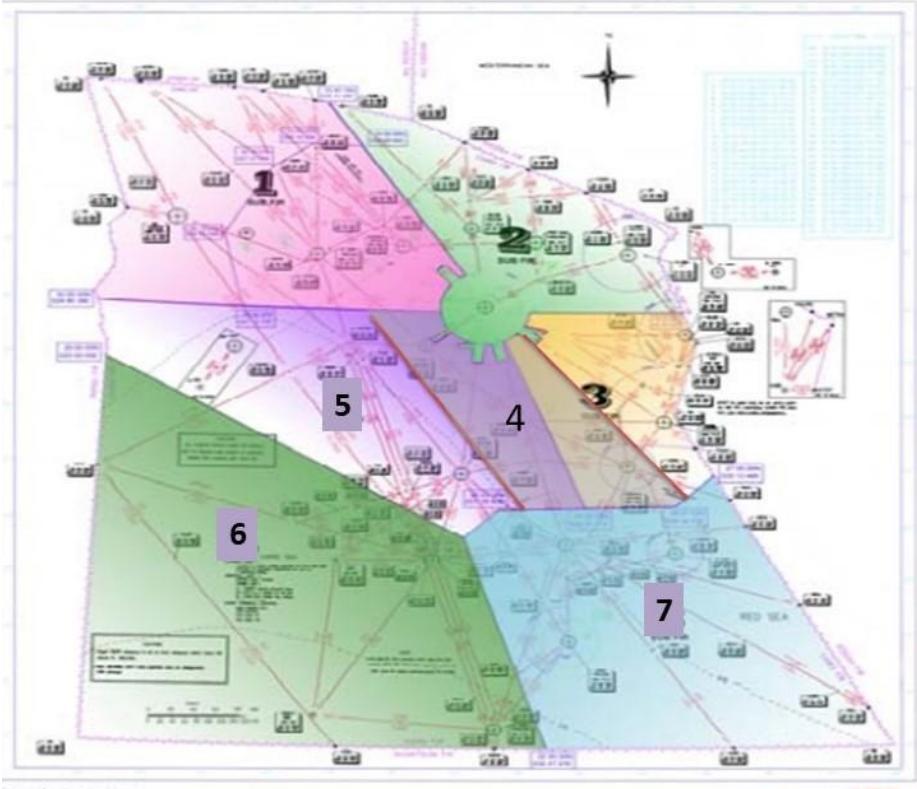 Figure (4.1): New Egypt airspace sectorization
Planning the sector capacity utilization model and operational use of the same one should take into account the required volume of new airspace structure, period of use, amount of traffic demand, and the geographical distribution of the airspace structure.
V. CONCLUSION
The proposed research aims to develop an optimal airspace structure for the Egyptian airspace, enhancing efficiency and safety in air traffic management, reducing congestion and delays, workload, and minimizing the environmental impact of aviation. The research will provide valuable insights and recommendations to policymakers, regulators, and other stakeholders in the aviation industry, promoting the development of a more sustainable and efficient air traffic management system.
Conflict of Interest
The authors declare no conflict of interest.
Ethical Approval
Not applicable
Data Availability
The datasets used in this study are openly available at [repository link] and the source code is available on GitHub at [GitHub link].
Funding
This work did not receive any external funding.
References
Cite this article
Related Research



Special Issue
Launch a focused special issue to highlight research, emerging trends, and expert insights in your academic field.
