


IntelliPaper
Abstract
Here, we report a statistical test of the hypothesis that feminicides in Spain have a monocausal explanation, known as the gender hypothesis. Using a time series of feminicides that occurred in the period 2001-2019, we conducted several regression analyses to compare the goodness of fit of linear and non-linear regression models, analysing the complete series and segments of the same. We also used a pre-test/post-test interrupted time series design to assess the effect of Law 1/2004, considered as a public policy intervention. As a result of these analyses, we conclude that a multicausal or ecological hypothesis may provide a better explanation for this kind of crime than the gender hypothesis.
Explore Digital Article Text
I. INTRODUCTION
Gender violence has become an increasingly visible problem in our society in recent decades, occupying a prominent place in the political and media agenda, public opinion and even in academic debate. The term "gender violence" refers to a type of violence inflicted on some women simply because they are women, because they belong to the female sex. The political perception of the gravity of this problem, which is substantiated by an alarming number of assaults of all kinds on women, in a multitude of circumstances and with effects of varying degrees, including death, prompted the enactment in 2004 of a special law aimed at tackling this phenomenon and protecting women in general against this kind of violence: Law 1/2004 of 28
December, known as the Law against Gender Violence (Spanish initials: LIVG).
As is well known, enactment of this law has given rise to considerable legal controversy, with some legal scholars claiming that in the field of criminal proceedings, it undermines the presumption of innocence (e.g., Huerta, 2008; Martín, 2018), restores offender-based criminal law and compromises the principle of equality before the law (e.g., Boldova and Rueda, 2004a, 2004b; Lascuráin, 2013); furthermore, its enforcement requires the establishment of "exceptional" courts (e.g., Alba, 2005), all aspects that could be considered manifestly contrary to the spirit and letter of the 1978 Constitution and might lead to a negative legal assessment of the entire law (Villacampa, 2018; cf. Pérez, 2016). In fact, following its promulgation, numerous Spanish judges presented various "questions of constitutionality" regarding its content (127 as of 06/03/2008: La Vanguardia, 2008), and almost half of the members of the Constitutional Court issued individual votes against one or more of its precepts when its constitutionality was reviewed (STC 59/2008).
However, it is not our intention here to dwell here on these aspects of the law, but rather to examine some of the aetiological considerations it cites regarding the criminal behaviour of male persons towards female persons, which seem to serve as a motivation and justification for the precepts the law contains. The LIVG refers to these questions in two paragraphs in the "explanatory memorandum", when it assumes that the violence it is intended to combat (gender violence) is a unique violence that "is directed against women for the very fact of being women, because they are considered by their aggressors as lacking the minimum rights of freedom, respect and decision-making capacity", and when, further on, this violence is described as "... the aggressions suffered by women as a consequence of socio-cultural factors that act on the male and female gender, placing the latter in a position of subordination to men". It seems a clear generalisation to claim that when male partners or ex-partners assault female partners or ex-partners (the case that the law is intended to correct: art. 1.1), they do so regardless of any contingent circumstance, as a manifestation of a pathological social syndrome (the law seems to attribute this to socio-cultural rather than biological, psychological or other factors, and implicitly to machismo1), which affects all men but is only expressed consciously and intentionally by some.
The phenomenology by which this simplistic vision of social reality has become established as a socio-anthropological explanation of a certain type of criminality, inspiring a law such as the LIVG in a modern democratic state, represents an interesting problem in the sociology of knowledge, and has even attracted a broad consensus of opinion; however, a detailed consideration of this question would go far beyond the scope of the present article. However, a statistical assessment of the alleged monocausal explanation for the crimes of which some women are victims is somewhat simpler and more immediate, since the use of appropriate analytical techniques can determine whether a criminal behaviour, and more specifically feminicide, can be attributed to a single identifiable causal factor (machismo) or instead reflects a plurality of causes that can be measured and recorded. This is precisely the question that we address here.
It is important to emphasise that we limit ourselves here to lethal assaults classified as feminicides because these constitute an indisputable indicator of the violence inflicted on some women within the context of an intimate partner relationship, which is valid (it serves to measure what we wish to measure: serious physical violence) and reliable (it measures this well, since the record of the event is precise and irrefutable), all indispensable methodological conditions of scientific observation to determine the reality and magnitude of a phenomenon. Other manifestations of gender violence are more difficult to apprehend in quantitative terms because the records are more imprecise and debatable and because their true incidence cannot be as reliably established as feminicide.
In short, here, we statistically assess the plausibility of the explanation given in the LIVG of a phenomenon that to a large extent would justify this law: that the fundamental cause of violence against a female partner or ex-partner by a male person is machismo. We shall call this monocausal explanation the gender hypothesis, a term that has been used before in other contexts (Hyde, 1995: 76ff) and which, more or less explicitly, is found in some of the literature on feminicide (e.g., Campbell, 1992; Dobash and Dobash, 2015; Johnson et al., 2017; Kelly, 1988; Laurenzo, 2012; Walker, 2012).
II. DESIGN AND METHOD
First, it is worth noting that although a statistical association between two variables does not imply a causal relationship between them (see e.g., Vigen, 2015), the inverse is ineluctable: if there is a causal relationship between two variables, there must necessarily be a statistical association between them expressing this. Therefore, if there is an identifiable cause (machismo) and an observable effect (feminicide), there must be a statistical relationship between the former and the latter. An important methodological requirement is that to observe the relationship between two (or more) variables, these must be operationalised and empirically substantiated in indicators, i.e., they must be measurable. For example, the variable "gender violence" can be measured with the indicator "number of women assaulted by a male partner or ex-partner" (with various sub-indicators, of which the number of feminicides is the most consistent). However, the variable "machismo" is, for these purposes, very difficult, if not impossible, to measure accurately in operational terms: when a woman is assaulted within the context of an intimate partner relationship, this may be due to a multiplicity of causes, among which machismo would be one of the possible causes, acting as the exclusive driver of the aggression or concomitantly with others. Isolating this factor from the other possible factors is highly complex methodologically. In the case of feminicides, if the perpetrator does not expressly state that he has killed the victim solely because she is a woman, the measurement instrument used for scientific observation will be incapable of tangibly identifying the cause, which is the independent or predictor variable (machismo); nor, therefore, will it be capable of establishing its real effect on the dependent or criterion variable (feminicide). In such circumstances, one feasible methodological option is to assume that the predictor variable exerts a general and constant effect, since according to the gender hypothesis, the "amount of machismo" should not fluctuate randomly or present marked variations in the short to medium term (which enables machismo to be defined as the effective cause of violence and is precisely the thesis assumed in the LIVG), and then to observe whether the criterion variable presents a structure of variability that can only be attributed to the effect of the former ( ). Such is the methodological strategy employed here.
It should be stressed that if machismo is the effective cause of gender violence in general and of feminicides in particular, variations in its amount (whatever the indicator or scale used to measure it) will correspond to variations of the same magnitude in the number of feminicides: their correlation coefficient will be . This implies that the function modelling the variable "feminicide" must be the same as the one modelling the variable "machismo", since the contrary indicates that its variability structure is different and therefore , which is incompatible with the causality relationship argued by the gender hypothesis. If the "machismo" variable is satisfactorily modelled with a linear function, which is the inherent assumption of its status as a constant and immutable social phenomenon in the short to medium term, the "feminicide" variable must necessarily also be modelled with a linear function. Thus, when modelling the feminicide series with a linear function, the goodness of fit to this model, measured according to the coefficient of linear determination , would indicate the extent of the difference with the functional equivalence of both variables, "machismo" and "feminicide", and consequently, of the magnitude of their causal relationship.
A classic time series regression analysis (Chatfield, 2004; Rodríguez, 2000; Uriel, 1995), taking feminicides as the criterion variable and limited to the study of the trend component, TC, with a global focus and a fitting method using the basic function , where time, t, in a given period, is the stochastic predictor variable (Rodríguez, 2000): 42-54; Parra, 2015: 27-31), is an acceptable statistical tool to test or verify the hypothesis of causality. The operational analysis procedure employed basically consisted of testing the goodness of fit of linear and non-linear models of the feminicide series for the period 2001-2019 , with arbitrary serial segmentation to better study the total series, complemented with an autocorrelation analysis using the Ljung-Box test in order to achieve a more refined functional interpretation.
Using this method, a perfect (or very good) fit to a linear function of the feminicide time series would provide clear evidence in favour of machismo as its effective cause, since this variable is modelled as a linear function in the gender hypothesis (at least, as mentioned above, in the short to medium term). In contrast, a poor fit to a linear function of the feminicide series would be clear evidence of a departure from the linear function that characterises machismo, and therefore, of its lack of covariation, which is necessary to confirm this hypothesis; similarly, a better fit to a non-linear function of the feminicide series would constitute evidence in favour of the intervention of other causal variables in the phenomenon (which may or may not include machismo). The concurrence of linear and non-linear functions to satisfactorily fit the entire empirical series of feminicides would be compatible with a random pattern in the statistics of the phenomenon.
Complementarily, and despite the short "length" of the feminicide time series, because the total number of observations it comprises is only nineteen, we conducted a statistical analysis that went a little further than mere visual inspection and regression analysis. Thus, we analysed two segments of the series, 2001-2004 and 2005-2019, hypothetically assuming that the data came from two samples and considering enactment of the LIVG as an "intervention" or "treatment". This implied examining the series from the perspective of a quasi-experimental design with time series without a control group (Campbell and Stanley, 1973; Campbell, 1992), using the customary methodology for interrupted time series analysis (González and Del Puerto, 2009; Mc Cleary and Hay, 1980; Rodríguez, 2000; Uriel, 1985; Vallejo, 1996). To test the effect of this intervention, we performed a t-test for independent samples, having previously performed Levene's test to determine whether the variances in the data in the pre/post intervention series were equal or not. This analysis was intended to complete the statistical assessment of the aetiology of feminicide reported here.
The time series analysis of feminicides is preceded by a statistical description of homicide in Spain disaggregated by sex, in order to provide a contextualised overview of the phenomenon studied and facilitate a better understanding.
III. FIELDWORK AND DATA ANALYSIS
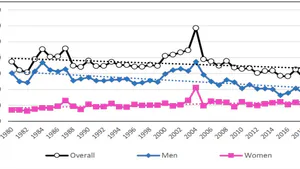
The figures for victims of intentional homicides (intentional homicides and murders) in Spain by sex in 2018, the latest year available from the Spanish National Institute of Statistics , show that of the 275 deaths resulting from an assault (INE, 2018), 177 were men and 98 were women, yielding a female/male ratio (F/M) slightly higher than 1/2. As can be seen in Figure 1, the number of deaths from assault shows a stable pattern for the entire period 1980-2018, with a slightly decreasing trend in general, which is repeated in the case of male deaths but shows a slightly increasing trend in the case of female deaths (the peak in 2004 is exceptional, being due to the 11-M massacres, and does not substantially modify the trend of the entire series). However, the ratio of female/male deaths (F/M) and the rate of female deaths due to assault over total deaths indicate two phases: one from the beginning of the series until the beginning of the 21st century and a later one, where both indicators underwent a clearly perceptible increase. In the final years of the period under consideration (2010-2018), the pattern characterising the final phase appears to become more pronounced, reproducing itself with little variation, with an F/M ratio oscillating around the value 1/2 (i.e., 0.50, when it had been lower than 0.34 on average in the period 1980-2002) and a percentage of women out of the total number of homicide deaths oscillating around 35% (when it had been lower than 25% on average in the period 1980-2002). Bearing in mind that the resident population in Spain grew by almost 25% over this period, with the increase for men being 24.88% and for women 25.20%, it can only be concluded that the relative incidence of intentional homicide in Spain has decreased considerably in relative terms for men, but has increased significantly for women.
{"image_source":{"path":"images/8eefc0e87d7f45759105139899c35b2b18900b3e8c7cf3ed37ba4e117c2006bf.jpg"},"content":"","chart_caption":[{"type":"text","content":"Source: Spanish National Statistics Institute and by the \authors"},{"type":"text","content":"Figure 1: Evolution of the number of homicides in Spain, by sex (1980-2018)"}],"chart_footnote":[]}
Complementing the longitudinal perspective of homicide disaggregated by sex, Figure 2 shows that between 1980 and 2018, the F/M ratio and the F/Total rate both presented an increasing trend, with a double regression coefficient in the case of the former ( : the steeper slope of the fitted trend line ), indicating that with time, a) there was a smaller difference between those killed by homicide by virtue of their sex, and b) correlatively, there was a larger share of women in the total number of homicide deaths.
{"image_source":{"path":"images/e0e499499b925d4ec2fe7d778e8267d418593964fe8a69d1c029b14e4524268c.jpg"},"content":"","chart_caption":[{"type":"text","content":"Source: Spanish National Statistics Institute and by the authors"}],"chart_footnote":[]}
Figure 2: Relative evolution of homicide in Spain, by sex (1980-2018)
Turning now to the deaths of persons of either sex caused by assaults by persons of either sex, it should first be noted that determining this is very difficult because the judicial statistics do not disaggregate by sex the perpetrator of the homicide about the sex of the victim of the homicide. It is possible to establish the sex of the murderers and the sex of the victims, but not to cross-reference them for differential purposes, except in the specific case of what was for a time generically termed domestic violence and later classified as gender violence, when the person perpetrating the lethal aggression is the victim's partner or ex-partner. Figure 3 shows the statistics for this type of homicide, distinguishing between deaths due to assaults on persons of both sexes by intimate partners or ex-partners or similar for the entire period 2001-2019 (C.G. Poder Judicial, 2019). The figures for women killed by feminicide in 2001 and 2002 were calculated from the numbers of deaths due to domestic violence. The figures for men killed due to an assault by an intimate partner or similar in domestic contexts in 2001-2003 were calculated by extrapolating those known for the rest of the period of men killed by intimate partner or ex-partner assaults in domestic contexts.
The M/F (male/female) ratio for the entire period was 1/8, although it was 1/5 or lower in some years (particularly in the last years of the time series considered). In some of the official reports on homicide between partners, ex-partners, or similar, the M/F ratio even exceeded the value of 1/4 slightly (C.G. Poder Judicial, 2016: 6). It should be noted that although the rates (and derived ratios) for male victims of this type of assault in Spain are low in relation to female victims , it is possible that in reality they are higher , because at least in some years (2010 and 2011) it has been possible to document (Toldos, 2013: 77-84) that the actual number of men killed by their female partners or ex-partners was almost twice as high as those included in the official statistics with which we constructed the graph of the time series in Figure 3 (in this respect, the Spanish Judicial Police reported that for the period 1996-1998, homicides perpetrated by wives on their husbands and vice versa were distributed in a proportion of 30%/70%: vid. Tobeña, 2001: 237).
On the other hand, contextualisation of this type of homicide due to partner or ex-partner assault within homicides in the general population indicates that while the latter show a decreasing trend over time, the former present a pattern of quantitative stability, especially in the period 2001-2019.
{"image_source":{"path":"images/ec5782bec6540bc30025234bd0dba308c9a67a4dbbd802b5d8536fb980d1733e.jpg"},"content":"","chart_caption":[{"type":"text","content":"Source: General Council of the Judiciary, V.G. Observatory and by the authors"},{"type":"text","content":"Figure 3: Number of intentional homicides in Spain in the context of intimate partner or similar relationships, by sex (2001-2019)"}],"chart_footnote":[]}
IV. RESULTS
Below, we report the results of our time series regression analysis, taking the number of feminicide victims as the criterion variable and the correlative year of occurrence as the predictor variable, as is customary in time series analyses. Table 1 shows the goodness of fit of the different regression models tested, reported with the coefficient of determination (indicating the amount of variance explained by the predictor).
When the 2001-2019 time series was modelled with a linear equation (a straight line), the slope of the curve was slightly negative, with a regressor coefficient b = -0.1565, clearly indicating that the incidence of the phenomenon (in absolute values) tended to decrease over time. However, the goodness of fit with this function was very poor, as the coefficient of determination was only , which means that the passage of time only explained 0.76% of the variance in the number of victims. When modelling the time series with a second-order polynomial function, a smooth parabolic curve was obtained with a slightly decreasing trend in the final phase, but the fit was much better than with a linear function, as .
When the time series was modelled with a third-order polynomial function, the slope of the curve was imprecise for the entire series, although the final phase showed a slightly positive trend, but the coefficient of determination was , i.e., the model now explained almost 54% of the variance in the phenomenon (more than seventy times more than with the linear function). With a fourth-order polynomial, the gain in goodness of fit was negligible ( ). What all this demonstrates is that the variance in the criterion variable presents the characteristics of a random or a multicausal phenomenon with indeterminate variables in which time elapsed in the strict sense barely plays a role.
The series was also divided into segments by attributing a meaning to each of them. Taking the 2001-2004 period (initial phase of the series), the linear model showed a slightly positive slope and explained 95% of the variance in the phenomenon , but a third-order polynomial model explained all the variance in the criterion variable. Taking the 2005-2011 period (period immediately after enactment of the LIVG), the linear model yielded a positive slope and explained a very small part of the variance in the criterion variable , but the second-order polynomial model explained almost 30% , while the fourth-order model, better fitted to the empirical form of the series, explained almost 45% of the variance . Lastly, considering the 2012-2019 period, the linear model showed a slightly negative slope (barely noticeable on visual inspection) and explained only 0.2% of the variance in the criterion variable, but the third-order polynomial explained 49% (the gain in variance explained was small with a fourth-order polynomial). In short, segmenting the 2001-2019 time series always yielded a better fit to a third-order (or higher) polynomial function than to the linear model. This confirms the previous conclusion for the series as a whole: it presents the characteristics of a random phenomenon or a multicausal phenomenon whose explanatory variables are unidentified.
| Period of the series | Coefficients of determination R2 with different regression models | |||
| Linear function | Polynomial function of degree 2 | Polynomial function of degree 3 | Polynomial function of degree 4 | |
| Complete series (2001-2019) | 0.0076 | 0.3093 | 0.5388 | 0.5431 |
| 2001-2004 | 0.9501 | 0.4064 | 1.0000 | 1.0000 |
| 2005-2011 | 0.0080 | 0.2943 | 0.3985 | 0.4492 |
| 2012-2019 | 0.0011 | 0.0021 | 0.4930 | 0.5034 |
| 2005-2019 | 0.4098 | 0.4101 | 0.6093 | 0.6601 |
An analysis of the autocorrelation of the time series using the Ljung-Box test (Ljung and Box, 1978) showed (Table 2) that this phenomenon does not occur systematically and that in a hypothetical sample of the time series data, almost none of the non-zero autocorrelations was statistically significant at the level , indicating that the hypothesis of independence of the observations (of the different annual data of the series) can be accepted. This is also of interest for the purposes of interpreting the data in terms of inter-annual dependence, as it supports the assumption that the series data are not interdependent and present a random pattern.
| Autocorrelations | |||||
| Series: Feminicides | |||||
| Delay | Autocorrelation | Ljung-Box test | |||
| Value | gl | Sig. | |||
| 1 | 0.253 | 0.212 | 1.424 | 1 | 0.233 |
| 2 | 0.130 | 0.206 | 1.821 | 2 | 0.402 |
| 3 | 0.219 | 0.200 | 3.022 | 3 | 0.388 |
| 4 | 0.031 | 0.194 | 3.047 | 4 | 0.550 |
| 5 | -0.108 | 0.187 | 3.377 | 5 | 0.642 |
| 6 | -0.500 | 0.181 | 11.045 | 6 | 0.087 |
| 7 | -0.127 | 0.173 | 11.581 | 7 | 0.115 |
| 8 | -0.212 | 0.166 | 13.209 | 8 | 0.105 |
| 9 | -0.338 | 0.158 | 17.756 | 9 | 0.038 |
| 10 | -0.146 | 0.150 | 18.705 | 10 | 0.044 |
| 11 | -0.033 | 0.142 | 18.760 | 11 | 0.066 |
| 12 | 0.063 | 0.132 | 18.984 | 12 | 0.089 |
| 13 | -0.044 | 0.123 | 19.111 | 13 | 0.120 |
| 14 | 0.026 | 0.112 | 19.167 | 14 | 0.159 |
| 15 | 0.116 | 0.100 | 20.516 | 15 | 0.153 |
| 16 | 0.096 | 0.087 | 21.732 | 16 | 0.152 |
Dividing the series into two segments, 2001-2004 and 2005-2019, considering enactment of the LIVG as an "intervention" or "treatment" and observing the series from the perspective of a "quasi-experimental design with interrupted time series and no control group", we compared whether the differences in feminicide means in both segments were statistically significant. The t-test for independent samples, with a prior Levene's test to determine whether the variances in the data in the pre/post intervention series were equal or not (the test for equality of means requires homoscedasticity or equality of variances), with the corresponding comparison of means, yielded the results shown in Tables 3 and 4.
| Periods | N | Mean | SD | Standard error of the mean |
| 2001-2004 | 4 | 51.75 | 13.71 | 6.85 |
| 2005-2019 | 15 | 59.53 | 8.75 | 2.26 |
Table 4: Levene's test and
-test for equality of variances and means of the time series segments
| Levene's test for equality of variance | t-test for equality of means | ||||||
| Assumption | F | Sig. | t | gl | Sig. (two-tailed) | Difference in means | Standard error of difference |
| Assuming equal variances | 0.734 | 0.403 | -1.409 | 17 | 0.177 | -7.7833 | 5.5226 |
| Not assuming equal variances | -1.079 | 3.679 | 0.346 | -7.7833 | 7.2168 | ||
As can be seen, Levene's test indicated that there were no statistically significant differences between the variances in the two periods, and therefore, their means could be compared (for inferential purposes not necessary here, although this statistical conclusion was also useful for the regression analysis we performed). A comparison of the means, using the t-test, showed that the difference in means between both periods was not statistically significant at the chosen level of significance ( ). When the time series data were divided into the periods 2001-2004 and
2005-2011, the comparison of means was statistically significant (two-tailed significance = 0.046), with a mean of 51.75 for the first segment and 66.43 for the second. However, when the data were divided into the periods 2001-2011 and 2012-2019, the difference in means test was not statistically significant (although in the latter case, Levene's test indicated heteroscedasticity, requiring a non-parametric test such as the Mann-Whitney test, the result of which [Sig. 0.091] also supported the null hypothesis that the distribution of the variable is similar between the two periods into which the series was subdivided: Siegel and Castellan, 1998: 157-165; Pardo and San Martín, 2010: 132ff).
In short, statistical analysis of a time series consisting of the number of women killed by gender violence or feminicide in the period 2001-2019, subdivided into the time periods 2001-2004 and 2005-2019 (before and after enactment of the LIVG), on the assumption that they came from two random population samples, has not allowed us to conclude that there are differences other than those generated by a random pattern between the means for deaths before and after enactment of this law. The difference in feminicide means between the period 2001-2004 and the period 2005-2011 also indicates, somewhat paradoxically, that the mean number of feminicides increased in the six years following enactment of the LIVG.
V. DISCUSSION AND CONCLUSIONS
The bulk of this paper has been devoted to an analysis of feminicides in Spain in the period 2001-2019 using regression techniques with time series and interrupted time series, previously contextualising them in the time series of homicides from 1980 to the present. As a result of our analyses of the time series of feminicides, we conclude that:
a) The linear regression scheme (with time as the stochastic criterion variable) used to model the time series of feminicides in the period 2001-2019 was barely capable of explaining 1% of the variance, whereas a third-order polynomial model explained almost 54%, which is compatible with a random pattern of the phenomenon, or alternatively, an indeterminate multicausal one.
b) Segmenting the series into the periods 2001-2004, 2005-2011, and 2012-2018 did not fit well according to a homogeneous scheme of regression models (linear and polynomial models must be combined to obtain acceptable fits), which is compatible with a random phenomenon, or alternatively, with a multicausal model whose explanatory variables are unidentified. A serial autocorrelation analysis supported this conclusion as there was no evidence to indicate interdependence between the observations (cases) in the series.
c) Subdividing the feminicide series into two segments, 2001-2004 and 2005-2019, in order to observe the possible effect of Law 1/2004 (LIVG) as a "treatment" (or "intervention") variable, using the appropriate statistical techniques (hypothesising the sampling origin of the observations) to complement visual inspection of the series, failed to identify significant differences between the feminicide means for the two segments of the series, suggesting that the law has had no appreciable effect on the phenomenon of feminicide and indicating a random (or indeterminate multicausal) pattern in the cases computed.
The statistical results outlined above with respect to feminicide indicate a phenomenon of complex and multiple aetiology with undefined intervening variables, and they do not support a structural monocausal explanation but instead suggest individual behaviours that cannot be attributed to a general motivational pattern that can be scientifically determined. We found no statistical evidence in support of a single causal factor for feminicides such as machismo; rather, the recorded cases of feminicides in the form of a time series corresponded to a random (or perhaps indeterminate multicausal) pattern that does not allow us to assign a specific general cause. One possible explanation for the statistically null effect of the LIVG on the recorded frequency of feminicides is that it attributes the causality of these crimes to a factor that does not in general possess it and it therefore has no appreciable statistical effect.
These findings refute the gender hypothesis as the origin and cause of all assaults, and especially lethal assaults, on women in Spain by their perpetrators.
The view of machismo as the fundamental driver of feminicides, without making circumstantial, psychological, pathological, life history, economic and sociological distinctions but instead indiscriminately grouping together not only all men but all concurrent cultural structures irrespective of time, appears to be a theoretical assumption that does not have the empirical support to be sustained in scientific terms. In fact, there is an abundance of accumulated, available scientific evidence that questions this, reported in criminology (e.g. Cuaresma, 2016; García-Pablos, 2014; Marchiori, 2007), the psychopathology of criminal behaviour (e.g. Garrido, 2003; Pozueco, 2014; Redondo, 2008) and in studies on intersex violence (e.g. Álvarez, 2014; Archer, 2000; Graham-Kevan, 2017; and especially the PASK project, 2012, in which more than 2,000 studies were reviewed). Furthermore, in light of the most recent multidisciplinary research conducted in Spain (López-Ossorio et al., 2018; González et al., 2018; cfr. Palacios, 2020; Cantera, 2005), it seems that an ecological model (Heise, 1998; cf. Jewkes, 2002; Vives et al., 2009) of a multicausal nature may provide a better explanatory approach to the phenomenon of feminicide, and such is the stance that the WHO appears to have assumed (see, for example, World Health Organisation, 2013).
In conclusion, the additional statistical evidence that we report here works in two different but complementary ways: on the one hand, it undermines the gender hypothesis, showing that its monocausal explanation of feminicide is weak and inconsistent and does not withstand a scientific falsification test based on an analysis of its quantitative structure; and on the other hand, it supports the plausibility of the ecological hypothesis that a multifactorial approach to feminicidal violence is possibly more suitable to explain this phenomenon, being more realistic and probably more useful to understand it well and combat it better.
Conflict of Interest
The authors declare no conflict of interest.
Ethical Approval
Not applicable
Data Availability
The datasets used in this study are openly available at [repository link] and the source code is available on GitHub at [GitHub link].
Funding
This work did not receive any external funding.
References
Cite this article
Related Research


Special Issue
Launch a focused special issue to highlight research, emerging trends, and expert insights in your academic field.