




IntelliPaper
Abstract
Starting with 80’s Chinese economy develop at an accelerated pace, with annual growth over 10 %. Economic growth overpassed the energy production development. If in 70’s-80’s energy production increase was 150-200% over economic growth increase, over the last twenty years it represents about 50%. China energy strategy focus on the following strategic goals:
⮚ Reliable energy production increase in order to support rapid economic development
⮚ Impose of energy efficiency both on production and consumption sectors
⮚ Harmonize the economic growth and energy production / consumption with reduction of CO2 and GHG emissions If until beginning of 70’s, energy production based on coal was performed exclusively by state - owned companies, after that in this sector appear local communities and individual enterprises, so that in last years these companies realize about 1/3 of coal energy production.
In beginning of 90’s China faced an important lack of energy production able to support rapid economic growth and house -keepers consumption.
Explore Digital Article Text
I. INTRODUCTION
Since the 1980s, China's economy has grown rapidly, with an annual growth rate exceeding 10%. This economic expansion has outpaced the development of energy production. While in the 1970s and 1980s, energy production growth was 150-200% higher than economic growth, in the last two decades, it has slowed to about 50% of the rate of economic growth.
China's energy strategy focuses on the following strategic goals:
□ Reliable energy production increases to support rapid economic development
□ Impose energy efficiency in the production and consumption sectors
☐ Harmonize the economic growth with energy production and consumption, aiming in the same time reduction of CO2 and GHG emissions
Until the early 1970s, coal energy production in China was exclusively carried out by state-owned companies. However, after this period, local communities and individual enterprises began to enter the sector. In recent years, these non-state entities have come to produce about one-third of China's coal energy.
In the early 1990s, China experienced a significant shortfall in energy production, which was insufficient to support its rapid economic growth and domestic consumption.
This shortfall in energy production was also driven by inefficient energy consumption, which became particularly evident in the 1980s. At that time, China's energy consumption relative to its GDP was four times higher than Japan's and three times higher than that of the USA.
The inefficiency in China's energy consumption was primarily due to its technological lag compared to developed countries. Additionally, the economy of the 1980s was characterized by low energy prices and a lack of incentives, which also contributed to this lack of efficiency.
Beginning in the 1980s, China prioritized energy efficiency by promoting significant investments in this area. The programs launched during this period to enhance energy efficiency were largely successful.
Today, China's energy policy relies on both enhancing energy efficiency and improving production and delivery.
II. LITERATURE REVIEW
Ngan, H.W., 2010 in, "Electricity regulation and electricity market reforms in China" thoroughly examines the regulatory structures that influence China's electricity market, highlighting the necessary policy changes required to harmonize the sector with global energy practices.
Wang, Q and Chen, X. in "Market-Oriented Reforms and China's Green Economic Development", published in 2012, evaluate the slow progress of market-oriented reforms, identifying major issues that obstruct the complete realization of market liberalization.
In their 2014 publication, "Sustainability Issues Arise in Several Other Policy Areas," Wu, Y et al. recommend that the government revise its policy framework to better support the development of the electricity market. They argue that these adjustments should ensure the market promotes both economic growth and environmental sustainability.
In their 2016 publication "Electricity Market Stochastic Dynamic Model and Its Mean Stability
Analysis," Zhang, W et al., introduced a dynamic analysis model designed to forecast future trends in the electricity market. This model considers the impact of existing policies and technological advancements.
Fang, D et al., published in 2018 their "Sustainability Issues Arise in Several Other Policy Areas", where they analyze the impact of government regulations on renewable energy. They advocate for the implementation of more robust policies that can keep pace with rapid technological advancements and changing market demands.
In their 2019 publication, "Challenges and Strategies for Electricity Market Transition in China," Kahrl, F., and Lin, J. explore the challenges faced by the electricity market as it shifts toward a more equitable and risk-aware framework. They emphasize the importance of implementing tariffs that accurately reflect the actual costs of electricity generation and consumption.
Yin, J et al., in "Economic and Efficiency Analysis of China Electricity Market Reform Using Computable General Equilibrium Model", published in 2019, use a computable general equilibrium model to evaluate the economic impacts of market liberalization on China's electricity sector. They highlight how these reforms have successfully enhanced efficiency and reduced costs.
In their 2019 article titled "Putting China's Electricity Market Reforms on the Spot," Bao, M et al., review the reforms in China's electricity spot market. They discuss the challenges encountered and the progress achieved through these reforms.
III. ASSIGNMENTS
3.1 Legal framework
The Electric Power Law, adopted in 1995, aims to promote and guarantee the development of the electric energy sector, ensure the safe use of electricity, and protect investors' interests, as stated in its General Provisions. It introduces the principle "whoever invests will benefit from there". If the electricity produced is delivered to the national grid, the producers will have priority for its usage when needed. If the electricity is not delivered to the national grid, the producers will have complete authority over its usage. The State establishes what electric power generation project to be implemented and what equipment and technologies to be used.
Local governments should support the expansion of the sector by ensuring the availability of necessary land and, in some cases, relocating the affected population.
The law also refers to the electric networks, which should be operated in a manner that ensures a reliable energy supply. The State Council establishes, according to the law, the dispatch conditions. It also approves a draft contract that stipulates the obligations and rights of the electricity supplier and clients/end-users. The law also sets the price for electricity delivered to the national grid, as well as the price that the grid is entitled to receive from consumers. The pricing established by the law follows the principle of equal price for equal quality of electricity on the same electric network.
The Coal Law, adopted in 1996 and later amended in 2011, creates the legislative framework for the coal industry. However, the aforementioned law has defects concerning the regulatory system and the use of labor forces.
The Energy Conservation Law, adopted in 1997 and amended in 2007, establishes a legislative framework to stimulate energy efficiency policies. It sets up an incentive mechanism to promote energy conservation and also imposes sanctions for non-compliance.
The Water Law, adopted in 1988 and amended in 2002, establishes the legal framework for the utilization and protection of water resources to support the country's economic development. It covers both ground and underground water resources, which, according to the law, are state-owned. The law also sets out rules for their use in civil and economic activities.
The Renewable Energy Promotion Law, adopted in 2005 and amended in 2009, encourages the use of renewable energy to mitigate environmental problems such as CO2 and GHG emissions caused by fossil fuels. The law sets up control mechanisms to promote the sector, regulates access to the national network, and outlines the costs and tariffs associated with renewable energy. Additionally, it provides for the allocation of special funds to support the use of renewable energy.
The State Council Regulations on Supply and Utilization of Electricity, adopted in 1996 in accordance with the Electric Power Law, are designed to establish the rules for electricity production, supply, and usage, and aim to protect the interests of all parties involved. The regulations emphasize safe delivery and use of electricity, while also highlighting the importance of rational and economical utilization.
The Regulations on Power Grid Dispatch Administration, adopted in 1993 and modified in 2011, organize the activity of national power grids to ensure safe energy intake and delivery, as well as to protect investors' rights.
3.2 Regulatory Authorities
The first organization founded in China with the role of regulating and surveying the power industry was the State Electricity Regulatory Commission (SERC) in 2002. SERC began its activities in 2003, and its main duties were:
□ Create the organization and operation rules for the electric sector.
☐ Provide recommendations for industry development to be incorporated into the development plan.
□ Oversee and amend the organization of electricity market and sale-purchase contracts.
□ Supervise the completion.
□ Supervise and regulate the operation of production facilities, as well as transmission and distribution systems, for electric energy.
□ Establish and impose the technical and safety standards in the sector, environmental protection.
☐ Calculate and submit for approval tariffs for ancillary services.
□ Control and enforce law and regulation.
□ Implement the policies and the programs pertaining to the sector decided by the State Council.
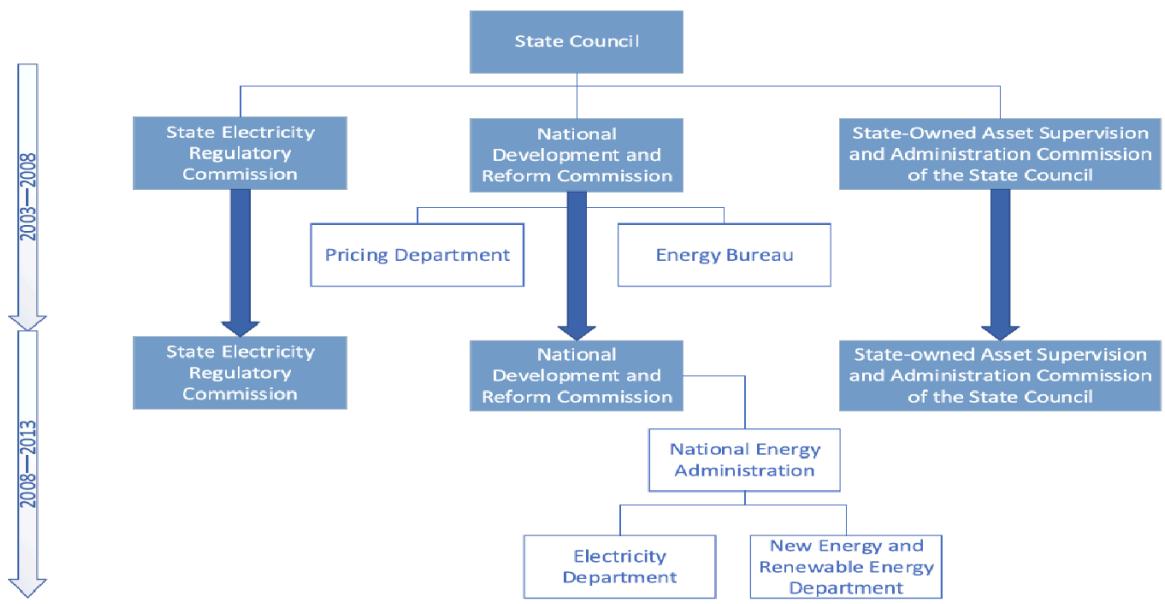
In a state-controlled economy, the commission's authority and tenure were, in fact, quite limited and short-lived, lasting approximately ten years. Beginning in 2013, the commission was merged into a state department called the National Energy Administration, whose goal is to regulate energy policy in China.
 Source: XU J, CAO X- Regulatory institutional reform on the power sector in China (2022) Figure 1. Reorganization of the ministries related to electricity administration.
The National Energy Administration is no longer an independent organization; it now operates as a state administration under the supervision of the National Development and Reform Commission (NDRC)."
Despite having national authority, the NEA reports directly to the head of the NDRC, rather than to the executive power, the State Council. Its relationship with the executive power is mediated through the head of the NDRC, who has full authority to determine which issues should be brought before the State Council and which ones must be decided by the NDRC.
Before being appointed as director of NEA, the nominated person must hold a ministerial rank, which allows the administration to have higher priority in communication with the State Council compared to other national administrations and authorities.
While the National Energy Administration is considered the regulatory authority of the electric sector, it lacks the independence and authority typically associated with regulatory bodies in Western countries. Instead, it is fully subordinate to the NDRC and the Chinese State.
3.3 China transport and distribution networks
According to the Regulation on the Administration of Power Grid Dispatching adopted in 1993 and amended in 2011, power grid dispatching is ensured by power grid dispatching agencies. These agencies are responsible for the operation, command, and coordination of the power grid to ensure safety, high quality, and economic efficiency.
The objective of power grid dispatching is to achieve unified dispatch and ensure the generation and utilization of electricity as outlined in the established plan. Deviations from the established plan are permitted only under special circumstances. A designated department within the State Council supervises power grid dispatching activities.
The electricity production and consumption are established on an administrative basis each year. The allocation is made on a fair principle so that generators using the same resources are given equal annual hours of production.
The State Council also establishes the operation of dispatching agencies, their jurisdiction, and hierarchy. The dispatching system is organized into a five-level hierarchy:
1. National Dispatch Organization
4. Prefectural Dispatch Organization
2. Regional Dispatch Organization
5. County Dispatch Organization
3. Provincial Dispatch Organization
Table 1: China Dispatching Organization
| LEVEL | HOST | JURISDICTION | KEY FUNCTION |
| National (NDO) | State Grid Corporation of China | Voltage level: >500 kVGeographic: Regional intertiesGenerators: Large thermal or hydropower shipping across regions | Interregional balancing, interregional dispatch |
| Regional (RDO) | Regional grid companies | Voltage level: 330–500 kVGeographic: Provincial intertiesGenerators: Pumped hydro storage, regulation | Interprovincial balancing, interprovincial dispatch |
| Provincial (PDO) | Provincial grid companies | Voltage level: 220 kV (330–500 kV terminal substations)Geographic: Bulk provincial systemGenerators: Larger generators not controlled by RDO or NDO | Intra-provincial balancing, intra-provincial dispatch, coordinating load management |
| Prefecture (MDO) | Prefecture power supply organizations | Voltage level: </=220 kVGeographic: Local systemGenerators: Smaller local generators | Prefecture load management |
| County (CDO) | County power supply organizations | Voltage level: </=110 kVGeographic: County systemGenerators: Any remaining generators | County load management |
The decisions of dispatching agencies are subordinate to the decisions of higher-level agencies, ultimately culminating in the national agency, which holds the highest authority. The national dispatching system is divided into two companies
-
State Grid Corporation of China (SGCC)
-
China Southern Power Grid Company's Dispatch Center (covering Guangdong, Guangxi, Yunnan, Guizhou, and Hainan)
State Grid Corporation of China (SGCC) was incorporated in 2002 and is considered the world's biggest utility company. According to the data available on the company's site (www.sgcc.com, 2023), bellow table presents the company's leading indicators evolution between 2010 - 2020.
Table 2: SGCC indicators evolution 2010/2020 Source: Own research based on available data
| INDICATOR | 2010 | 2020 | EVOLUTION |
| Electrical line length (million km) | 0.593 | 1.142 | $\uparrow x 1.9$ |
| Substation capacity (in trillion VA) | 2.25 | 5.23 | $\uparrow x 2.3$ |
| Electricity consumption (in trillion kwh) | 3.36 | 5.83 | $\uparrow x 1.7$ |
| Maximum load (in million kw) | 529 | 875 | $\uparrow x 1.7$ |
| Installed capacity (million kw) | 744 | 1700 | $\uparrow x 2.3$ |
The company is organized into 6 branches, 27 provincial companies and 37 subsidiaries, employing over 870,000 people. The company provides services for about 1.1 billion people and covers approximately 88% of China's territory.
The Company is ranked in third position on the Fortune Global 500 list of companies.
China Southern Power Grid Co., Ltd. (CSG), was established in 2002 and operates grid services across multiple regions, including Guangdong, Guangxi, Yunnan, Guizhou, Hainan, Hong Kong SAR, and Macao SAR.
Its services cover approximately 1 million square kilometers and serve around 230 million people. The service area spans 1 million square kilometers, with a population exceeding 272 million. The CSG electric network spans about 2,000 kilometers and has a total installed capacity of approximately 310 GW, with a transmission power of about 50 GW.
The company is organized into 3 branches, 13 wholly-owned subsidiaries and eight holding subsidiaries, encompassing nearly 280,000 employees in total.
Currently, the company is ranked 89th on the Fortune Global list of companies.
A particularity in CSG's development strategy is the orientation for export and interconnection with electrical grids of the nearby countries. Based on data from 2022, GSG exported 40,212 GWh to Vietnam, 1,228 GWh to Laos, and 4,969 GWh to Myanmar. Additionally, it purchased approximately 23,279 GWh from the same countries.
The companies mentioned above hold a state monopoly on purchasing electricity from producers and supplying it to consumers. Connections to the dispatching grids of power generators adhere to principles of equal access, mutual interest, and consensus.
3.4 Today market
Today, energy markets are globally used instruments to develop energy security, supply fair prices, and achieve the mutually agreed goal of reducing CO2 and GHG emissions.
Being the world's largest energy consumer, China's need for energy resources has led it to become a net importer of oil and other fossil fuels. This is despite the fact that its state-owned companies, as previously noted in the top Fortune Global companies list, are among the largest producers of energy.
China is taking significant steps towards developing its energy market with the aim of achieving a carbon-neutral economy by 2060. Decentralization and empowering provinces to make decisions are among the tools being utilized. This is alongside the challenge of creating a unified national market system to ensure fair access to resources.
An energy revolution was declared to combat pollution and promote the use of electricity, as well as natural gas, based on new non-polluting technologies. Despite significant strides in developing energy from renewable sources, demand for coal remains extremely high. The logistical challenge arises from the placement of coal mines in the North and Northwest provinces, while the major consumers and power plants are located in the eastern and southern coastal provinces. Over the last decade, approximately 80% of energy transport has been represented by coal, with the remaining balance covered by electricity transmission.
According to data received from IEA, China Energy Mix Evolution 1990-2020 is presented in the table below:
Table 3: 1990-2020 China Energy Mix Evolution
| Year | Coal | Natural gas | Hydro | Wind, solar, etc. | Biofuels and waste | Oil | Nuclear | TOTAL | |||||||
| Production | % | Production | % | Production | % | Production | % | Production | % | Production | % | Production | % | ||
| 1990 | 22,211,650 | 60.74 | 536,080 | 1.47 | 456,192 | 1.25 | 1,388 | 0.004 | 8,392,235 | 22.95 | 4,973,396 | 13.60 | 0 | 0.00 | 36,570,941 |
| 1995 | 27,131,803 | 62.02 | 627,918 | 1.44 | 686,077 | 1.57 | 54,157 | 0.124 | 8,573,514 | 19.60 | 6,534,880 | 14.94 | 139,996 | 0.32 | 43,748,345 |
| 2000 | 27,970,456 | 58.92 | 869,018 | 1.83 | 800,690 | 1.69 | 110,795 | 0.233 | 8,297,043 | 17.48 | 9,244,890 | 19.47 | 182,585 | 0.38 | 47,475,477 |
| 2005 | 50,392,934 | 67.55 | 1,624,042 | 2.18 | 1,429,261 | 1.92 | 221,166 | 0.296 | 7,050,149 | 9.45 | 13,306,545 | 17.84 | 579,142 | 0.78 | 74,603,239 |
| 2010 | 74,961,358 | 70.56 | 3,742,244 | 3.52 | 2,560,979 | 2.41 | 665,155 | 0.626 | 5,580,688 | 5.25 | 17,917,681 | 16.87 | 805,964 | 0.76 | 106,234,069 |
| 2015 | 83,697,393 | 66.65 | 6,639,779 | 5.29 | 4,012,092 | 3.19 | 2,056,636 | 1.638 | 4,758,105 | 3.79 | 22,555,622 | 17.96 | 1,863,153 | 1.48 | 125,582,780 |
| 2020 | 88,963,268 | 60.69 | 11,101,199 | 7.57 | 4,758,344 | 3.25 | 4,474,057 | 3.052 | 5,603,192 | 3.82 | 27,682,038 | 18.89 | 3,995,509 | 2.73 | 146,577,607 |
Over a 30-year development period, coal-fired electricity plants have maintained their share at about 60% of total power production. There has been a significant decrease in biofuels, dropping from approximately 23% in 1990 to 3.8% in 2020. This decrease has been offset by increases in natural gas, rising from 1.47% in 1990 to 7.57% in 2020, renewables from 0.004% in 1990 to 3.5% in
2020, oil from 13.6% in 1990 to 18.89% in 2020, and nuclear energy from 0% in 1990 to 2.73% in 2020.
China's energy market, like in many other countries, particularly socialist or communist ones, operates on centralized and regulated premises aimed at ensuring fair access to resources and stable, predictable prices. This regulation and control are realized through centralized plans for power production and consumption.
Since 2015, following Document No. 9 as a pilot project aimed at increasing the efficiency of power production, local power markets have been promoted. This project saw success in 2022, with approximately 61% of the generated electricity being commercialized through market mechanisms, marking a 39% increase from 2021. The wholesale market, constituting around 79% of the market, is composed of bilateral wholesale electricity contracts.
The aim is to establish a national spot energy market, building upon the existing regional and provincial markets that have been operating as pilot projects since 2017. The new national spot market will ensure better distribution of energy resources and preserve local autonomy.
The establishment of the local electricity market means that priority access is granted to certain established power producers (such as those from renewable sources) and domestic users. Others are required to sell or purchase the needed energy on the market. Since 2018, coal energy producers that commenced operations after 2015 are mandated to sell the energy they produce on energy markets.
In 2021, the concept of a standard process for commercial and industrial users disappeared, and they obtained the required energy directly from energy producers or from the grid.
In 2020, the NRDC published "The General Rules for Medium- and Long-Term Power Trading," encouraging electricity producers and users to engage in these agreements.
The rules establish models of contracts between the energy generation company, the grid company, and the energy users. According to the law, the prices on medium and long-term contracts are negotiated between sellers and buyers but are subject to restrictions imposed by the type of electricity being traded.
For example, in the case of electricity produced from coal, the price can be negotiated within 20% above or below the indicative price established in medium and long-term contracts. For renewable sources, there is no such limit, and the price is freely negotiated. In addition to the electricity price, as in other countries, users should also pay for transmission, ancillary services, and local and governmental subsidies.
Although the roles of provinces in regulating local markets are maintained according to NRDC and NEA regulations, the State is taking decisive steps to ensure central coordination of the markets involved in the energy sector through Document No. 118. Centralization is scheduled to commence in 2025 and be fully implemented by 2030.
3.5 SWOT analysis of China's electricity market
| Strengths1. Extensive Energy Infrastructure:China is renowned for having one of the world's most expansive and diverse energy infrastructures, which includes a wide range of energy sources such as large-scale hydroelectric facilities, solar farms, and wind parks.2. Strong State Support:The Chinese government has shown a strong commitment to the energy sector, withcontinuous support through initiatives and policies that focus on expanding renewable energy capabilities and cutting down on carbon emissions.3. Innovation in Renewable Technologies: Leading the charge in renewable energy technology, China stands as a major manufacturer of solar panels and wind turbines, securing its crucial position in the worldwide renewable energy market.4. Rapid Growth in Renewable Energy:China has rapidly expanded its renewable energy infrastructure, which has significantly decreased its dependence on traditional coal-based power sources. | Opportunities1. Renewable Energy Development:The renewable sector sees significant growth potential, bolstered by government initiatives and breakthroughs in clean energy technologies.2. Expansion in Electric Vehicles (EVs):The rapidly growing EV market is driving up electricity demand, opening up numerousopportunities for grid improvements and innovations in energy storage technologies.3. Advancements in Energy Storage: Advances in energy storage technology hold promise for grid stabilization by managing the intermittent nature of renewable energy sources.4. Leadership in Global Energy:China has the opportunity to expand its influence in global energy markets through exporting its renewable technology and participating in international clean energy programs. |
| Weaknesses1. Continued Coal Dependence:China's energy landscape continues to be dominated by coal, despite substantial investments in renewable energy. This reliance on coal power persists due to existing infrastructure and economic considerations, which results in continuous environmental degradation and public health concerns due to air pollution and greenhouse gas emissions.2. Uneven Electricity Access:Access to electricity in China is marked by significant regional disparities. While urban areas enjoy high levels of reliability and advanced infrastructure, rural and certain remote regions suffer from inconsistent power supplies and outdated facilities, leading to a gap in energy equity and hindering economic and social development in less urbanized areas.3. Grid Modernization Challenges:The integration of renewable energy into China's national grid is impeded by the grid's outdated design, which was primarily built | Threats1. Economic Volatility:Sharp downturns in the economy can dramatically curtail the availability of financial resources earmarked for critical energy projects, including the construction and modernization of infrastructure, as well as the development and implementation of emerging technologies in the energy sector.2. Global Political Frictions:Persistent geopolitical tensions and unresolved trade disputes could significantly undermine the stability and reliability of international supply chains. This disruption is particularly critical for the renewable energy sector, which depends heavily on the global flow of materials vital for manufacturing advanced technological components like solar panels and wind turbines.3. Susceptibility to Natural Catastrophes:China's energy framework is particularly vulnerable to the devastating impacts of natural disasters. Such events can lead to |
| for stable, centralized sources rather than the variable and dispersed nature of renewables like wind and solar. This results in inefficiencies and limitations in harnessing the full potential of renewable energy sources, necessitating substantial upgrades to both hardware and management systems to enhance grid resilience and flexibility.4. Complex Regulatory Framework:Investigating the regulatory landscape of China's electricity market can be daunting due to its complexity and lack of transparency. This intricate framework involves multiple layers of bureaucracy and often inconsistent policies across different regions and sectors, creating hurdles for investment and innovation. Such regulatory complexity can deter both domestic and international investors, potentially slowing down the pace of technological advancements and market-driven efficiencies. Despite advances in renewable energy, China's energy system remains heavily coal-dependent, leading to ongoing environmental and health challenges. | extensive disruptions in energy production and distribution systems, with especially severe consequences in regions that depend heavily on localized energy sources, such as hydroelectric power stations.4. Rapid Technological Changes:The fast pace of technological advancement may lead to current systems becoming outdated, necessitating substantial investments for upgrades or replacements to maintain competitive edge. |
IV. CONCLUSION
China's electricity sector has experienced significant transformation over the last several decades, evolving from a tightly controlled government-run system to a more liberalized and diverse energy market. The transformation is part of a larger narrative of China's rapid economic advancement and its increasing emphasis on sustainable development and energy security.
Initially driven by the demands of a fast-growing industrial sector and massive urban expansion, the electricity market in China was strained by supply shortages and inefficiencies, prompting the need for substantial governmental reforms.
Historically dominated by coal and overseen by state enterprises, the Chinese electricity market was marked by significant environmental challenges and operational inefficiencies. To address these issues, China enacted several reforms aimed at diversifying its energy sources and improving the efficiency and reliability of its electricity production systems. Laws such as the Electric Power Law and the Renewable Energy Promotion Law were instrumental in laying down a regulatory foundation that promoted safer and more environmentally sustainable practices in energy production.
The drive towards a market-oriented system began with efforts to decentralize control, introduce competition, and reduce state monopoly in the electricity sector. This included establishing local electricity markets and developing a national spot energy market. These initiatives aimed to enhance efficiency and reduce costs by promoting competitive practices and enabling direct transactions between energy producers and consumers.
Currently, China's electricity market is characterized by its vast scale and the pivotal role played by major state-owned grid operators such as the State Grid Corporation of China and the China Southern Power Grid. These companies are vital to in managing the nation's extensive and intricate grid infrastructure, ensuring system stability, and integrating an increasing percentage of renewable energy sources into the power mix.
Despite progress in diversifying energy sources, significant regional disparities in energy access persist, and integrating intermittent renewable energy sources into a grid originally designed for stable, centralized power sources remains a challenge. Additionally, coal continues to play a major role in China's energy landscape, contributing to ongoing environmental and public health issues.
Concluding, while significant progress has been made toward liberalizing and greening China's electricity market, the path forward requires continued reforms. The sector must embrace further technological advancements and foster international collaborations to ensure that China can meet its future energy demands in a sustainably and efficiently manner.
Conflict of Interest
The authors declare no conflict of interest.
Ethical Approval
Not applicable
Data Availability
The datasets used in this study are openly available at [repository link] and the source code is available on GitHub at [GitHub link].
Funding
This work did not receive any external funding.
References
Cite this article
Related Research


Special Issue
Launch a focused special issue to highlight research, emerging trends, and expert insights in your academic field.
