




IntelliPaper
Abstract
Fossil fuels are produced by non-renewable sources. The non-renewability is motivated for alternative fuels. Some common examples of feedstock for alternative fuels are seed oil, vegetable oil, waste cooking, soybean oil. Biodiesel is produced through transesterification reaction. Biodiesel production from waste cooking oil provides an alternate energy for various uses. Recycling waste cooking oil and methanol with the presence of (CaO) and (MgO) nano catalysts offers several benefits like economic, environmental and waste management. The nano catalysts CaO and MgO was synthesized by thermal decomposition method and calcinated at 500°C followed by characterization using diffraction (XRD) technique and RSM (Response Surface Methodology) is performed for optimization of the yield. This study investigates the repeatability of transesterification reaction with the presence of those nano catalysts.
Explore Digital Article Text
I. INTRODUCTION
Fuel plays a crucial role in powering vehicles and industries, with fossil fuels being the primary source. However, the lengthy formation process spanning millions of years and limited availability underscore the need for alternative fuel sources. Biofuels emerge as a viable substitute, derived from living organisms and produced through shorter, biological processes. This renewable energy source, including bioethanol and biodiesel, offers distinct advantages.
Bioethanol, a liquid fuel, is obtained through biological processes employing microorganisms and enzymes. Sugarcane and wheat serve as sources, with fermentation and distillation separating bioethanol from other components. It can be used as an additive with gasoline, reducing carbon monoxide emissions. Biodiesel, produced via transesterification using vegetable oil and fat, features resources like soybean oil and waste cooking oil. It proves effective in fuel mixtures, lowering unfavorable gas emissions by up to 60%.
While burning biofuels contributes to air pollution, the impact is comparatively lower than that of fossil fuels. The benefits of biofuels encompass lower emissions, renewability, biodegradability, and safety. They produce fewer greenhouse gases and are easily obtained from organic materials, making biofuels a sustainable energy source derived from readily available resources like plant biomass.
II. MATERIALS AND METHODS
2.1 List of Samples
Waste cooking oil (WCO)
2.2 List of Chemicals
Methanol, NaOH, Calcium nitrate Ca(NO3)2, Magnesium nitrate Mg(NO3)2, Ethylene glycol
2.3 List of instruments
Magnetic stirrer, Water bath, XRD (X-ray Diffraction), Muffle furnace.
2.4 Waste Cooking Oil sample preparation (WCO):
Waste cooking oil was collected from local hotels, which has been used for food frying. The waste cooking oil was settled for 4-6 days at room temperature and later it was filtered to remove any suspended food particles and by heating at C for water removal.
2.5 Nano-catalyst synthesis
MgO Nano catalyst was prepared by thermal decomposition method, it is a method that chemical decomposition of substance into constituents by heating. A solid material is heated beyond its decomposition temperature. CaO Nano catalyst was prepared by sol gel method. This method is a wet chemical technique that uses chemical solution to produce an integrated network(gel).
2.6 Catalyst characterization
The synthesized catalysts properties were characterized by X-ray diffraction (XRD) for identification of major components and for the determination of crystallite size.
2.7 Biodiesel Preparation
90ml of methanol poured into 250ml conical flask. The Sodium hydroxide 4g added with methanol solution. The mixture was shaken for 1 hour until catalyst fully dissolved in methanol. This is known as alkoxides sample. The alkoxides sample was added methanol 90ml and oil sample 90ml 1:1 ratio at 60°C, beyond this heat level it will leads to coagulation of oil sample. The transesterification reaction started at this movement. The reaction mixture was kept for 2 hours in shaker. After this sample was kept for layer separation by separator funnel. This experiment was also done in waste cooking oil using two types of catalysts Nano CaO and Nano MgO, in different ratio.
2.8 Nano CaO preparation
2.9 Nano MgO preparation
1.5 gram was dissolved in 50ml distilled water, mixed by magnetic stirrer. 0.5 gram NaOH was dissolved in 25ml distilled water, added to the solution in the magnetic stirrer. Keep the solution in magnetic stirrer for 2 hours so that a clear white gel was obtained. The white gel was left over for extra 2 hours at room temperature for the reaction to complete. Then after 4 times of being washed with water, NaOH was excreted. After that the gel was heated up to 80°C for 2 hours so that the water content could be vapourized and the gel concentrated. The resulting dry gel was milled in the form of white powder. The produced 5g powder was put in the cruse and into the oven which was gradually heated up to 500°C for 2 hour for decarbonization.
2.10 Preparation Of Sample
Waste Cooking Oil (used cooking oil) was Collected from restaurants and hotels. It is stored in a bottle and left over 3 day for settling down of impurities like food particles.
2.11 Process of reaction
100ml wco sample collected and filtered, heated up to C meanwhile 1 gram nano catalyst (CaO) was dissolved in 20ml methanol, the dissolved catalyst solution is added to the heated wco which was placed under magnetic stirrer, keep in magnetic stirrer for 30 minutes. After that sample was kept for layer separation by separator funnel. Top layer is considered as fatty acid methyl ester (biodiesel) in the conical flask and bottom layer is considered as glycerol in the beaker.
2.12 Transesterification steps
Take 100ml of Waste Cooking Oil sample. Preheat the sample at 50-60°C.Take 20ml of methanol and 1 gram of Nano CaO which was prepared earlier, mix it well in the conical flask.The sample is kept in magnetic stirrer at 50-60°C, the solution in the conical flask is added to the sample in magnetic stirrer. Maintain a speed of 890rpm and reaction is continued for above one and half an hour. After reaction time is completed, this mixture send to the separating funnel for glycerol settling down, the glycerol mixture in biodiesel settle in separating funnel with in 6- 12 hours. Remove the glycerol from the separating funnel and biodiesel is send to washing. The non polar methyl ester molecules making up the biodiesel do not mix with thempolar glycerol molecules and the mixture of products will separate into two layers with the less dense biodiesel floating on top of the more dense glycerol layer. The method of removing glycerol is mainly by gravity separation or centrifugation. In this process the layers are separated with the help of separating funnel which is known as gravity separation.
2.13 Washing and Drying
After biodiesel and glycerol are separated, trace amount of glycerine remain in the biodiesel. It is a process of washing biodiesel of its contaminants. These contaminants include trace amounts of methanol, soap, glycerin and catalysts. They are washed out with warm water. Dry washing is another most regularly used technology in the dynamics of biodiesel purification process. After the biodiesel is washed, it should be dried until it is crystal clear. This can be done by heated about for few hours.
III. RESULTS AND DISCUSSION
3.1 Biodiesel
Biodiesel is the generic name for the family of diesel fuel alternatives produced by transesterification of oils from agricultural feed stock. Waste cooking oil themselves from triglycerides as shown in Fig 3.1.1, which are esters derived from long chain fatty acids and polyalcohol glycerol. Some of the fatty acids have unsaturated chains. Fatty acid methyl ester is also called as biodiesel.
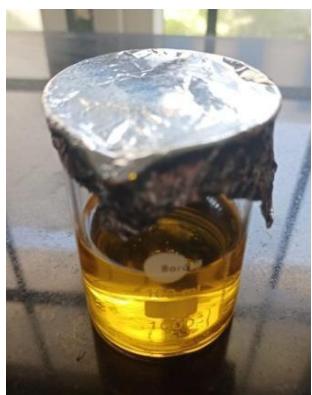 Fig.3.1: Biodiesel produced from
WCO using combination of Nano CaO and Nano MgO
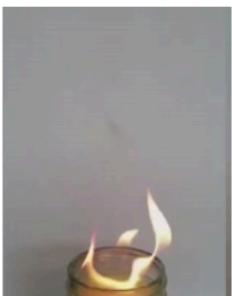
 Fig 3.2: Flaming test for biodiesel obtained from WCO using combination of Nano CaO and Nano MgO
3.2 Analysis of Nanoparticles
The application of XRD showed that the crystal structure of the particles was cubic. Additionally, the comparison of the obtained peaks and source peaks indicated that the CaO NPs were synthesized and average particle size was calculated 61 nm according to Scherer's equation (Fig:3.2.1). Also, the comparison of the obtained peaks and source peaks indicated that the Mgo NPs were synthesized and average particle size was calculated 69 nm according to Scherer's equation ()
Scherer's equation:
D = crystallite size.
hkl = broadening of the hkl diffraction peak, measured at half of its maximum intensity.
angle.
k = shape factor.
wavelength of radiation.
{"image_source":{"path":"images/6e0aeef0af3fd15b760dc513100a77986136696dd57001b01565f26ed2f8e90c.jpg"},"content":"","chart_caption":[{"type":"text","content":"Fig.3.3: XRD analysis of presence of Nano CaO"}],"chart_footnote":[]} {"image_source":{"path":"images/d555eb0caeb8f190afc442fae78702c79994126a0297a3d60c5092699bf71534.jpg"},"content":"","chart_caption":[{"type":"text","content":"Fig. 3.4: XRD analysis of presence of Nano MgO"}],"chart_footnote":[]}
3.3 Optimization of Reaction Conditions by RSM
Parametric effects such as temperature, reaction time, sample ratio, catalyst ratio and stirring speed are all important factors in the transesterification of waste cooking oil using Nano catalyst CaO and MgO. Their effect on waste cooking oil FAME yield was illustrated in Fig 3.3 to Fig 3.8 below. Experimental runs were carried out by a combination of the five variables resulting in a total 32 experimental runs best of 10 runs are presented in Table 3.1, Table 3.2 and Table 3.3.
| RUN | Temperature (°C) | Reaction time (min) | Sample ratio (ml) | Catalyst ratio (g) | Stirring speed (rpm) | Output Yield% |
| 1 | 60 | 67 | 80 | 2 | 590 | 72.63 |
| 2 | 50 | 45 | 100 | 8 | 400 | 75.34 |
| 3 | 60 | 35 | 90 | 5 | 590 | 69.67 |
| 4 | 65 | 67.5 | 100 | 5 | 590 | 72.59 |
| 5 | 70 | 45 | 75 | 2 | 400 | 54.87 |
| 6 | 60 | 67 | 75 | 5 | 590 | 65.12 |
| 7 | 70 | 45 | 100 | 2 | 780 | 67.85 |
| 8 | 50 | 90 | 70 | 2 | 780 | 55.32 |
| 9 | 70 | 90 | 80 | 8 | 780 | 64.27 |
| 10 | 70 | 90 | 90 | 8 | 400 | 78.58 |
3.4 Maximum yield using Nano CaO:
A maximum yield of 78.58% was obtained using optimum operating parameters of temperature C, reaction time 90 minutes, catalyst ratio 8 g, sample ratio 90 ml and stirring speed 400 rpm. The effect of the different parameters on the actual yield RSM prediction is reported in table 3.2. It was observed that run 10 had the highest actual yield of 78.58% with reaction parameters, temperature C, reaction time 90 minutes, catalyst ratio 8 g, sample ratio 90 ml and stirring speed 400 rpm.
Table 3.2: RSM Prediction using Nano MgO
| RUN | Temperature (°C) | Reaction time (min) | Sample ratio (ml) | Catalyst ratio (g) | Stirring speed (rpm) | Yield% |
| 1 | 55 | 60 | 85 | 2 | 590 | 78.58 |
| 2 | 50 | 45 | 100 | 3 | 400 | 64.27 |
| 3 | 60 | 50 | 75 | 5 | 590 | 55.32 |
| 4 | 65 | 65 | 75 | 5 | 590 | 67.85 |
| 5 | 70 | 45 | 75 | 2 | 400 | 54.87 |
| 6 | 60 | 65 | 75 | 5 | 590 | 65.12 |
| 7 | 65 | 45 | 100 | 2 | 780 | 72.59 |
| 8 | 50 | 90 | 85 | 2 | 780 | 69.67 |
| 9 | 70 | 90 | 90 | 3 | 780 | 75.34 |
| 10 | 70 | 90 | 90 | 3 | 400 | 72.63 |
3.5 Maximum yield using Nano MgO catalyst
A maximum yield of 78.58% was obtained using optimum operating parameters of temperature C, reaction time 60 minutes, catalyst ratio 2 g, sample ratio 85 ml and stirring speed 590rpm. The effect of the different parameters on the actual yield RSM prediction is reported in table 3.3. It was observed that run 1 had the highest actual yield of 78.58% with reaction parameters, temperature C, reaction time 60 minutes, catalyst ratio 2 g, sample ratio 85ml and stirring speed 590rpm.
Table 3.3: RSM Prediction using Nano CaO and MgO Catalyst
| RUN | Temperature (°C) | Reaction time (min) | Sample ratio (ml) | Catalyst ratio (g) | Stirring speed (rpm) | Yield% |
| 1 | 50 | 45 | 100 | 1.2 | 400 | 55.78 |
| 2 | 36.22 | 67 | 95 | 3 | 575 | 73.65 |
| 3 | 50 | 45 | 70 | 2 | 400 | 48.78 |
| 4 | 70 | 90 | 90 | 1.2 | 750 | 67.98 |
| 5 | 50 | 90 | 80 | 2 | 750 | 55.34 |
| 6 | 50 | 45 | 100 | 1.5 | 750 | 49.89 |
| 7 | 60 | 67 | 90 | 3 | 158 | 78.43 |
| 8 | 60 | 67 | 95 | 2 | 575 | 76.21 |
| 9 | 50 | 90 | 100 | 1.2 | 750 | 52.78 |
| 10 | 60 | 67 | 95 | 3 | 680 | 79.54 |
| 11 | 70 | 90 | 90 | 2 | 650 | 65.32 |
| 12 | 50 | 45 | 100 | 1.5 | 400 | 75.54 |
| 13 | 60 | 67 | 100 | 2 | 750 | 65.43 |
| 14 | 70 | 90 | 95 | 3 | 750 | 78.98 |
| 15 | 70 | 45 | 95 | 2 | 400 | 72.56 |
| 16 | 70 | 45 | 100 | 2 | 400 | 78.54 |
| 17 | 60 | 25 | 95 | 1.5 | 575 | 69.81 |
| 18 | 60 | 67 | 100 | 1.2 | 575 | 81.23 |
| 19 | 60 | 67 | 75 | 2 | 575 | 45.67 |
| 20 | 50 | 90 | 80 | 3 | 400 | 55.67 |
| 21 | 70 | 45 | 100 | 1.5 | 750 | 81.01 |
| 22 | 70 | 90 | 95 | 2 | 400 | 65.79 |
| 23 | 60 | 67 | 100 | 3 | 575 | 72.54 |
| 24 | 50 | 90 | 95 | 2 | 750 | 54.87 |
| 25 | 70 | 45 | 90 | 1 | 750 | 56.45 |
3.5 Maximum yield using Nano CaO and MgO catalyst
A maximum yield of 81.23% was obtained using optimum operating parameters of temperature C, reaction time 67 minutes, catalyst ratio 1.2g, sample ratio 100ml and stirring speed 575rpm. The effect of the different parameters on the actual yield RSM prediction is reported in table 3.3. It was observed that run 18 had the highest actual yield of 81.23% with reaction parameters, temperature C, reaction time 67 minutes, catalyst ratio 1.2g, sample ratio 100 ml and stirring speed 575rpm.
{"image_source":{"path":"images/b681c9e9bc7609f339b246ea4d9e1d50511908accf1f6e7083b43b87d60d8600.jpg"},"content":"","chart_caption":[],"chart_footnote":[]} {"image_source":{"path":"images/b77abc3efba30fd9372e7e7af3e8e93671004fa99f5a1bd7d9651bd15d618d87.jpg"},"content":"","chart_caption":[{"type":"text","content":"Fig 3.5: Effect of Reaction time and temperature"},{"type":"text","content":"Fig 3.6: Effect of Reaction time and temperature"}],"chart_footnote":[]}
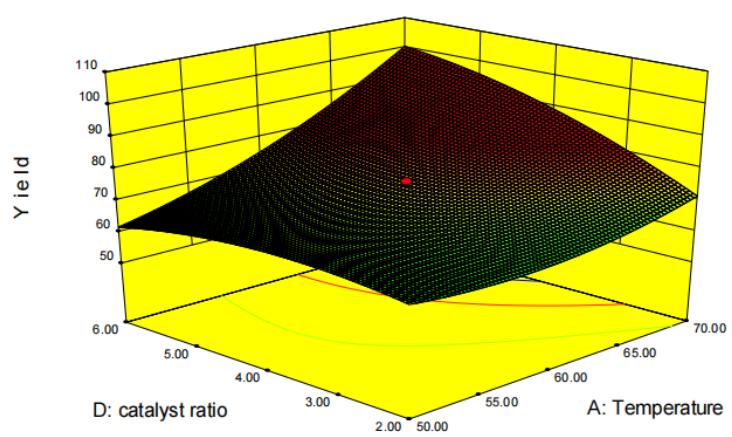
Design-Expert® Software Factor Coding: Actual Yield ● Design points above predicted value ● Design points below predicted value 81.23 45.67 X1 = A: Temperature X2 = D: catalyst ratio Actual Factors B: Reaction time = 67.50 C: Sample ratio = 75.00 E: Stirling speed = 575.00 {"image_source":{"path":"images/3706c937443cba77e3da74b722ffb8026c2820272d087951a03febe470652b19.jpg"},"content":"","chart_caption":[{"type":"text","content":"Fig 3.7: Effect of Catalyst ratio and temperature"}],"chart_footnote":[]}
{"image_source":{"path":"images/9d1f8167633a760d564920b84aa37f2c68deba8585dccd41172a2168a2afdd27.jpg"},"content":"","chart_caption":[{"type":"text","content":"Fig 3.8: Effect of Stirring speed and temperature"}],"chart_footnote":[]}
3.7 Analysis using Design Expert (RSM)
The interactive effects of adjusting the process variables within the design space were monitored using 3D surface plots. The analysis and optimization of waste cooking oil using nano catalyst CaO and MgO transesterification were completed using the Design Expert 8.0.7.1 and the graphical solutions presented in Fig 3.5 to Fig 3.8.
➢ Interactive effect of temperature and reaction time on the yield shown in Fig 3.5.
➢ Effect of varying sample ratio and temperature on waste cooking oil transesterification shown Fig 3.6.
➢ Effect of varying catalyst ratio and temperature on waste cooking oil
▶ transesterification shown in Fig 3.7.
➢ Surface plot of the effect of interacting varying temperature and stirring speed
▶ shown in Fig 3.8.
➢ Surface plot of the interaction sample ratio and reaction time shown in Fig 3.5.
➢ Effect of interaction of catalyst ratio and reaction time shown in Fig 3.6.
3.8 Physical Properties of Biodiesel from Waste Cooking Oil using Nano Cao and Nano Mgo Catalysts
Table 3.4: Comparison of obtained Biodiesel and Diesel physical properties
| Property | Diesel | Measured value of Biodiesel |
| Flash point | 55(°C) | 150(°C) |
| Viscosity | 2.5-3.2 mm2/s | 4.8 mm2/s |
| Cloud point | 15(°C) | 4(°C) |
| Pour point | 8(°C) | -5(°C) |
| Density | 0.84(gr/cm3) | 0.87(gr/cm3) |
The flash point of base diesel and obtained biodiesel are mentioned in table 3.4, the obtained biodiesel has flash point as C.
The viscosity of base diesel and obtained biodiesel are mentioned in table 3.4,
➢ the obtained biodiesel has viscosity as 4.8 mm22/s.
The cloud point of base diesel and obtained biodiesel are mentioned in table 3.4, the obtained biodiesel has cloud point as C.
The pour point of base diesel and obtained biodiesel are mentioned in table 3.4,
➢ the obtained biodiesel has pour point as .
The density of base diesel and biodiesel are mentioned in table 3.4, the obtained
▶ biodiesel has density as 0.89 gr/cm3.
窗体底端
IV. CONCLUSION
The findings demonstrate that the use of heterogeneous catalysts, specifically nano catalysts CaO and MgO, holds significant promise for biodiesel production. One of the primary advantages lies in catalyst regeneration, contributing to reduced catalyst costs and a simplified separation process, thereby lowering overall production costs. The results suggest that Nano CaO exhibits superior performance in terms of efficacy, reaction duration, repeatability of used catalyst weight percentage, methanol amount, and biodiesel production mass yield compared to self-combustion Nano MgO, attributed to its basic nature. While Nano MgO alone may not effectively catalyze transesterification due to its weaker basic affinity, when combined with Nano CaO, its surface structure enhances basic properties, making it a suitable base for the catalyst. This increased CaO contact surface results in a significant boost to transesterification reaction yield. Higher proportions of Nano CaO to Nano MgO further enhance biodiesel production mass yield. Additionally, the combined catalyst demonstrates better repeatability than Nano CaO alone.
- gram NaOH dissolved in 25ml distilled water added to the solution in the magnetic stirrer. Keep the solution in magnetic stirrer for 2 hours so that a clear white gel was obtained. The white gel was left over for extra 2 hours at room temperature for the reaction to complete. Then after 4 times of being washed with water, NaOH was excreted. After that the gel was heated up to 80°C for 2 hours so that the water content could be vapourized and the gel concentrated. The resulting dry gel was milled in the form of white powder. The produced 12g powder was put in the cruse and into the oven which was gradually heated up to 500°C for 2 hour for decarbonization. (p.3) ↩
- gram Ca(NO3)2 was dissolved in 25ml of ethylene glycol mixed by magnetic stirrer. (p.3) ↩
Conflict of Interest
The authors declare no conflict of interest.
Ethical Approval
Not applicable
Data Availability
The datasets used in this study are openly available at [repository link] and the source code is available on GitHub at [GitHub link].
Funding
This work did not receive any external funding.
References
Cite this article
Related Research



Special Issue
Launch a focused special issue to highlight research, emerging trends, and expert insights in your academic field.
