




IntelliPaper
Abstract
New data on the state of the Libelloides macaronius Scopoli, 1763 population, based on our three-year monitoring in Tajikistan, are presented. It has been shown that the state of the population of this species is stable and there is no need for further measures taken to preserve its population. The presented data is necessary for the prepared new edition of the Red Book of the Republic of Tajikistan, since Libelloides macaronius is listed in the previous edition of the Red Book of Tajikistan. In addition, data on other species of owlflies collected by us during the expedition to the Pamirs in 2024 are provided.
Explore Digital Article Text
I. INTRODUCTION
Libelloides macaronius Scopoli, 1763 is widespread in the Eastern Mediterranean, Southern Europe (from France, Southern Germany and Austria to Turkey), southern Ukraine and Russia, Kazakhstan, Altai, the Caucasus, Iran and Central Asia (Krivokhatsky et al., 2018). In Tajikistan, L. macaronius is a widespread species from the plains to the highlands. Morphologically, L. macaronius like other species of owflies, are superficially similar to dragonflies, but with a smaller size, and differing shape and color of wings, a hairy head and abdomen, as well as club-shaped antennae, similar to those found in butterflies. Owflies also have similarities with butterflies (Krivokhatsky et al., 2018), but the differences between these insect groups are that the wings of owflies are not covered with scales. In addition, the wings are narrow compared to butterfly wings and have a particular shape. Owflies represent an exciting group of insects, since some representatives of this group have several morphs and these phenomena require additional research to further the systematic position of this group. It should be noted that no one has been studying the Neuroptera of Tajikistan for a long time. Data about the Neuroptera of Tajikistan is contained in the works of Alexandrov-Martinov & Bianki (1931), Mak-Lahan, (1875) and Weele, (1908), there are also generalizing works on the fauna of the Neuroptera of Tajikistan and Central Asia as a whole (Luppova, 1971, 1973). The last publication by Luppova (1973) is devoted to the fauna of the Ascalaphidae of Central Asia. In this publication, the author, along with other species of owflies of Tajikistan, also provides information on the taxonomy and ecology of L. macaronius. In the work of Krivokhatsky et al. (2018), dedicated to owflies of the Crimea and the Western Palearctic, also consider the taxonomy of L. macaronius, including populations from Tajikistan. In none of the above works L. macaronius is mentioned as a rare, small-numbered or in need of protection species.
L. macaronius was included in the Red Book of the Republic of Tajikistan (Second edition), published in 2017, with the status of a vulnerable species, but without any new and reliable data on the population of this species. The section devoted to L. macaronius in this book was prepared based on information from the Red Book of the USSR (1984). However, the page containing information about L. macaronius in the Red Book of the USSR does not mention any data from Tajikistan.
Every year, during the accounting of the number of butterflies in different parts of Tajikistan, we also recorded the flight of L. macaronius. The abundance of L. macaronius varied in different places, but in some places, it exceeded the abundance of the butterfly. Given these situations, it would be necessary to monitor the state of the L. macaronius population and clarify whether its populations need protection in Tajikistan or not.
II. MATERIAL AND METHODS
The material for this paper was collected between 2021 – 2023. The material was collected in the hot daytime using an entomological net. Since owlflies fly in the daytime like butterflies, strategies of collecting butterflies can also be applied to them. When collecting the material, the methods proposed by Dubatolov & Kosterin (1999), were applied; that, the number of owlflies was calculated in specimens per/km , taking into account the route on a 4 m wide section and the duration of routes up to 2 km.
Below are the localities where the material was collected:
-
The northern slope of the Hazrati Shoh Ridge, Shugnovi Bolo, Knovaling district, 38°35'12.14"N, 070°21'28.32"E, h=2520 m. Vegetation – large herb semi-savannah (6.07.2021).
-
The southern slope of the Peter the Great Ridge, the vicinity of Gulkhani village, Rasht district, 39°00'12.98"N, 070°25'04.95"E, h=2180 m. Vegetation – agricultural landscape (fields with an esparcet) (19.06.2022).
-
The eastern slope of the Hissar Ridge, Siyohkuh, Varzob district, N, E, h=2540 m. Vegetation – meadows (3 – 4. 07.2022).
-
The northern slope of the Hissar Ridge, Anzob pass, Varzob district, 39°03'40.45"N, 068°43'05.69"E, h=2460 m. Vegetation – rocky – gravelly slope with sparse vegetation (6.07.2022).
-
The eastern slope of the Hissar Ridge, Ramit gorge, Vakhdat city, 38°43'30. 54"N, 069°18'06.31"E, h=1610 m. Vegetation – large herb semi-savannah (12.06.2023).
-
The northern slope of the Hissar Ridge, Fann mountains, Iskandarkul neighbourhood, Ayni district, 39°02'09.58"N, 068°17'09.01"E, h=2560 m. Vegetation – mixed-grass meadows (7 – 8.07.2023).
-
Sanglok ridge, Dangara district, 38°19'27.08"N, 069°14'58.58"E, h=1560 m. Vegetation – mixed grasslands with the presence of woody–shrubby plants (5.06.2023).
The collected materials are stored at the E.N. Pavlovsky Institute of Zoology and Parasitology National Academy of Sciences of Tajikistan.
III. RESULTS
After carrying out the appropriate accounting methods and obtaining reliable data on the number of L. macaronius in the last 3 years, we were finally able to clarify the state of the population of this species, which had not been known before. The density of L. macaronius in the localities as mentioned above turned out to be different. However, it is not small in number, but there is a case where this species occurs singly. The population density was highest at the 6th locality (68 specimens per/km ), and second-highest at the 2nd locality (23 specimens per/km ). The remainder of the populations had from 5 to 12 specimens per/km , but there was a case when one specimen per/km was encountered (locality and 2 localities, then in this case it is pretty consistent to numerous. The result of the collection from the 7th locality is the only case when owlfly met a single. Such population density indicates that there is no reason to consider this species rare or small in number.
In places where the plant community is still flourishing, L. macaronius is typical, but where the vegetation is semi-dry, it is rare, which is observed in 7 localities. In places where L. macaronius is numerous, it is possible to observe how several individuals fly together. L. macaronius flies slowly, so it is very convenient and does not cause difficulty to keep records of its number.
It is pretty likely that the number of is also influenced by anthropogenic factors such as cattle grazing and haymaking since we did not detect this species in places where the most significant influence of such factors was observed, even during several years of research.
Thus, the densest populations of L. macaronius were found on the Hissar and Peter the Great Ridges at an altitude of 1600-1850 m above sea level, whose numbers were several times higher than the populations from the Hazrati Shoh and Sanglok Ridges. It is possible that further studies will reveal populations of L. macaronius in other places in Tajikistan.
From the point of view of taxonomy, the populations of L. macaronius and, in general, all owflies inhabiting Tajikistan require additional research. L. macaronius is a polymorphic species with several morphs. In this paper, we will not touch on the issue of taxonomy of owflies, since there is insufficient material for this. If there is sufficient material, it is necessary to consider in detail the taxonomy of the owflies of Tajikistan from a modern point of view.
IV. CONCLUSION
Given the above data on the state of the L. macaronius population in Tajikistan, it is recommended not to include it in the next edition of the Red Book of Tajikistan.
Information about other species of owflies
During an expedition to the Pamir in 2024, we managed to collect other species of owflies. As mentioned earlier, no new information about the Neuroptera of Tajikistan has been received recently, and therefore any data is necessary for further research of this group of insects in our country.
The following is a list of these species:
Idricerus sogdianus McLachlan, 1875
Material: 2♂♂, 2♀♀. Pamir, Rushan Ridge, Khuf Valley. 37°52'26.90"N, 071°38'22.79" h=2210 m (3.08.2024). One male was caught sitting among rocky placers during the day, and three other specimens were caught in a light trap at night. During the day, we did not observe the flight of I. sogdianus. According to Luppova (1973), I. sogdianus flies mainly at dusk and night.
I. sogdianus is distributed in Tajikistan, Uzbekistan, Kazakhstan, Turkmenistan, Northern India, Southwestern China and Turkey.
Deleproctophylla variegata (Klug, 1834)
Material: 5♂♂, 2♀♀. Pamir, Shugnan Ridge, Botanical garden. 37°28'35.42"N, 071°36'05.01" h=2270 m (7.08.2024). All specimens were caught in the daytime on the outskirts of the botanical garden near the rocky slopes. The flight of D. variegata was recorded from several specimens at an altitude of 5-6 meters, which made it difficult to collect them. However, Luppova (1973) notes that this species rises low above the earth's surface during flight. In addition, the flight took place in a certain location, and such kind flight may be related to their mating period.
D. variegata is distributed in North Africa, Southwestern Europe, Cyprus, Iran, Central Asia, Kazakhstan and the Caucasus.
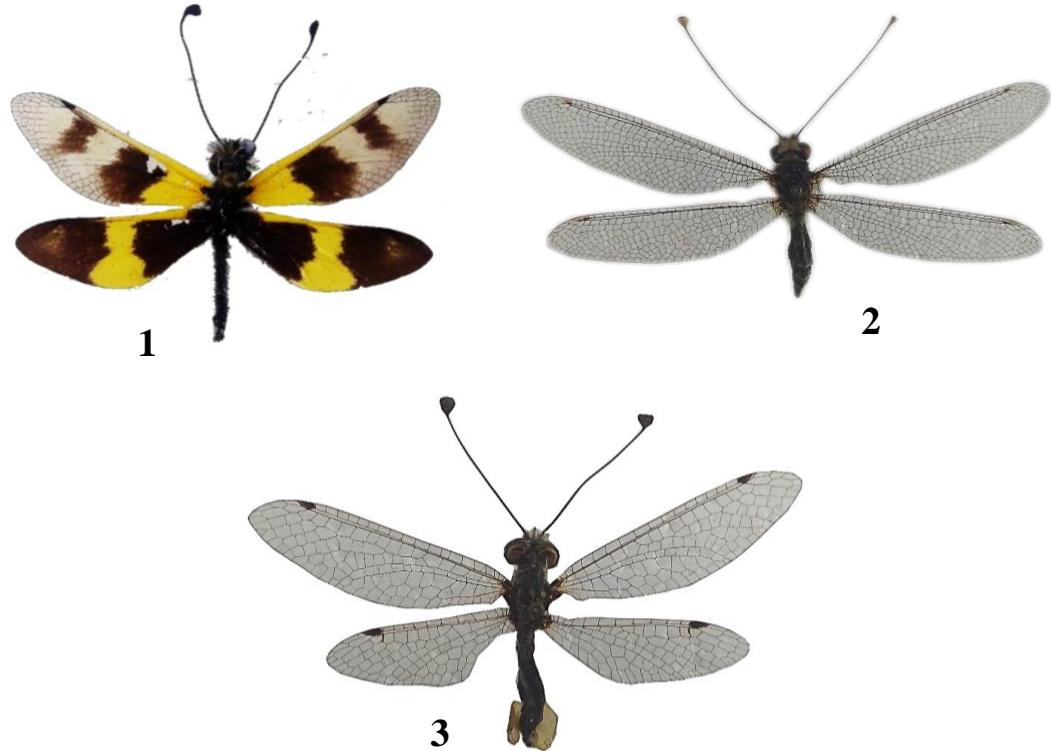
Fig. 1, Fig. 2, Fig. 3: 1 – Libelloides macaronius, 2 – Idricerus sogdianus, 3 – Deleproctophylla variegate. (photo by author).
ACKNOWLEDGEMENT
The work was carried out within the framework of a cooperation agreement between the Institute of Zoology, Chinese Academy of Sciences and the E.N. Pavlovsky Institute of Zoology and Parasitology, National Academy of Sciences of Tajikistan on the study of biodiversity of Tajikistan. The author expresses his gratitude to Prof. Gexia Qiao (Director of the Institute of Zoology, Chinese Academy of Sciences), Dr Jun Chen (Director of the National Animal Collection Resource Center of the Institute of Zoology, Chinese Academy of Sciences), Mr Peng He (staff of this Centre) and Dr Kadamzoda Dilshod (Director of the E.N. Pavlovsky Institute of Zoology and Parasitology, National Academy of Sciences of Tajikistan) for the efforts made to reach an agreement, as well as for organizing the expedition in Tajikistan.
Conflict of Interest
The authors declare no conflict of interest.
Ethical Approval
Not applicable
Data Availability
The datasets used in this study are openly available at [repository link] and the source code is available on GitHub at [GitHub link].
Funding
This work did not receive any external funding.
References
Cite this article
Related Research



Special Issue
Launch a focused special issue to highlight research, emerging trends, and expert insights in your academic field.
