



IntelliPaper
Abstract
Spirituality is impossible to define. It is like trying to catch flowing water in the hand. Its very fluidity brings it alive. Spirituality is more than the religious or the theological; it is partof being human. Spirituality cannot be defined but it is possible to attempt to devise models of it. Imperfect models can still be reflections and glimpses into the vital flow. A new model is proposed here working with the insights of Julia Kristeva, the Bulgarian/French post- structuralist, semiologist, and psychoanalyst. Applying Kristevan themes to Health Care can be fruitful as she is concerned with therapy and mental health. Definitions of spirituality (single ideas or short phrases) have been attempted in contemporary Health Care, though some modelling is also apparent. Consideration of pastoral relationships and activities in particular environments are foundational for approaches to spirituality in Health Care and this inter-relational dynamic is reflected in Kristeva’s oeuvre.
Explore Digital Article Text
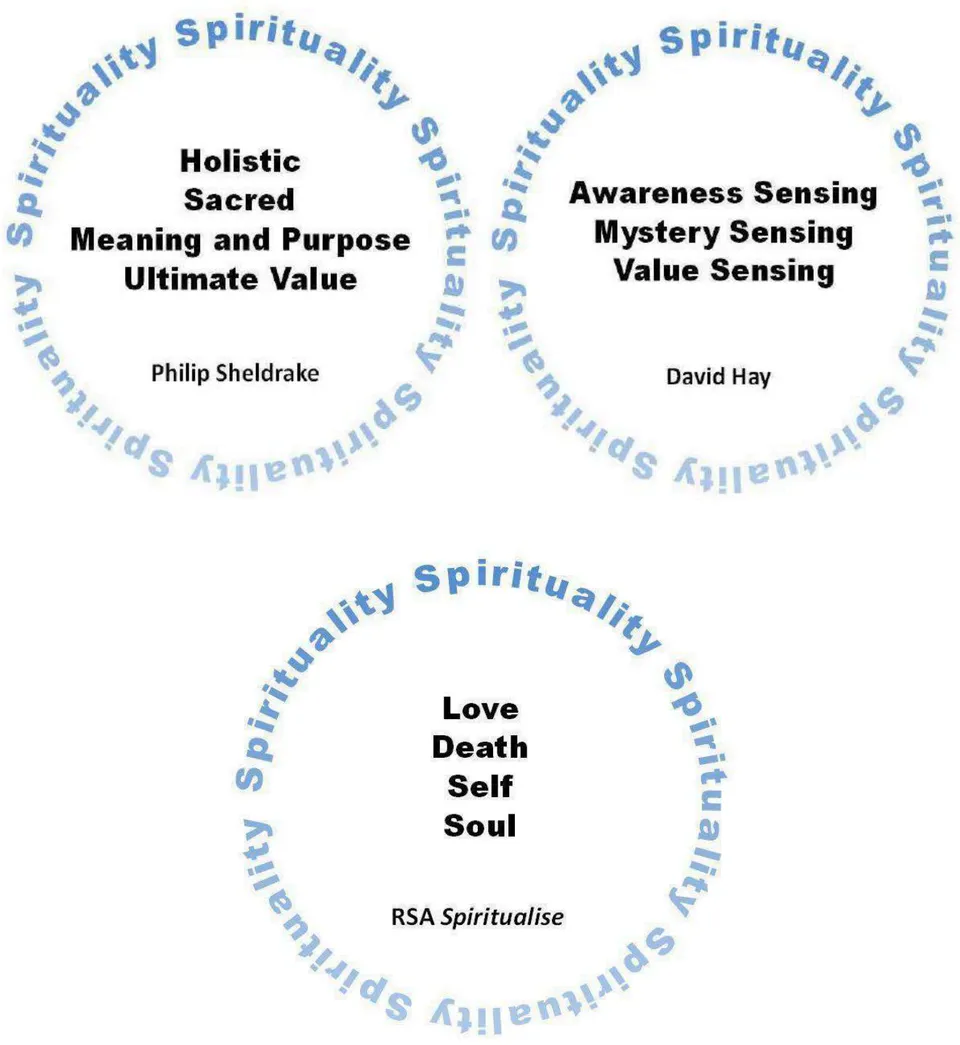
Sheldrake seeks to apply his understanding of spirituality in practical ways, using the term 'active-prophetic'. Two examples are social media, and the design of living spaces. He refers to 'cyber-monasticism'.. Social media has created virtual communities and friends without personal inter-action. Sheldrake is sensitive to life's difficulties and appeals for a 'tough spirituality' that can face the dark times and avoid self-indulgent well-being. His focus on design and living spaces fears that humanity, for the first time, faces what he describes as a 'mega-urbanised world'. Sheldrake sees three ways in which a city can provide sacred space: design that is not just utilitarian; the creation of public spaces; and the preservation of religious buildings. There should be an awe factor in architecture and design. Sculptures and artwork can be provided, for example, to enhance beauty and provoke symbolic perceptions, rather than the purely physical provision of amenities. Diverse and creatively designed structures should inhabit the city and its skyline. The spirituality of place is inter-active and can draw together different ideas, including his four themes as a holistic space (considering various aspects, including the anthropological and the creative), a sacred space (as caring and honouring the values of the individual in community), a meaningful space (efficient and yet aesthetic), and an ethical space (safe, affordable housing and sufficient amenities).
There is a sense of awe peppered through Hay's themes. The sense of the present moment first came alive for me when I was 5 years old, holding a model aeroplane and looking around the living room. "Gosh! I will never live in that second that has just past again!" I mused to myself philosophically. The beauty of nature and its sense of gift also evokes a powerful memory for me. A personal example would be my first experience as a boy of having my breath taken away by a sunken valley while on a school trip to the Isle of Mann. I stood transfixed for a few minutes. This was alive and it was gifted to us. Hay recognises spirituality in the darkness of life, too, even in unlikely places such as in the horrors of Nazi occupied Europe and the treatment of the Jews. Spirituality involves encountering darkness as well as holistic wellbeing. He references the work of Emmanuel Levinas, the post-structural list, Jewish philosopher, who based philosophy upon ethics and encounter with the Other. For him, ethics was the first philosophy. Hay (2006:253) sums up the behaviours of those who committed atrocities, after reading Levinas, as 'the suppression of the inborn obligation felt by one human being when gazing on the face of the Other.' The spiritual must be compassionate and empathetic. Levinas speaks of the role of the 'gaze'. The concentration camps that liquidated most of his family in the Holocaust, had to avert their 'gaze', that is, to be distanced from their own humanity and relational consciousness.
Dr Jonathan Rowson, Director of the Social Brain Centre of the Royal Society of Arts, authored the 2014 report of the RSA Action and Research Centre. Spiritualise explored various definitions and roles of spirituality in the 21st century. In 2011 about 300 people were involved in the Student Design Award, 'Speaking of the Spiritual'. The Award was a two-year project to provide more intellectual grounding for spirituality and new scientific understandings of human nature. The Award hosted six events covering Love, Death, Self and Soul.
Spirituality should be expressed primarily beyond the propositional and beyond discursive language. The report tried to avoid 'scientism' but aimed for co-operation between spirituality and empirical science. Not everything can be reduced into a test-tube, such as love or wonder. Also, if spirituality cannot inform the darker side of life, it is insipid and a consumer distraction, with the popularity of Mindfulness techniques and therapy being in danger of being self-indulgent and superficial. The act of facing self, failure and avoiding denial can be creative and healing. McGilchrist pondered on the nature of the soul in the third RSA event. He sees it as a potential that unfolds in living beings, beyond classification. 'Perhaps we have to grow our souls.'
Depression can thwart growth and create a soul-sickness. 'Soul' opens a space for life and experience and is a term that can carry a wide interpretation. What may seem to be vague can be creative. Soul is more than the self, and this alone is open to discussion and interpretation. Theological definitions are only one model available, and the psyche and the developing ego are models themselves in psychoanalysis which is empirically limited to observation, reporting, and behaviour. I suggest that 'Soul' can best sum up the themes of Spiritualise. To 'have Soul' is common parlance for having vitality, whether in the Arts or in human activities. It has a fluidity and a motility to traverse various concepts, situations, and personality, The RSA report is inclusive of all aspects in its terminology of beyondness which is more than empirical observation and physical structures. Similarly to Sheldrake, differentiation is valued in sociology and design as a form of spirituality that challenges all systems. Furthermore, the report differentiates between ground and place. 'Ground' is existence, human being; 'place' is physical location, systems and our ideas of the self. The latter can form a temporary security but are not permanent. Even 'ground' is not permanently fixed, but flows.
It is to be noted that all three examples of modeling spirituality do not avoid failure, fear, and suffering. Human experience and responses in the face of those are part of what is called spirituality, with Sheldrake's 'tough spirituality' and Hay's altruism allowing not just a coping mechanism, but change. I suggest that the sense of self, mystery, value, the relational and meaning can be adequately represented in Kristeva's idea of a safe, psychic space, as will be outlined shortly. In each of the above examples, various ideas are understood to be involved in spirituality, as being within its circle.
I. INTRODUCING KRISTEVA
Julia Kristeva is a practicing psychoanalyst, philosopher, semiologist, literary critic, and novelist. Kristeva is an atheist by conviction, French by nationality and Bulgarian by birth. She is a polymath, traversing different disciplines and traditions, including an admiration of religious imagery, narrative, and ritual from a literary and psychoanalytical perspective. Kristeva works within the poststructuralist tradition and is considered as a postmodernist, though that is a term she disowns. She is a Freudian psychoanalyst, adapting and developing Freud into her own, original system that explores a literary dynamic as a version of the Oedipus Complex. Kristeva's experience as an émigré has coloured much of her thought. She is concerned with the stranger, the dissident and the marginalised. Kristeva understands herself as a dissident within the French philosophical tradition as a polymath, and something of an outsider to her adopted nation. Even though she was awarded the légion d'honneur in 1997, she still does not consider herself French. When she travels abroad, though, she is seen nonetheless as elegantly French in her appearance, style and thought. Kristeva understands the US as another adopted country for she lectures there frequently, occupying an honorary chair at Columbia University. She describes herself as living in exile.
She is an atheist though respectful of and fascinated by aspects of Christianity as a symbolic system of codes and symbols and ideals. In Bulgaria, her mother was an atheist biologist, while her father was an Orthodox Christian. She received her primary schooling at the hands of Dominican sisters, and now resides in a Catholic country. Kristeva has written about belief; semiotics and language; the arts; love; depression and melancholy; the stranger; and more recently, about Teresa of Avila and Dostoyevsky. Kristeva is involved in campaigning for the rights of the disabled, and was a friend of Jean Vanier, the founder of L'Arche.
Her interpretation of religious faith is inspired by Freud. 'God' is an Ideal, the Law, the Phallus/Father and not a spiritual presence or entity, though a necessary symbol (or 'illusion'). In Teresa, My Love (2015) she heads a chapter 'The Imaginary of an Undefinable Sense Circled into a God Findable in Me'. The Undefinable within touches both on language, its origins and limits, and the nature of the psyche. A sense of the ineffable is expressed later in the text, 'All religions celebrate this otherness in the form of a sacred figure or limit (deity) ruling the desires of the vital flow...'
Kristeva celebrates the irrational and the poetic, the unconscious and the preverbal, arguing that humanity needs these alongside the God Ideal to give balance. Without this there is either suppressed conformity or chaos. Kristeva uses the figure of Christ as a symbol of harmony, of a reconciliation and balance between Law and creativity. He, as God incarnate, the God-Man, brings together earth and heaven (emotion and order, unconscious and conscious, the physical and the psyche). The Passion of the Christ reveals a suffering God both of incompleteness (avoiding totality) and also the definition of love as agape, an unconditional, undeserved love represented by the figure of Christ on the cross. Christianity, therefore, is to 'embody eroticism within music' (Kristeva, 1987: 136) taking the physical into a harmony with the poetic. The psychological, the aesthetic and the ethical are the drives of religion and the value of spirituality. She often references Biblical texts and stories in her writings, respecting faith and utilising its symbols. As a poststructuralist, she resists ideas of closed ideas and doctrinal systems that claim an absolute truth or a totality, and thus theology, as such, is to be mistrusted. Human thought and language can have no such boundaries but must be always open, an 'open text'. There is always more than we can say or think.
Kristeva has written widely about language, love, and alterity. Her key texts are Revolution in Poetic Language (1986), Language the Unknown (2009), Tales of Love (1987) and Strangers to Ourselves (1991) from the wide variety of writings in her oeuvre.
Language
Language cannot exist without the other two aspects. Language is a social contract, formed by a desire to communicate. Kristeva (1989b: 7) explains, 'Man speaks' and 'man is a social animal' are themselves both tautologies' There is no private language that falls from above. Human beings create language. Just as there is no private language, so language can never have a trans-human reality and viewpoint. We experience everything within the realm of language and cannot step outside it. In this way, Kristeva rejects the concept of logocentrism, a term shared with other poststructuralist thinkers such as Derrida. Logocentrism is the idea that Logos, or Reason, exists beyond our language. We only experience life within our limits. Structural, grammatical language is an ability to attempt to give order to the preverbal emotions and drives of the psyche. Poetry and the arts are more disruptive of the artificial, social ordering of language. We need
Love
both to keep our equilibrium. Kristeva designates syntax and grammatical, discursive language as the Symbolic, while the preverbal, disruptive poetic is the semiotic, coining her own term in French as 'la semiotique' rather than the grammatically correct 'le semiotique'. Kristeva's dialogue between the semiotic and the Symbolic allows change as a rupture in the present of the psyche and a return to preverbal and unconscious roots. The psyche is deeper than words. She traces a sense of primitive religion and magic in the semiotic and its remembrance, 'magic, shamanism, esotericism...the carnival that allows a passage to outer boundaries.' (Kristeva 1984:15). I suggest that this could be developed into the sense of the semiotic/Symbolic as seer, and shaman, prophet, and priest. There is provocation and disruption, new awareness and then reconciliation. Without the shamanistic or the priestly dimension, there would be abjection and psychosis, and without the seer and the prophet there would be no development of ego identity and a psyche that was stilted. Spirituality needs to be holistic, open and honest to be therapeutic, no matter what disorder that this may cause at first. Kristeva (2001: 14) locates a sense of the sacred as 'the sustained connection between life and meaning.'
Love is the ability to be open to the Other, to change and to self-reflect. A contemporary example in the media is the BBC TV series The A Word concerns the issues involved in a family with an autistic child, Joe. He can speak and communicate occasionally when he feels safe and listens to music continuously on his headphones to try to express his emotions. After unsuccessful attempts at being educated in mainstream Primary schools, he is transferred to a school specialising in autism. His former teachers and classroom assistants had tried to give him due attention and encouraged him to join in class sharing by singling him out. He would not, and retreated further into himself. The staff did not realise how frightening their supposed encouragement was. On his first day in the new school, he crawled under a table and refused to come out. The teacher waited and then got down on her knees and silently started to play a numbers game. After a little while, Joe stretched out a hand to join in. Eventually, feeling more secure, he sat down at the table. The programme demonstrates a technique used in such situations to get down on the child's level and wait patiently for a response through play and not speech.
Love is a metaphor and not a rule that cannot be pinned down exactly with its unpredictability. Kristeva follows Freud who declared that love is therapeutic. Love allows a safe, psychic space to be formed, both within the self and between people. Kristeva relates this to transference and countertransference in her work as a therapist. Without trust and listening, there can be no safety and therefore no vulnerability or possibility of change. Love calls for the ego to move on, and if it cannot for any reason, then it becomes abject, stuck at a psychic crossroads. Kristeva compares the stories of two sets of lovers, those of Romeo and Juliet, and the Biblical lovers in the Song of Songs. The former sought to possess each other and thereby embraced death; the latter allowed each other space in a give and take of presence and absence. Love encourages and allows transgression for change to take place, a crossing of boundaries from what is known to the unknown. Facing such challenges can be like crossing a taboo, entering a 'forbidden zone' that can be repulsive and disturbing at first. The semiotic drives are released from the control of the Symbolic order, as she argued in Powers of Horror (1986). Using a Biblical reference from Mark 7:24-30, Kristeva explains the encounter between Christ and the Syrian, pagan woman as a crossing of taboos. The woman dares to approach a teacher outside her race and faith, determinedly as a woman in a patriarchal society and becoming vulnerable for the sake of another, her child. Just so, Christ must cross a taboo, also, to meet her outside his 'tribe' and faith to respond with compassion. The result of this revolt against set traditions, and the listening and opening, is ultimately therapeutic. Kristeva understands the story symbolically and is not concerned about arguments over its historicity. If the woman had not crossed the taboo, she and her child would have remained unhealed of her depression and the child's illness, whatever had caused it. Steps towards healing need to be difficult sometimes to let go and to move on.
The idea of revolt is both linguistically and psychologically important for Kristeva. To revolt is to cross borders, break taboos, to return to lost ideas and ideals. Returning allows recognition of the semiotic, preverbal, poetic which the Symbolic order can repress, and only with this recognition and release can love be possible so the psyche is free to grow and be open. She admires the avant-garde writing of Joyce in texts such as Ulysses, or the experimental verse of the poet Mallarmé, which remind that the semiotic exists within the structure of order found in language. Not returning to creative roots, not remembering, not allowing the emotive self will create psychological imbalance. Depression will result if the psyche stays in the abject, the crossroads between states of being, and worse still, a descent into melancholy where all boundary markers are lost so that vocabulary ceases, as Kristeva elucidates in Black Sun (1989). The depressive knows what is wrong; the melancholic has no idea. Everything is blank and cannot use language in any meaningful way. Language helps to create structure and illusion to stabilise and guide the psyche in its ideas, beliefs, and goals. This ability shatters into fragments when psychological damage is too deep. The depressive erects negative emotion as a defense against psychic disintegration. The depressive uses language, even when saying "that's meaningless"; the schizoid's splitting is also a defense, but one more reckless and flimsier, and beyond this, there is no speaking. A step to recovery seeks belief in meaning that is appropriate to the person (which is not necessarily religious). Spirituality involves developing, with any assistance necessary, the resources to cope at least, and, hopefully, to then progress. Language is essential, whatever form it takes, including non-verbal gestures and rituals as can be encouraged in forms of Art therapy or religious devotion. Even a 'melancholic' who can splash different colours of paint around a room at intervals, quite deliberately, is not melancholic. The actions and colours speak in their own, limited way.
Alterity
Alterity allows ego formation by encountering the Other. The myth of Narcissus ignoring the advances of the beautiful Echo sums up its power. Responding to the Other breaks Narcissism as an unhealthy introversion and opens the psyche. When we are hurt, we withdraw for our own safety, but it is a withdrawal that will further disturb the ego if it cannot re-emerge. Loving response is healing (as indicated in the above example from The A Word series). Kristeva (1991) explores many historical examples of societies and movements from ancient Greece through to German Romanticism, outlining how inclusion always requires exclusion, whether handled charitably or harshly. Even with the example of early Christianity, a movement thati she admires as crossing the boundaries of race and status with its assembly (ekklesia) of slave and free, Jew and Gentile, male and female, there was an exclusion for the non-baptised which took on political ideas in the Middle Ages.
Kristeva writes most movingly about the experience of alterity in Stabat Mater, an essay included in Tales of Love. She describes the first encounter she had with her newborn son, eye to eye, gaze to gaze, "dances in my neck, flutters through my hair...slips on the breast...My son." (1987: 246). The face is a wonder, a wonder as a mystery (who is the person? What is a person, a life?) and a wonder of discovery (there is that which is not me). Kristeva's work with the disabled originated with the birth of David who is disabled himself. Her activity reveals a deep compassion and empathy for the outsider as well as an appreciation of the nonverbal. A look, a gesture, a touch, can say so much. Kristeva takes the argument further than external relationships into the psyche. Parts of us can be repressed and unconscious. Perhaps, sometimes, what we fear or hate in others reflects unresolved tensions in our own identity, hence she speaks of 'being strangers to ourselves'.
Transcendence
I suggest that a way into Kristevan transcendence may be to consider the phrase, 'the Beyond in the midst' taken from the Lutheran Pastor and Theologian, Dietrich Bonhoeffer, who was murdered by the Nazis shortly before the end of the war. He was expressing ideas about how Christ might be understood in modern, very human terms rather than the ancient Christology derived from Classical and Hellenistic philosophy. As such, he was making a theological statement, but Kristeva does not make theological statements. She writes sometimes about 'theologizing', rejecting this as the logocentric language of static essence and complete understanding. Taken beyond theology, the Beyond in the midst' suggests transcendence experienced in immanence in human existence,, and transcendence in this context can have wider applications than theology, Christian or otherwise. A sense of the beyond is implicated in the ability to be open to the Other, to move beyond a static ego into ongoing formation, and this must begin within the psyche and extend into relationships.
Kristeva has not written explicitly about transcendence, though she references aspects of belief and Christianity such as In the Beginning was Love (1987), New Maladies of the Soul (1995), This Incredible Need to Believe (2009), Teresa, my Love (2015) and Grandir, c'est croire (2020). Without a sense of the transcendent, however, there can be no movement beyond the self, no progression in ego formation, and no encounter with the Other. Transcendence is more than theology. Kristeva appreciates the ineffable and the unspeakable. There is much about life that we cannot define, tabulate, and put in a computer or under a microscope. The psyche remains a wonderful mystery for her, more than the physical but so much part of it. The role of the Unconscious is a 'beyond', the unknown, the preverbal and can be a way of bringing the past into the present, a recognition, a release, and a remembering, a 'beyond in the midst'. Kristeva references Proust and his memorable Madeleine cake with his Aunt Leonie, which brought him emotionally into the presence of his childhood when he ate one with his mother, for example. It was as though he was really present in both places, as a double event. Our discourses must always be an 'open text' and she rejects ideas of 'totality' in favour of the 'infinite'. Language is limited and can never attain the whole. Belief (in anything) is a structuring, a necessary illusion of form and meaning. Its relativity means that it must be what she describes as 'incredible', always open to 'a big question mark'.
Belief is an illusion, as God is a necessary illusion to help structure meaning and guidance in life. Because her concept of God is limited to an ideal, as the Symbolic order, a spirituality of creativity and experience results for her that is not explicitly theological. Love, as a metaphor in its unpredictability, is its own form of 'open text', that even begins to take on the qualities of a religion for her as she writes, "...a single religion remains: that of Love...That is Life." (2012: p.19).
Kristeva does not consider certain theological tropes, though. There seems to be no place in her oeuvre for a more mystical or apophatic theology, of what can't be said as well as what can be said about God. If she could free the concept of God from the Symbolic order, then it could have more vitality in infinity, fluidity, and awe, as the text from the Medieval mystical work, The Cloud of Unknowing, 'Because he may well be loved, but not thought. By love he can be caught and held, but by thinking never.' Kristeva's God is too static. She does not, in fact, bring the semiotic into deity thereby ignoring major aspects of Christian spirituality. Kristeva avoids addressing existential questions. Questions of meaning are psychological and therapeutic only. There are indications in her oeuvre why this might be so. She equated death and God from her childhood, for example, when she lost her grandparents, experiencing only the void of their absence and this must have been reinforced by the death of her beloved father years later. Just getting on with life and not exploring such issues seems to have been her motto. Jardine (2020: 232) reports that Kristeva's attitude was 'given that there is nothing to be done about death, the important thing is just to do one's absolute best in the face of it.' Has she erected her own psychic defenses? Existential questions are real, and people navigate them in their own ways. To ignore them entirely is surely a lack of balance. Perhaps it could be said that Kristeva is seeking the divine by not calling it 'God' in her terms?
Summary
Kristeva's themes of Language, Love, Alterity and Transcendence suggest a dynamic interplay. One cannot exist without the other and I argue that she presents a spirituality of what I refer to as an 'interiority with reciprocity'.
II. A KRISTEVAN MODEL
Miles (2012: 70) describes how two people stood on the street and looked into some run-down eateries in a poor district of San Francisco. One saw poverty and degradation. The food was junk and cheap. The other person smiled and said, 'I like to look in there too.' When the other person asked why, he gave the response, 'The people. They sit for a while and eat. It gives them a little peace. I like to see it. It makes me know that the world is good.' What interests me in this passage is that it is dynamic. It is not only about two different personalities, their feelings, and their interaction. It is about all the people doing things, sharing, looking, feeling, thinking, and nurturing themselves (however poor the quality of the food might be in this instance). What strikes me is the space. It only exists because of the people, the buildings, and the activities. Space cannot be held onto, placed in a test-tube or pushed under a microscope. It is empty, non-material and yet it allows things to be in motion with one another, and the activity also allows space to be. A sense of a dynamic that allows spirituality can be found in a Kristevan model of spirituality, and that is its originality.
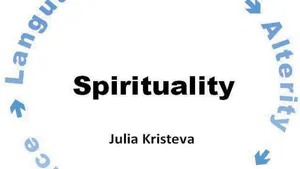
A presentation of Kristeva's themes of Language and Love, with their attendant and necessary themes of Alterity and Transcendence, can be set alongside other models of spirituality as in Sheldrake, Hay, and the RSA report, Spiritualise. As such, a new model has been formed and suggested in its terminology and focus. However, a close study of Kristevan themes begins to reveal a different dynamic. Other models focus on certain themes which are part of what is called 'spirituality'. They are small parts of a greater whole that cannot be defined, that can never have a totality of comprehension, and can only be modeled in a limited sense. No model can be anything other than a partial viewpoint and analysis. The models of Sheldrake, Hay and the RCA report are seen as being within spirituality, and other themes could be written in if so conceived and desired. An explanation of a dynamic Kristevan model involves an interconnection where one theme helps to form the other in a give and take that is circular.
In other models the separate themes are treated in isolation.. They are each a separate focus of investigation and reflection. Naturally, there will be an implicit overlap and inter-relationship of some kind, but the focus is on independent units. A Kristevan model can act differently. Language is impossible without the other themes, as is Love, or Alterity or Transcendence. They all need each other. So, Language is impossible without the ability to accept and trust oneself, and to be able to open up to others. Communication does not take place otherwise. There cannot be one state without the other, as love is made possible by trusting the Other as safe. Transcendence sounds too religious for some and may be difficult for them to position. However, opening to others is a moving beyond the self (as it is positioned in process) and a moving beyond is an act of transcendence (this is not necessarily to exclude existential questions). Furthermore, the reciprocal relationship creates a greater whole than the words and ideas of two different individuals or groups. The greater whole is transcendent, as suggested in the earlier example of the San Francisco diners. The ability to be conscious and to move from the preverbal is also transcendent. Language has an innate mystery as somehow being able to be formed from the preverbal psyche, as does Love, which can be more than a survival drive where extended qualia of altruism, and therapy result. Alterity must move out beyond the ego. Without any sense of moving beyond – ego, language and communication, relationships, and beliefs - then the interplay of the other themes is impossible. There would only be stasis, and worse still, regression.
Transcendence must relate to the other activities, or it is a purposeless, drifting, abstraction. Neither are we automated individuals, for with ego comes relationship.
In a Kristevan model, therefore, the four themes coinhere. To borrow a term from the Christian theology of the Trinity, they all form a perichoresis, one living within the other in a round dance of giving and taking. The whole is greater than the sum of the parts, and one cannot be separated from the others without limitation and even conceptual disfiguration. When their dynamic is thus observed, then the circles of spirituality utilised to depict other models of spirituality shift their semantics. The four themes of Language, Love, Alterity and Transcendence then form the circle. Spirituality is what is inside the circle. Their dynamic, their co-inherent interaction, makes spirituality what it is. A Kristevan model of spirituality can claim originality, not only in its four distinct four themes, but in a dynamic interaction. Granted that the circular movement of the themes is only one model to explicate spirituality and does not and cannot ever claim to be decisive, it is original in its positioning and emphases. That spirituality is involved in interaction, not just in ideas, feelings and ethics, results in an active interiority with reciprocity. Movement is fluid; a river cannot be captured in the hand. Spirituality needs space for movement to take place, analogous to the diners and their surroundings mentioned earlier. One forms the other. A Kristevan spirituality is thereby inclusive and must be rooted in the particularity of persons, situations, and places. There is no abstraction.
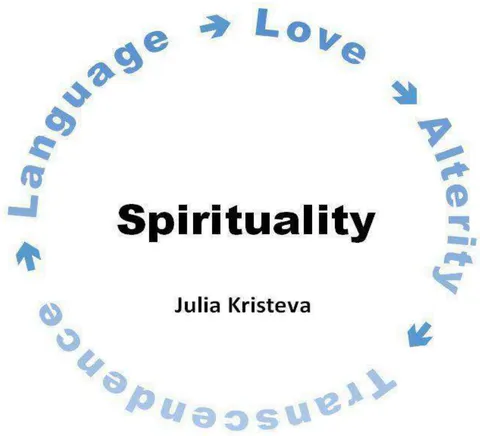
III. HEALTH CARE SPIRITUALITY
The Kristevan model is fecund when applied to Health Care in its interactive dynamic. Before outlining this, it is important to survey existing concepts and any models that seek to understand spirituality in that context. Various authors discern a necessary (if frustrating) fluidity. The Lancet (2023) sums this up when the editorial states; "One of the root causes for not accounting for spirituality in medical care is the lack of consensus on the understanding of what spirituality is, and how prevalent spiritual needs are. Spirituality is a broad and complex concept, with no single consensus definition in medical practice and is often considered taboo." Wattis (2017) describes spirituality as 'tricky'. It is something that cannot be seen or touched but it can be experienced. Lyall (in Orchard (ed.) 2001) rejects a reductionism whereby spirituality is a 'nothing but'. Culliford (2010) compares spirituality to a Moebius strip, where 'what goes round comes around'. Spirituality has no fixed boundaries. Methods of assessment of spiritual care can often risk too narrow a definition and cannot be reduced to a series of tick-boxes. Assessing is preferred to assessment as it is ongoing. King (2009) and Swinton (2020) argue that it is more helpful to speak of what spirituality does, rather than what it is. Spirituality is experienced and has effects.
Literature concerning spirituality and Health Care often has an emphasis on interiority. Gordon and Kelly (2011: 2, 5) suggest; 'Although religion may feature in a person's spirituality, it will be alongside a host of other aspects, such as family, friends, work, health, love and leisure activities' for the only way to understand spirituality 'is to start within ourselves'. Suggestions of alterity, existential questions and the numinous are also referenced but interiority is primary. Pargament (2011) aligns spirituality with concepts that concern the sacred, such as peace, solace, courage, faith, hope, and love. The focus on the person is expressed by Orchard (2001) as involving self, direction and the practical, or the tripartite 'Who? Why? and What?'
To move beyond the emphasis on interiority, Harrison (2017) advocates an autoethnographic approach where case studies are more valuable that abstract theories. Likewise, Whipp (in Wattis, Curran and Rogers (eds.) 2017) suggests journaling or encountering others (and therefore the self) in shared narratives - sharing ideas, making comparisons from their lives, expressing hopes and fears. The shared narrative suggests interconnectedness of caregivers and patients, as well as roles and systems. Related to interconnectedness, Mc Sherry (in Orchard (ed.), 2017) raises the problem of who to ask and what to say about spirituality in a multi-faith and secular context. Mattis (2017) appreciates the role of liminal spaces within both the individual (carer and patient) as well as the institution. Spaces are necessary for re-evaluating and creativity. For Gordon and Kelly (2011: 75) spirituality is not structured, 'undertaken in only one encounter or to rely on a single tool to be effective.'
Clarke (2017: 137) even argues that psychosis can be a creative space. While recognising the great danger of becoming lost in the process, and of danger to lifestyle, with careful support such a crisis can be a liminal realignment in the emergency. As he states, 'This perspective stands in sad contrast to depressing messages that people can often receive when they report such transliminal experiences.'
How Health Carers define spirituality will affect their work with patients and understanding their needs. Interiority is part of the experience of spirituality as caregivers need to get in touch with themselves, though in the context of relating to patients. Self-awareness through data, encounter, the liminal, and narrative should be part of the training of Health Care workers, as underlined by the Oxford Centre for Spirituality and Wellbeing (OCSW) in the need for adequate development and training of staff. Cobb, Puchalski and Rumbold (eds.) (2012: vii) describe spirituality as moving beyond interiority as it affects wider issues and relationships as;
...A way of engaging with the purpose and meaning of human existence and provides a reliable perspective on their lived experience and an orientation to the world. As spirituality engages Health Care it becomes inextricably linked with human suffering and therefore integral to the lives of patients, their families, and their caregivers.
McSherry, Lyall and Orchard (in Orchard (ed.) 2001) suggest that all branches of Health Care need to show an interest in spirituality and that collaboration is essential to the delivery and appreciation of spirituality. There are many facets of spiritual care within the organisational institution and a system of brokerage is necessary for a co-operative give and take. McSherry (2006) asks the pertinent question 'Who knows best?' within an institution of many departments and caregivers. 'Who', it should be noted, along with the idea of absence, is a necessary, liminal space. Absence, here, refers to the need for spaces. A Carer or a patient might not have any clear ideas, feelings, or suggestions to offer and need to be honest and take a step back. Life often involves the unknown, the confusing and the fearful as well as compassion, hope and creativity. Facing spaces can mean confronting empty spaces (not knowing or understanding) or time to reflect, realign and move on in a more beneficial direction. A respectful absence involves honesty about not having any answers or tending to the patient in silence. The silence respects their state of health or unanswered questions and allows a reprieve space to give them peace to be alone, or to tend to their practical needs, or just sit quietly with them.
The above present various themes and ideas, but there is no attempt at forming a model, unlike in some more philosophical or theological authors or reports such as those of Sheldrake, Hay and Spiritualise. Cobb et al (eds.) (2012), however, seek to provide a model. They sequence several themes for the views of their various contributors, which partly reiterate the opinions and observations mentioned above. Their model has a specificity of theme as a taxonomy, or modeling, though,
Person and not just patient
Narrative
Ritual
Why questions
Patient
The value of the patient as a person is central in the authors to facilitate listening. Hudson (in Cobb et al (eds.) 2012: 108) stresses the 'Who' of the patient and the carer, with the unknowns, as yet unconceived and ill defined:
We neither know who we are nor where we are for we are 'legion', or many. This post-modern dilemma finds its answer in the notion of persons as interdependent and inter-related.
Self-serving autonomous individuals neither make nor receive a compelling call.
Hudson continues 'persons emerge when they acknowledge their dependence on others.'
Narrative
Narratives may be needed as in coping with bereavement or any major health matter involving trauma and loss. Burke and Neimeyer (in Cobb et al (eds.) 2012) describe 'Meaning Making' and restructuring life narratives to allow new beginnings. The alternative is to help the patient with assimilation (usually more appropriate with members of a religious community who fall back on their faith, or, indeed, lose their faith). Narratives are more semiotic, to use Kristeva's terminology, and allow a fluidity in trying to understand, or to do, spirituality. The practice of narrative analysis in counsel or therapy involves telling the story of a situation, an event, but also a life. Gergen (2004) comments that subtle signs are formed by a gesture, a hesitation, silences, smiles and sharing experiences. The listener must become part of the speaking in verbal or non-verbal ways. What is said and what is not said? What realisations can be given to either teller? A life story can be restructured when events are held in question, particularly a master narrative, such as trust in someone or something. An example of changing the story is suggested by Carney (2004) who researched the testimonies of Holocaust survivors, finding a range of voices and opinions. A master narrative of 'moving on' from trauma was an affliction for psychological growth for some. It was easy to feel obliged when the personal reality was different. Reviewing life stories can also be helpful in cases of life changing or threatening illness. A patient needs to re-evaluate and adjust. Frank (1995) was diagnosed with terminal cancer and relates the value of sharing between such patients to seek companionship and to realise they were not alone. While a psychological withdrawal and depression can result, any helpful discourse can be therapeutic, such as holding the hand of the patient.
Ritual
Ritual can involve speech, actions, and space. Wards and rooms can convey emotions as well as decoration. How should a quiet room be arranged for relatives, for example? Davies (in Cobb et al (eds.) 2012) states that Health Care spirituality must be set in time and space. Ritual is different from routine in so far as it contains significant meaning when words alone sometimes are not sufficient, an act that allows what Romanov and Thompson (2006) describe as 'a symbolically charged experience'. Another example that Davies gives would be a form of wake. A ritual celebration of a colleague's life can be arranged in a suitable space using story, symbolic objects, tears, and laughter. Speaking can induce relationships of solidarity and narratives can segue into ritual. How does a doctor inform relatives that their loved one has died, for example? What symbols are not only useful but personally applicable (decor, setting, even the arrival of hot tea!)? Rituals, whether in the context of wakes or not, need to be provisional and fluid. The wake is also a form of narrative where stories are told, and responses shared.
The power of a wake became apparent to me personally when ministering as an Anglican curate in London. I had celebrated several Afro-Caribbean funerals which carried on all day after any official liturgy had ended. The men came forward to fill in the grave, and the women heaped their gifts of flowers on top of the raised soil. There was singling and weeping, embraces and even sometimes a little rum passed round. The mourners returned to a home or a hall and the whole day was given over to communal activities of food and music and company. Other more conventional funerals seemed brief and subdued in comparison.
Why Questions
Existential questions, the 'Why?' questions, need to be handled with care but not ignored. The questions and concerns exist and are part of being human. Listening is more important than trying to answer, being there is more important than doing. There is nothing wrong with admitting that a carer does not know the answers. Gordon and Kelly (2011) use the term 'Helplessness as Part of our Humanity' as well as 'Respectful Absence" (allowing people space to be silent or to grieve. Also, the carer absenting themselves when this needs to happen, and when answers cannot be given.) Such sensitivity is a reminder of the vulnerability and wonder of personality.
I wish to conclude this section with an example of therapy which was more spontaneous and occurred outside any formal institution. An American language student, Stephanie Saldaña, was on placement in Damascus in the 1990s to learn Arabic. She befriended several local people, including vendors. When fighting broke out between Lebanon and Syria she was conflicted and afraid. A US citizen in that situation could be seen as a potential enemy, and people she knew now could turn against her, or be hurt or killed in the bombings. As a result she deliberately avoided certain people whom she had become friendly with. One was an artist who had been very kind to her. When she finally found the courage to visit his shop, he was delighted to see her and not at all condemning. She admired his canvases and then he took one off the wall and presented it to her., It was of the face of a woman, with reflected light, suggesting hope. Then she realised it was wearing her earrings. He had painted her portrait and gave it to her. It was a symbol of hope, and the effect was healing. Saldaña (2010) states; "I cradle it gently in my arms. Then I carry my canvas home through the streets of Damascus, this unexpected gift of my own face emerging in the ruins, and here of all places, shining and alive." How apt the image of the face emerging from the ruins is for care of the sick. A gesture of love and acceptance began to lift fear and depression.
Fig.3: One model of Health Care spirituality
IV. KRISTEVA'S LANGUAGE, LOVE, ALTERITY AND TRANSCENDENCE
I suggest that one way that Health Care spirituality can be summed up is with the word, 'Aware'. The caregiver and the patient need self-awareness as well as the presence of the Other. Such awareness requires interconnections and a co-operative 'brokerage' of caregivers, specialists, and departments. Awareness of existential questions and experiences requires an honest liminality. Perhaps spirituality in Health Care touches most closely with the Kristevan sense of a safe, psychic space and certainly recognises that spirituality is more than interiority, also needing reciprocity. Furthermore, a Kristevan spirituality recognises the darker side of life in suffering and failing. The therapist allows revolt, remembering, taboo breaking and seeks to help people out of the depression and confusion of the abject state. In so far as Kristeva can navigate the fragility of lives, she resonates with the ideas of Sheldrake, Hay and Spiritualise which all reject a shallow well-being and recognise the need for a spirituality of pain, fear and failure.
The ideas expressed above clearly segue into Kristeva's sense of Language, Love, Alterity, and Transcendence. Language cannot happen, for Kristeva, unless there is sacrifice which must allow order and social contract to structure her idea of the semiotic, taming that deep interiority at the root of ego formation and a sense of self. Feelings and opinions need to interact and must therefore be open to change. However, the sacrifice also cuts the Symbolic. The discursive must always allow the non-discursive, and vice versa. One cannot exist without the other as fount and structure, a structure always contingent and incomplete. What cannot be said, as well as what should be spoken, are central to spirituality.
Language needs the space to form ego identity in cooperation with the social contract. However, the discursive nature of the empirical is not adequate to describe life as a whole. Closed definitions are boundaries of the Symbolic if the researcher is not careful. Listening; sensitivity; openness and vulnerability; silences (respectful absence) and helplessness (as entering a necessary state of abjection); and simply 'being there', are all Health Care tropes. There is an interweaving of connections and collaboration, including shared narratives. The institution as an organic whole is a shared narrative. The recognition of helplessness through absence, an absence of answers to difficult questions, or who should be asked or turned to for support, reflects Kristeva's concept of an abject, liminal, borderline space as a crossroads for psychic growth. Unless this is faced and encountered, there can be no therapeutic response. The use of psychic space and interiority requires the crossing of the boundaries and the awareness of others as sensing, feeling, thinking, and opening. A sick patient, perhaps newly diagnosed or invalided, can withdraw into herself and not desire to speak or cooperate. There might be no family to give support, or relations have broken down. Patience is required from busy and tired carers, and only gentleness and the language of gesture and giving privacy when desired will facilitate a psychic space. A gradual and gentle emergence into that space may happen with the experience of love, akin to that of the autistic boy, Joe, coming from under the table in the BBC series.
Another example could be when a person has suffered breakdown because of work conditions and the employers show no understanding and are angry that he has failed. There is adequate financial support through Union action, but the reasons for the mental collapse are not considered by the company. Furthermore, he has had accusations which did not consider his mental state, and his integrity has been shattered. He is eventually cleared of any criminal activity, but he finds that an odious reputation surrounds him. PTSD develops as a result, with trauma on top of breakdown. He displays an inability to speak, sometimes literally, but often in the sense that no one is listening, and the individual must carry the pain. There is a withdrawal into self, or just with a handful of trusted people. Listening, communicating, speaking what is believed to be true, are therefore essential parts of healing and well-being. When language shuts down, in any sense, there is a regression, and the ego cannot grow or mend. Moreover, in a case of multiple trauma and breakdown the danger is that the psyche will be overwhelmed and shatter. Such cases need very sensitive handling.
Love in Health Care should involve compassion and sensitivity; listening; the patient as a person; attitudes to patient and family; and allowing the carer also to be a person to love themselves with their own space to reflect and to restore. Do we allow ourselves to fail, to need guidance, to feel hurt and frustration? Love can be allowed in a withdrawal or else constant giving out will shatter the psyche. Self-awareness and reflection are essential. Moving from feeling to thought requires a wounding and a setting of the bar between the semiotic and the beginnings of conceptualisation. The bar is impossible without the beginning of trust, and that cannot exist without a development of love. Frank sharing with cancer patients, for example, or Saldaña being given the painting, both attest to the therapy of love.
Alterity is involved in Health Care spirituality as the person is relational and not a lone subject and not an object as 'patient'. Respect for, listening to, and interaction with others allows beliefs and self-awareness. The need to listen to a patient is important even if the carer is not the professional person that is officially required. Giving time and trust is a respect for the other allowing the 'Who?' of both the patient and carer. A Kristevan safe, psychic space also requires the space between people and not just within. Facing the abject and crossing taboo disrupts and moves beyond, towards wellbeing and relationship. Crossing from the abject is often simply being a presence to oneself or another, giving time for reprieve spaces and being honest.
To give an example, an elderly and very frail patient is bedridden. She is a devout Catholic but is too ill to be taken to the chapel but would like to receive communion from a priest. The only minister available is a Methodist. How should she be cared for? Arrangements can be made for a priest to visit, and for communion to be brought to her bedside. This will take time, maybe a day or two, and in the meantime her family wants to briefly wheel her outside into the small garden space outside her window while it is sunny. She agrees. They are not believers, but they invite the Minister to say a prayer. The family sits with her as she prays the rosary, slowly slipping the beads through her fingers. She is delighted that her daughter has brought her one to use. Flowers are placed at her bedside when she returns, and she is touched gently and kissed goodbye. In this exchange there is listening and sacrifice, the sacrifice of the Minister standing back, the sacrifice of the family staying with her as she prays, and her sacrifice of waiting for holy communion, and being taken from her bed, perhaps in some discomfort. Likewise, there is the sacrifice of the staff trying to understand her religious needs (perhaps frustrated that she prefers one type of ordained person to another?) and being sensitive to both her and the family. Alterity always involves a degree of giving. One cannot be with the Other unless both allow each other to be present.
Transcendence involves more than beliefs and religious questions and affiliations, though these are present and need respect within Health Care. Once, for example, I attended a gathering of ministers of religion in a large hospital chaired by secular staff. I asked the opening question "Why are we such a problem for you?" The resulting uneasiness opened further discussion as an honest awareness of each other. I had correctly discerned the wariness of the facilitators facing a group of various religious leaders. This relaxed the atmosphere and allowed a freer sharing. A time of dialogue suggested that apart from respecting beliefs no matter how much we may find them disagreeable or strange, members of faith groups have an important sense of belonging to a group, a tribe, a family. That level of belonging is essential for any therapeutic work. Having stated this, a sense of the transcendent reminds that the ego is stable only, paradoxically, if it can change and grow as a form of relational questing. The subject is in process and the ability to change needs to be infinite, in Kristeva's terminology. There cannot be an End, a telos, but an ongoing quest.
Relationships are always standing outside of oneself, an ekstatis. A relational consciousness is transcendent in so far as the self moves out to the Other. There is always an inexpressibility involved with the distance that allows the Other. De Armitt (2014: 75) captures this sense stating "...something that is here that cannot be here." The presence of the Other is not our ego or its ideas and structures. The relational must be unpredictable and not controlled (perhaps as in the example of surprising health coordinators with my unexpected and direct question). The Other is always beyond, a moving beyond the self, a transcendence. Kristeva's semiotics and psychoanalysis refuse closed narratives and fixed ideas. Language is a human construction and cannot move beyond its limits, though what cannot be said allows the poetic beyond the empirical. Belief, for Kristeva, is purpose-giving and practical rather than philosophical. Despite Kristeva's atheism, she is careful to be respectful of the beliefs, symbols, and narratives of others, especially in a therapy session. The beliefs, dreams, and experiences of her analysands are their truth and reveal something about them. A religious person who reports peace through prayer, or even a heavenly vision, are to be listened to as individuals whatever the therapist's own beliefs or lack of them. Her respect is particularly relevant to aspects of spirituality in HealthCare with the diverse beliefs and convictions of both caregivers and clients. As a psychoanalyst she understands the need in transference and countertransference to respect the Other, including their beliefs and values, creating a safe, psychic space.
Kristeva, and Health Care can be summarised as the creation of a sensitive, aware, caring community. A safe, psychic space requires the Other, an interiority with reciprocity. The key aspect of any sense of community is belonging, a belonging to others, or to oneself by self-affirmation and belief. A Kristevan sense of a caring community recognises motility and fluidity. Any group requires boundary markers to differentiate it from either other groups or individualism. Rules and rituals may help to establish and preserve this, but Kristeva's critique of fixed boundaries and the value of transgressing, failing, and revolt (to start over again) allow a certain flexibility which allows an individual to be individual by questioning, withdrawing if necessary (briefly or permanently). Fixed boundaries and rules can inhibit (a member of a faith group can give themselves, and be given, permission to question and change their opinions, as well as having beliefs respected). Within Health Care, there might be activities such as games, cookery, art, music, movement exercises, dance, and mindfulness, all individually practiced or in group contexts or therapy. Fluidity and individuality allow that some of these activities might not be appropriate, just as some counseling techniques are too limited for some (for example, Cognitive Behaviour Therapy) who have more complex needs. Care allows a person the right of 'entering', to come and go, to sit, to listen, to speak or not to speak without any sense of rejection or approbation. Eating a biscuit and having a drink, and then leaving, for example, are important allowances for the dignity of the person. An individual does not have to 'do' anything in particular, but belongs by being there, however occasionally. There are different degrees of belonging. Rejection involves a permanent absence. Encouragement to enter a group (and to exit if appropriate) are important, though, to draw the ego out into relationship. Such entering allows the person to leave an abject state, or to re-enter an abject state to allow reflection and psychic realignment if they feel confined in the group.
The psyche is never a closed narrative. Accepting one's own incompleteness is necessary for psychological balance. A person of faith (in anything) needs to allow themselves, and to be allowed by the group, to have unknowns, mysteries, paradoxes, and confusion as well as convictions and any acceptance of guidance. It is necessary to think about these and to feel free to speak them. Interaction allows development and new narratives to begin to be established. Menakem (2021) argues for 'reprieve spaces', not only in thought and speech, but in physical space as the expression of grief, for example, requires caring spaces. These spaces allow the right to 'be', which can include the right to be alone or to weep. Narrative encounters allow reflection and movement forward. These can involve aspects of narrative analysis and counsel or telling one's own stories. More informally, a narrative encounter can be simply a look, a smile, or a gentle touch. Who is present for the other? Presence as accompaniment does not necessarily require expertise, or even words.
Love draws out, allows language, recognises the other and through this stepping beyond boundaries, recognises the growing psyche allowing a safe, psychic space to develop. Listening, self-awareness, presence and absence, cooperation, brokerage, and respect are all aspects found in Kristevan modeling which are vital aspects of a Health Care spirituality. The patient should not feel ignored, and the carer should not feel alone in her work. There are no isolated individuals.
V. BE IN TOUCH – A POSSIBLE TRAINING SCHEME?
While different organisations recognise that the term 'spirituality' is necessary there seems to be little agency to develop this and limited resources are available to provide basic training. The Oxford Centre for Spirituality and Wellbeing (OCSW) has organised a postgraduate course in spirituality for Health Care workers. Its aims and thoroughness are to be commended, but the commitment and time required, and the educational level, prohibit its more general utilisation. The EPICC ('Enhancing Nurses and Midwives' Competence in Providing Spiritual Care through Innovative Education and Compassionate Care') provides a network and charts to help to recognise and assess spirituality. The NHS Esk, Tyne and Wear Valleys has an accessible summary and symbol to aid reflection. The symbol of the five petals of a flower contains ideas such as:
Being in the present moment.
Meaning and purpose in the things we value.
Loving relationships with self, others, and something beyond, giving a sense of belonging.
An experience of living, flourishing and finding hope amidst pain or difficulties.
The search for inner freedom, well-being and peace of mind.
A useful guideline states; "To be a human being is to be a spiritual being. Any care which is person-centred will attend to spirituality – even if, for some people, that is simply to confirm that they do not wish to discuss it." There are questions for reflection, and practical suggestions such as:
Using the spirituality flower to explore your spirituality and spiritual needs in greater depth.
Making provision for religious practice.
Making provision for non-religious spiritual practice. (for example, "walking and exercise, yoga and Tai Chi,having access to nature, creative activities such as art, music, cookery or gardening or practicing mindfulness.")
Referral to the chaplaincy service.
Referral to specialist therapies.
These are excellent points for reflection and practical ideas. However, no in service training as such is suggested in the documentation. An examination and discussion of the many associations helping with spirituality and health is beyond the scope of this present article, but their networks and resources do not seem to provide any clear, accessible training programmes. As an appendix to this article, I propose an accessible model to explore spirituality with Health Care workers in general, but only as a preliminary draft that is offered and open to discussion. It would be helpful to add selected case studies at the end of each session, too, to facilitate further discussion. The training course is deliverable in three sessions. Leaders would need to be trained and could be in-house (chaplaincy or general staff) or be externally invited. I began to devise a course in four sessions, adhering explicitly to the Kristevan four themes, but felt that this separated material too readily. The title BE IN TOUCH came first (actually in a dream), and then the realisation of its possible symbolic value. Three sessions worked better than four, not only because this would appear to be less onerous to the staff but allowed the themes to come together and inform each session. Their admixture reflects community, coinherence and brokerage. The title BE IN
TOUCH connects each session with existential questions, interiority and wellbeing, and relationships. Extra input would be needed on dealing with particular faith groups and issues.
BE IN TOUCH
INTRODUCING SPIRITUALITY FOR HEALTH CARE
INTRODUCING SPIRITUALITY
What is spirituality?
Even an atheist has a spirituality.
Spirituality is more than religion. It is part of being human. What is it? It is impossible to define fully or to pin down. It is like flowing water. Feelings, experiences, ideas, questions, and relationships are all involved. Put in another way, it is what makes us human, involving things like love, wonder, care, creativity, and mystery. There is no one model to sum up spirituality. This short course uses three themes, linked with the title BE IN TOUCH.
BE – the wonder of life.
IN – the interior life and wellbeing.
TOUCH – relating to others.
SESSION ONE: BE
Aim: To explore the wonder and mystery of life as an aspect of spirituality.
Objectives:
Experiencing 'WOW!' moments
Ask 'WHAT?' questions about life
Asking 'WHY?' questions
Responding to questions
'WOW!' moments
There are times when words do not suffice. The experience of love, the joy and delight of a new born child, or an amazing sunset are all what can be called 'Wow!' moments. They move us beyond the normal rhythm of life and present us with something that evokes experiences and feelings that we cannot put into words. They can often take us by surprise and take our breath away. Various gestures (for we speak with more than words) and sounds, and maybe a few expletive words, may be used in 'WOW!' situations but they move us beyond everyday life and thought.
There are times when silence is needed, too. Silence can be full of awe. Silence is a form of acknowledging that something is happening that is beyond our words. We are left speechless. This may be the case with the stars in the night sky which seem so vast, and we feel so small. There are other times for silence when words are not enough in caring situations. So, a carer sits with a patient, or holds their hand. No words are exchanged. This has its own sense of wonder between two people.
Asking 'WHAT?'
What is life? Is it just a physical reality? Consider the following:
Can you weigh a sentence?
Can love be put into a test tube?
Can a flower still be a flower when picked?
Is a kiss just a kiss?
If we can trace all the chemicals and electrical signals in the brain when a sentence is spoken, is that enough?
If we can list all the chemicals involved in a loving feeling, is that enough?
If we put a picked flower under a microscope, what is missing?
A technical description of a kiss is 'the anatomical juxtaposition of two orbiculars in a state of contraction'. What else is missing?
The purpose of life is to reproduce the species and to die to make room for others. Is that adequate?
There are some things that remain a mystery. With time, more will be understood as our technology improves. Some things may always be beyond human knowledge. Is everything physical, or is there more to life than that? 'Life' is like trying to catch flowing water, life is a form of spirituality.
Asking 'WHY?' questions
The complex vastness of the universe has produced consciousness, and the wonder of life. It is only natural to ask why anything should be. A physical answer analyses forces and atomic particles and traces the development of the expanding galaxies from the Big Bang. This explains how the universe formed. Isn't this the same as asking why? From one point of view, these are the same thing. How a thing is formed is why it has come to be. When a child asks, "Why are there clouds in the sky?" it is the same as asking "How are there clouds in the sky?"
Is this enough? Are there deeper 'WHY?' questions that we want to ask? As human beings we have the brain capacity and language complex enough to ask questions about existence. It is said that the odds against the universe happening by chance are astronomical. If conditions were slightly different, then life could not have developed on earth, for example. For some, that is just how it is. Life, the universe, and everything is just random, even if amazing. It can still be wonderful, beautiful, and life is to be cherished, even so. It just is that way. For others, there must be design and a Creator (however that is understood).
Ideas of God vary between individuals. For some, God is personal, or a force, or an invisible presence everywhere at once. Others prefer to speak of a higher power, or the depth to life, as the Universe, the Self (consciousness in general) or the chanting of a sacred symbol such as OM. It is good to be aware of such variety.
Being alive is being part of a mystery that we cannot solve. That is a wonder in itself.
Responding to questions:
Carers can often be asked a 'WHY?' question. One may ask:
"Why has this happened to me?" as they struggle to accept their illness. Another chats and asks, "What do you think is the purpose of life?" and a third asks, "Is there a God?" or "Is there a life after death?"
How would you begin to cope with these? Is it appropriate and caring to admit that you cannot give an answer? Who may you refer this to, and why? The most important action is to listen and to show care. Always ask "Who does the person want to talk with?"
Engage in free discussion and sharing about aspects of your work and the ideas in this session.
To Take Away
Try these simple activities that can have refresh and go deep (ie they are never too simple):
Take time out to go for a walk and notice things around you, looking for details that you might have missed before.
'Tree bathe' in a forest.
Go out at night to look at the stars in the sky.
Look at yourself in a mirror for about five minutes (It may sound frivolous, but this is to prepare for the next session.)
SESSION TWO: IN
Aim: To explore ourselves by searching within and seeking wellbeing.
Who is speaking?
Who am I?
What is my story?
Growing and loving
Being mindful
Who is speaking?
We speak to others and to ourselves. We speak about many and varied things, some very practical and objective, some abstract, some beyond words, or full of questions. We use visual language with gestures and symbols, sometimes. Speaking requires a self and the rules of a language. Language is a human creation. It was not given, complete, falling from the sky, as it were. Language cannot exist without others we speak with. We cannot process our own thoughts and feelings without language. We are speaking beings. We respond and interact, we connect, but do we take quality time to connect with ourselves, to listen to our own thoughts and feelings?
Who am I?
Take time now to relax. Close your eyes, Sit comfortably. Gently count your breaths until your breathing is steady and slow. Stay like this. Thoughts should slow down and stop whizzing around your head. Note any things that do come into your mind, perhaps unexpectedly. Count some more breaths, and then open your eyes.
The brief Mindfulness exercise that you have just carried out is a way of calming thoughts. Mindfulness can be developed further, as we shall do at the end of this session. We cannot think without using language. We do not have any private language. Language is always shared. Our feelings and thoughts are personal, though. Listening to them requires looking within. Mindfulness is one way. Taking time out to go for a walk, a run, sitting in the forest and so on all can help. Take time, have space.
But who is the 'Me' inside my head? While how we think about ourselves is formed by shared language, there is something that allows this to happen. What are we? Who are we? In pairs, play the 'Who are you?' game. One repeatedly asks the other "Who are you?". After a few minutes they change roles. Start simply (name, job, address etc) and then go gradually deeper (interests, ideas, ambitions etc) until you run out of things to say.
Some things are private and should remain private. There are also aspects of ourselves that we do not realise or understand.
The mind, the soul, the psyche, the ego, the self are all labels that we can give to our conscious selves. Consciousness is a puzzle. Some have religious beliefs about the soul, and some say that we are just a side effect of our brains working. Others simply do not know who or what we are. The workings of the brain itself are a constant surprise as more and more is discovered. Consciousness itself is a puzzle science alone is unable to explain this at present. Whatever we are, at root, we are something and we grow as a person as we live and interact. The self develops and is not just static.
What is my story?
Our ego, our identity, our sense of self, keeps on changing and growing. As we learn new things, and especially as we interact with others, we develop within. We are born with the beginning of a conscious mind (whatever form this takes) but our sense of self, our ego, grows with us, day by day. However, the 'Me' inside my head is self-aware. There must be a base, a spark, that allows us to be a conscious self in a unique way (we are not clones or robots) no matter what changes we go through. In some way, it is always 'Me' who experiences and changes. Our life story grows and changes as we journey on.
Humans are storytellers. We make connections with words to put things into a narrative order. Stories redact information and help people to make sense. What is missed out can reveal another story. Stories can involve experiences, our involvement with others, our beliefs, our work, and our nationality. What stories do we create about ourselves? Do we need to change our stories, sometimes, as our experiences or beliefs change? Becoming seriously ill or being disabled in an accident will change our stories, too.
Tell yourself your story, simply by thinking, by writing (a narrative or a journal) or drawing. (perhaps as a roadway marking things along its route). Can you tell different versions of it? How might this have changed along the way?
Growing and loving
How does love help us to grow? Two words are relevant – SAFE and OPEN. If we feel we are safe with certain people and places, then we can open up to them. More than this, we will be safe within and able to open up to ourselves. Everyone needs to find a safe space, both within and without. We need a place to live and relax in, and we need family and friends who we can feel safe enough with to be ourselves (though our ego is always developing). If we do not feel safe than we will withdraw, and we cannot interact and develop as we should. Our conscious life is only the tip of a much deeper iceberg, metaphorically speaking. So much of our self is unconscious. Some things we have pushed down there and do not want to face. Also, some very creative ideas can surface. We can listen to ourselves by being honest, by reflecting, and by going deeper sometimes.
Being Mindful
Being safe with safe places, and safe people are all necessary for mental health and wellbeing. Taking time out and to think are necessary for wellbeing. Reflecting on values and beliefs is also good for a balanced, holistic mind. The final activity in this session is an extended Mindfulness exercise that uses the imagination. Guided meditation in this way allows the unconscious to 'speak' to us.
Still yourself by gentle breathing and closing your eyes. After a time, when you feel calm, start to use your imagination. Imagine your peaceful place. This will probably be where you expect, or it may be made up, or come as a surprise. Stay there for a while in your mind. Then imagine that people you feel safe with meet you in the safe place. Who comes in? Were they people you expected? What do say or do? As it is time to leave the place, count several gentle breaths and then open your eyes.
Some of the things you imagine may be private, but what you can share with the group may be beneficial, as listening to their experiences may encourage you. We are wonderful places within our psyches – conscious and unconscious, creative, thinking, believing, valuing, feeling, and dreaming.
To Take Away
Try to take time to use Mindfulness, even if for only five minutes a day. Be imaginative and stay in a safe place(s). Just picture this in your mind.
Draw a simple outline of a head. In the diagram write in any ideas that you can think of.
Carry on writing your own story, maybe over a period of time, such as journaling.
SESSION THREE: TOUCH
Aim: To understand spirituality as relationship.
Objectives:
Love as gift
The myth of self-love
Meeting the gaze
Belonging and exclusion
Love as gift As the saying goes, 'love is a many splendored thing'. There are many positive, caring aspects of what we call 'love'. Draw and cut out ten pieces of a paper jigsaw. After discussions about what love may involve in your groups, write in your own opinions in each piece, but leave one blank. Four pieces should be bigger than the rest.
Therapists speak about transference and countertransference. This is when a client can be honest and share with the therapist. Their vulnerability should only be possible if the therapist makes herself vulnerable, too. Both parties will engage with one another. Love allows a safe space to develop where trust can be established. Such a space requires a relationship. Anything that inhibits or blocks that will result in withdrawal and even a collapse into self that shuts out the other in a defense mechanism. We withdraw in fear, in pain, in timidity, in shame or in anger. Rather, we are designed to function as open beings. Love is a gift from one to another, whether in friendship, or family, or romance.
The myth of self-love
Selfishness shuts the world out, uses others, and ourselves. People, our egos included, become utilitarian, only valuable for what we can get. The Greek myth of Narcissus shows the danger of not opening to others and turning in on oneself. Love can only work as a gift, a sharing, a giving up.
The young man Narcissus sees his reflection in the water and ignores the advances of the beautiful Echo. He cannot avert his gaze and falls in love with himself, entranced and unable to move until he dies. Echo herself withdraws and fades away. Besides this ancient Greek myth, there are modern stories that deal with the same emotions. Take Gollum, for example, in Tolkien's The Hobbit and The Lord of the Rings. He is obsessed with the ring, his 'Precious', so much so that he withdraws into himself and is a creepy, selfish figure who lives in the shadows in the narratives. Another example is Miss Havisham in Dickens' Great Expectations. She sits alone in her faded wedding dress and white veil, stuck in the same moment. She lives as if on her wedding day when she was abandoned by her fiancé. The difference in her story, though, is that she was deeply hurt by someone. Deep wounds of trauma turn inward, as both a protection and a way of trying to forget. She was traumatised by betrayal and locked within herself. Her abuse of power, and of herself, is a form of hatred, and hatred is rejected love. Hatred acts as a screen, a defense mechanism. If someone didn't care in the first place, would they feel so strongly? Anger can be the result of not getting what you want, Gollum style, or someone annoying you by what they do. Anger that becomes hatred is something more. Hatred requires love to exist, in one way or another.
Meeting the gaze
It is said that the eyes are the windows to the soul. When we look into the face of someone, we meet their gaze. The other person is no longer a type of object, a person 'out there', but in relationship. Another person cannot be respected if they are not given enough space of their own. This space is for ideas and emotions, as well as respecting their rights. When we give the other some space, we give up something of ours and our power as well.
For example, imagine an argument between yourself and someone. You rehearse all your points well and counter every predicted answer. Instead, if this takes place in real life, the other person can be original, unpredictable, and emotional. It is not so easy to win the argument. We are mysteries, and so is the other person. Unpredictability is part of life, and love.
To apply this to Health Care, the patient is also a person. Their gaze meets that of the carer and allows the space to be another, different person (also from the institution or the system). Their difference requires listening and respect, and the ability for the carer to change opinions of them or what they need. The carer is more aware of themselves in the encounter, too. Who is the person who is meeting the other? Who am I? A practical example can be when a patient asks for a particular religious minister. For example, if a Catholic asks for a priest, then if they wish to make a confession or to receive communion, a Church of England priest will not suffice. If the beliefs of the patient are not understood, then it is easy for the carer to be well intentioned but then impatient and confused. People need to have their beliefs respected, and to feel that they belong to their own communities. Belonging is balance.
Belonging and exclusion
Membership of a family, a group, a religion, a political party, or of a nation always involves exclusion. This means that some people will be outside the group. Exclusion can be hurtfully divisive. More informal groups such as rambling, yoga, drawing and painting etc have their insiders and their outsiders, though these boundaries are less fixed and people can enter and leave the groups, or belong to several, as they wish. They belong because they desire to belong, or to exclude themselves (though arguments can fracture this equilibrium).
Exclusion can be positive when someone does not feel compelled to belong and to join in. Smaller aspects of belonging are also valuable, such as infrequent attendance, or even coming and going without disapproval such as being quiet at the back, having a coffee, and then exiting. This is part of personal space, a level of communication, and keeping in touch, even if brief and silent. The individual is allowed to 'be' and not to conform when certain boundaries are more fluid. To give an example, a resident goes to an entertainment in a care home. She has the freedom to exit if it gets too noisy, or if people are expected to dance to music. That is her right. There need to be reprieve spaces where people can withdraw to, within themselves, or physical spaces when needing to reflect, to calm down, or even to feel safe from certain others. In Health Care the role of entering and exiting needs to be understood. Religious believers also need the right to exit and enter. Faith can be lost, questioned, or found during ill health. Reprieve spaces (of whatever sort) allow a liminal space to reassess and refresh.
Personal space is necessary, but it can only truly be personal if the self is also in relation to others.
What reprieve spaces might there be in your place of work for staff or patients? Also consider the position and décor of a relatives' room.
What personal reprieve spaces do you require and find?
Engage in free discussion and sharing about aspects of your work and the ideas in this session.
To Take Away
Choose three people. Focus on them in a short Mindfulness session. What do you appreciate about them, or maybe what annoys you about them?
Can you think of a situation that needs your attention?
Do one helpful thing for a person today.
SUMMING UP SPIRITUALITY AS BE IN TOUCH
Life is a wonderful mystery as part of a complex universe. We are conscious beings, and no one can explain how this works.
Our ego develops as we grow older, learn new information, and react to others. However, there is that x factor within us that allows this to happen and is always, to an extent, the 'Me' inside our heads, metaphorically speaking. It is essential for our wellbeing to look within, to think, to feel and to be in a safe space to allow this to take place.
Love is a gift that allows relationships and requires us to be open and safe. Otherwise, we withdraw and lose mental balance, lost in self. Others deserve due respect and their personal space. We all need to belong, but also to have the right to exclude ourselves. Entering and exiting, physically or psychologically, require reprieve spaces.
To Take Away
Reflect upon three things that you can take away from this course, and how you may be able to act upon them.
LEADERS' GUIDE
SESSION ONE: BE
A brief introduction opens the course to introduce and to explore the term 'spirituality'. It is essential that the participants recognise that this does not necessarily mean religious. It is also important to note that there are many ideas to describe spirituality and no one definition. Furthermore, spirituality is more than the inner life. It is also about engagement with others and the world around us.
Participants begin where they are, alive and in the world. For them, that is where spirituality begins, not a set of theories or doctrines beyond them. They start with themselves, ask questions, but they also live in relation to others.
Activity One
Begin with the teaser, "even an atheist has a spirituality".
Invite any immediate comments.
In groups, the participants share any ideas they have about what spirituality may mean. These are written down on paper provided. The groups feedback as the facilitator writes any new ideas on a whiteboard or flipchart.
Use the examples of holding running water to suggest how it is impossible to define spirituality. A different example is to try to hold onto a bird. If you do not grip it hard enough, then it will fly away. If you hold it too hard, then it will die. Spirituality must always have an element of mystery and it cannot be measured.
Highlight these ideas by showing images or short video clips of running water and then flying birds.
Invite the participants to suggest other analogies for this difficulty.
Activity Three
Introduce the concept of a 'WOW!' moment and give an example from your experience.
In groups, share any experiences of 'WOW!' moments. Feedback afterwards. Encourage further discussion of any that are like the example of sitting silently with a patient.
Introduce the idea of a 'Lou Beale moment'. Explain that this refers to an early episode of Eastenders when a new mother loses her child to cot death. She is bereft, and then Lou Beale, the local Matriarch, visits. She sits beside her, whispers "Say nothing." and then proceeds to hug her for a long time and both end up weeping together. What 'Lou Beale' moments have they experienced in their lives, or in their work?
Activity Four
Discuss the 'WHAT?' questions about weighing a sentence, putting love in a test tube, picking a flower, a kiss, and the purpose of life. Questions like this are part of spirituality. How do the participants react? Can the group suggest any others?
People have different ideas about consciousness and the brain. Discuss the ideas of soul or 'just the brain working'. Another possibility is speculation that though the conscious mind is produced by the complex (and largely unknown) workings of the brain, it has emerged as something more than physical and may be able to survive death.
Highlight that whatever ideas people hold, life has a wonderful and intangible quality.
Discuss 'WHY?' questions. Asking why and how can be the same thing, from one angle, but that why can imply more than that for some.
In groups, share any of the more existential 'WHY?' questions that the participants might have. These are fed back and written up.
Share ideas about the complexity of the universe and its meaning. Perhaps use the example of one of an infinite number of typing monkeys who could randomly type out the complete works of Shakespeare. Highly unlikely, but theoretically possible.
Some may introduce the idea of the multiverse where there can be endless possible universes, only some of which can sustain life. What difference would this make if true? The question 'WHY?' can still be asked.
Activity Six
To illustrate how complex the universe is, and that it may not be as solid as we think, or as 'physical' as we think, place a chair in front of the room.
Ask what it is, over, and over again.
After the obvious comments, questions of naming and language may be raised, or of craftsmanship and the artisan. The resulting answer should be that under a microscope, it is a swirl of patterns of atoms.
How much smaller may we be able to examine these as our technology progresses, on and on? It seems solid, as we seem to be solid, but are we really? Just what is the universe?
Activity Seven
In groups, discuss how the 'WHY?' questions patients may ask could be handled. Each group has a series of cards with Chaplain, Visitor, Doctor, Nurse, Friend, Care worker, on them. There is a large one with a '?' marked on it in the centre of the group. Discuss who is best placed to help by placing their cards near to the '?' and suggesting what the question/problem might be.
Feedback, share ideas, and experiences. At the end of the day, who does the patient wish to speak to? If a nurse, for example, cannot give good answers, their presence and their listening might be enough.
Take Away
Write any ideas of what spirituality is in a circle that each participant draws. These are the result of having completed this session.
Suggest activities to follow up with. These might sound too simple and flippant, even. However, they have definite benefits, especially if you are working hard and exhausted after long days. They are ways of switching off.
Take time out to go for a walk and take in new details, to 'tree bathe' in a forest, or to watch the night sky.
To prepare for the next session, look at yourself in the mirror for five minutes or so. (This will make sense then!)
SESSION TWO: IN
The aim of the second session is to explore the interior life and wellbeing.
Activity One
Explore different types of language (other than different national languages). Why do we use language? Language exists because other people exist.
In what ways do we communicate with others in health care situations?
How do we communicate with ourselves to reflect and have space?
Activity Two
Lead a brief time of Mindfulness, breathing slowly, for a few minutes. Perhaps use a small bell to 'awaken' the group. The aim is to calm our thinking, relax our bodies and refresh our minds.
Can we think without using language? Discuss. (No, but we can feel. How we process our feelings uses language, though.)
Who is the "Me" inside my head that thinks, feels, and speaks? Ask each person to point to various parts of their body and end with, "Now point to yourself" How do they react? (A holistic version might be to begin with the face and then indicate their whole body. We are a unity of mind and body.)
Activity Three
Ask the participants to work in pairs and play the 'Who are you?' game. One repeatedly asks the other "Who are you?". After a few minutes they change roles. Usually, the participants exhaust any information that they can think of after a few minutes. Stress that some things are private and should remain private.
Discuss the idea that there are aspects of ourselves that we do not realise or understand.
Activity Four
Discuss the role and value of stories. Can anyone share their favourite stories, or stories that have made an impression on them? The important thing is to be spontaneous and what comes immediately to mind.
Our life stories develop. How? The ego responds, changes, and grows through new information and interactions. In what ways have people changed through their lives? (However, there is always a 'Me' there somewhere, conscious, though always developing.)
In groups, share stories about where the participants work and patients you care for.
How does becoming ill affect a person's story, for example? Can telling a new story (either deliberately or in changing opinions) help them?
The group begins to tell their own stories. (This is another form of the 'Who are you?' game but more self-reflective.) During the session, a timeline is used on paper to process and fill in certain stages, events, and feelings. It will be suggested that this is continued and constructed more carefully as a Take Away option.
Display the words OPEN and SAFE. How do these allow love to take place? Ask the participants to imagine a safe place which they then share with the group. These are written on pieces of paper which are placed around the two cards saying OPEN and SAFE. We need safe spaces to grow and find balance.
Activity Six
Lead a guided mediation/mindfulness session.t. After closing eyes, breathing slowly, and counting a number of breaths (ten can be suggested) imagine a safe place. The aim is to visualise a safe place.
Where is it? Real (expected or as a surprise?) or imaginary?
Who might be there that you feel safe with? What do you say or do? Leave the place gently, counting breaths again.
Share any of the details of their guided meditation, if they feel able, to encourage one another.
Journeying within can allow things to surface from the unconscious which can be enlightening and creative. However, is this always beneficial? (It helps if this is in the context of a safe space, particularly with any others present with you who give support.)
Our psyches are creative, thinking, believing, valuing, feeling, and dreaming places.
Take Away
Try to use Mindfulness each day, even if only for five minutes. This need not imagine places or scenes. Just be still. A religious person may adapt this to a time of quiet prayer.
Draw the outline of a head, and write in any ideas to answer the question 'Inside me there is..." The inside, of course, is the journey into the psyche, and not biology!
Continue telling your own story on the timeline. Take this slowly, little by little, maybe as journaling over several days?
SESSION THREE: TOUCH
The aim of this session is to explore the value of relating to others and how this is also beneficial to us.
Distribute a jigsaw template. Four pieces are larger. The template has a piece missing deliberately. Discuss ideas about what love is. Groups write these in the pieces and then assemble them. Explain why the four pieces were larger. These represent the classical four loves derived from Greek philosophy – Empathy(bonding); Friendship; Romance; Self-Giving love. (The latter gives without expectation of return. What examples can they think of?).
Why do they think that there is a piece missing? (Love has an indefinable quality and can be unpredictable. It is not something that can be just physically analysed (although brain functions and the chemicals released are important). There is a personal quality and the attitudes and actions of another, or of ourselves, are never totally predictable.)
Love is a gift that allows a safe space to develop. If this does not happen, then we withdraw and lose our wellbeing.
Activity Two
Introduce the story of Narcissus. Why is self-love not really love? Consider modern stories of this type, eg Gollum in Tolkien, and Miss Havisham in Dickens. Read out a passage from Dickens' Great Expectations, describing the first meeting with Miss Havisham.
Can the participants think of any other modern examples? Develop this into a discussion about why some people are closed in on themselves. (Note that Miss Havisham is traumatised, not immature or greedy.)
How is hatred different from anger? Hatred is thwarted, traumatised love. It requires love to exist and shows that the person cared deeply about something or someone. Is this always true? Why might we hate a dictator who causes the death of many innocents, for example?
Can the group share any examples of people they have encountered who are difficult to help? Deeply wounded emotions do not allow a person to behave or analyse situations as in normal life. (Love accompanies a person, as well as seeking to be informed about the patient's history and the medical or psychological condition. Suggest 'person not patient' as a slogan).
Activity Three
Encountering others gives us something but also takes away something. Discuss how that might work.
What do we gain by listening to others? (We learn new things and realise some of our limitations.)
What do we lose by listening to others? (We lose by surrendering some of our control of the situation.)
What does the other person gain? (They gain by having their own space.) We are not in charge, but in relating Why is having space important? (Space is needed between people to allow individuality. For example, we can imagine a debate where we answer an opponent and easily win. In everyday life, it is more complicated. We do not always get the responses that we expect.)
Invite the group to share some examples of encounter and loss in these ways, if they feel comfortable doing so..
Talk through the example of the Catholic priest and the Church of England priest visiting a particular patient.. (Explain that a Catholic would only recognise the sacraments of anointing the sick, hearing a confession, or of celebrating communion if conveyed by a Catholic priest.) Can any other examples be suggested (not just religious)?
Discuss how carers need to learn more about the beliefs of some people to be able to help. What help would they like to have with this?
Activity Four
There are times to enter and times to exit situations, discussions, or relationships. In groups, participants share any examples that they can think of.
Apply this to Health Care and the need for freedom to choose who to speak with about a problem, to access certain treatment or therapy, to join in or to leave an activity.
Two cards are given to each group listing two activities: group discussion/ art therapy;
music therapy/religious worship: a presentation/ entertainment. They have two blank cards to each group as well, to think of different activities. Why might some enter and exit any of these?
If someone enters a meeting and takes a quick coffee at the back, listens for a minute, and then leaves, is that still valuable as a form of entering? (An exit may refer to taking time out, to seeking a quiet space, or a reprieve space.)
How can a reprieve space be possible in their schedule and place of work?
A reprieve space may also allow guarding, as in guarding ideas, principles, and beliefs in the face of opposition. Can anyone suggest examples?
An entrance, for some patients, might be into a faith, or a deeper faith, for example, or an exit may result where a patient begins to lose faith and face many doubts. Discuss the need for entrances and exits for wellbeing.
Take Away
Choose three people. Focus on them in a short Mindfulness exercise. What do you appreciate about them, or maybe, what annoys you?
How can it be helpful to encourage patients to tell their own stories about entering and exiting? How would you help them to do this?
What reprieve spaces might there be in your place of work for staff or patients? Think about recreation, and also rooms for visitors. How might these be decorated, what furniture would appropriate, and what symbols could help? (cf the painting over of the children's mural in an immigration centre in the UK. The government felt that it should not be too welcoming.)
What personal reprieve spaces do you require and find (including in your personal life)?
Try to consciously do one helpful thing for a person today.
Summing Up
Collect any ideas from the group about their responses and comments regarding each of the three sections, BE IN TOUCH, in turn.
What can they take away?
What could be improved or added to the course?
Conflict of Interest
The authors declare no conflict of interest.
Ethical Approval
Not applicable
Data Availability
The datasets used in this study are openly available at [repository link] and the source code is available on GitHub at [GitHub link].
Funding
This work did not receive any external funding.
References
Cite this article
Related Research


Special Issue
Launch a focused special issue to highlight research, emerging trends, and expert insights in your academic field.