

IntelliPaper
Abstract
The Serra Negra territory, which includes 79 archaeological sites, is situated on the northeastern slopes of the Serra do Espinhaço Meridional (Southern Espinhaço Range) in Minas Gerais, Brazil. This article analyzes archaeological data from this region through the lens of landscape theory, contributing to debates surrounding the so-called Archaic Gap. This article engages with the established literature on Holocene occupations of the Brazilian Central Plateau, emphasizing regional particularities. Our findings demonstrate that the Archaic Gap did not occur in Serra Negra, as the territory exhibits evidence of continuous occupation throughout this period. The persistent use and interconnection of landscapes reflect sustained demand, reinforcing the idea of a structured territory during these occupations, in addition to the continuity of social technologies involved in material culture production. Together, contextual, chronological, archaeological, and paleoenvironmental evidence supports the hypothesis of regional stability, both in terms of resources and worldview, marked by enduring site connectivity and occupation. These results further affirm the notion of a structured territory during the Mid-Holocene.
Explore Digital Article Text
(...) humans are not the only interesting beings with a perspective on existence. Many others have one. To sing, dance, and live the magical experience of suspending the sky is to broaden our horizon—not the prospective horizon, but an existential one. It is to enrich our subjectivities, the very substance that this time we live in seeks to consume.
I. INTRODUCTION - THE ACT OF BEING HERE
Some time ago, we asked an Andean elder what brought him the greatest joy. His answer was —A. Krenak, Ideas to Postpone the End of the World, p. 32, 2020.
almost automatic: "Being here!" The same question was posed to an artisan in the Araçuaí Valley, a place we have been researching for nearly two decades. To our (admittedly naïve) surprise, her reply was identical. Across these distinct communities, the affirmation was the same: being here! (Greco et al., 2021; Macedo, 2022; Fagundes et al., 2024).
Yet, what does "being here" truly mean? What genuinely moves us as human beings? We confess that this is not an easy question to answer, nor can it be answered quickly. Nevertheless, we have sought to understand that "being here" refers to how people express their way of living, moving, and inhabiting their worlds—that is, their dwellings, their cosmologies, territorialities, memories, and ancestral ties, and certainly, the land they live on and reinterpret with each new generation. It is where the memories and attachments essential to each community are preserved and safeguarded. In other words, every landscape is constructed (Johnston, 1998; Elden, 2009) .
Landscapes, across multiple temporalities and territorialities (Cosgrove, 1984), are not just scenarios where social and cultural acts take form, but rather perpetual constitutions, wherein human persons and other non-human beings interact through perceptions of space and time and materiality .
So, what is the nature of landscape? (Ashmore & Knapp, 1999). It certainly cannot be understood merely as a backdrop to the activities of human and non-human beings (Santos, 1998). For Ashmore and Knapp (1999), it undeniably provides resources and shelter, directly impacting how all humans (and non-humans) inhabit the world, but is that all? On the contrary, the authors emphasise its social and symbolic dimensions. Beyond being perceived and experienced (and beyond purely economic relations), landscape embodies lived experience, practices, and interrelationships, which will be explored further below.
Indeed, we seek (and have long sought) to understand how agentialities themselves have shaped the form of the world as it was, and is, inhabited, holistically rather than through reductive explanations of concepts central to archaeology, anthropology, or geography. In short, agentialities in this text refer to how the modes of action of non-human people are understood, and how these have operated in diverse forms, that is, within social practices with the enchantment of technologies, as proposed by Gell (1992, 1998, 2018).
As such, it is not tied to Eurocentric jurisprudence, nor to the geopolitical borders or divisions created by the world of capital (or the market). Rather, these are territories where memories are formed, entangled, reinterpreted, or practically reinvented (never "recovered" - another Eurocentric invention). According to Elden (2009), territory is where the maintenance and transformation of alterities unfold, and thus, it is always fluid and dynamic in its space-time relations, or, as Marcia Arcuri and Arianne Campos might say, "multi-space-temporality". We would argue that these diverse territorialities and temporalities are of immense importance if we aim to discuss (or aspire to address) context, agentialities, social interaction, resilience, enchantment and social technologies.
Therefore, the aim of this article is to reflect on how archaeology has engaged with the (often intertwined and deeply valued) concepts of landscape and territory, without any pretension of establishing a new (archaeological, philosophical, anthropological, or geographical) definition, given that hundreds already exist, having been historically shaped by diverse human people across time and space. Our intention is to understand, or even scrutinize or infer, how these concepts have been employed in research across distinct contexts (historical, geographical, cultural, ideological, or power-related), using a case study of archaeological sites dating to the Middle Holocene in the region known as Serra Negra, Alto Araçuaí, in northeastern Minas Gerais (Fagundes et al., 2025).
II. WHAT ARE LANDSCAPES? OR AT LEAST, WHAT WE UNDERSTAND THEM TO BE...
In our view, landscapes should never be reduced to mere environmental backdrops for analysing materiality, which is an approach that archaeologists have emphasized for centuries. It is time to move beyond this "cabinet of curiosities" perspective (Trigger, 1989) and finally commit to the ontological turn that so many have called for.
We must decolonise our thinking through an ethnography of archaeology (Silva, 2024), understanding landscape as a nexus of thought that embodies diversity, plurality, and ancestral creativity; it is a shared, affective practice unfolding in the longue durée. This aligns with what Denis Cosgrove termed the layers of landscape, a concept that other scholars, even across different temporal frameworks, have similarly articulated (Cosgrove, 1985, 2014; Daniels & Cosgrove, 1987; Johnston, 1998; Collot, 2012; Anschuetz et al., 2001; Krenak, 2020; Fagundes, 2022; Bispo dos Santos, 2023).
There are many characteristics, whether contextual, sociocultural, ideological, political (including disputes), religious, or those tied to power and privilege, that must take precedence in our reflections (and metaphors) to come. These are undeniably complex and entangled, like a knot that is nearly impossible to unravel. However, despite these interwoven forces, the concept of landscape carries an inherent fluidity and subjectivity, where only time-space permits archaeological inference, as in Cosgrove's layers (1985, 1994). That is, our view and understanding of life might themselves be interpreted as the very way we see and write about the world as a social, cultural, and symbolic construct. Life, whether past or present, is always lived experience, what Johnston calls perception (1998). And though many conversations (and shared coffees) with knowledge systems beyond our academic tradition suggesting alternative paths, the one we choose to follow – however diverse, subjective, and fluid – remains, to us, the right one. Moreover, it is the contextual path (past and present). After all, what is the truth if not the plurality of visions and knowledge about the world we inhabit, live, and feel?
Thus, we understand landscape as an inherently difficult and intricate concept and paradigm (or even axiom) to employ; it is one that is profoundly polysemic. Yet, despite substantial critiques, these are the procedures and propositions I have adopted, forming my theoretical and methodological compass. In this text, the 'real' world and the 'perceived' world intertwine, for what is reality if not perception? Indeed, everything is perceived, meaning multiple realities exist.
Thus, we must ask: why employ such subjective definitions in archaeological research? If archaeology's fundamental task is to study material or material culture, how can this assemblage of non-human entities (or materialities) speak to us about movement, habitation, attachment, and lived experiences so remote in time, when the very people behind them no longer exist.
Yet we maintain that their traces endure, for landscape is always culturally constructed through irreducible, contextual interrelations. While human people establish and utilize it, the influence of the landscape reciprocally shapes their choices in a mutual inter-relationality that remains fluid, subjective, and often irrational (in the sense of being neither questioned nor examined - agentiality, perhaps?).
To this end, I understand landscape as a "perceived space" (Collot, 2012), or rather, it is the conjunction of what is seen (the real) and what is perceived (the subjective), and is always collectively constituted. This differs from the phenomenological geographies of Yi-Fu Tuan (2012) or Pádua (2013). I therefore define landscape as a mode of thought that translates the historical trajectories of human people within a given territory across different temporalities (whether in the past or in the present world I inhabit and act within).
Are landscapes "images" of experiences, movements, lived practices, and ways of dwelling through time? Are they verbal representations (or texts) or images that offer researchers insight into how human (and non-human) people experience and (re)signify their territories?
This is fundamentally a reflection that leads to objective thought, liberating us "(...) from Western thought, to transcend a series of oppositions that structure it: sense and the sensible, the visible and the invisible, subject and object, thought and matter, spirit and body, nature and culture" (Collot, 2013, p.18).
Landscape, being a polysemic concept, defies simple definition, it is profoundly complex and almost metaphorical in nature (Krenak, 2000; Bispo dos Santos, 2023). The starting premise is that no landscape exists that isn't cultural in essence. What we might call "natural" landscapes only emerge from an inherently reductionist (and market-driven) perspective. This is a perspective that forcibly separates nature from social and cultural dimensions, a division that was thoroughly entrenched in century thought (through the Naturwissenschaften/ Geisteswissenschaften dichotomy) and remains embedded in colonialist worldviews.
A landscape or territory ("being here") exists through thoughts and meanings (subjectivities and perceptions), which are fundamental to understanding its symbolic constitution and substance (Cosgrove, 2012, 2014; Collot, 2012; Krenak, 2000). That is, territories are structured entities that reflect cultural and ritual practices, where time-space emerges as continuous, real concepts constructed by diverse human peoples (plurality). Throughout human historical trajectories, we find varying conceptions of time and space, including their periodic restructuring. Yet both past and present provide crucial data for physiological, psychological, and social reflection (Mauss, 2003).
Whether in cosmology or in rituals (typically festivals and celebrations linked to soil fertility and agriculture), these ultimately impose a web of meanings upon a given territory, and consequently upon landscape. These meanings interrelate with human peoples through symbolism and ritual practice, collectively influencing cultural production and reproduction (both historically and contemporaneously) (Arcuri, 2019; Fagundes et al., 2024).
Through this lens, we venture to understand landscape as a subjectivity endowed with agentiality.
Thus, landscape can be conceived as part (never the whole, nor a simple arithmetic sum) territory (Zedeño, 2016); the arena where all social and cultural activities (material and immaterial) unfold, always within the longue durée of temporality (Cosgrove, 1985, 2012, 2014; Schlanger, 1992; Zvelebil, 1997, 2006; Johnston, 1998; Ashmore & Knapp, 1999; Anschuetz et al., 2001; Cosgrove & Jackson, 2014; Wyndham, 2011; Zedeño, 2016; Krenak, 2020; Fagundes et al., 2021, 2024, 2025; Fagundes, 2022; Bispo dos Santos, 2023).
In this text, we proceed from the premise that Archaeology must contribute to the long-term understanding of these historical trajectories, what Cosgrove (2014) terms residual/emergent landscapes, which, in our case, represent ancient Indigenous histories and ancestralities (Silva, 2024; Krenak, 2020).
There are interactions and interrelations between human and non-human actions on the landscape - which is the persistent place (Schlanger, 1992) – in which this relationship should never be ignored (Ashmore & Knapp, 1999).
I learned that this mountain has a name - Takukrak - and a personality. In the early morning, from the village grounds, people observe it and know whether the day will be good or if it's better to remain still. When it wears an expression that says "I'm not in the mood for conversation today," people become watchful. When it dawns splendid and beautiful, with clear clouds floating above its head, all adorned, folks say: "You may feast, dance, fish - do whatever you wish" (Krenak, 2020, p.18). [Our emphasis]
The birds would warn us whether rain was coming, if the sun would shine, or if the sky would stay cloudy. Informed by them, even before rising, I already knew what the day would bring. Another pulse of childhood memories is the collective farming with the older Makī generations - mother's generation and grandmother's generation. We listened to the forest's sonority emerging from the wind's movement and the waters of streams, rivers and waterfalls, depending on where we passed (Bispo dos Santos, 2023, p.10).
Ultimately, the concept of landscape embodies infinite plurality in both conception and definition. Yet we choose to define it as interactive, subjective, relational, historical, ancestral, and perpetually layered (Cosgrove, 1984, 1985, 2014; Collot, 2012; Krenak, 2020; Fagundes, 2022; Bispo dos Santos, 2023; Fagundes et al., 2024, 2025).
Culture, as a symbolic act, continually forges this complexity of the landscape, rendering the term natural landscape redundant (and unnecessary). All landscapes are cultural (Zvelebil, 1997; Zedeño, 1997; Anschuetz et al., 2001; Cosgrove & Jackson, 2014; Zedeño et al., 2014; Krenak, 2020; Fagundes, 2022; Bispo dos Santos, 2023; Fagundes et al., 2025). Or, in Ailton Krenak's words, nature might be understood as the very fabric of multiple relations between human and non-human persons: "Everything is nature. The cosmos is nature. All that I can conceive is nature" (Krenak, 2020, p.17).
For much of the history of our discipline, archaeologists have employed these concepts as homologous of the (physiographic) environment or as a mere backdrop to their research, failing to recognise that 'environment' cannot serve as a simple synonym for far richer concepts like landscape or territory, which are, in fact, fundamentally distinct (Greco, 2019; Fagundes, 2022).
Even when encompassing physiographic features (which themselves possess agential qualities – Latour, 2009; Gell, 2018), these cannot be understood as existing apart from what human peoples conceptualise as 'nature'. By definition, landscape depends on human interpretation, which is often subjective and abstract, to truly exist. Among its defining characteristics, aesthetic dimension, creativity, ancestrality, subjectivity, and identity (individual or collective) operate as both structure and structuring force (Cosgrove, 2014; Greco, 2019; Krenak, 2020; Fagundes, 2022; Bispo dos Santos, 2023; Fagundes et al., 2024, 2025).
As such, landscape is not mere physiography and must never be reduced as such (Anschuetz et al., 2001). Human peoples are both products and projections of these interactions (human persons - non-human persons - landscape), while landscape itself emerges as a sociocultural construct, perceived as both entity and agent. It is a product, a constellation of thoughts, perceptions, and projected ideas, memories, and historical trajectories arising from uniquely human experiences (Zvelebil, 1997; Rivasplata Varilla, 2010; Gil, 2012; Collot, 2012; Krenak, 2020; Bispo dos Santos, 2023).
Thus, every landscape constitutes a cosmos of cultural products – one need only look to see what we call 'natural' transformed into 'cultural'. We must remember that landscape will always be a collective human interpretation and thought process. It embodies daily activities, ideologies, ritual practices, beliefs, and values established (and created) by human peoples. As such, it functions as an entity or agent endowed with desires and intentionality, and is consequently equally responsible for shaping human interpretations and collective thought (Cosgrove & Jackson, 2014).
In other words, landscape simultaneously shapes our way of being in the world just as we modify it according to how this world, and our ideas, subjectivities, creativity, and thoughts, evolve (Collot, 2012; Cosgrove, 2014) .
Human beings experience and transform the Natural world into a human world through direct engagement as thinking beings, with their sensory and material reality. The production and reproduction of material life is necessarily a collective art – mediated through consciousness and sustained by communicative codes. These codes encompass not merely formal language systems, but also gesture, dress, personal and social conduct, music, painting, dance, ritual, ceremonies, and built forms. Yet even this list cannot exhaust the range of symbolic production through which we sustain our lived world, for all human activity is simultaneously material and symbolic, both production and communication. This symbolic appropriation of the world generates distinct genres de vie and distinctive landscapes that are historically and geographically specific (Cosgrove, 2014, p.101).
It is precisely due to this encompassing complexity that the aim is to establish an interdisciplinary dialogue between concepts intrinsic to geography and their appropriation by archaeology, the meanings of which are highly valued in the former (Cosgrove, 1984; Berque, 1984; Duncan, 1995; Godoy, 2005) but often end up losing their definition when applied to archaeological research. To this end, we will discuss the territory known as Serra Negra, located at the far eastern end of the Serra do Espinhaço Meridional mountains (henceforth SdEM) in Minas Gerais.
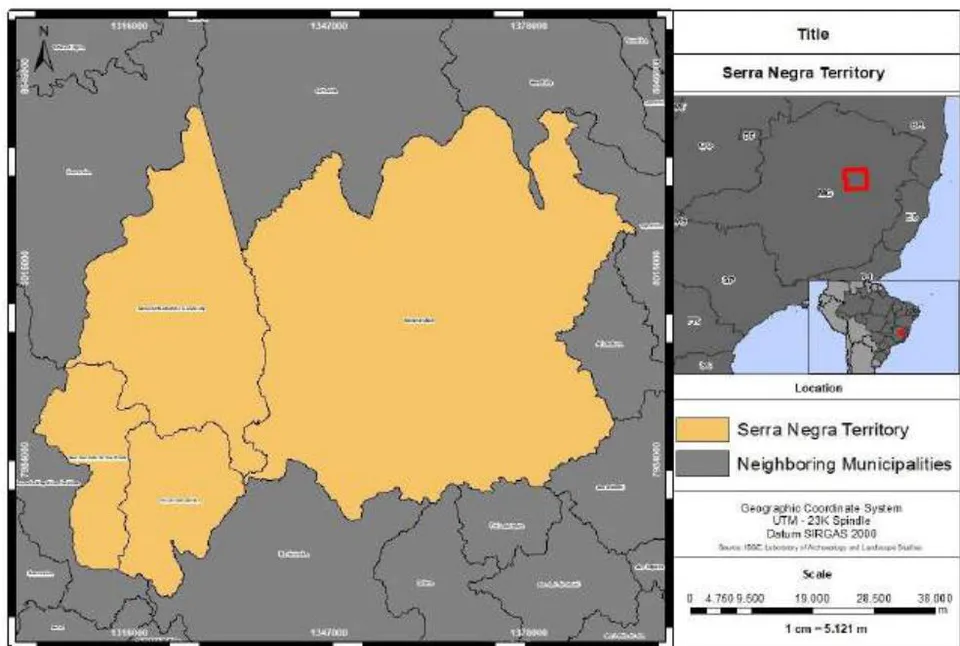
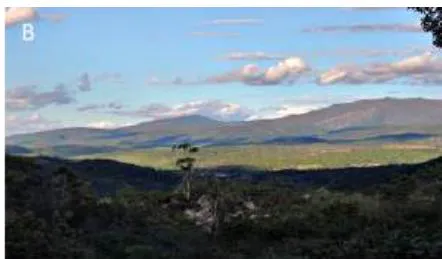
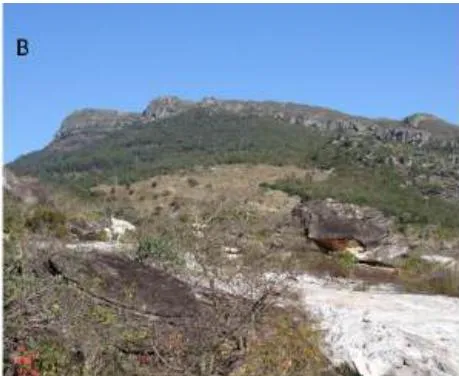
The morphology (or physiography) of this landscape is characterised by alternation between rocky outcrops and superficial formations, which are processes influenced by the region's lithological and structural differences. It lies precisely on the boundary between the Jequitinhonha and Doce River basins and between the Cerrado and Atlantic Forest biomes (Gontijo, 2022). (Fig. 1)
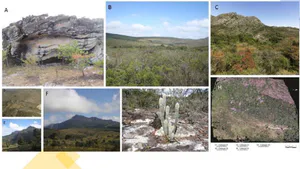
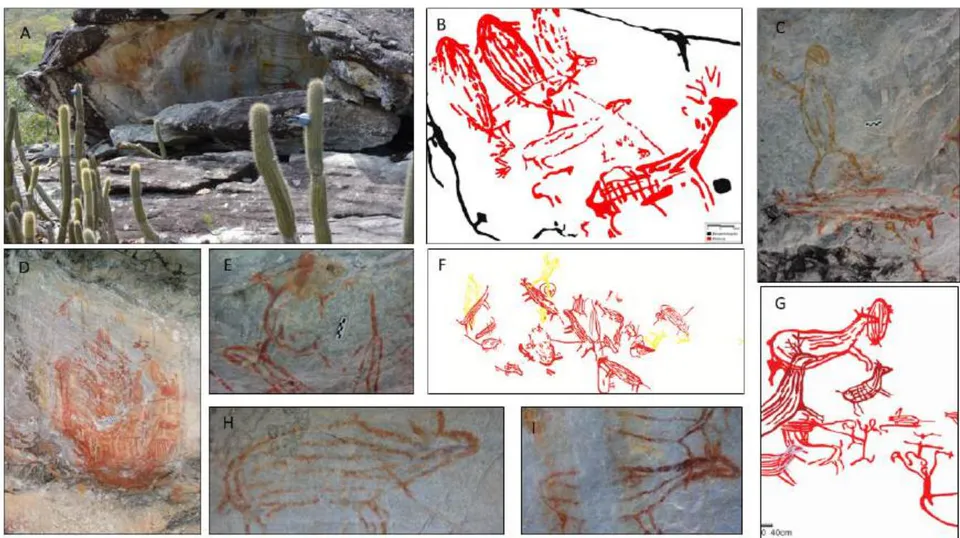
These attributes may indicate a significant influence on the diversity of archaeological sites, on the ways in which they were occupied, in addition to the graphic repertoire observed in the rock art (Greco, 2019) (Fig. 2). The mountain ranges (as they are currently called) are still used today as places of memory, pathways between communities, and narratives by hunters of wild animals, prospectors, or collectors of so-called everlasting flowers (Greco et al., 2021; Fagundes et al., 2024).
However, what is the archaeological objective of this physiographic understanding in the Serra Negra? Why is there an insistence, or a fixation, on stating that archaeologists cannot use geographical concepts randomly?
Initially, it is because even in archaeology these concepts (place, landscape, region, area, territory, etc.) are different and cannot be used as equivalents. There must be a differentiation (and an option) that ultimately becomes theoretical-methodological in the use of these terms: culturalist, phenomenological, materialist, to name just a few.
We have, for example, discussed the concept of landscape in archaeology at length, and it has been quite challenging, so to speak, to understand that landscape, place, and territory are very different concepts in their notions and uses for archaeologists, again making it very clear that landscape is not an arithmetic sum of places or territories (Ashmore; Knapp, 1999; Zvelebil, 1997; Zedeño, 1997, 2016; Anschuetz et al., 2001; Wyndham, 2011; Zedeño et al., 2014; Acevedo et al., 2019; Acha, 2021; Fagundes, 2022; Fagundes et al., 2024, 2025).
Thus, this article is marked by the scientific practice of adopting an (complex) interdisciplinary approach, in addition to a methodological praxis in which dialogue and functionality are ideas-based (Leis, 2005). The landscape, therefore, is understood as a Total Social Fact (Mauss, 2003) or a phenomenon that is always cultural and persists in layers, according to Cosgrove (1985), and is therefore always subjective/abstract, relational, and interpreted. It is read by human beings, who always influence this interpretation and its narratives (Collot, 2013). It is important to remember that it is human beings who confer intentionality on the non-human entities inhabiting this landscape (Fagundes, 2022; Fagundes et al., 2024).
In addition to these interactions and interrelations, there is a permutation from which ontologies, axiologies, and cosmologies originate. There is always an integration that human beings must experience and embody (the landscape) in their everyday experiences. The layers of the landscape are composed of these interrelations and their historical trajectories (or ancestries), tending to never reach a conclusion, as they exist in a state of long duration, and their temporality is therefore infinite (Cosgrove, 1984; Daniel; Cosgrove, 1987).
Another significant archaeologist discussing this concept is Maria Neves Zedeño (1997, 2016). According to the author, the process of forming persistent places, based on the concept of territory, does not need to be a visual unit. In terms of power and meaning, territories are units that result from the cumulative use of land over time, defined by the boundaries established by the human beings who use and control them, as well as by their neighbours (Zedeño, 1997).
In this case, as aggregates of resources, objects, and uses, territories are constituted as life stories resulting from these three factors, which include their formation, maintenance, and abandonment . Human beings establish, maintain, and transform their territories through effective interactions and activities that connect their own group and their neighbours to the land, and its resources, as well as the use of the landscape (Zedeño, 1997).
On the one hand, a territory is an aggregate of land, resources, and modifications made by human beings. Territoriality, on the other hand, is the sum of actions, emotions, and affectivities in the influence, control, and access to a specific piece of land.
According to Zedeño (2008), in all its domains (economic, social, political, power, and ritual), territoriality among people occurs in three dimensions: (a) one that pertains to the characteristics of land modifications and resources of a formal or material nature; (b) another that relates to the loci of activity and their interactive connections, which is spatial or relational; and (c) the third, of a temporal dimension resulting from the history of these two successive sequences.
Thus, territory and landscape possess life histories with overlapping spatial and formal dimensions (like a knot), although they are equally shaped by attachments while operating on different temporal scales, with the former marked by shorter lifespans. The landscape accumulates and embodies territories, interactions, practices, connections, and ancestral/contemporary alterities. Though rooted in the present when reified, it continually transforms itself through memory and action across these layered temporalities, which collectively constitute the fabric of a landscape (Zedeño, 2008).
At the heart of a persistent place (a territory that does not vanish, as per Schlanger, 1992) lies the connection societies maintain with their ancestors, which is a bond manifested through inherited rights, experiences, attachments, and obligations (Zedeño & Bowser, 2009; Zedeño et al., 2010).
Thus, there exists a permanent affective bond with territories, not merely through the maintenance of boundaries, but through the safeguarding of use and mobility (Darras, 2003; Fagundes & Arcuri, 2023). This emerges through movement within the landscape itself over time, as sequences of actions, agreements, productions, and experiences accumulate to form a collective mapping. Diverse connections are already established with this mapping, including emergent territorial identities tied to land-use rights (Zedeño & Bowser, 2009; Zedeño et al., 2010).
This is why they matter - not as nuclei around which human lives revolve, nor as points within referenced boundaries, nor even as gathering places for all layers and substrates of existence - but rather as (non-exclusive or wholly physical) repositories. They pulse with history and identity, remaining permanently essential even after a people has moved away, never to return (Zedeño & Anderson, 2010).
We therefore advocate a perspective closely aligned with Zedeño's (1997) foundational proposal.
Finally, based on ongoing work in the Serra Negra landscape (Alto Araçuaí, Minas Gerais, Brazil), we have developed a critical reflection on these concepts, central to archaeological science, and their (emic) meanings for the communities we collaborate with. This work aims to contribute to an understanding of temporality across divergent historical trajectories (Macedo, 2022; Bispo Jr., 2020; Greco et al., 2021; Fagundes, 2022; Campos, 2023; Fagundes et al., 2024, 2025; Perillo Filho, 2024; Fonseca, 2023).
We must never forget that the Indigenous peoples of the Upper Jequitinhonha Valley - a label applied through disciplinary normativity - were physically and culturally exterminated by European invasion and domination. The critical question remains: Who were these Indigenous peoples? We know little to nothing about them, which underscores the importance of landscape stratigraphy and archaeology. Through material evidence, we can reconstruct narratives about these communities' pasts and about their extinction/erasure.
III. LANDSCAPE AND TERRITORY IN SERRA NEGRA, BRAZIL
The definition of landscape as a concept cannot be understood as simple or singular. As Anschuetz et al. (2001) argue, reductive approaches ultimately hinder researchers far more than they assist in interpreting the archaeological record. The dynamics of any landscape can thus only be deciphered through the agency of human actors, that is, the driving force behind its continual transformation.
According to Cosgrove and Jackson (2014), we must emphasise the sophisticated cultural dimension of landscape within geography. They view it as foundational to the composition, structuring, and meaning-making of a world "(...) whose history must be understood in relation to the material appropriation of land. Consequently, the symbolic qualities of landscapes—which produce and sustain their social significance— have become key research foci, expanding the source materials available to cultural geography" (Cosgrove & Jackson, 2014, p. 137).
If landscape comes to be regarded as a cultural image – a pictorial medium for representing or symbolising humanity's surroundings – then it may be studied through multiple means and surfaces: through paint on canvas, ink on paper, images captured on film, and indeed through the very earth, stone, water and vegetation upon the ground (Daniel & Cosgrove, 1987, cited in Cosgrove & Jackson, 2014, p. 137).
This perspective from Cosgrove and Jackson (2014) grounds the concept in a non-linear space-time framework (contrary to conventional understanding), as this very perception influences its foundational basis. Just as time is an endless (continuous) phenomenon, so too is the constitution of landscape. However, we must avoid being overly prescriptive with this conception, which is rooted in social practice, ancestralities, cosmologies, and ontologies when addressing Indigenous human histories (Silva, 2024).
Landscape functions as an agent (a non-human person), possessing its own will and capacity for interaction with human persons. It reveals the meanings these humans ascribe(d) to the territories they inhabit(ed) (Gell, 2018); their colours, sensations, anxieties (fears), ideas, and conceptions, that is, their lived experiences through time. In the words of Cosgrove and Jackson (2014, p. 137):
The concept of landscape as a configuration of symbols and signs leads to methodologies that are more interpretative than morphological "(...) the metaphor of landscape as text, to be read and interpreted as an official document". After all, what have archaeologists done?
Territory, in turn, constitutes the arena where all activities unfold, although these reflect distinct temporal dimensions of the secular and the sacred (Zvelebil, 1997). This represents a key conceptual framework for interpreting archaeological records, enabling us to comprehend how things happened in the past, the interactions between nature and humans, and, above all, how the natural was interpreted and their territories defined.
Finally, what is the concept of landscape and how can it contribute to our interpretations of material traces, ancestral memory, and the lived practices of past communities?
Also, we must not overlook how the 'landscape as text' metaphor proves invaluable for analysing archaeological materiality, revealing narratives about past human behaviour that encompass everything from aesthetic creativity to ideological, political, and power relations (Fagundes, 2022).
Thus, within this framework, landscape is understood as a synthesis of interactions/interrelations and all social dynamics encompassing relational, economic, ideological, power-related, ancestral, ritual, cosmological, symbolic, contractual/conflictual, and politico-religious dimensions. It constitutes, therefore, a wholly cultural system that structures and organises these interrelations between human persons, non-human persons, and landscape across time and space (Zedeño, 1997).
Hence, as Zvelebil (1997) argues, all landscapes are structured through this time-space relationship, which fundamentally shapes their constitution. We must always remember that time is a social construct, and as previously noted, it cannot be treated arbitrarily (or linearly), and while mathematically definable, it's very meaning remains relative to each society's chosen frameworks.
For instance, many societies recognize both secular and sacred temporalities. Diverse strategies exist to move around (or choose not to) particular territories (Mauss, 2003). These decisions often elude conventional archaeological interpretation (or materiality-based analyses, if you prefer), being rooted in cosmological frameworks, ancestral connections, moral imperatives, political negotiations/conflicts, ritual practices, and the presence or absence of desire (Mauss, 2003; Viveiros de Castro, 2002, 2018, 2024; Fausto, 2014, 2023; Fagundes & Arcuri,
2023). Such cognitive systems consistently evade our Eurocentric pragmatism .
According to Zvelebil's (1997, p.36) research among the Ket people of Western Siberia, he identified two distinct landscape categories: ritual and practical. Ritual landscapes are founded upon three core principles: symbolism, ancestrality, and temporality. Practical landscapes (comprising ecological structures, resource productivity, seasonality, social technologies, and resource-use motivations/strategies) are contingent upon resource scarcity or abundance. Within these frameworks, Ket groups employ context-specific strategies to sustain their ways of being, whereby rituals play a constitutive role in group survival (Zvelebil, 1997, p.38)
Practical landscapes can only exist and sustain the seasonality of resources based on this rituality, that is, on the ideological and ritual issues that develop (Zvelebil, 1997, p. 35). In this case, as already mentioned, the entire Ket cosmology and rituality impose a network of symbolism on the landscape. Therefore, practical landscapes intrinsically depend on rituals for the existence of economic life. One thing cannot be separated from the other, and the territory of the Kets will always be a sociocultural (and ritualistic) construction, in which ancestry plays a very important role. In short, there is no way to separate economic life from religious life, an issue that Marcel Mauss had already warned us about in the first half of the 20th century (Mauss, 2003).
Rituals linking cosmology and landscape were also integrated into the course of regular subsistence activities. For example, after the first slaughter of animals that served as guardians or messengers in Ket cosmology, the soup left after cooking these animals (bears, elks, reindeer, waterfowl, or fish) was returned to the river at specific sacred sites, an act of symbolic regeneration (i.e., the essence of the animal messengers returned to the 'cosmic river'). The ceremonies associated with bear hunting defined sacred and ritual sites on the landscape, referring to the bear as the guardian of other animals and as being responsible for ensuring the success of the hunt: this was symbolized, for example, by specific bear bones (jaws, shoulder blades) hanging from trees (Zvelebil, 1987, p. 38).
Landscape (as one of the non-human entities) is perpetually shaped by human ritual practices and thought/ideology, while simultaneously influencing these very manipulations. It constitutes a symbolic continuity and expression of a ritual-ideological system structure, one that consistently emphasizes temporality and resource availability among the Ket people. This manifests through physical cycles (resource availability for economic life), in addition to cycles of the soul, body, and freedom, which involve the governance of both human and non-human persons, particularly key animals (bears, elk, reindeer, waterfowl, or fish). Thus a collective ideological appropriation of the landscape emerges.
According to Zvelebil, all things return to the sacred or cosmic river, in which nature is a gift from the environment, and, in this case, there is an equitable ideology, which is realized through the act of sharing (Zvelebil, 1997, p. 46). In any case, we must remember that according to Zedeño and Anderson (2010), all paths are contact links between nuclei and human persons, and to perimeters, involving behaviours, controls, and knowledge. The path is an activity in the process of ordering, delimiting, and monitoring between materialized or non-materialized thresholds. That is, perimeters can be understood as the periphery of historical knowledge and experiences of human persons, representing limits and thresholds not only between territories but narratives on safe and dangerous areas, the transcendental and unpredictable.
We believe that the different approaches proposed by Zedeño (1997, 2008), based on the concept of persistent places, coined by Schlanger (1992), are valid for archaeological research, especially for the study of landscape.
The philosopher and Immortal of the Brazilian Academy of Letters, Ailton Krenak (2020) brings to light the "indigenous" subjectivities and resilience along the Doce River Valley, a river they call Watu (our grandfather, a non-human person). That is, it has identity and agentialites and is not seen only as a supplier of resources (an extremely reductionist and Eurocentric view).
For Ailton Krenak (2020, p. 43), Watu is one of the living parts of the Earth, not only as a provider of basic resources for the physical survival of human persons, but as responsible for maintaining the experiences and existences of the Kre (which means head) -nak (earth): head of the earth (KRENAK, 2020, p. 48).
Krenak is the heritage we received from our ancestors, from our memories of origin, which identifies us as "heads of the earth", as a humanity that cannot conceive of itself without this connection, without this deep communion with the land. Not the land as a site, but as this place that we all share, and from which we, Krenak, feel most uprooted – from this place that has always been sacred to us, but which we realize that our neighbours are almost ashamed to admit can be seen as such (Krenak, 2000, p.48-49).
Therefore, for the author, we should never depersonalize what we call non-human people, such as mountains, rivers, forests, etc. After all, where does this humanity or agency come from? What is a human person? When we take away identity and agency from non-humans, we are transforming them into "(...) residues of industrial and extractive activity" (Krenak, 2020, p. 49).
Geographer Denis Cosgrove (1985, 2014) classifies the landscape as a text to be read and interpreted, a grammar of the landscape, which allows human beings to conceptualize (learn and apprehend) it, themselves, and others (Fagundes et al., 2021, p. 77).
This abstraction (or symbol) can even create landscapes, in which narratives and other original new readings can be logical. As has been said many times, human persons are part of landscapes and non-human landscapes are part of human persons, in interactions that structure and are structuring (Greco, 2019). There is observation, perception, description, and reproduction of what is seen (or subjectivized), that is, facts that establish new landscapes. This allows renewals, or layers, to occur (Cosgrove; Jackson, 2014), which enable archaeologists to interpret the archaeological record, which is always contemporary (Schiffer; Skibo, 1997; Darras, 2003; Fagundes; Arcuri, 2023).
For some time now, archaeological research (and concerns) has been theoretically and methodologically guided by the concept of landscape (as mentioned), which has always been understood through relational interactions and occupational and ritualistic dynamics, as a form of power. To this end, the bearers (human beings) of this landscape (in layers, past or present) interpret it, give meaning, attachments and feelings to their territories, inhabiting exactly where their ancestors lived. There is an affective and sentimental attachment to the territory (Zedeño, 1997). Establishing, creating and modifying, as well as occupying or abandoning an area, in this prerogative, involves choices beyond ecological-adaptive (economic) possibilities, which concern experiences and life as a whole (Zvelebil, 1997; Zedeño, 1997; Daniel; Cosgrove, 1987; Darras, 2003; Cosgrove; Jackson, 2014; Krenak, 2020; Fagundes; Arcuri 2023), in addition to the process of attributing meaning and order to nature, as indicated by Cosgrove (1985).
Landscapes are, therefore, established in layers in different temporalities (Cosgrove, 1985), constituted by ancestral territories, not as a simple arithmetic sum but rather of sentimental affections and attachments (ancestry), whereby territories would give rise to this landscape, established and experienced by human beings, according to their cosmologies and ontologies (Zvelebil, 1997, 2006; Zedeño, 1997; Krenak, 2020).
Thus, we must remember that they are always a product of people, a construction, and can be defined as part of a humanized social territory, in space-time, in culture, in historical trajectories, in experiences, and in ancestry.
In Alto Araçuaí, for example, the different shelters present characteristics that go beyond their resources or their physiographies (at least as we Westerners think and conceive of them). Therefore, their occupations resulted from an effective form of regulation between different factors of their sociocultural structures (environmental-adaptive, moral-ritualistic, ideological, political, etc.) (Zvelebil, 1997; Zedeño, 1987; Fagundes et al., 2024, 2025).
Therefore, landscapes will always be intelligible actions and ideas that enable life, beyond a sum of exclusively constructed territories (Anschuetz et al., 2001; Cosgrove; Jackson, 2014; Krenak, 2020). They are dynamic and relational, seen as a historical text, and function as a system of symbolic, power, and strategic manipulation (Cosgrove; Jackson, 2014), which are characteristics that allow them to be experienced, perceived, and contextualized (Knapp; Ashmore, 1999; Zvelebil, 1997; Zedeño, 1997; Krenak, 2020).
Composed of human and non-human people, landscapes are shaped by their long-term experiences (temporalities). If the world is always the result of human praxis, so are landscapes. It is human people project ideas, affections, and feelings from this universe onto the world to create/establish landscapes, which are therefore part of life, of the social construction of the space itself (Troncoso, 2001). In the words of Andrés Troncoso (2001), the landscape should always be understood as a materiality constructed by humanity.
(...) where its materiality resides in its natural configuration that disintegrates and filters through the human cultural kaleidoscope. Natural physical space is raw material appropriated and modelled in the social production of the landscape, transforming itself into the social, cultural, and historical (Troncoso, 2001, p. 5).
The landscape in its construction involves relationships between agreements and conflicts, and of power. It is always a field of struggle, a territory designed for the reproduction and subversion of social relations (Troncoso, 2021). Therefore, it is concrete, because it existed (and exists), but it is also abstract, because that is how its owners see it. Transforming, creating, establishing or innovating the landscape (rebuilding, remaining or abandoning, [re] signifying) is a procedure of elections that involves negotiations, contracts, exchanges and concessions; it is a field of narrative, and can even be used as a political tool (Troncoso, 2021).
Thus, the landscape is also the social use of land (individually and collectively), throughout historical trajectories, in which the different activities of human life modify and culturalise its constitution, as they are created and modified by life experiences (Viveiros de Castro, 2002, 2024; Fausto, 2014, 2023). If the choice of a territory is due, at first glance, to its possibilities of subsistence (resources), it is also related to its knowledge and, consequently, culturalisation, establishing links in regard to where, why and how to settle (ancestry).
The landscape is always in movement/dynamic, in motion in the Boasian sense, being shaped by experiences and reactivated by the interrelations between the world, in which the cognitive aspects allow us to experience, perceive, classify and contextualize this landscape.
Therefore, continuity and/or changes are choices (Silva, 2024). Landscapes are, always dynamic life stories (Zvelebil, 1997) of construction/reconstruction, modelling/remodelling and structuring/destructuring, where human beings are closely related (Krenak, 2020). Therefore, the landscape and human and non-human beings are linked in a continuous (cyclical), limited and changing movement throughout history.
It is true that the landscape brings with it attributes that enable the understanding of these layers that were established in historical trajectories (Silva, 2024; Krenak, 2020), but with each new occupation in space-time, the records left and the physiography itself (and its agency) gain new interpretations and resignifications, given by later occupants' experiences (Viveiros de Castro, 2002, 2024; Fausto, 2014, 2023). There are continuities (or not), but different from the linear form that we assume (Fagundes et al., 2024, 2025).
As Fagundes et al. (2021) say:
More than a set of forms, the landscape presents itself as a composition defined as a "visual unit" (...), since it is material; however, it only exists from a perspective (...) and beyond what is seen. The landscape is, therefore, an intentional expression composed of multiple layers of meaning that are established by humans in an arrangement that presents neither form nor coherence outside this action, in which signs establish a narrative (grammar), allowing emic reading in the present (by producers and/or code holders) and in the future, in which new interpretations can be given by and to the landscape. There is no landscape outside this human action (Fagundes et al., 2021).
Finally, based on the interrelations observed through the archaeological record, it is necessary to understand how these installations could/can (or cannot) have contributed to the creation of territories and experiences far beyond the economistic view, in which human beings only wanted to survive (or eat, for example). It is important to always keep in mind that the physiography of a given territory enabled the production and reproduction of material life and the symbolic universe (Zvelebil, 1997; Zedeño, 1997; Cosgrove, 2012). We understand this establishment (Mauss, 2003) as a way of being and existing in the world, and, therefore, archaeological sites are not established exclusively for reasons related to economic life. Living in society involves options beyond food and protection.
IV. ARCHAEOLOGY IN SERRA NEGRA, UPPER ARAÇUAÍ, MINAS GERAIS, BRAZIL
The Serra Negra territory is located northeast of the city of Diamantina, Minas Gerais, Brazil, covering lands of the municipalities of Felício dos Santos, Senador Modestino Gonçalves,
Itamarandiba, Rio Vermelho, and São Gonçalo do Rio Preto (Fig. 1).
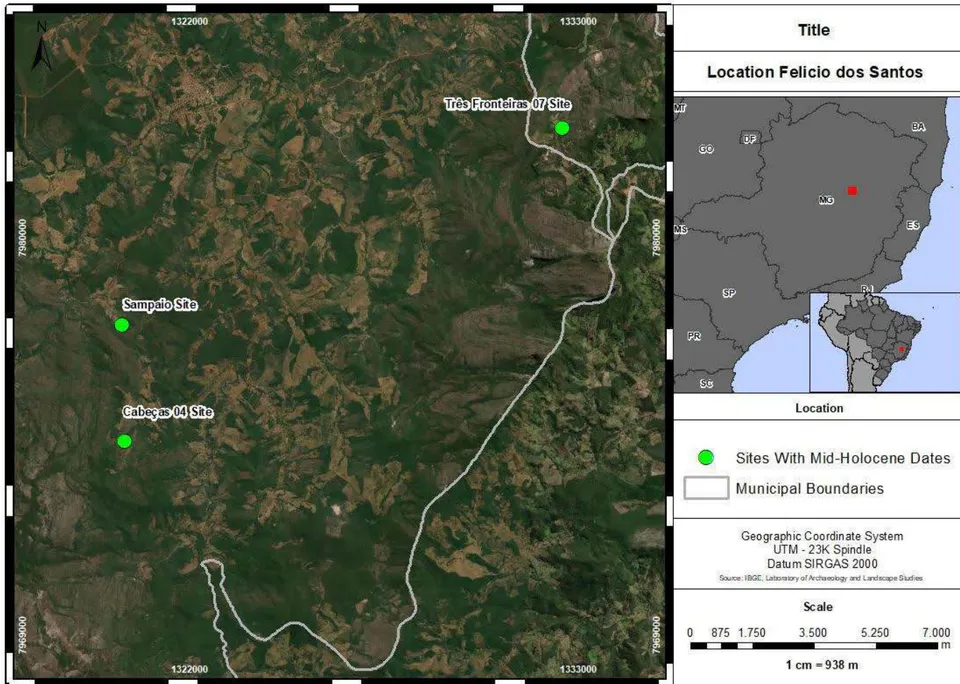
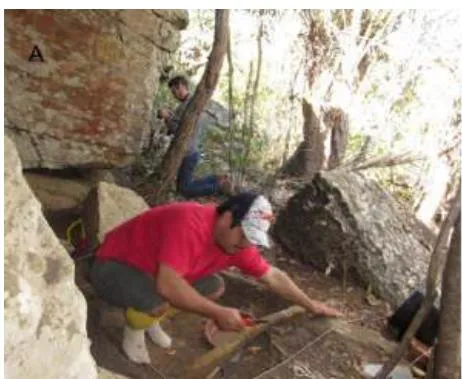
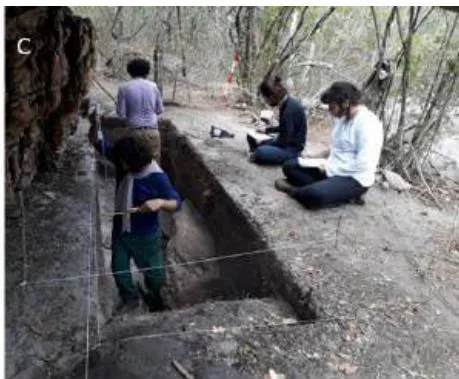
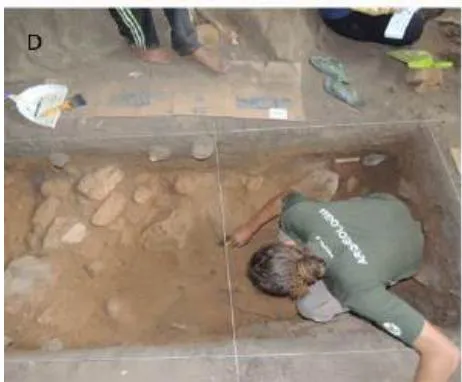
The investigations were concentrated entirely in the municipality of Felício dos Santos, especially at the sources of the Araçuaí River, which is the region where the oldest archaeological sites were discovered and excavated: Cabeças 4, Sampaio and Três Fronteiras 7 (all shelters dating from the Middle Holocene), between 7 and 4 thousand years BP, with no gaps for this period (Tables 1 and 2) .
| Sites | Area | Lab* | Method | Chronology (yrs BP) | Calibrated age (yrs BP) | Average probability (yrs BP) | Probability Y (2sigma) | Author | |
| EARY HOLOCENE | Caboclo | PD** | BETA 199502 | AMS*** | 12,637-12,469 | 12,549 | 0,958 | Isnardis (2009) | |
| Caboclo | PD | BETA 233764 | AMS | 12,472-11.935 | 12,182 | 1 | Isnardis (2009) | ||
| Peixe Gordo | PD | BETA 233762 | AMS | 12,021-11.622 | 11,817 | 0,95 | Isnardis (2009) | ||
| Lapa da Chica | PD | BETA 254271 | AMS | 9,910-9,541 | 9,703 | 0,893 | Isnardis (2009) | ||
| Lapa da Onça | PD | CEN 1180 | 9,773-9.129 | 9,481 | 0,995 | Fagundes (2013) | |||
| MID-HOLOCENE | Cabeças 4 | SN**** | BETA 379290 | LSC | 7,259-7,154 | 7,169 | 0,599 | Fagundes (2019) | |
| Cabeças 4 | SN | BETA 379290 | LSC | 7,086-6,854 | 6,978 | 0,805 | Fagundes (2019) | ||
| Três Fronteiras 7 | SN | DAT 5480 | LOE**** | -- | -- | -- | Fagundes (2022) | ||
| Três Fronteiras 7 | SN | DAT 5480 | LOE/SA RS 15 | -- | -- | -- | Fagundes (2022) | ||
| Cabeças 4 | SN | BETA 370289 | 6,035-5.912 | 5,996 | 0,637 | Fagundes (2019) | |||
| Água Quente 3 | SN | DAT 6073 | LOE/SA RS 15 | -- | -- | -- | Fagundes (2025) | ||
| Água Quente 3 | SN | DAT 6072 | LOE/SA RS 15 | -- | -- | -- | Fagundes (2 | ||
| Sampaio | SN | BETA 471280 | 4,870-4.797 | 4,823 | 0,581 | Fagundes (2019) | |||
| Três Fronteiras 7 | SN | BETA 471281 | 4,648-4,422 | 4,553 | 0,862 | Fagundes (2019) | |||
| Cabeças 4 | SN | BETA 370291 | 4,532 - 4,290 | 4,441 | 0,967 | Fagundes (2019) | |||
| Cabeças 4 | SN | BETA 379289 | AMS | 4,449 - 4,287 | 4,388 | 0,783 | Fagundes (2019) | ||
| LATE HOLOCENE | Matão 1 | SN | DAT 5479 | LOE SARS 15 | -- | -- | -- | Fagundes (2022) | |
| Matão 1 | SN | LOE 5140 | LOE SARS 15 | -- | -- | -- | Fagundes (2022) | ||
| Três Fronteiras 7 | SN | CENA/USP | 3,315 - 3,571 | -- | -- | Fagundes (2022) | |||
| Água Quente 3 | SN | DAT 6075 | LOE/SA RS15 | -- | -- | -- | Fagundes (2025) | ||
| Três Fronteiras 7 | SN | CENA/USP | 2,919 - 3.260 | -- | -- | Fagundes (2022) | |||
| Lapa da Chica | PD | BETA 254270 | AMS | 2,740 - 2.880 | 2,805 | 0,995 | Isnardis (2009) | ||
| Matão 1 | SN | BETA 506714 | AMS | 2,540 - 2.350 | 2.466 | 0,72 | Fagundes (2019) | ||
| Lapa do Taião | PD | CEN 1183 | 2,542-2,136 | 2,353 | 0,87 | Fagundes (2013) | |||
| Matão 1 | SN | DAT 5479 | LOE SARS 15 | -- | -- | -- | Fagundes (2022) | ||
| Água Quente | SN | DAT 6064 | LOE SARS 15 | -- | -- | -- | Fagundes (2025) | ||
| Cabeças 1 | SN | BETA 379288 | AMS | 1,930-1,812 | 1,864 | 0,875 | Fagundes (2019) | ||
| Matão 1 | SN | DAT 5479 | LOE SARS 15 | -- | -- | -- | Fagundes (2022) | ||
| Matão 1 | SN | DAT 5479 | LOE SARS 15 | -- | -- | -- | Fagundes (2022) | ||
| Matão 1 | SN | BETA 506716 | AMS | 1,179-1.065 | 1,132 | 0,82 | Fagundes (2019) | ||
| Matão 1 | SN | BETA 506715 | AMS | 1,178-1,054 | 1,112 | 0,924 | Fagundes (2019) | ||
| Lapa do Caboclo | PD | BETA 199503 | AMS | 1,177-975 | 1,087 | 0,98 | Isnardis (2009) | ||
| Matão 1 | SN | DAT 5479 | LOE SARS 15 | -- | -- | -- | Fagundes (2022) | ||
| Matão 1 | SN | BETA 506713 | AMS | 923-790 | 853 | 0,971 | Fagundes (2019) | ||
| Cabeças 3 | SN | BETA 400565 | AMS | 817-724 | 776 | 0,817 | Fagundes (2019) | ||
| Lapa da Onça | PD | BETA 370293 | 730-654 | 685 | 0,988 | Fagundes (2019) | |||
| Lapa do Caboclo | PD | BETA 199504 | AMS | 668-547 | 605 | 1 | Isnardis (2009) | ||
| Itanguá 2 | SN | CEN 1172 | 773-490 | 613 | 0,993 | Fagundes (2013) | |||
| Itanguá 2 | SN | CEN 1181 | 683-502 | 603 | 0,977 | Fagundes (2013) | |||
| Itanguá 2 | SN | CEN 1173 | 647-589 | 605 | 0,685 | Fagundes (2013) | |||
| Matão 1 | SN | LOE 5105 | LOE | -- | -- | -- | Fagundes (2022) | ||
| Cabeças 4 | SN | BETA 379291 | 531-451 | 501 | 0,976 | Fagundes (2019) | |||
| Matão 1 | SN | LOE 5105 | LOE | -- | -- | -- | Fagundes (2022) | ||
| Itanguá 2 | SN | BETA 310324 | AMS | 316-277 | 289 | 0,685 | Fagundes (2013) | ||
| Mendes 2 | PD | CEN 1182 | 507-249 | 354 | 0,815 | Fagundes (2013) | |||
| Cabeças 1 | SN | BETA 379288 | AMS | 316-277 | 289 | 0,685 | Fagundes (2013) | ||
| Mendes 2 | PD | UG 10586 | AMS | 221-143 | 194 | 0,811 | Fagundes (2013) | ||
| Itanguá 2 | SN | DAT3289 | 146-0 | 101 | 0,761 | Fagundes (2013) |
The Serra Negra territory, as mentioned, is made up of sites from 7,000 years BP onwards, with occupations duly dated from the Middle Holocene to the Late Holocene (see Tables 1 and 2). They are all archaeological sites in shelters (or in caves, as the regional communities call them), with very common designs of what André Prous called the Planalto Tradition (2019).
Another notable element is the lithic assemblages, in which mainly the main raw material is anhedral quartz (blocks and veins), in its hyaline and milky variants, although there are some other instruments produced in quartzite, flint, and silicified sandstone (Fonseca, 2023; Perillo Filho, 2024). Ceramics are found in the most recent levels of the Três Fronteiras 14 site (not excavated) and at the Cabeças 4 site, where the layer was dated between 531 and 451 cal. years BP. (480 ± 30 years BP. BETA 379291) (Figs. 3 and 4). Very recently, the first indigenous village was evidenced at the Heitor Archaeological Site, with many ceramics and lithics on the surface.
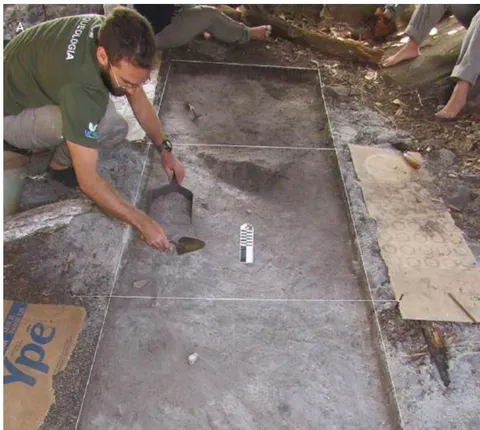
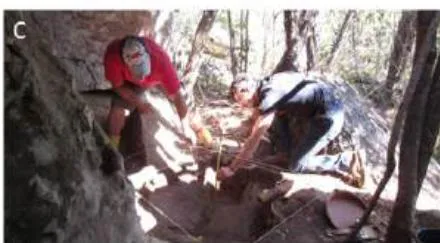
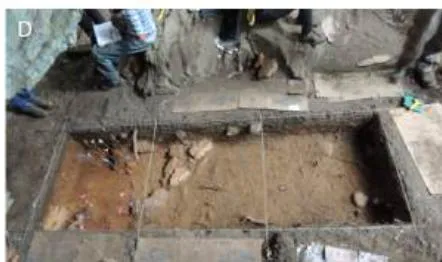
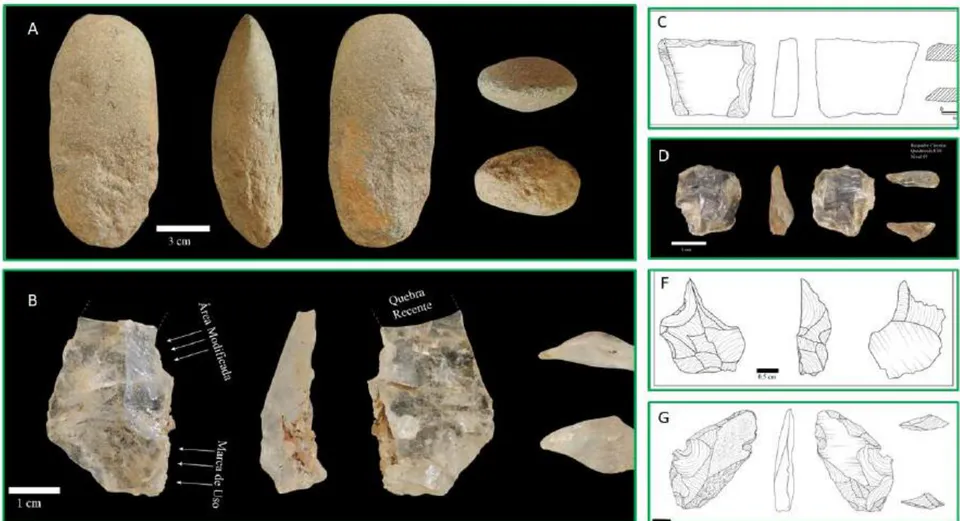
Therefore, certain physiographic reflections are extremely important for the analysis and interpretation of the archaeological record. Among the phytological-physiographic and paleoenvironmental analyses, in addition to the excavations that generate materiality, analyses, including archaeometric, are carried out on social technologies (Silva, 2024). We have invested heavily in what is known in the literature as archaeological ethnography, which aims to understand the multiple temporalities that exist in the materiality and the landscape itself (Silva, 2024; Fagundes et al., 2024).
Thus, based on the interrelations observed in the archaeological record, we seek to understand how these specificities may or may not have cooperated in the establishment of paths and experiences over millennia, in addition to economic visions, in which human (and non-human) people settle only for survival. Thus, as previously mentioned, we have sought in the physiography of this territory the production and reproduction of material life and the symbolic universe (Cosgrove, 2012).
Serra Negra is a natural border between two Brazilian river basins, those of the Jequitinhonha
River and the Doce River. It is, therefore, also between two ecotones, the Cerrado (in Jequitinhonha) and the Atlantic Forest (in Doce), which would probably have been explored by the groups that inhabited the area (Gontijo, 2022).
Geologically, this territory is inserted in the context of the Araçuaí Orogen, one of the most important geotectonic components of southeastern Brazil, which is associated with a series of mountains that were formed in this area due to several continental collisions, giving rise to the supercontinent Gondwana at the end of the Neoproterozoic (Alkmim et al., 2017).
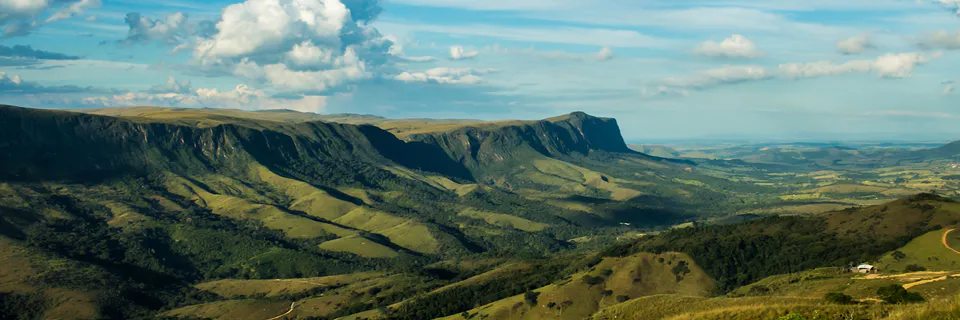
Thus, its morphology is characterized by the spatial alternation between rocky outcrops and surface formations, the processes of which were influenced by the litho structural differences of the region. This peculiarity led to the emergence of several buttresses in the region, many of which are part of the current communities, such as Gavião (or Chapada do Couto), Bocaina (or Miranda, on the eastern slope of the hill), Pedra Menina, Pico Dois Irmãos, and Ambrósio (Greco et al., 2021). (Fig. 5).
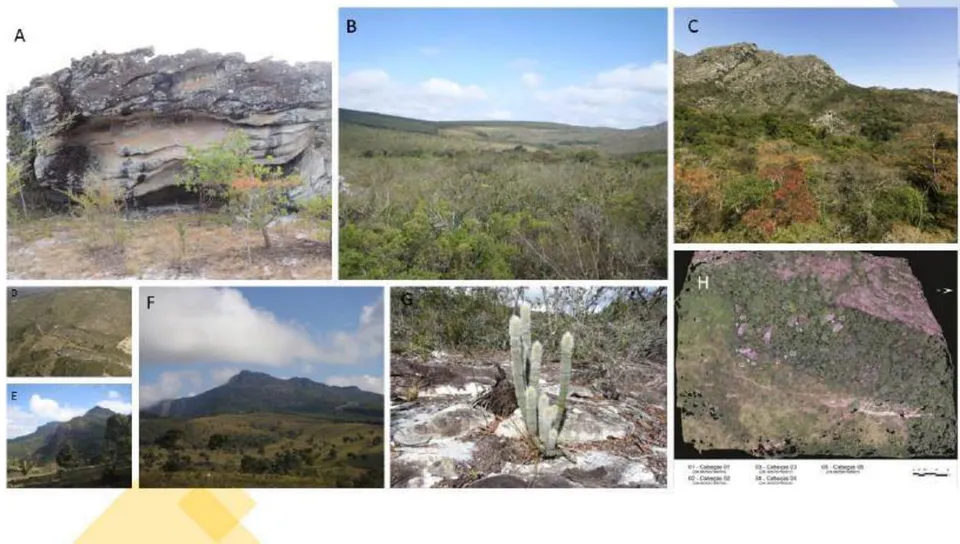
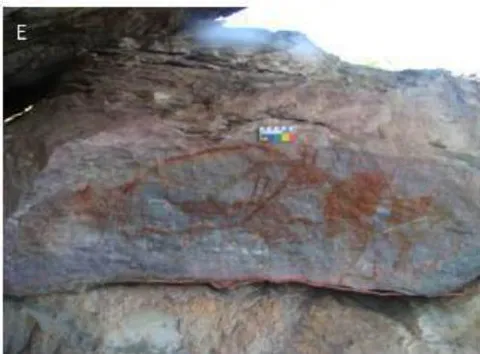
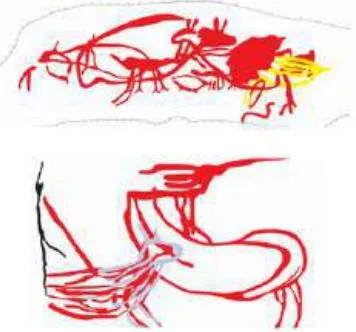
The climate of the entire territory is temperate (Subtropical highland climate, Cwb, according to the Köppen-Geiger classification) and with plenty of water available, both of which are key to understanding the past human occupation of this territory (Knegt, 2022).
In terms of geomorphology, it is possible to observe four main domains in Serra Negra: (a) mountain ranges supported by quartzite (resistant to weathering); (b) colluvial ramps related to the alteration of quartzites, characterized by sandy sediments arranged along the slopes of these mountain ranges; (c) flat tops, without the presence of outcrops, associated with areas with the presence of more developed and clayey weathering layers; and (d) narrow strips of river channels (Knegt, 2022).
Having evolved as Latosols, the soils can be characterized as different from other regions in the Diamantinense Plateau, being greatly influenced by a variety of other classes ranging from the youngest to the oldest soils, especially in places with intrusions of metabasic rocks. There is also the presence of Fulvic Neosols in alluvial zones (Vasconcelos, 2014). This variety, in turn, led to the development of family farming, mainly from the century onwards, which is, to this day, the main source of income for many communities (Greco et al., 2021).
Thus, these mountain ranges established bionic boundaries between the Cerrado and the Atlantic Forest (Gontijo, 2022), a fact that marked and determined paths for the realization of social and technological activities, as well as community differences (from the Middle Holocene to the present day), where all the shelters that were occupied in an immense temporality or layers are located (Cosgrove, 1984). These shelters (or limpets) are the most characteristic signs, being seen, perceived, experienced, experimented with, and reinvented over time (Greco, 2019).
In the same way, the particular phytophysiognomies of the Serra Negra are also responsible for the rhythms and movements present on this landscape. Examples include: (a) campo rupestre (rupestrian grassland), which is important for the life of current (and past) communities, especially for collecting everlasting flowers, an activity that provides income and has inspired stories about life among the mountains, reviving paths (shelters or caves) used for millennia by humans, in a past that dates back more than 7 thousand years; (b) the forests and all the stories about hunting, experiences, or fantastic beings; and (c) from the sacred nature of certain places to the ritual "permissions" that are granted to hunters or hikers.
Many of these forests were named after people, relating not only to the history of individuals, but also to communities, trajectories, and ancestry (Campos; Fagundes, 2023). Humans, forests, and actions are now interconnected in a single entity, such as Mata do Isidoro, Mata do Farias, Mata do Matão, Mato do Elias, or Mata dos Ausentes (Greco et al., 2021).
Chueng and her team (2018, 2023) were responsible for the paleoenvironmental research in Serra Negra. As a result, it is now known that subtle climate changes occurred between the Middle Holocene and contemporary life (Chueng et al., 2018, 2023; Chueng, 2020; Machado et al., 2021).
With regard to Archaeology, research with phytoliths and palynology indicated the presence of a stable, hot, humid climate, with the characteristic of a predominance of rupestrian grassland, at least in Serra do Jambreiro (region where almost all the archaeological sites with ancient dates are located), which is very different from what we have today with the contemporary, predominant presence of Semideciduous Seasonal Forest (Chueng, 2020).
An example of this is the excavation of the Matão site. Several pebbles were found during the intervention at this site, especially during the exploration of bipolar flakes during the Late Holocene (Perillo Filho, 2024). It was in the phytolith analyses carried out by Chueng et al. (2023) that it was possible to infer that these pebbles (in addition to the bipolar flake) were being used to break coconuts. The studies demonstrated an immense quantity of phytoliths from Poaceae (BLOCKY, BULLIFORM FLABELLATE and ACUTE BULBOSUS) and Arecaceae (SPHEROID ECHINATE), probably originating from the palm tree Syagrus ruschiana, which is abundant in the region and provides the so-called stone coconut, appreciated by local communities to this day.
We cannot forget that the landscape is a dynamic construction, in addition to being a means of capturing (symbolic) resources that guarantee life, incorporating principles of the social, economic, and political organization of its occupants. Therefore, the landscape is a means through which human beings manipulate (symbolically) its structures and materiality (Fagundes et al., 2021, 2024, 2025; Fonseca, 2023; Perillo Filho, 2024).
Finally, it should be highlighted that the Serra Negra is in constant transformation (Silva, 2024), mainly as a result of the action of human beings for more than 7 thousand years. There are many mountain ranges (and paths) that speak of directions, references, and interrelations between human persons, non-humans, and the landscape. It is a territory that has always been well irrigated, with watercourses that flow into both the Jequitinhonha and Doce River basins, with many peatlands responsible for these water flows (Silva et al., 2020).
The phytophysiognomy in Serra Negra presents both those typical of the Cerrado biome (with emphasis on the rupestrian grassland stricto sensu) and forested areas, mainly at the foot of the mountains or in the riparian forests of its streams and rivers. In other words, it is in a constant state of change (in both material and symbolic aspects), in which physiography constitutes experiences and human persons (re)signify this physiography, that is, in its landscape (Fagundes, 2022; Fagundes et al., 2025).
Thus, it is human and non-human people and their historical trajectories that constitute the layers (Cosgrove, 1985; Daniel; Cosgrove, 1987), and redirect and modify this landscape at all times. There are specificities on the landscape (whether historical, symbolic, behavioural, or temporal) in which Archaeology (and the understanding of certain concepts) plays an important role in the processes of this interpretation, seeking in materiality the interrelations between the environment, humanity, and other (non-human) entities in an understanding of how things were constituted and an understanding of the world in which they lived and are lived (Viveiros de Castro, 2002, 2024; Fausto, 2014, 2023; Isnardis; Linke, 2021).
V. FINAL CONSIDERATIONS
This article has addressed two fundamental points for archaeological research, landscape and territory. In fact, it should be made very clear that: (a) Landscape is not synonymous with environment; and (b) Landscape is not the arithmetic sum of territories. Every landscape is a construction of human persons, of what is seen and interpreted, with the addition of social and symbolic aspects (Cosgrove and Jackson, 2014).
Landscapes are always layered (Cosgrove, 1985) and their temporality is infinite, while concurrently dynamic, with changes in human beings influencing its constitution much more than physical or natural modifications themselves. Every landscape influences the lives of human beings in the same way that human beings influence the landscape itself.
At the same time, the landscape is ancestral and therefore will always be ideological, powerful, ritualistic and social, regardless of time, and will always be transformed by human actions. In other words, the landscape will always be the palimpsest of boundaries established by humans and manipulated by their actions. However, its constitution (as a non-human person) will also influence this manipulation and/or changes.
The interrelations between human beings and the landscape are always structural and mutual within the scope of ancestry and social memory. There is no landscape without human beings, and there is no society that does not establish its landscape. In short, the concept is a social construction capable of assisting our interpretations of experiences and of the archaeological record itself. As Cosgrove (1984) says, the landscape will always denote the mediation of the physical world and the experiences of humanity, which is always subjective and relational. In this case, it is a composition that directs all the actions of human beings.
Ultimately, the landscape, as a construction of culture, is the way in which human beings signify themselves and the world. It is through these landscapes and their relationships with nature that humanity announced (and announces) its own moral, religious, and social rules. It is a living stage for all the actions of human beings, including ancestry, rituals, and power.
In the territory of Serra Negra, the landscape is the same that establishes, creates and modifies, in addition to occupying or abandoning this territory, which is prominently an ecotone (Gontijo, 2022). In this prerogative, the landscape of Serra Negra is marked by the decisions taken by the group or groups that are beyond the ecological-adaptive (economic) possibilities but that pertain to life as a whole.
Landscapes are composed of territories (never a simple sum), which are established and experienced by subjects (individually and collectively) according to their ancestry and cosmologies (Zvelebil, 1997). In the territory of Serra Negra, there are ancient layers left by different inhabitants, which were appropriated by other new peoples: (a) Rock art and all the affection it caused and still causes in people; and (b) lithic sets that were made for a specific purpose but which are still used by the current community (whether to break coconuts or scrape grass) (Fagundes et al., 2024, 2025).
In Serra Negra, the landscape is a humanized social space, in time, space and culture. These are actions and ideas that enable life (Anchuetz et al., 2001). The landscape is dynamic, seen as a historical text that functions as a system of symbolic manipulation, characteristics that allow it to be experienced, perceived, and contextualized (Cosgrove, 1984). It is the social use of land, by individuals and communities, along historical trajectories (in themselves complex), where the different activities of human life modify and make culture a part of its constitution, as they are created and modified by historical trajectories.
If the first option for occupation is environmental (resource possibilities in themselves), the knowledge and consequent appropriation of that territory establish links and attachments to where, why, and how to settle.
ACKNOWLEDGEMENTS
The Fundação de Amparo à Pesquisa do Estado de Minas Gerais - FAPEMIG (Minas Gerais State Research Support Foundation) for supporting this research and to the Conselho Nacional de Desenvolvimento Científico e Tecnológico - CNPq-Brasil (National Council for Scientific and Technological Development).
Conflict of Interest
The authors declare no conflict of interest.
Ethical Approval
Not applicable
Data Availability
The datasets used in this study are openly available at [repository link] and the source code is available on GitHub at [GitHub link].
Funding
This work did not receive any external funding.
References
Cite this article
Related Research

Special Issue
Launch a focused special issue to highlight research, emerging trends, and expert insights in your academic field.