

Abstract
This article critically examines the growing institutional requirement that doctoral and postdoctoral researchers publish their work in Q1-ranked academic journals as a condition of degree completion or academic advancement. Drawing on the philosophy of science, the sociology of knowledge, higher education policy, and the political economy of publishing, the article interrogates three interconnected problems. First, it analyses the institutional logic by which universities have progressively outsourced their own research quality-assurance function to commercially operated journal-ranking systems, tracing this shift to the metrics-based accountability frameworks that emerged globally from the 1980s onward. Second, it challenges the epistemological assumptions underpinning the Q1 certification model, arguing that quartile rankings measure citation-based institutional prestige rather than intrinsic research quality, and that the peer review process, despite its indispensable role, is systemically constrained by reviewer knowledge limitations, availability pressures, and the inherent knowledge asymmetry between specialist researchers and generalist reviewers. Third, it analyses the structural distortion introduced by Article Processing Charges (APCs), which systematically disadvantage researchers from emerging economies and the Global South, thereby embedding financial access as a proxy for research quality within the Q1 corpus. The article develops three original analytical contributions not previously synthesized in the literature: first, a hypothetical comparison between a university-enrolled doctoral candidate and a self-taught independent researcher who achieves the same Q1 publication without institutional enrolment — used as an illustrative sample case to expose the logical contradiction of simultaneously treating Q1 publication as a definitive quality benchmark while requiring institutional enrolment to achieve it; second, a university-as-brand-certifier analogy, which demonstrates that universities outsource their operative quality determination to commercial peer reviewers while affixing their own institutional credential to the outcome; and third, a logical extension argument showing that a Q1 journal publisher offering basic research training could, by the university's own stated criteria, function as a de facto doctoral credential institution — demanding that universities rebuild a substantive, non-commercial account of what doctoral education distinctively provides. The article concludes by proposing an alternative, pluralistic model of research quality certification that restores meaningful institutional responsibility to universities while preserving the independent verification function that external review provides. Policy implications for universities in emerging economies, with particular reference to Thailand and Southeast Asia, are discussed
Explore Digital Article Text
Introduction
The contemporary research university operates within a paradox. On one hand, it claims institutional authority as a producer and certifier of knowledge, conferring doctoral degrees that represent the highest credential in its epistemological hierarchy. On the other hand, it has progressively oriented its quality determination practices around externally operated, commercially driven journal ranking systems - most notably, the Q1 quartile designation derived from Scimago Journal Rankings (SJR), Scopus, and the Journal Citation Reports (JCR) produced by Clarivate Analytics via Web of Science - to the point where institutional and commercial judgments have become difficult to disentangle. This alignment between institutional practice and commercial ranking systems is not incidental or temporary. It has become structurally embedded in doctoral programme requirements, faculty promotion criteria, institutional research evaluation frameworks, and national research funding allocation mechanisms worldwide (Jayasundara, 2021; McKiernan et al., 2019). Scholars working within the tradition of audit culture critique - notably in the sense developed by Power (1997) and extended to academic contexts by Shore and Wright (1999) - have documented how metric-based accountability mechanisms progressively reshape institutional behaviour, often supplanting substantive professional judgment with quantified proxies that are more administratively tractable than epistemologically defensible.
The Q1 label, denoting that a journal falls within the top 25 per cent of its subject category by impact factor or citation-weighted index, has acquired considerable normative authority in academic life that its architects almost certainly never intended - though the degree of this reliance varies meaningfully across disciplines, where citation cultures differ, and across national systems, where research assessment frameworks are structured differently. Doctoral programmes increasingly advise and, in many institutional contexts, formally require doctoral students to secure a Q1 publication as evidence that their research meets an international standard. University promotion committees treat Q1 publications as the primary currency of academic merit. National research assessment exercises, from the Research Excellence Framework (REF) in the United Kingdom (Bonnell, 2016) to the Performance-Based Research Fund (PBRF) in New Zealand (Anderson et al., 2013) and the research assessment systems operating in Thailand (Rhein & Nanni, 2023), incorporate journal ranking metrics, however indirectly, into their evaluations.
This article contends that this situation deserves sustained critical scrutiny on three distinct but interrelated grounds. The first concerns institutional authority: why have universities increasingly aligned their quality certification practices with commercial publishers, and what does this alignment imply for the integrity of doctoral education? The second concerns epistemology: does the Q1 label accurately reflect research quality, and does the peer review process through which articles earn that label reliably identify the best scholarship in any given field? The third concerns equity: do the financial structures of contemporary academic publishing, particularly the Article Processing Charge (APC) model that dominates Q1 open-access venues, systematically distort the quality signal that Q1 is supposed to transmit, by making publication access contingent on institutional wealth rather than research merit?
These questions are not merely academic. They have material consequences for doctoral students who invest years in original research, only to find that its formal recognition depends on a commercial gatekeeping system of questionable reliability. They have consequences for universities in the Global South (including Thailand, where this article is partly situated), whose researchers face the same publication fees as colleagues at Harvard or Oxford but with a fraction of the institutional financial support. Furthermore, they affect the broader epistemic ecosystem of scholarship. The Q1 canon increasingly shapes which problems researchers study, which methodologies they value, and whose voices they hear.
Literature Review
The Historical Development of Journal Rankings
The emergence of journal impact factors as a measure of scholarly prestige can be traced to the work of Eugene Garfield, whose citation index - developed at the Institute for Scientific Information (ISI) in the 1960s - was originally designed as a bibliographic retrieval tool rather than a quality evaluation instrument (Garfield, 1972). The journal impact factor (JIF), a metric that measures the average number of citations per article published in a journal over two years, was never intended by Garfield himself to serve as a proxy for individual article quality. Indeed, Garfield explicitly cautioned against such applications (Garfield, 2006). The distinction between original intent and subsequent misuse is well documented in the bibliometrics literature. What has received less analytical attention, however, is the question of institutional agency: universities did not merely inherit a distorted tool - they actively embedded it into their governance structures, thereby becoming complicit in institutionalising precisely the misuse Garfield had cautioned against. It is this institutional complicity, rather than the metric distortion itself, that constitutes the central problem this article examines.
From the 1980s onward, as new public management philosophies demanded quantifiable outputs from publicly funded universities, the impact factor was progressively repurposed into exactly the evaluative role its creator had warned against. The Scimago Journal Rankings (SJR), introduced in 2007 by the SCImago Research Group - a consortium of researchers affiliated with the University of Granada and several other Spanish universities operating under the Consejo Superior de Investigaciones Científicas (CSIC) - represented a significant methodological development in bibliometric evaluation (González-Pereira et al., 2010; Mueen Ahmed, 2011). Developed using citation data drawn from the Scopus database, SJR departed from the simple citation-counting model of the JIF by incorporating a PageRank-style algorithm that weights citations differently depending on the prestige of the citing journal (Mueen Ahmed, 2011). The system introduced a quartile classification scheme dividing all journals within a given subject category into four equal-ranked groups, with Q1 designating the top 25 per cent by citation-weighted prestige score (Velásquez & Tocuyo, 2021). What is analytically significant is not merely this technical design, but the speed and uncritical enthusiasm with which universities incorporated Q1 status into hiring criteria, promotion requirements, and doctoral programme regulations - a process that Hicks et al. (2015) describe in the Leiden Manifesto as the transformation of bibliometric indicators from analytical tools into governing instruments. Each step of that institutional adoption represented a further transfer of epistemic authority from the university to the commercial ranking apparatus.
The consequences of this transformation have been extensively documented. The San Francisco Declaration on Research Assessment (DORA), launched in 2012 and now signed by over 20,000 researchers and institutions, explicitly called for the cessation of journal-level metrics as proxies for individual article or researcher quality (DORA, 2024). The Leiden Manifesto similarly argued that the misuse of quantitative indicators has distorted academic incentive structures, rewarding metric optimisation over genuine scholarly contribution (Hicks et al., 2015). Despite these critiques, publication requirements in the Q1 have become stricter in many institutional contexts, particularly in Southeast Asia, the Middle East, and Eastern Europe, where national research policies have embraced bibliometric targets with particular enthusiasm. The persistence of these requirements in the face of sustained critique is itself revealing: it suggests that universities derive administrative and reputational benefits from Q1 alignment that they are unwilling to surrender, regardless of its epistemic costs.
The SJR system's claim to objectivity, however, is considerably more contested than its administrative convenience implies. Three specific limitations deserve attention in this critical review. First, quartile distributions are structurally imbalanced across subject fields: recent research by Kosyakov and Pislyakov (2024) demonstrates that some research areas lack Q1-designated journals entirely, meaning that researchers in those fields are effectively excluded from the Q1 benchmark regardless of the quality of their work - a structural inequity that undermines any claim to universal applicability. Second, there is an important technical inconsistency within Scopus-based metrics that is rarely acknowledged in institutional policy discussions: as Mzhelsky (2023) documents, SJR quartiles and official Scopus quartiles are not equivalent, because official Scopus quartiles are calculated using CiteScore rather than the PageRank-style SJR algorithm, yet institutional policies rarely specify which quartile system they are applying, introducing an ambiguity that further undermines the system's claimed precision. Third, as Hicks et al. (2015) caution, the quartile system necessarily oversimplifies journals whose citation environments, disciplinary norms, and publication cultures differ substantially from the natural sciences context in which impact-factor thinking originated. Taken together, these limitations do not merely constitute technical imperfections in an otherwise sound system; they expose the foundational incoherence of using a commercially constructed, disciplinarily uneven, and internally inconsistent metric as the primary arbiter of doctoral research quality.
Peer Review: Functions, Limitations, and Critiques
Peer review, in which independent experts evaluate submitted manuscripts before publication, occupies a foundational role in the legitimacy structure of academic publishing. Its origins can be traced to the seventeenth century, when the Philosophical Transactions of the Royal Society began soliciting evaluations of submitted communications from its fellows (Kronick, 1990). The contemporary double-blind peer review model, in which neither author nor reviewer knows the other's identity, became the standard practice in most scientific fields only in the mid-twentieth century (Burnham, 1990). Understanding the limitations of this process is essential to the present argument, because the Q1 quality claim rests directly upon the reliability of peer review as its operative mechanism. If the mechanism is structurally impaired, the quality signal it generates cannot bear the institutional weight universities place upon it.
The theoretical justification for peer review rests on two claims: that independent expert evaluation filters out errors, methodological weaknesses, and unsupported conclusions before they enter the scholarly record; and that this filtering process, aggregated across many journals and many reviews, produces a corpus of published literature that represents the most rigorously validated knowledge available in any field. Both claims have been subjected to sustained empirical scrutiny, with results that are considerably less reassuring than peer review's institutional prestige might suggest.
Studies examining the reliability of peer review have found it to be highly variable. Peters and Ceci (1982) conducted a landmark study in which they resubmitted previously published articles, originally accepted by prestigious psychology journals, with minor modifications and fictitious author names; the same journals that had originally accepted them later rejected most of the articles, largely on methodological grounds. Mahoney (1977) found significant reviewer bias based on whether submitted results confirmed or disconfirmed the reviewer's prior theoretical commitments. More recently, meta-analyses of peer review consistency have found inter-reviewer agreement rates only modestly above chance levels across many disciplines (Bornmann et al., 2010). These findings collectively suggest that peer review functions less as a stable quality filter and more as a variable social process whose outcomes reflect the normative conventions of a discipline, the availability of appropriately matched reviewers, and the particular moment in which a submission is evaluated - a characterisation that carries direct implications for the reliability of the Q1 label as a quality certification instrument.
The limitations of peer review are compounded by what might be termed the knowledge asymmetry problem - the condition in which a researcher who has spent three to five years developing deep expertise in a narrow domain may genuinely possess more detailed knowledge about their specific research question than any available reviewer can claim. This limitation is particularly acute in interdisciplinary, emerging, or highly specialised fields, where the pool of genuinely expert reviewers is small, and journals must rely on reviewers whose expertise only partially overlaps with the submitted work. As Csiszar (2016) observes, peer review functions less as an expert-quality filter and more as a social credentialing process - one whose outputs reflect the normative conventions of a discipline as much as the intrinsic quality of individual contributions. The institutional consequence is significant: when universities require Q1 publication as a doctoral quality standard, they are not requiring engagement with a transparent, stable, or expert-validated criterion; they are requiring participation in a commercially mediated social process whose reliability the empirical literature consistently questions.
The Political Economy of Academic Publishing
The commercial structure of academic publishing represents one of the most studied and least reformed features of the contemporary knowledge economy. Four major publishers - Elsevier, Springer Nature, Wiley, and Taylor and Francis - account for approximately half of all academic journal articles published globally (Larivière et al., 2015). These publishers generate operating profit margins that consistently exceed those of technology companies, pharmaceutical firms, and consumer goods corporations - Elsevier's reported margins have ranged between 30 and 40 per cent in recent years - in a business model that depends entirely on labour provided free of charge: researchers submit manuscripts without payment, peer reviewers evaluate manuscripts without payment, and editorial boards manage the process without payment, while publishers collect subscription fees or APCs from the same universities whose researchers provided the content (Buranyi, 2025). The relevance of this commercial architecture to the present argument is direct: universities that require Q1 publication as a doctoral credential are, in effect, requiring their students to satisfy the gatekeeping criteria of a profit-maximising commercial sector whose financial interests are not aligned with, and may actively conflict with, the epistemic interests of scholarship.
The transition toward open access publishing, which might have disrupted this model, has largely been absorbed by established publishers through the APC mechanism. Rather than charging readers to access content, APC-based open access journals charge authors to publish. In Q1 journals operated by major publishers, APCs typically range from USD 2,000 to over USD 5,000 per article, with some prestigious journals charging considerably more. The financial burden this places on researchers from institutions with limited funding - including the vast majority of researchers in Thailand, the Philippines, Indonesia, Vietnam, and other Southeast Asian economies - is substantial.
Unpaywall data and analyses by Kwon (2022) and Zhang et al. (2022) confirmed that APC costs are strongly correlated with institutional wealth, and that researchers from low- and middle-income countries are underrepresented in APC-dependent open access journals even after the removal of formal barriers to access. Mekonnen et al. (2021) document the specific disincentives facing African researchers, noting that open-access publication fees in leading journals can amount to approximately half a year's salary for scholars in many African countries, causing many to abandon intended Q1 submissions entirely. The structural implication is not merely one of access inequality but of epistemic distortion: when financial capacity functions as a de facto quality filter within the Q1 corpus, the corpus itself no longer reflects research merit but rather the distribution of institutional wealth. Universities that adopt Q1 requirements without acknowledging this distortion, however, are unwittingly constructing quality certification regimes whose foundations are partly financial rather than purely scholarly.
Theoretical Framework
Mertonian Norms and Their Institutional Corruption
Robert K. Merton's canonical analysis of the normative structure of science identified four institutional imperatives that characterise the scientific community at its ideal: universalism (the evaluation of knowledge claims by impersonal, pre-established criteria irrespective of the claimant's personal attributes); communalism (the shared ownership of scientific findings as a common heritage); disinterestedness (the subordination of personal gain to the advancement of knowledge); and organised scepticism (the systematic scrutiny of all claims before their acceptance into the body of scientific knowledge) (Macfarlane & Cheng, 2008; Merton, 1973).
Before deploying these norms analytically, it is necessary to acknowledge the substantial critiques to which Merton's framework has been subjected. Mulkay (1976) argued that norms describe an idealised ethos rather than scientists' observed behaviour, and that counter-norms (particularism, secrecy, self-interest, and organised dogmatism) are equally present in scientific practice. Mitroff (1974), in his study of Apollo lunar scientists, documented the prevalence of what he termed counter-norms, finding that committed partisanship and resistance to disconfirming evidence were common among elite researchers. More broadly, the sociology of scientific knowledge (SSK) tradition, as developed by Carrier and Bloor (1977) and others, challenged the Mertonian assumption that scientific norms reliably produce objective knowledge, arguing instead that knowledge claims are socially constructed and interest-laden. These critiques are important and cannot be dismissed. Merton's framework is historically situated - articulated in the mid-twentieth-century context of Western academic science - and its application to contemporary, globally mediated, commercially mediated publishing requires explicit qualification. The framework is employed here not as an empirical description of how science actually operates, but as an analytical benchmark: a set of normative commitments that the academic community has itself endorsed as constitutive of legitimate scholarly practice. The value of the Mertonian framework for this analysis lies precisely in the gap it reveals between the normative ideals universities invoke to justify their epistemic authority and the institutional practices they have adopted in relation to commercial publishing.
The contemporary Q1 publication system departs from each of these norms in ways that require careful specification of mechanism, not merely assertion of outcome. Beginning with universalism, the distortion operates through three distinct but cumulative pathways. The first is access to publication: the APC fee structure - typically ranging from USD 2,000 to over USD 5,000 per article in Q1 open-access venues - creates a financial barrier to submission that is structurally unrelated to research quality. A researcher at a well-funded institution whose fees are covered by institutional block grants faces no such barrier; a researcher at a resource-constrained institution in Thailand, Nigeria, or Indonesia may face a cost equivalent to several months of salary. The criterion determining publication eligibility in this pathway is financial capacity rather than epistemic merit. The second pathway is differential visibility: even where researchers from lower-income contexts succeed in publishing, studies by Kwon (2022) and Zhang et al. (2022) confirm that APC-dependent journals systematically underrepresent such researchers, meaning that the Q1 corpus does not represent a universal sampling of quality research but a financially filtered one. The third pathway is downstream citation effects: research that is not published in high-visibility venues receives fewer citations, accumulates less bibliometric capital, and is less likely to inform subsequent Q1 publications - creating a self-reinforcing cycle in which the geographic and institutional concentration of Q1 publication perpetuates itself across research generations. Taken together, these three mechanisms produce a structural violation of the universalism norm that is cumulative, self-reinforcing, and institutionally legitimised by the universities that require Q1 publication as a doctoral standard.
Communalism is undermined when subscription paywalls restrict access to publicly funded research to those whose institutions can afford licensing fees, effectively enclosing a common intellectual heritage within a commercial access regime. Disinterestedness is compromised when the commercial interests of major publishers shape editorial policies, acceptance rates, and strategies for journal proliferation, creating incentive structures in which revenue maximisation and quality certification are not reliably aligned. Peer reviewers are frequently overextended, inadequately compensated, and mismatched to the specialisms of the manuscripts they assess, resulting in evaluations that fall short of the rigour implied by the label "expert review". Consequently, organised scepticism - one of science's core self-correcting mechanisms - is meaningfully constrained. The cumulative effect across all four norms is not a marginal deviation from an otherwise sound system, but a systematic pattern of institutional corruption in which each norm is compromised by the same underlying condition: the subordination of epistemic criteria to commercial and financial logics.
Bourdieu's Field Theory and Academic Capital
Pierre Bourdieu's analysis of the academic field provides a complementary analytical lens. For Bourdieu, the academic field is a structured space of positions defined by differential access to various forms of capital, including economic, social, and cultural capital. He further theorises a distinct category specific to academia, which he terms scientific capital, as an additional dimension shaping that field (Bourdieu, 1975; Bourdieu, 1988). Scientific capital accrues to researchers through recognition by peers and through the institutional consecration of their work - a process that, in the contemporary university, is substantially mediated by publication in prestigious venues.
The Q1 system can be understood within this framework as a mechanism for reproducing existing capital hierarchies. Researchers who begin their careers in well-funded institutions with established publication networks, mentor relationships with editors, and financial resources to cover APCs accumulate scientific capital more rapidly than equally talented researchers who lack these advantages. The Q1 label, presented as a neutral certification of quality, in practice functions as a marker of field position - reflecting not only the intrinsic value of individual contributions but the social and economic capital of their authors' institutional contexts. Bourdieu's concept of symbolic violence is relevant here: the system naturalises its own hierarchies, presenting structurally produced inequalities as the legitimate outcomes of meritocratic evaluation, thereby rendering its own arbitrariness invisible to those who operate within it.
This analysis does not deny that Q1 journals publish excellent research - they manifestly do. It argues, rather, that the excellent research they publish is systematically non-representative of all excellent research being produced, and that the Q1 label therefore provides a biased rather than comprehensive signal of research quality at the global level.
Epistemological Realism and the Intrinsic Quality Thesis
The claim that research has intrinsic quality - independent of where it is published or how it is certified - rests on a realist epistemological commitment: the view that the world has a determinate character that research can more or less accurately capture, and that methodological rigour, conceptual coherence, empirical adequacy, and theoretical contribution are real properties of research that exist independently of the social processes through which their recognition is mediated.
This position is broadly consistent with scientific realism as developed by Sharpe and Bhaskar (1976), Putnam (2010), and more recently by Chakravartty (2007), and with the critical realist philosophy of social science articulated by Archer (1995) and Sayer (2000). On this view, a research study that employs rigorous methodology, produces accurate and reproducible findings, and makes a genuine contribution to theoretical or practical knowledge possesses these qualities whether it is published in a Q1 journal, a Q3 journal, a preprint repository, or a doctoral dissertation repository. While the publishing venue influences discoverability and social recognition, both of which matter, it neither constitutes nor creates the quality that the research inherently possesses or lacks.
This epistemological position has practical implications for how universities should approach quality certification. If research quality is intrinsic to the work, then the appropriate response to quality assurance is to develop processes capable of directly evaluating that intrinsic quality, not to substitute an indirect proxy measure - quartile ranking - for the thing it is supposed to represent. The realist commitment thus provides the normative foundation for the institutional reform argument developed in the subsequent sections of this article.
The University-Journal Certification Divide: Why Universities Abdicated
The Pre-Metric Era of University Certification
Before the widespread adoption of bibliometric performance metrics in the 1980s, universities exercised their quality certification function through a set of internal mechanisms that were genuinely institutional in character, though not without significant imperfections. The doctoral viva voce examination, particularly in the British and Commonwealth tradition, subjected candidates to scrutiny by examiners selected for their expertise in the dissertation's specific subject area. Research by Tinkler and Jackson (2004) documents the variability inherent in this process: examiner selection practices were inconsistent across institutions, criteria for pass and fail were rarely made explicit, and outcomes were susceptible to the disciplinary assumptions and interpersonal dynamics of individual examination panels. Trafford and Leshem (2008) similarly found that doctoral examination standards were more tacit than transparent, with examiners exercising considerable discretionary judgment that was difficult to standardise or audit. Nevertheless, and with these limitations acknowledged, the viva process possessed one structural feature that general peer review does not: it was specifically configured around the individual research project under examination. Examiners were selected for their proximity to the dissertation's precise intellectual domain, and the examination was conducted through extended dialogue that allowed the candidate to contextualise, justify, and defend choices that a written manuscript alone cannot fully communicate. Whatever its inconsistencies, the examination was at least formally designed to evaluate the specific work in question rather than to apply general disciplinary standards derived from a broader submission pool.
Internal promotion committees, annual reviews, departmental seminars, and collegial discussions all contributed to a diffuse process of quality assessment embedded within academic communities. This system, too, carried well-documented weaknesses that should not be minimised in retrospect. It was susceptible to parochialism, favouring locally prominent scholars and established theoretical orthodoxies over more innovative or challenging contributions (Seglen, 1997). Personal relationships, departmental politics, and institutional conservatism could systematically disadvantage outsiders, early-career researchers, and scholars working in minority traditions. In contexts where women, researchers from the Global South, and scholars from non-elite institutions were already marginalised, internal judgment mechanisms sometimes reproduced rather than corrected existing inequities. Evidence is concrete and specific: Gatwiri et al. (2025) interviewed 23 early-career to senior racially and culturally minoritised academics across 14 Australian universities, finding that peer review functions to “maintain the status quo through valorisation of Western ways of ‘knowing.’ ” Boyalı (2025) characterises these challenges as “structural and multilayered,” including biased review processes that result in “othering” of non-Western scholars.
Furthermore, the outcomes of such processes were difficult to compare across institutions, disciplines, and national systems. This limitation became increasingly problematic as academic labour markets and research funding became more internationally competitive. The argument advanced in this article is therefore not that the pre-metric era was epistemically sound and should be restored without modification. It is that the specific function of institutional quality certification - the direct evaluation of scholarly work by contextually informed academic judgment - was more genuinely located within the university than the Q1 publication requirement that has since displaced it, and that acknowledging the imperfections of the earlier system does not weaken the case for reclaiming that function in reformed and more equitable terms.
The New Public Management Revolution and Metric Capture
The shift to metrics-based accountability in higher education was not an organic academic development. It was a deliberate policy transformation driven by governments applying new public management (NPM) principles - developed initially in Thatcherite Britain and Reaganite America - to the publicly funded university sector. NPM doctrine held that public institutions should be managed according to measurable performance targets, that resource allocation should follow demonstrated output, and that competitive market mechanisms should replace bureaucratic administration wherever possible (Deem et al., 2007; Hood, 1991).
Applied to universities, NPM logic generated an urgent demand for quantifiable research outputs. Publication counts, citation metrics, grant income, and journal ranking categories provided the numerical raw material that performance assessment frameworks required. Universities, facing existential pressure to demonstrate productivity in terms that government agencies and ranking systems could process, restructured their internal incentive systems accordingly - replacing collegial academic judgment with metric-based criteria for hiring, promotion, tenure, and resource allocation.
The consequence, as Shore and Wright (1999) have argued, was the progressive colonisation of academic culture by audit logic - a transformation in which the external performance indicator came to replace rather than supplement internal professional judgment. Researchers learned to optimise for metrics rather than for scholarship; departments learned to recruit for citation potential rather than intellectual distinctiveness; and universities learned to measure research quality by counting Q1 publications rather than by reading and evaluating the research itself.
Institutional Conflict of Interest and the Supervision Paradox
One argument frequently advanced in defence of the Q1 publication requirement is that external peer review provides an independent check on the potential conflict of interest inherent in institutional self-certification. A doctoral supervisor who has invested years in a student's development may, the argument runs, be too personally and professionally invested to evaluate the finished dissertation with full critical rigour.
This argument has genuine merit as far as it goes, but it proves considerably less than its proponents suggest. The conflict-of-interest concern in doctoral assessment is already addressed - imperfectly but substantively - by existing examination structures: external examiners in the British viva tradition are precisely independent of the supervising institution; dissertation committees in the American and European traditions typically include members from outside the immediate supervisory relationship; and oral defence panels provide a forum for questioning that is at least partly independent of supervisorial investment.
The Q1 publication requirement does not so much solve the conflict-of-interest problem as displace it. The question becomes: whose conflict of interest is preferable - a supervisor's investment in their student's success, or a commercial publisher's investment in maintaining a prestigious and profitable journal brand? There is no obvious reason why the latter is epistemically superior to the former, and several reasons - including the financial incentive structures associated with APC revenue and journal prestige maintenance - to suppose it may be epistemically inferior.
The Edward-Robert Thought Experiment: A Test of Institutional Logic
The internal contradiction of the Q1-centric certification model can be made fully visible through a concrete thought experiment. Consider two individuals, Mr Edward and Mr Robert, who arrive at the same Q1 publication by entirely different routes.
Mr Edward enrols in a doctoral programme at an accredited university. He completes structured coursework, attends research seminars, receives sustained supervision from senior academics, develops a dissertation over three to five years, submits to an oral defence before a panel of professors, and ultimately publishes his research in a Q1 journal as a condition of degree completion. Upon satisfying all these requirements, the university awards him a doctorate.
Mr Robert does not follow such an institutional path. He takes a general research methods course offered on a public online platform, pays no tuition fees, submits to no oral examination, receives no formal supervision, and is accountable to no academic institution. He independently identifies a research problem, develops a methodology, collects and analyses data, writes up his findings, and submits the manuscript to a Q1 journal. His article underwent the same peer review process as Mr Edward's work and was accepted and published in the same quartile of the same journal ranking system.
The question that follows from this scenario is unavoidable: Does Mr Robert's Q1 publication demonstrate that he is more knowledgeable and capable than Mr Edward? The answer is that this is not necessarily so, but the university's own stated criteria cannot demonstrate the opposite. If the Q1 publication is the definitive quality benchmark, as the requirement imposed on Mr Edward implies, then Mr Robert has met that benchmark. The university cannot simultaneously insist that Q1 publication is the ultimate proof of doctoral research quality and then deny that a person who achieves it independently has demonstrated doctoral research capability. That is a logical contradiction that universities have largely avoided confronting because they have never been formally required to do so.
What the university might legitimately argue is that Mr Edward has demonstrated a breadth of scholarly formation that a single Q1 publication by Mr Robert does not capture. This formation includes theoretical grounding across multiple research traditions, methodological training, exposure to disciplinary debates, and the capacity to defend his work under sustained expert questioning. This argument is defensible and important, but it holds only if the university is willing to shift its quality claim away from Q1 publication and back toward the comprehensive process it administers. The university cannot credibly claim both simultaneously: that the degree represents a richly developed scholarly formation, and that Q1 publication is the primary criterion by which that formation is externally validated.
The Edward-Robert thought experiment, therefore, forces a clarification that universities have long deferred. Either the doctorate represents the full process - supervised development, broad training, independent examination, oral defence, and published contribution together - in which case a Q1 publication is one component among several rather than the defining criterion. Alternatively, if the doctorate's ultimate validation rests solely on Q1 publication, then Mr Robert has entirely satisfied the university's own standard without the university's involvement. Universities must choose one of these positions. The current system attempts to occupy both simultaneously, and the Edward-Robert scenario exposes why that position is logically untenable.
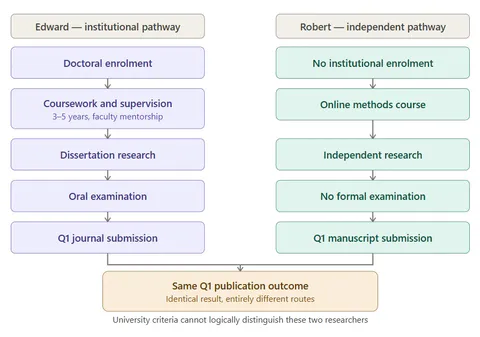
Diagram 1: Edward-Robert thought experiment. Two parallel pathways - one through the full institutional doctoral process, one through independent study - both converging at the same Q1 publication outcome. Robert's pathway includes the box 'No formal examination,' indicating that the absence of an oral defence is a named step in the sequence rather than a gap in the process. The convergence into the amber box makes the logical contradiction immediately visible: the university's own stated criteria cannot distinguish between the two researchers.
The University as Brand Certifier: A Product Quality Analogy
The institutional arrangement described in the preceding section bears a striking structural resemblance to a practice that would attract immediate scrutiny in any other quality-regulated domain: a manufacturer affixing its own quality certification label to a product whose quality was actually determined by a third-party testing laboratory, then charging a premium for that label without disclosing the outsourcing relationship.
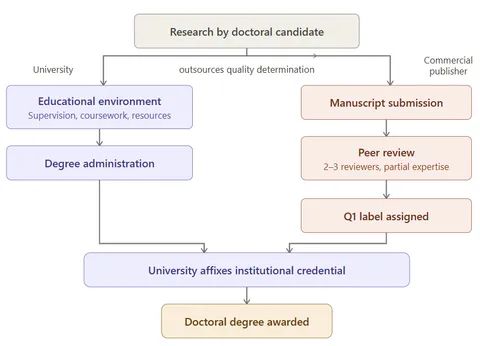
Diagram 2: University as Brand Certifier. Two parallel tracks run from the same starting point - the doctoral candidate's research. The left track shows the university's two retained functions: providing the educational environment and administering the degree process. The right track shows the quality determination function, which is transferred via a dashed arrow to the commercial publisher, where peer review assigns the Q1 label. Both tracks converge at the bottom, where the university affixes its institutional credential to an outcome whose quality was determined externally, producing the doctoral degree.
When a university makes a Q1 publication a graduation requirement and subsequently awards doctorates on that basis, it performs three distinct functions that are routinely conflated but warrant careful differentiation. First, it provides the educational environment - supervision, coursework, library and laboratory resources, access to an academic community - within which the research was conceived and developed. Such a contribution is both substantive and valuable. Second, it administers the degree process - registering the student, managing programme timelines, conducting examinations, maintaining institutional records, and conferring the credential. The administrative function is essential, though not in itself a quality determination. Third, it certifies research quality - but if a Q1 publication is the operative quality criterion, the actual quality determination was made by the journal's peer reviewers. The university's degree, in this third function, is a repackaging of an external commercial judgment under its own institutional brand.
The distinction carries significant implications. Universities charge substantial tuition fees - fees that are partly justified by the prestige and market value of the institutional credential being conferred. If the quality claim underlying that credential rests primarily on an external commercial judgment that any researcher could in principle obtain without institutional enrolment, then students and their families are partly paying for brand affiliation rather than for an independently verified quality certification. Employers and academic institutions that treat the doctorate as a reliable quality signal are similarly relying on a credential whose quality basis is more complex and more commercially mediated than its institutional presentation suggests.
None of this implies that university education adds no value - it manifestly does, through the breadth of formation, the supervisory relationship, and the disciplinary socialisation that doctoral programmes provide. The point is rather that the quality certification function, specifically - the function that the Q1 requirement is supposed to serve - has been contracted out to commercial publishers in a way that universities have never formally acknowledged, publicly justified, or subjected to independent scrutiny.
The Q1 Journal as Degree-Granting Institution: A Logical Terminus
The most radical implication of the analysis developed in this section follows directly from the positions examined above. If Q1 publication is the definitive criterion of doctoral research quality, and if that criterion can be met without university enrolment - as the case of Mr Robert demonstrates - then the logical terminus of the university's current position is that a Q1 journal could, in principle, serve as an alternative degree-granting institution.
Consider the following hypothetical extension of the thought experiment. Suppose a major Q1 journal publisher were to establish a structured research training programme - offering online instruction in research methodology, literature review practices, and academic writing - and were to require programme participants to independently conduct and successfully publish original research in a Q1 journal as the condition of programme completion. The publisher would then issue a certificate of completion to those who satisfy this requirement. By the university's own operational logic, Q1 publications are the definitive quality benchmark for doctoral-level research. Therefore, this certificate would represent the same level of demonstrated research competence as a university-conferred doctorate.
Such a scenario is not fanciful. It is simply the direct application of the university's own stated criteria to a non-university institutional context. If universities find this conclusion uncomfortable - and they should - the discomfort points directly to what the Q1 requirement has cost them: the articulation and defence of a distinctively institutional account of what doctoral education represents, beyond the publication credential that commercial publishers can now independently confer.
Addressing this challenge requires more than an appeal to institutional prestige; universities must articulate a substantive and distinctively educational account of what the doctoral process contributes beyond the publication credential itself. A genuine response requires universities to specify, defend, and reinvest in the elements of doctoral education that genuinely distinguish their credential from a publication record: the breadth of scholarly formation, the sustained supervisory relationship, the capacity for cross-disciplinary critical thinking, the ability to defend original work under expert questioning, and the socialisation into a community of scholarly practice that extends far beyond any single research output. These are real and important distinctions - but they are precisely the distinctions that universities undermine every time they reduce the doctorate's quality validation to a Q1 publication requirement.
Peer Review, Knowledge Asymmetry, and the Epistemology of Certification
What Peer Review Can and Cannot Do
The peer review process performs several functions that are genuinely valuable and that no proposed alternative has yet fully replicated. It provides a structured mechanism for independent evaluation of submitted research by individuals with relevant expertise. It catches errors, identifies methodological weaknesses, requests clarification of ambiguous claims, and suggests additional literature, analyses, or framings that strengthen manuscripts before publication. It creates a documented record of evaluative deliberation that - even when imperfect - represents a more explicit quality assurance process than would exist in its absence. These functions are real and important, and any credible critique of peer review must begin by acknowledging them.
The difficulty arises not from what peer review does, but from the institutional translation of what it does into a quality claim that extends well beyond its demonstrated capacity. Peer review, as a process, evaluates whether a submitted manuscript meets the criteria applied by two or three reviewers on a particular occasion. The process makes no claim, in its own internal logic, to certify that the published work is reproducible, that it represents the most significant contribution possible from the data, or that its findings will prove durable across contexts. These limitations are inherent to the review process as designed, and no reasonable assessment of peer review has ever claimed otherwise. The problem emerges at the institutional level, where universities embedding Q1 requirements into doctoral regulations, national research assessment frameworks incorporating journal rankings into funding allocation, and institutional league tables treating Q1 publication counts as proxies for research quality collectively transform a bounded and conditional process into an authoritative quality standard. It is this institutional amplification - not peer review itself - that produces the gap between what the process delivers and what it is officially taken to certify.
A further analytical distinction is necessary before proceeding to specific limitations. Some of the most frequently cited failures associated with peer-reviewed publication - the replication crisis, the prevalence of underpowered studies, the systematic suppression of null results, and the distortion of research agendas toward publishable rather than important questions - are not, strictly speaking, failures of peer review. They are failures that originate upstream of review: in research design decisions, in incentive structures that reward positive findings, and in publication practices that filter out null results before submission. Peer review receives submitted manuscripts; it does not determine what research gets conducted, how it is designed, or which results are withheld from submission. Attributing these systemic problems to the review process itself mislocates the causal mechanism and risks producing reform proposals targeted at the wrong point in the research production chain. The critique developed here is more precisely targeted: it concerns the limits of what peer review can evaluate given the information available to reviewers at the point of assessment, not the broader dysfunctions of the scientific incentive system within which peer review is embedded.
With this distinction established, the specific epistemic limits of peer review can be stated precisely. Peer review cannot guarantee the reproducibility of reported findings: this is partly because reviewers assess the plausibility and internal consistency of reported results rather than independently verifying them, and partly because many reproducibility failures originate in research design decisions that preceded submission and are not visible to reviewers from the manuscript alone. Ioannidis's (2005) empirically grounded argument that many published research findings are more uncertain than peer-reviewed publications has generated extensive discussion and considerable supporting evidence (Baker, 2016; Open Science Collaboration, 2015). Peer review also cannot ensure that the submitted work represents the most significant or impactful research in a field. It can only evaluate whether the work submitted to a particular journal on a particular occasion meets the journal's stated criteria for methodological adequacy and theoretical contribution. Whether the most significant work in a field is being submitted to Q1 journals - as opposed to being published in monographs, circulated in preprints, published in lower-ranked venues because Q1 fees are prohibitive, or disseminated through non-academic channels - is a question that peer review itself cannot address.
The Knowledge Asymmetry Problem
Perhaps the most underappreciated epistemological challenge confronting peer review is the problem of knowledge asymmetry between specialist researchers and generalist reviewers. Contemporary doctoral and postdoctoral research, by its nature, is a process of developing highly specialised expertise in a narrow domain. For example, A researcher who has spent three to five years investigating the relationship between AI-driven compensation transparency and human capital accounting disclosure in manufacturing firms has, by the end of that process, acquired a depth of contextual, methodological, and theoretical knowledge about that specific problem that virtually no reviewer can match.
This asymmetry creates a structural challenge for peer review as a quality certification mechanism. Reviewers can evaluate whether the manuscript's methodology is sound by general disciplinary standards, whether its literature review is representative, whether its conclusions are proportionate to its evidence, and whether its writing is clear and professionally adequate. These are valuable evaluations. However, reviewers typically cannot evaluate whether the research question chosen is the most important or productive question that could have been asked, whether the data collected are the best available data for answering it, whether the theoretical framework employed is the most appropriate among available alternatives, or whether the specific findings reported represent the most significant implications of the research. These judgments require the kind of deep contextual knowledge that only the researcher themselves, and perhaps a handful of genuine peers, possess.
The implication is not that peer review is useless but that it operates as a necessary rather than a sufficient condition for quality certification. A manuscript that fails peer review may genuinely contain methodological weaknesses, unsupported conclusions, or insufficient scholarly rigour that justify rejection. Nevertheless, a manuscript that passes peer review has only demonstrated that it meets the standards that two or three reviewers - working within a limited time, with partial expertise, and under no obligation to reach agreement - chose to apply on a particular occasion. Such an outcome represents a considerably weaker quality signal than the Q1 imprimatur is typically taken to represent.
Reviewer Availability, Reviewer Fatigue, and the Quality of Review
Structural problems on the reviewer supply side further constrain the practical quality of peer review. Proportionate growth has not kept pace with the expansion of academic publishing, leaving the pool of qualified reviewers undersized. According to the Publons Global State of Peer Review report (2018), approximately 15 million review requests were sent globally in 2017, and a significant proportion could not be filled, leaving editors to recruit increasingly junior, increasingly peripheral, or increasingly fatigued reviewers to cover the gap.
Reviewer fatigue is a documented and serious problem. As the volume of submitted manuscripts has grown - partly driven by the Q1 publication pressure that makes every doctoral student and faculty member a regular submitter - reviewers who are themselves subject to the same pressures find it increasingly difficult to devote the time and attention that rigorous evaluation requires. Kovanis et al. (2016), in a mathematical modelling study of peer review in the biomedical literature, found that 20 per cent of researchers accounted for 69-94 per cent of all reviews, with the vast majority of scientists contributing little or nothing to the system. The Publons report (2018) further found that researchers worldwide spend approximately 68.5 million hours on peer review annually - equivalent to approximately 7,800 researcher-years - a burden that is highly unequally distributed, with editors disproportionately selecting reviewers from established Western institutions. The predictable consequence is a highly variable quality of review, in which some manuscripts receive genuinely expert, rigorous, and constructive evaluation, while others do not. In contrast, others receive cursory, superficial, or poorly matched assessments that reflect reviewers' time constraints more than the manuscripts' actual qualities. This variability is not incidental to the peer review system; it is a structural feature of a process that has expanded in volume without a commensurate expansion in the supply of qualified, available, and appropriately matched reviewers.
Article Processing Charges, Financial Exclusion, and the Distortion of the Quality Signal
The Scale and Structure of APC Fees
The Article Processing Charge model that now dominates Q1 open-access publishing creates a financial barrier to publication that, in many institutional contexts, operates independently of research quality. Understanding the scale of this barrier requires engagement with both aggregate data and representative examples drawn from across the Q1 landscape. Aggregated evidence from the OpenAPC initiative - which collects APC payment data from participating institutions worldwide - and from systematic analyses such as that conducted by Morrison et al. (2022) and subsequently updated by Schimmer et al. (2015) indicates that mean APCs in hybrid and fully open-access Q1 journals have risen substantially over the past decade, with current average fees in major publisher portfolios typically ranging from USD 2,000 to over USD 5,000 per article. Morrison et al. (2022), analysing a large cross-publisher sample, found that APC costs are not uniformly distributed across the Q1 tier but vary considerably by discipline, publisher, and journal prestige level. This point qualifies any claim of uniform exclusion.
To illustrate the range and disciplinary spread of these costs, the following journals have been selected to represent different publishers, subject categories, and price points within the Q1 tier rather than to constitute a systematic sample: Nature Communications (Springer Nature, multidisciplinary) at approximately USD 6,790; PLOS ONE (PLOS, multidisciplinary) at USD 1,895 (representing the lower end of the Q1 range); Journal of Business Research (Elsevier, business and management) at EUR 3,200; and Sustainability (MDPI, environmental and social sciences, widely accessed in Southeast Asia) at approximately USD 2,700. These figures are indicative rather than exhaustive, and APC schedules are subject to periodic revision. Their purpose is to illustrate the order of magnitude and cross-publisher variability of the financial commitment that Q1 open-access publication typically requires, not to characterise the entire Q1 corpus.
For researchers at well-funded research universities in the United States, the United Kingdom, or Western Europe, APCs are typically covered by institutional open-access funds, grant budgets, or transformative read-and-publish agreements negotiated between publishers and university consortia. In these contexts, the researcher faces no direct personal financial obstacle to Q1 publication. For researchers at universities in Thailand, Vietnam, Indonesia, the Philippines, or other emerging economies - where institutional research budgets are limited and where individual researchers may receive little or no institutional APC support - the USD 2,000 to USD 7,000 fee represents a formidable obstacle. At Thailand's average academic salary levels, a single Q1 APC can represent one to three months of pre-tax income. The financial calculus facing many researchers in this situation is clear: lower-cost venues become more attractive, and a Q1 open-access submission may be abandoned entirely.
It is important to acknowledge the mitigating structures that publishers and institutions have introduced to address this disparity, as an accurate analysis requires engagement with these mechanisms rather than their omission. Most major publishers offer APC waiver or discount programmes for researchers from low- and middle-income countries, typically referencing World Bank income classification as the eligibility criterion. Springer Nature's Research4Life programme, Elsevier's waiver policy, and MDPI's discount schemes are among the most widely cited examples. Transformative agreements between publishers and national library consortia, now in place in several European countries and increasingly adopted in other regions, further reduce the direct APC burden for affiliated researchers. These structures are real, and their existence should not be minimised.
However, the documented limitations of these mitigating mechanisms substantially constrain their practical effectiveness. Several critical weaknesses warrant attention. First, waiver eligibility is inconsistently applied and administratively burdensome: researchers must identify the applicable policy, initiate a separate application process, and, in some cases, negotiate directly with journal editors, placing the burden of navigating a complex, non-transparent system on the researchers least equipped to do so (Lawson, 2015). Second, waiver programmes do not cover all Q1 journals: many high-prestige journals, particularly in business, economics, and the social sciences, either do not participate in waiver schemes or offer only partial discounts that still exceed the financial capacity of researchers in resource-limited contexts. Third, countries classified as middle-income by World Bank criteria - including Thailand, which is classified as an upper-middle-income economy - frequently do not qualify for the most generous waiver tiers, despite institutional research budgets that are substantially smaller than those of high-income country universities with which their researchers are expected to compete. The consequence is that the mitigating structures, while meaningfully reducing exclusion in some cases, do not eliminate the systemic financial disadvantage that APC-dependent publishing imposes on researchers from emerging economies, and that this disadvantage continues to contaminate the quality signal that Q1 publication is supposed to transmit.
Financial Contamination of the Quality Signal
The structural consequence of APC-based financial exclusion - even when partially mitigated by waivers and institutional agreements - is what this article terms the financial contamination of the Q1 quality signal. If the Q1 corpus systematically excludes or underrepresents research from resource-limited contexts, not because that research is of lower quality but because its authors face financial barriers that their counterparts in wealthier institutions do not. The Q1 label ceases to represent a pure quality signal and becomes instead a compound signal that conflates research quality with institutional financial capacity.
This contamination has several observable dimensions. Bibliometric analyses consistently show that research output from North American and Western European institutions dominates Q1 journals in proportion to those regions' share of global research activity. In contrast, research from Sub-Saharan Africa, South and Southeast Asia, and Latin America is systematically underrepresented relative to the volume and quality of research activity in those regions (Larivière et al., 2015; Zhang et al., 2022). While multiple factors contribute to this disparity - including language barriers, citation network effects, and disciplinary coverage gaps - APC costs are a significant and underappreciated contributor that interacts with these other factors to produce cumulative disadvantage.
The consequence for doctoral education is particularly problematic. When universities in emerging economies adopt Q1 publication requirements - often in emulation of Western institutional models or in response to national research policy incentives - they implicitly ask their doctoral students to compete in a publication market structurally tilted against them. The requirement that a Thai, Nigerian, or Indonesian doctoral student publish in Q1 journals as a condition of degree completion imposes on that student both the standard costs of doctoral research and an additional financial burden that their counterparts at well-funded Western institutions do not bear in the same form. The arrangement bears no resemblance to a level playing field: it is a handicap race presented as a sprint.
The Predatory Publisher Problem and Quality Inversion
A further complication arises from the proliferation of journals that exploit the APC model while providing little to no editorial or review services. So-called predatory journals - characterised by Beall (2012) and Beall (2016) and subsequently by Grudniewicz et al. (2019) - accept manuscripts with minimal or fraudulent peer review in exchange for APC payments, thereby corrupting the nominal quality signal that fee payment is supposed to accompany. While predatory journals are typically not Q1-ranked, the existence of this market demonstrates the extent to which APC payments have become decoupled from actual quality assurance in the broader academic publishing culture.
More relevant to the present analysis is the phenomenon of high-volume, APC-dependent Q1 journals - particularly those operated by MDPI and similar publishers - that have achieved Q1 status through citation accumulation strategies while accepting manuscripts at rates that raise legitimate questions about review rigour. A journal that publishes thousands of articles annually, charges APCs for each, and achieves high citation counts through sheer volume of output may achieve Q1 status through statistical effects that are quite different from the editorial selectivity that Q1 status is supposed to represent. The quality signal, in these cases, is not contaminated by exclusion but by inclusion - by the acceptance of manuscripts that a more rigorous process might have rejected, because the APC revenue incentive creates systematic pressure toward higher acceptance rates. The financial distortion of the Q1 quality signal therefore operates in two structurally opposite directions simultaneously: excluding high-quality research from under-resourced contexts through cost barriers, while admitting lower-threshold research from fee-paying authors through volume-driven acceptance strategies.
Toward an Alternative Model of Research Quality Certification
Principles for Reform
The critique developed in the preceding sections does not imply that research quality certification is unimportant or that external peer review should be abandoned. It suggests, rather, that the current Q1-centric model may not measure what it claims to measure with the accuracy or consistency its institutional application assumes, that it imposes disproportionate burdens on researchers from resource-limited contexts, and that it has generated incentive structures with consequences the scholarly community has not yet fully addressed. Several principles should guide a reformed model.
Before articulating these principles, it is necessary to acknowledge the practical constraints that originally motivated the adoption of proxy metrics and that any viable reform proposal must directly confront. The turn toward bibliometric indicators in the 1980s and 1990s was not purely ideological; it was partly a practical response to genuine institutional problems. As universities grew in size and disciplinary breadth, and as academic labour markets became more internationally competitive, the administrative cost of conducting substantive direct evaluation of every research output became prohibitive. Senior academics, faced with expanding workloads, could not realistically provide rigorous, direct assessment of hundreds of annual submissions across dozens of specialisms. Citation metrics and journal rankings offered a solution that was administratively tractable, comparatively cheap, and sufficiently standardised to support cross-institutional and cross-national comparisons. Any reform proposal that fails to acknowledge these genuine pressures risks appearing normatively attractive but operationally naive. The proposals advanced in the following subsections are designed with this constraint explicitly in mind: they do not propose the wholesale replacement of proxy metrics with bespoke direct evaluation for every research output, but rather a targeted and differentiated restoration of direct evaluation authority at the points where the proxy metric model produces its most serious distortions - specifically, doctoral quality certification and institutional research assessment for promotion and funding purposes.
With this operational framing established, four principles should guide reform. First, the principle of direct evaluation: quality assessment at the most consequential decision points - doctoral certification, promotion, and research funding - should be grounded in direct engagement with research content, including methodology, evidence, argument, and contribution, rather than in indirect proxies such as journal rankings or impact coefficients. Second, the principle of contextual adequacy: quality criteria should be appropriate to the research being evaluated, recognising that different disciplines, methodological traditions, and research purposes involve different standards of adequacy. For example, a mixed-methods study of compensation practices in Thai manufacturing firms should be evaluated by criteria appropriate to that type of research, not by metrics derived primarily from the natural sciences citation culture in which impact factors originated. Third, the principle of equity: quality certification mechanisms should not systematically disadvantage researchers based on the financial resources of their institutional context, since research quality is a property of the work rather than of the researcher's institutional address or their institution's ability to pay publication fees. Fourth, the principle of transparency: the processes by which research quality is assessed should be open to scrutiny, contestable, and subject to ongoing improvement, rather than locked within the proprietary systems of commercial publishers whose evaluation procedures are not subject to independent audit.
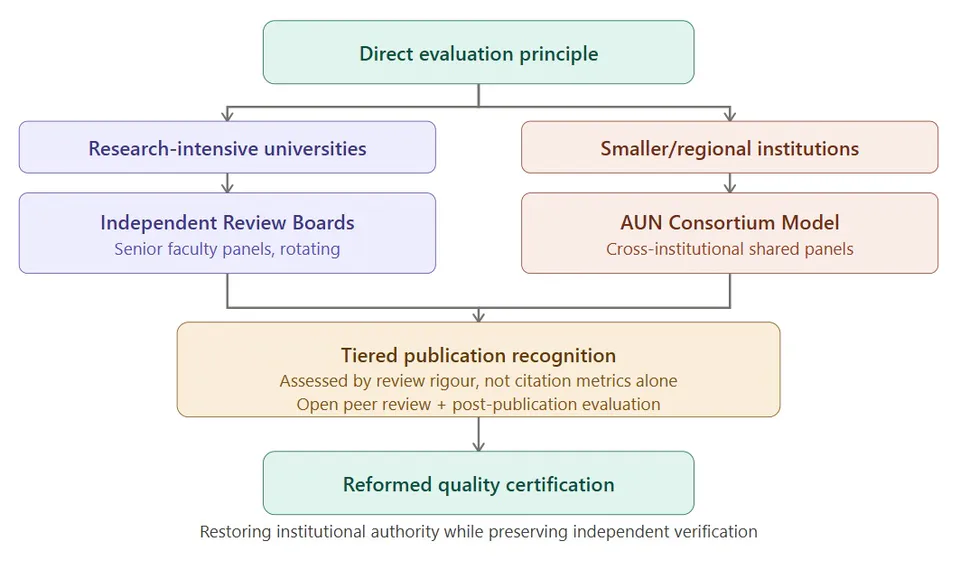
Diagram 3: Alternative model. A hierarchical framework flowing top to bottom. The direct evaluation principle sits at the top as the guiding commitment. Below it, two differentiated implementation pathways branch left and right: research-intensive universities establish Independent Review Boards with rotating senior faculty panels, while smaller and regional institutions adopt the ASEAN University Network (AUN) Consortium Model with cross-institutional shared panels. Both pathways converge into a central box covering tiered publication recognition - assessed by review rigour rather than citation metrics - and incorporating open peer review and post-publication evaluation. The final box at the bottom, reformed quality certification, represents the outcome: institutional authority restored while independent verification is preserved.
Institutional Review Boards for Research Quality
One concrete reform proposal involves the establishment of university-level research quality review boards - independent internal bodies with the authority and expertise to certify the quality of doctoral and postdoctoral research through direct evaluation, unlike the existing doctoral examination process, which focuses primarily on whether a candidate has demonstrated sufficient competence to be awarded a degree, such a board would evaluate whether specific research contributions meet a publicly stated standard of scholarly quality sufficient to count toward institutional research assessment.
The feasibility of this model varies significantly across institutional types and must be assessed differentially rather than as a uniform prescription. At research-intensive universities with large faculties spanning multiple disciplines, the senior academic workforce is broad enough to constitute credible review panels across a reasonable range of specialisms without placing unsustainable demands on individual scholars. The key operational requirement is that review board membership rotates systematically, that evaluation criteria are codified and publicly available, and that the time commitment per review is bounded and recognised in academic workload allocation. International precedent exists: the Norwegian and Danish national research assessment systems incorporate elements of direct expert panel review that operate alongside bibliometric measures, demonstrating that hybrid models are institutionally viable at scale (Sivertsen, 2017).
For smaller, more specialised, or less research-intensive institutions - including many regional universities and private institutions in Thailand and across Southeast Asia - the capacity for fully independent direct evaluation is more constrained. These institutions face genuine challenges of disciplinary breadth, senior faculty availability, and the risk that internal review panels may lack sufficient independence from supervisory relationships. For such institutions, the preferred implementation pathway is a consortium model: a regionally coordinated review structure in which participating universities contribute senior reviewers to shared panels that evaluate doctoral research across member institutions. Such a model distributes the workload, enhances independence, and enables smaller institutions to access specialist expertise they cannot maintain internally. The ASEAN University Network (AUN) quality assurance framework provides an existing regional infrastructure within which such a consortium arrangement could, in principle, be developed. Reaching this destination requires deliberate investment and institutional will, but neither the concept nor the operational requirements are beyond the capacity of the regional higher education system.
Such boards would not replace peer review - external publication would remain a valuable mechanism for disseminating and discussing research. However, they would reduce the institution's dependence on journal quartiles as a proxy for quality and restore meaningful quality certification authority to the institution that awarded the degree.
Tiered Recognition of Publication Venues
Rather than the binary Q1/non-Q1 distinction that dominates current policy, universities could adopt a tiered recognition framework that acknowledges genuine quality differences among publication venues while explicitly discounting financial access barriers. Such a framework might recognise Q1 publication in well-established journals with documented review rigour as the highest tier, while also recognising strong publications in Q2 and Q3 journals, high-quality open-access repositories such as SSRN and arXiv, and well-refereed conference proceedings in fields where these constitute primary dissemination vehicles.
Crucially, such a framework would assess journal quality based on documented review practices, editorial standards, and field reputation rather than citation metrics alone, explicitly discounting APC-gated access as a quality criterion. Journals that achieve Q1 status through high-volume acceptance and citation accumulation strategies would be assessed at a lower tier than journals with comparable citation metrics but more rigorous and selective review practices. The administrative cost of maintaining such a tiered framework is real but manageable: the principal requirement is a structured periodic review of journal quality indicators by discipline-specific academic committees, a function that many universities already perform informally and that could be formalised without prohibitive resource commitment.
Open Peer Review and Post-Publication Review
A growing movement within academic publishing advocates open peer review - in which reviewer identities and review texts are published alongside accepted manuscripts - as a mechanism to improve review quality, accountability, and transparency (Ross-Hellauer, 2017). When reviewers know their evaluations will be publicly attributed and scrutinised, they have stronger incentives to produce careful, rigorous, and fair assessments. The evidence base for open review's effectiveness is still developing, but early results from journals that have adopted it - including several operated by BioMed Central and the British Medical Journal group - are cautiously encouraging.
Post-publication peer review, in which published work continues to receive evaluation and commentary after journal acceptance, is a complementing mechanism particularly well-suited to addressing the knowledge asymmetry problem. Because post-publication review is open to any researcher with relevant expertise - not limited to the two or three reviewers a journal's editor selects - it is more likely to attract evaluation by the most genuinely expert readers in a speciality. Platforms such as PubPeer, F1000Research, and the overlay journal model developed around arXiv preprints represent practical implementations of this approach at varying stages of maturity.
Policy Implications for Thailand and Southeast Asia
For universities and research institutions in Thailand and Southeast Asia, the analysis in this article suggests several specific policy directions. National research funding agencies - including the Thailand Science Research and Innovation (TSRI) and the National Research Council of Thailand (NRCT) - should explicitly review their use of journal quartile rankings as funding eligibility or performance criteria, and consider replacing or supplementing them with direct evaluation criteria that are less susceptible to financial access distortion.
Thai universities that impose Q1 publication requirements as doctoral graduation conditions should either establish APC subsidy mechanisms sufficient to ensure that all doctoral candidates have equal financial access to Q1 venues or adopt tiered recognition frameworks that explicitly acknowledge the quality of research published in high-quality Q2 and Q3 venues. To require Q1 publication without providing the financial means to achieve it is to impose an inequitable requirement that systematically disadvantages researchers whose primary limitation is financial rather than intellectual.
Regional academic publishing initiatives, including the ASEAN Citation Index and Thailand's TCI (Thai-Journal Citation Index), should be developed with explicit attention to the lessons of the Q1 model's failures, building quality assurance frameworks that prioritise direct review rigour over citation-based metric proxies, and that establish APC structures accessible to researchers across the region's diverse institutional landscape.
Conclusion
This article has argued that the Q1 journal publication requirement, as currently institutionalised in doctoral education and research assessment frameworks worldwide, rests on a set of conflated assumptions that warrant critical examination and substantial reform. The quartile ranking system measures the citation-based prestige of journals - a property of the publication venue and its position in citation networks - rather than the intrinsic quality of individual research contributions. The peer review process, while genuinely valuable as one component of quality assurance, operates under structural constraints - including reviewer availability, knowledge asymmetry, and commercially mediated incentives - that limit its reliability as the primary mechanism for certifying doctoral research quality, even if these constraints do not eliminate its value as a necessary component of scholarly evaluation. Furthermore, the APC-based financial structure of the Q1 publishing market introduces a systematic equity distortion that causes the Q1 label to reflect institutional wealth alongside, and at times in place of, research quality.
What the analysis developed across the preceding sections has produced, taken together, is something that no individual strand of the critique could establish alone. The bibliometric critique - that citation metrics are imperfect proxies for research quality - is well established in the literature and, taken alone, might support only the modest conclusion that universities should supplement Q1 metrics with additional indicators. The epistemological critique - that peer review is a necessary but not sufficient quality condition - is similarly documented and, taken alone, might support only calls for peer review reform. The equity critique - that APC costs disadvantage researchers from resource-limited contexts - is increasingly recognised in policy discussions and, taken alone, might support only targeted subsidy mechanisms. The contribution of this article lies in demonstrating that these three critiques are not independent concerns but structurally interconnected manifestations of a single underlying condition: the institutional abdication of quality certification authority by universities to a commercial publishing system that is not accountable to scholarly values, not designed to evaluate intrinsic research quality, and not structured to provide equitable access across the global research community. Recognising this shared structural root transforms the policy prescription from incremental adjustment to principled institutional reclamation.
The Edward-Robert thought experiment crystallises the logical contradiction at the heart of the current system. When a university simultaneously insists that Q1 publication is the definitive quality benchmark for doctoral research and awards a degree on that basis, it implicitly accepts that anyone who achieves Q1 publication by any route has met that benchmark - whether or not they ever enrolled at the university. The point is not a theoretical curiosity. It is a direct consequence of the university's stated criteria, and it exposes the extent to which the doctoral credential, in its quality-certification dimension, has drifted toward a brand exercise rather than an independent institutional judgment.
A university that outsources its determination of operational quality to commercial peer reviewers and then affixes its own institutional credential to the outcome is performing a brand certification function rather than an independent scholarly evaluation. The distinction carries direct consequences for students, employers, and academic institutions, all of whom pay a premium for the doctoral credential that is partly - and perhaps substantially - a payment for institutional brand rather than for a quality determination made by the institution itself. Universities have an obligation to be transparent about this and to address it through reform.
The logical terminus of the current trajectory is that a Q1 journal publisher equipped with a basic research training programme could, by the university's own operative logic, serve as a de facto doctoral credential institution. The appropriate response to this conclusion is not to assert institutional prestige without justification, but to rebuild and articulate the substantive elements of doctoral education that genuinely distinguish the university credential from a publication record: the breadth of scholarly formation, sustained supervision, cross-disciplinary critical thinking, oral defence capacity, and the deep socialisation into scholarly practice that no publication alone can represent.
The institutional reorientation that the analysis calls for is neither unprecedented nor beyond reach. Universities have reformed their quality assurance practices before, in response to other moments of institutional crisis or policy transformation. The adoption of bibliometric governance under new public management pressures from the 1980s onward was itself a reform - one that solved certain administrative problems while generating the epistemological and equity distortions this article has documented. A further reform, one that restores direct evaluation authority to the institutions that train and examine researchers, is not only justified by the analysis but supported by emerging international precedent in national research assessment systems that have begun to reintegrate expert panel review alongside, or in partial replacement of, purely metric-based evaluation.
The stakes of this argument extend well beyond the procedural. They concern the fundamental question of who controls the definition and recognition of knowledge - and whether that control should reside with scholarly communities and their institutional homes, or with commercial publishers whose primary accountability is to shareholders rather than to the advancement of human understanding. A knowledge certification system that may systematically exclude excellent research because its authors cannot afford publication fees, that delegates institutional authority to commercial intermediaries, and that tends to conflate prestige proxies with intrinsic quality merits, sustained critical attention, regardless of its administrative convenience.
Doctoral researchers who ask why a commercial quartile label must serve as the final judge of their work - rather than the institution that trained, supervised, and formally examined them - are raising a legitimate institutional question that deserves a serious and substantive answer. This article has attempted to provide the analytical framework within which that answer must be developed, and to establish the grounds on which it must now be given with some urgency.
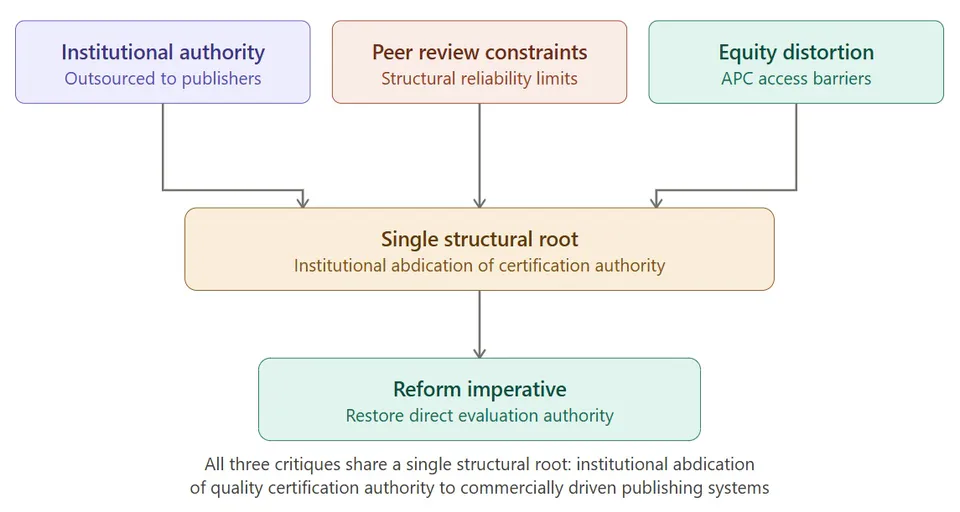
Diagram 4: Three-problem framework. The three interconnected problems - institutional authority, peer review constraints, and equity distortion - are arranged in a horizontal row at the top. Solid arrows from all three converge downward into a single central box identifying their shared structural root: the institutional abdication of quality certification authority. A further arrow descends from the structural root into the reform imperative, showing that all three critiques, once understood as manifestations of a single condition, point toward the same institutional response.
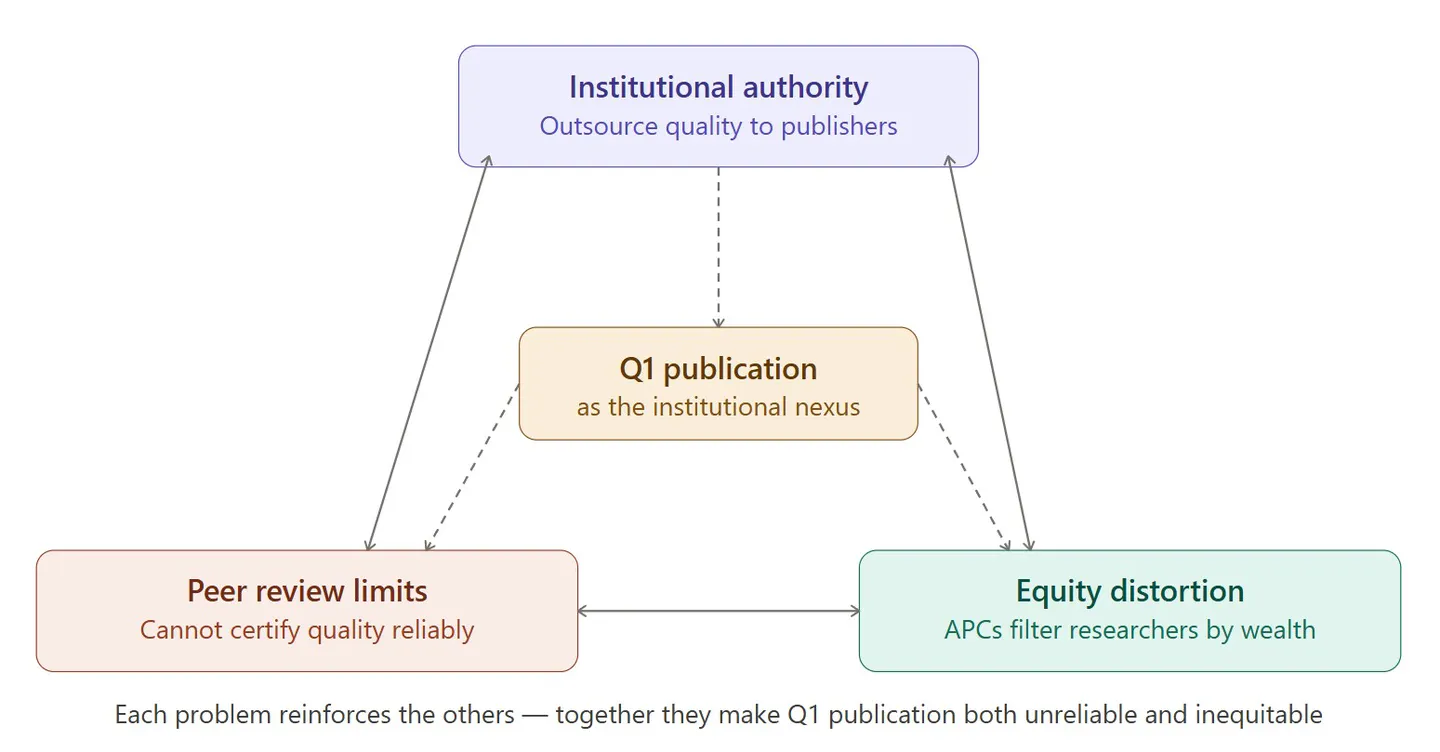
Three-problem framework (continued).
Data Availability Statement: No new data were generated or analysed in the course of this study. This article is a conceptual and critical review; it does not report empirical findings derived from a primary dataset.
Conflict of Interest
Ethical Approval
Not applicable
Data Availability
The datasets used in this study are openly available at [repository link] and the source code is available on GitHub at [GitHub link].
Funding
This work did not receive any external funding.
Cite this article
Related Research

Special Issue
Launch a focused special issue to highlight research, emerging trends, and expert insights in your academic field.