


Abstract
Based on a series of clinical experiences characterised by patients’ attempts to prevent the examination of parts of their body experienced as the cause of chronic pain, we speculated as to what dynamics might be behind this conflict. It was postulated that, if not moderated by the mother, early pain is linked with this very same maternal introject and must be preserved as the sole remaining organising core to prevent fragmentation. These pains, which we understand as early bodily sensations, evaluate a symbolically, imaginarily or asymbolically organised phantasm that is in many cases purely phenomenal, i.e., pre-propositional. Morgenthaler’s model of a filling formation was used here as a theoretical framework. Generalising, reference is made to the coupling of drive actions and affect, according to which a drive action that is inappropriate for the affect serves to sedate the very same affect that points to a usually traumatic situation.
Explore Digital Article Text
In this paper, we deal with the question of how very early childhood experiences are depicted in adulthood, especially in analysis. We assume that the relationship and attachment experiences of the small child lead to specific formations of the synaptic connections long before the existence of anything like stable mental representations.
Nevertheless, all the experts assume that these apparently unrepresented experiences have a profound specific influence on later psychological life (Braun et al. 2002). One might also postulate the existence here of a massive non-representable influence on the immune system, for which there are numerous highly valid indications. Whether the failure of the immune system has an unconscious or conscious correlate must remain open to debate. If it does at all, it consists of retroactive constructions centred around the phenomenon of having no boundaries (e.g. no skin).
From a biological perspective, we assume that these early synaptic impressions experience a new affective-cognitive transcription or formulation with each development, specifically, while preserving the essence of the previous development. We take our cue inter alia from Spitz's theory of the so-called "epigenetic landscape" (1972). In this theory, human development is represented as a cone projected into a landscape. The time around birth is the culmination:
The first organiser is found in unstable equilibrium on the tip of the topmost cone; it can roll down the outer surface of the cone somewhere within a 360degree radius to come to rest at a particular point on the periphery of the circle that forms the base of the cone. There it becomes a second-order organiser, the point where it forms irreversibly determining some of the further developmental lines (Spitz 1972, p. 51 f.). Figure 1 depicts such a developmental landscape:
The development is described as a traversing of paths, or, if you will, sunken paths. At any given time, the individual can only be on one of the paths. The stretches traversed imbue the individual with his characteristics, and the depth of the sunken paths represents the difficulty experienced by the individual in abandoning one path for another. Once traversed, a trajectory defines the next routes that are possible in principle. It is not possible to retrace one's steps on such routes. The interactions of the genetic and peristatic conditions, i.e., the interactions of the psychobiological conditions, determine which route is traversed. The consecutive 'paths' correspond to the various 'motivational systems', particularly to the attachment/security system, the relationship controls associated with the latter (in the sphere of autonomy, but also in the sphere of desire, i.e., of eroticisation and seduction).
Before we come to pain as an organiser of the early self, let us visualise this complex process of the various reworkings using the example of a set of fetishistic symptoms. The following case histories are clearly connected with an early disorder. Even so, the sexual impetus and the striving for autonomic regulation are unmistakable. The fetish forms an agglomeration of various forms of representation that are ready to be summoned as a highly stable part of the personality.
When Mr M. was 4 years old, he discovered – whilst going through an oedipal reorganisation – the life jacket as a perverse fetish. In Spitz's model (see Fig. 1), the ball B assumes specific positions over the course of development, on which early and current forms of representation solidify in the life jacket fetish. The ball B1, which marks the tip of the cone, consists e.g., in the experience of 'drowning' without the mother's support. The child is helpless. He cannot be without the mother. In a birth experience, this state would be one of complete helplessness. According to Winnicott (1974), B1 could be the state of a breakdown. Thus, the life jacket (B2) is the new version of a mother without whose physical presence survival cannot be ensured. When the jacket is fastened, it is supportive and lifesaving.
It was then supposed to have a particular smell, which would remind him of his earlier childhood world. Later, in adulthood, further paths are covered; the ball then assumes the B3–B5 positions. The life jacket now becomes a fetish that his partners wear: it keeps his partner alive.
It is a means of autonomic regulation or an instrument of domination that shackles and holds the object tight, and is ultimately a tremendously stimulating, visually sexual representation of a part of the body when it is worn during coitus a tergo by his partner and her head protrudes like a glans from the skin-like jacket.
We are therefore dealing with an invention that is re-illustrated and re devised at each of the outlined developmental stages (B2–B5). Any object that becomes associated with this invention and its variants is built into their structure. Sexuality only becomes involved over the course of oedipal development. In the earlier phases (B1, B2) it is a wholly existential matter, e.g., it concerns the integrity of the body image or the granting of a fundamental autonomy.
II. PAIN AS AN EARLY ORGANISER OF THE SELF
We applied this logic of the translation of early experiences into other, 'higher' forms of representation to explain a number of clinical constellations that will be described below.
Case Histories 2–5
Mr K., a very gifted, professionally competent man, was unshakeably convinced that he had a brain tumour, which triggered the severest of symptoms such as episodic visual impairment, shortness of breath, headaches and thought disorders. He was a member of the profession. There was no reason to assume that he was faking the symptoms, or that they were driven by a conversion-like dynamic. Nevertheless, at no time was he prepared to be seen by an expert diagnostician.
Ms G. could detect a very painful lump in her left lower abdomen which at bad times she assumed with certainty to be a malignant growth. The existence of this growth seemed as certain to her as her will not to have it examined. She had developed a very pronounced panic reaction to doctors which had nearly led to hospitalisation in the psychiatric ward, since both the experts and her husband were of the opinion that this symptom needed to be examined.
Mr. M., a 45-year-old former sportsman of great talent who now weighed 140 kg, had put on an enormous amount of weight following two accidents from which he had not recovered. At the time of treatment, he was scarcely able to walk. He had severe abdominal pains, especially when he was trying to sleep. His body grumbled with mysterious ailments and he was oppressed by dreadful aches and pains, especially when he was inactive, which because of his weight was the usual case. With all the technology at their disposal, including a stomach MRI, the doctors were unable to find a somatic correlate or reason for the pain, which distressed the patient, particularly since creating an image of his body had entailed huge effort and expense.
Ms P. was born shortly after the parents of her mother – a minor – had passed away within a few months of one other. The baby had been completely unplanned, effectively an "accident" in a conservative rural Alpine region. The mother was completely overwhelmed, and scarcely took care of the unwanted child, either during the mourning period or later, when she moved to the next town. In her first year, Ms P. was taken care of by an aunt on a neighbouring farm. The mother rejected the child, blaming her for her early unhappiness. As far back as the earliest years of her childhood ("as far back as I can remember"), Ms P. could recall the feeling of an inner emptiness and lifelessness. Later, Ms P. made every effort to secure her mother's love with over-the-top behavioural adjustments. Often, however, she felt depressed. She tried to ignore her emptiness with non-stop work (as an architect), but this strategy was destined to fail over the long term. She had a breakdown, suffered from a number of medical issues, some of them very serious, including a stroke, and had to give up her job. The only thing that remained was the pain. As soon as she woke, the pain would be there. Everything ached: her connective tissue, her periosteum, her head. She lived on a disability pension in the suburb of a fairly large town, in one of the conurbation's typically grim blocks of flats. Possibly, even as a baby that feels abandoned, unloved and helpless, she would have experienced bodily pain of this kind, from the muscular tension and the desperate turmoil of the autonomic nervous system. Perhaps the pain had then become the core of her self, whose gravitational field held the other layers of the self together. But then Ms P. managed to find other solutions: mature relationships, her profession. It is possible, however, that the non-represented condition of pain remained in her core, continuing to serve the purpose of cohesion.
During the 'breakdown', now an adult, her body again collapsed. Lacan (2006, p. 78) speaks of a "fragmented body" (corps morcelé) when the body, despite having passed through the entire mirror stage, fragments once again. In this crisis situation, the pain stood out more distinctly. That very pain, as an organiser of the self, now strode onto the stage of representation.
Case History 6 (Research Interview)
As part of a qualitative research project, we asked hospitalised patients with somatoform pain to take part in two interviews and to paint a total of three pictures in the interval between the interviews. Among others, the theme of floodgate of feelings was suggested. In the first interview – in other words, before painting the three pictures – one of the participants reported on her first few days in the clinic, while she was suffering from great loneliness and was worrying about the breaking-off of various relationships :
Ms A.: So, I was sweating from the pain. And one morning I actually cried with rage, you know, lying on my back. Although I take Doxepin, so, that's always been a great help to me, at home I only needed one tablet, and here, I've noticed, I don't know, it may be the surroundings, it's a change, isn't it? No family here, and everything's new, the people are new, uh, I've naturally brooded a great deal and thought about things and simply couldn't put an end to my thoughts.
Interviewer (L.G.): What were you thinking about?
Ms A.: Oh, it's, it's small stuff (laughs). So, um, I'll, I'll tell you what I think about at home, I always think about things that could happen. When this and this happens like, like I'd like it to, then that can happen, or, or if my daughter, for example, doesn't get home promptly, or my partner, or I can't reach my friend, then I always think she's been in an accident, and then I'm practically (laughs), in quotation marks, right, tearing my hair out, because I'm thinking that something has actually happened to them. I always get quite aggressive at home then, you know?
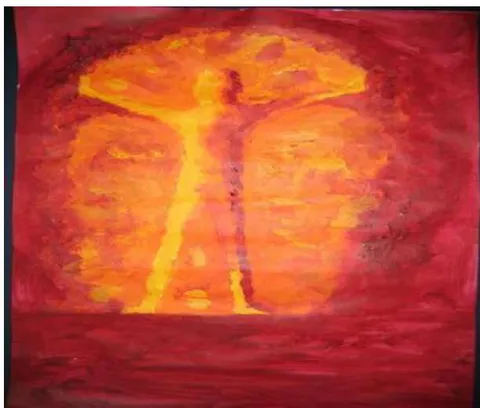
She then painted the following picture:
In the second interview, which was conducted after the three pictures were painted, Ms A. reported on the various instances of mental and physical abuse, undermining and humiliation that she had experienced since early childhood. She related that she had been raised by her grandmother for the first few years of her life; her parents had no interest in her. Although we do not know what the grandmother felt about the baby, Ms A. forms a positive figure in her memory. The Interviewer (I.) enquires:
I: "May I ask you, does it also hurt physically, when your mother..." (Ms A. interrupts him) Ms A.: Of course (with emphasis). So, the emotional is transferred to the body, isn't it, and, uh... it's simply, it also hurts, when... - it's just so tense, that also hurts physically.
The above picture (in Figure 2) was seen in our group of researchers (cf. Ruettner et al., 2021) as the expression of a state of intense pain (since it shows a figure that is burning). Ms A. commented on her work thus:
Ms A.: I wish I were like that! (laughs)
I.: In what way?
Ms A.: Yes, well, I, hm, I think, I'm standing totally (stresses the word) on the ground, with both feet, right? Um, my hands stretched out, straight, and I'm letting, like, I want to say, my aura, I don't know how I should express it.
I.: Hm, I understand.
Ms A.: Right? And, um...
I: And the orange here...
Ms A: I, I, yes, yes, um, it also had a lot [to do] with love (stresses the sentence), right? And, and, um, yes, I'm just, that's me, and everyone is, everyone will be alone at some stage, will simply die, right? So, I'm responsible for myself, and I intend to do something for myself, and, and as I said, I need to sense this aura, and, um, yes... (Pause)...
I.: Are you looking to the back here, or into the picture?
Ms A.: Right, no, into the picture.
I.: And why is it lighter here and darker here?
Ms A: No idea, because I, sort of, hm, yes, because I'm perhaps blazing. This is fire, yes, yes, yes, and sometimes one burns.
In her picture and explanations, it seems to us, the utter painfulness of this patient's physical and emotional state is represented: A human being that is burning – and who looks into the fire, into the fiery hell, it would appear, but the fire (pain) keeps her upright: as if it were in fact the organiser of the self, so that the patient can laugh and say "I wish I were like that!" (just like Ms P. in the previous case history sees only – emotional – death as an alternative to pain).
Of course, the phenomena that patients experience and feel have a physiological and physical correlate; it's just that they cannot be associated with a known causal theory of illness.
Mr M. was not consciously aware of any mental fantasies about the origin of his pain or any mental correlates of the pain, outside of the fact that there was something there that hurt. It was liquid or gaseous. Admittedly, when asleep he had a whole host of highly extended persecution fantasies that seemed far more dreadful to him than the pain, so that we can say that the pain protected him from the dreams. In all these cases we may observe that there is a dialectical tension between having the pain on the one hand and the panic-stricken fear of objectivising this pain on the other. The panic feeds on two sources: firstly, on the fear that there might actually be an illness or disease, i.e., that something is wrong with the body; and secondly, on the fear of giving up the (life-preserving) pain. Let us now consider the unconscious mechanisms underlying this tendency.
III. PAIN AS AN ORGANISER OF THE PROTOSELF
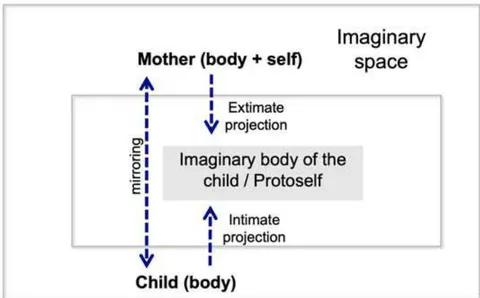
As part of a provisional heuristic, the hallucinated infliction of pain on oneself or others may be understood, within the meaning of Morgenthaler, as the filling of a gap, as with a sexually perverse act (Morgenthaler 1984). That is 'nothing'. And this nothing is filled with pain, since emptiness would be unbearable. The emptiness is filled with a physical sensation, and this physical sensation can be pain. The psychosomaticist Sami Ali assumes an emotional-physical whole that he calls a "psychosomatic totality" (Sami Ali, 2006, p. 15 ff., see also Leiser, 2007, p. 183). The basis of this totality is the "imaginary body" which develops in an "imaginary space" and later centres this space, i.e., becomes its constitutive focus. It arose through early mirror experiences between the child and the primary object: through mirror effects that lend this space its imaginary quality.
Widmer (1997, p. 30) points to the multiplicity of the imaginary mirror forms, ranging from the sensory perception of the mother's breast and skin, and her warmth and smell in general, to the intonation of her voice, all the way to her gaze.
Into this space the child now projects its real, previously unconscious bodily experience.
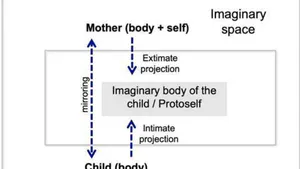
Because the projection serves to help create its own self, we speak – with reference to Lacan's idea of intimacy/extimacy – of an intimate projection. But the mother too will not only return to that space – ideally in a processed manner – that which she receives from her child, but – now via an estimate projection – her own contributions: her own affect, but also her own bodily states. Thus, the pain constituting the core of the infant protoself can stem from the child as well as the mother – or, as an amalgam, from both. This protoself, which develops via mirror effects and projections, contains early experiences of warmth, security, stability, well-being, but also of coldness, emptiness, pain or excruciating excitation. Damasio (2011, p. 33 ff.) speaks of a "bodily protoself" whose further development follows the "core self" (with emotional qualities in particular) or the in-cognitive-terms more highly structured, affectively differentiated "autobiographic self" that tends to belong to the symbolic order. This protoself survives as a living, or even as a wounded, damaged, dead core of the self: a core of events of bodily states that implicitly reminds us and can be updated repeatedly throughout one's lifetime. Figure 3 shows the mirroring and projective effects for the creation of the protoself.
These mirroring and projection processes can be understood by invoking the concept of a reflective mirror function, which Lacan described inter alia in his Seminar X (2010, p. 68). At a formal-logical level, Marc Heimann (2022, 2023) introduced the concept of the 'mirror operator', which explains how mirror relationships function between logical spaces.
In Seminar X, Lacan (2010, p. 69) distinguishes between a 'perverse' and a 'neurotic' structure, in which a mirror operation of this sort takes place. The 'perverse' subject knows nothing about object a but the voice or gaze of the Other. This subject is split ($) insofar as object a is completely unconscious. This mirror relationship can be described as follows (Lacan, 2010, p. 69; Heimann, 2022 and 2023):
In this formula,denotes the real object, anddenotes the mirror operator.denotes the mirror's split subject. The mirror operator causes the real object(e.g., pain) to be 'built into' the Protoself. This is the situation of the early breakdown(in Figure 1: B1). It is possible that this Real (i.e., Non-represented) is, so to speak, carried along in the further development of the personality, i.e., in a personality that is increasingly mature and capable of behaving more or less autonomously in relationships. In this case, the real objectcould be translated into the Imaginary-Phantasmic. If objectis 'translated' into the Imaginary, Lacan(2010, p. 69)then speaks of a 'neurotic structure'. In this sense,(in our case, pain) is real in the 'perverse structure' formula, whilstin the following 'neurotic structure' formula is imaginary, i.e., the subject () is aware of the pain (or experiences the pain as part of his body image).
A S | a $
This formula states that the subject S contains both the unconscious object a and the split subject $. 'Subject S' means a subject that corresponds to the interpretation of idealist philosophy in terms of an undivided autonomy (Heimann, 2022). In the event of a further breakdown (e.g., as part of Ms P's professional and personal crisis), pain, which is revealed in the imaginary body image, will once more have the task of organising a collapsed body. Hence, Ms. P's statement: "If I don't feel any pain, I'm dead."
We assume that pain constitutes a possible original form of a 'representation', long predating the development of more-mature representations. These effects are already possible in the prenatal period, assuming that babies already possess a phenomenal consciousness (Goetzmann & Janus, 2023). Here, the meaning of the picture should be noted: Olfactory and auditory perception are short and fleeting, and require endless repetition until they become one object, and then another object that is independent of the experiencer. By contrast, the mother's image can be stable when the infant looks at her. If conditions are favourable, the image of the mother's face can moderate, modify and comment on physiological processes, including that of pain. It can calm these physiological processes. If the mother is absent, i.e., if there is no meeting at the visual level and the child does not succeed in finding itself in its mother's gaze, then the pain is not moderated or modified sufficiently. If the mother is actually present but is also depressive, i.e., casts a numb, lifeless look at her child, pain may be associated with the image of this (emotionally) "dead mother" (Green 1983). Above all, however, pain – despite its dreadfulness – is possibly the most suitable physical-emotional experience for guaranteeing the child's survival. Pain becomes a lifejacket, long before the child knows what pain or lifejackets are. Pain fills the vacuum, the emptiness, it fills the hole, and it becomes, so to speak, the grain of sand around which the protoself develops with the absent or non-reacting 'dead mother'. The ball at the tip is emptiness, and on its further trajectories, this ball is filled with pain. The deep unconscious will to first hallucinate pain, then hold on to it with all one's strength, may derive its impetus from this. Another possibility is that the pain replaces the 'dead' introject of the mother. At later stages of development, it remains a not-(yet) representable introject that is in search of a sensory medium of representation, which it sometimes even finds.
In some of the cases we have described, pain is a representation of the dreadful-yet-stabilising maternal introject. Then, as shown by Novick and Novick (1991), taking on the pain of others could even be built into one of the highly archaic fantasies of grandeur that function according to the model of "when I 'have' my mother, she is freed from it". Pain is then an 'estimate symbol' (Niendorf & Goetzmann, work in preparation), i.e., a symptom whose origin is to be located in the unconscious of the Other. In this respect, it is 'ex-centred' (Lacan 2019a, p. 12). To a certain extent, the flip side of this is inflicting pain onto another; through this act, the patient has disposed of this 'dreadful' mother into another body, in an 'act of divine creation'.
Just as the fetish is an inanimate object between body and drive into which life is breathed in the sexual act, the creation of pain in one's own body is a process akin to a perversion which puts an end, at least in the short term, to the dreaded near-psychotic fear of complete loss of autonomy, to the feeling that one is fragmenting. In this context, initiating and feeling pain, and even taking part in the pain inflicted on others, could be a royal road to the temporary recovery of a narcissistic balance through feeling 'self-inflicted' bodily pain. This pain needs no more be 'real' than the fetish is animate. The key issue is what affect accompanies this pain.
IV. PAIN, AFFECT AND DRIVE ACTION
Pain can be associated with various affects. The following vignette may serve as an example:
Mr X. was nearly 50 and married with children. To his own surprise, he had a very intense coming out as a "homosexual". Within the context of a passionate sexual relationship, the patient increasingly engaged as a passive partner in the technique commonly referred to as 'fisting' – allowing himself to be penetrated by the fist and forearm of his partner. In the normal course of things, one would expect this practice to be associated with pain. However, Mr X. described it as a "peak experience" that caused him no pain whatsoever. No conscious fantasies fuelling such behaviour could be found.
In Mr X.'s case, however, the following may be important as context: orientation towards his own sex was not associated with the renunciation of women; rather, he was turning in a masochistic-symbiotic manner to his mother, who at this time had a bowel obstruction and was noticeably declining. In identifying with his mother, it is possible that Mr X. experienced this sexual practice as a vital healing of his gravely ill parent. The obstructed bowel was transformed into a vagina that was capable of sensation. The pain of the fisting was transformed into pleasure. The dead mother, who had declined irreparably, was transformed via identification into a female being who revelled in sex. Krause (2012) has described in detail such new creations – McDougall (2001) speaks of "neosexualities" – in their consolidative capacity. We assume that this high consolidation applies both to sexual enactments and to the experience of pain as an enactment of earlier traumas.
On the Internet there are a wealth of recordings, primarily of lesbian couples, that clearly contradict the assumption that this practice must be associated with pain; however, there is scarcely a description that does not allude to great trepidation, at least with regard to the initiation.
When the experience is a success, one finds descriptions like the following: "It was a peak experience to feel her so deep inside me, each finger movement triggered an orgasm." At the same time, the visual perception of the excitement of the lover being penetrated by one's arm is described as "tremendous", or in any case as very intense. This "pleasure-pain" could be compared to Lacan's female jouissance: to a traumatic enjoyment that is constitutive for the subject's self-organisation. In situations where there is an extreme threat of fragmenting, the jouissance becomes an organiser of the self.
V. PAIN AND UNPLEASURE
In early psychoanalysis, the avoidance of sensations of unpleasure and the maximisation of the opposite, namely, sensations of pleasure, were understood as a basic anthropological constant of human regulatory processes. Pleasure was defined as the result of the reduction of drive stimuli, inter alia pain. Unpleasure would then be the opposite, namely an increase in drive stimuli. The idea of the avoidance of unpleasure became key, right down to the understanding of dream events, since dream work, after all, aimed to maintain the conflict-ridden but pleasurable drive satisfaction through the process of deciphering. This did not work in practice, however. Total freedom from drive stimuli is unpleasant, and pain and feelings of unpleasure that even Freud was not able to understand as pleasure-concealing techniques make an appearance in the traumatic dreams.
Thus, when the dreams of accident neurotics regularly lead patients back into the setting of the accident, they are not serving the purpose of wish fulfilment in doing so. These dreams seek to catch up on stimulus mastery during the development of anxiety, the omission of which has become the cause of the traumatic neurosis (Freud 1920, p.32).
This is a very exciting idea, in which Freud maintains that the reason for the repetition is not the trauma per se, but the lack of protection from the stimulus, for example in the form of anxiety development during the traumatisation. The people are, so to speak, taken by surprise, and something along the lines of a dissociation could then occur. Subsequently, they develop an anxiety as a coping mechanism.
VI. SYMBOLIC CONVERSION
Where unconscious fantasies are fuelling or even causing the bodily process, we may be dealing with a symbolic conversion. In the classic interpretation of conversion, "unconscious internal conflicts that are meant to be relieved by a body-language symptom" (Egle 1996, p. 352) are assumed. By definition, conversion as a defence mechanism requires at least one further defence process, namely that of making the conflict unconscious. Usually, 'displacement' is invoked for this. On this basis, hysteria was conceptualised early on as a disease entity with a special potential for explaining psychogenic pain (Freud 1895). The fact that bodily symptoms could be an expression of an unconscious, e.g., oedipal, conflict tends to be overlooked in the "age of the post-oedipal society" (cf. Soiland, Frühauf & Hartmann, 2022).
In the above-mentioned study (Ruettner et al., 2021) it was shown that the threat of castration from a third party (regardless of whether this be the mother or father) is especially likely to be expressed in physical neurosis conversion disorders. The greater the likelihood of a traumatic vulnerability, the more severe the experience of the castration threat, which can then manifest mainly as physical disorders, e.g., pain (ranging from fibromyalgia and abdominal pain all the way to urethral disorders in both sexes). We could well imagine, within the context of Spitz's landscape, that early bodily pain that had led to the organisation of the early self is now used as symptoms to express aspects of a psychoneurotic conflict.
VII. METATHEORETICAL CONSIDERATIONS
In phylogeny, affects arose as non-specific appetences leading to definitive or final drive actions. In Pavlov's dog, salivation is the affective anticipation of the act of eating. Internally, this can probably be depicted as desire and appetite. In any case, based on this 'reflex', which is actually not a reflex, the animal can be conditioned – though only when it is 'in the mood to eat'. If another 'mood' – or, if you will, another drive – for example the removal of an enemy, rival or obstacle – is relevant to the action, the appetite affect is rage, and this in particular can also be used for conditioning, but only when the subject is in a mood of rage. The salivation reflex cannot be activated in this mood; in other words, the affect must match the drive or mood. Thus, sexual copulation as a consummatory action generally assumes bonding and courtship behaviour and hence positive affects: otherwise, the two would not come together. We have attempted to show here that a series of 'solutions' employed by patients consists in their trying to control or sedate an affect that they find unbearable – for example, grief or fear (usually about the loss of the object) – by mobilising a drive action that is not actually compatible with the affect (Krause 1993, p. 192). A similar consideration was developed not long ago by Grossman (2015). He postulated that, in addition to everything else, sadism, masochism and sadomasochism above all have an "object-preserving" function (Grossman 2015, p. 644).
Thus, a series of combinations that are actually unforeseen, like anxiety–appetite, rage–appetite, disgust–appetite and grief–appetite can arise. One of the problems of these solutions is that the drive assumes the quality of the affect. Drives are switched off by consummatory actions. For affects, there is no closing signal. After the consummatory action the anxiety/disgust/grief has increased rather than decreased, because it is now associated with contempt and revulsion, since the patient in fact knows that the action was harmful. This can be the basis for an addictive development.
Pain, as we have tried to show, can be associated with very different affects, and it is always available or involved in the form of one's own bodily experience. Hence, pain must intrinsically be experienced as an exclusively negative feeling. Pain can also be seen as the archetype of perversion. The delusional element can also attach itself to the body or the periphery of the body, for example, thinking that one is too fat, or being certain that one has scars on one's face, breasts that don't match, or too small a penis. Thanks to modern technology, surgical correction of the delusion is not associated with pain, although surgical slimming can be borderline. Like all perverse acts, however, the correction is only temporarily effective, since the unbearable affect of emptiness cannot be avoided in this way and the behaviour develops into an addiction, with the need for ever-greater doses.
In former times, the culture supporting such phantasms would always have taken this sort of pain in children in its stride; one need only think of the crippling of girls' feet or the deformation of infants' skulls in many of the world's cultures. The sexual significance of this fetishisation of body parts remained unconscious. It was probably more a question of beautification. The enforcement of this cruel beautification, which not least of all took its lead from masculine desire, was left to women. What this means for women among themselves remains to be researched. R.K. vividly remembers the mixture of rage and despair expressed by an intellectual mother, a teacher from Bougoni in Mali, when, during the holidays and without her knowledge, her daughter was taken by her mother – i.e., by the child's grandmother – for genital cutting.
ACKNOWLEDGEMENTS
Our thanks to Alf Gerlach for his feedback, criticism and suggestions.
Conflict of interests: The authors hereby state that there are no conflicts of interest.
Conflict of Interest
The authors declare no conflict of interest.
Ethical Approval
Not applicable
Data Availability
The datasets used in this study are openly available at [repository link] and the source code is available on GitHub at [GitHub link].
Funding
This work did not receive any external funding.
References
Cite this article
Related Research

Special Issue
Launch a focused special issue to highlight research, emerging trends, and expert insights in your academic field.