


IntelliPaper
Abstract
This paper reveals the concept of the "minimum energy expenditure" principle, which is one of the fundamental principles in the biological world. It plays a significant role in speciation, the formation of biodiversity, trophic chains, ecological niches, as well as in ensuring the long-term existence of biological species, populations, and individual organisms. The central idea of this principle is that among many possible scenarios, the one that requires the least energy expenditure for its continued existence is chosen. This, in turn, provides the selected scenario with a minimum of entropy, that is, maximum certainty. This regularity is characteristic of all established biological objects and processes. This generalized principle applies to a wide range of biological phenomena—from low-molecular processes to the biospheres level—and is one of the fundamental properties of open systems.
Explore Digital Article Text
I. INTRODUCTION
In this work, we limit our consideration exclusively to the principle of minimum energy expenditure, without addressing other, albeit related, principles such as the principle of minimum free energy, the principle of minimum total potential energy, and the principle of least action. Our goal is a detailed study exclusively of the principle of minimum energy expenditure using biological examples, emphasizing its unique role in the formation of the flora and fauna of the Earth's surface.
Although the principle of minimum energy expenditure and the principle of least action may seem conceptually close, they have significant differences. The scope of the principle of least action is limited to objects and phenomena of the physical world, where it has been thoroughly studied and formalized [9, 12]. In this work, we focus on the principle of minimum energy expenditure, as it is this principle that allows for effective analysis of regularities in biological systems.
In a broad sense, the principle of least action states that physical systems evolve in such a way as to minimize a certain quantity called action. Action is defined as the time integral of the system's Lagrangian, which represents the difference between its kinetic and potential energies. This principle is universal and applicable to a wide range of physical phenomena, from classical mechanics and electrodynamics to quantum mechanics. Mathematically, the principle is expressed using variational calculus, where instead of seeking a specific trajectory of an object, a trajectory is sought that makes the action functional stationary [12].
Examples of the application of the principle of least action:
- Classical Mechanics: A body thrown in a gravitational field moves along a trajectory that minimizes action.
- Optics: Light propagates along a path that minimizes propagation time (Fermat's principle, which is a special case of the principle of least action).
- Electrodynamics: The motion of charged particles in an electromagnetic field also obeys the principle of least action.
- General Relativity: Geodesics (paths along which objects move in a gravitational field) represent paths of least action.
The principle of minimum energy expenditure is one of the fundamental principles of the biological world, underlying many natural phenomena. It plays a key role in the processes of natural selection and the evolution of the biological world [3]. Living systems, functioning as open systems and constantly exchanging matter and energy with the environment, represent dissipative structures. They maintain their internal order (low entropy) through continuous production and export of entropy to the external environment. Thus, the minimization of energy expenditure corresponds to the minimization of internal entropy generation, which means maintaining the highest degree of order in the system [10].
II. MATERIALS AND METHODS
Based on empirical observations and a comparative analysis of specific and hypothetical biological examples, this study examines the concept of the "principle of minimum energy expenditure." First, it is necessary to clarify what is meant by "energy expenditure." In this work, "energy expenditure" refers to the energy required to maintain the biological structure or phenomenon itself. This quantity is not expressed in any specific energy units. The minimum energy expenditure is primarily associated with the genetic predisposition of biological systems (species, population, organism) and the corresponding structural arrangement of open physical systems. This will become clear in the subsequent presentation of our "minimum energy expenditure" concept.
The core idea of the principle of minimum energy expenditure is that, out of a multitude of possible options for the formation of a new biological object, the emergence of a phenomenon, or the course of a natural process, nature realizes the one that requires the least energy expenditure for its further existence [6]. Unlike the principle of least action, which pertains to the minimization of action over time, the principle of minimum energy expenditure determines the initial structure and organization of a biological object or phenomenon. This constitutes their fundamental difference. Moreover, the principle of minimum energy expenditure is more broadly applicable precisely to objects and phenomena of the biological world.
The existence of any biological object implies a certain degree of order; that is, the formation of any new structure must occur with a minimal increase in disorder. The principle of minimum energy expenditure explains this as nature's striving to realize the most probable option, in which the energy costs for forming and maintaining the structure are minimal. Consequently, the evolution of the biological world is directed towards establishing and maintaining order, which is confirmed by the ascending line of development from low-molecular biological objects to the biosphere level.
It is precisely the principle of minimum energy expenditure that ensures the possibility of long-term existence for any variant of an event realized in nature. Furthermore, the minimization of energy expenditure directly leads to the minimization of entropy, which, in turn, guarantees a high degree of certainty in the evolution of natural processes. This same principle drives all biological evolutionary processes occurring under conditions that meet the requirements of the ecological field of survival [5].
The requirements of the principle of minimum energy expenditure (its qualitative and quantitative characteristics) for each biological object or phenomenon are determined by its function. For example, the energy costs for maintaining metabolism in a predator and its prey will differ significantly in accordance with their roles in the trophic chain.
Let's consider a few examples. Take the migration of migratory birds: one route passes directly over a mountain range, requiring significant energy expenditure, while another is circuitous, along the coast, where access to food is easier and strong winds are less intense. Birds, as a rule, choose the second option, minimizing the total energy costs for migration, even if it is longer. Another illustration is the two types of metabolism in bacteria. In an oxygen-rich environment, bacteria use aerobic respiration, which generates significantly more energy from a smaller volume of substrate. In an oxygen-free environment, they switch to anaerobic respiration, which produces much less energy from the same amount of food. The realization of aerobic respiration in conditions of sufficient oxygen is due to its maximum energy efficiency. Yet another example is plant growth. A plant optimally allocates its resources (energy, water, nutrients) to maximize access to light and water. This may lead to slower growth or even death of some of its parts, but overall it allows the plant to minimize energy costs for survival and reproduction.
As examples of a different kind, one can consider mutational changes leading to the appearance of, for instance, a six-legged lamb or a three-eyed child; numerous such cases are known. Such individuals are generally incapable of long-term survival or reproduction. The reason lies in an energy deficit: the energy they consume is insufficient even for maintaining basic life functions of the organism, let alone performing vital functions such as hunting or reproduction. According to the principle of minimum energy expenditure, for each biological species, the optimal structure corresponds to the "standard" (four legs, two eyes, two arms, two feet, and so on), because precisely such variants ensure minimal energy costs for existence.
Upon analyzing the correspondence of each species to its ecological niche, it becomes evident that niches are distributed in trophic chains in accordance with the principle of minimum energy expenditure. At each link of the trophic chain, species optimally conforming to this principle dominate. Moreover, the nature of "minimum energy expenditure" is specific to each level: it is distinct in the plant world, different in the herbivore link, and entirely unique among predators. Thus, each trophic level is characterized by its unique manifestation of the principle of minimum energy expenditure.
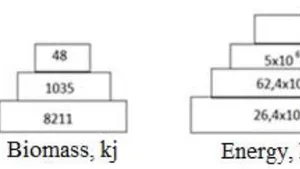
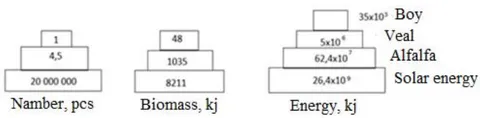
A more generalized and illustrative example reflecting the principle of minimum energy expenditure can be seen in the ecological pyramid of energy by E.P. Odum (1975) in ecological systems (see Fig. 1).
III. RESULT
Modern evolutionary theory shows that in archaic times, the prevailing conditions and inorganic matter gave rise to the organic world, leading to the emergence of life in its biological understanding. Thus, the phylogeny of organisms, based on the principle of minimum energy expenditure, demonstrates the directions and selective process of transforming various life forms, expressed in a general tendency towards the increasing complexity of the biological organization of living matter. Biological processes in the Earth's geographical envelope are multidirectional, saltatory, and, from an ecosystem perspective, ordered. They are subject to the logic of constant improvement and adaptation of organisms to changing habitat conditions thanks to the principle of minimum energy expenditure [3].
Informational, thermodynamic, and synergetic regularities collectively generate diversity, which can be viewed as evolutionary development. The mechanism of such development is the circulation of energy, matter, and information. This circulation occurs and will continue to occur uninterruptedly. The natural diversity of interconversions of energy, matter, and information in nature is infinite. Various biological species are, in essence, different mechanisms for converting energy from one form to another. All these transformations occur in accordance with the principle of minimum energy expenditure, which ensures the stability of their manifestation. Ultimately, this generates diversity in the real world, where this very diversity is both cause and effect [3].
Elements of biodiversity are constantly exposed to forces of attraction and pressure from surrounding environmental elements. As a result, unpredictable properties of the system manifest themselves. The action of internal forces of attraction and pressure leads to a violation of symmetry and to clustering, which, in turn, entails renewal. Interactions of any two or more elements from the entire array of Diversities of the Physical World (DPW) are always compared with one element from the multitude of All possible mentally conceivable diversities of information models of objects of ideal or physical nature (DIMIFN) in accordance with the principle of minimum energy expenditure [4] (see Fig. 2).
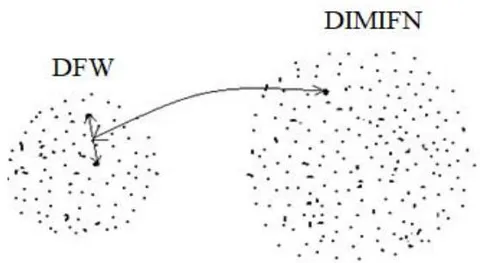
Fig. 2: Conditional representation of the relationship between two sets: DFW and DIMIFN.
Variants from the multitude of All possible mentally conceivable diversities of information models of objects of ideal or physical nature (DIMIFN) are realized in objects of the spatio-temporal continuum (Diversities of the Physical World (DFW)) through natural selection, that is, in accordance with the situation prevailing in nature within a given spatio-temporal continuum (the ecological field of survival) [4,5]. In this process, the guiding force of natural selection is the principle of minimum energy expenditure. This represents a logical continuation of the existence of physical objects from DFW that have exhausted their life cycle [4].
When a trophic chain or web is disrupted, several alternative chains or webs typically emerge. What accounts for the greater probability of a particular chain or web forming?
The probability of a particular alternative chain or web forming is determined by a variety of factors, including:
- Resource Availability: Which species, capable of occupying the vacant niche, have the greatest access to necessary resources (food, territory, light, water, etc.)? Species that can most efficiently utilize available resources will have an advantage.
- Species' Tolerance Ranges and Adaptability: As we have already discussed, species with wide tolerance ranges to various ecological factors (temperature, humidity, pH, etc.) and high adaptability will have a greater chance of survival and occupying the niche.
- Competition: Which species are the strongest competitors for resources in a given situation? Competitive interactions between species will determine which species can successfully establish themselves in the new structure.
- Predation and Other Interactions: The presence or absence of certain predators or symbionts can strongly influence the survival and distribution of species.
- Randomness and Historical Factors: Sometimes random events (e.g., the accidental appearance of a particular species in a given location) or historical factors (e.g., which species were already present in the ecosystem before the disruption) play a role.
Ultimately, the formation of a specific trophic chain or web is determined by the complex interaction of all the aforementioned factors, with the principle of minimum energy expenditure playing a leading role.
Let us consider a hypothetical trophic structure of biodiversity (a conceptual model of a trophic web). Suppose we are given the following biodiversity structure, consisting of 13 species [6] (see Fig. 3):
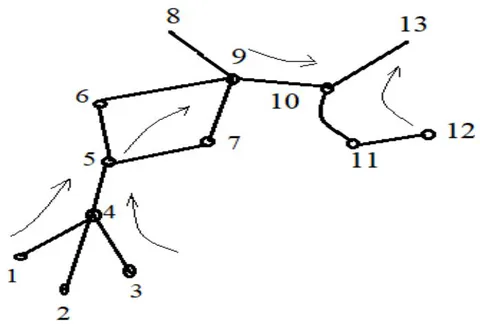
Fig. 3: Trophic chain of 13 conditional species.
Suppose that in this trophic web (Fig. 3), Species No. 7 is removed from the structure as a result of some ecological changes. What structural changes are possible in such a case?
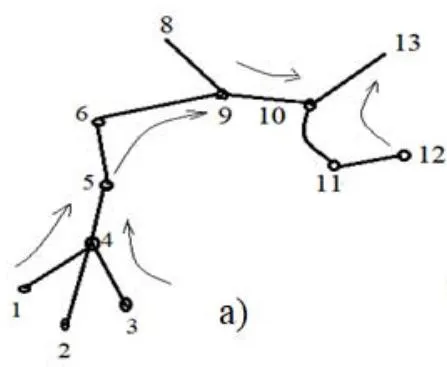
Fig. 4: Possible variants of structural changes in the trophic chain presented in Figure 3. 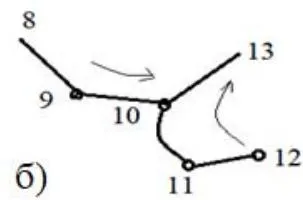
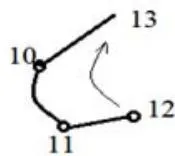
Depending on the survival coefficient values of species (6), (8), (9), and (10) (Fig. 3), trophic structures corresponding to variants (a), (b), or (c) (Fig. 4) may be realized [1,2,7]. In other words, the realization of various trophic structure variants is determined by a complex of factors, including (resource availability; species' tolerance ranges and adaptability; competition; predation and other interactions; randomness and historical factors). The wider the tolerance range, the higher the species' survivability. Knowing the biology of species, it is not difficult to determine their own optimal survival ranges in relation to ecological factors. In addition to this, a crucial role in the structural changes of ecosystem biodiversity is played by the universal fundamental principle of nature - the principle of minimum energy expenditure, meaning that when choosing from several possible food options, the one that requires the least energy expenditure for further existence is selected. This, in turn, is linked to the species' own optimal survival range [1]. The more complex and diverse the trophic web, the more variants of structural changes in ecosystem biodiversity.
IV. DISCUSSION
The principle of minimum energy expenditure only works on the condition that the realization of different possible variants of a physical phenomenon is not equally probable. If all possible variants of a physical phenomenon are equally probable, then discussing the principle of minimum energy expenditure is meaningless. For example, when flipping a coin, the outcome of either side is equally probable. The same applies to rolling a die (dice) in backgammon: the outcome of each face of the die is equally probable. There are many similar examples in nature.
The mathematical basis of the principle of minimum energy expenditure, which underlies any "open systems" and "dissipative structures," lies in the mathematical descriptions of the thermodynamics of systems far from equilibrium (nonlinear thermodynamics) and the methods of ecological factor interaction theory [1,2,7,10,11]. Diversity generates diversity. From existing diversity, in accordance with the principle of minimum energy expenditure, new diversity is born. Such transitions are characteristic of biological systems.
Of all possible development paths, and depending on the value of the ecological field of survival and in accordance with the principle of minimum energy expenditure, the newly formed variant of a biological object or phenomenon is realized.
V. CONCLUSION
The minimum energy expenditure is determined by the genetic predisposition of biological systems and the structural arrangement of open physical systems.
Based on the principle of minimum energy expenditure, the path or variant of biosystem development is chosen from a multitude of possible options that requires the least energy expenditure to achieve a stable state or equilibrium, which is characteristic of biological systems functioning far from thermodynamic equilibrium.
The principle of minimum energy expenditure can serve as a basis for understanding numerous processes in physics, chemistry, and biology, in which systems are formed or organized in ways that lead to optimal conditions for their existence and functioning.
The principle of minimum energy expenditure is one of the fundamental properties of open systems and lies at the foundation of the theory of natural selection.
The principle of minimum energy expenditure may play a significant role in the design and construction of modern technological, artificial, and resilient biological constructs and robots.
Glossary
- The key idea of the principle of minimum energy expenditure is that, from the many possible options for the formation of a new biological object, the emergence of a phenomenon, or the course of a natural process in nature, the one that requires the least energy expenditure for its continued existence is realized.
- The principle of minimum energy expenditure is explained by nature's desire to realize the most probable option, in which the energy costs for the formation and maintenance of the structure are minimal.
ACKNOWLEDGMENTS
Thank God.
Funding Source
This research did not receive any specific grants from funding agencies in the public, commercial, or non-profit sectors.
Author's Contributions
Mukhamad Isakovich Gulamov: developed the project, analyzed the literature, and prepared the manuscript.
Ethics
This material is the author's original work and has not been previously published.
Competing Interests
Since there is no conflict of interest as the sole author.
Conflict of Interest
The authors declare no conflict of interest.
Ethical Approval
Not applicable
Data Availability
The datasets used in this study are openly available at [repository link] and the source code is available on GitHub at [GitHub link].
Funding
This work did not receive any external funding.
Cite this article
Related Research


Special Issue
Launch a focused special issue to highlight research, emerging trends, and expert insights in your academic field.