





IntelliPaper
Abstract
The quantum diffusion model for impurity atoms in low-dimensional nanosystems has been developed with software for calculating the quantum diffusion coefficients for impurity atoms in materials at different temperatures. The temperature dependence of the quantum diffusion of hydrogen and deuterium on the ice surface is calculated, which shows that it is very close to a straight line in logarithmic coordinates. It has been shown that the quantum diffusion coefficient of hydrogen is about 35 times greater than the diffusion coefficient of deuterium at the temperature of 10 K. The developed model was used to calculate the dependence of the hydrogen quantum diffusion coefficient in a graphone on temperature. It has been established that at temperatures above 200 K, thermally activated diffusion of H begins to dominate, and at temperatures below 150 K, diffusion of hydrogen in graphone occurs by tunneling.
Explore Digital Article Text
I. INTRODUCTION
Hydrogen (H) is the most common element in the Universe, so its diffusion is a fundamental process in various fields of science, such as astrochemistry , materials science and technical sciences . The atoms of H and deuterium (D) exhibit a noticeable wave nature at low temperatures, so their diffusion by tunneling on the surface of solids is given considerable attention . The assessment of the parameters of hydrogen diffusion in materials with low dimensionality based on graphene, as possible hydrogen accumulators and elements of modern electronic devices, have a great importance .
At the same time, the tunneling diffusion of H atoms on water ice is the subject of modern research due to its importance for astronomy and astrochemistry . Unlike metal surfaces, H atoms are easily desorbed from water ice at low temperatures below 20 K , so studying the migration of H atoms on water ice, as well as the transition from thermally activated to tunneling diffusion is a difficult task.
It was established in that the surface diffusion of H atoms occurs approximately two orders of magnitude faster than the diffusion of D atoms, which cannot be explained by a classical thermal jump. This experimental evidence of tunneling on the ice surface should be explained by an adequate model of quantum diffusion. Therefore, it is interesting to estimate the parameters of hydrogen quantum diffusion on the ice surface at low temperatures and compare it with thermal diffusion.
In this case, to calculate the parameters of H quantum diffusion, it is necessary to apply a suitable quantum mechanical model of atomic tunneling. One such model for estimating the parameters of quantum diffusion was proposed in .
The purpose of this work is to develop the proposed model of particle tunneling in low-dimensional nanosystems and its application to estimate the parameters of quantum diffusion of hydrogen and deuterium on the surface of ice and graphene.
II. THEORETICAL METHOD
To describe the tunneling of an impurity atom through a potential barrier, we use a quantum-mechanical model of a particle with a mass located in a rectangular potential well of width a, bounded on one side by an infinitely high wall (x=0) and on the other (x=l) by a potential barrier height and width . If at some time t<0 width of the potential barrier is , then the particle is localized inside the low-dimensional "space" (o, l), and its wave function inside the potential well has a discrete spectrum (Fig. 1) [18].
{"image_source":{"path":"images/a93ff9abf87a908c7268f75fd3e28ab771f9651eaa4baf2187f8543916c04720.jpg"},"content":"","chart_caption":[{"type":"text","content":"Figure 1: Model of quantum diffusion of an atom through a potential barrier."}],"chart_footnote":[]}
The wave function of a particle at an arbitrary time for three regions: 1 (o < x < l), 2 ( ) and 3 ( ) are [18]:
where
The solution for the first region is chosen so that at x=0 it vanishes, and in the third region solution only the wave leaving the barrier is left. It leads to the appearance in the system of a quasi-discrete spectrum consisting of quasi-levels [18]. From the condition of continuity of the wave function of the particle at the boundaries of the barrier, the docking conditions are found.
At the x=l:
where .
The following relations follow from the last two equations:
From there, using some transformation [17, 18], for the energy of the particle, we find with accounting the additions:
is the quasi-discrete energy spectrum of the particle,
is the energy of particle in region 3,
– emitted energy passing through the barrier,
is a damping factor,
is a barrier transparency coefficient,
is the particle velocity in region 1.
The presence of the additive in the expression for the particle energy (11) means that in the quasi-discrete spectrum the particle energy decreases by compared to the energy in region 1. This state of the system corresponds to the particle velocity in region 3:
Consequently, when passing through the energy barrier, the atom loses speed and, therefore, radiates, reducing its energy by . The presence of the imaginary part in the expression for energy (10) indicates that the wave function of a particle in a potential well will decrease with time according to an exponential law. In this case, for the square of the modulus of the wave function, we will have:
where is the so-called decay constant, which characterizes the decrease in the probability of finding a particle inside the potential well.
Thus, the damping coefficients in regions 1 and 2 (inside the potential barrier) and 3 (outside the potential barrier) differ by a small amount equal to . It means that the probability of detecting a particle in region 1 changes with time as , and the probability of detecting a particle in region 3 as , where is the decay constant for region 3.
Using these expressions, we can make an equality:
and from here find the time , after which the amplitudes of the wave functions in regions 1 and 3 will have the same value:
Consequently, after a time determined by the formula (17), the probability of a particle staying in region 3 outside the potential barrier will equal the probability of its localization inside the potential well. Therefore, the time can also be used as the period the atom is in the potential well.
We can also calculate the time of half-life well-known from quantum mechanics [18]:
This value of time will be considered calculated according to the basic model. The calculation of thermally activated diffusion of hydrogen on the ice surface was performed according to the equation of the statistical model proposed in [19]:
where .
The presented simple model is mainly applicable to the description of the quantum diffusion of atoms of elements (hydrogen, nitrogen, carbon) at low temperatures. Software has been developed for calculating the parameters of quantum diffusion of elements in materials at different temperatures.
III. CALCULATION OF THE PARAMETERS OF QUANTUM DIFFUSION OF HYDROGEN AND DEUTERIUM ON
As an example of the application of the model, we will consider the diffusion of hydrogen and deuterium on the surface of ice molecules as a two-dimensional system at low temperatures (Fig. 2). In [20, 21], an experimental design was proposed to study the surface diffusion of H and D atoms on the ice surface, which combines photo stimulated desorption (PSD) and resonantly enhanced multiphoton ionization (REMPI). It is the zero-point energy difference between H and D atoms that causes the semiclassical kinetic isotope effect (KIE) [20]. Previously, a small KIE was reported in [21] for the diffusion of H and D atoms on the ice surface at 8 K and activation energies are 22 and 23 meV for the diffusion of H and D atoms, respectively. On the contrary, at higher atomic fluxes, the D/H ratio, especially for polycrystalline ice, increases to ~10 [14]. This large KIE cannot be explained by a thermal jump and is clear evidence of quantum tunneling diffusion of H and D atoms on the ice surface.
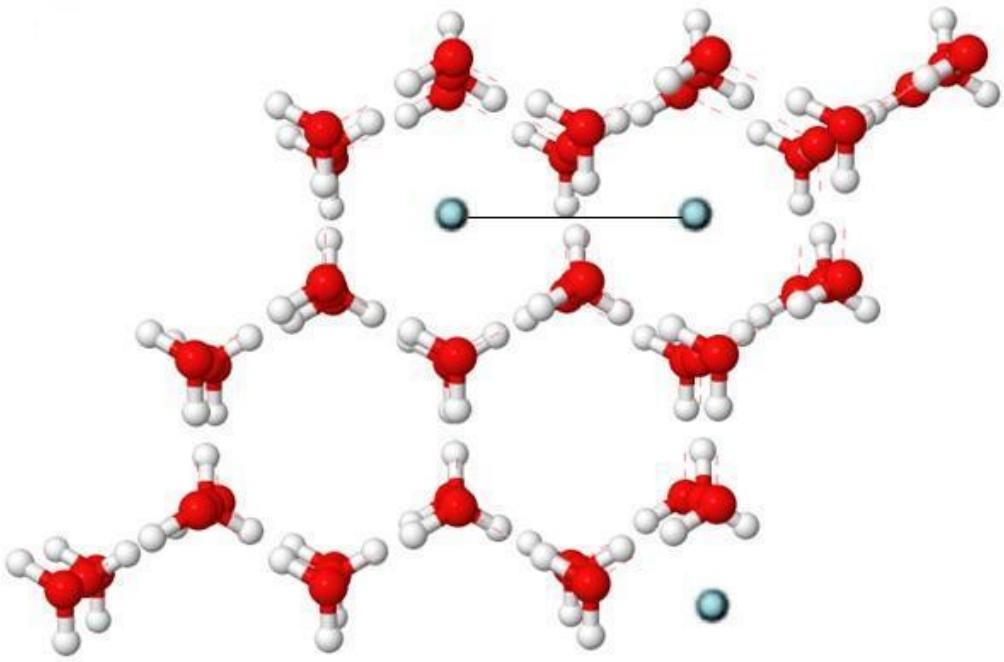
Figure. 2: Scheme of diffusion of a delocalized hydrogen atom (deuterium) on the surface of ice molecules. One of 6 equivalent directions of an atom motion is indicated. Oxygen atoms are shown in red, valent hydrogen atoms in white and delocalized hydrogen (deuterium) atoms in blue.
Using the above mentioned parameters, we calculate the quantum diffusion coefficient for hydrogen and deuterium atoms located on the ice surface. For calculations we will use the proposed low-dimensional model and assume that the dimensions of the potential well l and potential barrier a are equal to half the period d of the ice crystal lattice (0.225 nm). Considering 6 equivalent directions of motion of the hydrogen atom (and deuterium) on the ice surface, the diffusion coefficient will be calculated by the formula:
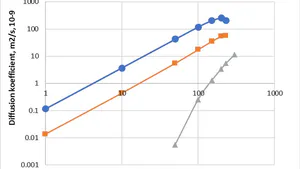
where is the time spent by the particle in the potential well, determined by the basic equation (18) and equation (17) of the proposed model. For comparison, the over-barrier diffusion coefficient was also calculated, and the results are presented in Fig. 3.
{"image_source":{"path":"images/8862a31896fbd9910d8693e05d1e486dcf4a803bdd8dd036e8fcdb96c909d117.jpg"},"content":"","chart_caption":[],"chart_footnote":[]} {"image_source":{"path":"images/c252764d47230f541ee4d9788870324640d165e6a48988e02e424fc038d42640.jpg"},"content":"","chart_caption":[{"type":"text","content":"a"},{"type":"text","content":"b"},{"type":"text","content":"Figure 3: Quantum diffusion H (blue line with balls) and Deuterium (orange line with squares) on the surface of the ice, with the estimate of over barrier diffusion H (gray line with triangles), a in the basic model, b in the developed model."}],"chart_footnote":[]}
Based on the above results, the following conclusions can be drawn. The calculation of the time spent by a particle in a potential well using the basic formula (18) gives underestimated values of the time spent by a particle in a potential well and high values of the diffusion coefficient (Fig. 3a). The values of the quantum diffusion coefficients, calculated by equation (18), significantly exceed the value of the thermal diffusion coefficient in the entire range of temperatures under consideration.
The proposed simple model makes it possible to obtain quite acceptable refined, in comparison with [17], values of these parameters at T=10 K, namely and . The quantum diffusion coefficient of hydrogen is about 35 times greater than the diffusion coefficient of deuterium at this temperature. This result was previously obtained theoretically in [17], allowing us to explain the experimental data of [14] satisfactorily. In the basic model, this ratio is about 8 and does not allow explaining the observed experimental ratio.
In the present work, it is established that the quantum diffusion coefficients of hydrogen and deuterium, as well as other elements, depend on temperature. This dependence takes place both in the basic calculation model (Fig. 3a) and in the proposed model (Fig. 3b). Therefore, the dependence of the diffusion coefficients of hydrogen and deuterium on the temperature in the range of 10–80 K observed in [14] can be explained precisely by quantum rather than ordinary diffusion through the barrier. This dependence on temperature for hydrogen is very close to a straight line in the Log (D) – Log (T) coordinates.
According to our estimate (Fig. 3b), ordinary hydrogen diffusion becomes more significant than quantum diffusion at temperatures above 150 K. At temperatures below 100 K, thermal diffusion does not contribute to the quantum diffusion of hydrogen, and the temperature dependence in the logarithmic coordinates is close to a straight line. This new theoretical result may well be confirmed experimentally.
IV. CALCULATION OF THE PARAMETERS OF QUANTUM DIFFUSION OF HYDROGEN ON THE GRAPHONE
A promising area of science and technology is the possible use of low-dimensional graphene-based materials for carbon electronics, chemical sensors with extraordinary sensitivity, and hydrogen storage .
In [23, 24], the properties of a stable graphone are studied (Fig. 4).
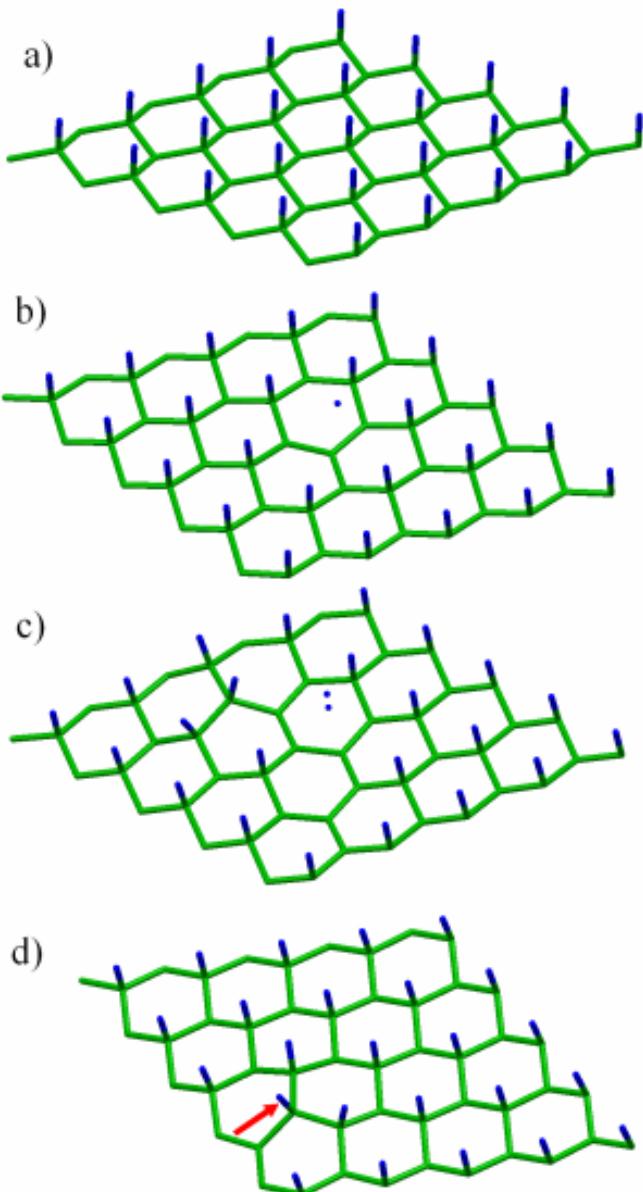
Figure 4: Structure of graphene [24]. Optimized atomic structure of pristine graphene (a), graphene with removed one (b) and two (c) adatoms; final step of the migration of adatom (shown by arrow) from one sublattice to another (d). Carbon atoms are shown in green and hydrogen in blue.
Using DFT, Bukhvalov argues that while the energy barrier to hydrogen removal is high enough to make graphene stable, hydrogen atom migration is favorable with an energy barrier of around 0.06 eV, so graphene may not be suitable for use in electronic devices and storage media .
Thus, studying hydrogen diffusion in low-dimensional materials at low temperatures is an important task.
In the present study, we calculate the parameters of quantum diffusion of a delocalized hydrogen atom on the surface of a graphene with an energy barrier of 0.06 eV [24] and a lattice period of 0.246 nm [25].
Following the general provisions of the quantum model, tunneling occurs when the energy of the atom is less than the energy barrier, in this case 0.06 eV, i.e., up to a temperature of about 650 K. However, thermally activated diffusion of atoms through the barrier will also occur at a sufficiently high temperature. Diffusion coefficients calculated by different models using equations (17) - (20) are shown in Fig. 5.
{"image_source":{"path":"images/984748103269b3fab337efc3aba331157983957bb8f40c66419d1d7514e254b1.jpg"},"content":"","chart_caption":[],"chart_footnote":[]}
Figure 5: Quantum diffusion H in the graphene, with the estimate of over barrier diffusion H (gray line with triangles), blue line with balls – basic model, red line with squares – developed model.
As expected, the basic calculation model overestimated the quantum diffusion coefficient of hydrogen in graphone, exceeding its thermal diffusion coefficient over the entire temperature range.
The proposed model made it possible to obtain an almost linear dependence of the quantum diffusion coefficient of hydrogen in a graphene in the Log (D) - Log (T) coordinates, i.e., there is a dependence (from 1 to ):
Where and N = 1.52 are the parameters of the developed model. With a small error, we can use a simple equation to calculate the quantum diffusion H in graphene:
As shown in Fig. 5, thermally activated diffusion of H begins to dominate at temperatures above 200 K, even at 500 K the contribution of quantum diffusion is approximately 1/10 of the total diffusion. At temperatures below 150 K, hydrogen diffusion in graphene occurs by tunneling under the proposed dependence (21).
Note that the above model of quantum diffusion does not consider the ZPE -zero-point energy, which significantly affects the tunneling parameters and near the temperature T=0, .
V. CONCLUSIONS
-
A simple quantum mechanical model of atom tunneling through a potential barrier is developed in this work. The software has been developed for calculating the parameters of quantum diffusion of elements in materials at different temperatures.
-
The temperature dependence of the quantum diffusion of hydrogen and deuterium on the ice surface is calculated. The values of the quantum diffusion coefficients are obtained at T=10 K, , and , respectively. The quantum diffusion coefficient of hydrogen is about 35 times greater than the diffusion coefficient of deuterium at this temperature, allowing a satisfactory explanation of the experimental results.
-
In the present work, it is established that the quantum diffusion coefficients of hydrogen and deuterium, as well as other elements, depend on temperature. This temperature dependence is very close to a straight line in the logarithmic coordinates. The experimentally observed dependence of the diffusion coefficients of hydrogen and deuterium on temperature in the range of 10–80 K can therefore be explained precisely by quantum diffusion rather than ordinary diffusion through the barrier. It is shown that thermally activated diffusion does not affect the diffusion of hydrogen at these temperatures.
-
The developed model makes it possible to calculate the quantum diffusion coefficients of hydrogen in a low-dimensional material - a graphene with an energy barrier of 0.06 eV. Theoretically, the dependence of the values of the coefficient of quantum diffusion of hydrogen in graphene on temperature is established in the form .
-
It has been established that the thermally activated diffusion of H in graphene begins to dominate at temperatures above 200 K, but even at a temperature of 500 K, the contribution of quantum diffusion is 1/10 of the total diffusion. At temperatures below 150 K hydrogen diffusion in graphene occurs by tunneling.
ACKNOWLEDGEMENTS
This project was funded by the Swedish Foundation for Strategic Research (SSF), contract UKR22-0070. I want to thank profs Annika Borgenstam and Joakim Odkvist for supporting this project.
Conflict of Interest
The authors declare no conflict of interest.
Ethical Approval
Not applicable
Data Availability
The datasets used in this study are openly available at [repository link] and the source code is available on GitHub at [GitHub link].
Funding
This work did not receive any external funding.
References
Cite this article
Related Research


Special Issue
Launch a focused special issue to highlight research, emerging trends, and expert insights in your academic field.
