

IntelliPaper
Abstract
This study explores mountain tourism as a multidimensional and dynamic phenomenon, integrating insights from literature, primary research, and interdisciplinary theory. Drawing from 453 survey responses and 16 international conferences (1998–2024), the research identifies eight foundational principles that shape mountain tourism, emphasizing sustainability, seasonality, and human transformation. The tripartite model—physical, emotional, and cognitive—frames tourism as an energetic exchange between the Individual and the Whole, oscillating between relaxation and exertion, self-confirmation and self-transcendence.
Factor analysis reveals two meta-factors: relaxation/ease and exercise/difficulty, which correlate with demographic variables such as age, gender, income, and education. The study proposes a conceptual framework based on energy flow, defining tourism as a pursuit of joy expressed through material, emotional, and cognitive transformation. It distinguishes between individual-centered (passive) and whole-centered (active) tourism work, linking harmonious energy exchange to health and sustainability, and imbalance to pathological conditions.
Recommendations include designing balanced experiences, fostering community engagement, and developing educational initiatives. Future research directions involve modeling tourism as a system of oscillating dipoles and constructing a dynamic personality theory rooted in cognitive, emotional, and behavioral dimensions
Explore Digital Article Text
I. INTRODUCTION
Mountain regions, covering of the Earth's land and hosting of its population, are vital ecological and cultural zones that attract of global tourists (UNWTO, 2021). Their unique topography, biodiversity, and heritage support well-being and offer socio-economic opportunities for remote communities (Rowan, 2016). Despite their value, mountains face increasing threats from climate change, land-use shifts, and ecosystem degradation (UNESCO, 2023).
Mountain tourism (MT), once overlooked in early tourism literature (Jafari, 2001), now encompasses diverse recreational, cultural, and agricultural activities (Lugosi, 2016). Defined by UNWTO (2021) as tourism in areas with distinct elevation, climate, and cultural identity, MT promotes sustainable development, mitigates seasonality, and enhances rural livelihoods. Its integration with agritourism fosters nature-linked experiences and community engagement.
Strategic development of MT requires inclusive planning, legal frameworks, digital innovation, and active local participation (UNWTO, 2017; 2019). While geographic isolation preserves cultural identity, it complicates access and infrastructure. Sustainable MT must balance growth with ecological integrity, empower local enterprises, and avoid heritage commodification. As Notarianni (2017) notes, "happy communities create happy tourists." Long-term resilience depends on visionary governance, investment, and adaptive policy.
II. LITERATURE REVIEW. CONCEPTUAL REFLECTIONS AND EMERGING PRINCIPLES IN MOUNTAIN TOURISM
A synthesis of literature and insights from 16 international conferences (1998-2024) confirms that sustainable development is central to MT, especially in addressing seasonality (Drivas & Moira, 2025). However, terms like "responsible" and "holistic" tourism remain vague, limiting practical application. Eight emerging principles—drawing from physics and energy flow—offer a structured framework for policy and typology. As Csikszentmihalyi (1990) notes, true enjoyment arises from challenge, not control. MT invites reflection and balance between autonomy and interdependence.
2.1 The Tripartite Human Experience in Mountain Tourism
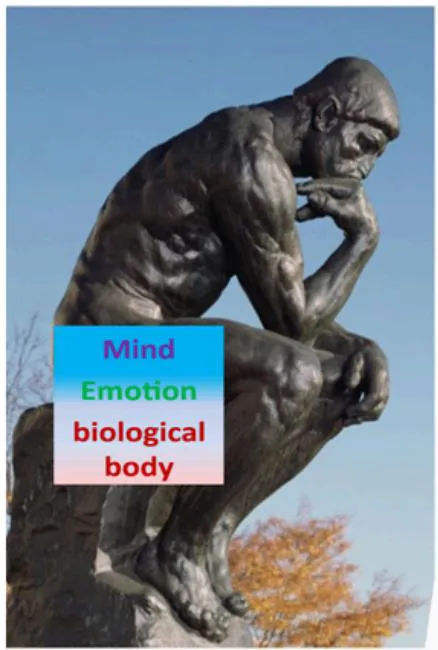
MT engages physical, emotional, and cognitive dimensions (Lambert, 2003; Nawijn, 2011; Moira et al., 2021). This tripartite model, rooted in neuroscience and personality theory (MacLean, 1989; Pervin & Cervone, 2013), frames tourism as a layered interaction between self, nature, and meaning.
2.2 Behavioral Dualities in Mountain Tourism
MT reflects dual motivations: "difficult joy" through challenge (Joachim, 2014; Sport England, 2015; Doyle, 2016; Hinteregger, 2018a; 2018b) and "easy joy" through comfort (Petković, 2012; Hinteregger, 2016; Thiele, 2016). These modes correspond to energy exchanges—physical, cognitive, and emotional (Ploog, 2003; Smith and Diekmann, 2017, Laidlaw, 2012; Pervin & Cervone, 2013; Silverman, 2015; Buhalis, 2018; Passafaro et al., 2021). Urban populations often seek ease and reconnection with nature (Nydegger, 2014; UNWTO, 2018), shaped by historical accessibility (Harari, 2015). MT responds to layered needs—from health and identity to escape and renewal (Franch et al., 2008; Cohen, 2010; Motel-Klingebiel, 2019).
2.3 Diversity and Adaptability in Mountain Tourism
MT evolves with shifting preferences and climate conditions. Millennials drive demand for personalized experiences (Prensky, 2001; Lalande, 2016; Moira & Drivas, 2017). Walking and nature immersion gain popularity (Germier-Hamel, 2016; Thiele, 2016), while four-season models support resilience (Wearing & McGehee, 2013; WTO, 2013; 2018; Downes, 2015; Hinteregger, 2015; 2016; Gotsiridze, 2017). Demand expands to new destinations (Franch et al., 2008; WTO, 2014; Bourn, 2014; Doyle, 2016; Torres, 2016; WTO, 2016), reflecting demographic shifts and rising expectations (Butler, 2006; Farini, 2015).
2.4 Holism and Interdependence in Mountain Tourism Systems
Sustainable MT integrates ecological, economic, and social dimensions (Hawken, 1993; McDonough & Braungart, 2002; Unruh, 2020). Tourist satisfaction links to community well-being (Milne, 2018). Policies must address energy flows, infrastructure, and authenticity (WTO, 2017). Tourists seek meaningful interaction (Crompton & McKay, 1997; Otto & Ritchie, 1996), while market segmentation reflects demographic diversity (Downes, 2015; Wight, 2022). The desire for connection and self-transcendence is central (Lalande, 2016; Mapova-Xatzoulou, 2014; Παπαδόπουλος, Γ, 2025).
2.5 Uncertainty and Complexity in Mountain Tourism
MT operates in unpredictable environments that foster humility and resilience (Büρβιδάκης, 2023, 2025, Sandel, 2011; Aristotle, 2004; Krishnamurti, 2011). Complexity science supports participatory governance (European Commission, 2016; MonViso Institute, 2025). Tourists balance safety and adventure, ego and eco modes (Eυθυμίου, 2016; Παπαδόπουλος, X., 2019; Δαββέτας, 2022). Community-centered approaches offer resilience against market-driven homogenization (Cousquer, 2016; Keller, 2014).
2.6 Paradox and Contradiction in Mountain Tourism
MT transforms remoteness and harsh terrain into experiential value (Keller, 2014). Paradoxes like Jevons' show how efficiency can increase consumption (Polimeni & Polimeni, 2006; Polimeni et al., 2012), while structured experiences may limit openness (Csikszentmihalyi, 1990). Human behavior follows chaotic logic, requiring balanced strategies (Lorenz, 2005; Negrepontis et al., 2020; WTO, 2017; Fox, 2017; Löffler et al., 2014). Institutions like MonViso and Euromontana explore the fusion of tradition and innovation (Franch, 2008; Petković, 2012; Kämpf, 2016; Olmedo, 2017; Roux, 2017; Buhalis, 2018). Education and dialogue foster adaptability (Nicolau, 2018; Martin, 2018).
2.7 Reciprocity and Regenerative Dynamics in Mountain Tourism
MT depends on reciprocal exchanges among stakeholders. Tourism benefits communities only when designed to serve them (Franch et al., 2008; Keller, 2014; Germier-Hamel, 2016; Fox, 2017; Milne, 2018). Regenerative Design (RG) promotes restoration and resilience by emulating natural systems (Wahl, 2016).
2.8 Seasonality and Cyclical Innovation in Mountain Tourism
Seasonality remains a challenge. Adventure models and year-round strategies—like Slovenia's Green Plan (Stravs Podlogar, 2019), Serbia's "Mountains and Lakes" (Petković, 2012), and China's four-season resorts (Downes, 2015)—offer solutions. Mountains buffer seasonal extremes (Keller, 2014), and destinations like New Zealand promote even tourist distribution (Milne, 2018). Innovation, digital tools (Pierret, 2012), multi-skilled professionals (Sport England, 2015), and ethical practices (World Tourism Organization, 1999) support resilience. Sustainability requires circularity and systemic thinking (MonViso Institute, 2025; Ellen MacArthur Foundation, 2016; Swat et al., 2019). Wolf (2019) reframes humanity's role as a "transient gardener," advocating stewardship over exploitation.
III. RESEARCH METHODOLOGY
To investigate perceptions of sustainability, seasonality, and the foundational principles of mountain tourism, a structured bilingual questionnaire (Greek and English) was developed and distributed via Google Forms. The instrument comprised 25 Likert-scale statement groups across eight thematic sections, aligned with the eight core principles identified in the literature review.
Two supplementary sections (11 items) captured respondents' engagement with mountain tourism and demographic characteristics. The survey was disseminated online to both mountain enthusiasts and general participants, within and beyond Greece, through relevant platforms (e.g. www.eooa.gr, www.snowreport.gr, www.snowclub.gr, www.eosvolos.gr).
Data collection occurred between 15 September and 15 December 2023, yielding 453 valid responses. Statistical analysis included exploratory factor analysis, supported by KMO and Bartlett's tests, with components extracted based on eigenvalues and rotated using varimax. A second-order factor analysis identified two overarching dimensions. Likert responses were binarized for further testing, and demographic correlations were examined using Fisher's exact test and independent-samples t-tests.
IV. PRIMARY RESEARCH RESULTS - STATISTICAL ANALYSIS
4.1 Physical, Emotional, and Cognitive Satisfaction of the Mountain Tourist
Mountain tourism engages visitors across three interconnected dimensions: the physical, the emotional, and the cognitive. On a physical level, activities such as hiking, skiing, and climbing contribute not only to recreation but also to improved fitness and overall well-being. Emotionally, mountain environments foster a sense of connection with nature, strengthen group bonding, and promote feelings of personal empowerment. At the same time, the cognitive dimension of mountain tourism is expressed through opportunities for reflection, spiritual renewal, and encounters with authenticity.
This multidimensionality is also reflected in the findings of Statement No. 5: "A mountain tourism activity (e.g., mountaineering, skiing, mountain biking, camping, climbing, sightseeing, etc.) is personally fulfilling because...". The responses show that of participants highlight reconnection with nature, emphasize improved physical fitness, and refer to the development of spirituality, while of the respondents point to a sense of holistic fulfillment that combines all these aspects. These results confirm that mountain tourism simultaneously satisfies physical, emotional, and intellectual needs, thereby offering a comprehensive form of personal fulfillment.
4.2 Two Poles of Human Personality: Relaxation and Exercise – Direction of Energy Flow
Mountain tourism reflects two complementary personality poles: on the one hand, relaxation, which is associated with comfort and predictability, and on the other, exercise, which entails physical effort and the pursuit of transcendence. These two poles correspond to distinct energy flows: the egocentric (or ego mode), which is oriented toward personal gratification, and the holocentric (or eco mode), which emphasizes nature and community. The balance between these poles, and particularly the shift toward the holocentric flow, is considered crucial for fostering forms of tourism that are both sustainable and meaningful.
This conceptual framework is further illustrated by the findings related to Statement No. 7: "During a mountain tourism activity, I primarily enjoy and seek...". The responses indicate that of participants value physical exercise, emphasize harmonization with nature, and highlight the importance of group participation. Moreover, associate their enjoyment with adventure and novelty, while note the alternation between exertion and relaxation, and the alternation between adventure and predictability. Interestingly, only express a preference for personalized services, with half of the respondents remaining neutral on this point. Overall, these results suggest a clear preference for dynamic, participatory, and nature-connected experiences over individualized or passive ones, reinforcing the view that mountain tourism thrives when it integrates physical challenge, collective engagement, and ecological attunement.
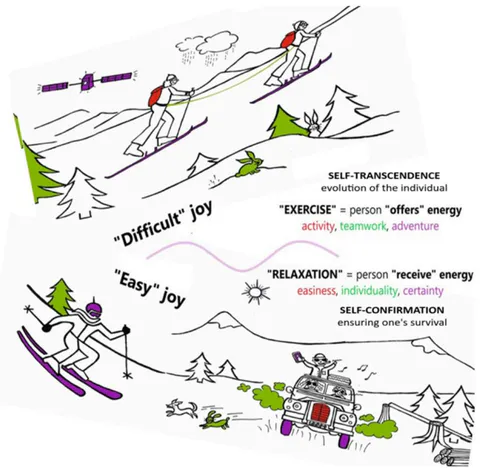
4.3 Instability and Adaptive Management in Mountain Tourism
Mountain tourism is characterized by constant variability, which requires adaptive responses from participants. Such responses may take the form of exercise, involving effort and resilience, or of relaxation, oriented toward release and self-care. The choice between action and rest largely depends on personal needs and contextual factors, yet striking an appropriate balance is crucial for sustaining resilience and ensuring long-term, meaningful participation in mountain activities.
The findings associated with Statement No. 1 ("Life is characterized by continuous change, for example due to technological advancement, a state of ceaseless motion. Regarding these ongoing changes...") illustrate this adaptability. A significant proportion of respondents (76%) reported enjoying change, while 54% indicated that their response depended on the context, and only a very small minority (3%) expressed disagreement. These results suggest that individuals engaged in mountain tourism are generally receptive to variability, yet their acceptance of change remains context-sensitive.
A similar pattern emerges in relation to cultural and gastronomic preferences, as reflected in Statement No. 4 ("As a festive meal during a mountain tourism event, I would be most satisfied with..."). The majority of participants expressed a preference for a traditional communal meal (80%) and a strong appreciation for a local tavern experience (73%). By contrast, only 13% favored a luxury restaurant, while 51% emphasized that their choice would depend on the specific occasion. This tendency highlights a pronounced orientation toward authenticity, simplicity, and flexibility, confirming that mountain tourism is experienced not only as physical or emotional engagement but also as a context-sensitive cultural practice that values tradition and shared experiences over individualized luxury.
4.4 Holism, Interdependence, and Interconnection in Mountain Tourism
Mountain tourism operates as a complex system in which natural, social, and psychological factors constantly interact. A holistic perspective acknowledges that humans, environments, economies, and cultures are deeply interconnected, and that effective planning must recognize this interdependence in order to safeguard both sustainability and authenticity. Within such a framework, the relationship between individual behavior and broader systemic dynamics becomes particularly significant.
The findings associated with Statement No. 10 ("Within this interdependence with the social and natural environment, I primarily seek...") reveal a pronounced normative orientation toward environmental responsibility. An overwhelming of respondents emphasized respect for environmental limitations, while only declared a preference for pursuing personal desires regardless of constraints. At the same time, stated that their behavior would depend on the context. These responses indicate a strong alignment with values of environmental stewardship, while also reflecting a degree of situational flexibility.
A similar tendency emerges from Statement No. 11 ("In a mountain sports-tourism event, I am more interested in..."). Here, of participants indicated that their primary interest lies in participation and the enjoyment of the process itself, while only emphasized advancement or ranking. A smaller group acknowledged that their preferences may shift depending on circumstances. The overall pattern suggests that mountain tourism motivations are more strongly associated with collective experience and process-oriented enjoyment than with competitive outcomes.
Finally, Statement No. 12 ("The existence of rules and restrictions in a tourist destination, necessary for the protection of its natural environment and local community...") highlights the role of regulation in shaping perceptions of destination quality. A large majority of respondents expressed positive attitudes toward rules, with stating that such measures create a favorable impression and believing that they enhance the attractiveness of the destination. Only a small minority voiced negative views, while remained neutral or undecided. Taken together, these findings demonstrate broad support for regulatory frameworks designed to protect natural and cultural assets, albeit tempered by some degree of ambivalence.
4.5 Uncertainty, Infinite Complexity, and Multivariable Dynamics in Mountain Tourism
Mountain tourism operates within a context of inherent uncertainty and complexity, shaped by environmental unpredictability, shifting visitor behavior, and evolving socio-economic conditions. Its multivariable character—ecological, cultural, psychological, and technological—renders linear approaches to planning insufficient and calls for adaptive strategies capable of embracing uncertainty. Such an orientation is essential for building resilience and ensuring sustainable development in mountain destinations.
The findings related to Statement No. 14 ("To manage the uncertainty around us, while adhering to basic safety rules, I most enjoy...") suggest that visitors tend to adopt flexible, context-sensitive strategies. A majority (60%) expressed a preference for alternating between security and adventure, 54% favored innovation and experimentation, while 38% opted for guaranteed solutions. This distribution illustrates an openness to adaptive behaviors that combine the desire for novelty with an underlying need for safety.
However, attitudes toward institutional and public discourse reveal a more critical stance. In response to Statement No. 15 ("Most stakeholders... usually speak with honesty and altruism, respecting and seeking the objectivity of scientific knowledge"), of participants disagreed, only agreed, and remained neutral. These results point to significant skepticism concerning the honesty, altruism, and scientific integrity of stakeholders involved in mountain tourism.
This mistrust extends to public governance, as shown in Statement No. 16 ("Public Administration usually works in the interest of the public... without being deterred by political cost"). Here, of respondents disagreed, expressed neutrality, and only agreed, indicating a perceived lack of credibility, sincerity, and independence in public administration.
Finally, responses to Statement No. 17 ("The existing communication and coordination... is sufficient. There is no need to spend more time and effort on consultation...") underscore the demand for stronger participatory processes. A large majority of disagreed with the sufficiency of current consultation mechanisms, while remained neutral and only agreed. This suggests that respondents favor deeper, more inclusive stakeholder dialogue as a prerequisite for effective tourism planning and governance in mountain regions.
4.6 Paradox and Coexistence of Opposing Forces
Mountain tourism thrives on paradox, where remoteness and unpredictability—often perceived as obstacles—emerge as core assets (Keller, 2014). Visitors are drawn simultaneously to comfort and challenge, navigating the interplay between relaxation and exertion. Theories such as the illusion of control (Csikszentmihalyi, 1990) and chaotic determinism (Lorenz, 2005) highlight that unpredictability can serve as a catalyst for personal transformation. From a planning perspective, sustainability requires embracing this duality, finding a balance between authenticity, innovation, and complexity.
The findings reinforce this paradoxical dimension. Statement No. 20 ("Heterogeneity within a group of tourists... may seem paradoxical, but is generally desirable and beneficial for all") elicited broad agreement: of respondents endorsed heterogeneity, remained neutral, and only disagreed. Diversity is thus recognized as a valuable source of enrichment and resilience within mountain tourism groups.
Similarly, Statement No. 21 ("In mountain tourism, ease and difficulty often coexist...") confirmed a shared awareness of paradox. Here, of participants agreed, were neutral, and disagreed. The results suggest that although challenges can pose obstacles to development, they are simultaneously perceived as mechanisms that safeguard cultural integrity and natural heritage.
Finally, Statement No. 22 ("In the tourism market, the impact of promotional activities and the presentation of the tourism product ('marketing') is considered particularly important...") revealed ambivalent attitudes toward the role of marketing. While considered marketing helpful for enhancing understanding, viewed it as a source of confusion, and argued that its impact depends on the context. This ambivalence underscores that marketing is perceived as both informative and manipulative, raising unresolved ethical questions concerning its influence on sustainable mountain tourism.
4.7 Reciprocity and Stakeholder Dynamics
MT functions as a system of reciprocal relationships, where the actions of tourists, locals, policymakers, and the environment trigger mutual reactions. Sustainable development depends on shared accountability and adaptive coordination. Statement 23 indicated strong theoretical support for reciprocity: agreed that relationships should be mutually beneficial, and endorsed the principle of "what you give is what you get." However, only believed their own interests are best served when others' are too, while remained neutral—suggesting ambivalence in the personal internalization of reciprocity, particularly among younger respondents.
4.8 Cyclicality, Seasonality, and Moderation
Mountain tourism follows natural and social rhythms—daily, seasonal, and annual—requiring planning that aligns with these cycles. Statement 3 showed that of respondents enjoy seasonality, accept it as a necessary compromise, and view it as purpose-dependent, with only expressing disagreement. This suggests that seasonality is broadly embraced, though its meaning varies by individual motivation. Statement 24 highlighted preferences for moderation: favored balance, only endorsed the idea that "more is better," and remained neutral. These findings reflect a cultural orientation toward moderation and sustainability in tourism experiences.
4.9 Factor Analysis and Demographic Correlations
From a total of 453 completed questionnaires (109 items), the high completion rate of provided a solid basis for statistical analysis. Factor analysis (KMO and Bartlett's tests) identified the core dimensions of mountain tourism, while varimax rotation and second-order analysis revealed the existence of two overarching meta-factors. To ensure clarity in interpretation, Likert-scale responses were binarized into agree/disagree categories, with neutral answers excluded. The data were then correlated with demographic variables using Fisher's exact test, Odds Ratios (OR), t-tests, and chi-square for trends, with statistical significance set at . Age emerged as a significant variable shaping perceptions of reciprocity. In relation to items such as V90 ("My interests are best served when others' interests are also served") and V92 ("You get what you give"), agreement was markedly higher among respondents over 45 years old compared to those under 45 . The calculated Odds Ratios of 2.57 and 3.0 indicate that older participants demonstrate stronger alignment with principles of collective benefit and ethical reciprocity.
Gender differences were also evident, particularly regarding motivations for rest. Women were significantly more likely than men to agree with item V32 ("I mainly enjoy and seek physical rest, e.g., a relaxed ride using a tourist lift"), suggesting that gender-sensitive planning that incorporates rest-oriented experiences may contribute to inclusivity and broader appeal.
Income levels further shaped attitudes toward mountain tourism. Higher-income respondents (earning over €20,000 annually) tended to value reciprocity (V90, OR = 3.0, p < 0.001) and modern infrastructure (V26, OR = 1.9, p < 0.024). In contrast, lower-income participants (earning €20,000 or less) placed greater emphasis on goal orientation (V21, OR = 0.32, p < 0.008), activities with locals (V35, OR = 0.47, p < 0.027), and simplicity or minimalism (V5, OR = 0.53, p < 0.045). The income distribution of the sample showed that most respondents belonged to the middle-income category, with earning between €10,001 and €20,000 and between €20,001 and €30,000, while only did not disclose their income. Statement No. 32 further supports this profile, with approximately of respondents reporting their income as moderately to fully sufficient for participating in mountain tourism. Only considered their income inadequate. These findings suggest that affordability is not the primary determinant in tourism decision-making, reinforcing the broader satisfaction trends discussed in section 4.1
Educational attainment also influenced interpretive frameworks. With of respondents holding university or postgraduate degrees, differences were notable between levels. Postgraduates were significantly more likely to accept stereotypes as useful interpretive tools (V84, OR = 2.3, p = 0.002) and to embrace temporal cyclicality rather than fixed trajectories (V96, OR = 0.36, p = 0.003). These findings suggest that higher education correlates with greater openness, flexibility, and tolerance for complexity in the context of tourism.
The relationship of respondents with mountain tourism itself further illuminates their motivational profiles. Statement No. 26 (V97) explored engagement with mountain tourism through reported visit frequency. All 453 participants responded, with distribution as follows: minimal time annually), limited times), moderate times), considerable times), and very frequent times). Nearly half of the respondents visited mountain destinations more than ten times per year, indicating strong and sustained engagement. Statistical analysis demonstrated that frequent visitors favored what can be described as "difficult joy"—an orientation toward adventure, effort, novelty, and personal growth—whereas infrequent visitors were more inclined toward "easy joy," characterized by comfort, predictability, and relaxation. This pattern suggests that deeper involvement in mountain tourism fosters a mindset oriented toward challenge and self-transcendence.
Secondary factor analysis of 299 valid responses further distilled eight initial factors into two overarching meta-factors. The first, Relaxation/Ease, was associated with mental, emotional, and physical comfort, and correlated strongly with higher income and postgraduate education. The second, Exercise/Difficulty, reflected a preference for mental and emotional challenge, with slightly higher scores among female respondents. Together, these meta-factors provide a valuable framework for interpreting the psychological orientations of mountain tourists and for designing targeted planning strategies that address diverse motivational profiles.
V. CONCLUSIONS
The study confirms that mountain tourism functions as a complex, multidimensional phenomenon, in which natural, social, cultural, and psychological factors interact. Visitors seek simultaneously physical and emotional satisfaction, spiritual renewal, and authentic experiences, highlighting the importance of a holistic framework for both understanding and planning. The analysis of the data underlines three core dimensions a) physical (exercise and well-being), b) emotional (connection with nature and social interaction), and c) cognitive/spiritual (reflection and personal growth), which together constitute a comprehensive experience of fulfillment.
Mountain tourism is characterized by paradox and variability, remoteness and uncertainty, rather than being obstacles, emerge as key attractions. Visitors strive to combine comfort with challenge, relaxation with exertion, and acceptance of uncertainty appears to enhance personal transformation and adaptability. Maintaining a balance between action and rest, ease and difficulty, authenticity and innovation is crucial for sustainable and meaningful participation.
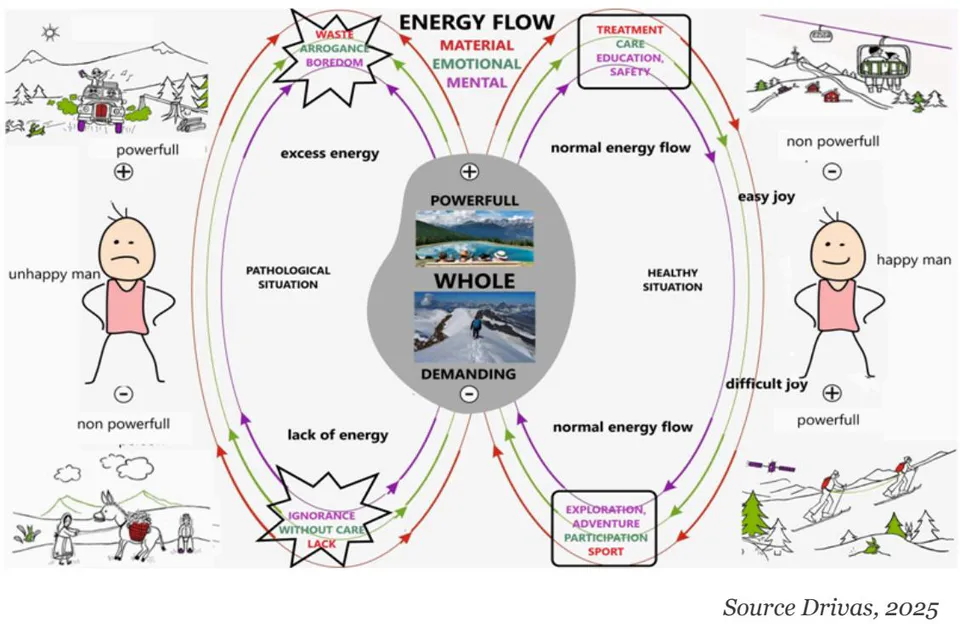
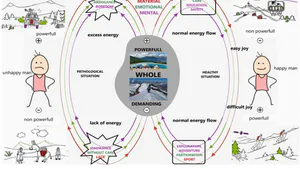
Figure 2: Tourism is a pursuit of joy, expressed through energy flow Balance of Energy Exchange.
Demographic characteristics significantly shape visitors' preferences and attitudes. Age is associated with greater sensitivity to ethical reciprocity and collective benefit, while gender influences the preference for relaxation-oriented experiences. Income affects approaches to material infrastructure, simplicity, and community engagement, whereas educational level correlates with higher tolerance for complexity and acceptance of temporal cyclicality in tourism experiences.
Frequency of engagement in mountain tourism further illuminates motivational patterns. Frequent visitors prefer "difficult joy" experiences that involve challenge, effort, and personal growth, whereas less frequent visitors lean toward "easy joy," characterized by comfort and predictability. Secondary factor analysis identified two overarching meta-factors: Relaxation/Ease, associated with mental, emotional, and physical comfort, and Exercise/Difficulty, reflecting a preference for challenge and self-transcendence. These meta-factors provide a practical framework for understanding the psychological orientations of mountain tourists and for developing targeted planning strategies.
Finally, the findings highlight the value of collectivity, authenticity, participation, and flexibility. Visitors appreciate group heterogeneity, recognize the coexistence of ease and difficulty, and express critical attitudes toward public administration and marketing practices, calling for more transparent, participatory, and ethically guided management of mountain tourism. Overall, the study demonstrates that the sustainability and meaningfulness of mountain tourism require a multidimensional, flexible, and participatory planning framework that integrates natural, social, psychological, and cultural dimensions.
Conflict of Interest
The authors declare no conflict of interest.
Ethical Approval
Not applicable
Data Availability
The datasets used in this study are openly available at [repository link] and the source code is available on GitHub at [GitHub link].
Funding
This work did not receive any external funding.
Cite this article
Related Research

Special Issue
Launch a focused special issue to highlight research, emerging trends, and expert insights in your academic field.