

IntelliPaper
Abstract
Digital marketing is increasingly shaping the competitiveness of Micro, Small and Medium Enterprises (MSMEs), cottage industries, and rural product enterprises by improving visibility, reducing intermediary dependence, widening customer reach, and enabling product differentiation. This paper develops an IEEE-style conceptual and policy-grounded study focused on Gujarat, a state with strong MSME depth and a distinctive ecosystem of handloom, handicraft, khadi, agro-processing, and village products. The paper combines official policy context, current national MSME dashboard statistics, digital commerce inclusion logic, and a field-oriented research design to examine how social media, messaging commerce, online catalogues, and e-marketplaces influence competitiveness outcomes. The proposed model links digital marketing adoption with market access, customer trust, conversion, sales growth, and margin improvement, while recognizing moderating constraints such as digital literacy, logistics, packaging, language, and payment confidence. The paper concludes that digital marketing should be treated not merely as a promotion channel but as a competitiveness infrastructure for Gujarat's MSME and rural product economy.
Explore Digital Article Text
Introduction
India’s MSME ecosystem remains central to output, exports, employment generation, and inclusive industrial growth. The Ministry of MSME states in its Annual Report 2024-25 that the sector contributes around of India’s GDP and over of India’s exports, underscoring the continued relevance of competitiveness-enhancing interventions for small enterprises. For Gujarat, the issue is particularly important because formal MSME activity coexists with strong traditions in village industries, artisan production, handloom, khadi, agro-processing, and district-linked heritage products. Digital marketing therefore becomes more than a communication activity; it becomes a mechanism for discovery, trust formation, geographic reach, and value capture.
Gujarat Context and Problem Statement
Gujarat’s cottage and rural industry ecosystem includes products that often compete on authenticity, craft value, regional identity, and localized production knowledge rather than on pure price. Yet many such products remain commercially underleveraged because producers face fragmented demand channels, weak branding, limited digital capability, and dependence on intermediaries. The Commissioner of Cottage and Rural Industries, Government of Gujarat, hosts the Cottage Policy-2024 and related artisan support schemes on its official portal, signaling a state-level policy commitment to the sector. The central problem, therefore, is not only production capacity but also market communication and digital market integration.
Review of Literature and Policy Backdrop
Official MSME policy literature consistently highlights market access, modernization, and competitiveness. The national MSME dashboard further shows a very large real-time base of registered enterprises and current support systems spanning credit, training, procurement, certification, and market development. ONDC frames digital commerce as an inclusive network intended to make sellers discoverable beyond closed platforms and to expand e-commerce participation among small-town and rural enterprises. For cottage and rural industries, this architecture is significant because it lowers entry barriers to online trade and supports direct producer-to-customer engagement.
Objectives of the Study
The study has five objectives: (i) to examine the role of digital marketing in improving market competitiveness of MSME, cottage, and rural industry products in Gujarat; (ii) to assess the effect of digital channels on visibility, customer reach, and sales; (iii) to identify the platforms and practices most relevant to small producers; (iv) to analyze barriers affecting digital marketing effectiveness; and (v) to suggest policy and managerial measures for strengthening digital competitiveness in Gujarat.
Hypotheses
H1: Digital marketing adoption has a significant positive effect on market competitiveness of MSME, cottage, and rural industry products in Gujarat. H2: Use of social media, messaging commerce, and online marketplaces significantly improves visibility and customer reach. H3: Digital literacy gaps, logistics limitations, and trust-related barriers significantly weaken digital marketing effectiveness. H4: Digital marketing reduces dependence on traditional intermediaries and improves producer-level realization.
Conceptual Framework
The proposed causal chain is: Digital Marketing Adoption Marketing Outcomes Competitiveness Outcomes. Adoption includes social media presence, WhatsApp Business, online cataloguing, digital payment readiness, marketplace listing, and storytelling content. Marketing outcomes include visibility, engagement, inquiries, trust, and conversion. Competitiveness outcomes include higher sales, wider market reach, stronger brand position, better margins, and greater resilience. The relationship is moderated by digital literacy, packaging, connectivity, content quality, language fit, and last-mile logistics.
Methodology
The paper is designed as a descriptive and analytical study with field survey potential. The suggested universe includes MSME units, artisan groups, khadi and village industry units, women-led enterprises, rural producer groups, and agro-processing microenterprises in Gujarat. A stratified sample of 200 respondents across districts such as Patan, Kutch, Ahmedabad, Surendranagar, Banaskantha, Jamnagar, and Bhavnagar may be used. Primary data can be collected through a structured questionnaire and interviews, while secondary data can be drawn from official MSME reports, the MSME dashboard, the Gujarat Cottage Policy framework, and ONDC materials. Suggested statistical tools include percentage analysis, weighted mean, chi-square, correlation, and regression.
Analysis and Discussion
Digital marketing improves competitiveness through five main pathways. First, it widens market access beyond fairs, local traders, and district-limited demand. Second, it enables product differentiation through origin stories, craft narratives, and visual trust signals. Third, it shortens the chain between producer and buyer, reducing dependence on intermediaries. Fourth, it generates feedback loops through inquiries, reviews, and repeat ordering patterns. Fifth, it lowers promotional entry costs relative to traditional advertising. For Gujarat’s rural and cottage products, these mechanisms are particularly useful because many products are identity-rich and image-sensitive, which makes them well suited to story-based online promotion.
Constraints and Risk Factors
The key barriers are low digital literacy, weak product photography, inconsistent catalog quality, poor packaging, unreliable delivery capability, limited language adaptability, return and payment concerns, and irregular content maintenance. Online presence alone does not create competitiveness; enterprises must sustain response quality, customer confidence, and service reliability. This implies that policy interventions should focus on ecosystem readiness, not just connectivity.
Policy Implications for Gujarat
District Industries Centres, artisan bodies, women-oriented enterprise programs, and cottage-industry institutions can improve competitiveness through district-level digital marketing training, shared product catalog support, packaging and photography assistance, multilingual content development, and onboarding support for online marketplaces and open digital commerce systems. Cluster-based logistics support and district branding for signature products can further strengthen competitiveness. Gujarat’s policy architecture already provides a useful base for such interventions if digital market facilitation is treated as a structured support function.
Conclusion
Digital marketing has emerged as a strategic competitiveness capability for MSME, cottage, and rural industry products. In Gujarat, where many products carry local identity and production heritage, digital channels can convert cultural and production strengths into commercial advantage. The paper therefore concludes that digital marketing should be treated as a competitiveness infrastructure – not merely an advertising technique – for the state’s MSME and rural enterprise economy.
Selected Official Charts
The following figures reproduce selected official dashboard indicators relevant to the paper’s market-competitiveness and rural enterprise context.
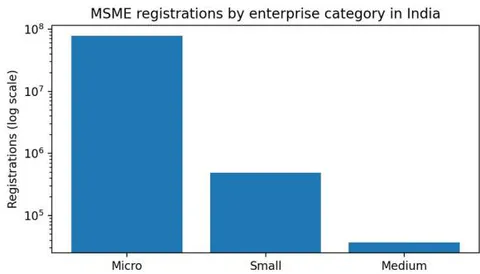
MSME registrations by enterprise category in India (log scale), based on the official MSME dashboard
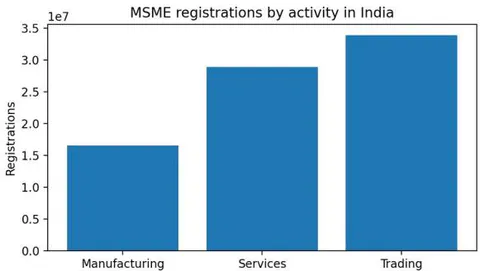
MSME registrations by activity in India, based on the official MSME dashboard
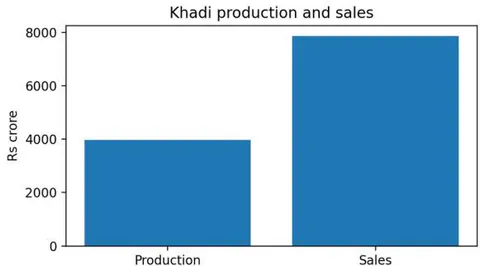
Khadi production and sales values reported on the official MSME dashboard
Official Indicators Supporting the Study
The study design and discussion are informed by official real-time MSME dashboard data, official Gujarat policy pages, and ONDC’s official site.
| Indicator | Value / Status | Source / Date |
|---|---|---|
| MSME contribution to India’s GDP | Around 30% | MSME Annual Report 2024-25 |
| MSME contribution to India’s exports | Over 45% | MSME Annual Report 2024-25 |
| Total MSME registrations incl. Udyam + UAP | 7,94,25,711 | MSME Dashboard, 14-04-2026 |
| Enterprise category split | Micro 7,88,97,394; Small 4,91,260; Medium 37,057 | MSME Dashboard, 14-04-2026 |
| Activity split | Manufacturing 1,65,78,457; Services 2,89,23,192; Trading 3,39,24,062 | MSME Dashboard, 14-04-2026 |
| Khadi production / sales | Rs 3973.98 crore / Rs 7868.74 crore | MSME Dashboard, 31-03-2026 |
| Gujarat policy anchor | Cottage Policy-2024 available on official portal | Govt. of Gujarat portal |
| Digital commerce inclusion frame | ONDC positions sellers as discoverable online and highlights low historic e-commerce enablement | ONDC official site |
Selected official indicators informing the study design and discussion
Appendix A. Suggested Questionnaire for Field Survey
The following questionnaire structure is suggested for an empirical Gujarat field study of MSME and rural product units.
| Section | Illustrative items | Response format |
|---|---|---|
| Profile | District; enterprise type; product category; years in operation; annual turnover band | Tick / short text |
| Digital presence | WhatsApp Business; Instagram/Facebook; online catalogue; online marketplace listing; digital payment option | Yes / No |
| Marketing practice | Use of product photos; videos/reels; customer testimonials; local-language content; paid ads | 5-point frequency scale |
| Competitiveness outcomes | Change in inquiries; customer reach; repeat orders; sales growth; margin improvement | 5-point agreement scale |
| Intermediary dependence | Share of sales routed through traders before and after digital adoption | Percentage band |
| Constraints | Digital skill gap; packaging weakness; logistics; photography quality; returns/refunds; payment confidence | 5-point severity scale |
| Support needs | Training, design support, packaging, cataloguing, marketplace onboarding, branding help | Multiple choice / ranking |
Suggested questionnaire structure for an empirical Gujarat field study
Appendix B. Suggested Measurement Scale
The following measurement constructs are suggested for hypothesis testing. Response scale: strongly disagree, disagree, neutral, agree, strongly agree.
| Construct | Illustrative measurement items |
|---|---|
| Digital marketing adoption | Our enterprise actively uses digital channels to showcase products; we respond to customers through digital platforms; digital catalogues are updated regularly. |
| Visibility and reach | Digital channels have improved product visibility; we receive inquiries from outside our district; new customer reach has increased. |
| Competitiveness | Digital marketing has improved our sales position; branding has strengthened our market identity; our dependence on intermediaries has reduced. |
| Constraint intensity | Lack of digital skills limits online growth; logistics/packaging reduce our competitiveness; language/content issues affect response and conversion. |
Suggested measurement constructs for hypothesis testing
Conflict of Interest
The authors declare no conflict of interest.
Ethical Approval
Not applicable
Data Availability
The datasets used in this study are openly available at [repository link] and the source code is available on GitHub at [GitHub link].
Funding
This work did not receive any external funding.
References
Cite this article
Related Research


Special Issue
Launch a focused special issue to highlight research, emerging trends, and expert insights in your academic field.